
Multi Camera System Market Size and Share
Market Overview
| Study Period | 2021 - 2031 |
|---|---|
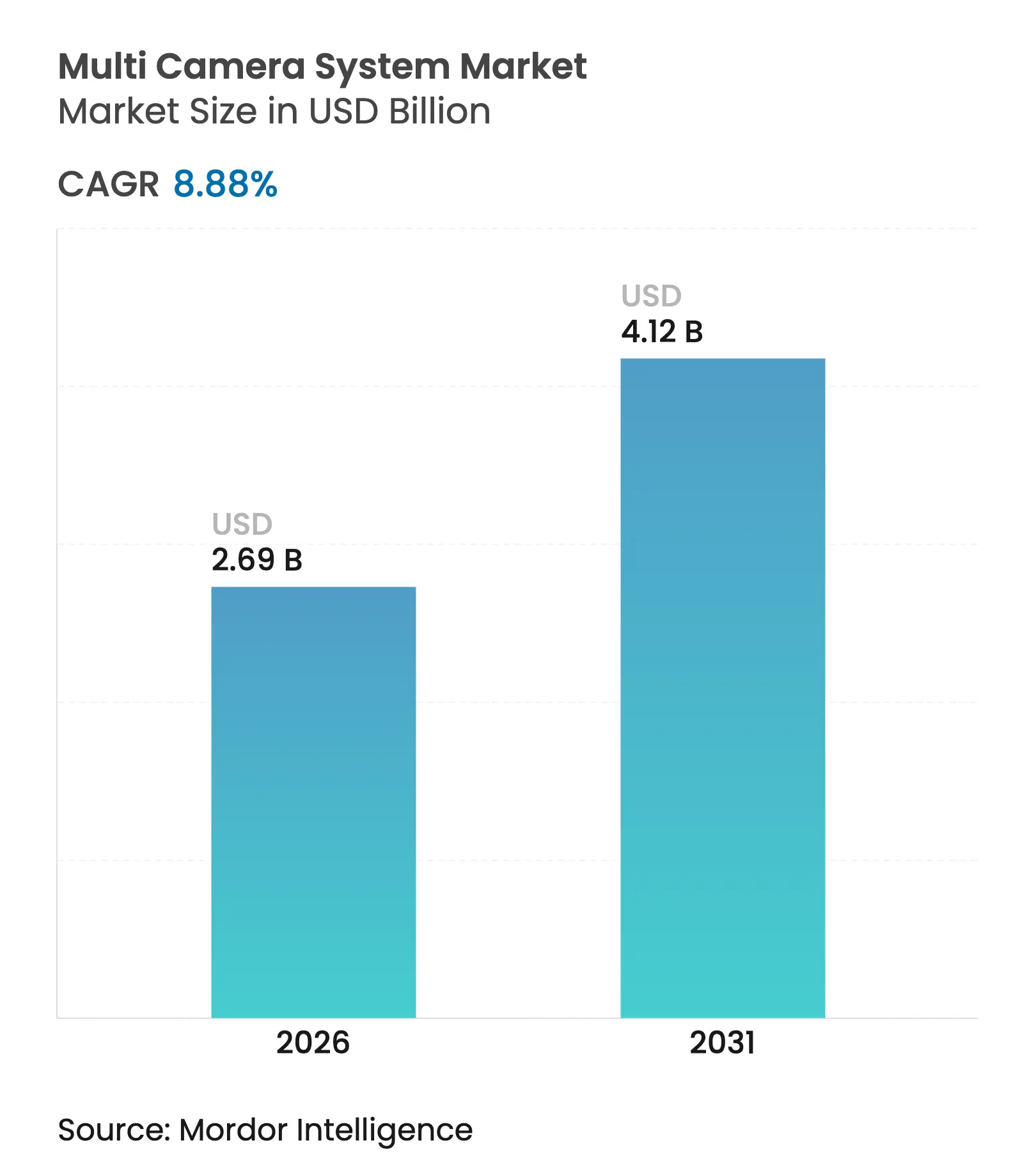
| Market Size (2026) | USD 2.69 Billion |
| Market Size (2031) | USD 4.12 Billion |
| Growth Rate (2026 - 2031) | 8.88 % CAGR |
| Fastest Growing Market | Middle East and Africa |
| Largest Market | Asia Pacific |
| Market Concentration | Medium |
Major Players *Disclaimer: Major Players sorted in no particular order. Image © Mordor Intelligence. Reuse requires attribution under CC BY 4.0. |

Multi Camera System Market Analysis by Mordor Intelligence
The Multi Camera System market size was valued at USD 2.47 billion in 2025 and estimated to grow from USD 2.69 billion in 2026 to reach USD 4.12 billion by 2031, at a CAGR of 8.88% during the forecast period (2026-2031). The current Multi Camera System market size reflects rising demand for AI-enabled image capture across automotive, smart-city, and industrial automation settings. Demand is accelerating as multi-sensor arrays shift from single-purpose recorders to intelligent endpoints that run analytics at the edge, cutting latency and network load. Cost reductions in CMOS sensors, tighter integration of ECUs, and the spread of 5G backhaul are lowering entry barriers and widening deployment scenarios. Meanwhile, edge-AI chipsets now support real-time stitching of 4K feeds, allowing the Multi Camera System market to extend into higher-value use cases such as volumetric sports capture and autonomous-vehicle perception. Vendors are responding by embedding pre-trained neural networks into camera modules that deliver object detection, facial recognition, and anomaly alerts without off-device processing.
Key Report Takeaways
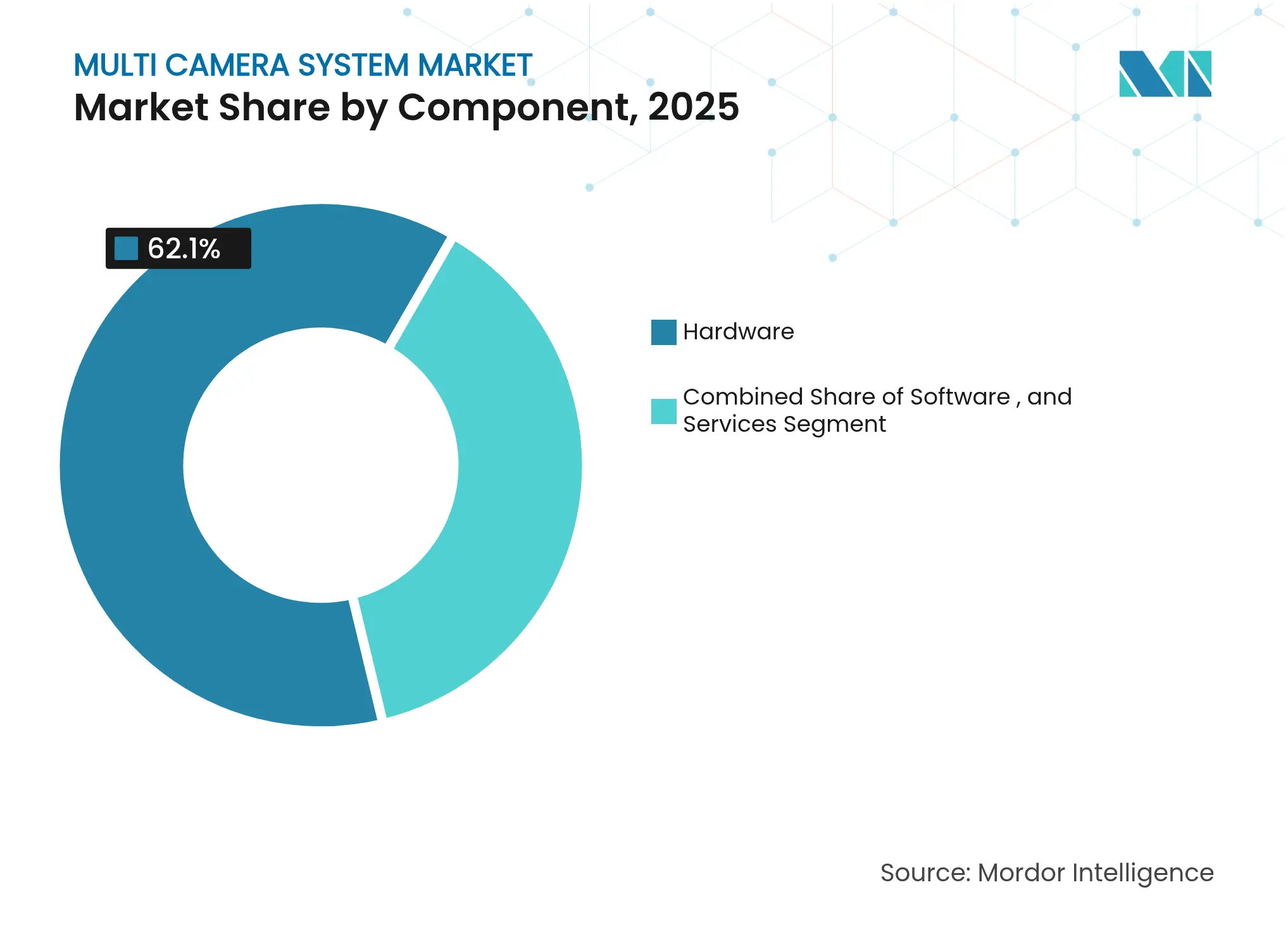
- By component, hardware led with 62.10% of the Multi Camera System market share in 2025; services are forecast to rise at a 9.85% CAGR to 2031.
- By display type, 2D solutions held 69.65% revenue share in 2025, while 3D/panoramic systems are expected to expand at an 10.75% CAGR through 2031.
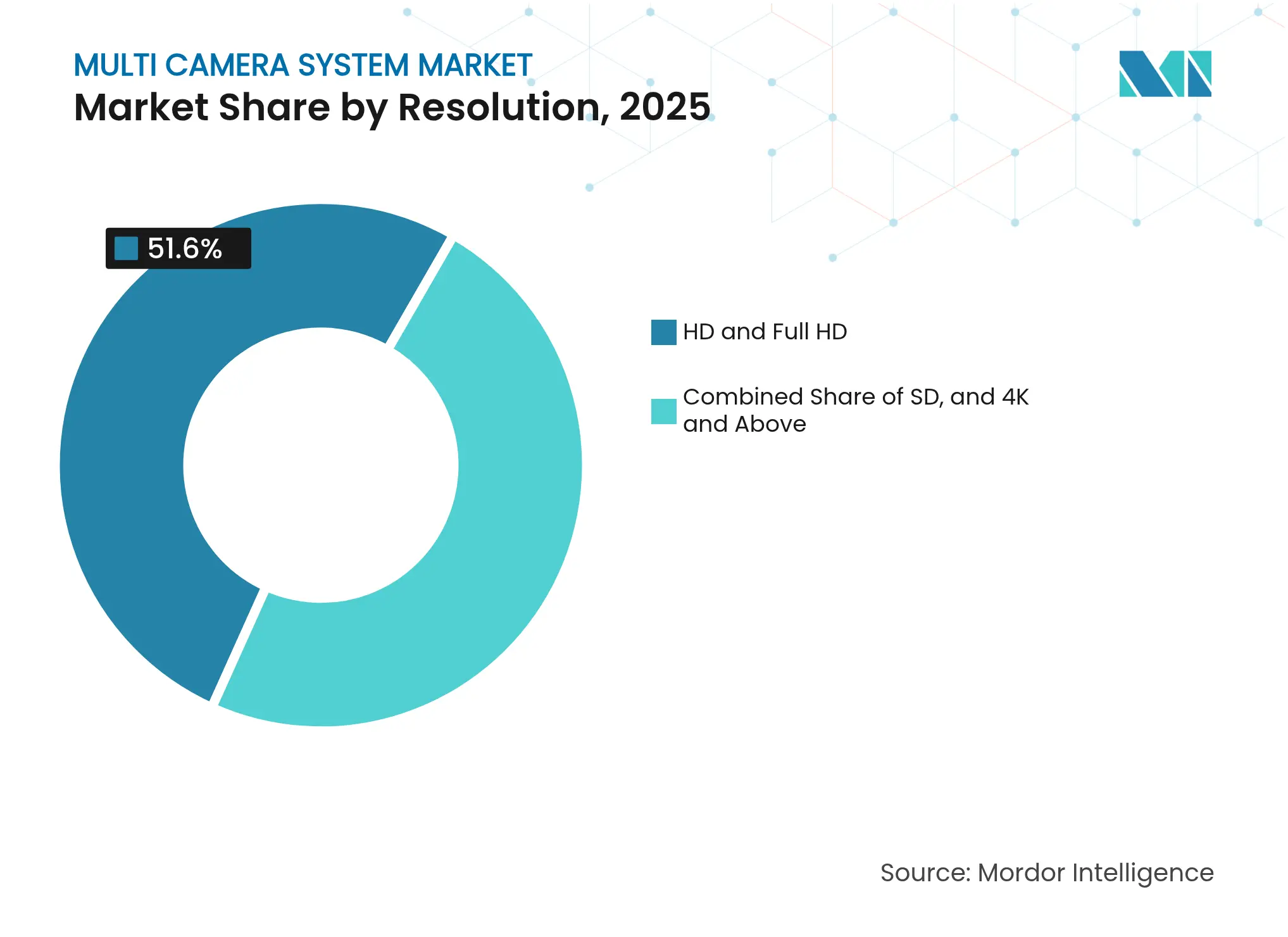
- By resolution, HD and Full HD accounted for 51.60% of the Multi Camera System market size in 2025; the 4K-and-above tier is advancing at a 12.30% CAGR between 2026-2031.
- By end-use, automotive captured 54.05% of the Multi Camera System market in 2025; sports and motion analytics is projected to grow the fastest at a 11.65% CAGR to 2031.
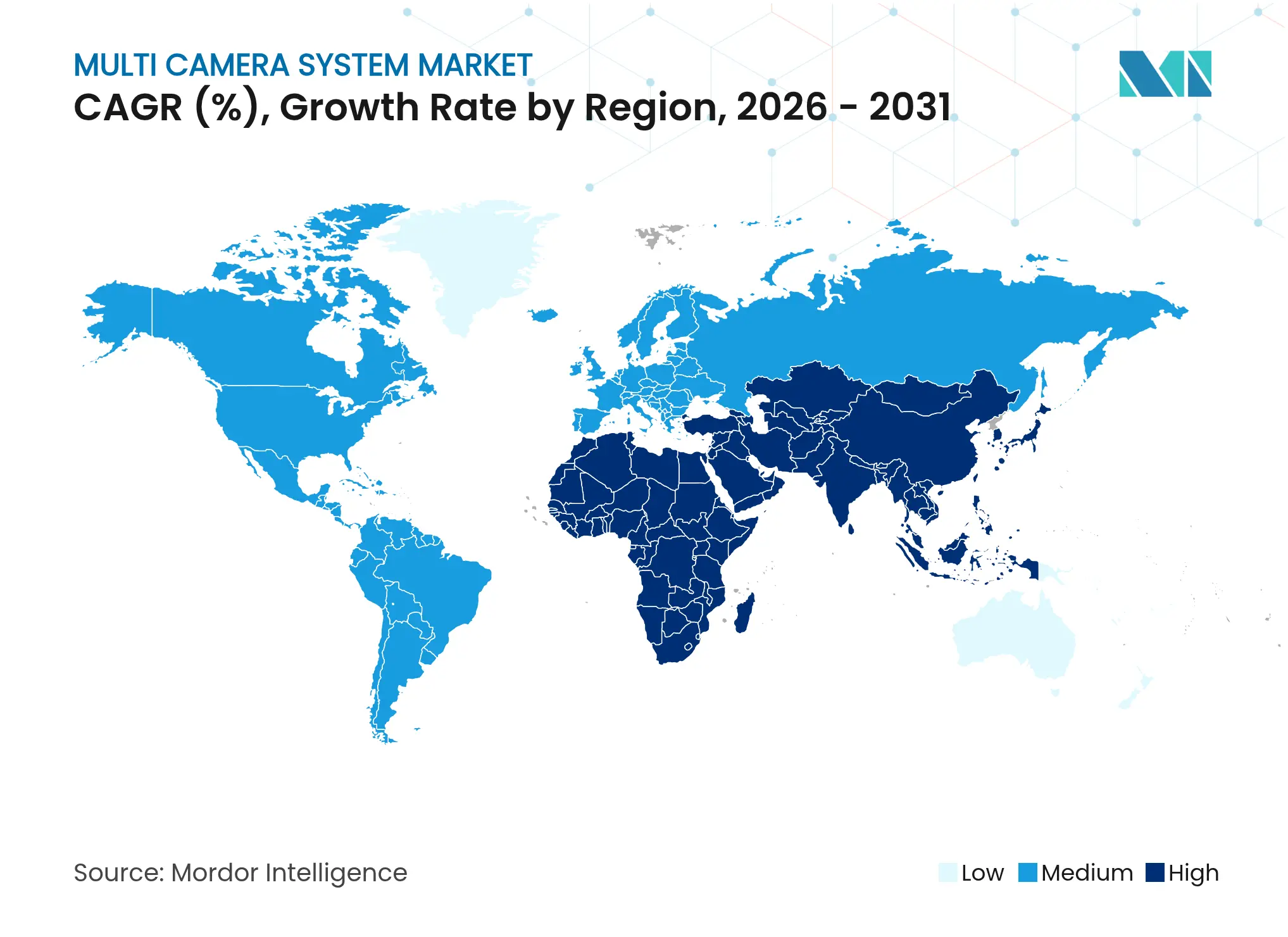
- By geography, Asia Pacific controlled 38.10% revenue share in 2025; the Middle East and Africa is set to post the quickest 9.35% CAGR from 2026-2031.
Note: Market size and forecast figures in this report are generated using Mordor Intelligence's proprietary estimation framework, updated with the latest available data and insights as of 2026.
Global Multi Camera System Market Trends and Insights
Drivers Impact Analysis
| Driver | (~) % Impact on CAGR Forecast | Geographic Relevance | Impact Timeline |
|---|---|---|---|
ADAS and autonomous-driving fitment surge | +2.5% | North America, Europe, spillover into Asia Pacific | Medium term (2-4 years) |
AI video analytics for smart-city programs | +1.9% | Asia Pacific, emerging in Middle East and Africa | Short term (≤ 2 years) |
Vision-guided robotics in Industry 4.0 | +1.6% | Global focus in Asia Pacific and Europe | Medium term (2-4 years) |
Immersive 360°/volumetric sports content | +1.3% | North America and Europe | Medium term (2-4 years) |
Falling camera and sensor ASPs | +1.0% | Global | Short term (≤ 2 years) |
Fleet-safety mandates for commercial vehicles | +0.8% | North America, Europe, Asia Pacific | Short term (≤ 2 years) |
| Source: Mordor Intelligence | |||
Soaring ADAS and Autonomous-Driving Fitment Rates in North America and Europe
Regulators in the EU and the United States now require new cars to include autonomous emergency braking and forward-collision warning, making multi-sensor camera arrays indispensable. Nearly every 2025 vehicle platform upgrade bundles at least four surround-view imagers that feed a perception stack combining preprocessing, AI inference, and post-processing on embedded ECUs. OEMs have moved these capabilities down-market into entry-level trims and light commercial fleets, transforming cameras from premium add-ons into baseline safety equipment. At the same time, silicon vendors are shipping system-on-chips that run convolutional neural networks at sub-3 W power envelopes, allowing fully enclosed, hermetically sealed modules that tolerate harsh automotive environments. The effect is a structural rise in unit volumes that pushes component ASPs lower, reinforcing adoption momentum.
Rapid Adoption of AI-Based Video Analytics in Smart-City Surveillance (Asia)
Municipal authorities across China, Singapore, and South Korea now deploy consolidated command centers that ingest hundreds of video streams from multi-camera light poles and transit hubs. Edge-AI units embedded in each node perform license-plate recognition, pedestrian counting, and abnormal-behavior alerts within 50 milliseconds, slashing false alarms and traffic delays. Metropolitan road-network managers report double-digit improvements in peak-hour throughput after real-time camera analytics adjusted signal timing. As urbanization pushes Asia’s city populations toward 58% by 2025, scalable camera grids remain central to public-safety policy. Vendors targeting the region pre-train models on local datasets to cope with language and signage differences, accelerating time-to-value for municipal buyers.
Growing Deployment of Vision-Guided Robotics in Industry 4.0 Manufacturing
Industrial OEMs are integrating multi-camera rigs and structured-light sensors into cobots that handle precision assembly, pick-and-place, and quality inspection. Immediate depth data from 3D imagers removes the need for complex multi-frame reconstruction, trimming calibration cycles and programming costs. The International Federation of Robotics highlighted collaborative robots and mobile manipulators among its top five global trends for 2024.[1] Manufacturers use digital twins generated from live camera feeds to simulate tool paths and predict faults, cutting downtime. Labor shortages in welding and logistics make automated visual guidance a compelling substitute, driving multi-camera adoption deeper inside factory cells.
Content Creators’ Shift to Immersive 360°/Volumetric Video for Live Sports
Broadcasters are replacing static side-line cameras with synchronized arrays that fuse volumetric depth maps and RGB imagery. Canon’s sports analysis platform delivers real-time player speed, space occupancy, and tactical overlays on live feeds.[2] Motion-tracking engines can now identify 85 body landmarks without markers in under one second, according to Southwest Research Institute.[3] Audiences receive interactive angles on streaming platforms, while teams mine captured datasets for performance optimization, creating a feedback loop that pushes venues to install permanent multi-camera infrastructures.
Restraints Impact Analysis
| Restraint | (~) % Impact on CAGR Forecast | Geographic Relevance | Impact Timeline |
|---|---|---|---|
Non-standard video formats hinder interoperability | -1.0% | Global | Medium term (2-4 years) |
High bandwidth and edge-compute needs for 4K stitching | -0.8% | Global, higher drag in emerging markets | Short term (≤ 2 years) |
Data privacy frameworks (GDPR, CCPA) | -0.6% | Europe, North America, expanding worldwide | Medium term (2-4 years) |
Thermal/weather limits on CMOS sensors | -0.4% | Global, severe in extreme climates | Long term (≥ 4 years) |
| Source: Mordor Intelligence | |||
Fragmented Video Standards Complicating Interoperability Across OEMs
Surveillance upgrades and fleet-wide automotive retrofits often stall because proprietary compression formats prevent cross-vendor mixing. Integrators must write custom middleware bridges, adding cost and stretching schedules. City-wide camera networks built in phases expose legacy MPEG streams that refuse to mesh with newer H.265-or-AV1 pipelines, forcing dual-stack operations. While international bodies debate common schemas, commercial incentives keep encoding methods closed, perpetuating vendor lock-in. Middleware specialists and “camera-agnostic” software vendors therefore find a lucrative niche bridging disparate ecosystems.
High Bandwidth and Edge-Compute Requirements in Real-Time Stitching
Aggregating eight 4K feeds at 60 fps demands roughly 48 Gbps of raw throughput and teraflop-scale inference horsepower. To stay within vehicle or drone thermal envelopes, designers lean on AI-native microcontrollers such as Synaptics’ 2025 SR-Series that integrate neural accelerators and multiple MIPI interfaces.[4] However, silicon budgets and battery constraints raise bill-of-materials prices in mass-market products. Emerging-market deployments feel the pinch most acutely where 5G coverage is patchy, holding back cloud offload strategies.
Segment Analysis
By Component: Hardware Dominance Masks Services Surge
Hardware still accounted for 62.10% of the Multi Camera System market in 2025, anchored by high-volume shipments of imagers, ECUs, and lens assemblies. Semiconductor roadmaps continue to double on-device TOPS every eighteen months, letting suppliers embed feature extraction and object classification directly in the sensor pipeline. This hardware heft underpins rapid wins in automotive ADAS and smart parking, where latency budgets sit below 100 milliseconds.
The services layer is now the fastest-growing slice, expanding at a 9.85% CAGR because enterprises seek custom integration that stitches cameras into MES, ERP, and security orchestration tools. Facility-management firms acquire specialist integrators so they can bundle design, installation, and lifecycle maintenance into managed-service contracts. As a result, the Multi Camera System market attracts private-equity roll-up strategies targeting regional installers that own sticky, recurring revenue.
Note: Segment shares of all individual segments available upon report purchase
By Display Type: 3D/Panoramic Visualizations Redefining User Experience
Conventional 2D consoles retained 69.65% revenue in 2025 thanks to entrenched control-room habits and lower equipment costs. Yet buyers are pivoting fast: 3D/panoramic user interfaces are booked to grow at 10.75% through 2031 as operators demand bird’s-eye situational awareness. Truck OEMs deploy 360° stitched views that erase blind spots, letting drivers maneuver articulated rigs in tight depots.
Immersive dashboards also spill into public safety. Command centers render photorealistic city twins textured with live camera tiles, allowing incident managers to “fly” through streets virtually. These capabilities rest on multi-core GPUs and depth-aware camera arrays that map environments within centimeter accuracy, thereby lifting overall Multi Camera System market utility for first responders and logistics operators alike.
By Resolution: 4K and Above Drives Premium Segment Growth
HD and Full HD streams still form the backbone, representing 51.60% of 2025 revenue because they balance clarity against storage and bandwidth budgets. Organizations with tens of thousands of endpoints favor standard-definition capture for wide-area coverage and long retention periods.
Yet 4K-plus cameras post the quickest 12.30% CAGR. In-vehicle modules capturing 8-megapixel frames boost object-classification accuracy especially at night, narrowing the distance margin for automated braking. Semiconductor progress pulls encoding power down so that 4K sensors now fit low-profile domes, enabling retrofit in retail ceilings. These upgrades signal a steady migration path that enlarges the premium end of the Multi Camera System market.
Note: Segment shares of all individual segments available upon report purchase
By End-use Industry: Automotive Leadership Faces Sports Analytics Challenge
Automotive dominated 54.05% of the Multi Camera System market in 2025, riding on fitment cascades mandated by UNECE and NHTSA regulations. Every incremental L2-plus autonomous feature requires an additional imager pair, elevating camera counts from four in 2023 sedans to six or eight in 2025 crossovers. Suppliers scale modular ECU boards so OEMs can differentiate via software while reusing hardware enclosures, securing volume efficiencies.
Sports and motion-analytics, though smaller, races ahead at a 11.65% CAGR. Stadium owners retrofit truss-mounted arrays that feed real-time stats overlays to broadcasters and coaching staffs. Canon’s orchestration workflow unveiled at ISE 2025 lets a single operator steer multiple PTZ units from one console, slashing crew costs. The segment’s dynamism positions it as the primary challenger to automotive volume over the forecast period.
Geography Analysis
Asia Pacific controlled 38.10% of global revenue in 2025 on the back of China’s surveillance projects and its status as the world’s largest vehicle producer. Local camera giants incorporate proprietary ASICs that embed deep-learning cores, accelerating edge-AI adoption while shielding data sovereignty. Municipal programs in Shenzhen and Hangzhou integrate license-plate and facial biometrics entirely on-premise to comply with strict national-security rules. These practices anchor long-term contract cycles that underpin the Multi Camera System market.
North America and Europe form mature but innovation-heavy arenas. Both regions enforce stringent data-privacy regimes-GDPR in Europe and CCPA in California-prompting vendors to add differential-privacy layers that mask personally identifiable information at the sensor. Automakers on both continents lead validation of camera-only autonomous stacks that fuse visible and infrared inputs. Federal agencies meanwhile update procurement lists to bar non-NDAA-compliant components, reshaping demand toward certified suppliers.
The Middle East and Africa, while holding a smaller baseline, exhibits the fastest 9.35% CAGR to 2031. Gulf mega-projects embed “security-by-design” with city-wide fiber spines and edge data centers. Ministries of interior allocate budget share to integrated command platforms that synchronize drones, fixed cameras, and mobile feeds, skipping legacy analog stages altogether. Defense modernization in the region injects incremental orders for ruggedized airborne and naval camera pods, augmenting the Multi Camera System market size for premium military-grade hardware.

Competitive Landscape
Market Concentration
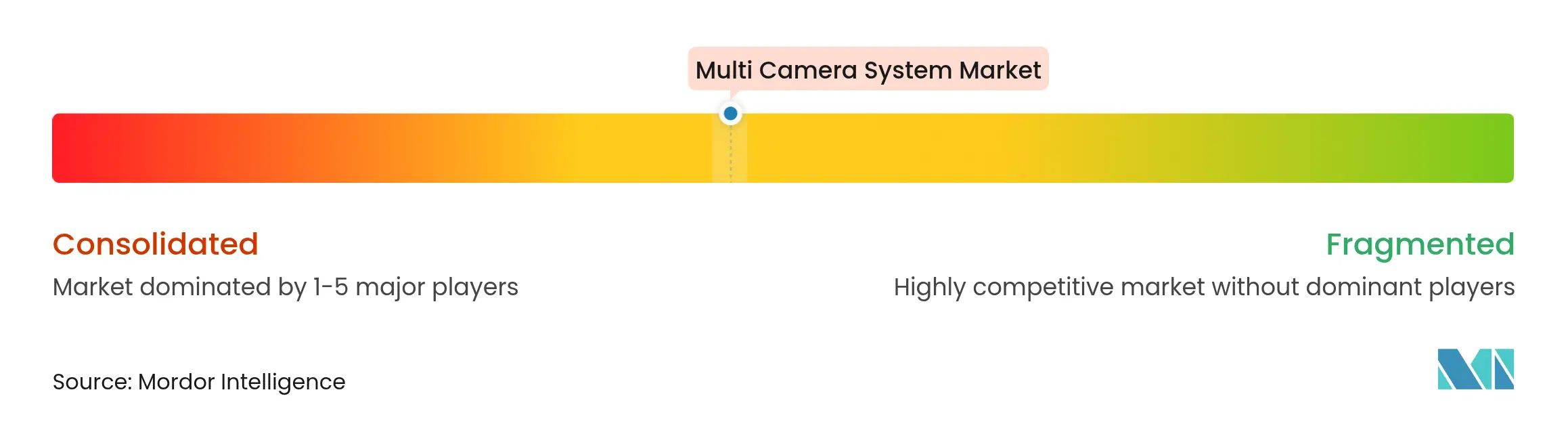
The value chain is moderately consolidated: the top five suppliers capture just over half of shipments, yet dozens of regional specialists populate vertical niches. Bosch, Continental, and Sony leverage multi-billion-dollar fabs and optics heritage to mass-produce automotive-grade imagers. Parallel to them, Hikvision and Dahua dominate smart-city tenders in Asia, bundling VMS software with camera hardware.
Strategic M&A centers on AI inference and edge-compute IP. Redwire’s USD 925 million purchase of Edge Autonomy offers turnkey airborne platforms for defense ISR tasks. Synaptics expands horizontally with SR-Series microcontrollers that shorten design cycles for battery-based devices. Honeywell’s plan to spin off its Automation arm will create a pure-play industrial-camera integrator capable of faster capital allocation.[6] Smaller entrants fight on algorithms, not optics, offering subscription-based video analytics that retrofit existing fleets.
Regulation is another competitive wedge. US federal purchasing rules now exclude certain Chinese components; EU cyber-resilience acts require vulnerability disclosures. Vendors with secure-element credentials and transparent supply chains win share. Conversely, firms lacking in-house silicon pivot to software-defined open SDK models so customers can swap sensors without lock-in, a strategy that enlarges the Multi Camera System industry partner ecosystem.
Multi Camera System Industry Leaders

*Disclaimer: Major Players sorted in no particular order
Recent Industry Developments
- May 2025: AgEagle Aerial Systems secured a 20-unit RedEdge-P camera order from Wingtra for precision-agriculture drones, enabling 2 cm survey accuracy .
- March 2025: Synaptics rolled out SR-Series MCUs under its Astra AI-Native platform for context-aware edge AI with multi-camera support.
- February 2025: Honeywell revealed a three-way split that will see its Automation unit operating independently by late 2026.
- January 2025: Canon debuted a single-operator multi-camera orchestration suite at ISE 2025.
Table of Contents for Multi Camera System Industry Report
1. INTRODUCTION
- 1.1 Study Assumptions and Market Definition
- 1.2 Scope of the Study
2. RESEARCH METHODOLOGY
3. EXECUTIVE SUMMARY
4. MARKET LANDSCAPE
- 4.1 Market Overview
- 4.2 Market Drivers
- 4.2.1 Soaring ADAS and Autonomous-Driving Fitment Rates in North America and Europe
- 4.2.2 Rapid Adoption of AI-Based Video Analytics in Smart-City Surveillance
- 4.2.3 Growing Deployment of Vision-Guided Robotics in Industry 4.0 Manufacturing
- 4.2.4 Content Creators' Shift to Immersive 360 degree/Volumetric Video for Live Sports
- 4.2.5 Shrinking Camera and Sensor ASPs Enabling Multi-Sensor Aggregation
- 4.2.6 Fleet-Safety Mandates Driving Surround-View Cameras in Commercial Vehicles
- 4.3 Market Restraints
- 4.3.1 Fragmented Video Standards Complicating Interoperability Across OEMs
- 4.3.2 High Bandwidth and Edge-Compute Requirements in Real-Time Stitching
- 4.3.3 Data-Privacy Regulations (GDPR, CCPA) Limiting Continuous Recording
- 4.3.4 Thermal and Weather Limitations of CMOS Sensors in Outdoor Deployments
- 4.4 Industry Ecosystem Analysis
- 4.5 Technological Outlook
- 4.6 Porter's Five Forces Analysis
- 4.6.1 Bargaining Power of Suppliers
- 4.6.2 Bargaining Power of Buyers
- 4.6.3 Threat of New Entrants
- 4.6.4 Threat of Substitutes
- 4.6.5 Intensity of Competitive Rivalry
5. MARKET SIZE AND GROWTH FORECASTS (VALUES)
- 5.1 By Component
- 5.1.1 Hardware
- 5.1.1.1 Cameras
- 5.1.1.2 Electronic Control Units (ECU)
- 5.1.1.3 Image Sensors and Optics
- 5.1.1.4 Others
- 5.1.2 Software
- 5.1.2.1 Image-Stitching and Calibration
- 5.1.2.2 Computer-Vision and AI Analytics
- 5.1.3 Services
- 5.1.3.1 System Integration
- 5.1.3.2 Maintenance and Support
- 5.2 By Display Type
- 5.2.1 2D
- 5.2.2 3D/Panoramic
- 5.3 By Resolution
- 5.3.1 SD
- 5.3.2 HD and Full HD
- 5.3.3 4K and Above
- 5.4 By End-use Industry
- 5.4.1 Automotive
- 5.4.1.1 Passenger Cars
- 5.4.1.2 Commercial Vehicles
- 5.4.2 Security and Surveillance
- 5.4.3 Industrial Manufacturing and Robotics
- 5.4.4 Media, Entertainment and Broadcasting
- 5.4.5 Sports and Motion Analytics
- 5.4.6 Healthcare and Medical Imaging
- 5.4.7 Others
- 5.5 By Geography
- 5.5.1 North America
- 5.5.1.1 United States
- 5.5.1.2 Canada
- 5.5.1.3 Mexico
- 5.5.2 Europe
- 5.5.2.1 Germany
- 5.5.2.2 United Kingdom
- 5.5.2.3 France
- 5.5.2.4 Italy
- 5.5.2.5 Spain
- 5.5.2.6 Rest of Europe
- 5.5.3 Asia-Pacific
- 5.5.3.1 China
- 5.5.3.2 Japan
- 5.5.3.3 South Korea
- 5.5.3.4 India
- 5.5.3.5 South East Asia
- 5.5.3.6 Rest of Asia-Pacific
- 5.5.4 South America
- 5.5.4.1 Brazil
- 5.5.4.2 Rest of South America
- 5.5.5 Middle East and Africa
- 5.5.5.1 Middle East
- 5.5.5.1.1 United Arab Emirates
- 5.5.5.1.2 Saudi Arabia
- 5.5.5.1.3 Rest of Middle East
- 5.5.5.2 Africa
- 5.5.5.2.1 South Africa
- 5.5.5.2.2 Rest of Africa
6. COMPETITIVE LANDSCAPE
- 6.1 Market Concentration
- 6.2 Strategic Moves
- 6.3 Market Share Analysis
- 6.4 Company Profiles (includes Global level Overview, Market level overview, Core Segments, Financials as available, Strategic Information, Market Rank/Share for key companies, Products and Services, and Recent Developments)
- 6.4.1 Robert Bosch GmbH
- 6.4.2 Continental AG
- 6.4.3 ZF Friedrichshafen AG
- 6.4.4 Sony Semiconductor Solutions Corp.
- 6.4.5 Aptiv plc
- 6.4.6 Valeo SA
- 6.4.7 Ambarella Inc.
- 6.4.8 OmniVision Technologies Inc.
- 6.4.9 Denso Corp.
- 6.4.10 ON Semiconductor Corp.
- 6.4.11 Dahua Technology Co., Ltd.
- 6.4.12 Hangzhou Hikvision Digital Technology Co., Ltd.
- 6.4.13 e-con Systems India Pvt Ltd.
- 6.4.14 Teledyne FLIR LLC
- 6.4.15 Spillard Safety Systems Ltd.
- 6.4.16 VMukti Solutions Pvt Ltd.
- 6.4.17 Multicam Systems SAS
- 6.4.18 Radius Ltd. (SmartWitness)
- 6.4.19 Cognex Corp.
- 6.4.20 Allied Vision Technologies GmbH
- 6.4.21 CONTEMPLAS GmbH
- 6.4.22 Mantis Live Ltd.
7. MARKET OPPORTUNITIES AND FUTURE OUTLOOK
- 7.1 White-Space and Unmet-Need Assessment
Scope and Methodology
The multi camera system market is witnessing a rising demand owing to increase demand for surveillance, enhanced vehicle safety, and technological advancement in camera such as embedded vision and multi lenses camera which are aiding in the pricing model followed by vendors typically includes bundles package, customization, and subscription model based on the end user needs.
The report covers multi camera system market companies and the market is segmented by type (hardware, software, and solution ), by display (2d and 3d), by end use (automotive, manufacturing, media and entertainment, and others ), by geography (North America, Europe, Asia Pacific, Latin America). The market sizes and forecasts are provided in terms of value (USD) for all the above segments.
| By Component | Hardware | Cameras | |
| Electronic Control Units (ECU) | |||
| Image Sensors and Optics | |||
| Others | |||
| Software | Image-Stitching and Calibration | ||
| Computer-Vision and AI Analytics | |||
| Services | System Integration | ||
| Maintenance and Support | |||
| By Display Type | 2D | ||
| 3D/Panoramic | |||
| By Resolution | SD | ||
| HD and Full HD | |||
| 4K and Above | |||
| By End-use Industry | Automotive | Passenger Cars | |
| Commercial Vehicles | |||
| Security and Surveillance | |||
| Industrial Manufacturing and Robotics | |||
| Media, Entertainment and Broadcasting | |||
| Sports and Motion Analytics | |||
| Healthcare and Medical Imaging | |||
| Others | |||
| By Geography | North America | United States | |
| Canada | |||
| Mexico | |||
| Europe | Germany | ||
| United Kingdom | |||
| France | |||
| Italy | |||
| Spain | |||
| Rest of Europe | |||
| Asia-Pacific | China | ||
| Japan | |||
| South Korea | |||
| India | |||
| South East Asia | |||
| Rest of Asia-Pacific | |||
| South America | Brazil | ||
| Rest of South America | |||
| Middle East and Africa | Middle East | United Arab Emirates | |
| Saudi Arabia | |||
| Rest of Middle East | |||
| Africa | South Africa | ||
| Rest of Africa | |||
