
Market Overview
| Study Period | 2020 - 2031 |
|---|---|
| Forecast Data Period | 2026 - 2031 |
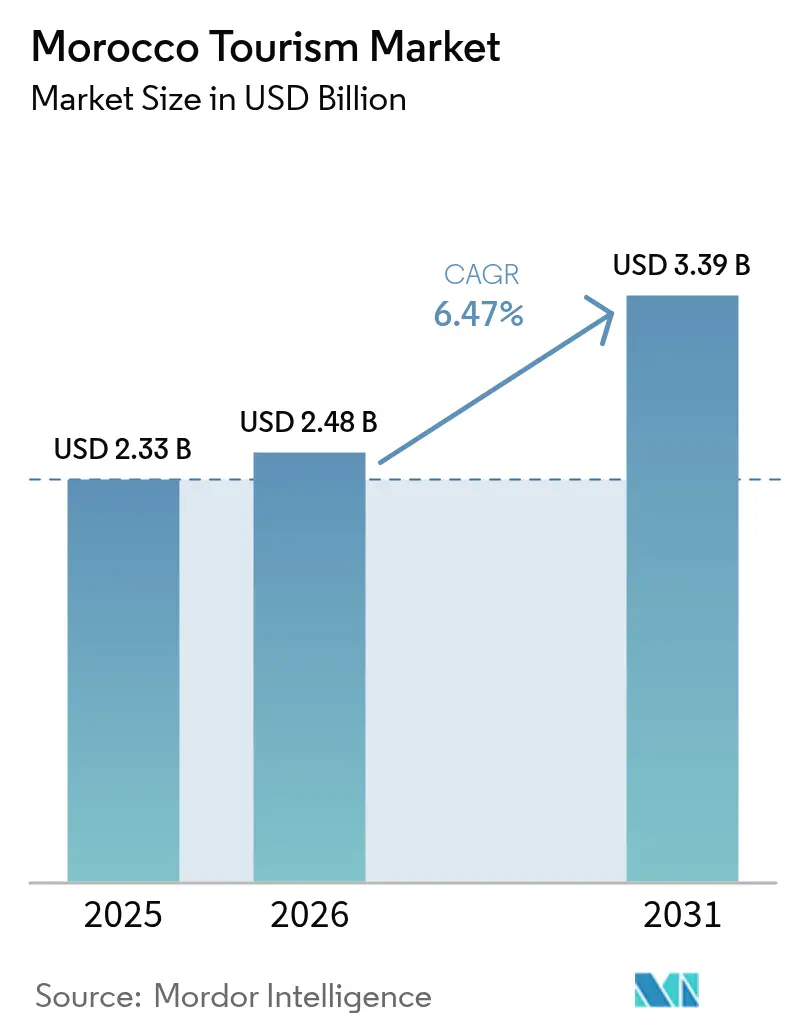
| Base Year Market Size (2025) | USD 2.33 Billion |
| Market Size (2026) | USD 2.48 Billion |
| Market Size (2031) | USD 3.39 Billion |
| Growth Rate (2026 - 2031) | 6.47 % |
| Market Concentration | Low |
Major Players *Disclaimer: Major Players sorted in no particular order Image © Mordor Intelligence. Reuse requires attribution under CC BY 4.0. | |
Morocco Tourism Market Analysis by Mordor Intelligence
The Morocco tourism market size was valued at USD 2.33 billion in 2025 and estimated to grow from USD 2.48 billion in 2026 to reach USD 3.39 billion by 2031, at a CAGR of 6.47% during the forecast period (2026-2031). Strong international arrivals, expanding air connectivity, and targeted government incentives combine to keep the Morocco tourism market on a resilient growth path despite intensifying regional competition. Ongoing infrastructure developments, such as the USD 4.2 billion investment in airport expansions and the planned extension of the Al Boraq high-speed rail network, are strategically enhancing the geographic accessibility of travel destinations. These initiatives are anticipated to drive increased traveler dispersion across regions while promoting longer average durations of stay, thereby contributing to the overall growth of the travel and tourism market[1]. Diversified source-market strategies, especially aggressive pursuit of U.K. and North American visitors, lessen over-dependence on France and Spain and cushion cyclical demand swings. Meanwhile, niche segments such as surf, golf, film-induced, and desert eco-tourism deepen visitor engagement, raise per-capita spend, and stretch the traditional season. Sustainability rules designed to cope with critical water stress raise project costs but also encourage operators to adopt innovative technologies that can enhance long-run competitiveness.
Key Report Takeaways
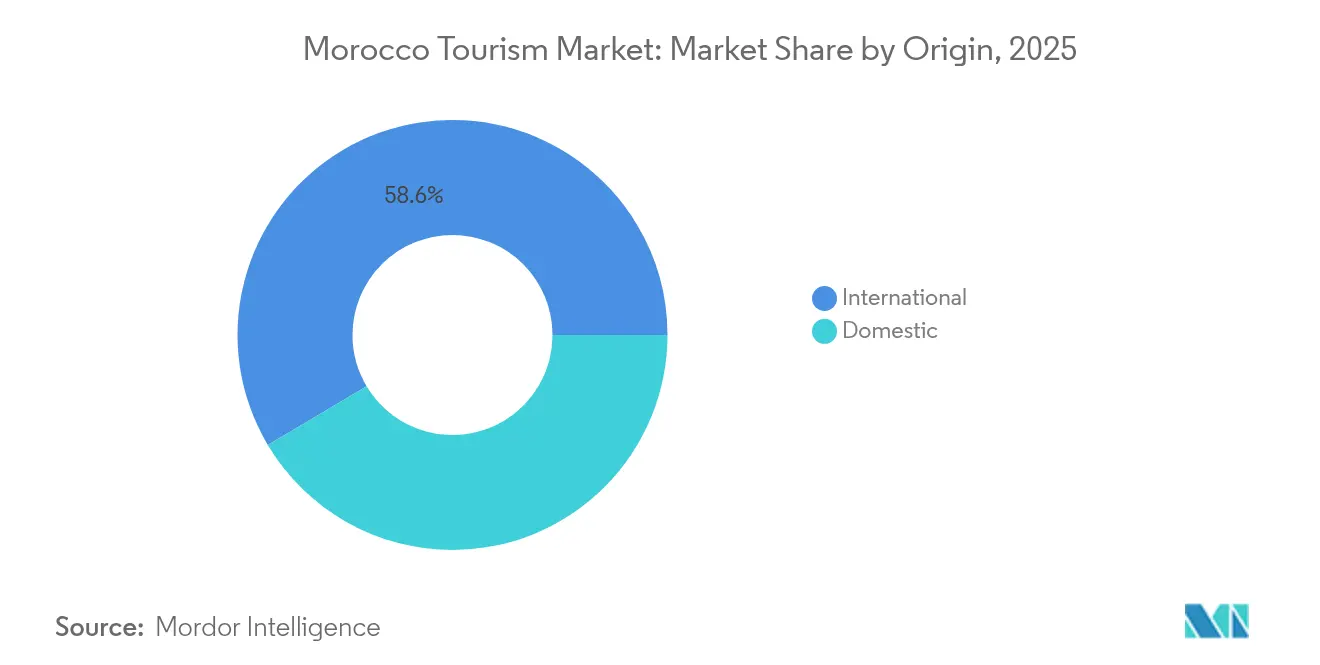
- By origin, international visitors led with 58.55% of the Morocco tourism market share in 2025 and are projected to grow at an 8.19% CAGR through 2031.
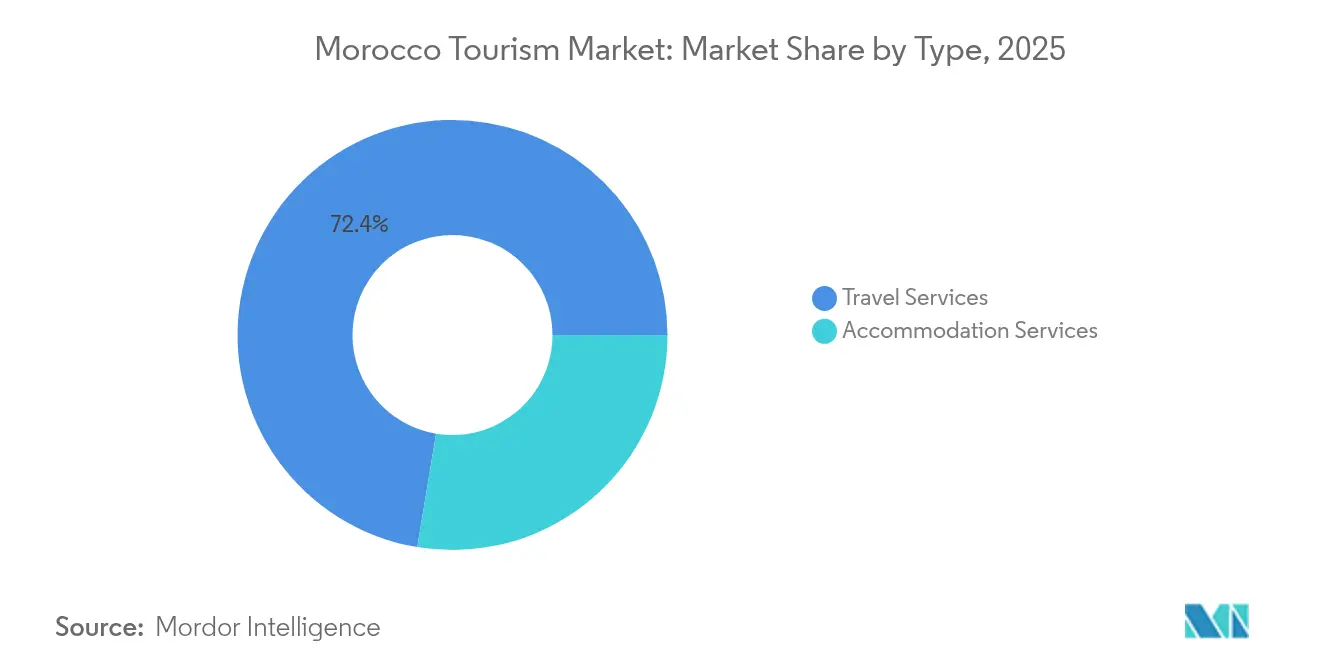
- By type, accommodation services commanded 27.62% of the Morocco tourism market size in 2025 and are forecast to expand at a 7.69% CAGR to 2031.
- By purpose, the MICE segment recorded the highest projected growth, advancing at an 11.47% CAGR between 2025 and 2031, while leisure retained 69.85% share of the Morocco tourism market.
Note: Market size and forecast figures in this report are generated using Mordor Intelligence’s proprietary estimation framework, updated with the latest available data and insights as of 2026.
Morocco Tourism Market Trends and Insights
Drivers Impact Analysis*
| Driver | (~) % Impact on CAGR Forecast | Geographic Relevance | Impact Timeline |
|---|---|---|---|
| Rising air-connectivity & low-cost carrier routes | +1.2% | Global, with a concentration in Europe-Morocco corridors | Medium term (2-4 years) |
| Government "Morocco Tourism Vision 2030" incentives | +0.9% | National, with priority zones in Agadir, Tangier, Tetouan | Long term (≥ 4 years) |
| Diversification into surf, golf & desert eco-tourism niches | +0.7% | Atlantic coast, High Atlas, Draa-Tafilalet regions | Medium term (2-4 years) |
| Digital nomad visa rollout attracting long-stay visitors | +0.5% | Urban centers: Marrakech, Casablanca, Rabat, Essaouira | Short term (≤ 2 years) |
| High-speed rail (Al Boraq) expansion to Agadir (planned 2028) | +0.8% | Casablanca-Rabat-Agadir corridor | Long term (≥ 4 years) |
| Rapid growth in film-induced tourism (Ouarzazate studios) | +0.4% | Ouarzazate, High Atlas, desert regions | Short term (≤ 2 years) |
| Source: Mordor Intelligence | |||
Rising Air Connectivity & Low-Cost Carrier Routes
Morocco’s aviation policy increases route density and lowers fares, enabling the Morocco tourism market to tap mid-income European travellers previously priced out. Delta’s direct Atlanta–Marrakech flight starting October 2025 opens a new North American corridor, shrinking reliance on multi-stop itineraries and improving travel convenience. Morocco's strategic investments in airport infrastructure, particularly the expansion of Casablanca's facilities to handle millions of passengers annually, have significantly enhanced the country's capacity to sustain growing tourist inflows. The liberalization of air travel has led to a reduction in average airfares on key European routes, thereby improving the accessibility of Morocco's tourism market to a broader audience. Furthermore, consistent growth in airline seat availability has enabled Morocco to secure a competitive share of North Africa's international arrivals, despite its relatively small geographic footprint within the region.
Tourism Vision 2030 Incentives
The national Vision 2030 framework offers multi-year tax holidays, streamlined permitting, and priority infrastructure funding to spur hotel pipelines and experiential offerings. In 2024, cities enhanced their port infrastructure to capitalize on the growing demand for cruise tourism. Simultaneously, the introduction of rebates ranging from 10% to 30% on eligible film production budgets incentivized foreign production spending, driving economic activity in the entertainment sector[2]. Mandatory green building codes embedded in Vision 2030 ensure water-recycling and energy-efficient designs, protecting long-term resource availability. By coupling incentives with sustainability standards, Morocco positions itself as a year-round premium destination, fueling steady CAGR contributions to the Morocco tourism market.
Surf, Golf & Desert Eco-Tourism Diversification
The increasing preference for activity-based vacations is driving higher daily expenditure among tourists. Surf tourists visiting Taghazout, drawn by its Atlantic swells, demonstrate significantly higher daily spending compared to traditional mass-beach visitors, highlighting a shift in consumer behavior toward experiential travel. Championship-quality courses in Marrakech draw affluent golfers from Europe and North America who willingly pay luxury-hotel rack rates, further enlarging Morocco's tourism market revenue. Luxury desert camps in Draa-Tafilalet demonstrate a strong pricing strategy, with room rates significantly exceeding the national ADR benchmarks. Furthermore, community-based tourism projects, supported by GIZ, have contributed to the creation of 1,700 employment opportunities, with a notable emphasis on empowering women by filling these roles predominantly with female workers[3]. Because these niches peak outside traditional seasons, they smooth occupancy curves and lift annual asset utilization.
Digital Nomad Visa Rollout
Digital Morocco 2030 deployed broadband upgrades and e-government services that underpin a soon-to-launch digital-nomad visa, targeting remote professionals from Europe and North America. Co-working hubs are increasingly being established near Medina districts, strategically combining cultural heritage with modern infrastructure to attract professionals. This approach enables the tourism market in Morocco to diversify its revenue streams by encouraging longer stays without overloading peak summer capacities. The success of this initiative is contingent on the availability of high-speed gigabit internet and the implementation of transparent residency policies that reduce administrative complexities, thereby enhancing the overall user experience.
Restraints Impact Analysis*
| Restraint | (~) % Impact on CAGR Forecast | Geographic Relevance | Impact Timeline |
|---|---|---|---|
| Seasonality is causing capacity under-utilisation | -0.8% | National, particularly coastal destinations | Medium term (2-4 years) |
| Over-dependence on European source markets | -0.6% | National, with the highest impact on Atlantic coast resorts | Long term (≥ 4 years) |
| Limited mid-scale hotel stock outside Marrakesh & Agadir | -0.5% | Secondary cities: Fez, Meknes, Tangier, Essaouira | Medium term (2-4 years) |
| Water-stress & sustainability regulations capping new resorts | -0.7% | Arid regions, coastal developments, golf resorts | Long term (≥ 4 years) |
| Source: Mordor Intelligence | |||
Seasonality Causing Capacity Under-Utilization
The seasonal downsizing of staff within the hotel industry increases training expenses and creates barriers to career advancement, impacting workforce stability. Fixed overhead costs, which persist throughout the year, reduce return on investment (ROI) and pose challenges to securing financing for new developments in Morocco's tourism market. Desert camps, which experience counter-cyclical demand peaks during European winters, remain an underutilized opportunity due to insufficient marketing efforts. Government initiatives, such as cultural festivals and MICE (Meetings, Incentives, Conferences, and Exhibitions) events, provide some relief during off-peak periods. However, these measures have yet to achieve the scale necessary to stabilize the fluctuations in leisure tourism volumes effectively.
Water Stress & Sustainability Regulations
Dam reservoirs are operating significantly below capacity, while Marrakech's groundwater resources have experienced a marked depletion over the years. The enforcement of compliance measures has resulted in increased development costs and extended project approval timelines, thereby impeding the critical expansion of room stock within the market. Golf resorts, due to their high irrigation requirements, are facing intensified regulatory scrutiny. Additionally, the financial burden of addressing coastal erosion, which poses a substantial risk to beachfront properties, continues to escalate. Market participants who invest in advanced solutions such as desalination technologies, grey-water recycling systems, and drought-resistant infrastructure are better positioned to mitigate risks and ensure long-term asset sustainability. Conversely, operators that delay adopting such measures may encounter restricted growth opportunities, potentially dampening the tourism market's CAGR over the forecast period.
*Our forecasts treat driver/restraint impacts as directional, not additive. The impact forecasts reflect baseline growth, mix effects, and variable interactions.
Segment Analysis
By Origin: International Visitors Drive Premium Growth
International arrivals held a 58.55% share of the Morocco tourism market in 2025 and are predicted to advance at an 8.19% CAGR, underpinned by 6.4 million annual airline seats linking France, Spain, the U.K., and rising North American gateways. Morocco's tourism market, primarily driven by international travellers, is projected to experience substantial growth in the coming years. The strategic expansion of Royal Air Maroc's fleet demonstrates a focused effort to enhance the nation's capacity for inbound tourism, aligning with long-term growth objectives. Additionally, the implementation of visa facilitation measures and biometric e-gates reflects a commitment to improving operational efficiency at entry points, thereby creating a seamless and positive experience for visitors upon arrival.
Domestic travel, which constitutes a notable portion of the market, is expanding at a slower pace due to constrained household purchasing power and persistent seasonality. However, the development of high-speed rail corridors is enhancing connectivity by reducing intercity travel times and creating more opportunities for short-term trips, particularly over weekends. In contrast, international tourists demonstrate significantly higher daily expenditure compared to local travellers, reinforcing their substantial contribution to overall tourism revenue. The growing presence of digital nomads, characterized by extended stays, is further driving up per-capita revenue. This trend is fostering demand for long-term apartment rentals and stimulating growth in local neighbourhood services. These evolving dynamics are collectively elevating the competitive landscape of Morocco's tourism market, setting higher benchmarks for market participants.

By Type: Accommodation Services Lead Value Creation
Accommodation Services captured 27.62% revenue in 2025 and are forecast to deliver a faster 7.69% CAGR on tightening room supply. The tourism accommodation segment in Morocco is projected to witness notable growth in the coming years. Currently, Marrakech and Agadir dominate the market, holding a substantial share of the classified accommodation inventory. However, leading hotel operators are strategically shifting their focus toward emerging opportunities in cities such as Tangier, Fez, and Essaouira. These cities, which have traditionally been underserved, present significant potential for expansion and investment, aligning with the evolving dynamics of the market.
The introduction of properties such as Four Seasons Rabat, Ritz-Carlton Rabat, and Radisson Casablanca reflects growing confidence in the potential for premium yield generation within Morocco's tourism market. However, the market continues to face a significant deficit in room availability, particularly within the 3- to 4-star hotel segment, which is critical for attracting middle-income travelers. Investors leveraging modular construction techniques and adopting lean operational models are positioned to expedite project timelines and address this unmet demand effectively. Meanwhile, travel-service providers are hindered by the challenges of seasonality. Strategic integration with rail, cruise, and airline networks could enable the creation of bundled travel experiences, thereby enhancing ticket revenue streams and improving overall market performance.
By Purpose: MICE Tourism Emerges as Growth Engine
Leisure retained 69.85% revenue share in 2025, benefiting from Morocco’s cultural heritage, beaches, and film-spot allure. Tourism activities in Ouarzazate are increasingly diversifying, with location tours emerging as a significant addition to the traditional souq and medina-focused itineraries. This trend is driving sustained interest in destinations beyond Marrakech. Concurrently, the business travel segment, while representing a smaller proportion of the overall travel market, is experiencing consistent growth. This expansion is attributed to Morocco's strategic efforts to enhance trade relationships across the African continent and its role as a host for various multilateral summits.
MICE demand, up 11.47% CAGR, benefits from new convention centers in Casablanca, Rabat, and planned facilities in Agadir. The MICE segment within Morocco's tourism market is projected to experience significant growth by 2030. This expansion is attributed to the implementation of event-friendly visa policies and the development of a dedicated hotel infrastructure designed to cater to business events and conferences. Religious, VFR, and specialty segments together fill the remaining demand, delivering stable base volumes that help dampen volatility. Overall, purpose diversification spreads revenue across seasons and hedges macro shocks, supporting long-term Morocco tourism market stability.
Geography Analysis
In 2024, Marrakech maintained its position as a leading contributor to Morocco's tourism market, driven by its well-established hotel infrastructure, dependable air connectivity, and the enduring appeal of its iconic medina. The city has implemented proactive sustainability initiatives, including mandatory grey-water systems and restrictions on pool sizes, to address groundwater conservation challenges while ensuring visitor numbers remain unaffected. Agadir, on the other hand, capitalized on its favorable year-round beach climate and proximity to prominent surf destinations such as Taghazout, which have contributed to an increase in average daily rates. The anticipated launch of the Al Boraq rail link, which will significantly reduce travel time between Casablanca and Agadir to 90 minutes, is expected to facilitate multi-city travel itineraries. This development is likely to distribute tourist traffic more evenly across regions and enhance overall revenue generation within Morocco's tourism market.
Casablanca continues to serve as Morocco's primary business gateway, with its airport upgrade reinforcing its position as a central hub for commerce and travel. Fez, Meknes, and Rabat, despite their recognition as UNESCO heritage sites, face challenges in attracting mid-scale hotel investments. However, the recent introduction of luxury accommodations in Rabat indicates a strategic effort to reposition the city within the tourism market. The northern ports near Tangier have benefited from cruise terminal enhancements, which have increased Mediterranean ship arrivals and created opportunities for inland excursions, thereby diversifying the region's tourism offerings.
The desert regions, led by Ouarzazate, are experiencing growth driven by film tourism and high-value desert camp experiences. Nevertheless, the region's expansion potential is constrained by critical issues such as water scarcity and inadequate paved road infrastructure. Coastal erosion, which incurs significant annual costs, poses a substantial risk to the sustainability of beachfront developments. Secondary cities like Chefchaouen and Essaouira demonstrate untapped potential in eco-tourism and cultural tourism. Realizing this potential will require targeted investments in transportation infrastructure and marketing initiatives to enhance their contribution to Morocco's overall tourism market.
Regulatory Landscape
Morocco’s tourism regulatory framework is anchored by Law No. 80.14, which governs tourist establishments and alternative lodging, with enforcement and modernization led by the Ministry of Tourism, Handicrafts, and the Social and Solidarity Economy, and investment facilitation supported by SMIT. In December 2024, Joint Orders n° 985-24, 986-24, and 987-24 updated classification standards for tourist accommodation and restaurants, tightening requirements around service quality and the customer experience in addition to physical infrastructure.
Implementation has moved toward more active compliance monitoring ahead of major international events, including periodic re-classification cycles and mystery-audit style controls. In May 2026, the Ministry launched a mystery visit system targeting 2,500 classified tourist establishments to reinforce service-quality standards under the updated classification approach and to improve consistency across regions and lodging formats.
Value Chain Analysis
Morocco’s tourism value chain begins with demand generation and market access (ONMT promotion and airline connectivity led by Royal Air Maroc and low-cost carriers), then flows through intermediated distribution (OTAs, tour operators, and destination management companies) into on-the-ground service delivery (accommodation, attractions, guiding, transport, F&B, and events/MICE venues). Investment and product development sit as enabling layers, with SMIT and the Ministry structuring project pipelines, licensing, and quality standards that shape what gets built, upgraded, and formally classified.
On the supply side, recent policy tools are reshaping how capital and capabilities enter the chain. The Tourism Roadmap 2023-2026 provides the operating framework for capacity growth and geographic diversification, while financing mechanisms such as Cap Hospitality reduce renovation and upgrade friction for classified accommodation through subsidized borrowing. The Tourism Project Bank adds a digital investment interface using a catalog of model projects to improve developer visibility and speed feasibility work, and partnerships such as Attijariwafa Bank with SMIT (April 2025) strengthen financing and advisory support for tourism-focused digital SMEs that feed booking, marketing, and experience orchestration.
Competitive Landscape
The Morocco tourism market is highly fragmented; the five largest operators control a small combined revenue, fostering price competition and service differentiation. Royal Air Maroc dominates air access yet faces rivalry from LCCs offering double-digit capacity growth and eroding fare premiums. Global hotel chains deploy multi-brand strategies—Accor emphasizes mid-scale Novotel and Ibis, while Marriott advances luxury St. Regis and select-service Moxy—to capture diverse demand slices.
Local groups such as Tikida leverage deep market knowledge to develop resorts outside classic corridors, while independent riads remain vital in medina districts where boutique authenticity commands loyalty. OTA giants Booking Holdings and Expedia intensify online marketing, pushing suppliers toward dynamic pricing and direct-booking loyalty programs to reduce commission leakage.
Specialist operators capitalize on niches: surf camps align with foreign instructors, golf tour packagers partner with top-ranked courses, and desert-camp brands integrate private astronomy sessions to justify rate premiums. Sustainability capabilities increasingly differentiate winners; properties that showcase water recycling and solar power boost brand perceptions and hedge regulatory risks that could limit future Morocco tourism market expansion.
Morocco Tourism Industry Leaders
-
Royal Air Maroc
-
Accor SA
-
Marriott International Inc.
-
TUI Group
-
FTI Touristik
- *Disclaimer: Major Players sorted in no particular order

Market Opportunities and Future Outlook
A first opportunity sits in accelerating room additions and renovations where the pipeline is already being operationalized through government programs and event-led readiness. A 35 billion dirham investment program is underway to add 25,000 hotel rooms across around 700 projects, with a large share concentrated in Casablanca, Marrakech, Rabat, Fes, Agadir, and Tangier. This activity creates whitespace for operators and contractors that can deliver mid-scale inventory while meeting updated classification and sustainability requirements. In parallel, Cap Hospitality and the broader Investment Charter support mechanisms (including up to 30% support referenced in the policy toolkit) provide a financing and incentives wrapper that favors modernization of existing classified stock, not only greenfield builds.
A second opportunity is destination diversification into the southern Atlantic and desert corridors, where formal enterprise support and anchor investments are emerging alongside new product categories in the classification system. In April 2026, the Ministry signed new Go Siyaha contracts in Dakhla, Boujdour, and Tarfaya to support tourism enterprise development, and the Go Siyaha program had 1,400 accepted projects as of February 2026 toward a 1,700-enterprise target by 2026. Also in April 2026, an Egypt-UAE consortium committed EUR 200 million for the first phase of the Essaouira Mogador resort development, reinforcing momentum for mixed-use coastal projects and related excursion, transport, and staffing activity beyond the core city clusters.
Recent Industry Developments
- July 2026: Royal Air Maroc announced the resumption of direct services from Casablanca to Doha and Dubai, with flights starting July 1, 2026 and July 3, 2026, respectively, using Boeing 787-8 aircraft. The route update strengthens Morocco’s long-haul hub connectivity into the Gulf, supporting inbound leisure flows and higher-yield business travel tied to Casablanca and major event calendars.
- April 2026: Accor and Risma agreed to accelerate hotel expansion in Morocco and to establish a joint Tourism Academy to train local staff, with CEO Sebastien Bazin confirming the commitment during an April 2-3, 2026 visit. Linking pipeline growth with structured talent development addresses service-quality requirements embedded in the updated classification regime and reduces ramp-up risk for new and repositioned properties.
- September 2025: Delta Air Lines inaugurated nonstop Atlanta to Marrakech service, creating a direct link between Morocco and the southeastern United States. The route broadened North American access and supported source-market diversification beyond Morocco’s traditional European corridors.
Research Methodology Framework and Report Scope
Market Definition and Coverage
This market is defined as the value generated in Morocco from travel services and accommodation services that support domestic and international trips, including the related booking and on-ground service delivery.
Scope exclusions: International airfare outside Morocco and long-term residential rentals are excluded, and we also avoid double counting taxes and fees that are not retained by service providers.
Segmentation Overview
- By Origin
- Domestic
- International
- By Type
- Accommodation Services
- Travel Services
- By Purpose
- Leisure
- Business
- Visiting Friends & Relatives (VFR)
- Religious
- Meetings-Incentives-Conferences-Exhibitions (MICE)
- Other Purposes
Data Sources, Market Sizing, and Validation
Desk Research
Desk work started by mapping tourism demand and hotel supply for Morocco, then narrowing it to what is counted as travel services and accommodation services. Public sources such as Moroccan Ministry of Tourism publications, Bank Al-Maghrib macro series, UN Tourism (UNWTO) country indicators, and World Bank data helped anchor arrivals, receipts, and the economic context. We also reviewed airport and rail infrastructure disclosures, national statistics releases, and trade association updates to track lodging performance signals.
To translate activity into value, we reviewed company annual reports, investor decks, and credible press coverage to understand pricing behavior, occupancy direction, and capacity additions. Where data was fragmented, we used a paid subscription for company financials and intelligence, plus a paid patent database for innovation signals related to travel technology, to confirm timelines and business mix. These desk research sources are illustrative, and we also reviewed other public releases and documents for data collection, validation, and clarification.
Primary Interviews and Surveys
We interview hotel operators, travel-service providers, destination bodies, and public tourism specialists in Morocco. Surveys and follow-ups test occupancy, room rates, booking patterns, domestic demand, and event effects, helping us fill gaps and triangulate the final model.
Distribution of primary research fieldwork respondents
| Company type | Respondent position |
|---|---|
| Top tier: 30% | CXOs: 15% |
| Mid tier: 45% | Functional/Unit leaders: 30% |
| Smaller Players: 25% | Managers: 55% |
Market-Sizing & Forecasting
Market sizing was built using top-down and bottom-up logic. The build starts from Morocco travel demand indicators and tourism receipts, then allocates into accommodation services and travel services based on validated splits. To keep the numbers practical, we used signals such as international and domestic trip volumes, average length of stay, hotel room supply and pipeline additions, occupancy and ADR direction, and seasonality patterns across destinations like Marrakesh, Agadir plus Taghazout, Casablanca, Rabat, and Tangier. After forming the first-pass totals, we used selective bottom-up approximations to corroborate the result, including sampled room nights multiplied by average realized rates and channel checks on commission levels.
Forecasting relied on scenario analysis supported by short input models that connect demand to air connectivity, infrastructure rollouts, and traveler mix shifts. When gaps appeared in destination or purpose splits, the model was backfilled using proportional allocations based on the nearest comparable period, then adjusted after interview feedback so unusual spikes were not extrapolated blindly. The same scope rules were maintained across years so growth reflects real demand and pricing movement rather than changing definitions.
Data Validation & Update Cycle
Before finalizing, we checked outputs against independent signals like arrivals and receipts trends, hotel capacity additions, and broad macro constraints, then reviewed variances for reasonableness with a second analyst. Outliers were flagged when implied spend per visitor or implied revenue per room night moved outside a realistic band. In those cases, we revisited assumptions and, when needed, re-contacted experts.
This work is refreshed annually, with interim updates when material events change travel flows or supply conditions. Right before delivery, we completed a final sweep so the numbers reflect the latest public releases and the most recent validation notes.
Mordor Intelligence's Morocco Tourism and Hotel Market Sizing Compared With Other Published Estimates
It is normal to see different market values for Morocco tourism and hotels, even when everyone uses USD, because the counting boundary can shift in small but important ways. Common reasons include whether travel services are included alongside hotels, whether informal accommodation is modeled, which base year is used, and how currency timing is handled.
By tracking receipt-to-service allocation splits and refreshing destination-level seasonality checks, Mordor Intelligence keeps the 2026 total tied to accommodation services plus travel services delivered inside Morocco, rather than mixing in broader hospitality spend that sits outside the defined service scope.
Benchmark comparison
| Source | Market Size | Gaps in Research Methodology |
|---|---|---|
| Mordor Intelligence | USD 2.48 B (2026) | |
| Global Consultancy A | USD 4.50 B (2024) | Uses an earlier base year and a broader definition that can bundle hotels with wider leisure and tourism ecosystem revenues, which raises the total versus a service-only boundary. |
| Industry Publisher B | USD 2.50 B (2024) | Focuses on hospitality value and may not fully capture travel services, and the estimate is anchored to 2024 without showing how receipts and trip mix are reconciled across destinations. |
The spread mainly comes from scope and base year choices, then from how spend is allocated between hotels, travel intermediaries, and adjacent leisure activities. Our approach stays traceable because each step links back to visible demand signals, pricing direction, and capacity realities that can be checked and repeated.
Key Questions Answered in the Report
How large is the Morocco tourism market in 2026?
The Morocco tourism market size is USD 2.48 billion in 2026 and is forecast to reach USD 3.39 billion by 2031.
What is driving growth in Morocco’s visitor arrivals?
Expanded air connectivity, Vision 2030 incentives, and diversification into surf, golf, film, and desert eco-tourism are primary growth drivers.
Which segment is expanding fastest?
MICE travel shows the highest forecast growth at 11.47% CAGR as Morocco develops modern convention facilities.
Why is water stress a concern for Moroccan tourism?
Due to critically low dam levels, regulatory measures have been implemented to enforce water recycling and impose restrictions on resort landscaping, aiming to optimize the management of limited water resources.
Which cities capture most overnight stays?
Marrakech accounts for a significant share of overnight stays, with Agadir contributing notably, while secondary cities such as Fez and Tangier focus on enhancing their accommodation capacities.
How fragmented is the competitive landscape?
The market exhibits significant fragmentation, with the leading five companies capturing a considerable portion of revenue. This scenario highlights substantial opportunities for potential new entrants.