
Molecular Biology Enzymes, Kits and Reagents Market Size and Share
Market Overview
| Study Period | 2020 - 2031 |
|---|---|
| Market Size (2026) | USD 15.05 Billion |
| Market Size (2031) | USD 24.26 Billion |
| Growth Rate (2026 - 2031) | 10.02 % |
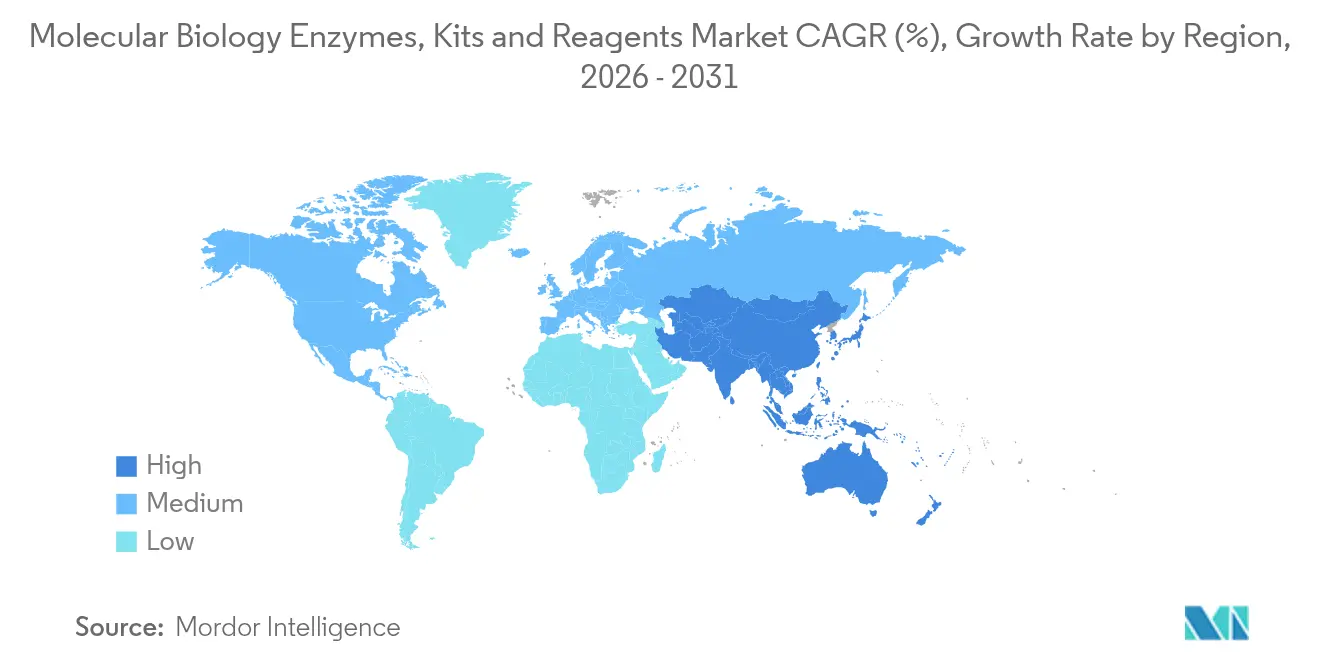
| Fastest Growing Market | Asia Pacific |
| Largest Market | North America |
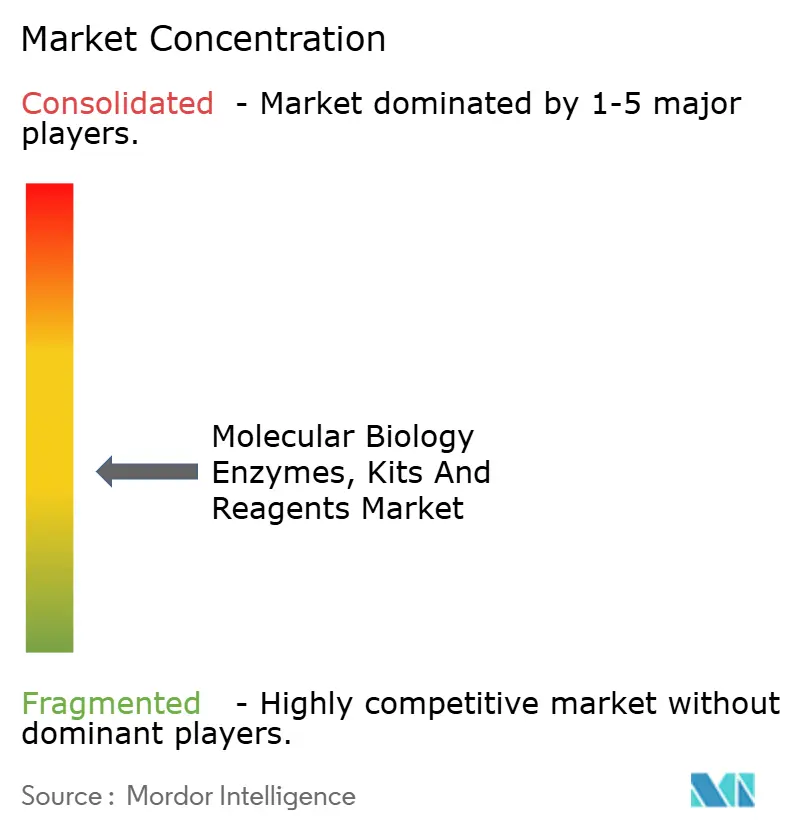
| Market Concentration | Medium |
Major Players *Disclaimer: Major Players sorted in no particular order Image © Mordor Intelligence. Reuse requires attribution under CC BY 4.0. | |
Molecular Biology Enzymes, Kits and Reagents Market Analysis by Mordor Intelligence
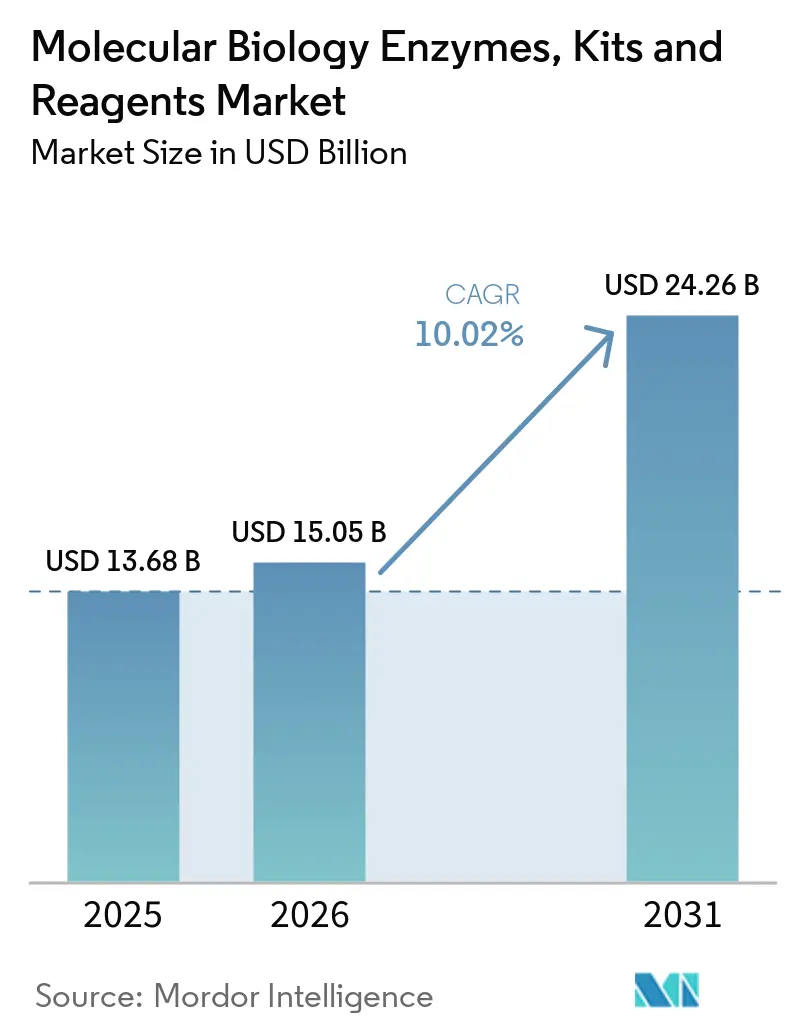
The molecular biology enzymes, kits & reagents market size in 2026 is estimated at USD 15.05 billion, growing from 2025 value of USD 13.68 billion with 2031 projections showing USD 24.26 billion, growing at 10.02% CAGR over 2026-2031. Strong momentum comes from next-generation sequencing platform upgrades, growing clinical adoption of single-cell multi-omics assays, and the shift toward field-deployable, lyophilized diagnostics. Ultra-high-fidelity enzyme innovations are raising analytical precision, enabling detection of rare mutations and supporting CRISPR-based therapeutic pipelines. At the same time, sustained federal R&D spending in North America and Europe, coupled with intensified life-science investment in Asia-Pacific, is enlarging the customer base for high-value consumables. Competitive rivalry is intensifying as large suppliers pursue strategic acquisitions to integrate sample preparation, amplification, detection, and data-analysis capabilities, while smaller specialists stake out opportunities in sustainable consumables and machine-learning-guided enzyme engineering.
Key Report Takeaways
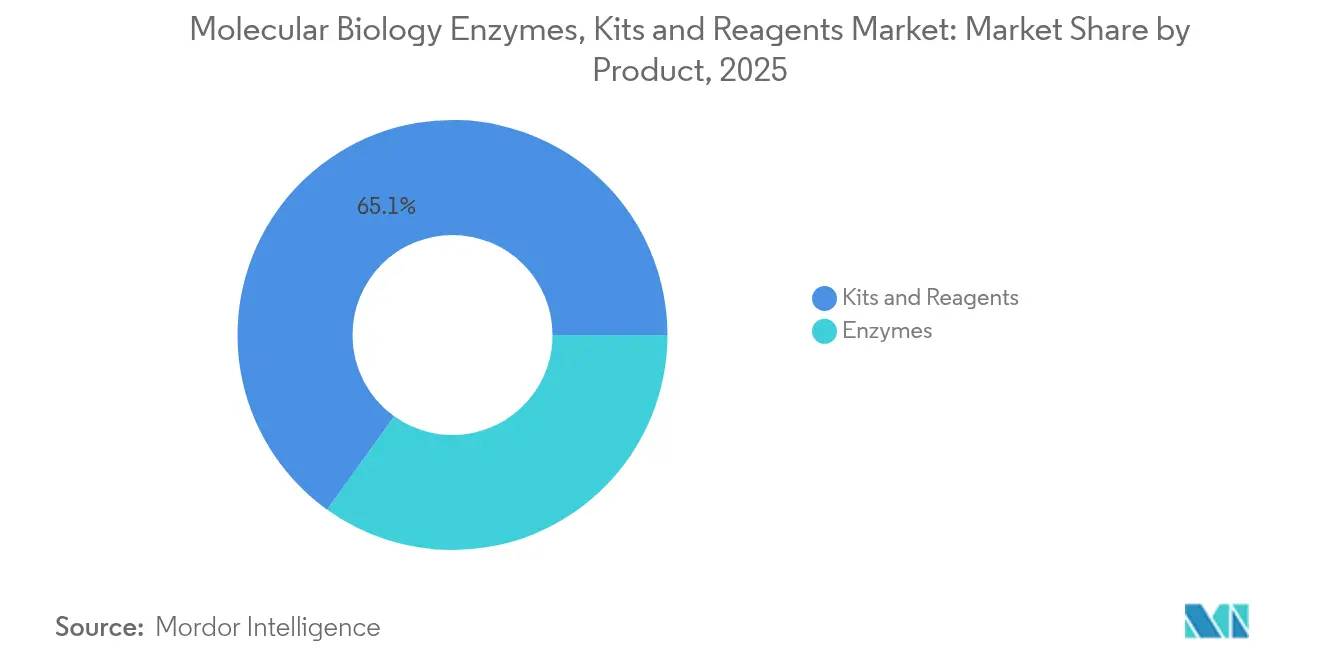
- By product category, kits & reagents led with 65.10% revenue share in 2025, while enzymes are advancing at a 12.05% CAGR through 2031.
- By application, PCR retained 45.10% of the molecular biology enzymes, kits & reagents market share in 2025, whereas next-generation sequencing is projected to expand at 15.95% CAGR to 2031.
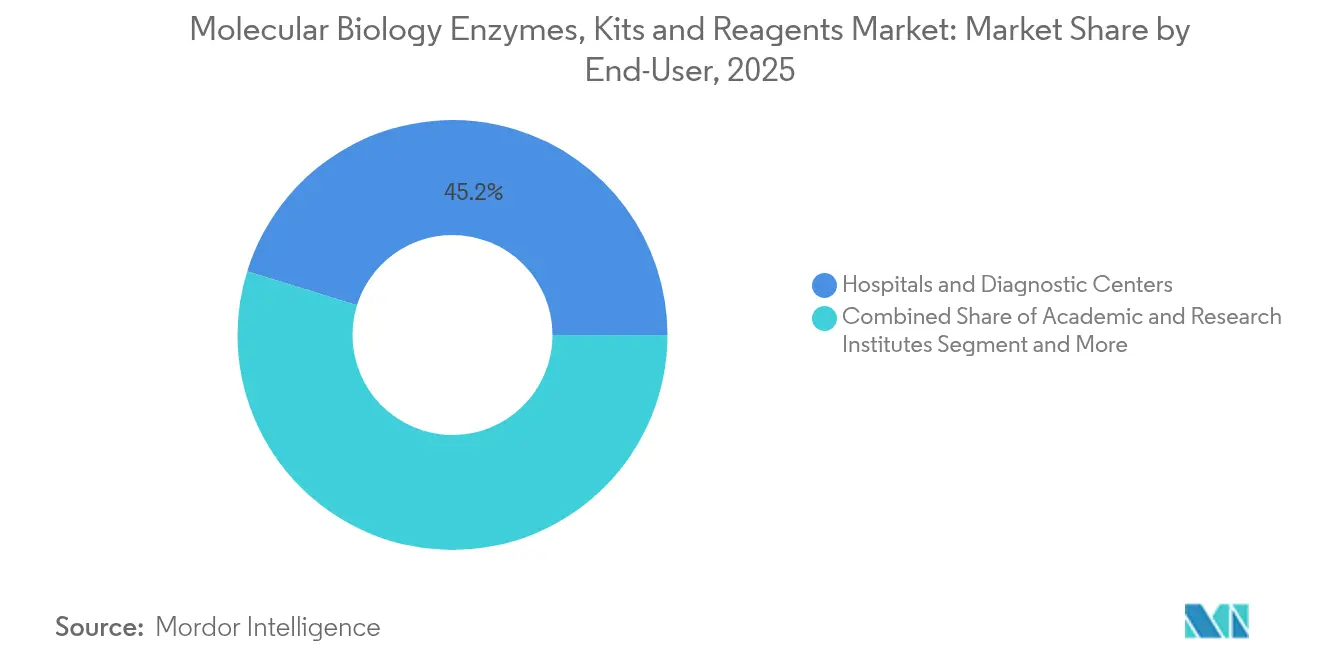
- By end-user, hospitals & diagnostic centers commanded 45.20% of the molecular biology enzymes, kits & reagents market size in 2025; contract research & manufacturing organizations post the quickest growth at 12.98% CAGR.
- By form, liquid products held 58.10% revenue share in 2025; lyophilized formats are rising at 14.10% CAGR as cold-chain-free diagnostics gain traction.
- By geography, North America dominated with 38.40% market share in 2025, while Asia-Pacific is forecast to grow at 11.05% CAGR through 2031.
Note: Market size and forecast figures in this report are generated using Mordor Intelligence’s proprietary estimation framework, updated with the latest available data and insights as of 2026.
Market Trends and Insights
Drivers Impact Analysis of Molecular Biology Enzymes, Kits and Reagents Market*
| Driver | (~) % Impact on CAGR Forecast | Geographic Relevance | Impact Timeline |
|---|---|---|---|
| Rapid Advances In NGS, qPCR & dPCR Platforms | +2.3% | Global, with early adoption in North America and EU | Medium term (2-4 years) |
| Rising Incidence Of Infectious Diseases & Genetic Disorders | +2.1% | Global, with concentrated impact in APAC and MEA | Medium term (2-4 years) |
| Growing Adoption Of Precision-Medicine Diagnostics | +1.9% | North America & EU, expanding to APAC urban centers | Long term (≥ 4 years) |
| Expanding Life-Science R&D Budgets | +1.8% | North America & EU core, spillover to APAC | Short term (≤ 2 years) |
| Ultra-High-Fidelity Enzymes Enabling Single-Cell Multi-Omics | +1.2% | Global research hubs, concentrated in North America and EU | Long term (≥ 4 years) |
| Field-Deployable Lyophilized Kits Reduce Cold-Chain Costs | +0.9% | Global, with highest impact in resource-limited settings | Medium term (2-4 years) |
| Source: Mordor Intelligence | |||
Rising Incidence of Infectious Diseases & Genetic Disorders
COVID-19 highlighted the value of rapid nucleic-acid testing, accelerating demand for portable molecular platforms such as a lyophilized LAMP-based Dragonfly system that achieved 96.1% sensitivity for mpox detection[1]. Health systems now view early molecular surveillance as essential for outbreak containment and cost control. Expanded newborn genetic-disorder screening and population-level carrier testing require enzymes with extremely low error rates to spot rare variants. CRISPR-based detection chemistries and microfluidic cartridges are entering frontline laboratories, enlarging the addressable market for high-value reagents.
Expanding Life-Science R&D Budgets
A 2025 survey showed overall academic research budgets rising 4%, even as some capital-equipment lines stayed flat, signaling a tilt toward high-turnover consumables. Contract research organizations increasingly win bulk-supply agreements, encouraging vendors to offer customized master mixes and sustainably packaged kits.
Rapid Advances in NGS, qPCR & dPCR Platforms
Third-generation sequencers such as Oxford Nanopore and PacBio reduce amplification steps, yet drive demand for specialty polymerases tolerant of long reads and modified bases. Enzymatic DNA synthesis has achieved 1,005-mer oligonucleotides at 99.9% yield, cutting hazardous waste relative to phosphoramidite chemistry. Takara Bio’s SmartChip ND system performs 5,184 qPCR reactions in under 30 minutes, underscoring the need for heat-stable enzymes and pre-aliquoted reagent plates. Machine-learning-guided cell-free expression accelerates screening of 10 million polymerase mutants per day, shrinking development cycles.
Growing Adoption of Precision-Medicine Diagnostics
Genomic profiling is moving beyond oncology into neurology and immunology. The myeloMATCH trial employs a one-day NGS workflow to place acute myeloid leukemia patients into matched studies, illustrating clinical demand for rapid library-prep kits. Mutation detection kits in genome editing include formats calibrated for rapid library preparation and barcoding. Companion-diagnostic partnerships tie reagent sales to drug launches, yet U.S. MolDX coverage policies still require exhaustive clinical-utility data, delaying revenue recognition[2].
Restraints Impact Analysis of Molecular Biology Enzymes, Kits and Reagents Market*
| Restraint | (~) % Impact on CAGR Forecast | Geographic Relevance | Impact Timeline |
|---|---|---|---|
| High Cost & Limited Reimbursement For Genetic Testing | -1.6% | Global, most pronounced in North America and EU | Short term (≤ 2 years) |
| Fragile Supply Chain For Specialty Recombinant Reagents | -1.1% | Global, with acute impact in APAC manufacturing | Medium term (2-4 years) |
| Complex IP & Licensing Landscape For Enzyme Patents | -0.8% | Global, concentrated in innovation hubs | Long term (≥ 4 years) |
| Sustainability Pressure On Single-Use Kit Plastics | -0.7% | EU and North America leading, expanding globally | Long term (≥ 4 years) |
| Source: Mordor Intelligence | |||
High Cost & Limited Reimbursement For Genetic Testing
Medicare’s MolDX program uses stringent clinical-utility thresholds, leaving many novel assays uncovered or reimbursed below cost. Private insurers now demand real-world evidence, adding time and expense to test launches. Smaller labs struggle to fund multi-site trials, constraining innovation until payers harmonize evidence standards.
Complex IP & Licensing Landscape for Enzyme Patents
More than 11,000 CRISPR-related patents create a thicket that newcomers must navigate[3]. Ongoing UC–Broad disputes over Cas9 raise licensing uncertainties that ripple across polymerase and ligase portfolios. Royalty stacking inflates bill-of-materials costs and can deter investment in next-generation editing enzymes.
*Our forecasts treat driver/restraint impacts as directional, not additive. The impact forecasts reflect baseline growth, mix effects, and variable interactions.
Molecular Biology Enzymes, Kits and Reagents Market Segment Analysis
By Product:
Reagents Lead While Enzymes AccelerateKits & reagents contributed 65.10% of 2025 revenue, underlining their consumable nature in routine workflows. The enzymes portion, though smaller, is climbing at 12.05% CAGR as researchers demand ultra-high-fidelity polymerases for single-cell sequencing. DNA polymerases remain the dominant enzyme class, bolstered by a screening platform that can assay 10 million variants daily. Within the molecular biology enzymes, kits & reagents market size, Takara Bio’s mutant T7 RNA polymerase cuts double-stranded RNA by 90%, addressing mRNA-therapeutics quality needs.
Recurrence-driven revenue from PCR master mixes and NGS library kits cements reagent leadership. Yet enzymes capture premium pricing because single-amino-acid tweaks can halve error rates and improve CRISPR specificity. Machine-learning-aided evolution lets vendors tailor catalytic optima to new sequencing chemistries, ensuring double-digit growth for the enzymes slice of the molecular biology enzymes, kits & reagents market.

By Application:
PCR Dominates As NGS SurgesPCR held 45.10% market share in 2025, reflecting ubiquity in diagnostics and QA. However, NGS is expanding at 15.95% CAGR on the back of falling per-genome costs and rapid oncology adoption. A new amplification method, AMPLON, shortens run time 50% without sacrificing accuracy, widening PCR’s reach into rapid screening.
CRISPR workflows are the fastest-growing niche inside the molecular biology enzymes, kits & reagents market, fueled by engineered Cas12a variants that deliver allele-specific edits. Epigenetics assays and protein-analysis kits also gain traction as multi-omic studies proliferate, creating cross-selling potential for integrated reagent bundles.
By End-User:
Hospitals Lead While CROs AccelerateHospitals & diagnostic centers generated 45.20% of 2025 revenue thanks to mainstream use of molecular tests for infectious-disease panels and oncology markers. The CRO CMO segment is growing at 12.98% CAGR as drug-development firms outsource specialized assays requiring bespoke reagent lots. Federal agencies estimate academic basic-research obligations grew in 2022, sustaining demand from universities.
Pharmaceutical innovators increasingly partner with CROs for single-cell RNA-seq and CRISPR screening, enlarging bulk-purchase contracts within the molecular biology enzymes, kits & reagents market. Forensic labs, meanwhile, adopt low-stutter STR kits such as Promega’s new enzyme formulation, ensuring stable if smaller-volume demand.
By Form:
Liquid Dominates While Lyophilized Gains GroundLiquid mixes accounted for 58.10% of 2025 sales owing to plug-and-play compatibility with automated platforms. Lyophilized products are rising at 14.10% CAGR because they travel at room temperature and cut cold-chain overhead. A colorimetric RT-LAMP kit retained full sensitivity after 28 days at ambient temperature.
Sustainability pressure encourages migration toward biobased plates and concentrated reagents that shrink plastic waste. Vendors in the molecular biology enzymes, kits & reagents industry now bundle lyophilized pellets with low-profile eco-friendly consumables to win procurement points under green-lab guidelines.
Geography Analysis
North America Molecular Biology Enzymes, Kits And Reagents Market
North America held 38.40% of 2025 revenue, anchored by NIH and NSF funding lines that sustain reagent consumption across academic and clinical labs. Strong reimbursement for molecular tests, despite MolDX hurdles, keeps hospital throughput high, and U.S. start-ups continue to spin out novel enzymes, maintaining regional leadership.
Europe Molecular Biology Enzymes, Kits And Reagents Market
Europe posted steady mid-single-digit growth. Regulatory alignment under IVDR is driving demand for validated kit components, benefiting suppliers able to document performance to CE-IVD standards. Investment in antimicrobial-resistance surveillance has led to rollout of high-density qPCR systems capable of thousands of reactions per run, spurring reagent pull-through.
APAC Molecular Biology Enzymes, Kits And Reagents Market
Asia-Pacific registers the fastest trajectory at 11.05% CAGR. China recorded a 35.84% jump in drug and device filings in 2023, with IVD reagents comprising nearly one-quarter of submissions. Japan is revising laboratory-developed-test frameworks, giving clarity to local innovators. South Korea’s tiered approval pathway expedites low-risk molecular assays, widening market access. APAC public-health agencies also invest in field-deployable diagnostics for rural clinics, accelerating uptake of lyophilized formats within the molecular biology enzymes, kits & reagents market size.
MEA and LATAM Molecular Biology Enzymes, Kits And Reagents Market
The Middle East & Africa are smaller today but pursue national genomics programs that mandate kit localization, signaling long-run upside. Latin America sees procurement spikes tied to disease-surveillance campaigns, though currency volatility moderates spending cycles.
Value Chain Analysis
Upstream supply starts with biological raw materials (host strains, plasmids, cell-culture media, chromatography resins) and chemical inputs (buffers, dNTPs, and oligonucleotides) that feed recombinant enzyme expression and purification. The highest-friction node is high-purity recombinant enzyme manufacturing, where tight activity and impurity specifications can constrain yield and lot-to-lot reproducibility. The chain is also sensitive to single-source dependencies in certain oligonucleotide synthesis inputs and specialty high-fidelity polymerases, which can limit scalability and trigger downstream reformulation or revalidation work.
Midstream players formulate master mixes, lyophilize or liquid-fill, and assemble kits with plastics and consumables before release testing and documentation for research-use or IVD-grade supply. OEM and custom-manufacturing models (for bulk enzymes, buffers, and customized aliquots) consolidate sourcing and access GMP-capable capacity, while downstream distribution relies on direct sales to key accounts, plus e-commerce and distributors that manage cold-chain and last-mile compliance. As purchasing consolidates through group purchasing and larger procurement channels, suppliers differentiate via application support, regulatory-ready documentation (where relevant), and reliable change control that limits customer disruption from raw-material or process updates.
Competitive Landscape
The market is moderately fragmented. Thermo Fisher Scientific, Illumina, and Roche collectively deploy multibillion-dollar M&A war chests to assemble end-to-end workflows; Thermo Fisher alone targets USD 40–50 billion in future acquisitions. Bio-Rad seeks to close its Stilla Technologies purchase to round out digital PCR capabilities.
Mid-tier players such as New England Biolabs and Promega focus on proprietary enzyme engineering and sustainability-oriented consumables. Start-ups leverage AI-driven protein design to shorten R&D cycles, drawing venture funds toward niche CRISPR editing enzymes or synthetic-biology toolkits. Intellectual-property cross-licensing remains a gating factor; vendors with broad patent portfolios can bundle freedom-to-operate assurances into contracts, tipping competitive bids.
White-space opportunities include ultra-stable polymerases for microfluidic NGS, single-use plastics derived from renewable feedstocks, and automation-ready lyophilized mastermixes. The race to commercialize enzymatic DNA synthesis is another potential disruptor, as lower-cost gene assembly would further expand applications and pull reagent demand.
Molecular Biology Enzymes, Kits and Reagents Industry Leaders
-
Agilent Technologies
-
F. Hoffmann-La Roche Ltd
-
Merck KGaA
-
Qiagen NV
-
Thermo Fisher Scientific
- *Disclaimer: Major Players sorted in no particular order
Molecular Biology Enzymes, Kits and Reagents Market Companies Covered in this Report
- Agilent Technologies
- Thermo Fisher Scientific
- Roche
- Illumina
- Merck
- QIAGEN
- Takara Bio
- New England Biolabs
- Promega
- Lucigen (LGC Biosearch)
- Bio-Rad Laboratories
- PerkinElmer
- Oxford Nanopore Technologies
- Pacific Biosciences
- BGI
- Bio-Techne
- Enzymatics (Cell Signaling Tech)
- Genscript
- ArcherDx (Invitae)
Read Analysis of Molecular Biology Enzymes, Kits and Reagents Companies
Market Opportunities and Future Outlook
Workflow integration around higher-throughput NGS and multiplexed PCR creates whitespace for reagent suppliers that combine performance (ultra-high-fidelity enzymes and inhibitor-tolerant chemistries) with simpler usability, such as pre-aliquoted plates, automation-ready formats, and validated library-prep modules. Roche's June 2026 launch of the AXELIOS 1 sequencing platform (SBX technology) underscores ongoing platform refresh cycles, which pull through demand for compatible sample-prep and library-prep kits, along with specialized polymerases and modifying enzymes tuned for new read structures and chemistries.
Ambient-stable and field-deployable molecular testing is another opportunity area, aligned with the market shift toward lyophilized formats and one-pot chemistries that reduce cold-chain dependence and operator steps. Additional headroom exists at the point where clinical validation meets kit commercialization, where suppliers that pair wet-lab performance with clear software and documentation handoffs can reduce adoption friction for regulated NGS and syndromic workflows. At the same time, US and EU policy activity around lab testing and device registration, including CLIA-centered oversight discussions for LDTs and expanded EU database registration requirements effective May 2026, increases the value of traceable materials, controlled change management, and OEM-grade supply options for laboratories and test developers that need continuity across updates.
Recent Industry Developments in Molecular Biology Enzymes, Kits and Reagents Market
- July 2026: QIAGEN launched the CE-IVDR-certified QIAstat-Dx BCID GN Plus AMR Panel, expanding its bloodstream infection testing menu in Europe. The launch strengthens cartridge-based syndromic testing pull-through for molecular reagents and reinforces QIAGEN's installed-base strategy in regulated clinical settings.
- June 2026: QIAGEN expanded the QIAcuity digital PCR ecosystem with new Gene Expression Assays and the QIAcuity OneStep High Multiplex Probe PCR Kit. The additions push dPCR adoption by improving assay breadth and multiplexing, supporting recurring demand for compatible kits and reagents across research and biopharma labs.
- April 2026: Thermo Fisher Scientific launched the Applied Biosystems PowerFlex Thermal Cycler to improve PCR flexibility and productivity. New instrument placements typically increase consumption of PCR master mixes, enzymes, and workflow reagents, tightening vendor ecosystems around routine amplification workflows.
Molecular Biology Enzymes, Kits and Reagents Market Report Scope and Research Methodology
Market Definition and Coverage
This market covers revenues earned from commercially sold molecular biology enzymes, kits, and ready-to-use reagents that are used to run common lab workflows like PCR, sequencing preparation, cloning, and related nucleic acid analysis.
Scope exclusions: Bulk industrial enzymes, proteomics-focused reagents, stand-alone instruments, and captive or in-house prepared formulations are excluded.
Segments Covered in This Report
- By Product
- Enzymes
- DNA Polymerases
- Reverse Transcriptases
- Ligases & Kinases
- Nucleases & Restriction Enzymes
- Modifying Enzymes
- Other Specialty Enzymes
- Kits & Reagents
- PCR Master-Mix & qPCR Kits
- NGS/Library-Prep Kits
- DNA/RNA Extraction & Purification Kits
- Lyophilized Field-Use Kits
- Buffers, dNTPs & Additives
- Enzymes
- By Application
- Polymerase Chain Reaction
- Next-Generation Sequencing
- Epigenetics
- Cloning & Synthetic Biology
- Gene-Editing / CRISPR Workflows
- Protein Analysis & Proteomics
- By End-User
- Hospitals & Diagnostic Centers
- Academic & Research Institutes
- Pharmaceutical & Biotechnology Companies
- Contract Research & Manufacturing Organizations
- Forensic & Security Laboratories
- Food, Environmental & Agricultural Testing Labs
- By Form
- Liquid (Cold-Chain)
- Lyophilized (Ambient)
- Geography
- North America
- United States
- Canada
- Mexico
- Europe
- Germany
- United Kingdom
- France
- Italy
- Spain
- Rest of Europe
- Asia-Pacific
- China
- Japan
- India
- South Korea
- Australia
- Rest of Asia-Pacific
- Middle East and Africa
- GCC
- South Africa
- Rest of Middle East and Africa
- South America
- Brazil
- Argentina
- Rest of South America
- North America
Data Sources, Market Sizing, and Validation
Desk Research
Desk research starts with public science and health references to set the demand context and the workflow mix behind enzyme and kit usage. Common starting points include sources such as the US FDA databases for diagnostic and assay context, NIH and NCBI for genomics activity signals, CDC for public health testing cues, OECD health and biotech indicators, and World Bank macro series that support normalization by country.
We then layer in company filings, annual reports, investor decks, product catalogs, and pricing lists to understand what is being sold as a finished product versus components bundled in kits. Trade association pages, peer-reviewed journals, and patent databases are also used to cross-check technology shifts, typical pack sizes, and which workflows are expanding. The sources named above are illustrative only, and many other references were used for collection, validation, and clarification during the study.
Primary Interviews and Surveys
Primary work is used to pressure-test the desk assumptions and to pin down variables that are not consistently visible in public documents, especially mix shifts between enzymes, kits, and supporting reagents. We spoke with executives, functional leaders, and managers across manufacturers, distributors, and lab end users in APAC, EMEA, and the Americas, so regional adoption patterns and pricing moves could be confirmed before finalizing the model.
Distribution of primary research fieldwork respondents
| Company type | Respondent position | Region |
|---|---|---|
| Top tier: 27% | CXOs: 14% | APAC: 40% |
| Mid tier: 51% | Functional/Unit leaders: 41% | EMEA: 34% |
| Smaller Players: 22% | Managers: 45% | Americas: 26% |
Market-Sizing & Forecasting
Sizing is built using a top-down approach where the addressable demand pool is reconstructed from molecular testing and research activity, and then filtered into purchasable enzymes, kits, and ready-to-use reagents. Because the market is tied to repeat lab workflows, the model uses a mix of indicators such as PCR and sequencing run activity, funded genomics programs, clinical and public health testing intensity, installed base of relevant lab workflows, and average selling price movements by pack size and format.
Once the country and end-user demand picture is shaped, results are corroborated with selective bottom-up checks like sampled catalog price points multiplied by estimated volumes, distributor channel checks, and roll-ups from a subset of suppliers where public financial disclosures allow it. When bottom-up coverage is incomplete, gaps are filled using workflow-level consumption ratios and region-specific adoption rates confirmed in interviews, and then the totals are adjusted to keep the assumptions consistent.
For forecasting, scenario analysis is used to reflect how quickly genomics adoption, assay menu expansion, and pricing normalization can change across regions. The scenarios are guided by expert views on funding cycles and testing demand, and the final forecast is taken from the case that best matches observable activity signals.
Data Validation & Update Cycle
Validation is done through repeated cross-checks so the final number stays aligned with independent signals, not only with one dataset. We compare the modeled totals with external activity indicators and with implied revenue per workflow where it can be sensibly derived, and outliers are reviewed until the driver is clearly explained.
Before sign-off, the model and written assumptions go through multi-step analyst review, and follow-up calls are triggered when interview feedback and desk indicators diverge beyond an acceptable range. Reports are refreshed annually, and interim updates are made when there are material events that can shift demand or pricing. Right before delivery, a final pass is completed so clients receive the most current view supported by the same repeatable steps.
Mordor Intelligence's Molecular Biology Enzymes Kits and Reagents Market Size Versus Other Published Estimates
Published market sizes for molecular biology enzymes, kits, and reagents can differ even when the category name looks the same, since groups do not always count the same items or treat the same lab workflows in the same way. The spread usually comes from scope choices, base-year selection, how pricing is averaged across pack sizes, and whether demand is tied back to visible workflow activity before the final number is released.
A common gap driver in this market is whether estimates include only finished commercial products sold through catalog or direct channels, or if they also add in adjacent lab consumables, broader life science reagents, and internal captive formulations. Timing also matters because currency conversion points and post-pandemic pricing normalization can change the base value, and older estimates may not reflect newer shifts such as sequencing library prep mix changes. The benchmark below uses an approach that excludes in-house formulations and stand-alone instruments, and it is updated with workflow adoption checks and pack-level pricing inputs before totals are signed off, a modeling choice applied by Mordor Intelligence.
Benchmark comparison
| Source | Market Size | Gaps in Research Methodology |
|---|---|---|
| Mordor Intelligence | USD 15.05 B (2026) | |
| Global Consultancy A | USD 15.93 B (2025) | Uses a 2025 base year and can differ on what is treated as a reagent, since some line items are grouped broadly across enzymes, kits, and general molecular reagents, which can shift the starting value versus a finished-product-only scope. |
| Industry Publisher B | USD 27.68 B (2025) | The higher figure is consistent with a wider basket that may fold in additional life science consumables and a broader definition of molecular biology reagents across more end uses, which inflates the market compared with enzyme and kit focused counting. |
Taken together, the comparison shows that the main differences come from what is included around the core enzyme and kit spend, and from the base year and pricing assumptions used to translate workflow activity into revenue. By keeping the scope tied to sellable finished products and by checking the totals against practical workflow signals, we are able to present a market size that is easier to trace back to clear inputs and repeatable steps.
Key Questions Answered in the Report
What is the current size of the molecular biology enzymes, kits & reagents market?
The molecular biology enzymes, kits & reagents market size stands at USD 15.05 billion in 2026, with a projected value of USD 24.26 billion by 2031.
Which segment is expanding the fastest?
Enzymes are the quickest-growing product segment, advancing at a 12.05% CAGR due to demand for ultra-high-fidelity polymerases and CRISPR-specific nucleases.
Why are lyophilized kits gaining popularity?
Lyophilized formulations enable room-temperature shipping and storage, lowering cold-chain costs and supporting field diagnostics where infrastructure is limited.
How do reimbursement policies affect market growth?
Restrictive coverage criteria under programs such as Medicare MolDX can delay adoption of innovative tests, trimming projected CAGR by an estimated 1.6%.
Which geographic region offers the highest growth potential?
Asia-Pacific shows the highest CAGR at 11.05% through 2031, fueled by rising R&D investments, regulatory reforms, and expanding precision-medicine programs.