Market Overview
| Study Period | 2020 - 2031 |
|---|---|
| Forecast Data Period | 2026 - 2031 |
| Base Year Market Size (2025) | USD 1.02 Billion |
| Market Size (2026) | USD 1.12 Billion |
| Market Size (2031) | USD 1.75 Billion |
| Growth Rate (2026 - 2031) | 9.43% CAGR |
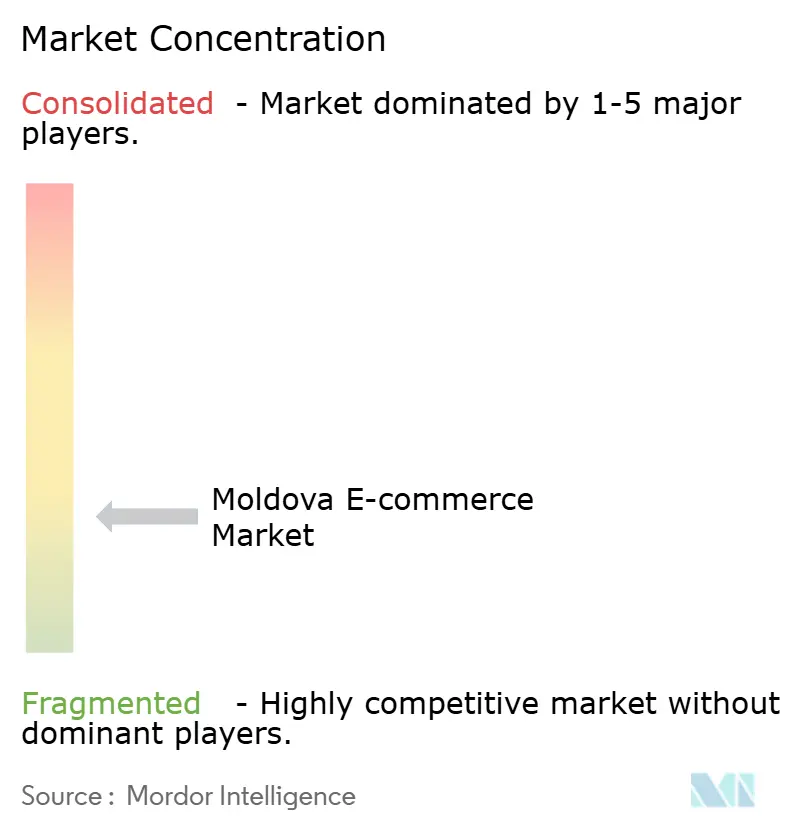
| Market Concentration | Low |
Major Players *Disclaimer: Major Players sorted in no particular order Image © Mordor Intelligence. Reuse requires attribution under CC BY 4.0. | |
Moldova E-commerce Market Analysis by Mordor Intelligence
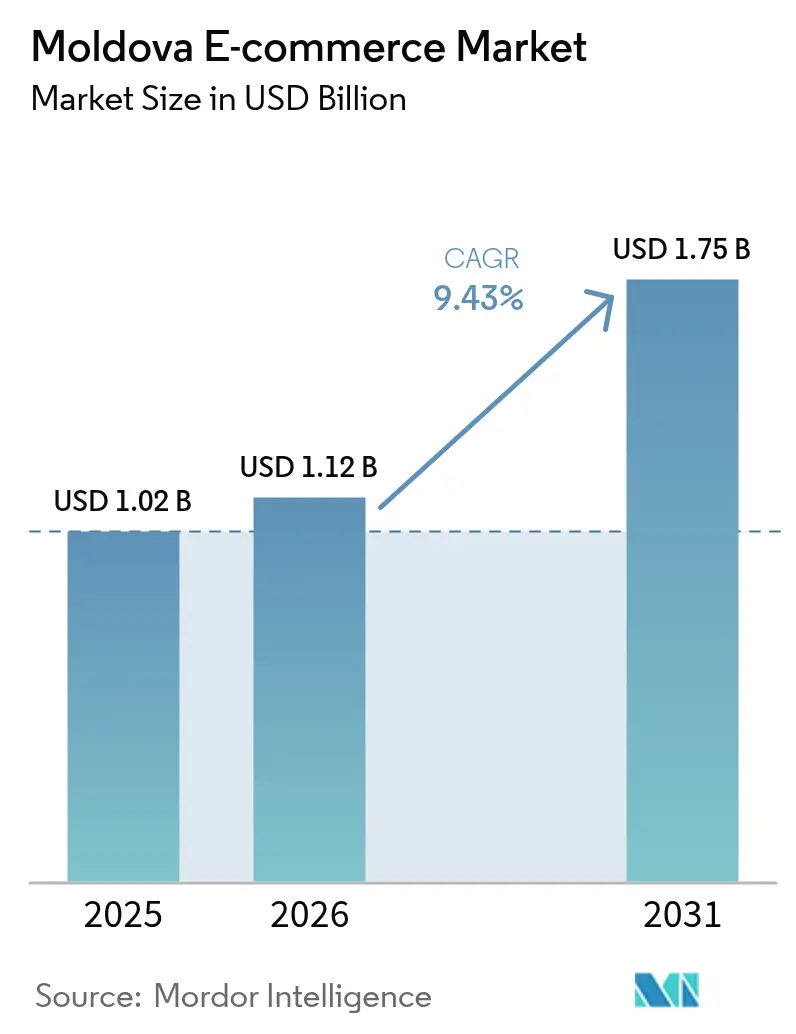
The Moldova e-commerce market size was valued at USD 1.02 billion in 2025 and estimated to grow from USD 1.12 billion in 2026 to reach USD 1.75 billion by 2031, at a CAGR of 9.43% during the forecast period (2026-2031). Widespread internet access now covers 80.2% of residents, smartphones drive most online traffic, and SEPA participation is streamlining cross-border payments. Continuous policy support—from the Digital Transformation Strategy 2023-2030 to targeted IT-sector incentives—is lowering operational friction, while parcel-locker roll-outs in secondary cities are broadening fulfilment reach. Regional integration is accelerating: the EU already absorbs two-thirds of Moldova’s exports, and the DCFTA framework is driving fresh efficiencies across logistics, customs and payments. Competitive intensity is rising as roughly 1,700 domestic webshops jostle with cross-border giants, and Romania-based eMAG prepares market entry.
Key Report Takeaways
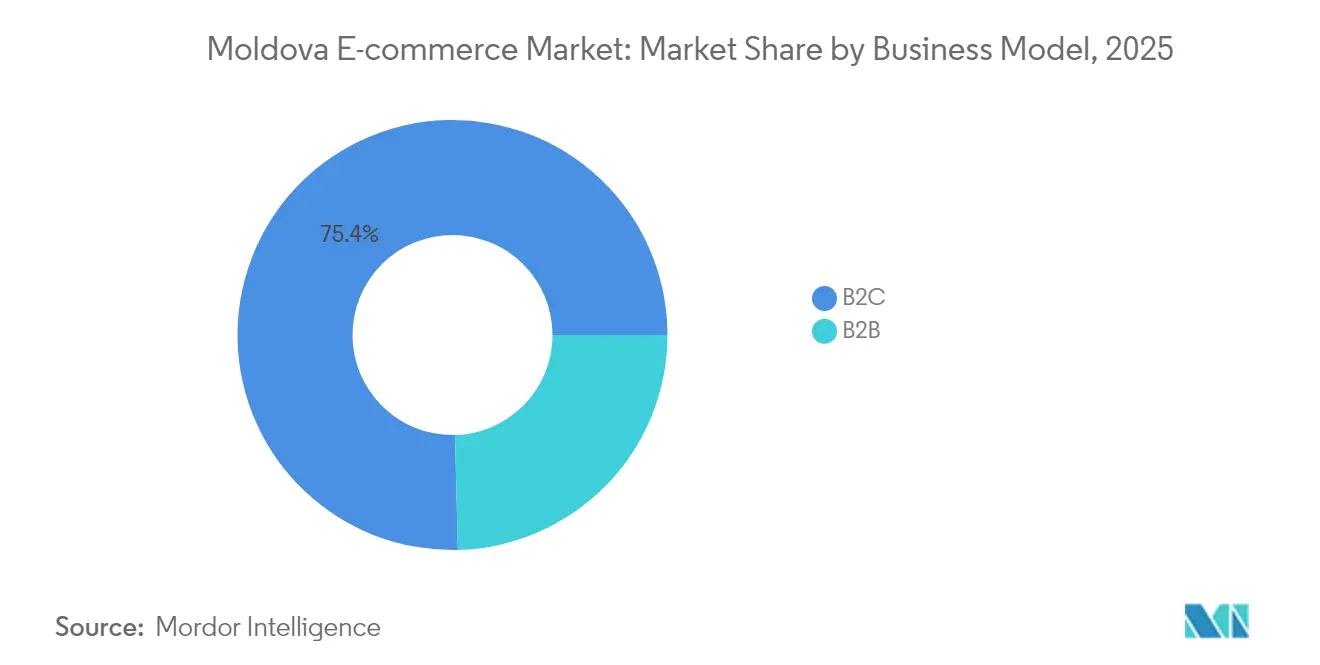
- By business model, the B2C segment led with 75.40% revenue share in 2025; the B2B segment is forecast to expand at an 10.84% CAGR through 2031.
- By device, smartphones accounted for 69.40% of transactions in 2025 and are advancing at a 11.76% CAGR to 2031.
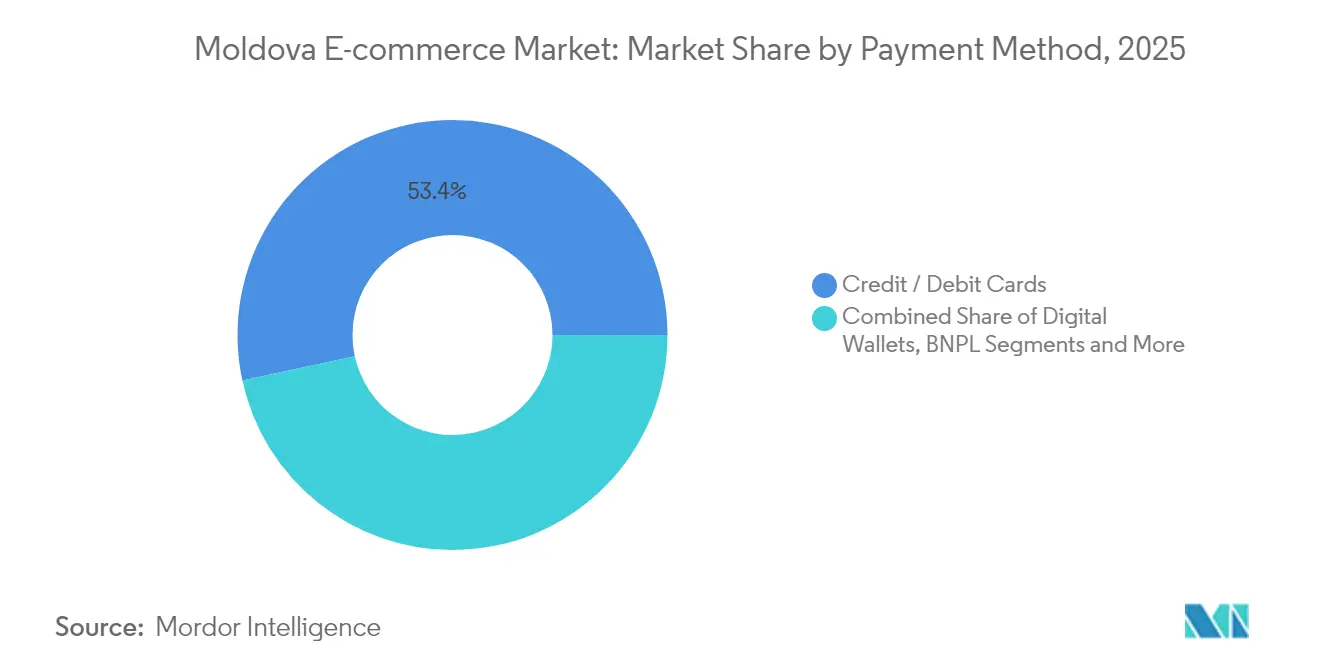
- By payment method, credit/debit cards held 53.40% of the Moldova e-commerce market share in 2025, while digital wallets post the fastest growth at 12.65% CAGR to 2031.
- By product category, fashion and apparel captured 31.60% of the Moldova e-commerce market size in 2025; food and beverages is projected to grow at 13.25% CAGR between 2026-2031.
Note: Market size and forecast figures in this report are generated using Mordor Intelligence’s proprietary estimation framework, updated with the latest available data and insights as of 2026.
Moldova E-commerce Market Trends and Insights
Drivers Impact Analysis*
| Driver | (~) % Impact on CAGR Forecast | Geographic Relevance | Impact Timeline |
|---|---|---|---|
| Rising internet and smartphone penetration | +2.3% | National, with higher impact in secondary cities | Medium term (2-4 years) |
| Government IT‐sector incentives and tax breaks | +1.8% | National, concentrated in urban centers | Medium term (2-4 years) |
| Fin-tech adoption improving checkout conversion | +1.5% | Urban centers, primarily Chișinău | Short term (≤ 2 years) |
| EU-DCFTA logistics corridors lowering cross-border costs | +1.2% | National, with emphasis on border regions | Medium term (2-4 years) |
| Remittance-fuelled purchasing power among diaspora families | +0.9% | Rural areas and smaller cities | Short term (≤ 2 years) |
| Expansion of parcel-locker networks in secondary cities | +0.7% | Secondary cities and suburban areas | Short term (≤ 2 years) |
| Source: Mordor Intelligence | |||
Rising Internet and Smartphone Penetration: Digital Divide Narrowing
Moldova counts 2.42 million internet users in 2025, and average download speeds reach 133.96 Mbps on fixed lines and 48.29 Mbps on mobile connections. [1]National Bureau of Statistics, “Situația privind utilizarea produselor tehnologiei informației și comunicațiilor în întreprinderi în anul 2025,” statistica.gov.md Daily online engagement now exceeds 91% of users, enabling merchants to interact with shoppers almost continuously. Telecom operators Orange and Moldcell started 5G roll-outs in 2024, bolstering bandwidth-heavy mobile shopping experiences. The sector contributes 7% of GDP, underscoring its macro-economic weight. Still, 19.8% of the population remains offline, and low-income rural households face affordability constraints that temper nationwide adoption.
Government IT-Sector Incentives: Creating Digital Innovation Hubs
The Moldova Innovation Technology Park (MITP), now extended to 2037, offers a flat 7% tax rate that has attracted nearly 1,600 companies. IT’s fiscal contribution expanded from EUR 19 million (USD 20.6 million) in 2017 to EUR 68 million (USD 73.6 million) in 2023, catalysing digital-commerce enablers. Liberalised work-permit policies widen the talent pool, accelerating next-generation e-commerce platform development and middleware services.
Fin-tech Adoption: Streamlining the Digital Purchase Journey
SEPA accession in March 2025 allows Moldovan banks to execute euro-denominated transfers at EU-standard cost and speed. Domestic providers such as Paynet rolled out Strong Customer Authentication in February 2025, raising fraud resilience without adding checkout friction. Cashless transactions per capita climbed from 8 in 2017 to 54 in 2023, signalling a decisive behavioural pivot, though headroom to the EU average of 170 remains large.
EU-DCFTA Logistics Corridors: Redefining Cross-Border Commerce
Gravity-model analysis shows the DCFTA added 9% to Moldova-EU trade. [2]Journal of Eastern European and Central Asian Research, “Effectiveness of the DCFTA on Moldova’s Trade with the EU,” ieeca.org The EBRD’s customs-digitisation project, due for completion in 2024, covers electronic certificates of origin, pre-arrival processing and ATA carnet digitalisation. Faster, paper-free clearance lowers landed cost for inbound stock and expedites exports by local merchants, making the Moldova e-commerce market more attractive for EU consumers.
Restraints Impact Analysis*
| Restraint | (~) % Impact on CAGR Forecast | Geographic Relevance | Impact Timeline |
|---|---|---|---|
| Fragmented last-mile delivery outside Chișinău | -1.2% | Rural areas and smaller cities | Medium term (2-4 years) |
| Low consumer trust in online pre-payment | -0.9% | National, more pronounced in rural areas | Short term (≤ 2 years) |
| VAT compliance burden on micro-sellers under EU rules | -0.7% | National, affecting cross-border sellers | Medium term (2-4 years) |
| Language fragmentation limiting local-content merchandising | -0.5% | National, particularly affecting Romanian/Russian content | Long term (≥ 4 years) |
| Source: Mordor Intelligence | |||
Fragmented Last-Mile Delivery: The Rural Connectivity Challenge
Roughly 60% of Moldovans live outside Chișinău, yet courier density remains urban-centric, resulting in slower fulfilment and higher shipping fees. Parcel-locker deployments help, but low population density and aging road infrastructure keep unit economics challenging. Retailers experiment with pickup-point partnerships in petrol stations and grocery outlets to bridge service gaps.
Low Consumer Trust: The Cash-on-Delivery Conundrum
Cash-on-delivery (COD) still dominates rural transactions. COD drives return rates up to 18%, inflating reverse-logistics costs. Regulatory caps on high-value cash payments effective 2025 will nudge adoption of cards and wallets, yet merchants must reinforce buyer-protection messaging to convert entrenched COD users.
*Our forecasts treat driver/restraint impacts as directional, not additive. The impact forecasts reflect baseline growth, mix effects, and variable interactions.
Segment Analysis
By Business Model: Corporate Digital Procurement Gains Momentum
The Moldova e-commerce market size for B2C transactions stood at USD 0.77 billion in 2025, accounting for a 75.40% revenue share. Corporate buyers, however, are triggering the next growth wave: the B2B segment is projected to grow 10.84% annually to 2031, driven by EU supply-chain harmonisation and the World Bank-backed MSME Competitiveness Project.
Large agribusinesses and manufacturing exporters already source packaging, spares and ICT hardware online, trimming procurement cycle times by up to 30%. Platform providers are introducing punch-out catalogues, dynamic pricing and integration with enterprise resource-planning (ERP) suites, narrowing the functionality gap with Western peers. As corporate workflows digitalise, category spending migrating online is set to outstrip household consumption growth.


By Device Type: Smartphones Dictate User-Experience Priorities
Smartphone-initiated orders formed 69.40% of the Moldova e-commerce market in 2025, and are tracking a 11.76% CAGR to 2031. The convenience of tap-to-pay, push notifications and in-app loyalty schemes keeps mobile retargeting efficiency high relative to desktop banners.
Operators now cover 95.7% of active SIMs with broadband speeds; 5G pilots launched in Chișinău produce latency below 15 ms. Merchants respond with lightweight progressive-web-app frameworks that load under 3 seconds on 4G, minimising bounce rates. Desktop sessions persist for high-ticket items such as modular furniture, but the revenue mix will continue gravitating toward handheld devices.
By Payment Method: Wallets Break the Card-COD Duopoly
Cards controlled 53.40% of payment volume in 2025, yet digital wallets are on a 12.65% CAGR trajectory. Their biometric authentication, embedded loyalty perks and zero-FX cost on euro transactions under SEPA enhance adoption, particularly among Gen Z shoppers.
Wallet providers integrate BNPL modules that split invoices into interest-free instalments, lifting average order value by 18% in electronics and home-improvement categories. COD’s share is gradually eroding, pressured by regulatory cash caps and higher courier surcharges. Payment orchestration platforms now route transactions dynamically, ensuring redundancy and maximising authorisation rates across local banks.
By B2C Product Category: Groceries Accelerate Urban Basket Shift
Fashion held 31.60% of the Moldova e-commerce market share in 2025, propelled by frequent purchase cycles and manageable reverse logistics. Food and beverages, however, exhibit the steepest 13.25% CAGR through 2031, nudged by COVID-era habit shifts and the rapid expansion of chilled-chain fulfilment networks.
Grocery chains such as Kaufland offer ≤90-minute delivery in Chișinău, bundling loyalty points redeemable both online and in-store. Consumer electronics remains a staple, yet average replacement cycles lengthened from 28 to 32 months, moderating unit sales growth. Beauty, personal care and pet supplies capture incremental wallet share due to their recurring-purchase nature and low return rates, reinforcing customer-lifetime-value economics for omnichannel retailers.
Geography Analysis
The Moldova e-commerce market interfaces closely with European trade flows: the EU accounts for 53.7% of overall trade and absorbs 65.4% of Moldovan exports. DCFTA provisions simplify compliance, enable mutual recognition of electronic signatures and lower logistics costs along Prut River border crossings.
Urban-rural disparity defines domestic demand dynamics. Chișinău hosts nearly half of online sales thanks to higher disposable income, dense courier coverage and a tech-literate workforce. Bălți, Cahul and Ungheni form secondary nodes where parcel-locker density and same-day delivery pilots are gaining momentum. Rural districts, though home to 1.8 million residents, lag on both broadband affordability and last-mile reliability, dampening uptake.
Cross-border consumer shopping is growing at a 13.20% annual clip, reflecting wider product assortments on EU-based platforms that now ship under streamlined customs rules. Integration with SEPA reduces checkout abandonment by removing hidden currency-conversion fees. Nevertheless, language duality (Romanian and Russian) complicates search-engine optimisation and merchandising localisation for global merchants, curbing potential conversion rates.
Regulatory Landscape
Moldova's e-commerce framework is anchored by Law No. 284/2004 on Electronic Commerce (as amended), which broadly follows the EU Directive 2000/31/EC principles for online contracting and information duties. Policy direction is led by the Ministry of Economic Development and Digitalization (MDED), while the National Agency for Regulation of Electronic Communications and Information Technology (ANRCETI) regulates electronic communications and the postal sector that underpins parcel delivery.
Regulatory change has focused on digitizing compliance and reducing administrative friction for online merchants. Moldova joined SEPA in March 2025, strengthening the payments layer for euro transfers, and the national e-Factura program is in a phased rollout for B2B, with full mandatory implementation scheduled for October 1, 2026. In parallel, MDED advanced a 2026 deregulation package to amend a large set of normative acts, including exemptions for e-commerce operators without physical premises from fixed local taxes and simpler VAT refunds through recognized transport and CN23 documentation. In Chișinău, e-commerce operators must also notify the competent authority through state portals such as servicii.gov.md or actpermisiv.gov.md.
Value Chain Analysis
Moldova's e-commerce value chain begins with merchants and sourcing, spanning domestic brands and importers that stock via EU-linked trade corridors under the DCFTA framework, and then progresses through storefront enablement, payment acceptance, order management, fulfillment, last-mile delivery, and after-sales and returns. Storefront creation commonly draws on widely used platforms such as OpenCart and WooCommerce, supported by commercial tools including Shopify, GoMag, and Cartum, alongside broader ICT ecosystem services for digital commerce.
Payments and logistics remain the two operational choke points that shape customer experience and cost-to-serve. The National Bank of Moldova's MIA instant payment system (launched in 2024) supports faster cashless settlement, while SEPA participation (from March 2025) helps reduce cross-border euro payment friction for merchants and consumers. On the delivery side, third-party couriers and postal operators play a material role, with providers including Fan Courier, Nova Post, Posta Moldovei, Glovo, and Straus fulfilling a significant share of domestic-goods e-commerce value in 2024. At the same time, fragmented last-mile coverage outside Chișinău raises delivery times, increases COD handling and reverse-logistics costs, which makes pickup networks and parcel lockers important intermediaries between couriers and end customers.
Competitive Landscape
Roughly 1,700 local e-shops compete across niches ranging from books to auto parts. Classifieds portal 999.md maintains traffic leadership, aided by its parent Simpals’ ecosystem of media and payment services. Marketplaces like Makler.md and OLX replicate peer-to-peer models, yet face rising compliance scrutiny over VAT and product-safety obligations.
Romania’s eMAG disclosed plans for Moldovan expansion in 2025-2026. Its entry could reset delivery-speed benchmarks and accelerate category consolidation, particularly in electronics and general merchandise. International platforms AliExpress and Amazon rely on postal parcels and freight forwarders, which elongate delivery timelines to 8-15 days, leaving space for local champions on speed-sensitive SKUs.
Competitive differentiation is shifting toward embedded-finance offerings, real-time stock visibility and hyper-local fulfilment. Several mid-tier players explore micro-fulfilment centres inside supermarket backrooms to achieve sub-2-hour delivery. Strategic alliances between couriers and fuel-station chains expand pickup-point density, while payment-service providers bundle escrow and buyer-protection modules to convert COD users to prepaid orders.
Moldova E-commerce Industry Leaders
Makler.md
999.md
AliExpress.com
eBay.com
Amazon.com
- *Disclaimer: Major Players sorted in no particular order

Market Opportunities and Future Outlook
Policy-led simplification is creating clearer whitespace for merchants, payment providers, and logistics enablers to formalize and scale newer online selling models. In June 2026, the Ministry of Economic Development and Digitalization (MDED) announced a comprehensive legislative package to amend around 90 normative acts, including tax clarity for social commerce (such as sales via Instagram/Facebook Shop), a legal and tax framework for cross-border dropshipping, and procedural simplification for VAT refunds through acceptance of CN23 declarations and electronically confirmed transport documents. These changes target pain points that have kept micro-sellers informal and increased operating costs for legitimate online merchants.
Infrastructure upgrades also open opportunity areas tied to conversion and fulfillment performance rather than demand creation. SEPA accession in March 2025 strengthens euro-denominated payment flows, while instant payments via MIA (introduced in 2024) support faster checkout and settlement for domestic commerce. With e-commerce representing about 5.69% of total retail in 2024, operators can deepen online penetration through trust-building mechanisms that reduce COD reliance (buyer protection, escrow-like flows, and strong authentication) and through logistics solutions designed for non-Chișinău regions, including pickup-point partnerships and parcel-locker deployments that can lower failed-delivery and return rates.
Recent Industry Developments
- June 2026: 999.md published updated user guidance and security warnings addressing phishing and fraud schemes targeting classifieds and marketplace users. The update reinforced trust and reduced transaction risk in one of Moldova's highest-traffic commerce-adjacent platforms, supporting safer lead generation and buyer-seller interactions for online merchants.
- March 2025: Moldova joined SEPA, enabling local banks to send and receive SEPA Credit Transfers, SEPA Instant, and SEPA Direct Debits, with full operational readiness set for 5 Oct 2025. The step tightened integration with EU payment rails, improving cross-border euro settlement conditions for consumers and merchants engaged in international e-commerce.
- October 2024: The government introduced phased restrictions on large-value cash payments effective 2025. By constraining high-value cash usage, the measure supported the shift from cash-on-delivery toward cards and digital wallets, with implications for courier cash handling, returns, and fraud exposure.


Research Methodology Framework and Report Scope
Market Definition and Coverage
We define the Moldova e-commerce market as the value of goods and services ordered online by buyers in Moldova and completed through a digital checkout on desktop or mobile, covering both B2C and B2B purchases.
Scope exclusions: We exclude peer-to-peer resale listings and purely digital content downloads that do not represent a physical or service order fulfilled through commerce workflows.
Segmentation Overview
- By Business Model
- B2C
- B2B
- By Device Type
- Smartphone / Mobile
- Desktop and Laptop
- Other Device Types
- By Payment Method
- Credit / Debit Cards
- Digital Wallets
- BNPL
- Other Payment Method
- By B2C Product Category
- Beauty and Personal Care
- Consumer Electronics
- Fashion and Apparel
- Food and Beverages
- Furniture and Home
- Toys, DIY and Media
- Other Product Categories
Data Sources, Market Sizing, and Validation
Desk Research
Desk work starts by grounding the demand pool for online purchases in Moldova, before any growth math is applied. We pull context from public sources such as the National Bureau of Statistics of the Republic of Moldova for household spending and retail patterns, and the National Bank of Moldova for payments and currency context that affects USD conversions.
To keep assumptions realistic, we also review connectivity and digital adoption indicators from sources such as the International Telecommunication Union, the World Bank, and UNCTAD eTrade readiness style publications, and then we add customs and trade signals where cross-border buying matters. Company filings, investor presentations, reputable press coverage, and association websites are used to sanity check category momentum, delivery constraints, and payment method mix. We also use paid subscriptions for company financials and intelligence, and for shipment-level import and export checks where it helps validate cross-border flows. The sources listed above are illustrative only, and there are many other references used for data collection, validation, and research clarification.
Primary Interviews and Surveys
Primary work is used to stress test what desk indicators cannot confirm on their own, especially category mix, cross-border behavior, and the share of orders paid through cash-on-delivery versus electronic methods. We speak with marketplace operators, retailers running direct-to-consumer sites, logistics and delivery intermediaries, payment ecosystem participants, and informed industry observers, then we reconcile their inputs into one consistent view for Moldova.
Distribution of primary research fieldwork respondents
| Company type | Respondent position | Region |
|---|---|---|
| Top tier: 33% | CXOs: 16% | APAC: 44% |
| Mid tier: 48% | Functional/Unit leaders: 24% | EMEA: 35% |
| Smaller Players: 19% | Managers: 60% | Americas: 21% |
Market-Sizing & Forecasting
For sizing, we use a top-down and bottom-up combination, where the primary build starts from Moldova retail and services demand indicators and then gets translated into an online share that reflects local buying behavior. The top-down build is shaped through a penetration-rate assessment of the demand pool, linking internet usage, digital payment usage, delivery reach, and category-level online suitability to an implied online spend total.
Those totals are then corroborated with selective bottom-up approximations so we do not drift away from real execution limits. In practice, we cross-check using sampled order value and order frequency discussions, observed category mix shifts, cross-border share estimates, and practical constraints like delivery capacity and returns behavior, and then we adjust totals where mismatches are repeatedly flagged in interviews. Key inputs we track include household consumption and retail turnover context, internet access and smartphone use trends, electronic payments adoption versus cash-on-delivery dependence, cross-border purchasing intensity, and average order value direction in main baskets like fashion, electronics, groceries, and travel-type bookings.
Forecasting uses scenario analysis, with a base case anchored in macro and digital adoption trajectories, then moderated by expert views on logistics and payments improvements. Where bottom-up signals are incomplete, we fill gaps using conservative ranges tied back to the same demand indicators, which keeps the model reproducible and avoids over-counting fast-growing but small niches.
Data Validation & Update Cycle
Validation is done in layers so that one data series does not decide the market size on its own. We compare outputs against independent signals like payments growth direction, retail spending context, and connectivity adoption, then we look for abnormal jumps that cannot be explained by any of these drivers.
Before sign-off, the model is reviewed by another analyst, and outliers are sent back for a re-check of assumptions, currency conversion timing, and any double counting between domestic and cross-border purchases. Reports are refreshed annually, with interim checks when material events occur, such as regulatory changes affecting payments, large shifts in delivery coverage, or sudden inflation and currency movements. Right before delivery, we do a final pass so clients receive the most current view that can be supported by traceable inputs.
Mordor Intelligence's Moldova Ecommerce Market Size Versus Other Published Estimates
Published market sizes for Moldova e-commerce can look far apart because the counted transaction pool is not always the same. Differences usually come from what is treated as e-commerce (goods only versus goods plus services), how cross-border orders are counted, and whether cash-on-delivery is treated as part of online commerce or filtered out.
The main gap comes from including or excluding cross-border purchases and service-heavy baskets like travel-style bookings, where Mordor Intelligence counts these values when the buyer is in Moldova and the order is completed through an online checkout, even if the merchant operates from outside the country.
Benchmark comparison
| Source | Market Size | Gaps in Research Methodology |
|---|---|---|
| Mordor Intelligence | USD 1.12 B (2026) | |
| Industry Association A | USD 0.88 B (2026) | This figure often reflects domestically fulfilled online retail and may exclude cross-border orders and service bookings, which can reduce totals in a small, import-reliant market. |
| Regional Consultancy B | USD 1.35 B (2026) | This estimate appears to use a higher online penetration assumption across broad spend pools and may not fully adjust for cash-on-delivery share, delivery reach, and category-level online suitability, which can lift the modeled value. |
The table suggests that most variance comes from scope alignment and how offline consumption is translated into completed online checkouts. When the same demand indicators and conversion steps are applied consistently, the market size becomes easier to replicate and update as payments, logistics, and cross-border intensity shift over time.


Key Questions Answered in the Report
What is the current size of the Moldova e-commerce market?
The market is valued at USD 1.12 billion in 2026 and is projected to reach USD 1.75 billion by 2031 at a 9.43% CAGR during 2026-2031.
Which segment is expanding the fastest?
On the business-model axis, B2B e-commerce shows the highest momentum at an 10.84% CAGR through 2031.
How dominant is mobile shopping?
Smartphones generated 69.40% of online orders in 2025, and their share is increasing at a 11.76% CAGR.
Which payment method is gaining ground most rapidly?
Digital wallets lead growth with a 12.65% CAGR, supported by SEPA integration and biometric authentication.
What categories offer the strongest upside?
Food and beverages sales are forecast to grow 13.25% annually, reflecting improved cold-chain logistics and evolving consumer habits.
How will eMAG’s entry influence competition?
EMAG’s advanced logistics and marketplace model are likely to raise service benchmarks, prompting local players to accelerate delivery and payment innovations.
Page last updated on: