
Mobile Vehicle Repair Service Market Size and Share
Market Overview
| Study Period | 2019 - 2031 |
|---|---|
| Market Size (2026) | USD 4.65 Billion |
| Market Size (2031) | USD 7.09 Billion |
| Growth Rate (2026 - 2031) | 8.82 % |
| Fastest Growing Market | Asia Pacific |
| Largest Market | North America |
| Market Concentration | Low |
Major Players *Disclaimer: Major Players sorted in no particular order Image © Mordor Intelligence. Reuse requires attribution under CC BY 4.0. | |
Mobile Vehicle Repair Service Market Analysis by Mordor Intelligence
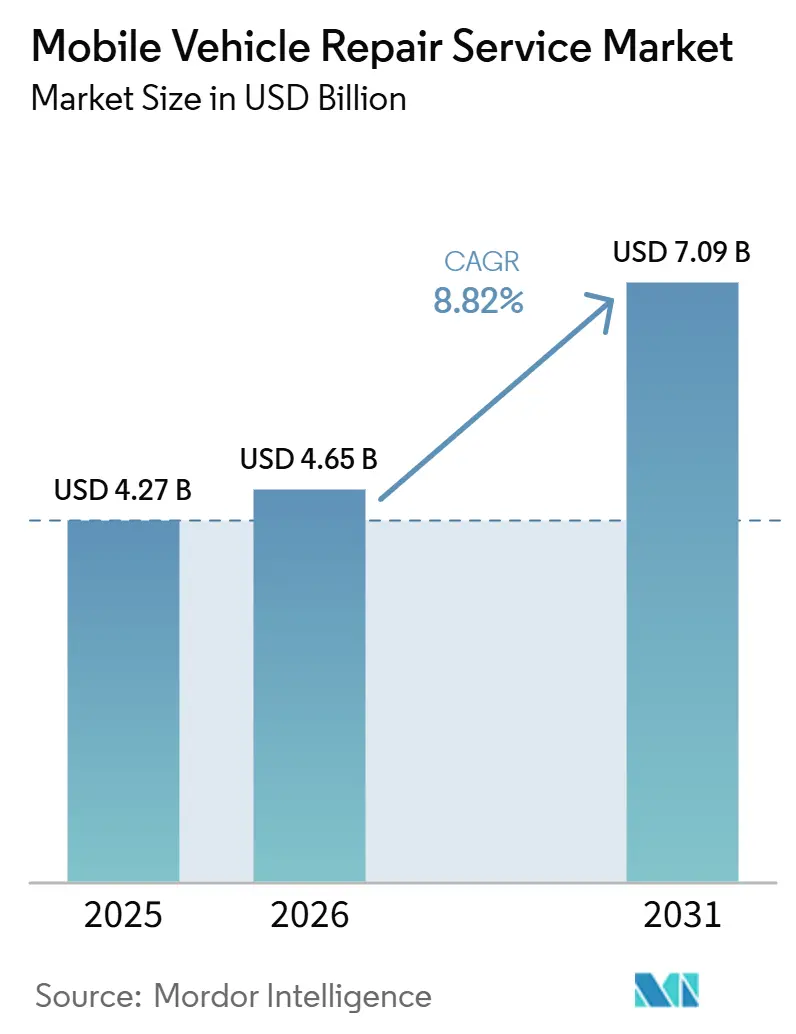
The mobile automotive repair services market size is expected to increase from USD 4.27 billion in 2025 to USD 4.65 billion in 2026 and reach USD 7.09 billion by 2031, growing at a CAGR of 8.82% over 2026-2031. As vehicle populations age and connected-car telematics proliferate, owners and fleet managers are reshaping their maintenance scheduling. While passenger cars remain the primary revenue source, commercial fleets are experiencing faster growth. This surge is largely driven by e-commerce operators who are outsourcing on-site maintenance to minimize depot downtime. Additionally, challenges in affording new vehicles are extending replacement cycles, thereby increasing the average vehicle age. The competitive landscape is heating up, with venture-funded platforms, tire chains, and OEM dealer groups scaling mobile vans, investing in predictive-maintenance APIs, and offering bundled services in fixed-price plans to ease customer cash flow.
Key Report Takeaways
- By vehicle type, passenger cars led with 53.47% of the mobile automotive repair services market share in 2025, while commercial vehicles are projected to expand at an 8.87% CAGR through 2031.
- By propulsion type, internal combustion engine units accounted for 66.28% of 2025 revenue, while electric vehicles are forecast to post a 9.92% CAGR through 2031.
- By service type, routine maintenance commanded 36.84% of 2025 revenue; diagnostic services are advancing at an 8.95% CAGR over the forecast horizon.
- By component, tires contributed 38.71% of 2025 revenue, whereas batteries are expected to post a 9.18% CAGR.
- By provider, third-party service providers captured 62.33% of 2025 revenue, while OEM programs grew at an 8.03% CAGR.
- By end user, individual consumers accounted for 76.36% of 2025 demand, yet the fleet segment is slated for a 9.07% CAGR on the back of last-mile logistics expansion.
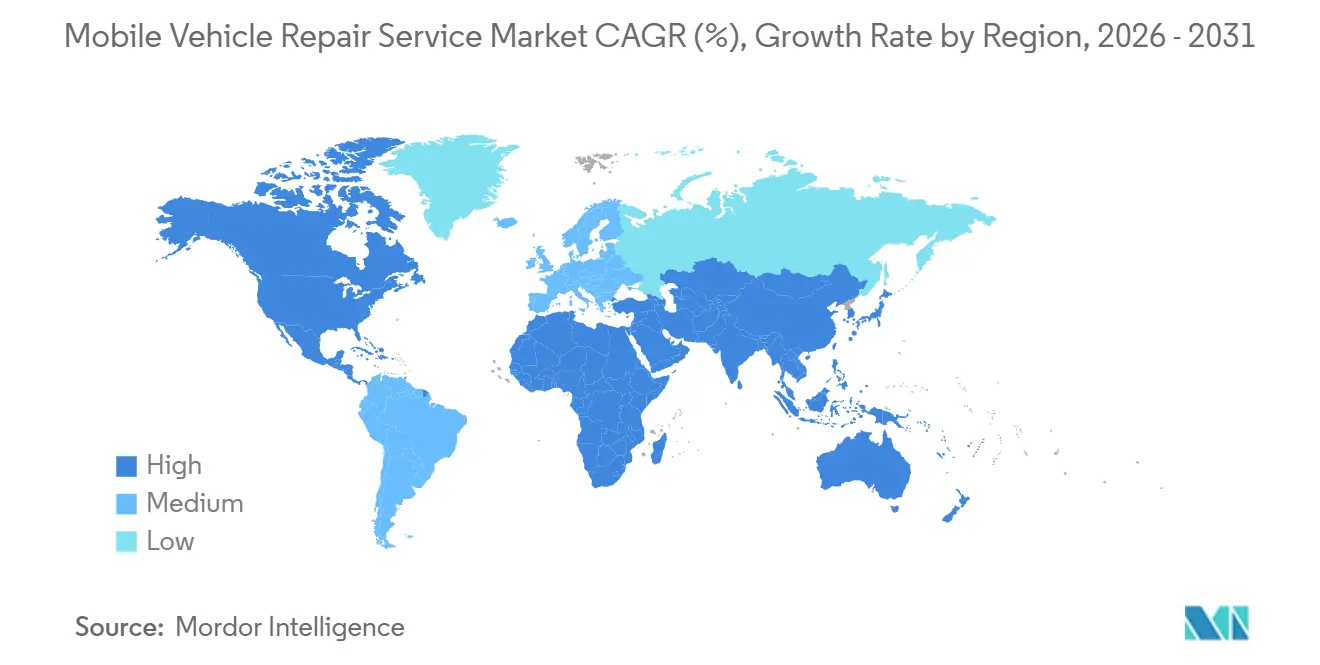
- By geography, North America led the mobile vehicle repair service market in 2025, while Asia-Pacific is expected to record the fastest CAGR of 8.91% through 2031.
Note: Market size and forecast figures in this report are generated using Mordor Intelligence’s proprietary estimation framework, updated with the latest available data and insights as of January 2026.
Market Trends and Insights
Drivers Impact Analysis of Mobile Vehicle Repair Service Market*
| Driver | (~) % Impact on CAGR Forecast | Geographic Relevance | Impact Timeline |
|---|---|---|---|
| Aging Vehicle Parc | +2.1% | Global, particularly North America and Europe | Medium term (2-4 years) |
| Consumer Preference For Convenience | +1.8% | Global, with higher adoption in urban areas | Short term (≤ 2 years) |
| Growth of Connected-Car Telematics | +1.5% | North America, Europe, and developed Asia Pacific markets | Medium term (2-4 years) |
| Fleet Outsourcing By E-Commerce | +1.3% | Global, concentrated in major metropolitan areas | Short term (≤ 2 years) |
| Low-Emission Repair-Zone Mandates | +1.1% | Europe, select North American cities, developed Asia Pacific urban centers | Medium term (2-4 years) |
| Subscription-Based Mobile Maintenance Bundles | +0.9% | North America, Europe, major Asia Pacific cities with ride-hailing penetration | Long term (≥ 4 years) |
| Source: Mordor Intelligence | |||
Aging Vehicle Parc Boosts Maintenance Demand
The average age of vehicles has increased, leading to more frequent repairs and driving demand for mobile operators who can address issues on-site. Maintaining older vehicles is significantly more expensive than maintaining newer ones, prompting owners to choose preventive maintenance subscriptions to manage unexpected expenses[1]. Regions such as North America and Europe, affected by supply shortages and rising new-vehicle prices, have experienced a noticeable increase in demand for these services, extending vehicle replacement cycles. Common issues, such as battery or cooling system failures, are efficiently handled by mobile vans, eliminating towing costs and minimizing lost work hours, which enhances customer loyalty. As a result, platforms that offer both preventive and emergency coverage under a single monthly fee are capturing greater lifetime value from each user.
Consumer Preference For Convenience and On-Site Service
A significant portion of urban car owners in India are opting for digital doorstep services, a trend also observed in the U.S. and Germany, where leading apps provide quick response times. Busy dual-income households and gig-economy drivers are replacing lengthy shop visits with efficient curbside services. This shift has resulted in higher repeat purchase rates. Features such as transparent pricing, real-time GPS tracking, and instant digital receipts have strengthened user trust. Consequently, service providers can charge premiums over traditional brick-and-mortar shops while effectively addressing travel inefficiencies.
Growth of Connected-Car Telematics Enabling Remote Diagnostics
Smartcar, an API platform, showcased in pilot trials that by aggregating vehicle data across brands and enabling predictive alerts, they could significantly reduce unplanned downtime. When integrated with 5G technology, fault-prediction engines enable mobile technicians to preload the right parts, resulting in a notable decrease in average resolution time. Aware of the challenges thin-margin fleets encounter, service providers now offer monthly bundled packages of connectivity, monitoring, and service, fully understanding that each hour a vehicle remains idle translates directly to lost revenue.
Fleet Outsourcing By E-Commerce and Last-Mile Operators
Zenith's recent agreement with Amazon significantly improved fleet uptime by deploying mobile units at depots and drivers' homes. Previously, each breakdown resulted in substantial financial losses due to missed deliveries, making preventive mobile plans highly cost-effective. As parcel drop density increases per route, fleets cannot afford to allocate vehicles for shop visits, making mobile service a critical operational requirement rather than an optional benefit.
Restraints Impact Analysis of Mobile Vehicle Repair Service Market*
| Restraint | (~) % Impact on CAGR Forecast | Geographic Relevance | Impact Timeline |
|---|---|---|---|
| Shortage of Certified Mobile Technicians | -1.4% | Global, particularly acute in developed markets | Long term (≥ 4 years) |
| Lower Maintenance Needs of Battery-Electric Vehicles | -0.8% | Regions with high EV adoption rates | Medium term (2-4 years) |
| City Restrictions on Roadside Work Zones | -0.6% | Urban areas globally, particularly dense metropolitan regions | Short term (≤ 2 years) |
| Cyber-Security Liability | -0.4% | Global, with stricter enforcement in North America and Europe | Medium term (2-4 years) |
| Source: Mordor Intelligence | |||
Shortage of Certified Mobile Technicians
Many repair shops are grappling with staffing challenges, as worker compensation struggles to keep pace with changing rates. This issue has been exacerbated by a growing demand for skilled labor, making it increasingly difficult for repair shops to attract and retain qualified workers [2]. This wage gap discourages new talent from entering the field and limits the potential for mobile expansion. With an aging workforce and a wave of retirements expected, platforms are focusing on initiatives such as apprenticeships and equity incentives to strengthen their labor pipelines. These efforts may delay immediate geographic expansion but aim to build sustainable long-term capacity.
Lower Maintenance Needs of Battery-Electric Vehicles
EVs, by design, do away with oil changes and enhance brake longevity through regenerative systems, thereby cutting into scheduled-maintenance revenue streams. While repair costs in the early stages may spike due to software glitches or high-voltage component malfunctions, the overall frequency of visits remains lower than that of traditional ICE vehicles. In response, mobile service providers are shifting their focus towards diagnostics, tire services, and on-the-go charging support, compensating for the dip in income from fluid exchanges.
*Our forecasts treat driver/restraint impacts as directional, not additive. The impact forecasts reflect baseline growth, mix effects, and variable interactions.
Mobile Vehicle Repair Service Market Segment Analysis
By Vehicle Type:
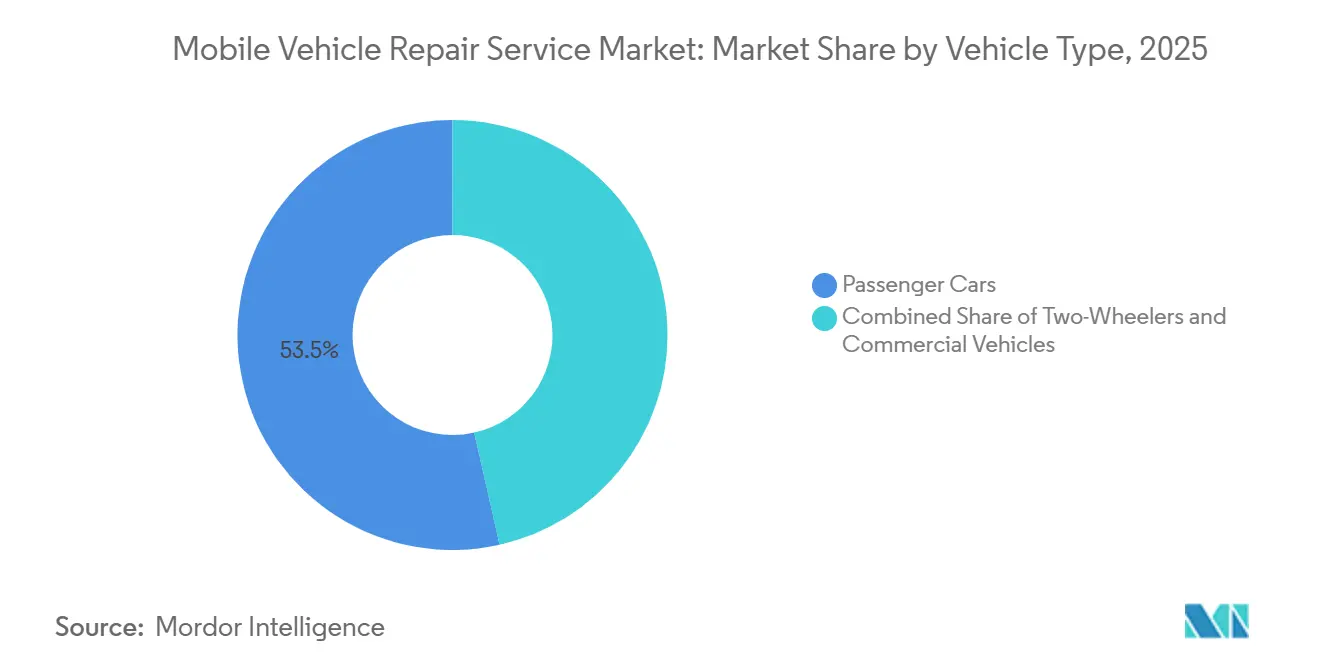
Commercial Fleets Drive Mobile AdoptionPassenger cars held 53.47% of 2025 revenue, reflecting a vast installed base, though growth lags as newer models demand fewer services. Commercial vehicles are forecast to expand at an 8.87% CAGR, propelled by e-commerce and ride-hailing fleets that embed mobile automotive repair services into operating budgets amid tight delivery schedules.
Zenith's collaboration with Amazon to improve uptime across its fleet of vans highlights the asset utilization benefits of fleet outsourcing. In densely populated Asian cities, two-wheelers carve out a niche growth segment, with scooter couriers depending on quick roadside repairs to sustain their income. The mobile automotive repair services market is evolving: individual owners opt for occasional convenience visits, whereas fleets secure long-term contracts linked to uptime metrics. Providers offering enterprise dashboards, consolidated billing, and night-shift crews at depots are seizing a larger slice of the commercial pie.

By Propulsion Type:
Electric Transition Reshaping Service ModelsInternal-combustion units accounted for 66.28% of 2025 revenue, still anchoring the mobile automotive repair services market share, due to the legacy parc size. Electric-vehicle demand, however, is rising at a 9.92% CAGR as governments mandate zero-emission sales and battery costs fall. Reduced fluid-change frequency lowers visit counts, yet high-voltage diagnostics, tire wear from heavier curb weights, and software updates create new revenue lanes. GM’s nationwide MobileService+—delivered by BrightDrop electric vans—illustrates how OEMs are monetizing EV-specific pain points such as range-anxiety rescue.
Operators that retrain technicians in high-voltage safety, invest in portable DC chargers, and stock battery-state-of-health analyzers will hold the strongest position in the mobile automotive repair services market as electrification advances. Those that cling to an oil-change-centric offering risk revenue erosion.
By Service Type:
Diagnostics Emerge as Growth DriverRoutine maintenance generated 36.84% of 2025 revenue, but diagnostic services are advancing at an 8.95% CAGR as telematics alerts let vans roll with pre-picked parts. Emergency repairs retain high ticket values yet decline in frequency as predictive analytics reduces roadside failures. API platforms such as Smartcar grant mobile providers OEM-level data access, cutting mean-time-to-repair and boosting technician productivity. The mobile automotive repair services market size tied to diagnostics is therefore expected to scale disproportionately versus fluid exchanges or seasonal tire swaps.
Subscription bundles that marry always-on vehicle monitoring with scheduled visits lock in recurring cash flows and differentiate providers from purely transactional competitors. Faster fault resolution also raises net promoter scores, enhancing organic customer acquisition.
By Component Type:
Battery Services Lead InnovationTires accounted for 38.71% of 2025 revenue, benefiting from universal replacement needs and 24/7 roadside demand. Batteries are projected to post a 9.18% CAGR, driven by aging 12-volt units and the proliferation of EV traction packs needing periodic diagnostics or module swaps. Regenerative brakes lengthen pad life, mitigating near-term brake-service volume but not eliminating it. Providers that add mobile wheel-balancing rigs and high-voltage battery testers strengthen their mobile automotive repair services market profile and capture upsell revenue from state-of-health reporting.
Chinese aftermarket players already deploy portable battery-analysis vans in third-tier cities, demonstrating how targeted equipment investments unlock underserved micro-markets where fixed shops are scarce.
By Service Provider:
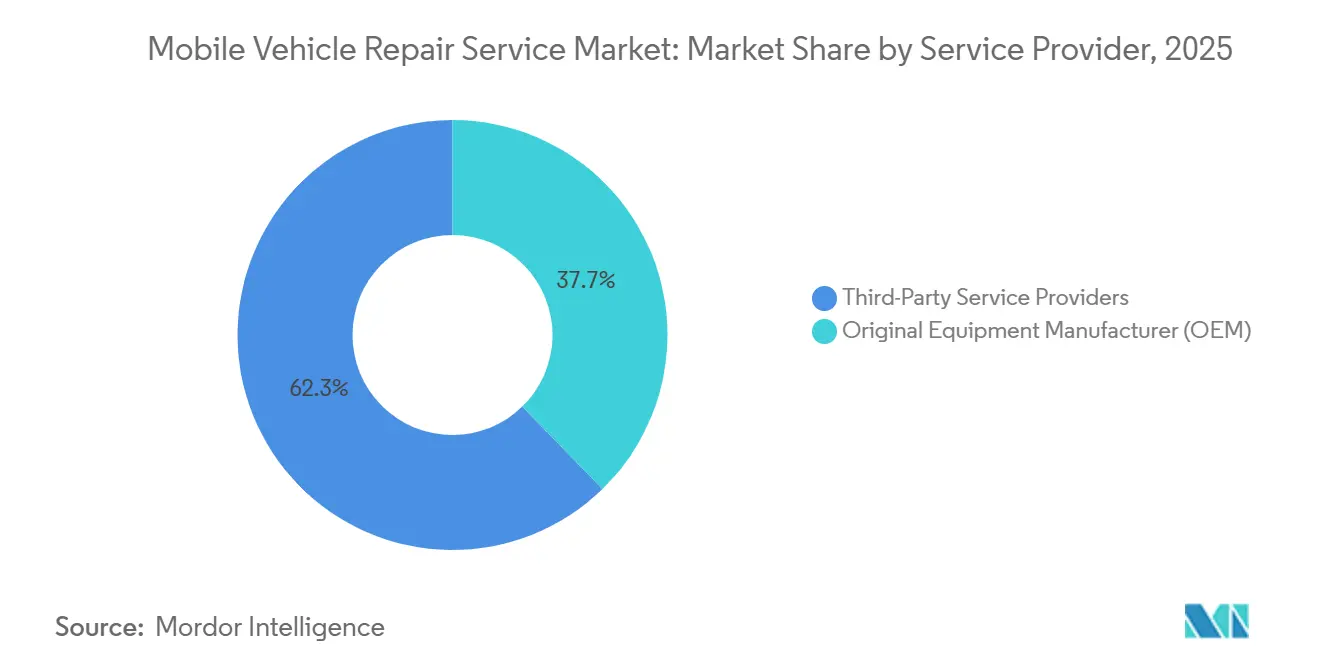
Third-Party Dominance ContinuesThird-party service providers held 62.33% of 2025 revenue through transparent pricing and broad coverage. OEM-backed programs are growing at an 8.03% CAGR, leveraging proprietary diagnostics and factory-trained staff. FordPass enables complimentary at-home warranty maintenance, improving loyalty scores and drawing post-warranty business back to dealer networks. Yet independents counter with faster response times and multi-brand capability, reinforcing their dominance in out-of-warranty segments of the mobile automotive repair services industry.
Strategic coexistence is emerging: OEMs focus on vehicles under five years old, while independents specialize in aging fleets. Cross-channel partnerships—dealers subcontracting off-hour overflow to independent vans—are surfacing as a pragmatic compromise in technician-starved regions.
By End-Users:
Fleet Growth AcceleratesIndividuals accounted for 76.36% of 2025 demand, driven by the sheer number of privately owned cars and the convenience premium users are willing to pay for on-site work. Fleet clients, however, will register a 9.07% CAGR, driven by last-mile logistics and ride-sharing services that view uptime as mission-critical.
Unplanned downtime can lead to high daily costs per vehicle, underscoring the value of preventive mobile contracts. Providers offering depot-overnight service windows, API-based maintenance scheduling, and consolidated invoicing can strengthen their position in the mobile automotive repair services market, particularly within enterprise accounts.
Geography Analysis
North America Mobile Vehicle Repair Service Market
North America contributed 42.18% of 2025 revenue, buoyed by high labor rates—median USD 160 per mobile billable hour—and widespread telematics penetration, which feeds predictive maintenance workflows. OEM initiatives such as GM’s MobileService+ have widened the addressable market for mobile automotive repair services subscription packages, while technician shortages temper the speed of geographic rollout. Aging vehicles and suburban sprawl favor mobile convenience, though stricter California emissions inspections raise compliance costs for diesel service vans.
APAC Mobile Vehicle Repair Service Market
Asia-Pacific will advance at an 8.91% CAGR, propelled by India’s digitally savvy urban population, China's vast parc of vehicles, and Japan's growing demand for EV maintenance. GoMechanic, a local player, has established service hubs in multiple Tier-II cities across India. They have combined fixed workshops with mobile vans, targeting neighborhoods where traditional lift-bay real estate is limited. Meanwhile, OEMs and global suppliers are setting up franchise networks in Japan, focusing on the expanding EV maintenance market, which is expected to grow significantly. Collectively, these efforts are increasing the availability of mobile automotive repair services throughout the region.
Europe, LATAM and Middle East Mobile Vehicle Repair Service Market
Europe's clean-air initiatives bring both opportunities and challenges. London's policies mandate van electrification but provide benefits like unrestricted downtown access to compliant operators. Amsterdam is working toward achieving a zero-emission service fleet. ClickMechanic, a UK-based platform, has demonstrated the potential for scalability in mature markets by uniting a large number of approved mechanics on a single booking engine, achieving notable revenue growth. While Latin America and the Gulf markets remain largely untapped, there is a noticeable increase in vehicle ownership and fleet expansion in countries such as Brazil, Argentina, the UAE, and Saudi Arabia. Operators who adapt their pricing and payment strategies to align with local customs are well-positioned to benefit.
Competitive Landscape
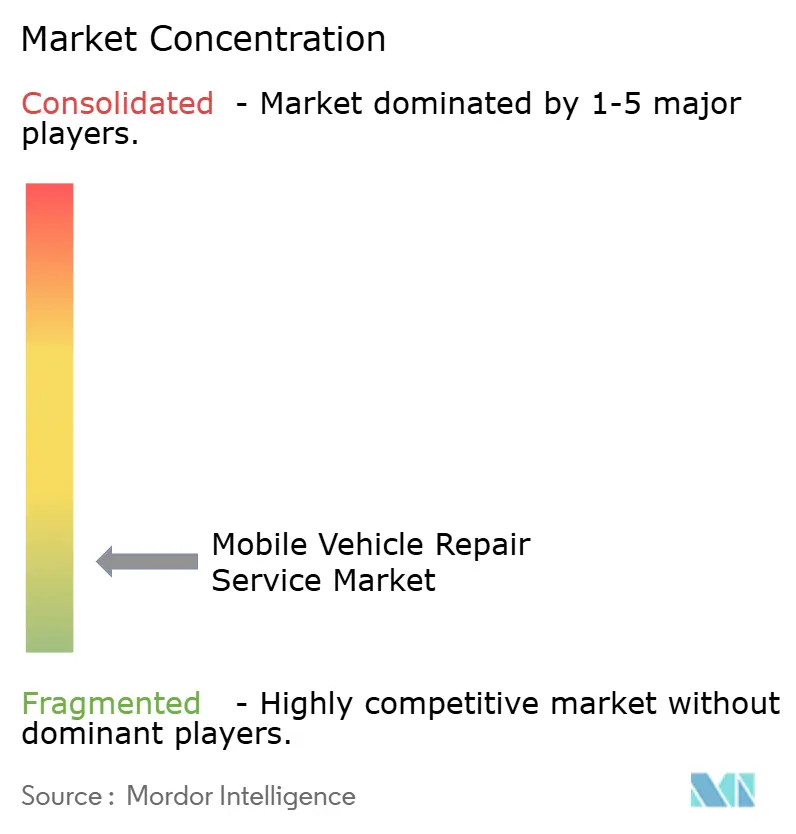
The mobile automotive repair services market remains highly fragmented, with no single player holding a significant global share. RepairSmith, an independent venture-backed company, is expanding its reach across numerous U.S. cities, emphasizing transparent quotes and same-day service. In response, OEMs are introducing factory-backed services like GM's MobileService+ and FordPass mobile maintenance. These services utilize vehicle telematics to embed service triggers, aiming to counter the growth of independent providers. On the diagnostics side, technology firms are consolidating their infrastructure. For example, Repairify's planned merger with Opus IVS will combine a substantial number of patents and a large customer base, granting third-party providers access to OEM-grade fault codes via the cloud.
Strategic acquisitions underscore the industry's push for scale. Caliber's acquisition of Car Body Lab enhanced its on-site collision repair services across multiple U.S. cities. Similarly, GreatWater 360 Auto Care's purchase of Complete Auto's mechanical division facilitated its expansion into several states. The capital-intensive nature of the business—covering vans, insurance, and technician wages—favors entities supported by private equity or OEM balance sheets. While niche opportunities such as fleet-specific battery swaps and portable fast charging exist, achieving success increasingly depends on advanced routing algorithms, strategic inventory positioning, and technician-retention initiatives that improve first-time-fix rates.
Mobile Vehicle Repair Service Industry Leaders
-
YourMechanic
-
Wrench Inc.
-
RepairSmith
-
Get Spiffy
-
Mach1 Services
- *Disclaimer: Major Players sorted in no particular order
Mobile Vehicle Repair Service Market Companies Covered in this Report
- YourMechanic
- Wrench Inc.
- RepairSmith
- Get Spiffy
- Mach1 Services
- Pep Boys
- AAA Roadside & Mobile
- Jiffy Lube Fleet Services
- Firestone Complete Auto Care Mobile
- GoMechanic
- Pitstop
- AutoNation Mobile Service
- Bosch Car Service
- Meineke Car Care Centers
- Mister Mobile
- Lube Mobile
- ClickMechanic
Recent Industry Developments in Mobile Vehicle Repair Service Market
- June 2025: Guerrero Mobile Mechanics has rolled out its mobile auto repair services nationwide, unveiling a proprietary digital platform designed to simplify vehicle repair scheduling and enhance service transparency. This nationwide debut underscores the company's commitment to delivering convenient, professional auto repairs right at customers' doorsteps.
- February 2025: XOi secured USD 230 million and acquired Specifx, integrating advanced diagnostic software that accelerates triage and standardizes workflows for mobile technicians.
Global Mobile Vehicle Repair Service Market Report Scope
The mobile vehicle repair service market report is segmented by vehicle type (two-wheelers, passenger cars, and commercial vehicles), propulsion type (internal combustion engine and electric), service type (routine maintenance, diagnostic services, emergency repairs, and others (tire services, etc.)), component type (batteries, tires, brakes & braking systems, and other components (engine, etc.)), service provider (original equipment manufacturer and third-party service providers), end-user (individual and fleet owners), and geography. The market forecasts are provided in terms of value (USD).
| Two-Wheelers |
| Passenger Cars |
| Commercial Vehicles |
| Internal Combustion Engine (ICE) |
| Electric |
| Routine Maintenance |
| Diagnostic Services |
| Emergency Repairs |
| Others (Tire Services, etc.) |
| Batteries |
| Tires |
| Brakes and Braking Systems |
| Other Components (Engine, etc.) |
| Original Equipment Manufacturer (OEM) |
| Third-Party Service Providers |
| Individual |
| Fleet Owners |
| North America | United States |
| Canada | |
| Rest of North America | |
| South America | Brazil |
| Argentina | |
| Rest of South America | |
| Europe | Germany |
| United Kingdom | |
| Spain | |
| Italy | |
| France | |
| Netherlands | |
| Rest of Europe | |
| Asia-Pacific | India |
| China | |
| Japan | |
| South Korea | |
| Indonesia | |
| Rest of Asia-Pacific | |
| Middle-East and Africa | United Arab Emirates |
| Saudi Arabia | |
| Turkey | |
| Egypt | |
| South Africa | |
| Rest of Middle-East and Africa |
| By Vehicle Type | Two-Wheelers | |
| Passenger Cars | ||
| Commercial Vehicles | ||
| By Propulsion Type | Internal Combustion Engine (ICE) | |
| Electric | ||
| By Service Type | Routine Maintenance | |
| Diagnostic Services | ||
| Emergency Repairs | ||
| Others (Tire Services, etc.) | ||
| By Component Type | Batteries | |
| Tires | ||
| Brakes and Braking Systems | ||
| Other Components (Engine, etc.) | ||
| By Service Provider | Original Equipment Manufacturer (OEM) | |
| Third-Party Service Providers | ||
| By End-User | Individual | |
| Fleet Owners | ||
| By Geography | North America | United States |
| Canada | ||
| Rest of North America | ||
| South America | Brazil | |
| Argentina | ||
| Rest of South America | ||
| Europe | Germany | |
| United Kingdom | ||
| Spain | ||
| Italy | ||
| France | ||
| Netherlands | ||
| Rest of Europe | ||
| Asia-Pacific | India | |
| China | ||
| Japan | ||
| South Korea | ||
| Indonesia | ||
| Rest of Asia-Pacific | ||
| Middle-East and Africa | United Arab Emirates | |
| Saudi Arabia | ||
| Turkey | ||
| Egypt | ||
| South Africa | ||
| Rest of Middle-East and Africa | ||
Key Questions Answered in the Report
How large will North America’s mobile repair segment be by 2031?
North America accounts for 42.18% of current revenue and, at an 8.82% global CAGR, is projected to exceed USD 2.9 billion by 2031.
Which service type is expanding fastest?
Diagnostic services are forecast to register an 8.95% CAGR, outpacing routine maintenance as telematics alerts push predictive workflows.
How does electrification influence mobile repair demand?
While lower routine maintenance reduces visit frequency, EV adoption unlocks new revenue in battery diagnostics, software updates, and high-voltage safety inspections, supporting long-term mobile service growth.
Why are third-party providers leading the channel?
Independent platforms hold a 62.33% share because they offer multi-brand coverage, flexible scheduling, and transparent pricing that resonate with consumers and fleet managers.
Which region presents the most substantial growth potential?
Asia-Pacific is set to record an 8.91% CAGR to 2031, driven by rising vehicle ownership and urban demand for on-site convenience in India, China, and Southeast Asia.