
Mobile Edge Computing Market Size and Share
Market Overview
| Study Period | 2020 - 2031 |
|---|---|
| Market Size (2026) | USD 1.04 Billion |
| Market Size (2031) | USD 3.88 Billion |
| Growth Rate (2026 - 2031) | 30.10 % |
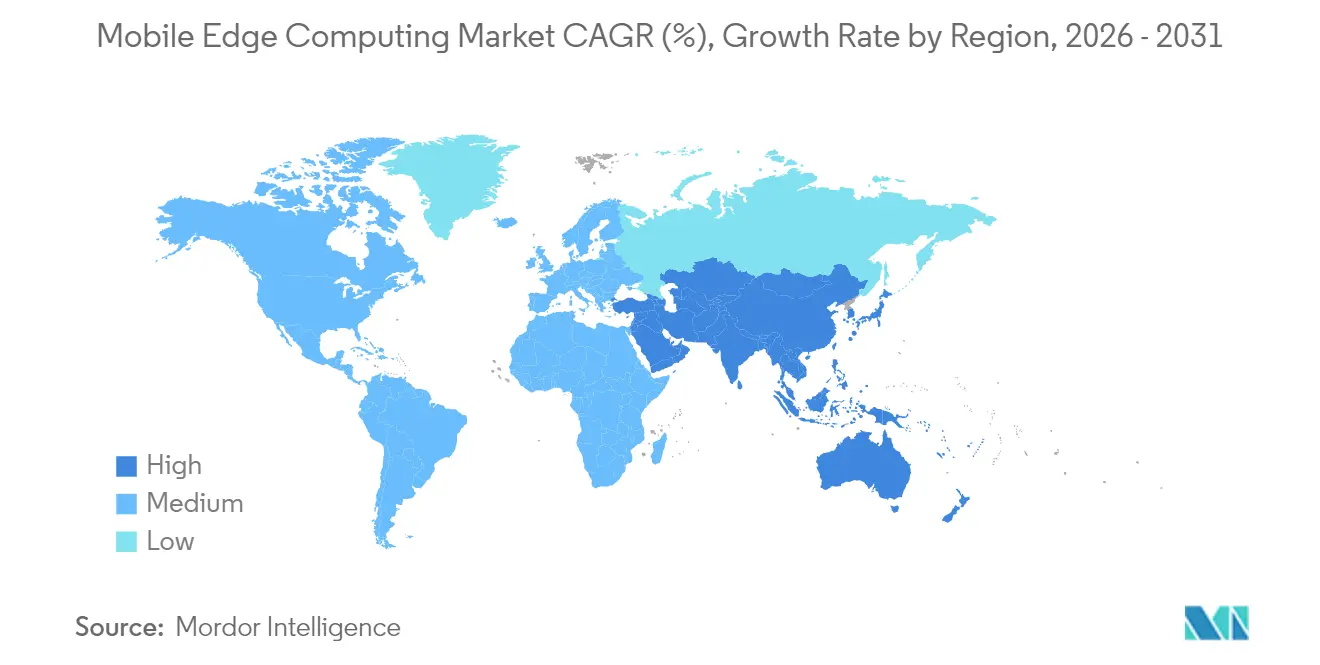
| Fastest Growing Market | Asia Pacific |
| Largest Market | North America |
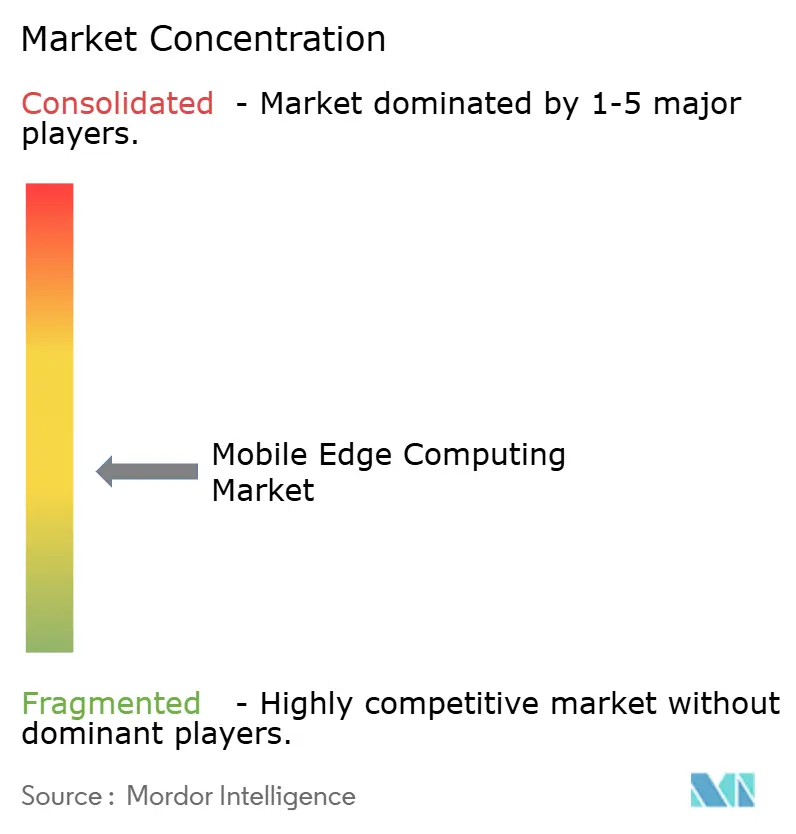
| Market Concentration | Medium |
Major Players *Disclaimer: Major Players sorted in no particular order Image © Mordor Intelligence. Reuse requires attribution under CC BY 4.0. | |
Mobile Edge Computing Market Analysis by Mordor Intelligence
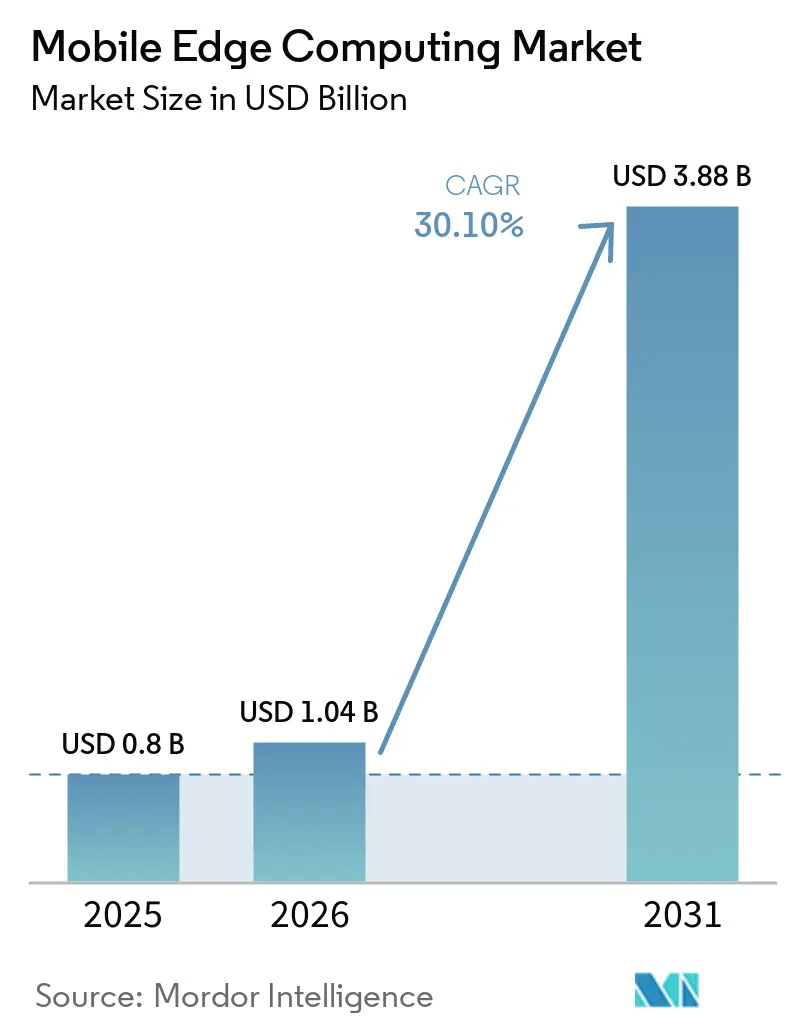
The mobile edge computing market size was valued at USD 0.80 billion in 2025 and estimated to grow from USD 1.04 billion in 2026 to reach USD 3.88 billion by 2031, at a CAGR of 30.10% during the forecast period (2026-2031). The intensifying demand for low-latency services, the maturation of 5G standalone (SA) networks, and the need to process ever-rising data volumes closer to end-users are accelerating adoption. Hardware continues to anchor spending, yet rapid progress in software-defined infrastructure, container orchestration, and AI inference is shifting the balance toward service-centric revenue streams. Telcos, hyperscalers, and specialist start-ups increasingly view edge capabilities as a core differentiator that underpins premium connectivity, new enterprise services, and cost-effective AI deployment. Regulatory interest in data sovereignty, coupled with standardization efforts led by the European Telecommunications Standards Institute (ETSI), is further influencing market architecture and vendor strategies. Convergence among connectivity, cloud, and AI domains is reshaping competitive boundaries, compelling players to pursue cross-domain partnerships and vertical-specific solutions.
Key Report Takeaways
- By component, hardware led with 60.60% revenue share in 2025, while software is forecast to expand at a 36.2% CAGR through 2031.
- By end-user, telecommunications accounted for 28.50% of the mobile edge computing market share in 2025; healthcare and life sciences are expected to grow at the fastest rate, with a 40.6% CAGR, from 2026 to 2031.
- By geography, North America accounted for 40.80% of the mobile edge computing market in 2025; Asia-Pacific is poised to grow at a 35.4% CAGR during 2026-2031.
Note: Market size and forecast figures in this report are generated using Mordor Intelligence’s proprietary estimation framework, updated with the latest available data and insights as of 2026.
Market Trends and Insights
Drivers Impact Analysis of Mobile Edge Computing Market*
| Driver | (~) % Impact on CAGR Forecast | Geographic Relevance | Impact Timeline |
|---|---|---|---|
| Latency-critical consumer apps (AR/VR gaming, livestreaming) gaining traction in Asia | + 7.80% | Asia-Pacific, North America | Medium term (2-4 years) |
| Rapid 5G standalone roll-outs unlocking MEC monetization in North America | + 6.30% | North America, Europe | Short term (≤2 years) |
| Telco adoption of disaggregated Open RAN driving on-prem edge demand in Europe | +4.70% | Europe, North America | Medium term (2-4 years) |
| Industrial Time-Sensitive Networking mandates (IEC/IEEE 60802) in manufacturing hubs | +3.80% | Europe, North America, East Asia | Medium term (2-4 years) |
| Government smart-city megaprojects (NEOM, Saudi Arabia) embedding MEC | +3.10% | Middle East, Asia-Pacific | Long term (≥4 years) |
| AI-inferencing at the edge lowering cloud egress costs for hyperscalers | +2.50% | Global | Short term (≤2 years) |
| Source: Mordor Intelligence | |||
Latency-critical consumer apps (AR/VR gaming, livestreaming) gaining traction in Asia
AR/VR gaming and livestreaming continue to reshape network design by demanding sub-20 millisecond round-trip latency. Ericsson’s trials demonstrate that relocating game servers to edge nodes can reduce transport latency by 75%, enabling sustained fluid gameplay under fluctuating radio conditions. [1]Telecom operators in South Korea, where mobile gaming revenue exceeded USD 5.6 billion in 2024, have already deployed multi-access edge computing clusters near dense urban zones, enabling premium subscription tiers for latency-sensitive titles. Content providers benefit from higher retention and revenue per user, while operators monetize the differentiated quality of experience. Similar patterns are emerging in Japan, China, and select U.S. markets as 5G SA coverage expands and device adoption grows.
Rapid 5G standalone roll-outs unlocking MEC monetization in North America
Forty-nine operators in 29 countries had launched 5G SA by mid-2024, but North American carriers lead in national coverage. T-Mobile’s full-scale SA deployment permits deterministic network slicing aligned with edge workloads and underpins new service-level agreements for enterprise applications. Verizon targets sub-10 millisecond edge latency to enable VR, autonomous mobility, and real-time analytics. Revenue opportunities stem from pay-as-you-go exposure of network APIs, including quality-on-demand and location-based compute. Collaboration with hyperscalers accelerates application onboarding and shortens time-to-market for developers.
Telco adoption of disaggregated Open RAN driving on-prem edge demand in Europe
Vodafone’s pilot in Italy demonstrates how containerized baseband software running on Dell’s XR8000 server allows baseband processing and edge workloads to share the same rugged platform. The U.K. government targets 35% of nationwide traffic to pass through open networks by 2035, stimulating vendor diversity and localized compute. Open RAN’s reliance on standardized hardware pushes compute functions from centralized data centers to sites at or near radio units, creating fresh demand for compact edge servers and orchestration software.
Industrial Time-Sensitive Networking mandates (IEC/IEEE 60802) in manufacturing hubs
Manufacturers pursuing deterministic Ethernet rely on edge gateways to deliver sub-millisecond jitter and synchronized time across devices. Phoenix Contact demonstrated deterministic traffic scheduling via TSN edge switches that prioritize mission-critical packets while supporting concurrent IT traffic. Global TSN spending is forecast to reach USD 1.7 billion by 2028, and edge platforms capable of hosting AI-driven quality inspection models in real time are becoming mandatory in automotive, electronics, and pharmaceutical plants.
Restraints Impact Analysis of Mobile Edge Computing Market*
| Restraint | (~) % Impact on CAGR Forecast | Geographic Relevance | Impact Timeline |
|---|---|---|---|
| Absence of globally harmonized security & trust framework for multi-access edge | -4.70% | Global | Medium term (2-4 years) |
| Scarcity of ruggedized micro-data-center hardware in tropical & desert climates | -3.10% | Middle East, Southeast Asia, Latin America | Short term (≤2 years) |
| High TCO of edge orchestration platforms for Tier-2/3 mobile operators | -2.50% | Global (emerging markets) | Medium term (2-4 years) |
| Shortage of MEC-skilled DevOps talent delaying PoC-to-production conversions | -1.60% | Global | Short term (≤2 years) |
| Source: Mordor Intelligence | |||
Absence of globally harmonized security & trust framework for multi-access edge
Edge infrastructure widens the attack surface because workloads, data, and orchestration span thousands of unattended nodes. Academic studies show a surge in DDoS and lateral-movement threats targeting cached content and orchestration APIs. Regulated sectors hesitate to migrate sensitive workloads until zero-trust reference models, secure enclave support, and federated identity standards mature. ETSI MEC working groups are drafting inter-domain trust specifications, yet full consensus remains years away, prolonging integration cycles and increasing compliance costs for multinational deployments.
Scarcity of ruggedized micro-data-center hardware in extreme climates
Ambient temperatures above 45 °C, airborne dust, and saline humidity diminish equipment lifespan and force operators to derate performance. The U.S. Department of Defense’s Climate Adaptation Plan calls for resilience upgrades for edge compute used in field operations. In commercial contexts, power-efficient liquid cooling and sealed chassis designs carry a 20–30% cost premium, impeding ROI for projects in the Arabian Peninsula and equatorial Southeast Asia.
*Our forecasts treat driver/restraint impacts as directional, not additive. The impact forecasts reflect baseline growth, mix effects, and variable interactions.
Mobile Edge Computing Market Segment Analysis
By Component:
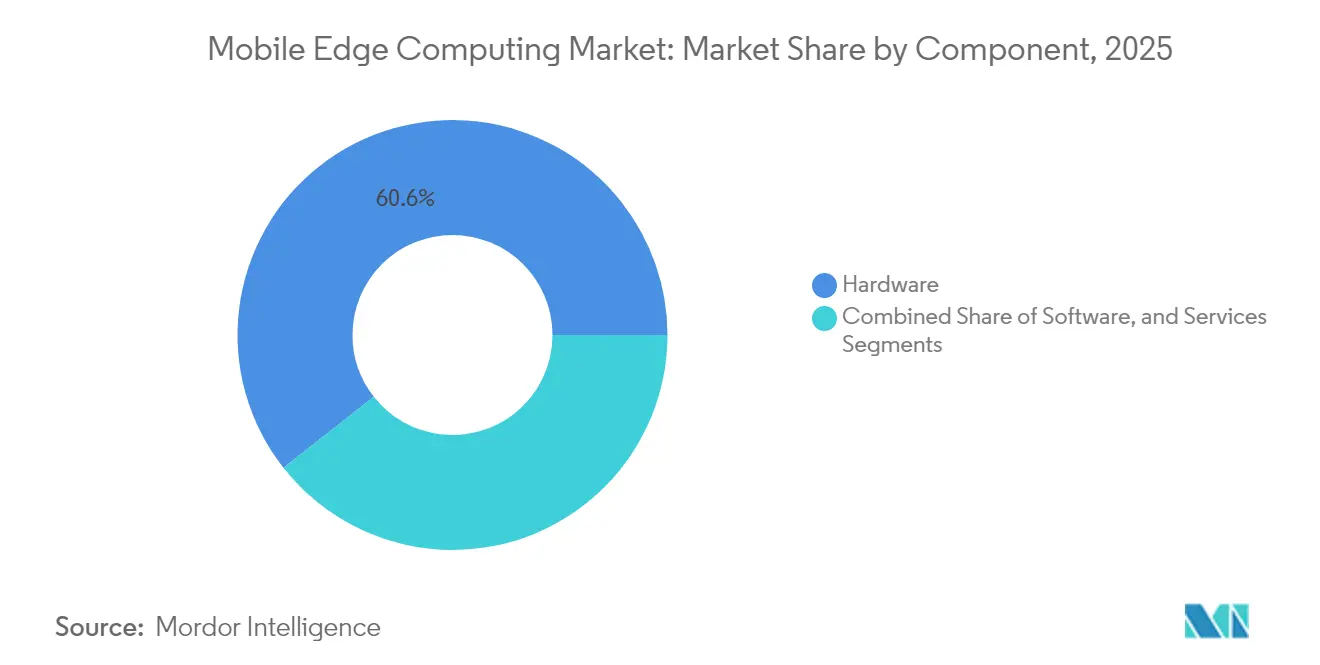
Software Outpaces Hardware GrowthIn 2025 the hardware segment accounted for 60.60% of mobile edge computing market revenue, anchored by investments in servers, rugged enclosures, and specialized network interface cards. Nevertheless, software is projected to grow at a 36.2% CAGR between 2026 and 2031, significantly outpacing the overall mobile edge computing market growth rate, as orchestration, CI/CD pipelines, and AI frameworks enable flexible deployment models. Edge orchestration suites for multi-access edge computing now combine service meshes with policy engines that translate network slices into compute and storage reservations, enabling operators to launch new services in hours instead of months.
By 2025, software-defined functions will embed AI-powered resource schedulers, predictive maintenance, and zero-touch provisioning. Akamai’s adoption of WebAssembly, alongside Fermyon, exemplifies lighter-weight execution that trims cold-start latency to sub-10 milliseconds, a prerequisite for interactive workloads. Consequently, hyperscalers and telcos are shifting their R&D budgets toward platform software, even as they continue to refresh edge hardware every four to five years. Services, consulting, integration, and managed operations are catching up as enterprises outsource complexity. The demand for multi-vendor blueprints is particularly high among healthcare and manufacturing clients that operate hybrid private/public edge footprints.

By End-user:
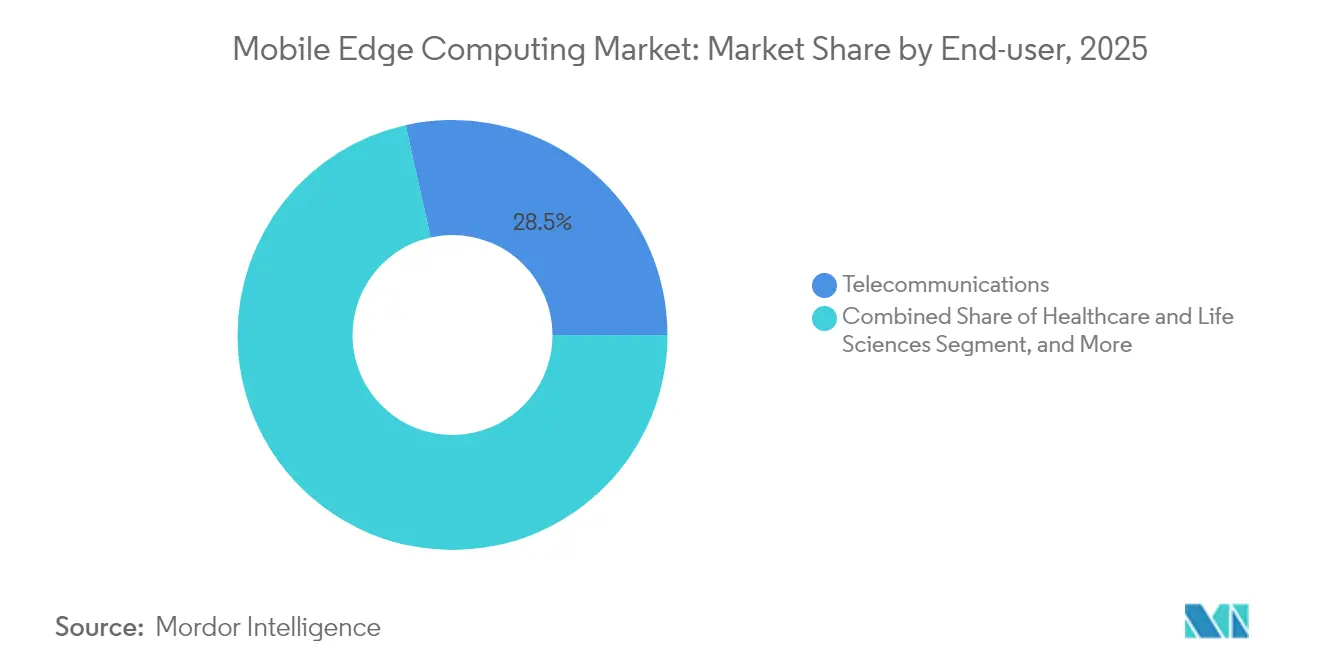
Healthcare Leads Growth TrajectoryTelecommunications retained 28.50% of 2025 revenue because operators leverage existing network infrastructure to host edge computing. Yet, the healthcare and life sciences sector is expected to post a 40.6% CAGR to 2031, reflecting the sector’s increasing demand for real-time diagnostics, operating-room video, and patient monitoring in bandwidth-constrained environments. Providers harness edge AI to anonymize data onsite before sharing with research clouds, easing compliance with patient-privacy rules.
Financial institutions deploy edge nodes near trading venues to shave microseconds off order execution, while retailers adopt localized recommendation engines that raised basket sizes by 25% in pilot stores. Manufacturers integrate predictive maintenance algorithms on the shop floor, benefitting from deterministic TSN backbones. Energy operators count on low-latency edge analytics for grid balancing and leak detection across distributed assets. Emerging adopters include transportation agencies that are integrating edge-enabled V2X (vehicle-to-everything) data exchanges to enhance traffic flow and safety.
Geography Analysis
North America Mobile Edge Computing Market
North America generated 40.80% of mobile edge computing market revenue in 2025, leveraged by nationwide 5G SA connectivity, dense fiber backbones, and strong hyperscaler presence. AWS Wavelength Zones and Microsoft Azure Edge Zones have been deployed in more than 40 metropolitan areas, offering developers sub-20 millisecond round-trip latency for consumer and industrial apps . Regulatory scrutiny of cloud concentration prompts carriers to diversify suppliers, spurring collaborative ventures with infrastructure companies and semiconductor vendors.
APAC Mobile Edge Computing Market
Asia-Pacific is expected to register the fastest growth, at a 35.4% CAGR during 2026-2031, driven by multi-billion-dollar smart-city investments, robust manufacturing bases, and the world’s highest mobile-gaming spending. China Mobile’s trials with Huawei illustrate nation-scale edge roll-outs supporting AR-assisted maintenance on high-speed rail. Japan’s telcos partner with console publishers to stream AAA titles without downloads, whereas India’s Jio integrates MEC to reduce backhaul congestion while expanding rural coverage.
EMEA and South America Mobile Edge Computing Market
Europe emphasizes industrial applications, privacy, and data localization. ETSI’s MEC standards assure cross-border service portability, and Vodafone’s commitment to deploy Open RAN across 30% of masts by 2030 underscores the region’s focus on supply-chain resilience. The Middle East advances giga-projects such as NEOM that embed cognitive edge infrastructure, while Africa and South America adopt MEC to alleviate latency for e-learning, telemedicine, and mining operations in remote zones.
Competitive Landscape
The mobile edge computing market features converging cohorts of network equipment vendors (Nokia, Ericsson, Huawei), cloud hyperscalers (AWS, Microsoft, Google), semiconductor firms (NVIDIA, Intel), and software-first innovators (Akamai, Fermyon). Strategic alliances have intensified; Vodafone’s 10-year pact with Microsoft couples Azure’s AI stack with carrier-grade edge sites across Europe, Africa, and the Asia-Pacific region. [3]
Product differentiation revolves around workload portability, AI acceleration, and industry-specific compliance. Equipment vendors leverage radio expertise to bundle MEC with Open RAN, promising operator-friendly integration. Hyperscalers attract developers via familiar DevOps tooling, while edge-native start-ups bet on ultralight serverless runtimes that reduce cost per function. The combined revenue share of the top five suppliers reached approximately 58% in 2024, reflecting moderate concentration yet leaving white-space for specialist providers that solve niche latency, security, or ruggedization challenges. Private-equity interest continues to fuel consolidation among regional data-center operators, indicating a path toward tighter aggregation.
Mobile Edge Computing Industry Leaders
-
Nokia Corporation
-
Telefonaktiebolaget LM Ericsson
-
AT&T Inc
-
Huawei Technologies Co. Ltd
-
Verizon Communications Inc.
- *Disclaimer: Major Players sorted in no particular order
Mobile Edge Computing Market Companies Covered in this Report
- Huawei Technologies Co. Ltd.
- Nokia Corporation
- Telefonaktiebolaget LM Ericsson
- AT&T Inc.
- Verizon Communications Inc.
- Amazon Web Services Inc.
- Microsoft Corp. (Azure Edge Zones)
- Google LLC (Google Distributed Cloud Edge)
- Cisco Systems Inc.
- Hewlett Packard Enterprise Co.
- IBM Corp.
- ZTE Corp.
- EdgeConneX Inc.
- Cloudflare Inc.
- Fermyon Technologies
- Saguna Networks Ltd.
- ADLINK Technology Inc.
- ADVA Optical Networking SE
- Akamai Technologies
- CoreSite
Market Opportunities and Future Outlook
AI-RAN and GPU-accelerated edge inference are creating a new monetization lane where RAN sites and nearby edge nodes run real-time AI workloads alongside connectivity. In 2026, Nokia and Indosat initiated a nationwide AI-RAN rollout in Indonesia using NVIDIA-powered GPU platforms, which points to edge compute being embedded deeper in the access network rather than limited to isolated metro edge zones. Funding activity around open, AI-native architectures also supports whitespace for vendors that can unify multi-vendor RAN, sensing, and edge intelligence, as reflected in ORAN Development Companys USD 45 million Series A backed by strategic investors including Nokia, NVIDIA, AT&T, and MTN.
Private 5G is also moving from isolated pilots to repeatable multi-site blueprints that combine on-prem MEC, local user plane functions, and orchestration for robotics, computer vision, and industrial automation. Enterprise rollouts including Telkomsel and Pegatrons private 5G SA deployment at Pegatrons 85,000 square meter Batam facility, along with Cargills reported private 5G expansion across 50 facilities (as of February 2026), underline demand for standardized edge stacks that can be replicated across global footprints. Infrastructure availability remains a practical opportunity area as well, with KKR investing USD 1.5 billion in Vertical Bridge in 2026, highlighting capital flowing into dense site networks that can host edge compute footprints for carriers and neutral hosts.
Recent Industry Developments in Mobile Edge Computing Market
- July 2026: Nokia introduced its first commercial AI-native RAN platform combining Nokia anyRAN software with the NVIDIA Aerial AI-RAN platform. The release links RAN modernization to GPU-accelerated compute, supporting tighter integration between AI inference and MEC workloads at the network edge and shaping vendor roadmaps for edge-native deployments.
- June 2026: Verizon expanded its private 5G partnership with Ericsson to support international deployments that integrate localized edge computing and on-site cloud orchestration. The approach enables local processing for AI, robotics, and industrial workloads through a local user plane function and on-prem MEC, strengthening repeatable private-network edge blueprints across geographies.
- December 2024: Verizon announced a collaboration with NVIDIA to bring NVIDIA AI Enterprise software and NIM microservices to Verizons 5G private networks and private Mobile Edge Compute offerings. The partnership lowers barriers for enterprise developers to deploy packaged AI inference at the edge using standardized software stacks, reinforcing MEC as a delivery layer for industrial AI applications.
Mobile Edge Computing Market Report Scope and Research Methodology
Market Definition and Coverage
For this study, the mobile edge computing market covers products and services that place compute and storage resources closer to mobile users and connected devices, mainly near telecom access networks, so applications can run with lower latency and better bandwidth efficiency.
Scope exclusions: We exclude general hyperscale cloud-only compute that is not deployed at the network edge and does not support edge-hosted application delivery.
Segments Covered in This Report
- By Component
- Hardware
- Software
- Services
- By End-user
- Banking and Financial Services
- Retail
- Healthcare and Life Sciences
- Industrial Manufacturing
- Energy and Utilities
- Telecommunications
- Other End-users
- By Geography
- North America
- United States
- Canada
- Mexico
- South America
- Brazil
- Argentina
- Chile
- Peru
- Rest of South America
- Europe
- Germany
- United Kingdom
- France
- Italy
- Spain
- Rest of Europe
- Asia-Pacific
- China
- Japan
- South Korea
- India
- Australia
- New Zealand
- Rest of Asia-Pacific
- Middle East and Africa
- Middle East
- United Arab Emirates
- Saudi Arabia
- Rest of Middle East
- Africa
- South Africa
- Nigeria
- Rest of Africa
- Middle East
- North America
Data Sources, Market Sizing, and Validation
Desk Research
Desk work started with building a clean fact base on 5G rollouts, spectrum, and telecom infrastructure readiness, because those are the practical constraints for mobile edge computing deployment. We referenced public sources such as the ITU, OECD broadband statistics, FCC releases, Eurostat, and national telecom regulators to capture coverage, subscriptions, and network investment signals.
To keep the model grounded in real deployments, we also reviewed standards and technical adoption cues from groups such as ETSI MEC and 3GPP, along with peer-reviewed journals that discuss edge latency targets and use case maturity. Company annual reports, earnings decks, and product announcements were used to validate where revenue is being booked, and whether it is classified as hardware, software, or services. Where needed, paid subscriptions for company financials and intelligence, patent databases, and a news and financials service were used to cross-check timelines, product launches, and pricing direction. These sources are illustrative only, and many other public references were also used for data collection, validation, and clarification.
Primary Interviews and Surveys
Primary work focused on interviews and structured surveys with telecom ecosystem participants and enterprise adopters to confirm what is being deployed at the edge, how it is packaged commercially, and which use cases are moving from pilots into scaled rollouts. We also tested assumptions across APAC, EMEA, and the Americas, since rollout timing and edge site density can differ meaningfully and can shift the near-term revenue curve.
Distribution of primary research fieldwork respondents
| Company type | Respondent position | Region |
|---|---|---|
| Top tier: 35% | CXOs: 14% | APAC: 38% |
| Mid tier: 48% | Functional/Unit leaders: 30% | EMEA: 37% |
| Smaller Players: 17% | Managers: 56% | Americas: 25% |
Market-Sizing & Forecasting
Sizing is built with a top-down model where mobile network expansion and edge site rollouts are used to reconstruct the reachable demand pool for edge-hosted workloads, and then converted into spend by applying adoption and pricing assumptions. To keep the totals realistic, the output is checked with selective bottom-up approximations, such as sampled deployments multiplied by typical capacity and an average selling price, followed by channel feedback on what gets purchased as software versus services.
Key inputs used in the model include 5G population coverage and subscriber growth, the number of edge locations expected to be activated, the mix of on-premise edge versus operator-hosted edge, average contract durations, and the shifting revenue split between hardware, software, and services. We also track use case pull-through signals (for example, content delivery, real-time analytics, and industrial automation readiness) because these affect utilization and software attach rates. For forecasting, scenario analysis is applied around rollout pace and monetization rates, and then aligned to expert consensus from primary discussions. Where bottom-up data is sparse in smaller countries, ratios are inferred from comparable markets using telecom investment intensity and enterprise digitization indicators, and then adjusted in the next validation pass.
Data Validation & Update Cycle
Outputs are validated by comparing them with independent market signals, such as telecom capex direction, public rollout milestones, and observed pricing movement for edge stacks and managed services. Large variances are flagged, and assumptions are revisited through follow-up checks with respondents, especially when a new network launch or a major policy change shifts deployment plans.
Before sign-off, the model goes through multi-step analyst review where units, currency conversions, and year-to-year growth patterns are stress tested for anomalies. The report is refreshed annually, and interim updates are triggered when material events occur, such as accelerated 5G standalone deployments or changes in operator edge partnerships. Right before delivery, a final review pass is completed so clients receive the latest updated view.
Mordor Intelligence's Mobile Edge Computing Market Sizing Compared With Other Published Estimates
Published market sizes for mobile edge computing can look far apart, because studies often count different things and then apply different pricing and timing assumptions. The spread usually comes from scope boundaries, how hardware versus software versus services are treated, and whether the current year value is anchored to validated deployments or to longer-term opportunity projections.
In our work, the current-year value is kept consistent by using the same currency timing across inputs and by re-checking ASP progression and the hardware to software to services mix during each refresh cycle, which is why Mordor Intelligence reports a smaller 2025 number than estimates that price in broader edge cloud spending earlier. Differences also appear when some publishers fold in adjacent categories such as general edge computing platforms, or assume faster enterprise scaling of AR/VR and analytics than what telecom rollout constraints allow.
Benchmark comparison
| Source | Market Size | Gaps in Research Methodology |
|---|---|---|
| Mordor Intelligence | USD 0.80 B (2025) | |
| Global Consultancy A | USD 4.69 B (2025) | Uses a broader application-led scope that can pull in non-operator enterprise edge deployments, and the split between software and services can be counted as a larger bundled spend in the same year. |
| Industry Research Desk B | USD 18.74 B (2025) | Appears to include a wider edge cloud and deployment envelope, and can apply higher near-term monetization and ASP assumptions for multiple use cases before rollout and utilization are validated. |
The comparison shows that most of the gap is explained by what gets counted as mobile edge computing in the current year, and how quickly pricing and adoption are assumed to ramp. By anchoring the model to rollout-linked activity and by keeping the revenue mix and currency timing consistent, the estimate stays traceable to clear inputs and can be replicated as new deployment evidence comes in.
Key Questions Answered in the Report
How big is the Mobile Edge Computing Market?
The Mobile Edge Computing Market size is expected to reach USD 1.04 billion in 2026 and grow at a CAGR of 30.10% to reach USD 3.88 billion by 2031.
What is the current Mobile Edge Computing Market size?
In 2026, the Mobile Edge Computing Market size is expected to reach USD 1.04 billion.
What is driving the rapid growth of the mobile edge computing market?
Low-latency consumer apps, nationwide 5G standalone deployments, industrial Time-Sensitive Networking, and AI-inference cost savings collectively push the market toward a 30.10% CAGR through 2031.
Which component segment is growing fastest?
Software is projected to expand at a 36.2% CAGR as orchestration platforms, service meshes, and AI frameworks become essential for large-scale edge deployments.
Why is healthcare the fastest-growing end-user?
Edge computing enables real-time diagnostics, video analytics, and data privacy compliance in hospitals and remote clinics, supporting a 40.6% CAGR for healthcare applications.
How does 5G standalone influence edge adoption?
5G SA introduces network slicing and ultra-low latency, letting carriers monetize differentiated services that run on edge nodes positioned close to users.
What are the main challenges limiting adoption?
Lack of unified security standards, scarcity of ruggedized hardware for extreme climates, high orchestration platform costs for smaller operators, and shortages of MEC-skilled DevOps talent hinder wider rollout.
Who are the leading vendors in the market?
Ericsson, Nokia, Huawei, AWS, Microsoft, and Google jointly captured about 58% of 2024 revenue, reflecting moderate concentration with ongoing convergence among telecom, cloud, and semiconductor players.