
Mobile Application Testing Services (MATS) Market Size and Share
Market Overview
| Study Period | 2020 - 2031 |
|---|---|
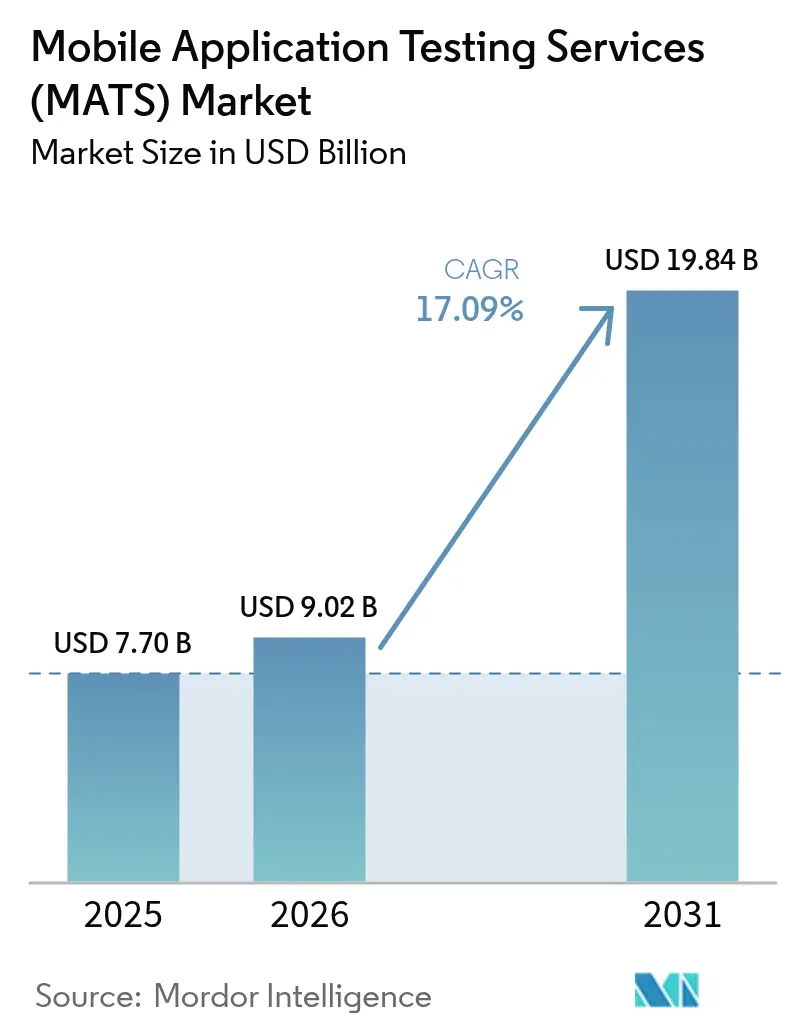
| Market Size (2026) | USD 9.02 Billion |
| Market Size (2031) | USD 19.84 Billion |
| Growth Rate (2026 - 2031) | 17.09 % |
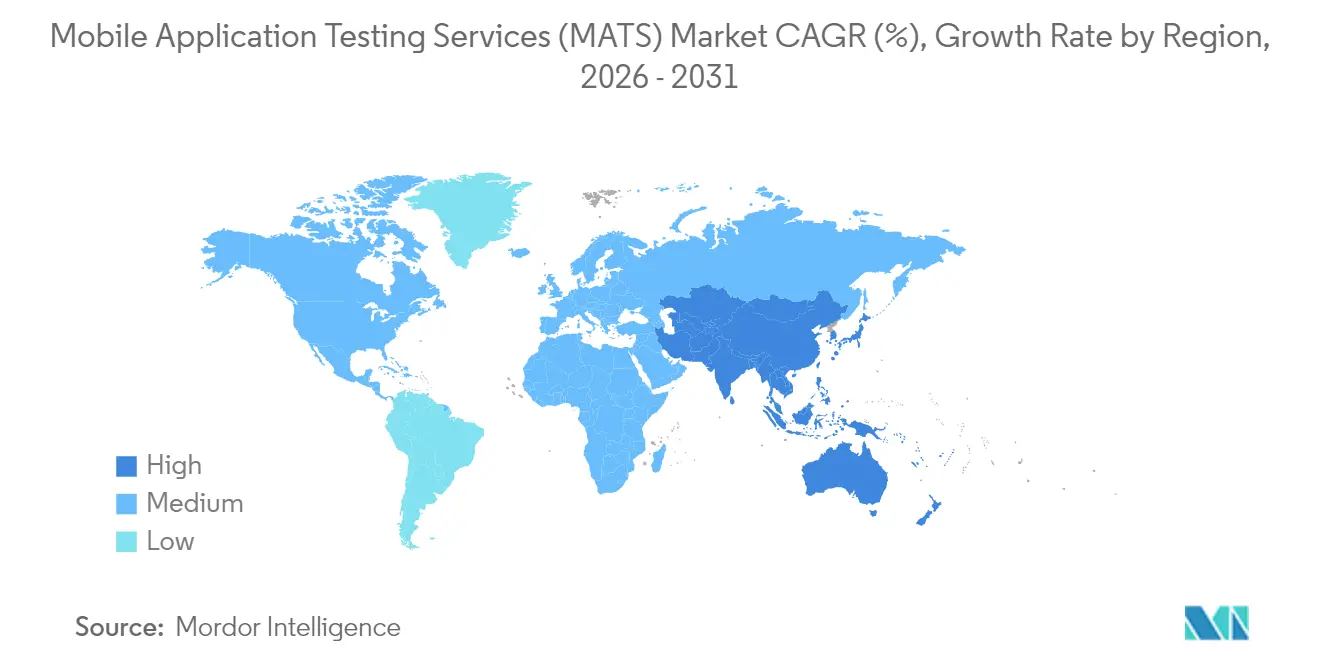
| Fastest Growing Market | Asia Pacific |
| Largest Market | North America |
| Market Concentration | Low |
Major Players *Disclaimer: Major Players sorted in no particular order Image © Mordor Intelligence. Reuse requires attribution under CC BY 4.0. | |
Mobile Application Testing Services (MATS) Market Analysis by Mordor Intelligence
The mobile application testing services market size is expected to grow from USD 7.70 billion in 2025 to USD 9.02 billion in 2026 and is forecast to reach USD 19.84 billion by 2031 at 17.09% CAGR over 2026-2031. Strong demand stems from enterprises baking continuous quality checks into DevOps pipelines, tighter security regulations, and the race to deliver flawless customer experiences on an ever-wider range of 5G-enabled smartphones. The shift from manual, release-end testing to real-time quality assurance has raised expectations for specialized partners that can automate at scale, provide deep domain expertise, and cover vast device matrices. Automated and crowd-sourced approaches now coexist to balance velocity with real-world coverage, while compliance-driven industries such as BFSI and healthcare fuel robust spend on security and accessibility validation. Vendors that fuse AI-assisted test creation with cloud-based device farms are winning share as clients seek faster feedback loops and lower total cost of ownership.
Key Report Takeaways
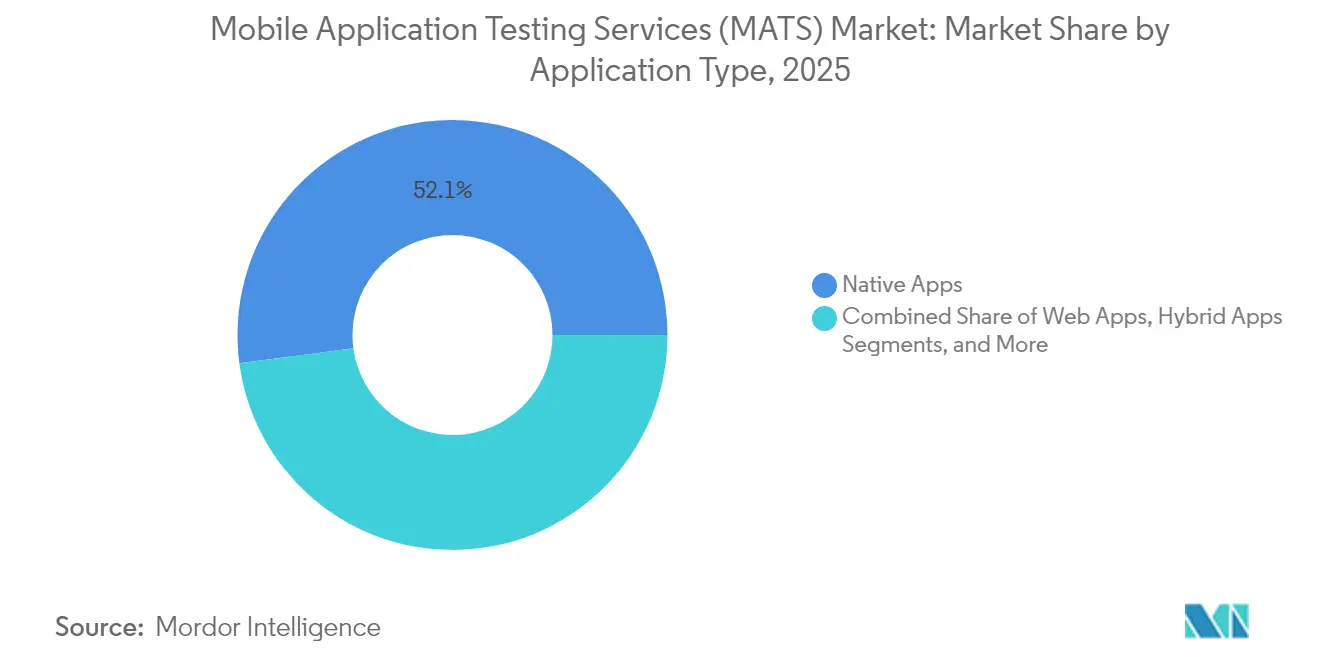
- By application type, native apps led with 52.10% of the mobile application testing services market share in 2025, whereas progressive web apps are advancing at an 18.15% CAGR through 2031.
- By service type, functional testing commanded 41.30% of the mobile application testing services market size in 2025; security and penetration testing is projected to expand at 17.95% CAGR.
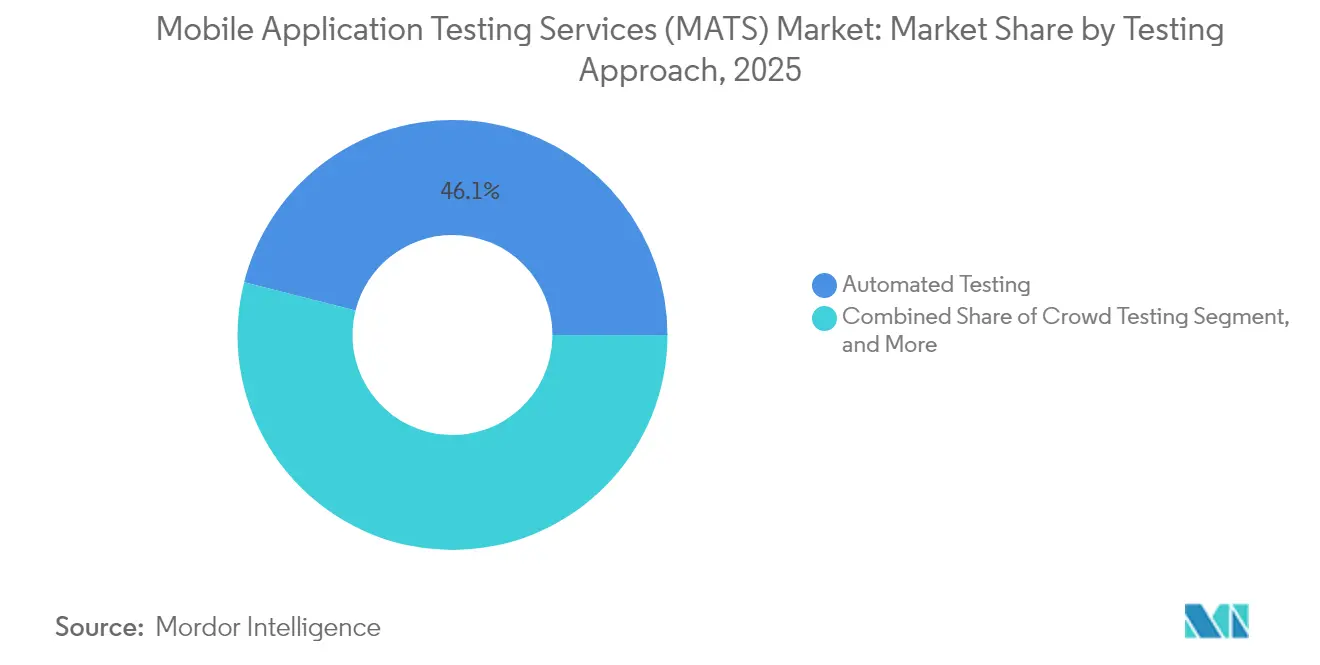
- By testing approach, automated testing captured 46.05% share of the mobile application testing services market size in 2025, while crowd testing records the fastest 18.02% CAGR.
- By end-user industry, BFSI accounted for 28.30% share of the mobile application testing services market size in 2025; healthcare and life sciences is growing at 17.62% CAGR.
- By geography, North America maintained 37.10% share in 2025 in the mobile application testing services, yet Asia-Pacific is set to post a 17.82% CAGR to 2031.
Note: Market size and forecast figures in this report are generated using Mordor Intelligence’s proprietary estimation framework, updated with the latest available data and insights as of 2026.
Market Trends and Insights
Drivers Impact Analysis of Mobile Application Testing Services (MATS) Market*
| Driver | (~) % Impact on CAGR Forecast | Geographic Relevance | Impact Timeline |
|---|---|---|---|
| Rising global smartphone penetration | +3.2% | APAC leadership, global reach | Medium term (2-4 years) |
| Agile/DevOps shift demanding continuous test | +4.1% | North America and EU lead, global adoption | Short term (≤ 2 years) |
| AI/ML, AR/VR, 5G rich-experience apps | +2.8% | Developed markets worldwide | Long term (≥ 4 years) |
| Stronger mobile security and privacy rules | +3.5% | EU and North America primary | Medium term (2-4 years) |
| OEM push for in-vehicle infotainment testing | +1.9% | North America, EU, China auto hubs | Long term (≥ 4 years) |
| Sustainability KPIs for battery/CO₂ testing | +1.3% | EU leadership, North America following | Long term (≥ 4 years) |
| Source: Mordor Intelligence | |||
Rising Global Smartphone Penetration Accelerates Testing Demand
Smartphone adoption in India, Indonesia, and the Philippines climbed sharply in 2025 as the average 5G handset fell below USD 200, spawning thousands of localized apps targeting varied network conditions and lower-spec devices. For suppliers to this mobile application testing services market, the result is a surge in compatibility workloads across fragmented Android forks where OEM tweaks often break core functions.[1] Device coverage must span multiple chipset vendors and screen sizes, pressuring service providers to expand real-device clouds and refine test-case prioritization. Enterprises unable to maintain these device matrices in-house increasingly outsource, creating recurring revenue streams for pure-play testing firms.
Rapid Shift to Agile and DevOps Demanding Continuous Testing
Fortune 500 developers now push code to production dozens of times a day, dissolving the wall between development and quality. Testing therefore moves upstream, runs in parallel with every commit, and feeds go/no-go gates in CI/CD pipelines. Vendors that plug AI-assisted script generation into Jenkins, GitLab, and Azure DevOps see stronger win rates because they compress feedback cycles from hours to minutes.[2] The mobile application testing services market prizes such partners for lowering mean time to remediation and supporting the “fail-fast” ethos central to digital product teams.
Proliferation of AI/ML, AR/VR and 5G Rich-Experience Apps
Generative AI chatbots, AR shopping assistants, and low-latency gaming streaks rely on edge computing and multi-camera input, introducing state-space explosions beyond traditional test permutations. Service providers now model neural-network drift, sensor fusion accuracy, and radio-handover scenarios that saturate conventional lab setups. Leaders in the mobile application testing services market deploy synthetic data, 5G network emulation, and hardware-in-the-loop rigs to validate such experiences at scale, giving clients confidence to launch demanding real-time services.
Growing Regulatory Push for Mobile App Security and Privacy
The European Accessibility Act, enforced in June 2025, and evolving GDPR case law have transformed security and accessibility tests from best practice into legal necessity. Health, finance, and public-sector apps must document conformance to EN 301 549, WCAG 2.1, and stringent encryption standards before app-store submission. Providers that deliver audit-ready evidence packages, penetration tests, and threat-model overlays gain premium pricing power, particularly among U.S. banks seeking EU passporting rights post-launch.
Restraints Impact Analysis of Mobile Application Testing Services (MATS) Market*
| Restraint | (~) % Impact on CAGR Forecast | Geographic Relevance | Impact Timeline |
|---|---|---|---|
| High device-lab infrastructure costs | -2.1% | Global, hurts smaller vendors | Short term (≤ 2 years) |
| Android fragmentation erodes automation ROI | -1.8% | Global, strongest in APAC | Medium term (2-4 years) |
| In-app ad-tech SDK complexity adds flakiness | -1.2% | Consumer apps worldwide | Short term (≤ 2 years) |
| Limited test-data privacy for GenAI testing | -0.9% | EU and North America focus | Medium term (2-4 years) |
| Source: Mordor Intelligence | |||
High Infrastructure and Device-Lab Investment Costs
A lab with 1,000 real devices spanning iOS and 20 Android OEMs can cost USD 6 million to build and USD 50,000 per month to refresh. Smaller providers cannot amortize these outlays across enough clients, curbing their ability to compete on price. Cloud device farms alleviate capex but introduce opex tied to hourly usage and geographic data-center fees. This restraint slows new-entrant growth in the mobile application testing services market and accelerates M&A as niche players seek scale advantages.
Fragmented Device/OS Ecosystem Complicates Automation ROI
Android 14 behaves differently on Samsung One UI, Xiaomi HyperOS, and Oppo ColorOS. The same XPath locator can fail across skin variants, forcing script rewrites and ballooning maintenance hours. Enterprises often allocate 40% of automation budgets to handle fragmentation, diluting ROI versus iOS. Service partners with dynamic locator strategies and AI-based element detection mitigate, but not eliminate, the drag on the mobile application testing services market growth.
*Our forecasts treat driver/restraint impacts as directional, not additive. The impact forecasts reflect baseline growth, mix effects, and variable interactions.
Mobile Application Testing Services (MATS) Market Segment Analysis
By Application Type:
Native Apps Dominate Despite PWA AccelerationNative apps held 52.10% of the mobile application testing services market share in 2025, underscoring enterprise reliance on platform-level performance and camera, GPS, or biometric APIs. The segment’s durability keeps demand high for Swift, Kotlin, and Jetpack Compose test specialists who validate deep device integrations. Progressive web apps, expanding at 18.15% CAGR, require cross-browser conformance testing and service-worker validation that differ from native test patterns. Their rise encourages providers to offer unified test suites blending browser and device farms, thereby broadening total addressable spend within the mobile application testing services market.
PWAs also attract mid-sized retailers and SaaS vendors seeking a single code-base strategy. Testing partners must therefore prove capability in offline caching, push-notification integrity, and installability across Chromium forks and WebKit. As bandwidth improves, enterprises expect near-native UX, raising the bar for load-time and animation smoothness benchmarks. Firms that can deliver side-by-side performance analytics for native versus PWA builds gain influence over tech-stack decisions, increasing wallet share.

By Service Type:
Security Testing Accelerates Amid Functional DominanceFunctional testing represented 41.30% of the mobile application testing services market size in 2025 as UI verification and regression suites remained table stakes across all industries. Yet security and penetration testing grows at 17.95% CAGR, propelled by financial institutions extending zero-trust policies to every software component. Providers bundling OWASP MASVS compliance audits with API fuzzing and runtime app self-protection checks shorten remediation cycles and justify premium fees.
Expanded privacy laws and high-profile breaches elevate budget priority for mobile pentests that simulate device rooting, network-layer interception, and malicious SDK inclusion. Vendors that feed findings into DevSecOps dashboards and retest patches automatically in CI/CD pipelines demonstrate tangible risk-reduction ROI. This pull through boosts their cross-sell of managed vulnerability management and red-team services, raising average contract value across the mobile application testing services industry.
By Testing Approach:
Automation Leads While Crowd Testing SurgesAutomation commanded 46.05% share of the mobile application testing services market size in 2025 as enterprises codified regression packs in Java, Kotlin, or JavaScript. AI-generated scripts now cut authoring time by 60%, although maintenance challenges persist amid device churn. Crowd testing’s 18.02% CAGR shows organizations valuing organic user feedback across networks, locales, and accessibility contexts that labs cannot replicate. Platforms that pre-qualify testers, encrypt PII, and stream session replays directly into issue trackers convert episodic pilots into annual subscriptions.
Blended strategies are becoming typical. A retailer, for example, may run nightly automated smoke suites on 200-device clouds, then trigger weekend crowd sprints focused on promotional flows in top-five target countries. Providers fluent in orchestration and data hygiene occupy a strategic niche, steering more spend toward the mobile application testing services market as clients offload coordination complexity.
By End-User Industry:
BFSI Leadership Challenged by Healthcare GrowthBFSI retained 28.30% share of the mobile application testing services market size in 2025. Mobile banking failures carry direct monetary losses and regulatory fines, compelling exhaustive functional, security, and accessibility tests before every release. Providers that map test cases to PSD2, SOC 2, and PCI-DSS controls become trusted risk partners rather than commoditized vendors, solidifying multi-year engagements.
Healthcare and life sciences, expanding at 17.62% CAGR, embody the next frontier. FDA guidance requires evidence of clinical safety, data integrity, and interoperability for mobile medical apps, lifting test-case volume and documentation rigor. Testing partners that blend HIPAA-grade data isolation with domain-expert clinical validation tap higher bill rates. As remote patient monitoring, telehealth, and digital therapeutics scale, healthcare is poised to challenge BFSI’s dominance in the mobile application testing services market.
Geography Analysis
North America Mobile Application Testing Services (MATS) Market
North America generated 37.10% of 2025 revenues, leveraging deep DevOps adoption and strict compliance mandates. U.S. banks and payers rolled out real-time fraud-detection apps that need 24×7 security scans, while digital-native brands outsource regression suites to manage bi-weekly release cadences. Canadian demand centers on healthcare digitization and provincial accessibility laws, sustaining premium for bilingual testing coverage across English and French apps.
APAC Mobile Application Testing Services (MATS) Market
Asia-Pacific posts the strongest 17.82% CAGR through 2031. India’s fintech and social-commerce boom prompts large-scale crowd campaigns across 15 regional languages and myriad low-cost handsets. China’s super-app ecosystems require providers versed in mini-program architectures and domestic compliance, creating two-track engagements covering both domestic and export builds. Mature 5G rollouts in Japan and South Korea elevate AR/VR app workloads, expanding the device lab footprint for vendors in the mobile application testing services market.
Europe Mobile Application Testing Services (MATS) Market
Europe shows steady growth underpinned by regulation. The European Accessibility Act and GDPR fine regime convert accessibility and privacy checks into non-negotiable budget lines. Germany leads demand via automotive OTA-update testing, while the U.K. remains strong in finance despite post-Brexit regulatory divergence. Nordic clients emphasize sustainability metrics, asking suppliers to report test-lab carbon intensity, a nascent differentiator within the mobile application testing services industry.
Regulatory Landscape
Mobile application testing services increasingly translate security, privacy, and accessibility requirements into deliverables that affect app release readiness. In the EU, the European Accessibility Act entered enforcement in June 2025, prompting regulated service providers to evidence conformance to EN 301 549 and WCAG 2.1 through accessibility validation as part of QA sign-off. Security obligations are also tightening, with the EU Cyber Resilience Act (Regulation (EU) 2024/2847) extending requirements to products with digital elements, including mobile applications that rely on remote data processing, which increases demand for secure development and test evidence across the software lifecycle.
Government programs and national standards are also making mobile security testing more prescriptive across key markets. In the United States, CISA Mobile App Vetting (MAV) formalizes static and dynamic analysis aligned to NIST and NIAP application software protection profiles, reinforcing a baseline that federal and critical-infrastructure suppliers can align to. In China, mobile-app personal information protection and app-store governance are being codified through standards such as GB/T 43739-2024 (implemented November 1, 2024) and RB/T 182-2023 (implemented July 1, 2024), which increases the need for audit-ready privacy testing, SDK scrutiny, and app-store compliance documentation for developers and publishers operating across regions.
Value Chain Analysis
The value chain starts with tool and infrastructure inputs that shape test scale and coverage, including automation frameworks (Appium, Espresso, XCUITest), security testing methodologies aligned to OWASP MASVS/MSTG, and execution environments such as cloud and device-farm infrastructure (AWS Device Farm, Firebase Test Lab, and vendor-managed real-device clouds). These inputs support service providers and integrators that design test strategies, build automation, run functional, performance, security, and accessibility validation, and embed quality gates into CI/CD toolchains such as Jenkins, GitLab, and Azure DevOps to enable continuous testing.
Downstream, enterprises and digital product teams, especially in regulated and high-transaction industries such as BFSI and healthcare, use the outputs as release decisions and audit evidence packages. These include penetration-test results, accessibility conformance reports, and remediation verification. Device and OS fragmentation and specialized talent scarcity in automation and security testing remain key bottlenecks, while infrastructure economics continue to influence delivery models. Because at-scale real-device labs are capital intensive, many providers emphasize cloud device farms and blended approaches (automation plus crowd testing) to widen geographic and network-condition coverage without fully replicating in-house device matrices.
Competitive Landscape
The market is moderately fragmented. Global IT-services majors, Accenture, TCS, Wipro, bundle testing with transformation deals, leveraging offshore talent for scale. Pure-play platforms such as BrowserStack and Sauce Labs anchor differentiation in cloud device coverage and developer UX, frequently courting SMBs and agile squads. Mid-tier specialists like Applause focus on crowd models that deliver authentic user feedback at speed.
Consolidation accelerated after Vista Equity Partners acquired Applause in late 2024 and BrowserStack bought Bird Eats Bug in January 2025. Private-equity backing fuels R&D into AI-powered defect clustering and self-healing test cases. Tech-driven deals also aim to assemble end-to-end quality suites spanning planning, execution, observability, and analytics. Simultaneously, smaller regional vendors seek vertical niches, sustainability testing or automotive infotainment, to command premium margins.
Competitive advantage now hinges on three pillars: real-device breadth, AI-driven efficiency, and regulatory fluency. Vendors delivering continuous quality dashboards that merge functional, security, and ESG telemetry gain stickiness. The top five hold roughly 45% of global revenue, indicating mid-level concentration yet room for specialist challengers in the mobile application testing services market.
Mobile Application Testing Services (MATS) Industry Leaders
-
Accenture PLC
-
Capgemini SE
-
EPAM Systems Inc.
-
Cognizant Technology Solutions Corporation
-
International Business Machines Corporation
- *Disclaimer: Major Players sorted in no particular order

Mobile Application Testing Services (MATS) Market Companies Covered in this Report
- Accenture PLC
- Capgemini SE
- Cognizant Technology Solutions Corporation
- EPAM Systems Inc.
- International Business Machines Corporation
- Wipro Limited
- Tata Consultancy Services Limited
- Cigniti Technologies Limited
- Sauce Labs Inc.
- Amazon Web Services, Inc. (Device Farm)
- Applause App Quality, Inc.
- BrowserStack Limited
- Infosys Limited
- Qualitest Group Ltd.
- Tricentis GmbH
- Testlio Inc.
- Perfecto Mobile Ltd. (Perforce Software)
- Global App Testing Ltd.
- Testbirds GmbH
- Rainforest QA, Inc.
- BugRaptors QA Solutions Pvt. Ltd.
Read Analysis of Mobile Application Testing Services (MATS) Companies
Market Opportunities and Future Outlook
Compliance-led testing packages represent a clear whitespace for providers that can deliver audit-ready evidence across accessibility, privacy, and security in a single engagement. The European Accessibility Act enforcement from June 2025 increases demand for systematic mobile accessibility validation tied to EN 301 549 and WCAG 2.1, while PCI DSS v4.0 full enforcement in March 2025 raises the bar for authentication, encryption, and penetration testing in payment-adjacent mobile journeys. Providers that unify functional regression with security and accessibility sign-off, and package results for governance and risk teams, can shift beyond project-based QA into recurring compliance and continuous-assurance programs.
A second opportunity sits at the intersection of device-lab economics and modern app complexity, where clients want broader device coverage without building large physical labs. The market context suggests that a 1,000-device lab can cost about USD 6 million to build and requires ongoing refresh spend, reinforcing the shift toward cloud device farms and managed real-device clouds supported by strong observability and debug tooling. Vendors that pair these environments with AI-assisted test creation, self-healing locators to reduce Android fragmentation maintenance, and specialized performance metrics such as cold-start time, network handover, and battery drain can capture share as enterprises standardize continuous testing across expanding device matrices and 5G user experiences.
Recent Industry Developments in Mobile Application Testing Services (MATS) Market
- May 2026: Accenture invested in XBOW, positioning autonomous cybersecurity testing as part of its Cyber.AI offering. The move strengthens continuous offensive testing and exposure management capabilities that can be embedded into DevSecOps pipelines alongside mobile security and penetration testing services. It also supports larger managed-testing engagements where security validation is a standing release gate rather than a periodic audit.
- October 2025: EPAM Systems launched Agentic QA, an AI-native approach aimed at combining human and AI capabilities in software testing workflows. This expands the competitive focus from scripted automation toward AI-assisted test creation, execution, and triage across fast-changing application environments. For mobile testing services, it reinforces the push for shorter feedback loops and higher automation resilience across fragmented devices and OS versions.
- September 2024: Cognizant partnered with KOMBIT to centralize quality assurance and testing for 26 Danish public-service applications using a Testing-as-a-Service model. The engagement highlights public-sector demand for standardized, repeatable testing operations across multiple applications with shared governance requirements. It also underscores the importance of scalable test management and compliance-ready reporting for citizen-facing mobile services.
Mobile Application Testing Services (MATS) Market Report Scope and Research Methodology
Market Definition and Coverage
For this study, the market covers revenue earned from services that test mobile apps across devices, operating systems, and network conditions, so teams can validate functionality, performance, security, and user experience before and after releases.
Scope exclusions: We exclude testing tool license revenue and in-house QA costs that are not billed as an external testing service.
Segments Covered in This Report
- By Application Type
- Native Apps
- Web Apps
- Hybrid Apps
- Progressive Web Apps (PWA)
- By Service Type
- Functional Testing Services
- Performance and Load Testing Services
- Security and Pen-Testing Services
- Compatibility and UX Testing Services
- Test Automation Services
- By Testing Approach
- Manual Testing
- Automated Testing
- Crowd / Crowd-source Testing
- By End-User Industry
- Gaming
- BFSI
- Healthcare and Life Sciences
- Retail and E-Commerce
- Travel and Hospitality
- Media and Entertainment
- Other End-User Industries
- By Geography
- North America
- United States
- Canada
- South America
- Brazil
- Argentina
- Rest of South America
- Europe
- Germany
- United Kingdom
- France
- Italy
- Spain
- Netherlands
- Rest of Europe
- Asia-Pacific
- China
- India
- Japan
- South Korea
- Australia
- Rest of Asia-Pacific
- Middle East and Africa
- Middle East
- United Arab Emirates
- Saudi Arabia
- Rest of Middle East
- Africa
- South Africa
- Nigeria
- Rest of Africa
- Middle East
- North America
Data Sources, Market Sizing, and Validation
Desk Research
Desk research was used to set the market boundary and build a practical demand map for mobile testing work, especially around device and OS fragmentation, release cadence, and app quality expectations. We relied on public datasets and standards sources such as the US Bureau of Labor Statistics for wage and employment context, the US SEC filings and annual reports for service revenue clues, and public metrics from Android and iOS ecosystem documentation for OS coverage and version adoption patterns.
We also used sources such as IEEE and ACM publications for test automation and defect trends, OWASP Mobile Security Testing Guide references for security testing expectations, and public accessibility guidance such as WCAG for regulatory context on when testing spend tends to rise. When needed, a paid subscription database for company financials and intelligence, and a patent database, were used to cross-check service mix shifts and automation intensity. These examples are not exhaustive, and many other public and paid sources were also reviewed to collect, validate, and clarify data points.
Primary Interviews and Surveys
Primary work focused on confirming what buyers actually purchase as testing services and how pricing changes with automation, device lab usage, and specialized testing such as security and accessibility. We spoke with service providers, independent QA leaders, and app owners in major end-use industries across key regions, so assumptions on utilization, engagement length, and blended billing rates could be refined.
Findings from these discussions were used to test the desk inputs, close gaps where public data is thin, and align final market totals to what active projects and contracting patterns indicate.
Distribution of primary research fieldwork respondents
| Company type | Respondent position | Region |
|---|---|---|
| Top tier: 26% | CXOs: 13% | APAC: 44% |
| Mid tier: 56% | Functional/Unit leaders: 29% | EMEA: 29% |
| Smaller Players: 18% | Managers: 58% | Americas: 27% |
Market-Sizing & Forecasting
Sizing starts with a top-down build where mobile app production and maintenance activity is converted into an addressable testing spend pool, then filtered by the share outsourced to specialist testing services. The model uses inputs such as active mobile app release frequency, the mix of native versus web and hybrid builds, the typical device and OS coverage matrix, automation penetration in regression testing, and the weighted share of security, performance, and accessibility testing within a test cycle.
Those totals are then corroborated using selective bottom-up checks, including sampled provider revenue splits, project-based rate cards, and an ASP times delivery volume approximation for common testing engagements. Where direct bottom-up visibility is missing (for smaller providers or bundled contracts), we fill gaps using conservative ranges from interviews, followed by sensitivity checks so the final number does not overreact to a small set of large accounts.
For forecasting, we use scenario analysis anchored on expected changes in mobile release cadence, enterprise app modernization, automation tooling maturity, and compliance-driven testing intensity. Scenarios stay within the bounds shared by experts, and they are reconciled back to macro signals such as IT services budgets and digital channel adoption.
Data Validation & Update Cycle
Validation is done through multiple passes that compare modeled totals with independent signals, including outsourcing rates for application services, observed pricing movement for testing labor, and shifts toward automated and cloud device lab testing. Outliers are investigated by checking whether they come from one-time contract spikes, unusual currency movements, or a scope mismatch, and then the assumptions are adjusted and rechecked.
Before sign-off, the work is reviewed by another analyst to confirm that the definitions, unit economics, and regional splits still hold together. Reports are refreshed annually, and interim updates are made when major events materially change pricing, demand, or delivery capacity. Right before delivery, a final scan is completed so clients receive the latest updated view.
Mordor Intelligence's Mobile Application Testing Services Market Size Measured Against Other Published Estimates
Published market sizes for mobile application testing services often differ because the scope line is drawn differently, and because the same service work can be priced in several ways across regions and contract types. Timing also matters, since fast-moving billing rates and currency conversion choices can shift the reported USD value even when underlying project volumes are similar.
A refresh-led driver is the handling of blended ASPs and currency timing, where quarterly rate movements, offshore mix changes, and re-validation calls with practitioners are used to keep the current-year run-rate realistic. This approach reflects how Mordor Intelligence updates its inputs when practitioner pricing feedback indicates changes in device lab and automation costs.
Benchmark comparison
| Source | Market Size | Gaps in Research Methodology |
|---|---|---|
| Mordor Intelligence | USD 9.02 B (2026) | |
| Industry Research Publisher A | USD 8.18 B (2025) | Uses an earlier base year and a lower growth path, which can reflect more conservative billing-rate escalation and fewer refresh touchpoints for updated device-lab and automation pricing. |
| Market Tracker B | USD 6.87 B (2024) | Tracks a broader "mobile testing services" label with simpler segment mapping, which can undercount specialized security and accessibility testing and may apply older exchange rates for USD conversion. |
Overall, the spread is explained by base-year choice, what is counted as billable testing services versus adjacent tooling, and how pricing is updated as automation and delivery mix changes. By keeping inputs tied to observable demand signals and repeatable checks, the resulting estimate stays transparent and easier to reconcile with real contracting behavior.
Key Questions Answered in the Report
What is the projected value of the mobile application testing services market in 2031?
The market is expected to reach USD 19.84 billion by 2031, reflecting a 17.09% CAGR.
Which region is growing fastest for mobile application testing services?
Asia Pacific shows the highest growth, poised for a 17.82% CAGR through 2031 driven by rising smartphone adoption and digital transformation.
Which application type currently holds the largest share?
Native apps lead with 52.10% share thanks to their platform-specific performance advantages.
Why is security testing demand accelerating?
Escalating cyber threats and stringent regulations are boosting security and penetration testing, the fastest-growing service at 17.95% CAGR.
Which end-user sector spends the most on mobile application testing?
BFSI remains the largest spender, accounting for 28.30% of 2025 revenue due to its zero-tolerance stance on transaction failures.