
Mint Essential Oils Market Size and Share
Market Overview
| Study Period | 2021 - 2031 |
|---|---|
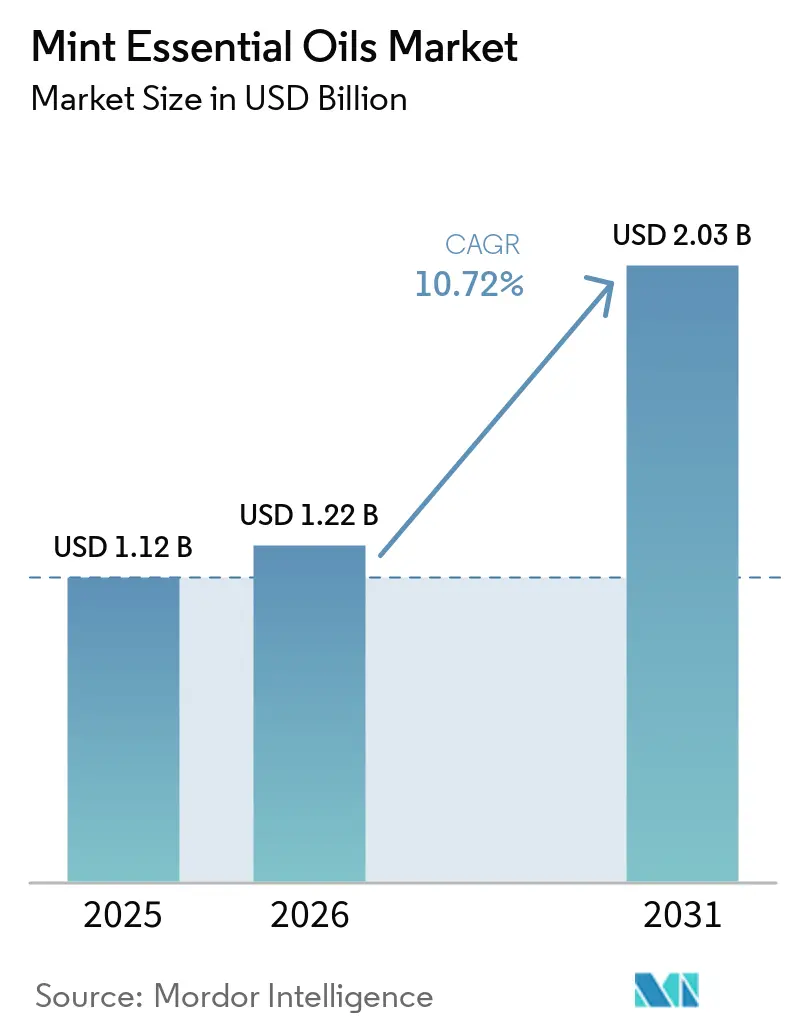
| Market Size (2026) | USD 1.22 Billion |
| Market Size (2031) | USD 2.03 Billion |
| Growth Rate (2026 - 2031) | 10.72 % |
| Fastest Growing Market | Asia-Pacific |
| Largest Market | Asia-Pacific |
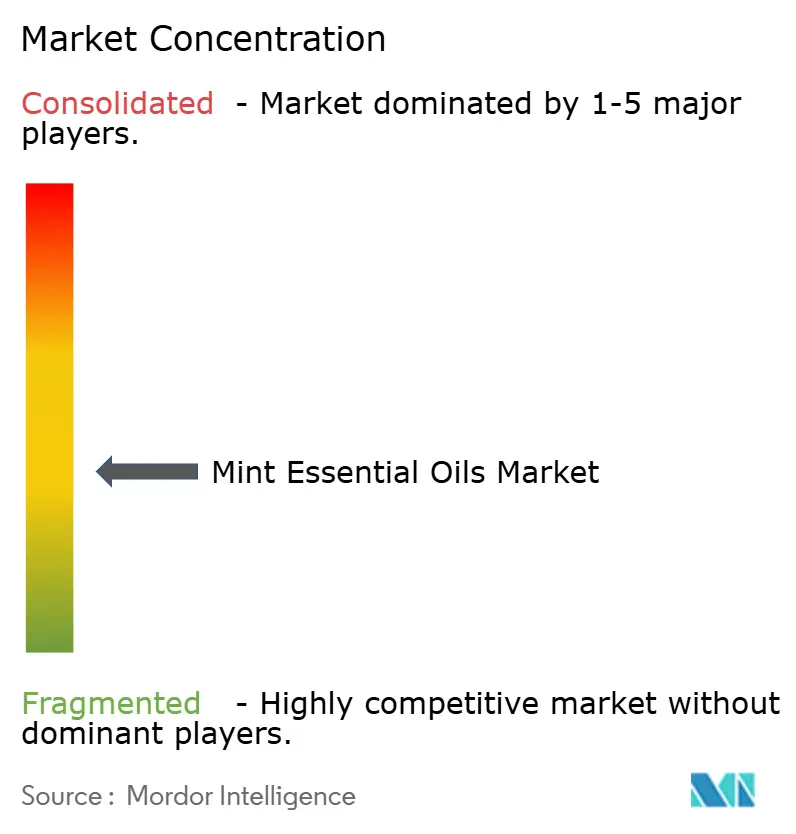
| Market Concentration | Medium |
Major Players *Disclaimer: Major Players sorted in no particular order Image © Mordor Intelligence. Reuse requires attribution under CC BY 4.0. | |
Mint Essential Oils Market Analysis by Mordor Intelligence
The mint essential oils market size was valued at USD 1.12 billion in 2025 to USD 1.22 billion in 2026 and is forecast to reach USD 2.03 billion by 2031 at 10.72% CAGR over 2026-2031. Natural botanical inputs now reach mainstream food, personal care, and pharmaceutical formulation pipelines. Buyers place greater weight on extraction provenance, traceability, and functional performance. This shift favors suppliers that can provide dependable quality and documented origin. India and the United States remain important raw-material bases, while European and East Asian manufacturers remain important finished-product buyers. The market is also shaped by a tighter supply environment, which can support natural-oil pricing but increases availability risk for spot purchasers.
Key Report Takeaways
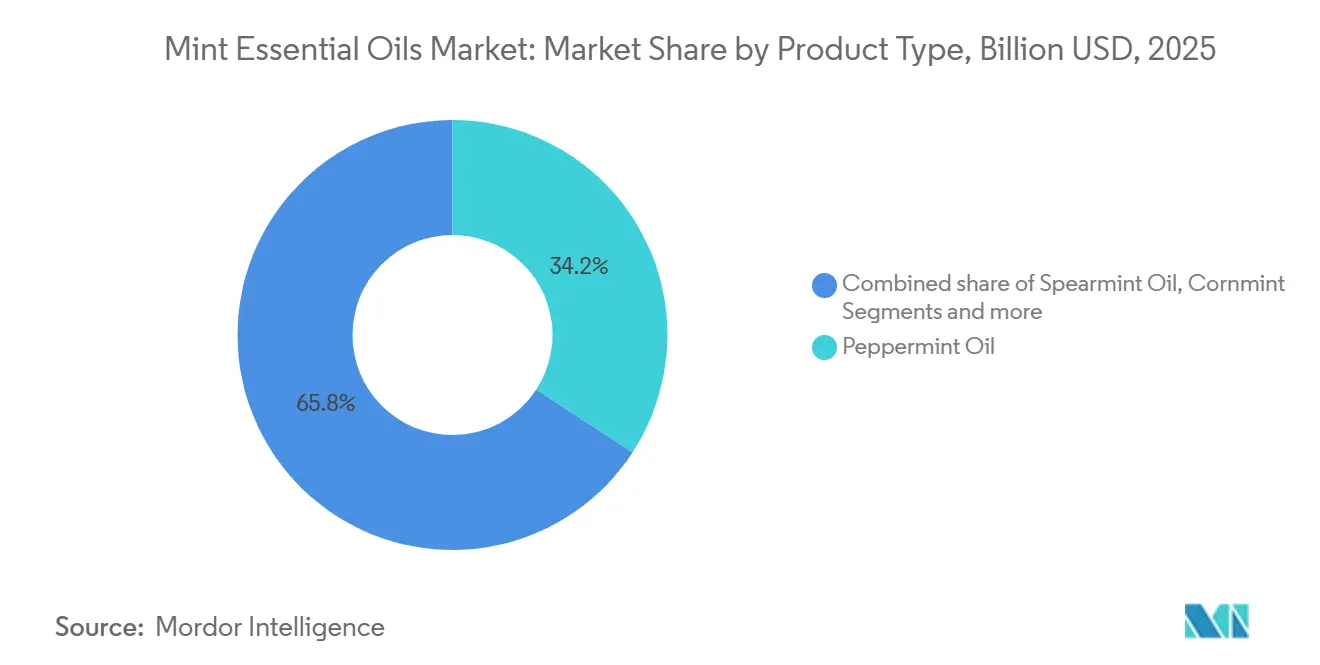
- By product type, peppermint oil led with 34.18% of the mint essential oils market share in 2025, while cornmint oil is forecast to grow at an 11.46% CAGR through 2031.
- By nature, conventional oils held 79.95% of the mint essential oils market share in 2025, while organic oils are forecast to grow at a 12.38% CAGR through 2031.
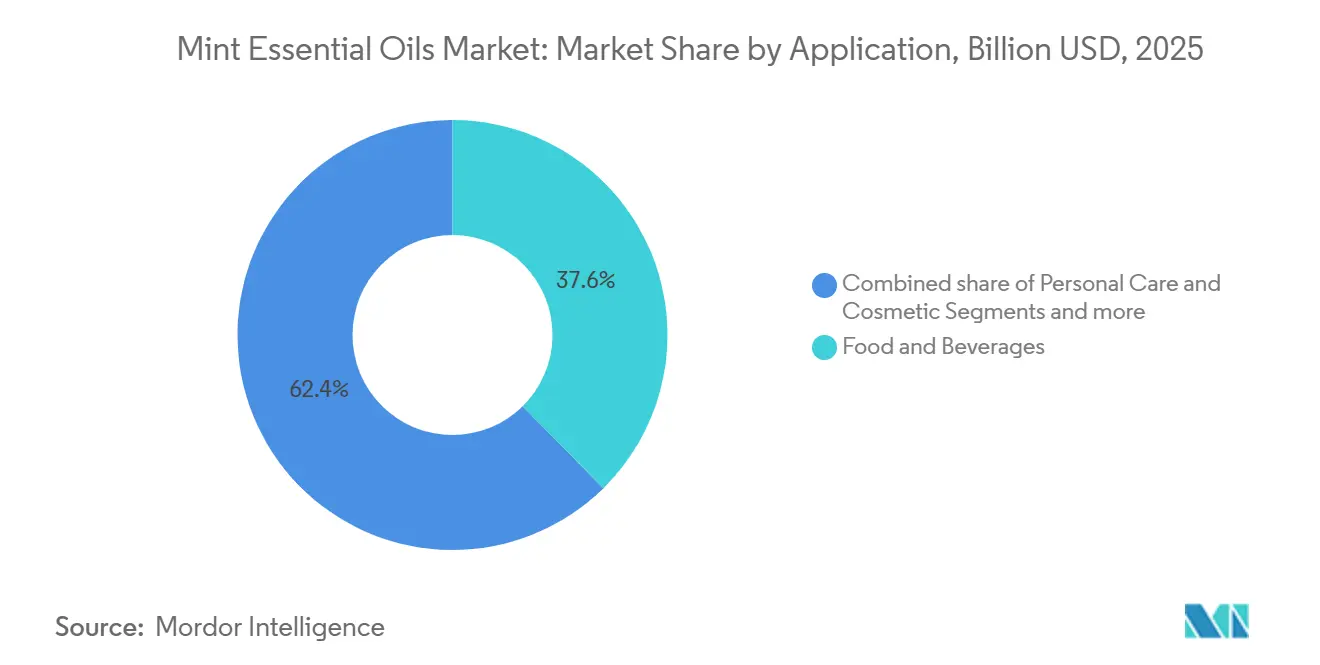
- By application, food and beverage held 37.62% of the mint essential oils market size in 2025, while aromatherapy and wellness is forecast to grow at an 11.83% CAGR through 2031.
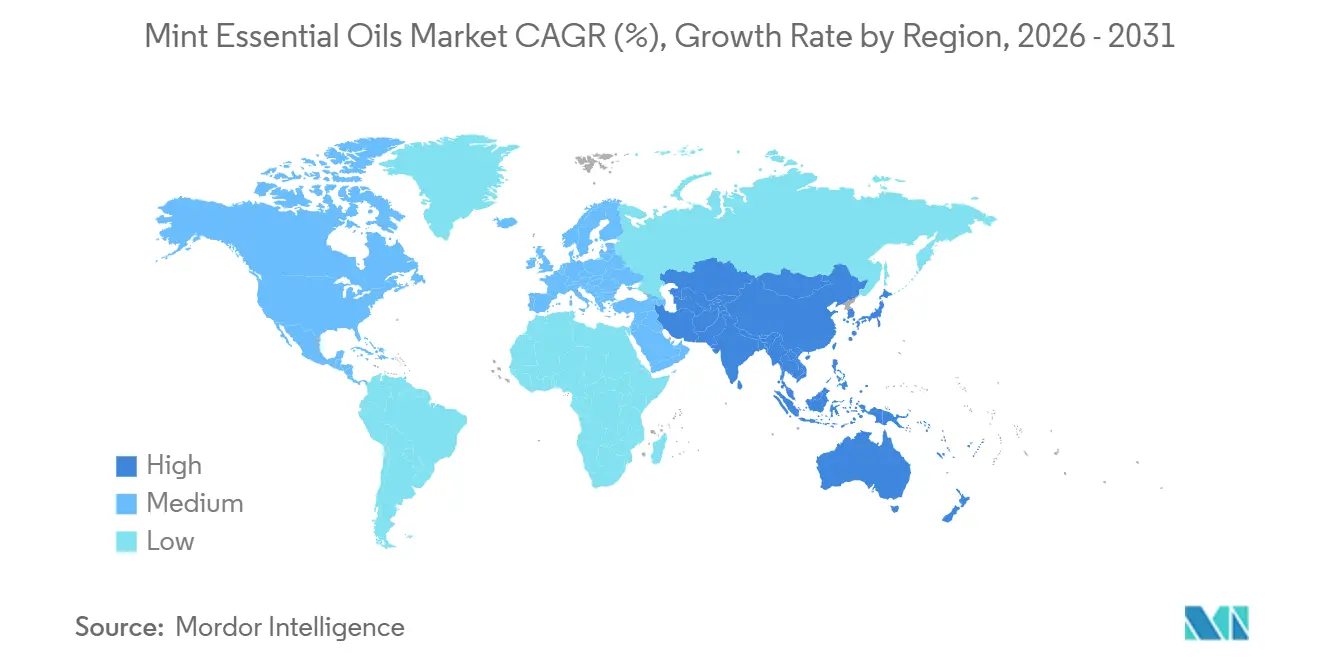
- By geography, Asia-Pacific held 35.17% of the mint essential oils Market size in 2025 and is forecast to grow at a 12.11% CAGR through 2031.
Note: Market size and forecast figures in this report are generated using Mordor Intelligence’s proprietary estimation framework, updated with the latest available data and insights as of January 2026.
Market Trends and Insights
Drivers Impact Analysis of Mint Essential Oils Market*
| Driver | (~) % Impact on CAGR Forecast | Geographic Relevance | Impact Timeline |
|---|---|---|---|
| Growing Demand for Natural and Plant-Based Ingredients | +2.8% | Global | Medium term (2-4 years) |
| Rising Use in Aromatherapy and Wellness Products | +2.1% | Global, North America and Asia-Pacific leading | Medium term (2-4 years) |
| Increasing Application in Personal Care and Cosmetics | +1.7% | North America and Europe | Short term (≤ 2 years) |
| Rising Consumer Preference for Clean-Label Products | +1.2% | North America and Europe, with spillover to Asia-Pacific | Medium term (2-4 years) |
| Growing Demand for Natural Flavoring Agents | +1.5% | Global | Short term (≤ 2 years) |
| Advancements in extraction and purification technologies | +0.9% | Asia-Pacific, Europe, and North America | Long term (≥ 4 years) |
| Source: Mordor Intelligence | |||
Growing Demand for Natural and Plant-Based Ingredients
Consumer demand for transparent ingredients has reshaped purchasing decisions across food, beverages, and consumer goods. As shoppers increasingly review labels and favor recognizable ingredients, manufacturers are placing greater emphasis on natural inputs during product development and reformulation. Manufacturers increasingly consider natural mint oils during product reformulation because they support clean-label positioning while delivering familiar sensory attributes. They also use mint oils as antimicrobial agents in active packaging, edible coatings, and probiotic formulations. These applications extend beyond conventional flavoring and can generate demand outside typical flavor cycles, particularly as brands seek multifunctional ingredients that support preservation, freshness, and product differentiation. Reformulation programs in confectionery and functional beverages can support longer-term purchasing relationships compared to spot buying, as suppliers become more involved in ingredient standardization, sensory optimization, and continuity of supply.
Rising Use in Aromatherapy and Wellness Products
Aromatherapy and wellness applications increasingly prioritize practical use cases over scent alone, as consumers and institutional buyers seek products that support specific health and wellness outcomes. Peppermint oil is widely used in applications focused on headache relief, cognitive alertness, and mental clarity, making it relevant across both personal care and professional wellness settings. Buyers in hospital settings, corporate wellness programs, and spa chains often require pharmaceutical-grade purity, consistent batches, and reliable product documentation. These requirements favor certified suppliers with established quality systems and strong compliance practices. Wider distribution through pharmacy chains and subscription-based online retail can increase repeat purchases by improving product accessibility and purchase convenience. This channel expansion supports a broader customer base for the mint essential oils market.
Increasing Application in Personal Care and Cosmetics
The use of mint essential oils in personal care and cosmetic products is expanding steadily due to growing consumer demand for natural and plant-based ingredients. Peppermint and spearmint oils are widely incorporated into skincare, haircare, oral care, soaps, and cosmetic formulations for their cooling, refreshing, and antimicrobial properties. A 2024 consumer survey commissioned by the National Sanitation Foundation (NSF) found that 74% of U.S. consumers consider organic ingredients important in skincare and personal care products[1]Source: National Sanitation Foundation, “74% of Consumers Consider Organic Ingredients Important in Personal Care Products”, nsf.org. This increasing preference for organic and clean-label beauty products is encouraging manufacturers to incorporate botanical ingredients such as mint essential oils into a broader range of premium personal care formulations.
Rising Consumer Preference for Clean-Label Products
Rising consumer preference for clean-label products is a key driver of the mint essential oils market. Consumers increasingly favor products made with natural, recognizable, and minimally processed ingredients while avoiding synthetic additives and artificial flavors. Mint essential oils fit this trend as they are plant-derived and widely used in food, beverages, personal care, and wellness products. According to research by the CBI Ministry of Foreign Affairs, clean-label products in Europe are projected to constitute over 70% of product portfolios in 2025 and 2026, up from 52% in 2021[2]Source: CBI Ministry of Foreign Affairs, “Which trends offer opportunities”, cbi.eu. This growing shift toward clean-label formulations is increasing demand for natural botanical ingredients such as peppermint, spearmint, and cornmint oils.
Restraints Impact Analysis of Mint Essential Oils Market*
| Restraint | (~) % Impact on CAGR Forecast | Geographic Relevance | Impact Timeline |
|---|---|---|---|
| Volatility in Mint Crop Yields and Raw-Material Supply | -2.0% | Asia-Pacific core, especially India, with global spillover | Short term (≤ 2 years) |
| Fluctuations in Mint Oil Prices | -1.3% | Global | Short term (≤ 2 years) |
| Adulteration and Quality-Consistency Issues | -0.9% | Global | Medium term (2-4 years) |
| Strict Regulations for Essential Oil Use | -0.6% | Europe and North America | Long term (≥ 4 years) |
| Source: Mordor Intelligence | |||
Volatility in Mint Crop Yields and Raw-Material Supply
The volatility in mint crop yields and raw-material supply poses a significant restraint to the mint essential oils market by creating risks around availability and pricing. India supplies approximately 83% of global mentha oil output, making the market highly exposed to disruptions in a single major agricultural geography. In India, Barabanki’s mentha output declined from 11,200 metric tons in 2022–23 to 7,950 metric tons in 2024–25, reflecting the impact of weather variations and rising labor costs[3]Source: World Resources Institute, “Climate Resilience Takes Root on India’s Mint Farms”, wri.org. Competition from synthetic menthol further pressures growers and processors by reducing demand for natural mint-derived raw materials. Such fluctuations can increase procurement costs and create uncertainty for essential oil manufacturers.
Fluctuations in Mint Oil Prices
Fluctuations in mint oil prices can restrain the growth of the mint essential oils market by creating uncertainty for manufacturers and downstream users. Mint oil prices are influenced by changes in crop yields, weather conditions, cultivation costs, and the availability of raw materials. Volatility in menthol and mint oil prices can increase production and procurement costs for manufacturers, particularly those dependent on natural mint-derived ingredients. These cost increases may be passed on to food, beverage, pharmaceutical, and personal care manufacturers, affecting product pricing. Smaller producers may face greater pressure on profit margins when they are unable to absorb sudden increases in input costs. Consequently, persistent price volatility can discourage long-term procurement commitments and limit the adoption of mint essential oils in cost-sensitive applications.
*Our forecasts treat driver/restraint impacts as directional, not additive. The impact forecasts reflect baseline growth, mix effects, and variable interactions.
Mint Essential Oils Market Segment Analysis
By Product Type:
Peppermint Leads While Cornmint ExpandsPeppermint oil accounted for the largest share of the market, representing 34.18% of the market in 2025. The segment continues to dominate due to its extensive use across pharmaceuticals, personal care, food and beverages, aromatherapy, and oral care products. Its high menthol content makes it particularly valuable for applications involving cooling, analgesic, digestive, and respiratory benefits. Strong consumer preference for natural and multifunctional ingredients has further strengthened demand for peppermint oil in wellness and healthcare formulations. In addition, widespread use in premium cosmetic products, herbal remedies, and functional food formulations supports the segment’s leading position in the global market.
Cornmint oil is projected to be the fastest-growing product type in the market, registering a CAGR of 11.46% through 2031. The segment is expanding rapidly because cornmint is one of the most economical and abundant natural sources of menthol, making it highly attractive for large-scale industrial applications. Rising demand for menthol-based products in pharmaceuticals, oral care, confectionery, tobacco, and personal care industries is driving increased consumption of cornmint oil. Manufacturers are increasingly adopting cornmint oil as a cost-effective alternative to peppermint oil in formulations that require high menthol content.


By Nature:
Conventional Supply Holds Scale While Organic Gains GroundConventional mint essential oils accounted for the largest share of the market, representing 79.95% of the market in 2025. The segment dominates due to its widespread availability, lower production costs, and large-scale commercial cultivation across major mint-producing regions. Conventional oils are extensively used in pharmaceuticals, food and beverages, personal care, oral care, and industrial applications where cost efficiency and consistent supply are critical. Their established distribution networks and well-developed processing infrastructure further support strong market penetration.
Organic mint essential oils are projected to be the fastest-growing segment in the market, registering a CAGR of 12.38% through 2031. The segment is expanding rapidly due to increasing consumer preference for natural, chemical-free, and sustainably produced ingredients. Rising awareness of organic certification standards and concerns regarding pesticide residues in agricultural products are encouraging greater adoption of organic essential oils. Demand is particularly strong in premium personal care, aromatherapy, wellness, and clean-label food applications.
By Application:
Food and Beverage Retains Scale While Wellness Grows FasterThe food and beverage segment accounted for the largest share of the market, representing 37.62% of the market in 2025. The segment dominates because mint essential oils are widely used as natural flavoring agents in confectionery, beverages, dairy products, baked goods, chewing gum, and oral freshness products. Peppermint and spearmint oils are particularly valued for their refreshing taste profile and strong consumer acceptance across a broad range of food applications. Growing demand for clean-label ingredients and natural flavor alternatives has further strengthened the adoption of mint essential oils in food manufacturing.
The aromatherapy and wellness segment is projected to be the fastest-growing application in the market, registering a CAGR of 11.83% through 2031. The segment is expanding rapidly as consumers increasingly prioritize stress management, relaxation, mental well-being, and holistic health practices as part of their daily routines. Mint essential oils are widely incorporated into diffusers, massage oils, spa treatments, personal wellness products, and home fragrance applications, supported by their cooling, refreshing, and invigorating properties. Growing adoption of at-home aromatherapy and self-care routines is further expanding the use of mint essential oils across wellness applications.
Geography Analysis
APAC Mint Essential Oils Market
Asia-Pacific accounted for 35.17% of the mint essential oils market revenue in 2025 and is forecast to expand at a CAGR of 12.11% through 2031. India remains the principal source of mentha oil, producing 83% of global output. China also supplies cornmint and Japanese mint oils for pharmaceutical and flavoring applications. Demand continues to grow across China, India, Japan, Australia, and ASEAN markets, supported by higher disposable income, increasing interest in wellness, and rising requirements for natural flavors. Givaudan’s planned operating presence in India highlights the importance of regional sourcing and production capabilities.
North America and Europe Mint Essential Oils Market
North America and Europe remain major demand centers in the mint essential oils market, particularly for premium and certified oils. France imported EUR 303.8 million in essential oils in 2024, equivalent to USD 334 million, while Germany imported EUR 134 million, equivalent to USD 147 million. France’s aromatic-plant sector reported revenue growth in early 2025 for mint, lavandin, and thyme, although higher material and transport costs affected producer margins. The United States remains the largest demand center by country. Food-grade peppermint oil in the conventional segment was priced at USD 52-55 per kilogram in 2025. Buyers in these regions routinely consider International Fragrance Association requirements when selecting suppliers.
South America and MEA Mint Essential Oils Market
South America and the Middle East and Africa are emerging as secondary areas in the mint essential oils market. Brazil benefits from activity in food processing and personal care, while Argentina contributes demand from organic food and cosmetics. However, both countries remain dependent on imports for quality oils. Givaudan’s acquisition of Vollmens Fragrances and its new product-development centers in São Paulo indicate growing interest in Latin American demand for premium ingredients. Saudi Arabia and the United Arab Emirates are developing demand for premium wellness and fragrance-grade oils. South Africa remains a regional distribution and re-export center, while Givaudan’s Rwanda programs reflect longer-term attention to Africa as both a sourcing and demand region.

Competitive Landscape
The mint essential oils market is characterized by medium market concentration, with a broad mix of global and regional suppliers. Givaudan, IFF, Symrise, and dsm-firmenich operate alongside specialized producers, Indian exporters, and contract-farming businesses. The four large companies hold a combined 52% share of the broader aroma, fragrance, and flavor space, rather than a documented mint-oil-only share. This broader measure indicates the resources available to major suppliers but does not establish concentration within mint oils. Givaudan plans to invest CHF 55 million, equivalent to USD 62.2 million, in Campus 52 in Grasse in 2026. The site aims to strengthen premium extraction, agronomy, and natural-ingredient development.
IFF expanded its LMR Naturals site in Grasse following a EUR 10 million investment, equivalent to USD 11 million, in September 2025. The project is expected to increase the site footprint by 75% and bring together more than 30 research and development experts for traceable natural-ingredient work. Robertet acquired Phasex in November 2024 to add supercritical carbon dioxide extraction capability in North America. These moves indicate that companies in the mint essential oils market are focusing on extraction capabilities and direct access to botanical materials. India-based businesses retain a cost advantage in the mint essential oils market through natural raw materials and processing. Increased scrutiny of origin and purity gives analytical capability a larger role in supplier differentiation.
Blockchain-supported traceability and routine chiral gas chromatography and mass spectrometry documentation remain potential service gaps. Suppliers that combine Indian or U.S. raw-material access with strong analytical infrastructure can compete on documented quality. Competition from synthetic menthol adds pressure on natural suppliers. Climate-related supply constraints also limit the pool of credible large-volume suppliers. Certification requirements can further raise qualification thresholds.
Mint Essential Oils Industry Leaders
Symrise AG
Givaudan SA
International Flavors & Fragrances Inc.
Dsm-Firmenich AG
Robertet SA
- *Disclaimer: Major Players sorted in no particular order
Mint Essential Oils Market Companies Covered in this Report
- Symrise AG
- Givaudan SA
- International Flavors & Fragrances Inc.
- dsm-firmenich AG
- Takasago International Corporation
- Mane SA
- Robertet SA
- A. M. Todd Company
- Lebermuth, Inc.
- Ultra International B.V.
- Ventos, S.A.
- Berjé Inc.
- The Lebermuth Company, Inc.
- Norex Flavours Private Limited
- Synthite Industries Private Limited
- Natural & Essential Oils Pvt. Ltd.
- Katyani Exports
- AOS Products Private Limited
- Aromaaz International
- Ungerer & Company

Recent Industry Developments in Mint Essential Oils Market
- April 2026: Givaudan broke ground on a new fragrance manufacturing facility in Pedro Escobedo, Mexico, as part of a broader expansion program. The combined investment across two related projects exceeds USD 160 million and is expected to create a compounding capacity of approximately 20,000-25,000 metric tons by 2029, strengthening the company’s production and supply capabilities across the Americas.
- February 2026: Givaudan announced a CHF 55 million investment to develop Campus 52 in Grasse, France, which will serve as a center of excellence for its House of Naturals organization. The facility will focus on advanced extraction technologies, agronomy research, and innovation in natural ingredients, including the development and processing of botanical mint derivatives for fragrance and flavor applications.
- September 2025: IFF inaugurated its expanded LMR Naturals facility in Grasse, France, following a EUR 10 million investment (approximately USD 11 million). The site has been expanded by 75% to 4,687 square meters, enhancing the company’s capabilities in sourcing, processing, and producing traceable natural ingredients for the flavor, fragrance, and botanical extracts industries.


Global Mint Essential Oils Market Report Scope
Mint essential oils are concentrated, volatile oils extracted from the leaves and other aerial parts of mint plants, primarily peppermint (Mentha × piperita) and spearmint (Mentha spicata). They contain aromatic compounds such as menthol, menthone, and carvone, which give them their characteristic cooling, refreshing, and minty properties. The mint essential oils market is segmented by product type, nature, application and geography. Based on the product type, the market is segmented into peppermint, spearmint, cornmint, japanese mint, and others. Based on nature, the market is segmented into organic and conventional. Based on application, the market is segmented into food and beverage, personal care and cosmetics, aromatherapy and wellness, pharmaceuticals and nutraceuticals, and others. By geography, the market is segmented into North America, Europe, Asia-Pacific, South America, and Middle East and Africa. For each segment, the market sizing and forecasting have been done in value terms (USD billion).
| Peppermint Oil |
| Spearmint Oil |
| Cornmint Oil |
| Japanese Mint Oil |
| Other Product Types |
| Organic |
| Conventional |
| Food and Beverage |
| Personal Care and Cosmetics |
| Aromatherapy and Wellness |
| Pharmaceuticals and Nutraceuticals |
| Others |
| North America | United States |
| Canada | |
| Mexico | |
| Rest of North America | |
| Europe | Germany |
| United Kingdom | |
| Italy | |
| France | |
| Spain | |
| Rest of Europe | |
| Asia-Pacific | China |
| India | |
| Japan | |
| Australia | |
| Rest of Asia-Pacific | |
| South America | Brazil |
| Argentina | |
| Rest of South America | |
| Middle East and Africa | South Africa |
| Saudi Arabia | |
| United Arab Emirates | |
| Rest of Middle East and Africa |
| By Product Type | Peppermint Oil | |
| Spearmint Oil | ||
| Cornmint Oil | ||
| Japanese Mint Oil | ||
| Other Product Types | ||
| By Nature | Organic | |
| Conventional | ||
| By Application | Food and Beverage | |
| Personal Care and Cosmetics | ||
| Aromatherapy and Wellness | ||
| Pharmaceuticals and Nutraceuticals | ||
| Others | ||
| By Geography | North America | United States |
| Canada | ||
| Mexico | ||
| Rest of North America | ||
| Europe | Germany | |
| United Kingdom | ||
| Italy | ||
| France | ||
| Spain | ||
| Rest of Europe | ||
| Asia-Pacific | China | |
| India | ||
| Japan | ||
| Australia | ||
| Rest of Asia-Pacific | ||
| South America | Brazil | |
| Argentina | ||
| Rest of South America | ||
| Middle East and Africa | South Africa | |
| Saudi Arabia | ||
| United Arab Emirates | ||
| Rest of Middle East and Africa | ||


Key Questions Answered in the Report
What is the forecast growth rate for mint essential oils?
The mint essential oils market is forecast to grow at a 10.72% CAGR from 2026 to 2031, reaching USD 2.03 billion in 2031.
Which mint oil product type has the largest share?
Peppermint oil led the product-type segment with 34.18% share in 2025.
Which application is growing fastest for mint essential oils?
Aromatherapy and wellness is forecast to grow at an 11.83% CAGR through 2031.
Why are organic mint oils gaining demand?
Clean-label requirements and certified sourcing needs in personal care, premium foods, and aromatherapy support organic oil demand.
Which region leads demand and growth?
Asia-Pacific held 35.17% share in 2025 and is forecast to grow at a 12.11% CAGR through 2031.
Page last updated on:


 Your data is secure and never sold or shared.


