
Military Aircraft Avionics Market Size and Share
Market Overview
| Study Period | 2019 - 2031 |
|---|---|
| Market Size (2026) | USD 24.06 Billion |
| Market Size (2031) | USD 30.38 Billion |
| Growth Rate (2026 - 2031) | 4.78 % |
| Fastest Growing Market | Asia Pacific |
| Largest Market | North America |
| Market Concentration | Medium |
Major Players *Disclaimer: Major Players sorted in no particular order Image © Mordor Intelligence. Reuse requires attribution under CC BY 4.0. | |

Military Aircraft Avionics Market Analysis by Mordor Intelligence
The military aircraft avionics market size is estimated at USD 24.06 billion in 2026 and is projected to reach USD 30.38 billion by 2031, growing at a 4.78% CAGR. The growing demand for AI-enabled sensor fusion that processes data at the edge, the mandatory adoption of open-systems architecture, and the rapid fielding of power-efficient avionics for unmanned platforms are shaping procurement priorities in every major air arm. Suppliers are racing to embed zero-trust cyber controls that satisfy DO-326A and EUROCAE ED-202A while still meeting weight and power budgets. At the same time, on-shoring of RF and microelectronics capacity is redrawing supply chains and moderating the impact of semiconductor disruptions. These intersecting forces reinforce a momentum that offsets the long certification cycles typical of the military aircraft avionics market.
Key Report Takeaways
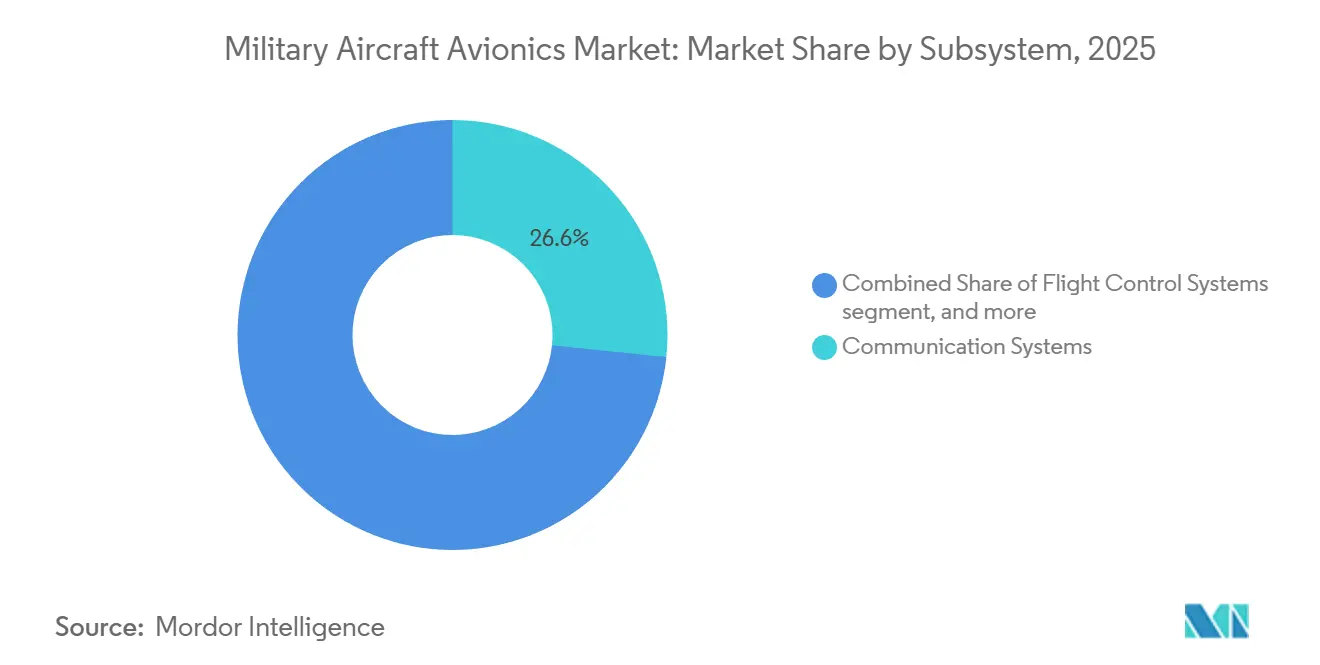
- By subsystem, communication systems led the military aircraft avionics market with a 26.64% market share in 2025 and are forecasted to expand at a 6.03% CAGR through 2031.
- By aircraft type, fixed-wing combat aircraft accounted for 41.21% of the military aircraft avionics market size in 2025, whereas unmanned aerial vehicles (UAVs) are projected to advance at a 9.81% CAGR through 2031.
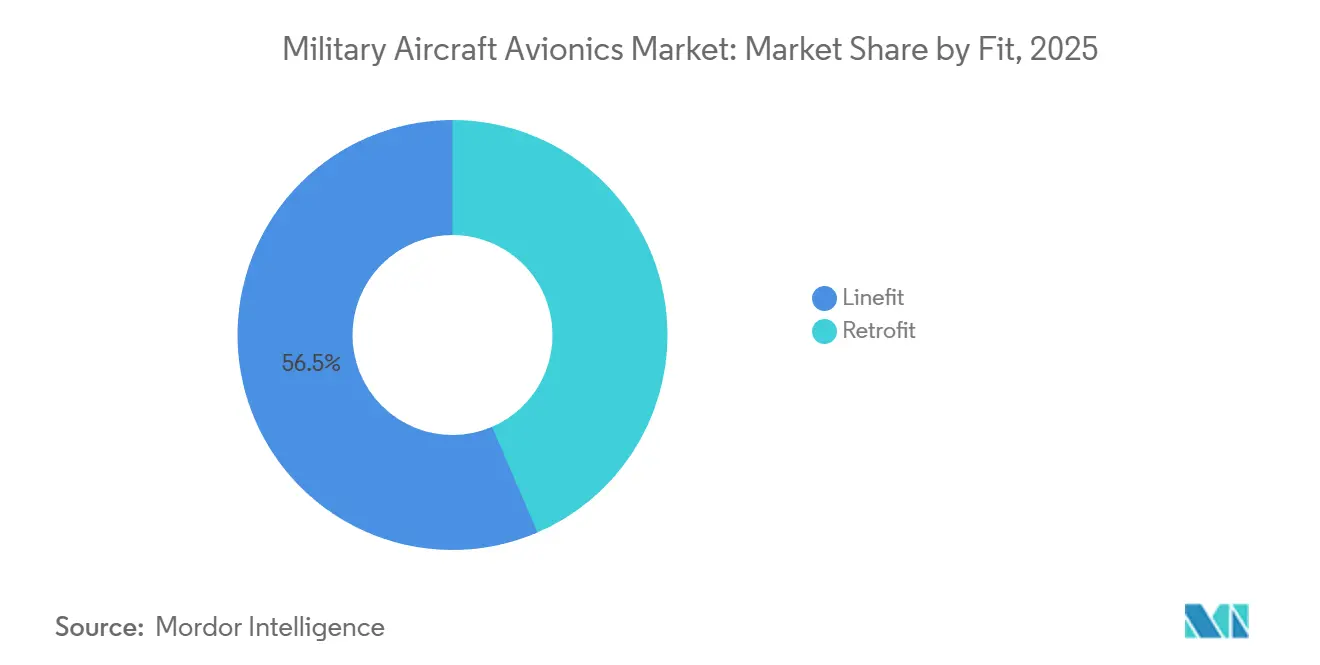
- By fit, linefit installations captured 56.47% of the military aircraft avionics market in 2025; however, retrofit applications are growing at the fastest rate, with a 6.67% CAGR.
- By geography, North America held 30.47% of the military aircraft avionics market in 2025, while Asia-Pacific is registering the highest regional CAGR at 5.65% through 2031.
Note: Market size and forecast figures in this report are generated using Mordor Intelligence’s proprietary estimation framework, updated with the latest available data and insights as of January 2026.
Market Trends and Insights
Drivers Impact Analysis of Military Aircraft Avionics Market*
| Driver | (~) % Impact on CAGR Forecast | Geographic Relevance | Impact Timeline |
|---|---|---|---|
| Rising global defense spending and modernization of military aircraft fleets | +1.20% | North America, Europe, Asia-Pacific | Medium term (2-4 years) |
| Accelerated integration of AI-enabled sensor fusion and edge analytics | +0.90% | North America, Europe, Asia-Pacific | Medium term (2-4 years) |
| Proliferation of UAV platforms driving demand for lightweight avionics | +1.10% | Middle East, Asia-Pacific | Short term (≤ 2 years) |
| Mandates for open-systems architecture by DoD and NATO | +0.70% | North America, Europe, allied APAC | Long term (≥ 4 years) |
| Strategic on-shoring and localization of RF and microelectronics | +0.50% | North America, Europe, India, Japan | Long term (≥ 4 years) |
| Emergence of zero-trust cybersecurity standards for avionics certification | +0.40% | Global, early adoption in North America, Europe | Medium term (2-4 years) |
| Source: Mordor Intelligence | |||
Rising Global Defense Spending and Modernization of Military Aircraft Fleets
Military expenditure reached USD 2.44 trillion in 2024 and continued to rise in 2025 as 41 nations spent more than 2% of GDP on defense, extending fleet life cycles and expanding the upgrade pipeline.[1] The US Department of Defense (DoD) earmarked USD 33.1 billion for aircraft procurement in fiscal year 2026, prioritizing F-35 Block 4 and Next Generation Air Dominance capability increments. Germany allocated EUR 8 billion (USD 9.37 billion) for Eurofighter Typhoon enhancements, which include new mission computers, AESA radar, and electronic-warfare suites. India, Japan, and South Korea are channeling resources into indigenous fighters that must incorporate domestic avionics to circumvent export controls, reinforcing a long-term demand stream. These budgets lengthen platform service lives to 40 years and create an 8-to-10-year retrofit cadence that underpins the 6.67% retrofit CAGR in the military aircraft avionics market.
Accelerated Integration of AI-Enabled Sensor Fusion and Edge Analytics
DARPA flight trials in 2024 showed autonomous dogfighting algorithms fusing radar, electro-optical, and electronic-support data in under 20 milliseconds, proving real-time edge processing viability.[2] RTX Corporation fielded an AI-accelerated mission computer on the F/A-18E/F that runs convolutional neural networks while drawing less than 60 watts, a power envelope compatible with legacy wiring. Shifting from centralized to distributed architectures has cut avionics bus bandwidth by up to 70% and improved survivability in jammed environments. Lockheed Martin’s Sikorsky unit embedded predictive maintenance analytics in the CH-53K, resulting in a 35% increase in mission-capable rates. Suppliers therefore co-design hardware and software on integrated modular avionics cards, accelerating technology refresh cycles inside the military aircraft avionics market.
Proliferation of UAV Platforms Driving Demand for Lightweight Avionics
US procurement of 1,200 Group 3 and Group 4 UAVs in 2025 pushed annual unmanned shipments 42% higher than 2024 levels.[3] Northrop Grumman’s MQ-4C Triton uses a 180-kilogram modular avionics suite that is 40% lighter than comparable crewed-aircraft systems, showing the benefits of carbon-fiber enclosures and gallium-nitride (GaN) power amplifiers. Turkey’s Bayraktar TB3 consolidates cockpit, autopilot, and payload control into a 12-kilogram stack, freeing payload for sensors or weapons. Middle East deployments of attritable drones priced under USD 2 million are expanding the demand for small, rugged mission computers that can survive 9-G loads. Lightweight designs, therefore, broaden the addressable market for military aircraft avionics beyond crewed platforms.
Mandates for Open-Systems Architecture by DoD and NATO
A 2024 DoD memorandum requires new aircraft programs to comply with the Modular Open Systems Approach, utilizing published interfaces and government-owned data to reduce lifecycle costs by 30%. NATO adopted the Future Airborne Capability Environment standard in 2025, enabling software portability across disparate platforms. Lockheed Martin reduced the unit upgrade cost of the F-35 Technology Refresh 3 from USD 18 million to USD 11 million by replacing proprietary processors with commercial GPUs that are compliant with the Sensor Open Systems Architecture. BAE Systems released interface-control documents for the multinational Tempest fighter, reducing technology insertion cycles from 10 years to 3 years. These mandates open the military aircraft avionics market to new entrants that supply modular subsystems.
Restraints Impact Analysis of Military Aircraft Avionics Market*
| Restraint | (~) % Impact on CAGR Forecast | Geographic Relevance | Impact Timeline |
|---|---|---|---|
| Rising R&D and integration costs associated with advanced avionics systems | -0.80% | Global, acute in Europe and Asia-Pacific | Short term (≤ 2 years) |
| Persistent supply chain disruptions in semiconductors and specialized chips | -0.60% | North America, Europe | Medium term (2-4 years) |
| Power limitations in legacy wiring harnesses hindering avionics retrofits | -0.30% | North America, Europe | Long term (≥ 4 years) |
| Export control barriers affecting encryption and EW technologies | -0.40% | Global, impacts non-allied nations | Long term (≥ 4 years) |
| Source: Mordor Intelligence | |||
Rising R&D and Integration Costs Associated with Advanced Avionics Systems
Non-recurring engineering charges for next-generation flight-control suites now exceed USD 50 million per platform, 35% higher than the 2020 levels, reflecting the adoption of AI processors, GaN RF front ends, and DO-178C Level A validation.[4] Exhaustive DO-178C and DO-254 testing consumes up to half of total budgets and pushes complex projects to five-year development cycles. Smaller OEMs are exiting or consolidating, as shown by TransDigm’s 2024 purchase of Cobham’s avionics arm for USD 9.5 billion. Cross-functional expertise in real-time operating systems and partitioning kernels commands salary premiums of 25% and is tightening talent supply outside North America and Western Europe. High costs encourage incremental upgrades over clean-sheet avionics, tempering near-term growth in the military aircraft avionics market.
Persistent Supply Chain Disruptions in Semiconductors and Specialized Chips
Lead times for radiation-hardened FPGAs doubled to 52 weeks in 2025, forcing primes to carry 18 months of inventory that ties up working capital and erodes margins. Taiwan Semiconductor Manufacturing Company dedicates less than 5% of advanced nodes to defense-grade runs, creating allocation risk as commercial buyers outbid military volumes. In 2024, US export rules added 140 Chinese firms to the Entity List, blocking high-performance AI silicon shipments exceeding 600 TOPS and fragmenting global supply chains. Mercury Systems recorded USD 120 million in deferred revenue due to shortages that delayed F-35 and F/A-18 mission-computer deliveries by six months. Dual sourcing and board redesigns mitigate risk but add up to 15% to material costs and extend qualification by a year, restraining expansion of the military aircraft avionics market.
*Our forecasts treat driver/restraint impacts as directional, not additive. The impact forecasts reflect baseline growth, mix effects, and variable interactions.
Military Aircraft Avionics Market Segment Analysis
By Subsystem:
Communication Systems Anchor the Network-Centric PivotThe communication systems segment accounted for 26.64% of the military aircraft avionics market share in 2025 and is forecasted to grow at a 6.03% CAGR through 2031. L3Harris won a USD 1.2 billion contract in 2025 to supply AN/ARC-210 software-defined radios (SDRs) across multiple US fighter fleets, reflecting demand for simultaneous voice, data, and video links. Navigation systems are integrating jam-resistant M-Code GPS as the US Space Force declared initial operational capability in 2024. Flight-control subsystems are increasingly relying on model-based tools that reduce software defects by 40%, thereby speeding up DO-178C certification. Health-management platforms highlight maintenance savings, with Honeywell analytics predicting failures 150 flight hours in advance.
Line-replaceable units (LRUs) are consolidating into large-format touchscreens that reduce cockpit-panel weight by 30%, as seen in Elbit Systems’ CockpitNG for India’s Tejas Mk2. These shifts sustain premium pricing while lowering lifecycle costs, ensuring that communication-heavy architectures dominate the military aircraft avionics market. Continued upgrades to Link 16, SATCOM, and SDRs ensure long-term visibility for vendors that control waveform libraries and cryptographic keys, providing a competitive edge.

By Aircraft Type:
UAVs Set the Growth PaceFixed-wing combat airframes accounted for 41.21% of the military aircraft avionics market size in 2025, driven by 156 F-35 deliveries.[5] Despite this mass, UAVs are expanding at a 9.81% CAGR through 2031, driven by ISR and counter-drone missions that can tolerate higher attrition rates. Northrop Grumman’s MQ-4C Triton and General Atomics’ MQ-9B together generated 22% of UAV avionics revenue in 2025, each employing open-architecture mission computers that simplify sensor swaps. Non-combat fixed-wing aircraft such as transports and tankers are adopting civil-derivative flight decks, leveraging commercial economies of scale.
Helicopter programs, including Poland’s AW149, add synthetic vision and helmet displays that improve low-visibility operations. Attritable UAVs priced below USD 2 million demand ruggedized yet low-cost avionics, prompting suppliers to modularize designs for platforms ranging from 25 kilograms to 15 tons. The breadth of this unmanned demand will keep UAVs at the forefront of the military aircraft avionics market through the forecast period.
By Fit:
Retrofit Accelerates as Airframes AgeLinefit installations captured 56.47% of the military aircraft avionics market in 2025, driven by ongoing production of the F-35, F-15EX, and Rafale. Retrofit demand, however, is climbing at a 6.67% CAGR as operators stretch service lives to 40 years and refresh mission systems every decade. The USD 4.2 billion F-16 Viper program will retrofit 608 jets with AESA radar, modern computers, and Link 16, underscoring the scale of the retrofit. Europe is following a similar path through the Eurofighter Phase 4 Enhancement, which spans 500 aircraft and adds the Common Radar System Mark 2.
Power limits in legacy wiring harnesses create trade-offs that slow adoption of full-suite upgrades, yet the imperative to keep fleets interoperable sustains retrofit volume. Because obsolescence cycles for commercial processors now run four to five years, retrofit will remain the faster-growing slice of the military aircraft avionics market.
Geography Analysis
North America, APAC and Europe Military Aircraft Avionics Market
North America accounted for 30.47% of revenue in 2025, primarily due to the US procurement budget and the F-35 ramp, with avionics content exceeding USD 12 million per jet. The Asia-Pacific region is the fastest-growing, with a 5.65% CAGR, driven by programs such as India’s Light Combat Aircraft (LCA) Mk2, Japan’s F-X, and South Korea’s KF-21, which target 60% local avionics content. Europe captured 24% of the revenue in 2025, sustained by the Future Combat Air System (FCAS) and Tempest initiatives, which will embed open architectures from inception.
Middle East, Oceania and APAC Military Aircraft Avionics Market
Middle East buyers accelerate UAV acquisitions, exemplified by Saudi Arabia’s 300 Wing Loong II order, while Australia continues F-35A procurement and Wedgetail upgrades, anchoring demand in Oceania. China’s domestic programs, notably the J-20 and Y-20, are estimated to represent 12% of global demand but remain insulated behind export controls. Fragmented supply chains and industrial-sovereignty policies will keep Asia-Pacific at the center of incremental capacity expansion in the military aircraft avionics market.

Regulatory Landscape
Military aircraft avionics certification and procurement are increasingly shaped by airworthiness, cybersecurity, and open-architecture requirements across civil and military authorities. In the United States, a December 2024 DoD Tri-Service memorandum directed acquisition officers to implement the five pillars of the Modular Open Systems Approach (MOSA), reinforcing the statutory MOSA requirements under 10 U.S.C. 4401-4403 that were further detailed in the DoD MOSA info sheet cleared in March 2025. In Europe, the European Defence Agency approved EMAD OSD (Edition 1.0) in May 2025 to harmonize how National Military Airworthiness Authorities use EASA Operational Suitability Data in military environments, while EASA continued issuing agency decisions and certification material relevant to avionics (for example, airworthiness review and import-related updates in 2026).
Cybersecurity and electronic-hardware assurance guidance are also tightening the compliance baseline for avionics suppliers. The FAA advanced civil cybersecurity rulemaking in August 2024 on protections against intentional unauthorized electronic interactions for transport-category airplanes, aligning with EASA certification specifications and pushing suppliers toward avionics security processes already referenced in programs using DO-326A and EUROCAE ED-202A. On the hardware assurance side, RTCA/EUROCAE SC-243 approved a revised Terms of Reference in March 2026 to update DO-254/ED-80 guidance for airborne electronic hardware, while the DoD Defense Standardization Program issued a Digital Standards Strategy in January 2026 that emphasizes digital interoperability and standards execution, supporting faster, model-driven compliance workflows across defense aviation.
Value Chain Analysis
The military aircraft avionics value chain starts with specialized electronic components and materials, including radiation-tolerant semiconductors, FPGAs/GPUs, GaN RF devices, sensors, and secure elements. This is followed by board-level design and manufacturing, LRU and mission-computer integration, and platform-level qualification to flight and airworthiness requirements. Primes and major tier-ones such as RTX, Lockheed Martin, Northrop Grumman, L3Harris, and Thales typically control systems engineering, safety and security assurance, and final integration into aircraft baselines, while tier-two and tier-three suppliers provide displays, data concentrators, compute modules, RF assemblies, wiring, and environmental packaging. Long qualification cycles for alternative parts and materials constrain substitution, keeping approved vendor lists and configuration control central to throughput and sustainment.
Downstream, the chain extends into installation (linefit and retrofit), software integration, and life-cycle support through depot maintenance, field service representatives, and regional MRO capabilities that sustain mission computers, radios, displays, and helmet-mounted systems. Recent contract activity reflects a shift toward modular upgrades and distributed sourcing: Boeing selected Intellisense Systems in May 2026 for C-17 flight deck replacement content, including data concentrator units and multifunction displays, and the U.S. Navy awarded a large April 2026 helmet-mounted display production contract to Collins Elbit Vision Systems for the F-35. Regional localization also remains visible, including HAL awarding Aitech in May 2026 for avionics computing on Indias Light Combat Helicopter program, where indigenous content goals and export-control constraints are affecting supplier selection and integration pathways.
Competitive Landscape
The top five suppliers, RTX Corporation, Lockheed Martin Corporation, Northrop Grumman Corporation, L3Harris Technologies Inc., and Thales Group, control roughly 62% of the military aircraft avionics market through vertical integration of sensors, processors, and software. Open-systems mandates are lowering entry barriers, enabling Mercury Systems, Elbit Systems, and Leonardo to win subsystem awards with MOSA-compliant hardware that slots into prime architectures without proprietary interfaces. Strategic moves focus on AI and software, such as RTX Corporation’s 2024 purchase of a machine-learning firm to accelerate sensor-fusion algorithms and BAE Systems’ alliance with Palantir to embed data analytics in mission planners.
White-space opportunities are emerging in attritable UAV avionics, where subsystems must balance 9-G survivability with price points fit for expendable platforms. Technology remains the decisive lever: suppliers invest in GaN RF, neuromorphic processors, and quantum-secure encryption, which future-proofs designs against evolving threats. Patent activity underscores this shift; L3Harris filed 142 avionics-related patents in 2024, with a focus on adaptive waveform generation and cognitive electronic warfare. As open standards proliferate, differentiation moves from hardware enclosures to the software stack, reshaping competitive dynamics across the military aircraft avionics market.
Military Aircraft Avionics Industry Leaders
-
Lockheed Martin Corporation
-
Northrop Grumman Corporation
-
RTX Corporation
-
Thales Group
-
L3Harris Technologies, Inc.
- *Disclaimer: Major Players sorted in no particular order

Military Aircraft Avionics Market Companies Covered in this Report
- L3Harris Technologies Inc.
- RTX Corporation
- Lockheed Martin Corporation
- Northrop Grumman Corporation
- Thales Group
- BAE Systems plc
- Honeywell International Inc.
- Elbit Systems Ltd.
- Cobham Limited
- Garmin Ltd.
- Moog Inc.
- Mercury Systems Inc.
- TransDigm Group
- Leonardo S.p.A.
- Elbit Systems Ltd.
Market Opportunities and Future Outlook
Open-architecture mandates and software-defined upgrades are expanding the scope for avionics suppliers beyond traditional prime-led hardware refreshes. The DoD MOSA framework, reinforced by the December 2024 Tri-Service memorandum and the March 2025 MOSA info sheet, and the NATO-aligned open standards referenced in the report context, support more modular procurements where mission computers, communication management, display systems, and electronic-warfare subsystems can be inserted as MOSA or SOSA-compliant modules. Alongside that, certification-aligned avionics cybersecurity and assurance workflows are becoming a more visible buying criterion as civil and military authorities tighten cybersecurity protections and electronic-hardware assurance guidance, including the FAA cybersecurity rulemaking track initiated in 2024 and the RTCA/EUROCAE SC-243 work to update DO-254/ED-80 guidance in March 2026.
Funded retrofit programs and international upgrade activity create near-term whitespace for suppliers that can deliver power-efficient edge processing, sensor fusion, and secure connectivity within constrained legacy wiring and weight budgets. Specific awards cited in the report include the May 2026 NAVAIR award to Lockheed Martin for an electronic-warfare retrofit effort across 432 F-35 aircraft, the April 2026 U.S. Navy award to Collins Elbit Vision Systems for F-35 helmet-mounted display production, and Boeing contracts in early 2026 for Growler avionics upgrades and P-8A Poseidon software modernization through 2030. Outside the United States, the February 2026 South Korea F-15K upgrade deal to F-15EX standards highlights ongoing demand for mission computers, radar integration, and cockpit modernization in allied fleets, consistent with the markets pivot toward AI-enabled sensor fusion, edge analytics, and resilient communications.
Recent Industry Developments in Military Aircraft Avionics Market
- July 2026: Lockheed Martin secured a USD 502 million contract for sustainment support of the AH-64 Apache M-TADS/PNVS sensor suite. The award underpins long-cycle demand for electro-optical targeting and night-vision avionics content across deployed rotary-wing fleets and keeps upgrade pathways active alongside sustainment.
- November 2025: Collins Aerospace (RTX) signed a multi-decade agreement with the Royal Netherlands Air and Space Force to establish a Netherlands-based avionics service center supporting European F-35 and CH-47F fleets. Expanding regional support infrastructure shortens turnaround time for repairs and upgrades and strengthens Europes in-theater sustainment capacity for high-utilization platforms.
- August 2024: The FAA issued proposed rulemaking to mandate cybersecurity protections against intentional unauthorized electronic interactions for transport category airplanes, aligning with EASA certification specifications. While civil-focused, the rulemaking signals broader normalization of aviation cybersecurity compliance practices that influence dual-use avionics designs and supplier assurance processes.
Military Aircraft Avionics Market Report Scope and Research Methodology
Market Definition and Coverage
For this study, the market covers avionics equipment and embedded software that are installed on military aircraft to support safe flight and mission tasks, including communication, navigation, flight control, and onboard monitoring functions.
Scope exclusions: It does not count ground-based command centers, satellite manufacturing, or stand-alone weapons that are not part of the aircraft avionics suite.
Segments Covered in This Report
- By Subsystem
- Flight Control Systems
- Communication Systems
- Navigation Systems
- Monitoring and Health-Management Systems
- Other Subsystems
- By Aircraft Type
- Fixed-wing Combat Aircraft
- Fixed-Wing Non-Combat Aircraft
- Helicopters
- Unmanned Aerial Vehicles (UAVs)
- By Fit
- Linefit
- Retrofit
- By Geography
- North America
- United States
- Canada
- Mexico
- Europe
- United Kingdom
- France
- Germany
- Russia
- Rest of Europe
- Asia-Pacific
- China
- India
- Japan
- Australia
- Rest of Asia-Pacific
- South America
- Brazil
- Rest of South America
- Middle East and Africa
- Middle East
- Saudi Arabia
- United Arab Emirates
- Rest of Middle East
- Africa
- South Africa
- Rest of Africa
- Middle East
- North America
Data Sources, Market Sizing, and Validation
Desk Research
We start by mapping what is being bought and upgraded across military aviation programs, and then we align it with publicly visible funding and fleet indicators. The desk work typically uses sources such as defense budget documents, procurement plans, and audit publications, together with aircraft fleet and program updates from official defense ministry releases.
To keep assumptions realistic, we also review trade and customs statistics for relevant electronics categories, technical papers and standards from aerospace bodies, and contract award notices from public tender portals. Company annual reports, investor presentations, and trusted aviation press are used to cross-check program timing, retrofit waves, and upgrade content. In a few places, paid subscriptions for company financials and news intelligence, contract and tender databases, and defense platform databases are used to confirm timelines and reduce missed contract value. The desk sources mentioned are illustrative only, and many other public references were also reviewed to collect data, validate it, and clarify gaps.
Primary Interviews and Surveys
Our model assumptions are tested through expert interviews and structured surveys with avionics suppliers, aircraft integrators, maintenance and upgrade providers, and defense procurement and program stakeholders across the main aircraft categories. We use these discussions to confirm what is counted as avionics value in an upgrade, how line-fit versus retrofit splits are trending, and which subsystems are showing faster content growth driven by mission and safety needs.
Distribution of primary research fieldwork respondents
| Company type | Respondent position | Region |
|---|---|---|
| Top tier: 33% | CXOs: 15% | APAC: 45% |
| Mid tier: 52% | Functional/Unit leaders: 26% | EMEA: 32% |
| Smaller Players: 15% | Managers: 59% | Americas: 23% |
Market-Sizing & Forecasting
Sizing is built using a top-down demand pool, where aircraft deliveries, active fleet counts, and modernization cadence by platform are translated into avionics value using subsystem content and typical upgrade packages. Once that structure is in place, we corroborate it with selective bottom-up checks such as sampled contract values, supplier revenue exposure to military aviation, and unit-level approximations (volume by program multiplied by observed price bands).
A few practical inputs keep the model grounded, including fleet age profiles that trigger retrofit, expected mission computer and communication upgrades tied to interoperability requirements, electronics share of overall aircraft upgrade spend, and timing of major procurement lots. Pricing is handled through an ASP logic that separates new-build avionics content from retrofit kits and software-driven upgrades, before being converted to USD using consistent year-average exchange rates. For forecasting, scenario analysis is used around defense spending cycles and program slippages, and then the outlook is smoothed with simple trend-based techniques when year-to-year contract timing creates spikes. Where bottom-up visibility is partial for specific subsystems or smaller programs, the gap is filled using platform-level averages that are rechecked in interviews before totals are finalized.
Data Validation & Update Cycle
Outputs are triangulated against independent signals such as procurement announcements, fleet growth and retirement patterns, and upgrade timelines, then obvious variances are flagged for review. When a large deviation shows up, we recheck the input driver first, and then we reconnect with relevant interviewees to confirm whether the shift is real or only timing related.
Before sign-off, the market model is reviewed in multiple steps to ensure the same scope and currency timing is applied across regions, platforms, and fit types. Reports are refreshed on an annual cycle, and interim updates are completed when material events occur, such as a major program award, a large retrofit decision, or a significant budget revision. Right before delivery, a final analyst pass is done so clients receive the most current view possible.
Mordor Intelligence's Military Aircraft Avionics Market Size Measured Against Other Published Estimates
Published values for this market often do not match because the counting rules differ, and the timing of prices and currency conversion is not always handled the same way. Even when the same aircraft categories are covered, totals can shift based on what each source treats as avionics value inside a modernization package.
A key driver is refresh cadence, where late-year contract awards and delivery slip changes can move the current-year view, and this interacts with whether USD conversion uses a single spot rate or a year-average. By refreshing exchange-rate timing and upgrade ASP checks close to release, and then re-validating outliers against program-level signals, Mordor Intelligence reduces the drift that can happen when older pricing snapshots are carried forward.
Benchmark comparison
| Source | Market Size | Gaps in Research Methodology |
|---|---|---|
| Mordor Intelligence | USD 24.06 B (2026) | |
| Industry Publisher A | USD 25.84 B (2024) | Uses an earlier base year and a longer forecast window, and the current-year value can reflect broader platform and technology buckets without the same line-fit versus retrofit pricing separation. |
| Global Research Publisher B | USD 35.00 B (2024) | Appears to apply a higher 2024 revenue capture and may bundle wider mission-system content and faster ASP uplift assumptions, which can lift near-term totals when upgrade timing is front-loaded. |
Overall, the spread mainly comes from year selection and how avionics content is priced and converted, not from a different aircraft universe alone. By keeping the scope tied to aircraft-installed avionics and then stress-testing prices and upgrade timing through repeatable checks, we keep the final number easier to trace back to clear drivers and update when program schedules shift.
Key Questions Answered in the Report
What is the current value of the military aircraft avionics market?
The military aircraft avionics market size is USD 24.06 billion in 2026 and is projected to reach USD 30.38 billion by 2031.
Which subsystem segment is growing fastest?
Communication systems are expanding at a 6.03% CAGR due to widespread installation of wideband SATCOM, Link 16, and software-defined radios (SDRs).
Why are unmanned aerial vehicles (UAVs) important for avionics suppliers?
UAVs require lightweight, power-efficient avionics and are posting a 9.81% CAGR, making them the most dynamic aircraft-type opportunity.
How significant is retrofitting compared with new-build installations?
Retrofit demand is rising at 6.67% annually as air forces extend aircraft service lives and refresh mission systems every decade.
Which region shows the highest growth through 2031?
Asia-Pacific leads regional growth with a 5.65% CAGR, underscored by large indigenous fighter programs in India, Japan, and South Korea.
What impact do zero-trust cybersecurity standards have on avionics development timelines?
Adoption of DO-326A and EUROCAE ED-202A adds 12–18 months to certification because suppliers must implement continuous authentication, network micro-segmentation, and hardware roots of trust, yet the extra effort sharply reduces cyber-attack surface and is becoming mandatory on new programs.