
Migraine Therapeutics Market Size and Share
Market Overview
| Study Period | 2020 - 2031 |
|---|---|
| Market Size (2026) | USD 7.02 Billion |
| Market Size (2031) | USD 9.74 Billion |
| Growth Rate (2026 - 2031) | 6.75 % |
| Fastest Growing Market | Asia Pacific |
| Largest Market | North America |
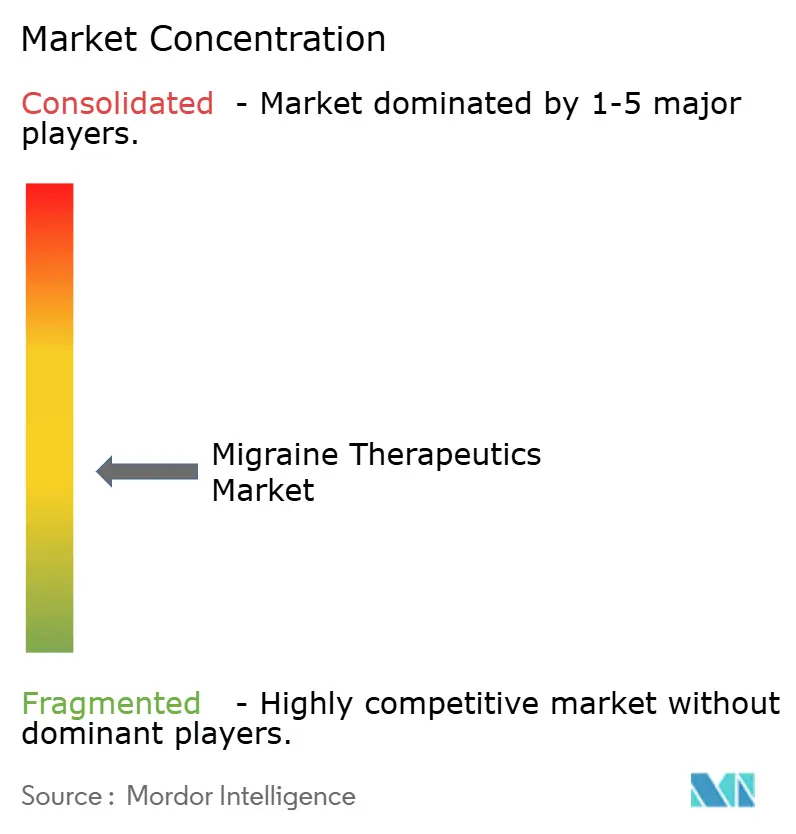
| Market Concentration | Medium |
Major Players
*Disclaimer: Major Players sorted in no particular order Image © Mordor Intelligence. Reuse requires attribution under CC BY 4.0. |
|
Migraine Therapeutics Market Analysis by Mordor Intelligence
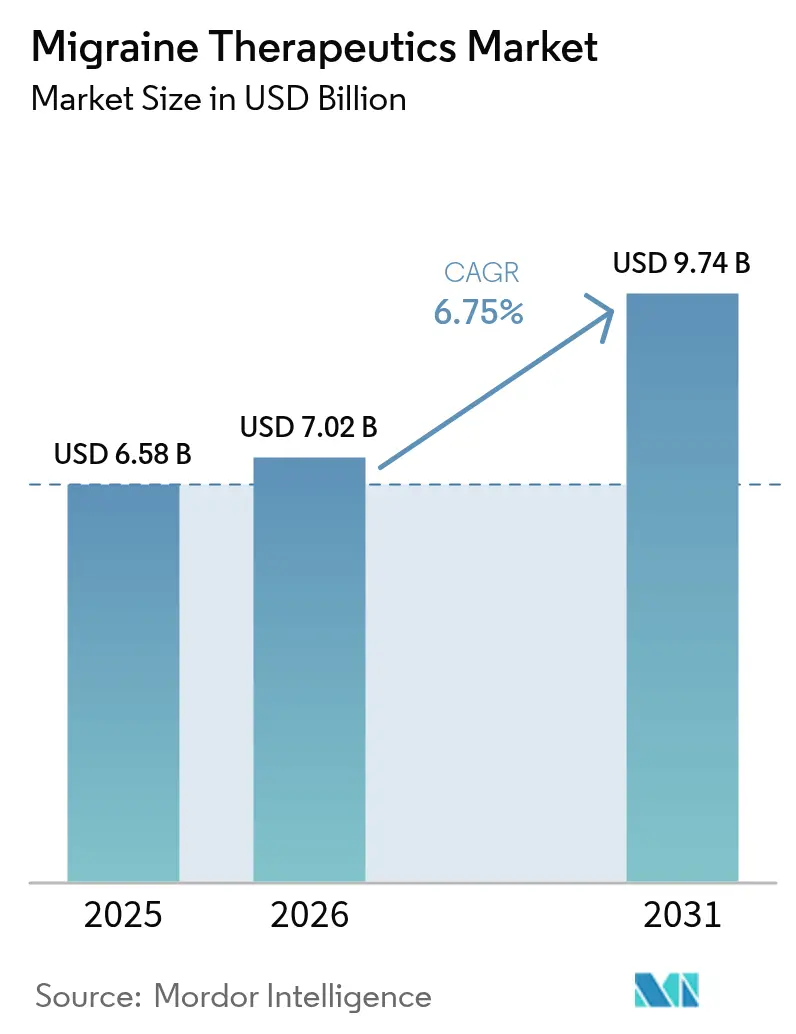
The migraine therapeutics market size expanded from USD 6.58 billion in 2025 to USD 7.02 billion in 2026 and is projected to reach USD 9.74 billion by 2031, advancing at a 6.75% CAGR over 2026-2031. Rising uptake of calcitonin gene-related peptide (CGRP) antibodies, fast-acting oral gepants, and intranasal zavegepant sprays accelerates the migraine therapeutics market, while triptans, NSAIDs, and ergot derivatives continue to anchor acute care portfolios. Manufacturers prioritize real-world adherence evidence, pediatric label extensions, and telehealth partnerships as differentiators, given that payers increasingly demand economic outcomes rather than head-to-head efficacy trials. Teleneurology bridges diagnostic gaps in Asia-Pacific, where up to 90% of migraine patients remained untreated before 2024, and now delivers guideline-concordant preventive prescriptions 22 percentage points more often than episodic emergency-department encounters. Intranasal delivery systems such as POD DHE offer sub-15-minute onset for patients who abandon subcutaneous biologics because of injection anxiety, estimated at 30-40% globally.
Key Report Takeaways
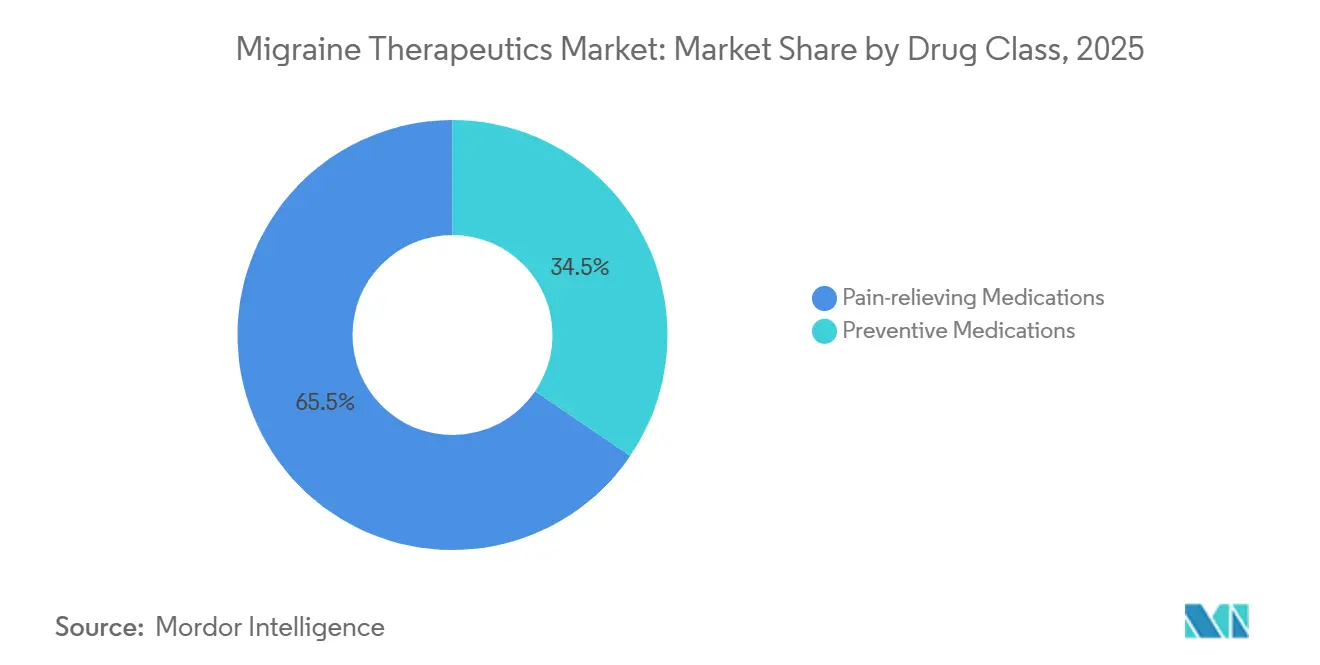
- By drug class, pain-relieving medications retained 65.55% of the migraine therapeutics market share in 2025, whereas preventive medications are forecast to expand at a 9.85% CAGR through 2031.
- By route of administration, intranasal delivery commanded 11.75% CAGR between 2026-2031, surpassing the growth of oral and subcutaneous formats.
- By patient group, adolescents recorded a 10.82% CAGR from 2026-2031 after U.S. and EU regulators cleared fremanezumab and eptinezumab for ages 6-17.
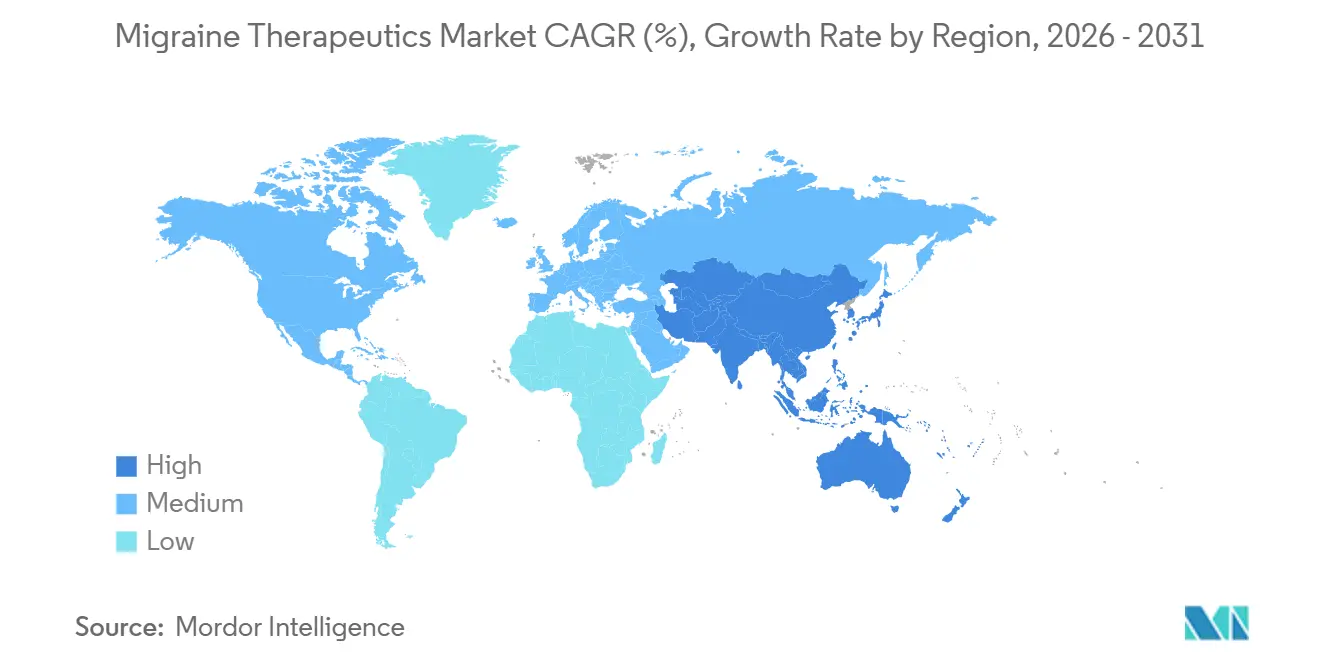
- By geography, North America accounted for 42.55% revenue in 2025, while Asia-Pacific leads growth at 9.72% CAGR through 2031.
Note: Market size and forecast figures in this report are generated using Mordor Intelligence’s proprietary estimation framework, updated with the latest available data and insights as of 2026.
Market Trends and Insights
Drivers Impact Analysis of Migraine Therapeutics Market*
| Driver | (~) % Impact on CAGR Forecast | Geographic Relevance | Impact Timeline |
|---|---|---|---|
| Rapid penetration of CGRP antibodies into first-line prevention | +2.8% | Global, led by North America & Western Europe | Medium term (2-4 years) |
| Oral gepants closing the "triptan-non-responder" gap | +1.9% | North America, Europe, Japan | Short term (≤2 years) |
| Post-pandemic telehealth adoption accelerates accurate diagnosis & Rx | +1.2% | Global, strongest in APAC & Latin America | Short term (≤2 years) |
| Favorable reimbursement in EU for preventive biologics | +0.9% | Western Europe (UK, France, Germany, Spain, Italy) | Medium term (2-4 years) |
| Devices enabling upper-nasal or POD DHE delivery | +0.7% | North America & Europe, early adoption in urban APAC | Medium term (2-4 years) |
| Employer-funded migraine-care programmes in Asia-Pacific | +0.4% | APAC core (Japan, China, Singapore), spill-over to India | Long term (≥4 years) |
| Source: Mordor Intelligence | |||
Rapid Penetration of CGRP Antibodies Into First-Line Prevention
The American College of Physicians allowed CGRP antibodies after failure of a single preventive in its 2025 guideline, trimming median time to biologic from 18 months to 5.7 months for commercially insured U.S. adults. Real-world Danish registry tracking shows 52% 12-month adherence for rimegepant compared with 31% for topiramate, largely because gepants avoid cognitive side effects and weight gain. Eptinezumab’s quarterly infusion schedule attracts patients intolerant of monthly injections, capturing 18% U.S. biologic share within two years of launch and broadening into pediatrics after October 2024 approval for ages 6-17. Payers accept higher drug costs as emergency-department admissions fall 53% and inpatient stays drop 41% among chronic migraine patients treated with CGRP therapy, delivering USD 4,200 net savings per member annually. Meta-analysis positions erenumab and fremanezumab as superior to flunarizine or valproate by reducing monthly migraine days by 2.4-3.1 versus 1.6-2.0, fueling formulary prioritization.
Oral Gepants Closing the “Triptan-Non-Responder” Gap
Roughly 30-40% of migraine sufferers gain little benefit from triptans because of inadequate efficacy or cardiovascular contraindications, creating headroom for oral gepants that block CGRP receptors without vasoconstriction. The HeAD-US real-world study in 1,856 patients showed similar two-hour pain freedom between gepants and triptans (about 21%) but eight-point higher 24-hour pain relief for gepants, lowering risk of medication overuse. Atogepant became the first oral daily CGRP preventive for chronic migraine in December 2024, offering needle-free convenience that resonates with rural patients lacking refrigeration access. Zavegepant nasal spray delivers pain freedom in 24% within two hours and onset inside 15 minutes, bridging the speed gap between tablets and injections. Rimegepant’s dual acute-plus-preventive label simplifies regimens for episodic patients, improving adherence when attack frequency fluctuates.
Post-Pandemic Telehealth Adoption Accelerates Accurate Diagnosis & Rx
Neurology teleconsultations soared 340% between 2019-2023 and stabilized 220% above baseline through 2025, driven by specialist shortages and patient preference for at-home care. Italian registry evidence found virtual visits delivered guideline-correct preventive therapy in 68% of cases versus 46% for emergency departments, thanks to structured diaries and phenotype categorization. China leaned on policy to reimburse remote neurology in 2024, unlocking access for 180 million migraine patients who seldom saw specialists beforehand. Tele-prescribing of CGRP therapies trims treatment initiation time by 23 days compared with brick-and-mortar pathways, as integrated pharmacy services expedite prior authorization. Spanish data indicate adherence improves 19 points under tele-follow-up, reflecting more frequent dosage optimization touchpoints.
Favorable Reimbursement in EU for Preventive Biologics
NICE endorsed atogepant (TA973), eptinezumab (TA871), and erenumab (TA682) between 2021-2024 for adults with ≥4 migraine days monthly after two preventive failures, harmonizing payer criteria with clinician practice. France reimbursed atogepant in 2024 for patients with ≥8 migraine days per month but rejected rimegepant and all monoclonals, splitting EU demand between oral gepants in France and injectables in Germany and the UK. Germany awarded “considerable additional benefit” to fremanezumab and galcanezumab, enabling list-price premiums and unrestricted access that outpace Spain’s capped regional budgets. Italy negotiated 40-50% confidential discounts, maintaining volume growth without breaching healthcare budgets—a model eyed by Poland and Portugal. The EMA cleared atogepant for adolescents 12-17 in 2024, yet reimbursement lag of 18-24 months continues to temper uptake.
Restraints Impact Analysis of Migraine Therapeutics Market*
| Restraint | (~) % Impact on CAGR Forecast | Geographic Relevance | Impact Timeline |
|---|---|---|---|
| High biologic list prices & step-therapy restrictions | -1.4% | North America & select EU markets (France, Spain, Italy) | Long term (≥4 years) |
| Safety concerns around ditans' driving-impairment label | -0.6% | Global, most acute in North America & Japan | Medium term (2-4 years) |
| Limited paediatric approvals outside US & JP | -0.4% | Europe (ex-UK), APAC (ex-Japan), Latin America, MEA | Medium term (2-4 years) |
| Supply-chain cold-chain gaps in GCC & Africa | -0.3% | GCC, Sub-Saharan Africa, select emerging APAC markets | Long term (≥4 years) |
| Source: Mordor Intelligence | |||
High Biologic List Prices & Step-Therapy Restrictions
CGRP monoclonal antibodies list at USD 8,100-9,400 annually in the U.S., prompting step-therapy in 72% of commercial and 89% of Medicaid plans. Step protocols postpone CGRP use by 14.3 months and correspond with 38% higher emergency visits, adding USD 11,200 avoidable costs that eclipse the drug price. France assigned ASMR V (“no added benefit”) to monoclonals, denying reimbursement and steering neurologists to atogepant or off-label Botox. Absence of biosimilar CGRP antibodies before 2029-2031 preserves price rigidity, ensuring payer resistance will persist beyond the forecast window[1].
Safety Concerns Around Ditans’ Driving-Impairment Label
Lasmiditan requires an eight-hour driving restriction because dizziness affects 29.2% of users, limiting uptake to 12% of eligible U.S. adults who can avoid driving during attacks. Korean real-world data show 22% discontinuation within three months, almost double gepant discontinuation, because of dizziness and fatigue. European and Japanese regulators imposed similar driving cautions, further narrowing the addressable pool to home-based patients.
*Our forecasts treat driver/restraint impacts as directional, not additive. The impact forecasts reflect baseline growth, mix effects, and variable interactions.
Migraine Therapeutics Market Segment Analysis
By Drug Class:
Preventive Biologics Reshape Treatment AlgorithmsPain-relieving medications retained 65.55% of migraine therapeutics market share in 2025, led by triptans and NSAIDs, whereas preventive agents are forecast to grow 9.85% CAGR through 2031, increasing their slice of migraine therapeutics market size. Triptans stay dominant because of generic prices and prescriber familiarity, yet oral gepants capture up to 30-40% of triptan-non-responders, shrinking triptan volumes modestly over the period. Ditans remain niche as their driving label curbs weekday use. CGRP monoclonal antibodies and oral gepants propel preventive uptake after guidelines moved them to second-line status. Botulinum toxin A anchors chronic migraine prevention with long-standing efficacy, although atogepant’s chronic label now challenges its near-monopoly. Anticonvulsants and beta-blockers lose ground because of poor tolerability, evidenced by 28-35% 12-month persistence, fueling migration to CGRP options. Meta-analysis shows erenumab and fremanezumab lower monthly migraine days by 2.4-3.1 versus 1.6-2.0 for flunarizine, justifying payer preference for biologics despite cost premium. France’s refusal to fund monoclonals but coverage of atogepant illustrates divergent European formularies that influence brand strategy.
Shifts within migraine therapeutics market size mirror clinical innovation tempo. Quarterly eptinezumab infusions entice patients unwilling to self-inject monthly. Oral gepants such as atogepant appeal to chronic patients seeking daily, needle-free dosing. Rimegepant offers dual acute-plus-preventive versatility, easing pill burden for episodic sufferers. Ditans await label refinements to lift mobility restrictions. Ergot alkaloids slide because of vasoconstrictive risk. As biosimilars are unlikely before 2030, originators keep pricing power, while generic triptan suppliers defend share on volume and price.
By Route of Administration:
Intranasal Delivery Gains MomentumOral therapies commanded 64.53% of migraine therapeutics market share in 2025; nevertheless, intranasal products are forecast to outpace all routes at 11.75% CAGR through 2031, lifting their slice of migraine therapeutics market size. Zavegepant spray secures 24% 2-hour pain freedom and sub-15-minute onset without injections, appealing to patients who abandon subcutaneous biologics over needle anxiety[2]. Impel’s POD DHE technology achieves 73.3% 2-hour pain freedom and pharmacokinetics resembling IV delivery, supplying hospital-level efficacy at home. Subcutaneous autoinjectors dominate preventive biologics but face adherence drag owing to injection-site reactions reported by 38% of users. Quarterly eptinezumab IV infusions offer less-frequent dosing yet require clinic visits, limiting uptake among rural patients. Oral gepants expand the oral segment further, particularly after atogepant’s chronic label. Transdermal patches and microneedle arrays promise discreet workplace administration for sumatriptan and other actives. Cold-chain deficits in GCC and Africa complicate biologic distribution, nudging prescribers toward ambient-stable oral and intranasal options.
Although oral remains the largest share, intranasal momentum reflects unmet need for rapid-onset, needle-free acute relief. Real-world audits show 30-40% of patients discontinue injectables within a year, and 40-50% develop gastroparesis during moderate attacks that slows tablet absorption, both factors that intranasal delivery directly addresses. Regulatory approvals for zavegepant in 2023 and growing POD device familiarity suggest sustained double-digit growth for nasal formats.
By Patient Group:
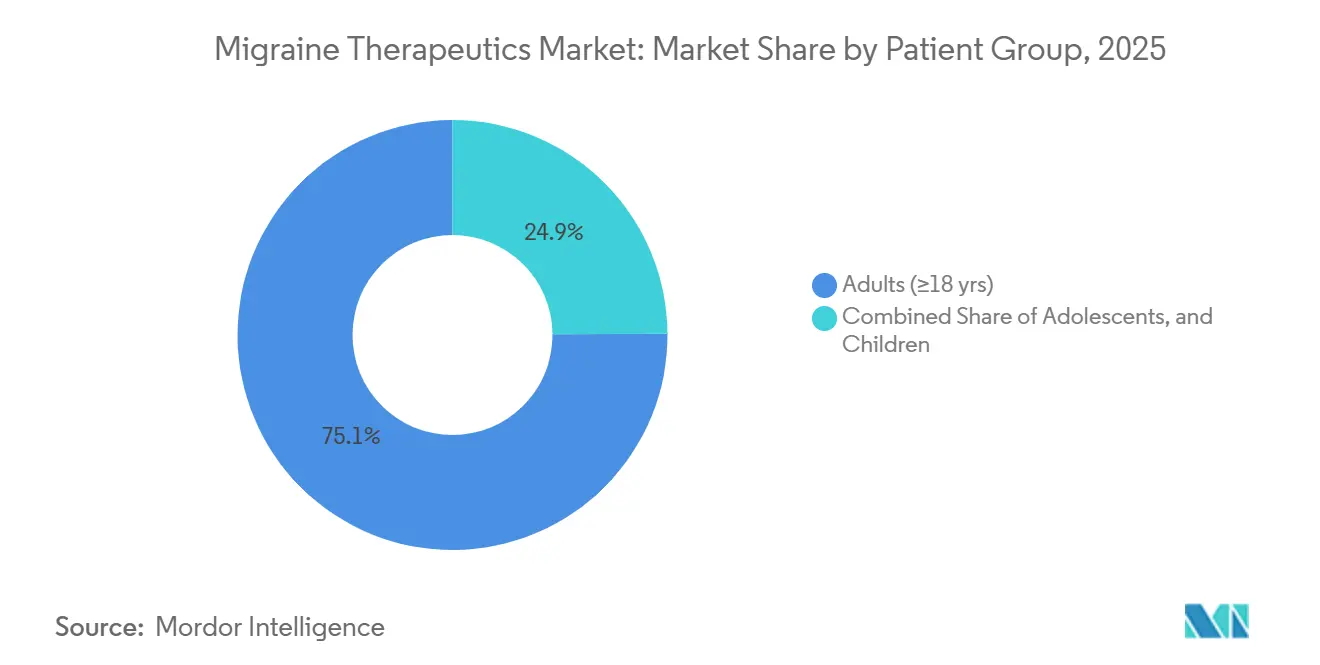
Pediatric Approvals Unlock Adolescent SegmentAdults ≥ 18 years controlled 75.15% of migraine therapeutics market share in 2025, yet adolescents 12-17 are projected to grow at a 10.82% CAGR through 2031, lifting their weight in migraine therapeutics market size. Teva’s fremanezumab won the first pediatric CGRP approval in April 2024, quickly followed by Lundbeck’s eptinezumab in October 2024, opening a historically underserved cohort where off-label usage dominated. AbbVie’s atogepant read-outs expected late 2026 signal further adolescent competition. EMA’s clearance of atogepant for EU adolescents in 2024 enlarges the market by 12 million potential patients, although reimbursement lags will slow monetization. Children under 12 remain largely unserved, leaving scope for future label extensions as safety databases mature.
Adolescent prevalence spikes during puberty, yet diagnosis trails adults by 40% because headache symptoms overlap with tension-type disorders and few pediatric neurologists practice outside urban hubs. Telehealth reduces wait times and broadens subspecialty reach, accelerating earlier preventive intervention. Generic triptans still dominate acute care in youth, but gepants gain share among cardiovascular-contraindicated or refractory cases. As school schedules magnify the burden of frequent attacks, quarterly IV eptinezumab and monthly subcutaneous fremanezumab attract parents seeking convenient regimens, driving robust double-digit pediatric growth.

Geography Analysis
North America Migraine Therapeutics Market
North America secured 42.55% of 2025 revenue thanks to high diagnosis rates, broad commercial coverage for CGRP biologics, and dense specialty-clinic networks. Yet step-therapy adds 14.3-month delays and 38% more emergency visits, undercutting optimal outcomes. Canada’s fragmented provincial formularies cause inconsistent access; Ontario funds biologics after four migraine days monthly, while Quebec restricts to chronic cases. Mexico’s private insurers reimburse CGRP agents for urban elites, but national coverage gaps leave most reliant on triptans.
Europe Migraine Therapeutics Market
Europe presents a split landscape. The UK funds atogepant, erenumab, and eptinezumab after two preventive failures, aligning with clinical norms. Germany’s positive “additional benefit” rulings give broad reimbursement, whereas Spain’s spending caps enforce mid-year pauses. France funds only atogepant among CGRP agents, channeling demand to oral therapy and Botox. Italy’s steep discounts keep biologic budgets manageable and volumes rising, offering a blueprint for other cost-sensitive EU states.
APAC, MEA and South America Migraine Therapeutics Market
Asia-Pacific leads growth at 9.72% CAGR. China’s 2024 telemedicine reimbursement adds 180 million potential patients who previously lacked specialist care[3]. India awaits its first CGRP approvals; until then, generic triptans and anticonvulsants dominate. Australia reimburses erenumab and fremanezumab for chronic migraine but not episodic disease, capturing the sickest cohort. South Korea listed rimegepant in 2024, the region’s first reimbursed oral gepant, catalyzing adoption momentum. Middle East and Africa confront 4-6-week biologic distribution delays because of cold-chain limitations, sustaining dominance of oral and intranasal drugs. South America’s growth focuses on Brazil and Argentina, where private insurance covers CGRP biologics, whereas public systems remain price-constrained.
Regulatory Landscape
Regulatory requirements for migraine therapeutics continue to be shaped by regulator-issued clinical guidance for acute and preventive indications. In the United States, the FDA maintains dedicated guidance on developing drugs for acute and preventive treatment of migraine, which affects endpoint selection, study design, and safety requirements for both small molecules (for example, gepants and ditans) and biologics. In the European Union, the EMA framework is anchored by its scientific guideline on clinical investigation for migraine, supporting harmonized evidence expectations across member states.
Recent label and indication actions reflect ongoing lifecycle management, with continued attention to delivery and broader eligible populations. In June 2026, the European Commission approved AbbVie AQUIPTA (atogepant) for the acute treatment of migraine in adults, expanding its EU indication for prophylaxis, following an EMA CHMP positive opinion for a variation in April 2026. In the United States, the FDA approval of Amneal Brekiya (dihydroergotamine mesylate) injection in May 2025 as a ready-to-use autoinjector for acute migraine and cluster headache highlights how device-enabled administration improvements can accelerate access to established molecules.
Competitive Landscape
The migraine therapeutics market features moderate concentration: the five largest companies—AbbVie, Amgen, Eli Lilly, Pfizer, and Teva—accounted for a significant share of revenue in 2025. AbbVie leverages Botox plus atogepant, balancing injectable and oral franchises. Amgen’s Aimovig pioneered monoclonals but now faces share dilution from Lilly’s Emgality, Teva’s Ajovy, and Lundbeck’s Vyepti, each carving niches via dosing frequency or pediatric expansion. Generic firms Teva, Viatris, and Sun Pharma dominate triptan volumes, defending their turf as gepants erode non-responder pools.
Strategic focus shifts to real-world data generation. Danish registry findings showing higher rimegepant adherence allow manufacturers to differentiate without costly head-to-head trials. Pediatric approvals extend patent life and tap underserved segments, while geographic diversification adapts to reimbursement heterogeneity. Impel’s POD DHE represents an innovative entrant targeting rapid nasal rescue for post-triptan failure. Neuromodulation devices (Cefaly, Nerivio, gammaCore) occupy adjunctive niches but face reimbursement hurdles. Absent biosimilars postpone price erosion, preserving brand margins through 2031.
Migraine Therapeutics Industry Leaders
-
AbbVie Inc.
-
Amgen Inc.
-
Pfizer Inc.
-
Teva Pharmaceutical Industries Ltd.
-
Eli Lilly and Company
- *Disclaimer: Major Players sorted in no particular order
Migraine Therapeutics Market Companies Covered in this Report
- Abbvie
- Amgen
- Amneal Pharmaceuticals
- AstraZeneca
- Biohaven Pharmaceutical Holding Company Ltd.
- Bausch Health
- Bayer
- Dr. Reddy’s Laboratories
- Eli Lilly and Company
- GlaxoSmithKline
- H. Lundbeck
- Impel Pharmaceuticals Inc.
- Johnson & Johnson
- Merck
- Novartis
- Pfizer
- Sun Pharmaceuticals Industries
- Teva Pharmaceutical Industries
- Viatris
Market Opportunities and Future Outlook
Pipeline diversification beyond CGRP is becoming a more visible opportunity as development targets expand to PACAP and other pathways. PACAP-pathway approaches have been a notable development vector, with H. Lundbeck presenting Phase IIb PROCEED data for bocunebart (a PACAP-targeting monoclonal antibody) at the European Academy of Neurology Congress in June 2026. Large-scale trials are also running for novel acute agents, including Kallyope's Phase III study for elismetrep (K-304) for acute migraine treatment with enrollment around 1,800 patients.
Differentiation through modality and delivery is creating whitespace where oral absorption can be unreliable during attacks and where patients avoid injections. Next-generation intranasal and nose-to-brain formulation work remains under active academic exploration for faster onset and improved bioavailability, building on commercially established intranasal options. Prevention competition is also tightening within established classes, with Ipsen reporting positive Phase III topline results in July 2026 for its BEOND program evaluating Dysport (abobotulinumtoxinA) in episodic and chronic migraine, adding another branded botulinum toxin option to a segment historically anchored by botulinum toxin A use in chronic migraine.
Recent Industry Developments in Migraine Therapeutics Market
- June 2026: Ipsen announced positive Phase III topline results from its BEOND clinical program evaluating Dysport (abobotulinumtoxinA) for preventing episodic and chronic migraine. The readout broadens competitive pressure in migraine prevention beyond CGRP-based therapies and strengthens the case for differentiated injectable prevention options across multiple migraine subtypes.
- May 2025: Amneal launched Brekiya (dihydroergotamine mesylate) in the United States as a ready-to-use autoinjector for the acute treatment of migraine and cluster headache in adults. By simplifying DHE administration into an autoinjector format, the launch supports faster at-home rescue use and adds an alternative for patients who cycle through or do not respond to standard oral acute regimens.
- April 2024: Teva fremanezumab (AJOVY) received a pediatric CGRP approval for ages 6-17, expanding access to preventive therapy in pediatric populations. The label expansion increases competitive dynamics for adolescent and pediatric prescribing and supports payer and provider efforts to move prevention earlier for patients with high attack frequency.
Migraine Therapeutics Market Report Scope and Research Methodology
Market Definition and Coverage
The migraine therapeutics market is defined as the revenues generated from medicines used to treat or prevent migraine, including prescription medicines and commonly used drug classes that are routinely recommended in clinical practice across major regions.
Scope exclusions: It excludes diagnostic tests, physician consultation fees, inpatient procedure charges, and non-drug wellness products that do not have a therapeutic drug label.
Segments Covered in This Report
-
By Drug Class
-
Pain-relieving Medications
- Analgesics
- Triptans
- Ergot Alkaloids
- Ditans
- NSAIDs
-
Preventive Medications
- Blood-pressure-lowering Agents
- Anticonvulsants
- Calcitonin Gene-related Peptide (CGRP) Antagonists
- Botulinum Toxin A
- Antidepressants
-
Pain-relieving Medications
-
By Route of Administration
- Oral
- Subcutaneous Injection
- Intranasal
- Intravenous
- Transdermal / Other Novel
-
By Patient Group
- Adults (Greater Than 18 yrs)
- Adolescents (12-17 yrs)
- Children (Less than 12 yrs)
-
By Geography
-
North America
- United States
- Canada
- Mexico
-
Europe
- Germany
- United Kingdom
- France
- Italy
- Spain
- Rest of Europe
-
Asia-Pacific
- China
- India
- Japan
- Australia
- South Korea
- Rest of Asia-Pacific
-
Middle East and Africa
- GCC
- South Africa
- Rest of Middle East and Africa
-
South America
- Brazil
- Argentina
- Rest of South America
-
North America
Data Sources, Market Sizing, and Validation
Desk Research
Desk research starts with building a clean view of the migraine burden, treatment patterns, and access conditions that shape demand. We review non-paywalled sources such as the CDC, NIH, and WHO for epidemiology signals, and we also use FDA and EMA public drug-label databases to track approvals, indications, and safety updates that can shift usage.
To anchor market mechanics, we refer to sources such as the World Bank and OECD for health spending context, and we cross-check clinical literature in PubMed for changes in guideline-backed care, including acute versus preventive use. Company filings, investor presentations, and reputable press are used to understand pipeline timing and broad pricing direction. Where needed, paid subscriptions for company financials and patent intelligence are used to validate launch timing and portfolio exposure. This list is not exhaustive, and many other public sources were also used for data collection, validation, and clarification.
Primary Interviews and Surveys
Primary work is used to stress-test the desk assumptions and fill the gaps that public data does not explain well, especially around real prescribing mix, persistence on therapy, and payer controls. We speak with a blend of clinicians, pharmacists, payers, distributors, and manufacturer-side commercial or medical roles across APAC, EMEA, and the Americas so the model reflects how migraine care is delivered in different settings.
Distribution of primary research fieldwork respondents
| Company type | Respondent position | Region |
|---|---|---|
| Top tier: 37% | CXOs: 17% | APAC: 47% |
| Mid tier: 41% | Functional/Unit leaders: 29% | EMEA: 34% |
| Smaller Players: 22% | Managers: 54% | Americas: 19% |
Market-Sizing & Forecasting
Market sizing is built using a top-down, treated-patient demand pool that is reconstructed by region from migraine prevalence, diagnosis and treatment rates, and the split of acute versus preventive therapy. Once this pool is defined, value is estimated by applying therapy mix and typical annualized therapy cost ranges, which are then adjusted for channel and reimbursement realities discussed with interviewees.
To keep outputs practical, we use a small set of measurable inputs that can be tracked each year, such as CGRP antagonist uptake versus older classes, triptan and NSAID utilization trends, route-of-administration shifts (oral versus intranasal or injection), new label expansions, and changes in payer restrictions that affect access. Results are corroborated with selective bottom-up checks, such as supplier revenue direction, sampled price points, and country-level channel checks, and then totals are adjusted if the implied usage looks inconsistent with the treated population size.
Forecasting is mainly run through scenario analysis supported by expert consensus, because launches, patent timing, and reimbursement can change the adoption curve quickly. When data is thin for smaller countries, proxy ratios from similar healthcare systems are applied and normalized so the regional totals still align with the overall treated cohort logic.
Data Validation & Update Cycle
Validation is done through step-by-step checks where model outputs are compared with independent signals, including drug approval timelines, epidemiology ranges, and the direction of class-level adoption shared by clinicians and payers. Outliers are investigated at the country and therapy-class level so unexpected jumps are explained by a real driver, not a formula artifact.
Before sign-off, the work is reviewed by another analyst who rechecks core assumptions, unit logic, and currency conversions, and any large variances trigger follow-up calls with selected respondents. Reports are refreshed annually, and interim updates are made when material events occur, such as a major approval, safety update, or reimbursement change. Right before delivery, we run a fresh review pass so the client receives the latest updated view.
Mordor Intelligence's Migraine Therapeutics Market Size Versus Other Published Estimates
Published market values for migraine therapeutics can look far apart because the underlying scope is not always aligned, even when the title is similar. Differences usually come from what is counted as a migraine therapy, how acute and preventive classes are treated, and how pricing and uptake are carried forward through the forecast years.
The key gap drivers in this market are often whether older, generic-heavy drug classes are fully included, whether off-label preventive use is treated as part of the addressable market, and how fast newer CGRP therapies are assumed to penetrate under payer controls. Currency timing also matters because pricing is set and reimbursed locally, and some publishers convert using different year averages or different inflation assumptions.
Benchmark comparison
| Source | Market Size | Gaps in Research Methodology |
|---|---|---|
| Mordor Intelligence | USD 7.02 B (2026) | |
| Global Consultancy A | USD 6.81 B (2024) | Uses an earlier base year and a broader 'migraine drugs' framing that may blend prescription and non-prescription demand without a consistent treated-patient build by country, which can shift totals when access rules differ. |
| Industry Publisher B | USD 4.80 B (2024) | Leans on aggressive long-horizon growth to 2034 with limited visibility on class-level mix, payer step therapy, and persistence, which can depress the stated current-year value while stretching the forward curve. |
The table shows a spread mainly because the base year and counted demand pool are not the same across sources, and in Mordor Intelligence's model the sizing is anchored to treated migraine patients and therapy mix by class and route, then checked against adoption and access signals from interviews. With that structure, the number stays traceable to clear inputs, and updates are easier when a new label, reimbursement decision, or utilization shift happens.
Key Questions Answered in the Report
What is the projected value of the migraine therapeutics market in 2031?
The migraine therapeutics market is forecast to reach USD 9.74 billion by 2031.
How fast will preventive medications grow compared with acute treatments?
Preventive medications are expected to expand at a 9.85% CAGR through 2031, outpacing the overall 6.75% CAGR.
Which region will register the quickest growth in demand?
Asia-Pacific is projected to advance at 9.72% CAGR between 2026-2031, the fastest among all regions.
Which delivery route is gaining popularity for rapid pain relief?
Intranasal formulations, led by zavegepant and POD DHE devices, are growing at 11.75% CAGR thanks to sub-15-minute onset.
Why are CGRP antibodies penetrating earlier therapy lines?
Updated guidelines allow their use after failure of one preventive, shortening time-to-biologic and leveraging superior real-world adherence.
What limits widespread adoption of lasmiditan?
An eight-hour post-dose driving restriction and high dizziness incidence confine its use to situations where patients can avoid vehicle operation.