
Market Overview
| Study Period | 2019 - 2031 |
|---|---|
| Forecast Data Period | 2026 - 2031 |
| Base Year Market Size (2025) | USD 1.24 Billion |
| Market Size (2026) | USD 1.26 Billion |
| Market Size (2031) | USD 1.64 Billion |
| Growth Rate (2026 - 2031) | 5.41 % |
| Market Concentration | Medium |
Major Players *Disclaimer: Major Players sorted in no particular order Image © Mordor Intelligence. Reuse requires attribution under CC BY 4.0. | |
Middle East Riot Control System Market Analysis by Mordor Intelligence
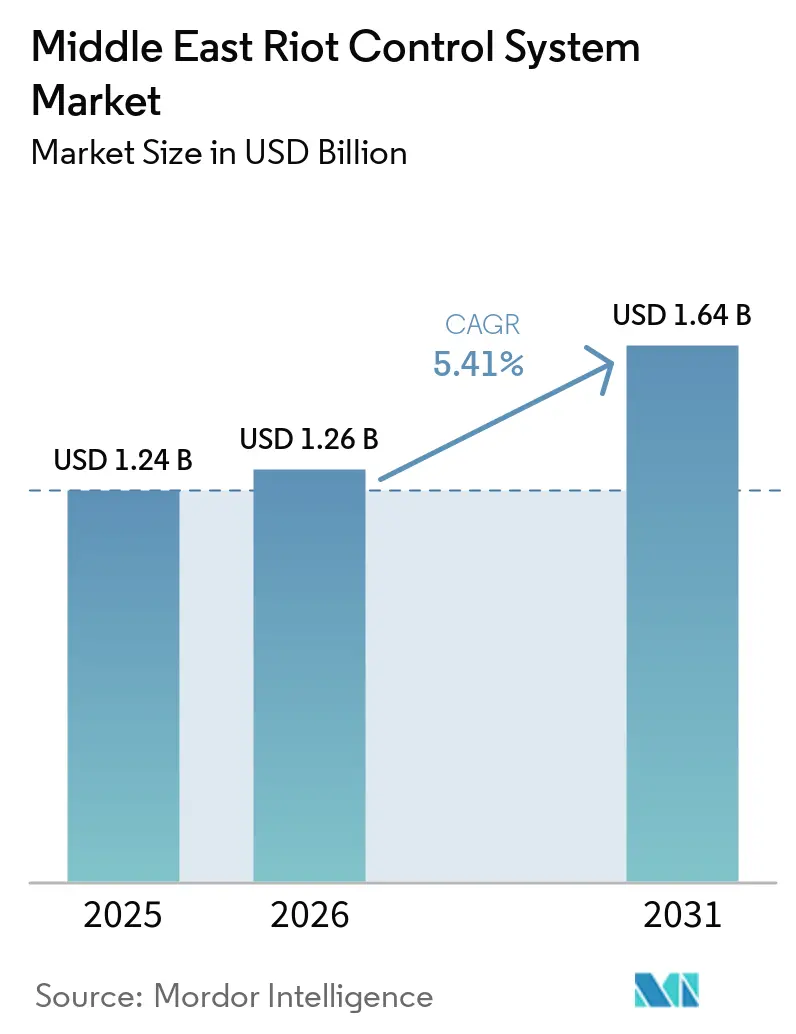
The Middle East riot control system market size was valued at USD 1.24 billion in 2025 and is forecast to grow from USD 1.26 billion in 2026 to reach USD 1.64 billion by 2031, at a 5.41% CAGR during the forecast period (2026-2031). Demand is being shaped by the need to renew equipment after civil unrest and to maintain readiness across large police forces that must respond in cities, at borders, and at critical infrastructure locations. Governments are also linking public-order capabilities with border security, which favors equipment that can be used across several operational settings and carried by forces rotating between domestic and perimeter assignments. Local manufacturing requirements in Saudi Arabia and the UAE are changing how suppliers approach procurement, partnerships, and production, particularly where contract eligibility depends on credible local-content commitments. Digital integration is becoming more relevant where public-safety systems are connected to smart-city platforms. Export controls and shortages of protective-material inputs may delay orders, require agencies to carry more inventory, and make dependable lead times a greater factor in supplier selection.
Key Report Takeaways
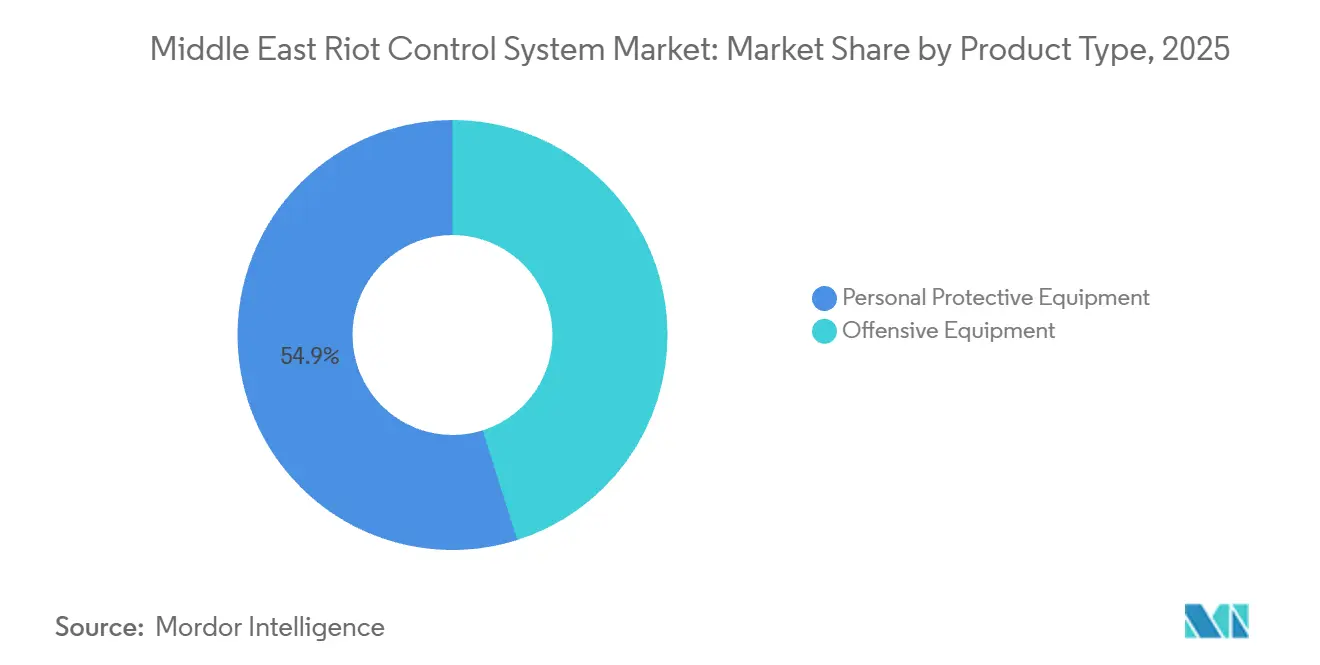
- By product type, personal protective equipment held 54.87% of revenue in 2025, while offensive equipment is forecast to grow at a 6.17% CAGR through 2031.
- By end-user, law enforcement held 66.84% of revenue in 2025, while special forces is forecast to grow at a 6.06% CAGR through 2031.
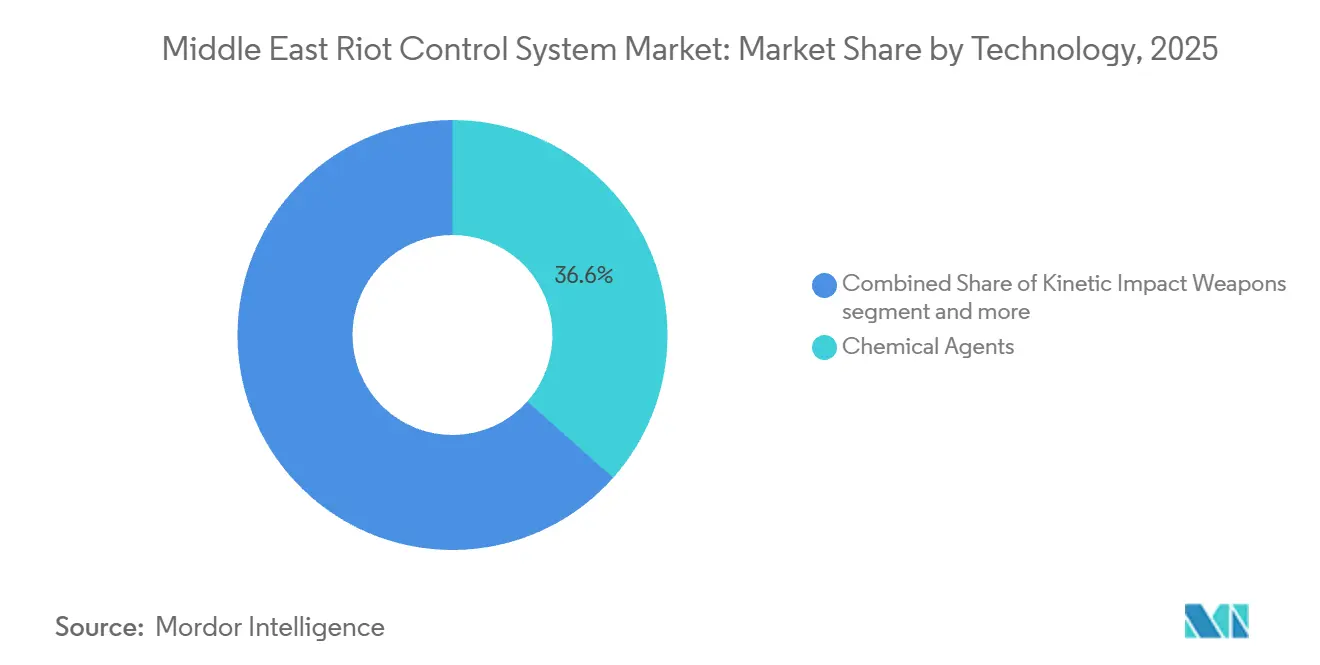
- By technology, chemical agents accounted for 36.56% of revenue in 2025, while electronic and sonic weapons are forecast to grow at a 7.01% CAGR through 2031.
- By geography, Saudi Arabia held 33.98% of revenue in 2025, while the UAE is forecast to grow at a 6.21% CAGR through 2031.
Note: Market size and forecast figures in this report are generated using Mordor Intelligence’s proprietary estimation framework, updated with the latest available data and insights as of January 2026.
Middle East Riot Control System Market Trends and Insights
Drivers Impact Analysis*
| Driver | (~) % Impact on CAGR Forecast | Geographic Relevance | Impact Timeline |
|---|---|---|---|
| Escalating civil-unrest incidents post-2025 | +1.20% | Saudi Arabia, Israel, Iran, Rest of Middle East and Africa | Short term (≤ 2 years) |
| Intensifying border-security programmes (Red Sea and Sahel) | +0.90% | Saudi Arabia, UAE, global coalition partners | Medium term (2-4 years) |
| GCC smart-city policing budgets (e.g., NEOM) | +0.80% | Saudi Arabia, UAE | Medium term (2-4 years) |
| Procurement subsidies via the Tawazun Economic Program | +0.60% | UAE, with spillover to Saudi Arabia | Long term (≥ 4 years) |
| Emergence of bio-degradable irritant payloads | +0.50% | Global, with early gains in Israel and the GCC | Medium term (2-4 years) |
| Rapid miniaturisation of acoustic hailing devices | +0.40% | GCC core, with spillover to Jordan and Egypt | Short term (≤ 2 years) |
| Source: Mordor Intelligence | |||
Escalating Civil-Unrest Incidents Post-2025
Iranian protests that began in December 2025 had extended across all 31 provinces by January 2026, placing sustained demand on deployed security forces.[1] The events highlighted how prolonged operations can consume less-lethal munitions, protective equipment, and related supplies faster than normal replacement plans allow, especially when deployments span multiple locations simultaneously. The Middle East riot control system market, therefore, benefits when agencies review readiness levels and replenish equipment after periods of elevated use. Regional governments near Iran and Syria may assess domestic policing and border requirements together when instability spreads across neighboring areas, reducing the separation between preparedness budgets that had previously been managed independently. That approach supports purchases of scalable systems, including modular ammunition and acoustic hailing equipment, rather than only one-time consumables. It also makes delivery speed, local inventory, and supplier support more important in the Middle East riot control system market.
Intensifying Border-Security Programs
Saudi Arabia announced a 43-nation maritime defense coalition in July 2026 covering the Bab al-Mandab Strait, the Red Sea, and the Gulf of Aden, with headquarters in Riyadh. The coalition gives border and maritime security a more permanent place in regional capability planning, rather than treating these requirements solely as a short-term response to a specific incident. Units that manage maritime patrols and land crossings may also support urban crowd-management operations when needed, which means their training, mobility, communications, and equipment requirements can overlap. This operating model broadens demand for portable, multi-role equipment in the Middle East riot control equipment market, especially equipment suitable for rapid redeployment without a separate support structure. Migration pressure affecting Red Sea and Mediterranean routes also increases the value of systems that can move quickly between border and domestic assignments. Suppliers with products suited to several operational environments can address a wider set of procurement requirements.
GCC Smart-City Policing Budgets
Smart-city programs are moving public-safety procurement toward connected systems that integrate with broader C2 and monitoring networks, shifting the assessment from a hardware purchase to a broader operational-capability decision. Dubai Police deployed AI-enhanced Ghiath smart patrol vehicles in 2026 through partnerships with BYD and Al-Futtaim. Abu Dhabi Police also entered a strategic cooperation arrangement with Presight for an AI policing suite. These projects show why agencies may favor equipment that can share data with command systems and support coordinated field response, including the ability to provide real-time status information during fast-moving public-order incidents. In the Middle East riot control system market, connected helmets, shields, and acoustic equipment can more easily fit into smart public-safety designs. Manufacturers that rely solely on conventional protective specifications may be less competitive when digital connectivity is part of the tender criteria, even if their core protective performance remains acceptable to users.
Emergence of Bio-degradable Irritant Payloads
Environmental and accountability requirements are encouraging suppliers to consider crowd-control agents with lower persistence after deployment, particularly in dense urban environments where cleanup, documentation, and public exposure are material operational issues. A 2024 study reported that ionic-liquid formulations of PAVA exhibited water solubility and irritant effects comparable to those of natural capsaicin. Separate 2024 research assessed a capsaicin-based smoke agent with a 10% capsaicin concentration as an alternative to CS gas. These developments give chemistry-capable manufacturers a route to differentiate their offerings in the Middle East riot control system market, because formulation design can become as important as the launcher or dispersal hardware. High temperatures in GCC cities may also support faster degradation cycles and reduce surface contamination in confined public spaces. The shift could widen the gap between suppliers that develop formulations in-house and those that depend on standard irritant inputs. At the same time, buyers assess environmental handling and post-deployment cleanup alongside traditional effectiveness.
Restraints Impact Analysis*
| Restraint | (~) % Impact on CAGR Forecast | Geographic Relevance | Impact Timeline |
|---|---|---|---|
| EU-style export licensing pressure on MEA suppliers | -0.80% | Saudi Arabia, Israel, and European supplier-dependent markets | Short term (≤ 2 years) |
| Scarcity of UHMWPE and aramid fibres 2025-2028 | -0.60% | Global, with an acute effect on PPE suppliers to the region | Short term (≤ 2 years) |
| Tightened ESG screening by sovereign-wealth funds | -0.40% | Global, concentrated in European capital markets | Medium term (2-4 years) |
| Heightened public-perception risk after 2024 Sudan footage | -0.30% | Rest of Middle East and Africa, Israel, and export markets | Short term (≤ 2 years) |
| Source: Mordor Intelligence | |||
EU-Style Export Licensing Pressure on Middle East Suppliers
Council Decision (CFSP) 2025/779 took effect in April 2025and strengthened the controls governing the export of military technology and equipment from EU member states.[2] The decision requires licensing authorities to consider the risk that equipment could be used for internal repression or serious human-rights violations, bringing country conditions and end-use controls closer to the center of export review. Riot control agents listed under ML7 of the EU Common Military List are directly relevant to this framework. The Middle East riot control system market may face longer procurement schedules when buyers rely on European suppliers for irritants, electroshock systems, or acoustic devices. Agencies may respond by planning inventory further in advance or by assessing suppliers with non-EU supply chains. However, that choice can introduce separate requirements for qualification, maintenance, and operator familiarity. Production within the UAE can also become more attractive, as it reduces dependence on imports and supports local industrial policy.
Scarcity of UHMWPE and Aramid Fibers
Supply conditions for protective materials matter to the region's procurement cycle. Aramid fiber is a core input for vests, helmets, and hard armor plates. An April 2026 industry notice reported that aramid fiber lead times had moved from 2-6 weeks to 12-18 weeks or longer. Longer lead times can raise unit costs and leave agencies with fewer options when orders are needed on compressed schedules, particularly after periods of heavy deployment that reduce available equipment reserves. The Middle East riot control system market may therefore see greater interest in strategic stockpiles, local assembly, and suppliers with more secure access to materials. The constraint also raises the value of framework agreements that protect production capacity and delivery commitments, since dependable access can matter as much as the quoted purchase price for critical protective gear. This is particularly relevant for buyers who cannot defer replacements without affecting readiness.
*Our forecasts treat driver/restraint impacts as directional, not additive. The impact forecasts reflect baseline growth, mix effects, and variable interactions.
Segment Analysis
By Product Type: Protective Gear Leads While Offensive Systems Grow Faster
Personal protective equipment accounted for 54.87% of the Middle East riot control system market share in 2025. This segment includes ballistic vests, ceramic plate carriers, helmets, gas masks, ballistic shields, and face shields. Its demand is supported by the size of standing police and security forces in GCC countries, Israel, and other regional markets. Routine replacement is required because equipment is used in training, field deployment, and periodic compliance upgrades, with each of these activities placing wear on textiles, visors, fasteners, filters, and protective plates. Purchases can also be linked to ballistic protection standards, including NIJ and VPAM requirements, which can lead agencies to replace equipment even before it is fully exhausted in service. These factors give the protective-equipment category a stable role in the industry.
Offensive equipment is forecast to expand at a CAGR of 6.17% from 2026 to 2031. The Middle East riot control system market size for offensive equipment is supported by demand for area-denial systems, directed-energy devices, electro-shock platforms, and other graduated-response tools. Israel approved a Police Ordinance Amendment in 2026 that allows the deployment of water cannon only with clean water and requires audiovisual documentation for every use. This requirement supports interest in foam cannons and water-based alternatives, where chemical payloads face additional scrutiny. It also places greater value on equipment that enables agencies to provide a documented and proportionate response without altering the core operational purpose of water cannon deployment.
Ammunition categories include rubber bullets, bean bag rounds, sponge grenades, and wax bullets, and suppliers are improving accuracy and range. Gases and sprays continue to command significant volume due to cost and operator familiarity, while flashbang and sting grenades remain relevant for smaller, specialized uses. The coexistence of these products means procurement can still include conventional consumables even as agencies evaluate alternatives with lower environmental persistence.

By End-User: Law Enforcement Maintains Scale While Special Forces Gain Momentum
Law enforcement agencies accounted for 66.84% of the Middle East riot control system market in 2025. Their purchasing base includes Saudi Ministry of Interior forces, UAE federal and emirate police commands, and Israel's police and border police organizations. Large institutions commonly use multi-year framework agreements with a limited number of approved suppliers, providing procurement teams with continuity while enabling standardization of training, spare parts, maintenance, and equipment documentation. This structure can create volume certainty for vendors, while also giving buyers substantial negotiating leverage over pricing, delivery schedules, local support requirements, and the scope of product customization. Smaller suppliers can find it difficult to gain entry when they lack a record of supplying the approved product configurations and maintaining them locally over the full contract period. The arrangement supports existing suppliers with local support, proven delivery capabilities, and established institutional relationships. It also makes initial qualification important for companies seeking to enter the Middle East riot control system market. Vendors need to demonstrate that their equipment, training, documentation, maintenance arrangements, and spare-part availability meet the purchasing agency's operational requirements.
The special forces segment is expected to grow at a CAGR of 6.06% through 2031. These units increasingly combine counterterrorism work with rapid response during civil unrest events, which changes their equipment requirements. In July 2025, Genasys announced USD 1 million in LRAD orders for the Middle East and Africa, citing border incursions and large-scale demonstrations as drivers of demand. Special forces specifications favor lighter systems, compact acoustic hailing devices, and equipment compatible with unmanned aerial or ground platforms. Israeli procurement of advanced riot-control vehicles illustrates this shift toward vehicles with foam cannons, pepper-spray nozzles, malodorant sprayers, aiming lasers, and facial-recognition cameras. Suppliers able to maintain pre-positioned inventory can be better prepared for requirements tied to spontaneous demonstrations. This approach reduces the dependency on standard global logistics routes when agencies need a replacement vehicle, acoustic system, or consumable stock on short notice.
By Technology: Chemical Agents Retain Scale While Electronic And Sonic Weapons Advance
Chemical agents accounted for 36.56% of the Middle East riot control system market share in 2025. The category includes CS gas, oleoresin capsicum sprays, PAVA-based irritants, and chemical additives used in water-cannon applications. The Chemical Weapons Convention permits riot-control agents for domestic law-enforcement purposes within defined conditions. This framework affects how agencies document and control their stocks. Chemical products retain a broad user base, but their composition may shift as agencies examine lower-persistence alternatives and apply stricter oversight. Agencies can weigh familiar operating procedures against new requirements for recordkeeping and cleanup. Suppliers that can explain chemical composition and handling controls may have an advantage. The Middle East riot control systems industry may therefore see a gradual shift rather than a rapid replacement of existing products.
Electronic and sonic weapons are forecast to grow at a 7.01% CAGR from 2026 to 2031. Acoustic hailing devices can provide instructions and warnings while also supporting escalation procedures. Genasys received a USD 2 million order in February 2026 to equip Singapore Navy unmanned surface vessels with LRAD 950NXT devices. This order illustrates the wider use of stabilized acoustic systems on remote platforms. Kinetic impact weapons continue to require replenishment because they are familiar to operators and relatively inexpensive. Human-rights documentation requirements may nevertheless increase training and reporting demands for their use. Agencies will need procedures that link equipment use to clear command decisions and records. That need supports demand for systems that can contribute to communication and accountability. Technology choices will reflect operational policy as well as technical performance.
Geography Analysis
Saudi Arabia held 33.98% market share in the Middle East riot control system market in 2025. The country continues to anchor demand through procurement by the Ministry of Interior and the Saudi Arabian National Guard. Vision 2030 targets 50% domestic sourcing of defense procurement by 2030, compared with a 24.9% localization baseline in 2024.[3] That direction encourages joint ventures and technology-transfer arrangements rather than direct-import relationships. The maritime coalition announced in July 2026 further supports demand for systems that can serve domestic and allied-force deployments. Saudi procurement is therefore important to the Middle East riot control system market because changes in its policy, budgets, or supplier terms can affect regional demand. Its domestic sourcing focus also means suppliers must consider how to establish production, assembly, technology transfer, and after-sales support within the kingdom. International companies cannot assume that direct imports alone will meet the commercial conditions of major tenders, particularly where government buyers seek durable local capability and more reliable long-term support.
The UAE is forecast to record a CAGR of 6.21% from 2026 to 2031. Smart-city investment, defense-industrial expansion, and an AI-focused policing approach are driving its demand profile, placing the UAE among the regional buyers most likely to assess integration and local value alongside basic equipment performance. Tawazun's economic program requires foreign defense contractors with contracts over USD 10 million to generate local-content credits. This requirement supports local assembly and component manufacturing in the UAE, giving overseas suppliers a reason to consider local partners rather than serving the country only through imported finished equipment. Tawazun and AD Ports Group announced the Al Selmiyyah Defense Industrial Free Zone in May 2026 to attract defense manufacturers and expand sovereign production capabilities. Suppliers need to address both technology integration and local-content expectations to fully participate in the Middle East riot control system market. The result is a procurement environment where a supplier's local industrial plan can be reviewed alongside its product specifications and operational support model. This can favor firms that establish credible partnerships early, since production arrangements and local-content planning may require time to develop before a formal equipment requirement is issued.
Israel and the Rest of the Middle East and Africa represent different procurement settings. Israel has a high-technology environment with strong regulatory scrutiny and a focus on documented deployment practices. The 2026 water-cannon amendment is driving demand for nonchemical dispersal options, with regulations due by February 2027. The country is also acquiring vehicles that combine water cannons with cameras, lasers, and other response tools. Jordan, Egypt, Kuwait, Oman, Qatar, and African states often rely on periodic or donor-funded upgrades instead of continuous domestic procurement budgets. These buyers may be more sensitive to export licensing, price, and the availability of external financing. Their periodic purchasing pattern can also favor suppliers that offer practical packages of equipment, training, maintenance, and spare parts rather than narrowly defined product deliveries.
Competitive Landscape
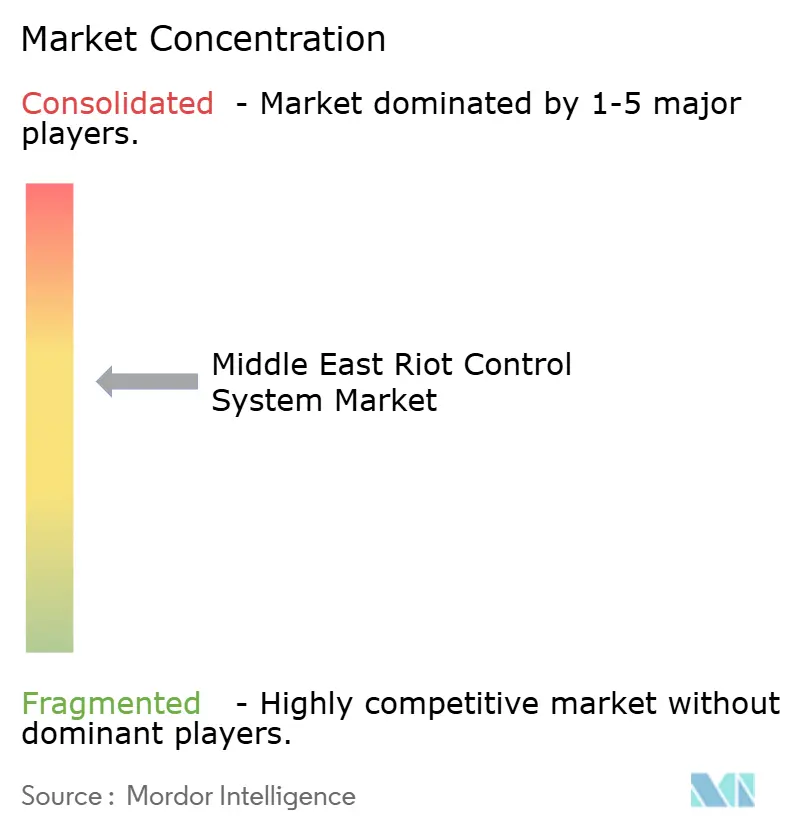
The Middle East riot control system market has moderate concentration. Axon Enterprise, BAE Systems, Rheinmetall AG, FN Herstal, and Genasys have institutional relationships with GCC defense ministries through foreign military sales arrangements and defense channels. No company holds a dominant regional position, leaving room for capable regional entrants who can combine acceptable product performance with local support, practical training services, and compliance with government procurement requirements.
BAE Systems' Arabian Industries subsidiary employs more than 7,000 people in Saudi Arabia, demonstrating the in-country presence expected by major buyers. Suppliers often seek multi-year agreements that secure approved status and minimum volumes, because the process of technical evaluation, field trials, documentation, and local qualification can take considerable time. They are also working to strengthen access to components, as constraints on UHMWPE and aramid fibers increase the risk of delivery delays. This includes assessing the resilience of material suppliers and considering manufacturing arrangements that can reduce exposure to disruptions outside the region.
Technology and product development are becoming increasingly important sources of differentiation in the market. US Patent 12659662 describes a network-capable parametric speaker array with distributed coherence, showing the direction of acoustic-deterrent development. Such systems can be relevant to both law enforcement and special forces, yet no supplier dominates this category across the region. Byrna Technologies completed its acquisition of substantially all HERO Defense Systems assets in August 2026. The deal added compact PAVA projectile launchers and extended-range pepper-gel devices to Byrna's portfolio. Desert Wolf offers drone-mounted crowd-control platforms that provide a remotely operated option distinct from vehicle-based systems. The offering illustrates how specialized companies can compete through an operational niche rather than by matching the full product range of long-established defense manufacturers.
Suppliers face a clear need to align local production requirements with equipment that integrates into broader public-safety systems. Companies that do not provide connectivity for command networks and smart-city environments may have a weaker position in GCC tenders. Biodegradable payloads and lightweight directed-energy platforms also provide openings for specialized competitors, particularly where established suppliers have not yet adapted their catalogs to emerging environmental or connected-equipment requirements. Access to capital can be affected by environmental, social, and governance screening, which in turn influences suppliers' investment decisions. Companies with clear compliance practices and products that address environmental or accountability concerns may be better placed to respond to those investor and customer requirements. The Middle East riot control system market nevertheless remains contestable because buyers assess product suitability, support capability, compliance, and local value creation together.
Middle East Riot Control System Industry Leaders
-
Desert Wolf
-
Safariland, LLC
-
EDGE Group PJSC
-
Pacem Solution International, LLC
-
Combined Systems, Inc.
- *Disclaimer: Major Players sorted in no particular order
Recent Industry Developments
- August 2026: Byrna Technologies completed the acquisition of substantially all of the assets of HERO Defense Systems, LLC under an Asset Purchase Agreement, adding compact PAVA-filled projectile launchers (HERO 2020) and extended-range pepper-gel devices (AIIRO) to its institutional and consumer product portfolios. The transaction included cash, restricted stock (104,000 common shares issued to HERO's members), and net sales royalties.
- August 2026: Genasys announced USD 1.40 million in LRAD orders from customers in Asia-Pacific and Europe for Navy, Coast Guard, Police, and Security applications. The company cited strong international momentum expected to carry into 2027.
Middle East Riot Control System Market Report Scope
The Middle East riot control system market encompasses equipment and solutions used by law enforcement agencies, special forces, border security units, and related public security organizations to manage crowds, maintain public order, and respond to civil unrest situations.
The Middle East riot control system market is segmented by product type, end-user, technology, and geography. By product type, the market is segmented into personal protective equipment and offensive equipment. By end-user, the market is segmented into law enforcement and special forces. By technology, the market is segmented into chemical agents, electronic and sonic weapons, kinetic impact weapons, and others. The report also covers the market sizes and forecasts for the Middle East riot control system market in three countries across the region. For each segment, the market size is provided in terms of value (USD).
By Product Type
| Personal Protective Equipment | Vests | |
| Helmets | ||
| Gas Masks | ||
| Shields | ||
| Offensive Equipment | Area Denial | Anti-vehicle |
| Anti-personnel | ||
| Ammunition | Rubber Bullets | |
| Wax Bullets | ||
| Plastic Bullets | ||
| Bean Bag Rounds | ||
| Sponge Grenades | ||
| Explosives | Flashbang Grenades | |
| Sting Grenades | ||
| Gases and Sprays | Water Cannons | |
| Scent-based Weapons | ||
| Tear Gas | ||
| Pepper Spray | ||
| Directed Energy Weapons | ||
| Electro-shock Weapons | ||
| Other Offensive Equipment | ||
By End-User
| Law Enforcement |
| Special Forces |
By Technology
| Electronic and Sonic Weapons |
| Kinetic Impact Weapons |
| Chemical Agents |
| Others |
By Geography
| Saudi Arabia |
| United Arab Emirates |
| Israel |
| Rest of Middle East and Africa |
| By Product Type | Personal Protective Equipment | Vests | |
| Helmets | |||
| Gas Masks | |||
| Shields | |||
| Offensive Equipment | Area Denial | Anti-vehicle | |
| Anti-personnel | |||
| Ammunition | Rubber Bullets | ||
| Wax Bullets | |||
| Plastic Bullets | |||
| Bean Bag Rounds | |||
| Sponge Grenades | |||
| Explosives | Flashbang Grenades | ||
| Sting Grenades | |||
| Gases and Sprays | Water Cannons | ||
| Scent-based Weapons | |||
| Tear Gas | |||
| Pepper Spray | |||
| Directed Energy Weapons | |||
| Electro-shock Weapons | |||
| Other Offensive Equipment | |||
| By End-User | Law Enforcement | ||
| Special Forces | |||
| By Technology | Electronic and Sonic Weapons | ||
| Kinetic Impact Weapons | |||
| Chemical Agents | |||
| Others | |||
| By Geography | Saudi Arabia | ||
| United Arab Emirates | |||
| Israel | |||
| Rest of Middle East and Africa | |||
Key Questions Answered in the Report
What is the 2026 value of the Middle East riot control system market?
The Middle East riot control system market is valued at USD 1.26 billion in 2026 and is forecast to reach USD 1.64 billion by 2031 at a 5.41% CAGR. Demand reflects equipment renewal, border-security requirements, local industrial policies, and the increasing importance of connected public-safety systems.
Which product category leads regional demand?
Personal protective equipment led with a 54.87% revenue share in 2025, supported by recurring needs for vests, helmets, masks, and shields used by large police and security organizations. This category also reflects regular replacement needs from training use, active deployment, equipment wear, and compliance upgrades.
Which product category is expanding fastest?
Offensive equipment is projected to grow at a 6.17% CAGR through 2031 as agencies add scalable response tools, including equipment designed for graduated crowd-management responses. Product demand spans munitions, acoustic systems, water-based dispersal equipment, and smaller specialized systems with higher unit values.
Which end-user group has the largest requirement?
Law enforcement accounted for 66.84% of revenue in 2025 because regional police organizations maintain large standing forces that require standardized equipment, training, maintenance, and replacement supplies. Framework agreements can help these agencies standardize equipment and maintain access to qualified suppliers over several years.
Which country has the largest regional procurement base?
Saudi Arabia held 33.98% of revenue in 2025 and remains central to demand through security modernization and domestic sourcing policies. Its procurement activity matters regionally because policy changes, localization terms, and equipment requirements can influence supplier planning across the wider Middle East.
What factors could delay equipment delivery?
EU export controls and longer aramid and UHMWPE supply lead times can delay procurement and increase inventory planning needs. Agencies may respond by building stockpiles, seeking dependable delivery commitments, qualifying alternative supply chains, or assessing local assembly arrangements.