
Market Overview
| Study Period | 2020 - 2031 |
|---|---|
| Forecast Data Period | 2026 - 2031 |
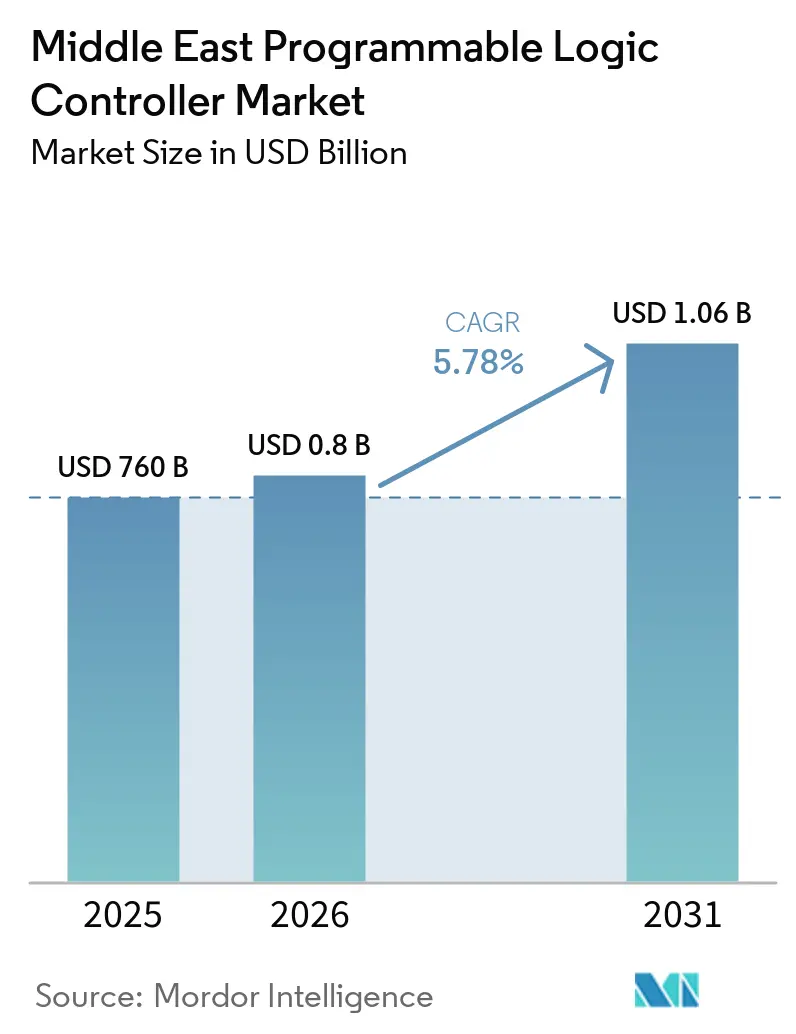
| Base Year Market Size (2025) | USD 760 Billion |
| Market Size (2026) | USD 0.8 Billion |
| Market Size (2031) | USD 1.06 Billion |
| Growth Rate (2026 - 2031) | 5.78 % |
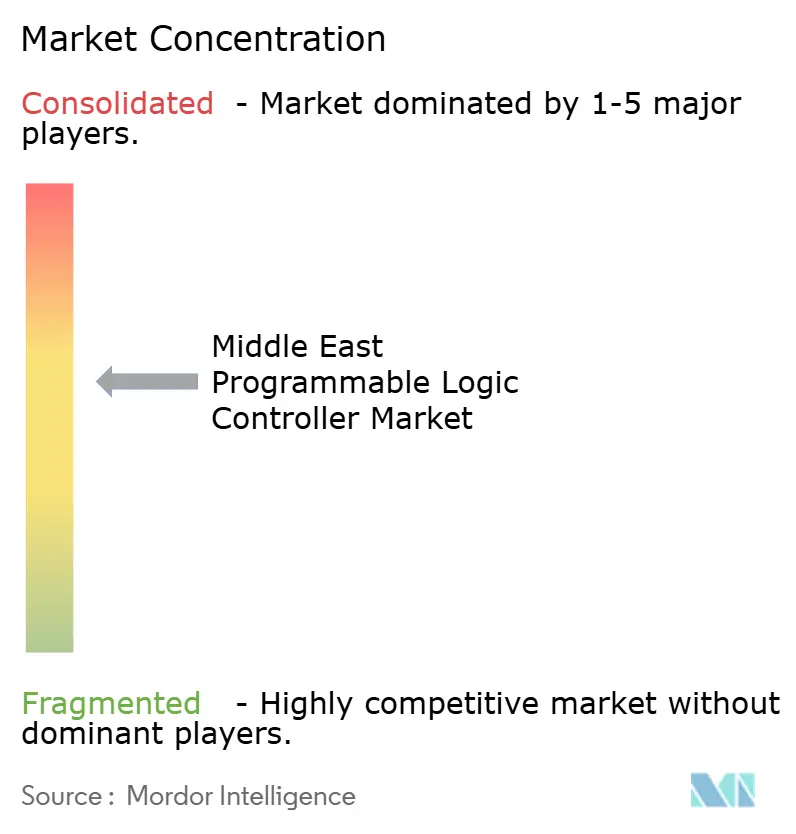
| Market Concentration | Medium |
Major Players *Disclaimer: Major Players sorted in no particular order Image © Mordor Intelligence. Reuse requires attribution under CC BY 4.0. | |
Middle East Programmable Logic Controller Market Analysis by Mordor Intelligence
Middle East programmable logic controller market size in 2026 is estimated at USD 803.93 million, growing from 2025 value of USD 760 million with 2031 projections showing USD 1.06 billion, growing at 5.78% CAGR over 2026-2031. This steady climb reflects a regional pivot away from hydrocarbons toward diversified manufacturing, renewable energy, and water infrastructure, all of which depend on tight-loop PLC control for safety interlocks and real-time data capture. Saudi Arabia’s high contribution in marekt highlighted the Kingdom’s Vision 2030 expansion of factory capacity, while the United Arab Emirates (UAE) set the fastest trajectory of growth riding on the back of the Transform 4.0 program.[1]
Key Report Takeaways
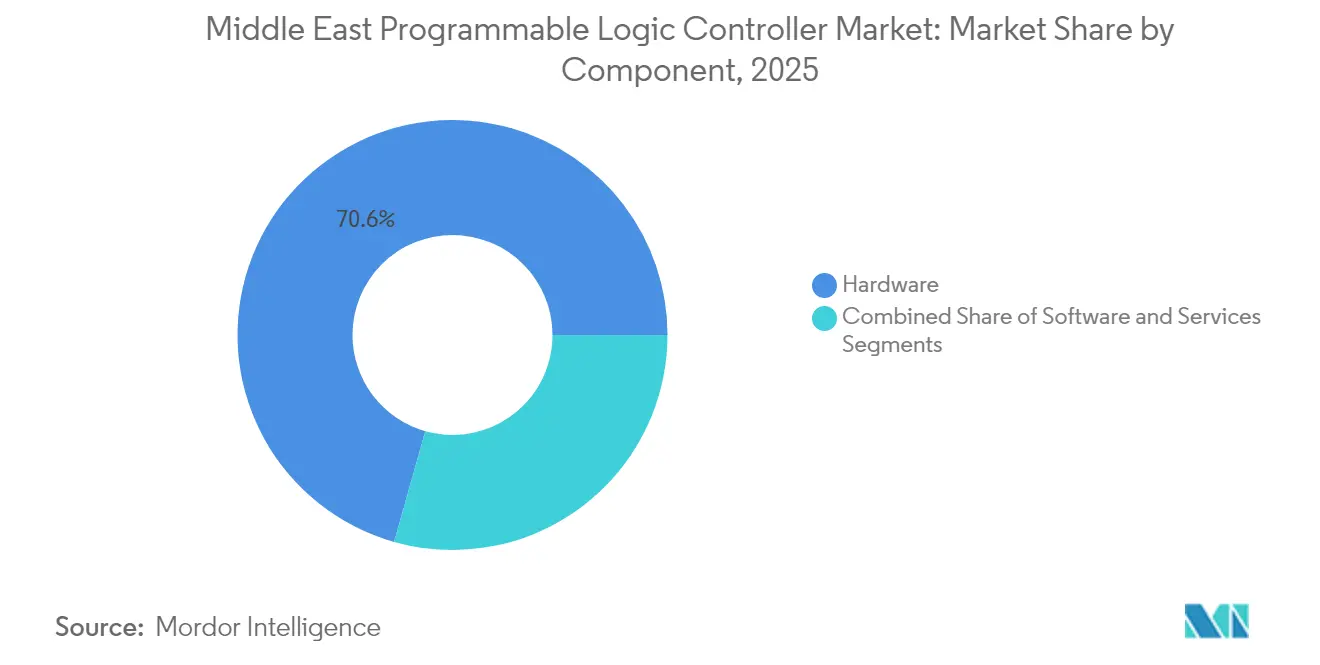
- By component, hardware captured 70.62% of the Middle East programmable logic controller market share in 2025, while software is expanding at a 6.71% CAGR through 2031.
- By PLC type, medium PLCs retained 34.15% revenue share in 2025; safety PLCs record the highest 7.26% CAGR outlook to 2031.
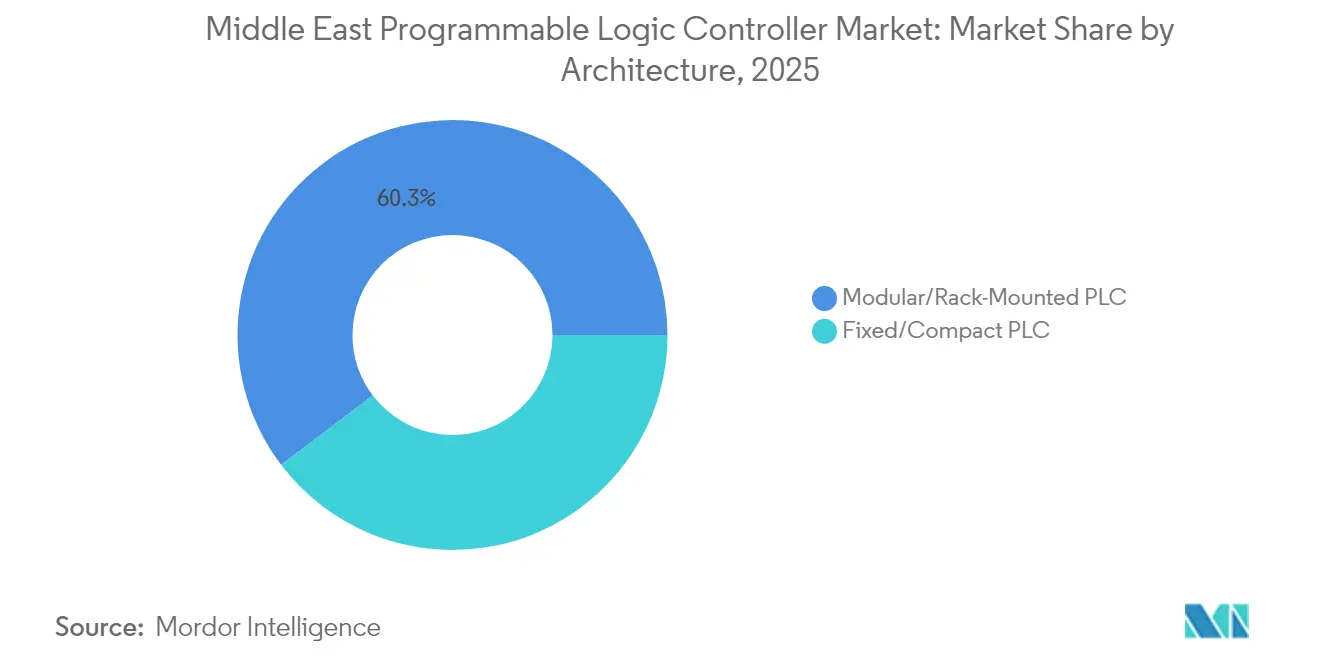
- By architecture, modular racks held 60.32% share in 2025 and are advancing at a 5.88% CAGR through 2031.
- By end user, oil and gas commanded 25.96% revenue in 2025; hydrogen production is forecast to expand at a 6.98% CAGR between 2026 and 2031.
- By geography, Saudi Arabia led with 39.12% revenue share in 2025, whereas the UAE posts the strongest 7.35% CAGR through 2031.
Note: Market size and forecast figures in this report are generated using Mordor Intelligence’s proprietary estimation framework, updated with the latest available data and insights as of 2026.
Middle East Programmable Logic Controller Market Trends and Insights
Drivers Impact Analysis*
| Driver | (~) % Impact on CAGR Forecast | Geographic Relevance | Impact Timeline |
|---|---|---|---|
| Expanding Oil and Gas Digitalisation Projects | +1.2% | Saudi Arabia, UAE, Qatar, Kuwait | Medium term (2-4 years) |
| Surge in Brownfield Automation Retrofits | +0.9% | Saudi Arabia, UAE, Oman | Short term (≤2 years) |
| Growing GCC Vision-Driven Manufacturing Hubs | +1.5% | Saudi Arabia, UAE, Bahrain | Long term (≥4 years) |
| Mandatory Functional-Safety Compliance in Energy Sector | +0.8% | GCC-wide | Medium term (2-4 years) |
| Hydrogen Economy Pilot Investments | +0.7% | Saudi Arabia, UAE, Oman | Long term (≥4 years) |
| AI-Enabled Predictive Maintenance in Desalination | +0.6% | UAE, Saudi Arabia, Qatar | Medium term (2-4 years) |
| Source: Mordor Intelligence | |||
Expanding Oil and Gas Digitalisation Projects
National oil firms are embedding PLC-centric digital twins to compress drilling cycles and defer new-well capital outlays. ADNOC’s Neuron 5 platform lowered unplanned shutdowns by 50% and extended maintenance intervals by 20% across offshore and onshore assets. Saudi Aramco’s RoboWell system fuses downhole telemetry with surface PLCs to optimize bit weight and rotary speed, trimming non-productive time by 30%. Qatar’s North Field LNG expansion mandates IEC 61511 SIL-3-certified safety PLCs, creating a multi-year hardware and software pipeline. These deployments underscore why software revenue is outpacing hardware despite hardware’s large base. As analytics shift to the edge, the Middle East programmable logic controller market benefits from recurring software updates layered onto existing racks.
Surge in Brownfield Automation Retrofits
Aging refineries and petrochemical plants commissioned in the 1980s and 1990s face tighter emissions standards, prompting modular PLC upgrades that cut energy use and add remote diagnostics. ADNOC Gas replaced pneumatic actuators with rack PLCs at Habshan-5, reducing energy consumption by 15%. Saudi Aramco’s Yanbu modernization integrated Siemens S7-1500 PLCs compliant with IEC 62443 cyber-security guidelines. Brownfield operators prefer modular racks because hot-swappable I/O cards limit downtime to weekend cutovers. With installed capacity above 10 million barrels per day across Saudi and UAE refineries, retrofit momentum sustains steady hardware demand even as software margins grow.
Accelerating Gulf Data-Center Construction
Hyperscale and colocation operators are racing to add more than 1.3 GW of new data center capacity across Saudi Arabia and the UAE by 2027, driven by surging cloud and AI workloads. Each facility relies on PLC-based switchgear, uninterruptible power supply sequencing, and chilled-water plant automation to maintain uptime guarantees of 99.999%. Microsoft’s USD 2.1 billion Riyadh cloud region, scheduled for 2026, specifies redundant rack PLCs for power and cooling orchestration that must react within millisecond windows to load swings. Amazon Web Services and Oracle follow similar architectures, standardizing on modular PLCs for hot-swappable breaker control inside 11–33 kV substations. The sector’s short development timelines translate into immediate hardware orders and recurring software revenue for energy-efficiency analytics layered on the same controllers. The burst of construction adds a measurable 0.8% lift to the forecast CAGR for PLC demand in the near term.
Wastewater Reuse Mandates in Water-Stressed Economies
Saudi Arabia targets lifting treated-sewage-effluent reuse from 25% in 2024 to 60% by 2030 under the National Water Strategy, compelling municipalities to retrofit existing plants with advanced PLC-controlled membrane bioreactors and UV disinfection. Oman’s Haya Water plans to double tertiary-treatment capacity to 568,000 m³/day by 2027, specifying safety-rated PLCs for chemical-dosing loops that must meet stricter effluent quality thresholds. Jordan’s As-Samra plant expansion adds 65 MW of biogas cogeneration, integrating PLCs for synchronized generator, digester-gas, and grid-tie logic. These upgrades demand software modules for nutrient-removal optimization and predictive maintenance, spurring 0.6% incremental CAGR uplift over the medium term. Vendors able to bundle cyber-secure controllers with SCADA analytics are best positioned as tenders now include ISO 55000 lifecycle asset-management clauses.
Restraints Impact Analysis*
| Restraint | (~) % Impact on CAGR Forecast | Geographic Relevance | Impact Timeline |
|---|---|---|---|
| Supply Chain Volatility for Advanced ICs | –0.7% | Global, acute in Middle East | Short term (≤2 years) |
| Limited Local System-Integrator Skill Pool | –0.5% | Non-GCC Middle East | Medium term (2-4 years) |
| High Cyber-Security Certification Costs | –0.3% | GCC-wide | Medium term (2-4 years) |
| Preference for Distributed Control Systems in Mega-Plants | –0.4% | Saudi Arabia, UAE, Qatar | Long term (≥4 years) |
| Source: Mordor Intelligence | |||
Import Tariffs on Industrial Automation Hardware Outside GCC
Non-GCC states apply import duties ranging from 10% to 25% on PLCs, power supplies, and I/O cards, whereas intra-GCC trade remains tariff-free under the Unified Customs Law. Egyptian decree 465/2024 raised the duty on programmable controllers to 20%, immediately inflating project budgets for wastewater-treatment upgrades in Cairo and Alexandria. Lebanon and Jordan maintain similar levies to protect nascent local assembly, yet neither hosts semiconductor fabrication or high-precision PCB production, forcing integrators to import anyway. The higher landed cost compels end users to defer non-essential retrofits and reduces order sizes, trimming 0.4% from near-term CAGR potential. Vendors resort to bundling programming software at no charge to offset hardware sticker shock, but margin erosion persists.
Freight Congestion Through Red Sea and Strait of Hormuz
Geopolitical tensions and recurring maritime security incidents have prolonged average transit times for containerized electronics by 18 days since mid-2024. PLC shipments routed from East-Asian factories now face additional insurance premiums of USD 65/TEU when passing Bab-el-Mandeb, and occasional diversions around the Cape of Good Hope add two weeks to delivery schedules. Gulf project managers respond by ordering six months of buffer stock, tying up working capital and limiting flexibility to adopt late-cycle firmware revisions. Smaller system integrators lacking the liquidity for advance purchases cede contracts to larger peers with deeper inventories, depressing competitive diversity and shaving 0.3% from regional CAGR expectations. Freight volatility also complicates warranty-parts logistics, increasing unplanned downtime risk in critical oil-and-gas sites.
*Our forecasts treat driver/restraint impacts as directional, not additive. The impact forecasts reflect baseline growth, mix effects, and variable interactions.
Segment Analysis
By Component: Software Extends the Lifecycle of Existing Hardware
Hardware controlled 70.62% of 2025 revenue, yet software’s 6.71% CAGR shows operators layering analytics and cyber-security modules onto installed assets. TAQA’s USD 26 million AI SCADA rollout placed machine-learning models directly on Siemens S7-1500 PLCs, cutting chemical use 18% and deferring capital on new reverse-osmosis trains. Services revenue gained 5.5% as long-term agreements converted capex into opex. The Middle East programmable logic controller market size for software components is expected to reach USD 0.32 billion by 2031, reflecting rising subscription adoption.
Edge analytics explains software’s momentum. Rockwell Automation reported that 87% of surveyed manufacturers in Saudi and the UAE run at least one AI model at the PLC layer, supporting quality inspection and anomaly detection. Vendors monetize this shift through annual licenses rather than one-time hardware margins, broadening total contract value even when new unit shipments plateau.

By PLC Type: Safety Controllers Capture Compliance Budgets
Medium PLCs held 34.15% of Middle East programmable logic controller market share in 2025 thanks to legacy dominance in food, beverage, and cement. Safety PLCs, however, post a 7.26% CAGR as GCC regulators enforce IEC 61511 certification for new and retrofitted systems. Qatar Petrochemical Company’s SIL-3 deployment achieved 99.9% availability and third-party TÜV validation. The Middle East programmable logic controller market size for safety units is forecast to double to USD 0.13 billion by 2031, fueled by LNG, hydrogen, and high-pressure gas projects.
Safety PLCs carry higher per-unit prices yet remain under 10% of shipments, indicating long runway for mix shift. Vendors bundle firmware-level OT security, shortening lead times and aligning with integrated cyber certification mandates.
By Architecture: Modular Racks Remain the Workhorse
Modular racks owned 60.32% of 2025 revenue and grow at 5.88% as mega-projects call for scalable I/O and hot-standby redundancy. NEOM’s 600 tonnes-per-day hydrogen plant will operate 1,200 Siemens S7-1500 racks with redundant power supplies to reach 99.95% uptime.
Fixed PLCs grow 5.08% in building automation where smaller I/O counts and lower cost matter more. Mid-sized water utilities prefer compact designs to fit constrained panel space, yet large desalination plants stick with racks to enable online card replacement without shutting down pumps.
By End-User: Hydrogen and Desalination Create New White Space
Oil and gas led 25.96% demand in 2025, but hydrogen facilities advance 6.98% CAGR on the back of NEOM, Oman, and Qatar pilot lines. Desalination plants extend PLC penetration as regional capacity climbs from 26 million to 31.6 million m³ per day by 2030.
Utilities deploy AI-based edge analytics to predict membrane fouling and schedule maintenance, pushing software sales even where annual hardware spend is flat. Food, tobacco, and beverage processors grow 5.1% by adopting track-and-trace PLC solutions to meet halal certification and e-grocery fulfillment demands.
Geography Analysis
Saudi Arabia held 39.12% revenue share in 2025 behind Vision 2030’s plan to triple factory count and automate 40% of its electricity distribution network. The country installed 11 million smart meters by 2024 and targets 40% grid automation penetration in 2025, sustaining substation PLC orders. Siemens secured a USD 1.5 billion contract for Taiba 2 and Qassim 2 power plants, integrating S7-1500 logic with turbine governors and emissions monitors.
The UAE records the region’s fastest 7.35% CAGR as Transform 4.0 pushes for 100 Industry 4.0 lighthouses by 2030. Emerson’s 13,000 m² SPARK hub slashes lead times from 16 weeks to 4 weeks, boosting local content and cushioning buyers from dollar volatility. TAQA’s AI SCADA rollout showcases edge intelligence leadership in water infrastructure.
Qatar, Oman, Kuwait, Bahrain, Israel, and the rest of the Middle East contributed 34.28% of 2025 revenue. Qatar’s LNG expansion to 142 million tpa by 2030 drives safety PLC demand for cryogenic handling. Oman’s blue-hydrogen pathways add explosion-proof PLC requirements, while Israel’s semiconductor and medical-device clusters create niche opportunities for nano PLCs.
Regulatory Landscape
PLC deployments across Middle East critical infrastructure are increasingly governed by national OT/ICS cybersecurity frameworks that reference international baselines such as ISA/IEC 62443, NIST SP 800-82, and ISO 27001. In Saudi Arabia, the National Cybersecurity Authority (NCA) Operational Technology Cybersecurity Controls (OTCC-1:2022) sets minimum requirements for OT assets in critical infrastructure, which pushes PLC vendors and system integrators to provide secure-by-design controllers, hardening guides, and evidence packages for operator audits and RFP scoring.
The UAE adds a parallel compliance layer through the Dubai Electronic Security Center (DESC) Information Security Regulation (ISR) for Industrial Control Systems under Dubai Law No. 11 of 2014 and related resolutions. This shapes procurement for industrial operators running power, water, and oil and gas assets in Dubai. Qatar’s National Cyber Security Agency (NCSA) also publishes a national ICS security standard used by critical operators, reinforcing a region-wide trend where PLC selection criteria extend beyond performance and I/O scale to include documented OT security controls, certification readiness, and lifecycle patch governance.
Value Chain Analysis
The PLC value chain serving the Middle East starts with semiconductor and electronic component supply, much of which comes from global fabrication and module production hubs (primarily East Asia). It then moves through global OEM manufacturing (Siemens, ABB, Schneider Electric, Rockwell Automation, Mitsubishi Electric, Honeywell, Emerson) into regional stocking and configuration. Distribution and project logistics are often centralized through UAE-based trade and re-export channels, with Dubai acting as a consolidation point for shipments into major industrial clusters such as Jubail Industrial City (Saudi Arabia) and KIZAD (UAE), where short project timelines make local inventory, spares, and panel-building capacity decisive.
System integration, panel fabrication, commissioning, and lifecycle services are delivered through a tiered ecosystem of local certified integrators and distributors that translate PLC platforms into plant-ready solutions, including ControlTech Middle East (UAE), IICS (Saudi Arabia), ESS Middle East (UAE), and MAFA (Saudi Arabia). This downstream layer is also where compliance and interoperability risks are managed, including environmental and EMC requirements referenced by SASO-aligned conformity practices, brownfield protocol migration, and OT cybersecurity implementation work that increasingly shapes acceptance into end-user approved vendor lists.
Competitive Landscape
The Middle East programmable logic controller market is moderately concentrated. Siemens, ABB, Schneider Electric, and Rockwell Automation jointly account for about 60% revenue via long-term service contracts and installed-base lock-in. Siemens won a USD 1.5 billion Saudi power contract in 2024 and integrates TIA Portal to trim commissioning by 25%. Schneider Electric inaugurated a 20,000 m² SPARK plant in March 2025, manufacturing emergency-shutdown systems to serve Qatar’s North Field and Aramco’s Jafurah projects.
Emerson’s local hub enables same-day spares for offshore platforms, shortening retrofit project cycles by 30%.[4] Honeywell leverages Made-in-Saudi incentives, opening building-automation lines that enjoy a 10% public-tender price edge. Mitsubishi Electric’s firmware-level OT security partnership with Nozomi Networks positions the firm to win IEC 62443-driven bids.
Local integrators retain advantages in Arabic-language support and government-procurement familiarity, especially in non-GCC states where expatriate hiring costs run 40–60% above local rates.
Middle East Programmable Logic Controller Industry Leaders
-
Siemens AG
-
ABB Ltd
-
Schneider Electric SE
-
Rockwell Automation Inc.
-
Mitsubishi Electric Corporation
- *Disclaimer: Major Players sorted in no particular order
Market Opportunities and Future Outlook
There is a practical whitespace where PLC hardware refresh cycles intersect with software-led modernization, as operators convert installed rack bases into recurring programs through cybersecurity, analytics, and digital operations layers. The shift is visible in manufacturer investment priorities: Rockwell Automation’s May 2026 regional findings reported that 98% of Middle East manufacturers consider digital transformation essential, along with meaningful operating-budget allocation to industrial technology, supporting demand for PLC-adjacent subscriptions such as edge analytics, asset monitoring, and secure remote access rather than only one-off controller shipments.
Data-center and digitally enabled infrastructure buildouts also pull PLCs into power distribution, cooling plants, and critical facility sequencing. This is reinforced by hyperscaler capex announcements such as Microsoft’s March 2026 commitment to invest over USD 7.9 billion in the UAE over 2026-2029. On the industrial side, plant-level adoption of connected manufacturing platforms provides a pathway for PLC vendors and integrators to attach software and services to discrete control assets, as seen in July 2026 when UAE-based Hadaf Foods adopted Rockwell Automation’s Plex Smart Manufacturing Platform with local channel support. At the same time, localization agendas in Saudi Arabia, including IKTVA-linked procurement behavior cited in market context, keep elevating local assembly, service hubs, and training capacity as differentiators for PLC suppliers bidding into energy, water, and manufacturing projects.
Recent Industry Developments
- May 2026: Schneider Electric announced a commitment to nearly triple its Saudi manufacturing capacity to 32 production lines by 2030. The move strengthens local availability for industrial automation and control offerings tied to national localization requirements, improving lead-time resilience for large project pipelines.
- November 2025: Rockwell Automation and alfanar launched a strategic manufacturing collaboration in Riyadh to support local production of industrial systems. This supports Saudi localization-driven procurement and expands in-country capability for delivering PLC-centered automation systems with local service coverage.
- September 2024: Avanceon secured a USD 16.5 million critical control systems project for a major Middle East energy provider, including PLC and safety panels, with execution running through 2027. The award reflects sustained investment in safety-rated control upgrades and provides multi-year pull-through for engineering, commissioning, and lifecycle support.
Research Methodology Framework and Report Scope
Market Definition and Coverage
For this study, the market includes revenues earned from programmable logic controllers used in industrial and infrastructure automation across Middle East end users, counted across hardware, supporting software, and related services when they are sold for PLC deployments.
Scope exclusions: We exclude adjacent factory automation items that are not PLCs (such as SCADA, DCS, drives, sensors, and robotics) unless they are bundled and priced as part of a PLC contract.
Segmentation Overview
- By Component
- Hardware
- Software
- Services
- By PLC Type
- Nano PLC
- Micro PLC
- Medium PLC
- Large PLC
- Safety PLC
- By Architecture
- Fixed/Compact PLC
- Modular/Rack-Mounted PLC
- By End-User Industry
- Oil and Gas
- Chemical and Petrochemical
- Energy and Utilities
- Food, Tobacco, and Beverage
- Automotive
- Pharmaceutical
- Other End-User Industries
- By Country
- United Arab Emirates
- Saudi Arabia
- Israel
- Oman
- Qatar
- Kuwait
- Bahrain
- Rest of Middle East
Data Sources, Market Sizing, and Validation
Desk Research
Desk research was used to build the basic demand picture and the country level context before any modeling was done. We referenced public statistics and policy releases that describe the pace of industrial activity and capital spending, which is a key pull factor for PLC demand in oil and gas, energy, and manufacturing.
Sources reviewed included, in an illustrative way, national statistics portals and central bank releases for industrial output and investment, customs and trade statistics for electrical and control equipment flows, and energy regulators and ministries for power and industrial project pipelines. We also used standards and technical publications from bodies such as IEC and ISA to align PLC definitions, plus peer reviewed automation and control engineering journals for adoption patterns. Company filings, annual reports, and investor presentations were used to understand product mix and exposure to the region, and a paid subscription for company financials and news was used for cross checks on regional revenue mentions. This list is not exhaustive, and many other public sources were also reviewed for data capture, validation, and clarification.
Primary Interviews and Surveys
Primary work focused on validating what portion of automation spend converts into PLC purchases, and how buying decisions differ by country and end use. We spoke with system integrators, distributors, EPC and plant engineering teams, and operations and maintenance leaders across major Middle East markets to confirm PLC type preferences, replacement cycles, and service attachment.
To keep assumptions realistic, feedback was also gathered on typical pricing movement, tendering behavior, and how safety and modular architectures get specified in oil and gas, chemicals, and utilities.
Distribution of primary research fieldwork respondents
| Company type | Respondent position |
|---|---|
| Top tier: 38% | CXOs: 12% |
| Mid tier: 40% | Functional/Unit leaders: 38% |
| Smaller Players: 22% | Managers: 50% |
Market-Sizing & Forecasting
Sizing started from a top-down build that reconstructs PLC demand from the region's industrial activity and project investment signals, and then allocates that demand into PLC spending using validated automation intensity factors. The model was subsequently checked with selective bottom-up approximations, using a supplier and channel roll up for a sample of countries and end users, followed by sampled average selling price assumptions multiplied by unit shipment ranges from channel checks.
Key inputs used to keep the model grounded included planned and active oil and gas and petrochemical projects, power generation and grid upgrade spending, manufacturing output trends, the mix of new builds versus brownfield upgrades, and the split between compact and modular PLC architectures that affects average pricing. We also tracked adoption of safety PLCs in higher risk plants, plus typical replacement and retrofit cycles that influence recurring demand.
For forecasting, we used scenario analysis supported by a light multivariate regression view at the regional level, where PLC spend is linked to industrial production growth, energy sector capex, and non-oil manufacturing expansion. Where bottom-up visibility was weaker (for example, smaller countries and indirect imports), gaps were handled by using proxy indicators like project counts, trade flows for control equipment categories, and distributor feedback, which were then normalized to avoid overstating the long tail.
Data Validation & Update Cycle
Validation was done by checking that the final values stay consistent with independent signals, such as industrial capex direction, trade movement for relevant equipment categories, and the pace of large project awards. Any sharp step changes were reviewed to confirm whether they came from a real event (like a major project start) or from an input assumption that needed tightening, and then the model was re-run.
Before sign-off, outputs go through multi-step analyst reviews that look for country mix issues, unrealistic price paths, and sudden changes in PLC type shares. If a variance is still large, experts are re-contacted to confirm the specific assumption that is driving it. The report is refreshed annually, and interim updates are made when material events affect project pipelines, currency conditions, or spending plans, followed by a final pre-delivery review so clients receive the latest view.
Mordor Intelligence's Middle East Programmable Logic Controller Market Size Compared Against Other Published Estimates
Published market numbers for Middle East PLCs can differ even when the topic sounds the same, because the included product set, the way services are counted, and the year chosen for currency conversion are not consistent. Variation also shows up when some estimates lean more on shipment proxies, and others lean more on capex and project driven demand pools.
Some publications bundle PLCs into wider industrial automation, then allocate back using broad component shares, which can pull the number upward in years with heavy projects. In Mordor Intelligence's model, values are counted only for PLC hardware, PLC software tied to the controller, and PLC services, and non-PLC control layers like SCADA or DCS are kept out even if they sit in the same plant budget.
Benchmark comparison
| Source | Market Size | Gaps in Research Methodology |
|---|---|---|
| Mordor Intelligence | USD 0.76 B (2025) | |
| Regional Consultancy A | USD 1.05 B (2025) | This figure appears to fold PLCs into a broader industrial controls bundle and then applies a share down approach, which can include adjacent control software and instrumentation that our scope excludes. |
| Industry Association B | USD 0.63 B (2024) | This estimate looks closer to a hardware-heavy tally and uses an earlier year, and it may not fully capture services and software attached to PLC projects, plus it can understate safety and modular system pricing. |
The spread across sources is mainly explained by what gets counted alongside the controller, and by how prices and services are treated across countries and end uses. By tying the total to clear demand indicators like project starts, retrofit cycles, and architecture mix, the final number stays traceable to practical inputs that can be checked and repeated.
Key Questions Answered in the Report
What is the current value of the Middle East programmable logic controller market?
The Middle East programmable logic controller market size stands at USD 0.8 billion in 2026 and is projected to reach USD 1.06 billion by 2031.
Which country leads regional PLC revenue?
Saudi Arabia held 39.12% revenue share in 2025, driven by its Vision 2030 industrial expansion.
Which segment is growing fastest?
Safety PLCs post the highest 7.26% CAGR thanks to IEC 61511 compliance mandates across Gulf energy assets.
Why is software outpacing hardware growth?
Utilities and manufacturers increasingly embed predictive analytics and cyber-security at the controller level, pushing software revenue up 6.71% annually.
How are supply-chain issues affecting PLC deployments?
Long lead times for advanced chips add up to 52 weeks, forcing vendors to prioritize large orders and delaying smaller integrator projects by several months.