
Market Overview
| Study Period | 2020 - 2031 |
|---|---|
| Forecast Data Period | 2026 - 2031 |
| Base Year Market Size (2025) | USD 44.16 Billion |
| Market Size (2026) | USD 48.43 Billion |
| Market Size (2031) | USD 76.79 Billion |
| Growth Rate (2026 - 2031) | 9.66% CAGR |
| Market Concentration | Medium |
Major Players *Disclaimer: Major Players sorted in no particular order Image © Mordor Intelligence. Reuse requires attribution under CC BY 4.0. | |
Middle East Media And Entertainment Market Analysis by Mordor Intelligence
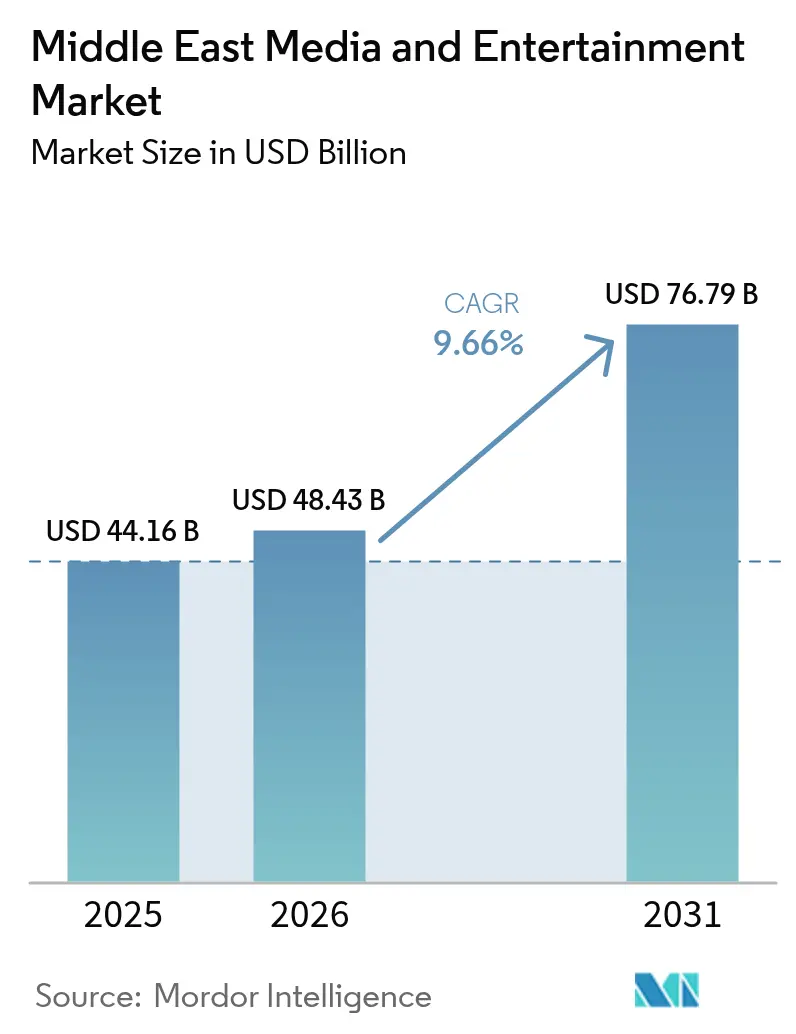
The Middle East Media And Entertainment Market size is projected to be USD 44.16 billion in 2025, USD 48.43 billion in 2026, and reach USD 76.79 billion by 2031, growing at a CAGR of 9.66% from 2026 to 2031.
This rapid trajectory springs from Vision 2030-driven economic diversification, region-wide 5G and fiber roll-outs, and an audience skewed toward digitally native youth. Saudi Arabia anchors demand through large-scale state investment, while the United Arab Emirates (UAE) races ahead by commercializing advanced connectivity and a pro-innovation regulatory climate. Online video, gaming, and immersive formats gain momentum as smartphone ubiquity, cloud infrastructure, and metaverse programs converge. Strategic partnerships between regional broadcasters and global streamers are reshaping competitive rules, and flexible monetization mixes are becoming essential to offset currency-linked advertising volatility.
Key Report Takeaways
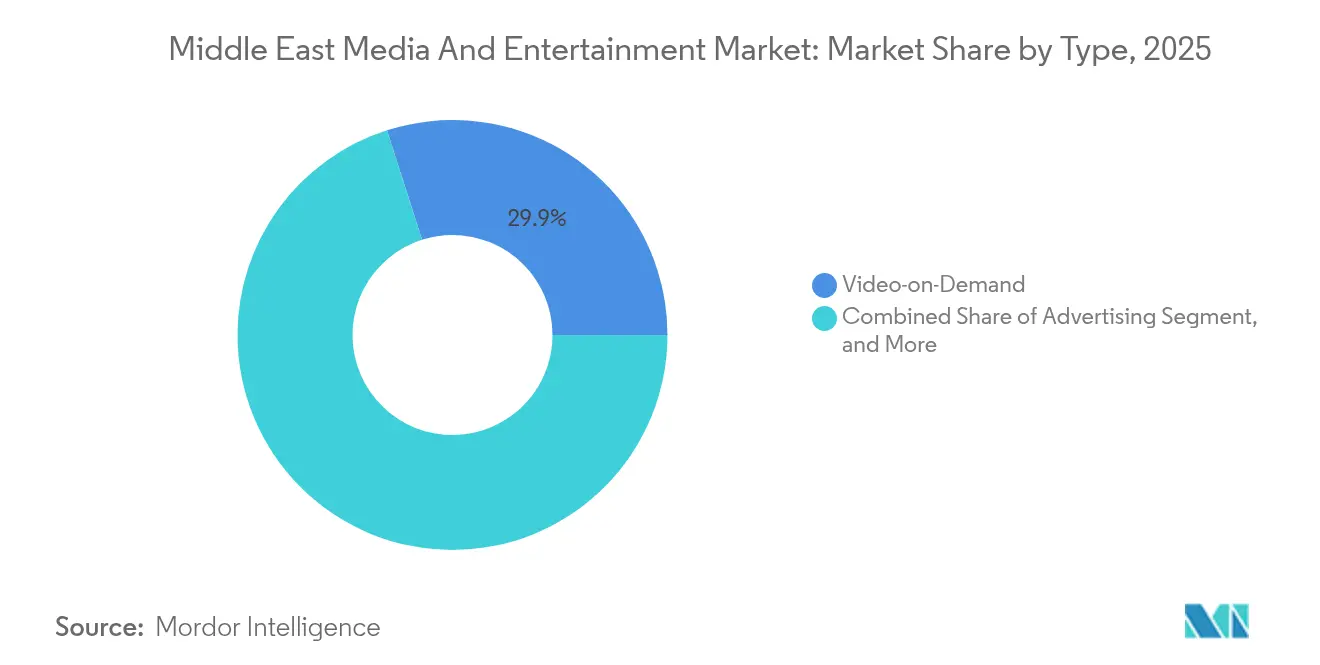
- By type, video-on-demand led with 29.93% revenue share of the Middle East media and entertainment market in 2025; advertising is projected to log the fastest 11.05% CAGR through 2031.
- By platform, online/digital captured 59.62% of the Middle East media and entertainment market share in 2025, while hybrid approaches are advancing at a 10.65% CAGR through 2031.
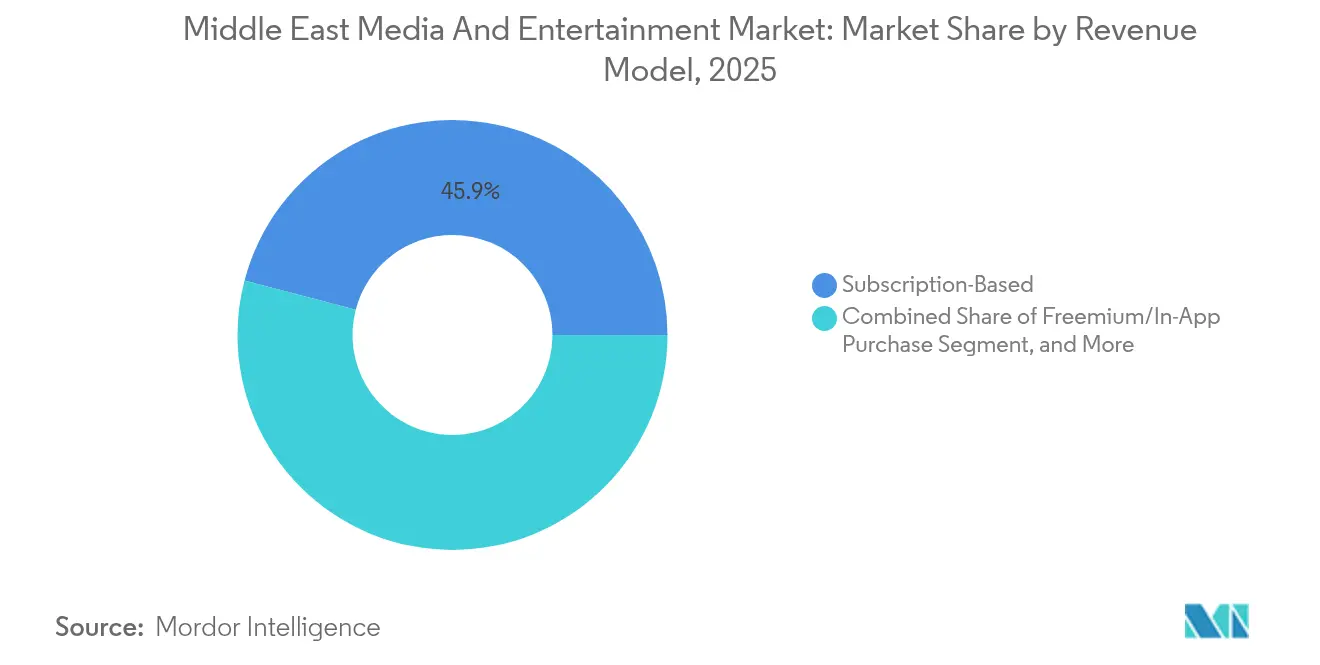
- By revenue model, subscriptions accounted for 45.92% of the Middle East media and entertainment market size in 2025; freemium and in-app purchase models are expected to grow at an 10.96% CAGR to 2031.
- By age group, millennials held a 35.62% share of the Middle East media and entertainment market in 2025, but Generation Z is growing fastest at an 11.19% CAGR through 2031.
- By device, smartphones commanded 44.88% share of the Middle East media and entertainment market in 2025, whereas VR/AR headsets should escalate at an 11.49% CAGR during the forecast.
- By geography, Saudi Arabia dominated with a 39.22% share of the Middle East media and entertainment market in 2025; the UAE registers the highest 11.08% CAGR toward 2031.
- The Public Investment Fund, MBC Group, and beIN MEDIA GROUP jointly held an estimated 41% revenue share in 2024 amid rising state-backed consolidation.
Note: Market size and forecast figures in this report are generated using Mordor Intelligence’s proprietary estimation framework, updated with the latest available data and insights as of 2026.
Middle East Media And Entertainment Market Trends and Insights
Drivers Impact Analysis*
| Driver | (~) % Impact on CAGR Forecast | Geographic Relevance | Impact Timeline |
|---|---|---|---|
| Accelerated rollout of 5G networks and fibre broadband | +2.1% | Saudi Arabia, UAE, Qatar core with spillover to Kuwait, Bahrain | Medium term (2-4 years) |
| Booming smartphone and smart-TV penetration enabling OTT growth | +1.8% | Regional with strongest impact in Saudi Arabia, UAE | Short term (≤ 2 years) |
| Government-funded mega-events boosting content demand | +1.4% | Saudi Arabia (Vision 2030), UAE (Expo legacy), Qatar (World Cup legacy) | Long term (≥ 4 years) |
| Rapid rise of esports and in-app micro-transactions | +1.2% | Saudi Arabia, UAE leading with expansion across GCC | Medium term (2-4 years) |
| Arabic-language original production incentives | +1.0% | Saudi Arabia, UAE primary with regional content distribution | Long term (≥ 4 years) |
| Growing diaspora demand for Middle-East content on global platforms | +0.9% | Global reach with concentration in North America, Europe | Medium term (2-4 years) |
| Source: Mordor Intelligence | |||
Accelerated Rollout of 5G Networks and Fiber Broadband
Telecommunications incumbents continue to blanket major cities with 5G coverage, furnishing latency below 10 milliseconds and enabling 4K streaming, cloud gaming, and real-time augmented-reality services. Saudi Telecom Company allocated more than USD 2.4 billion to 5G and fiber upgrades in 2024, underscoring its pivot from voice carrier to digital-service orchestrator. UAE operators have already surpassed 95% fiber-to-the-home penetration in core emirates, creating a competitive scramble to monetize bandwidth with premium OTT bundles and interactive advertising inventory.
Booming Smartphone and Smart-TV Penetration Enabling OTT Growth
Regional smartphone penetration crossed 90% in 2024, and smart-TV connections doubled in Saudi homes over the past three years. This device base encourages consumers to bypass legacy satellite boxes in favor of direct-to-consumer apps, lifting paid subscription loyalty while widening addressable audiences for targeted programmatic ads. As internet connection speeds climb, average viewing hours on mobile screens have overtaken linear television among audiences below 35.
Government-Funded Mega-Events Boosting Content Demand
Fiscal stimulus targeting film, music, and live-event ecosystems continues to catalyze the Middle East media and entertainment market. Saudi Arabia’s USD 233 million film-sector financing program opened long-term credit lines for local productions, accelerating studio build-outs and job creation. [1]Melanie Goodfellow, “Saudi Arabia Launches USD 233 Million Film Financing Program,” Deadline, deadline.com Legacy from Expo 2020 Dubai and the Qatar World Cup sustains tourism-linked content pipelines, nurturing event coverage, documentaries, and commercial tie-ins that keep the global spotlight on the region.
Rapid Rise of Esports and In-App Micro-Transactions
Gaming revenues rose from USD 2.2 billion in 2024 toward a projected USD 4.7 billion by 2033 in Saudi Arabia alone, pushing publishers and platforms to replicate flexible monetization models across music and video verticals. [2]Kwalee, “2024 Guide to the Fast-Growing MENA Games Market,” kwalee.com Government-run accelerators such as the “Game Changers” program are seeding developer talent, while stadium-scale esports tournaments generate ancillary ad and sponsorship sales far beyond ticket revenues.
Restraints Impact Analysis*
| Restraint | (~) % Impact on CAGR Forecast | Geographic Relevance | Impact Timeline |
|---|---|---|---|
| High levels of piracy and illicit streaming sites | -1.6% | Regional with highest impact in Saudi Arabia, Egypt | Short term (≤ 2 years) |
| Fragmented regulatory and censorship regimes across countries | -1.2% | Pan-regional with varying intensity by jurisdiction | Long term (≥ 4 years) |
| Talent shortage in advanced VFX/game development | -0.8% | Saudi Arabia, UAE primary with regional spillover | Medium term (2-4 years) |
| Currency-linked ad-spend volatility due to oil price swings | -0.7% | GCC countries with oil-dependent economies | Short term (≤ 2 years) |
| Source: Mordor Intelligence | |||
High Levels of Piracy and Illicit Streaming Sites
The 2024 takedown of Cima4U, an illegal portal with 30 million monthly visits, underscored the revenue leakage jeopardizing premium platforms. Despite improved enforcement, 23% of regional users still access pirate IPTV boxes, and account sharing hits 35% in Saudi Arabia, diluting subscription value and deterring premium advertisers who demand verified reach metrics.
Fragmented Regulatory and Censorship Regimes Across Countries
Content creators juggle eight separate broadcast-media statutes across Gulf states alone, inflating legal vetting costs. The UAE’s Decree-Law 55 of 2023 anchors local values, mandating edits to material deemed contrary to Islamic principles or social harmony, with fines reaching AED 1 million. [3]UAE Government, “Media Regulation,” u.ae This patchwork complicates the scaling of pan-Arab content libraries and strains release schedules.
*Our forecasts treat driver/restraint impacts as directional, not additive. The impact forecasts reflect baseline growth, mix effects, and variable interactions.
Segment Analysis
By Type: Video-on-Demand Dominates Amid Advertising Acceleration
The segment generated USD 13.22 billion in 2025, amounting to 29.93% of the Middle East media and entertainment market. Advertising, worth USD 7.24 billion, is expected to expand at an 11.05% CAGR as programmatic tools mature. Premium series, live sports replays, and diversified genres keep subscription renewal high, aided by improved measurement that helps brands allocate budgets confidently. The Middle East media and entertainment market size for advertising-supported formats could therefore outpace transactional video once real-time bidding and audience graphs reach scale. Regional music streaming consolidations—such as Anghami’s union with OSN+—point to synergistic cross-sell prospects, while video-game revenues ride mobile penetration and national esports leagues.
Content localization remains central; incentive funds underwrite Arabic scripts, and dubbing contests ensure regional dialect authenticity. Publishers see e-books gain traction as educational ministries digitize curricula, though monetization relies on micropayments rather than outright downloads. Meanwhile, internet access services furnish the substrate for all categories; yet price competition and regulatory fee caps constrain their growth contribution relative to higher-margin content verticals.


By Platform: Digital Leadership with Hybrid Momentum
Online and app-based environments contributed 59.62% of the total 2025 revenue, affirming the primacy of direct-to-consumer delivery in the Middle East media and entertainment market. Fast-growing hybrid models merging linear channels with on-demand libraries now track a 10.65% CAGR, a pace that reflects consumer appetite for choice without sacrificing live communal viewing. MBC’s bundling of Netflix inside the MBCNOW TV box illustrates how incumbents protect linear ad pools while upselling global catalogs. Traditional satellite still serves rural homes and older viewers, positioning hybrid set-tops as a soft migration path instead of abrupt cord-cutting.
For advertisers, platform diversity complicates reach but opens granular targeting. Cross-screen campaigns integrate linear ratings, OTT impressions, and social video engagements to maximize frequency without redundancy. As data-privacy codes tighten, first-party data from hybrid login environments strengthens value propositions, giving operators leverage over pure-play digital rivals lacking broadcast networks.
By Revenue Model: Subscription Strength Meets Freemium Disruption
Subscriptions held a 45.92% share in 2025, buoyed by household pay-TV upgrades and binge-worthy drama launches. Yet the freemium and in-app purchase segment is on track to eclipse USD 15.62 billion by 2031, its 10.96% CAGR reflecting gaming influence on wider entertainment habits. The Middle East media and entertainment market size for freemium pathways gains from low entry barriers, allowing mass sampling before micro-transaction conversion. Pay-per-view remains limited to marquee boxing cards and regional football tournaments, but dynamic pricing pilots hint at broader adoption once payment infrastructure matures. Ad-supported video climbs steadily as CPM yields rise alongside audience verification improvements.
Currency swings prompt platforms to experiment with multi-tier pricing denominated in local currencies while reporting consolidated earnings in USD, insulating revenue against petro-linked fluctuations. Bundling music, video, and cloud gaming inside single subscriptions improves average revenue per user and lengthens churn cycles, a trend accentuated after Warner Bros Discovery’s USD 57 million stake in OSN Streaming.
By End-User Age Group: Millennials Rule but Generation Z Surges
Millennials captured 35.62% revenue share in 2025 thanks to established purchasing power. Generation Z, however, accelerates with an 11.19% CAGR, fueling product decisions that prioritize mobile-first interactivity and creator-led content. Social-video challenges, esports tournaments, and influencer shopping streams resonate strongly, reshaping the Middle East media and entertainment market’s programming grid. Generation X and baby boomers still prefer long-form series and linear news, encouraging hybrid scheduling that alternates bingeable box-sets with appointment viewing. Platforms now segment marketing communication by life stage rather than merely chronological age, tailoring payment plans, parental controls, and cross-device synchronization features to each cohort.
Youth councils and ministries of culture invest in skills programs that mesh content creation with heritage preservation, fostering pipelines of Arabic-language animators and podcasters. This deliberate capacity building reduces external dependency and ensures region-specific narratives remain authentic and relatable.
By Device: Smartphones Lead While Immersive Gear Gains
Smartphones contributed 44.88% of 2025 consumption value, cementing their role as the principal screen for the Middle East media and entertainment market. VR/AR headsets, projected to climb at an 11.49% CAGR, benefit from Dubai’s metaverse blueprint, which targets USD 4 billion economic output and 42,000 jobs by 2030. Smart-TV shipments rise as vendors embed OSN, Shahid, and Netflix apps natively, simplifying sign-ups. Gaming consoles hold niche prestige among affluent youth, anchoring premium AAA releases and local esports leagues. Tablets serve education ministries pushing e-learning, whereas laptops keep their foothold among professionals and university students seeking higher-resolution productivity and video quality.
Government duty exemptions on VR equipment and grants to AR startups lower ownership hurdles, allowing museums, universities, and retail venues to pilot immersive storytelling. Device convergence also accelerates; foldable screens and 5G tethering blur lines between phone and tablet, while smart TVs double as console replacements through cloud gaming services.
Geography Analysis
Saudi Arabia retained 39.22% of the Middle East media and entertainment market in 2025, advancing from bold Vision 2030 allocations and the region’s largest youth demographic. Sector revenue reached SAR 17.4 billion (USD 4.6 billion) in the same year, with digital formats expanding at a 26% CAGR over five years. Public Investment Fund backing of MBC Group and landmark projects such as NEOM’s XR studios anchor the kingdom as both a production and distribution powerhouse. Gaming potential of USD 13.3 billion by 2030 and 39,000 projected jobs extend diversification beyond oil dependence.
The UAE is the fastest-growing sub-market, recording an 11.08% CAGR to 2031 on the strength of a fully articulated regulatory framework and its long-standing role as regional headquarters for multinationals. Dubai’s Metaverse Strategy alone aims for a USD 4 billion GDP impact, luring content tech firms and fostering a creative-class workforce. Warner Bros Discovery’s minority investment in OSN and Etisalat’s deployment of ultra-capacity 5G emphasize international confidence.
Qatar, Kuwait, and Bahrain ride post-mega-event tourism and cross-border content exchanges, with Qatar’s esports segment alone valued at USD 125.7 million in 2024. Joint marketing initiatives across the GCC nurture premium ad packages appealing to pan-regional brands. Rest-of-Middle-East territories exhibit heterogeneous regulatory landscapes yet offer upside in localized streaming catalogs adapted to linguistic and cultural nuance.
Regulatory Landscape
Media and entertainment regulation in the Middle East is fragmented across jurisdictions, with the UAE and Saudi Arabia setting many of the operating benchmarks for pan-regional platforms. In the UAE, Federal Decree-Law No. (55) of 2023 Regulating the Media is implemented through Cabinet Resolution No. (68) of 2024. The UAE Media Council applies Media Content Standards spanning multiple content categories, and administrative fines cited for violations reach up to AED 2 million. In May 2026, the UAE National Media Authority launched a nationwide campaign to promote the 2026 Media Content Standards, reinforcing compliance expectations across digital, social, and traditional channels.
In Saudi Arabia, the General Authority for Media Regulation (GAMR) administers licensing for visual, audio, and print activities under the Law of Audiovisual Media, extending oversight to influencer-led advertising through licensing pathways such as Mawthoq for advertising content provided via social media platforms. Where spectrum and technical coordination is required, GAMR works alongside the Communications and Space Technology Commission, adding an additional layer for broadcasters and some event-oriented media operations. These frameworks raise the need for localized compliance operations, including content review, advertising approvals, and platform governance to manage censorship variability and cross-border release planning.
Value Chain Analysis
The Middle East media and entertainment value chain covers IP origination and commissioning, financing and rights management, production (studios, post, VFX, and localization), distribution (linear broadcast, OTT aggregators, app stores, and telco bundles), and monetization (subscription, advertising, sponsorship, transactional models, and in-app purchases). The region is shifting toward technology-enabled production and distribution, with cloud-native workflows evidenced by Al Arabiya Jordan airing a fully digital news bulletin in July 2026 using TVU Networks and MEBS. Activity also points to build-out of virtual production capability, with LED-volume capacity cited as 13 operational stages in 2026 (six in Saudi Arabia, five in the UAE, and two in Egypt). UAE scale as a services hub supports the chain as well, with industry reporting citing more than 10,000 media companies and 55,000 media professionals.
Downstream, platforms and broadcasters increasingly use partnerships to secure audiences and diversify touchpoints, while live entertainment infrastructure is being professionalized to support venue-based content, ticketing, sponsorship, and broadcast rights. In July 2026, SURJ, Live Nation, and Oak View Group formed radia to manage, operate, and commercialize Saudi sports and entertainment venues, strengthening the physical distribution layer for events. On the commercial side, mall and destination formats are being linked with broadcast-ready capabilities, including the July 2026 MBC Group and Cenomi Centers partnership to launch an immersive live media experience at Westfield Riyadh with dedicated studio infrastructure. Key bottlenecks remain piracy leakage, multi-country compliance, and a skills gap in advanced VFX and game development, pushing producers toward training programs and selective outsourcing for high-end workflows.
Competitive Landscape
The Middle East media and entertainment market remains moderately consolidated as state funds, legacy broadcasters, and tech-native entrants vie for scale. MBC Group, beIN MEDIA GROUP, and OSN collectively commanded around 41% revenue share in 2024, while Netflix, StarzPlay, and Shahid accelerate subscriber gains through localized originals. Public Investment Fund’s USD 2 billion acquisition of a 54% stake in MBC in November 2024 epitomizes sovereign intent to build national creative champions. Global entities increasingly prefer joint ventures instead of green-field expansion; Netflix’s July 2025 bundle with MBC NOW offers integrated billing, marketing, and set-top hardware.
Content is emerging as the decisive differentiator. Anghami’s merger with OSN+ couples music discovery with premium drama streaming, demonstrating ecosystem bundling as an antidote to churn. Korean giant CJ ENM opened its first Middle East subsidiary in Riyadh in July 2025 to co-produce Arabic-language adaptations of K-formats, exemplifying cross-cultural IP exchange. Smaller disruptors focus on esports broadcasting, children’s FAST channels, and vertical niches such as Islamic-compliant entertainment.
Capital inflows from sovereign funds lower financing costs for large-scale productions, but they also raise competitive entry barriers for pure start-ups. Meanwhile, rising expectations on cultural alignment, data residency, and compliance oblige foreign platforms to ally with local partners possessing regulatory know-how.
Middle East Media And Entertainment Industry Leaders
Middle East Broadcasting Center FZ-LLC (MBC Group)
Orbit Showtime Network FZ-LLC
beIN MEDIA GROUP LLC
Abu Dhabi Media Company PJSC
Arab Media Group LLC
- *Disclaimer: Major Players sorted in no particular order


Market Opportunities and Future Outlook
Opportunities are strengthening around policy-backed digitization and higher-value advertising formats as regulators and public-sector communicators formalize standards and modernize production methods. In the UAE, the National Media Authority's May 2026 campaign to promote the 2026 Media Content Standards, paired with the UAE media compliance regime under Federal Decree-Law No. (55) of 2023 and its executive regulation, increases demand for content governance, brand-safety tooling, and compliant creator-marketplace operations. In Qatar, the Government Communications Office launched the Qatar Media Library in January 2026 as a national digital portal for government visual content, and public communications in February 2026 emphasized in-house digital capabilities across TikTok, Snapchat, Instagram, and X. That activity supports whitespace for Arabic-first short-form production, rights-cleared archives, and public-sector content services.
Technology investment and content operations supported by advanced tooling are also creating room for cloud production, localization, and data-driven monetization across OTT and hybrid models. Reuters reported Microsoft reaffirming a multi-year UAE investment plan covering 2023 to 2029, including a 2026 to 2029 commitment, adding momentum to cloud and AI infrastructure that underpins streaming personalization, ad tech, and secure media workflows. In June 2026, the UAE Government Media Office published a media content guideline that prioritizes Agentic AI for proactive, real-time government content creation, and the International Affairs Office unveiled an AI-generated spokesman (Zayed), supporting use cases such as automated clipping, multilingual dubbing, synthetic presenters, and real-time newsroom operations. Consolidation and portfolio expansion also keep partnership space open for content and distribution, highlighted by OSN's July 2026 proposal to acquire the remaining stake in Anghami to take it private and deepen control over a combined music and video ecosystem in MENA.
Recent Industry Developments
- February 2026: beIN MEDIA GROUP secured exclusive multi-platform broadcast rights across MENA for the Milano Cortina 2026 Winter Olympic Games and the Los Angeles 2028 Olympic Games. The deal strengthens beINs premium live-sports slate across linear and digital distribution and supports higher-value ad and subscription packaging around tentpole events.
- September 2025: Public Investment Fund (PIF) completed the acquisition of a 54% stake in MBC Group from Istedamah Holding Company for SAR 7.469 billion. The transaction formalized sovereign backing for a leading regional broadcaster and streamer, expanding MBCs capacity to finance Arabic originals and compete more aggressively for rights and talent.
- April 2024: MBC Group renewed its partnership with Parrot Analytics to deepen measurement of audience demand and valuation for Arabic content. Enhanced content intelligence supports commissioning decisions and strengthens monetization discussions with advertisers, distributors, and co-production partners seeking data-backed performance signals.


Research Methodology Framework and Report Scope
Market Definition and Coverage
For this study, the Middle East media and entertainment market means the total revenue generated from paid and ad-funded media content and related access that enables consumption across the region.
Scope exclusions: We exclude pure hardware device sales (such as TVs, consoles, and smartphones), as well as telecom connectivity revenue not directly tied to consumer internet access sold as part of media access.
Segmentation Overview
- By Type
- Digital Music
- Music Downloads
- Music Streaming
- Video Games
- Video-on-Demand
- Subscription VoD (SVoD)
- Transaction VoD (TVoD)
- Electronic Sell-Through/Downloads
- E-Publishing
- Advertising
- Digital Advertising
- Newspaper
- Magazine
- Television
- Radio
- Outdoor Advertising
- Internet Access Services
- Digital Music
- By Platform
- Online/Digital
- Traditional/Linear
- Hybrid (Omnichannel)
- By Revenue Model
- Subscription-Based
- Advertising-Supported
- Pay-Per-View/Transactional
- Freemium/In-App Purchase
- By End-User Age Group
- Generation Z (≤24)
- Millennials (25-40)
- Generation X (41-56)
- Baby Boomers (57+)
- By Device
- Smartphones
- Smart TVs and Connected TV Devices
- PCs and Laptops
- Tablets
- Gaming Consoles
- VR/AR Headsets
- By Country
- Saudi Arabia
- United Arab Emirates
- Qatar
- Kuwait
- Bahrain
- Rest of Middle East
Data Sources, Market Sizing, and Validation
Desk Research
Desk research was used to set the market boundary, map the revenue pool, and anchor the model to public signals that are hard to dispute. For the Middle East, we leaned on sources such as ITU indicators for connectivity adoption, World Bank and IMF macro series for GDP and household spend direction, and country regulators and ministries that publish sector programs, licensing rules, and digital policy updates.
We also used illustrative inputs from sources such as national statistics agencies, central banks, and customs portals where relevant, along with annual reports, 10-K style filings where available, investor presentations, and trusted press coverage on content rights and platform launches. When a company-level revenue split was not clear, we selectively used a paid subscription focused on company financials and intelligence, plus a separate patent database, to cross-check product focus and monetization exposure. The desk sources listed here are not exhaustive, and many other public documents were reviewed to collect data, validate assumptions, and clarify open questions.
Primary Interviews and Surveys
Primary work was used to validate what the public data cannot fully explain, especially monetization patterns, pricing moves, and how quickly users shift toward digital consumption. We spoke with a mix of content ecosystem participants, including platform-side leaders, advertising and agency professionals, and operators involved in distribution and rights, with coverage across key Middle East markets and the wider region to avoid single-country bias.
Distribution of primary research fieldwork respondents
| Company type | Respondent position | Region |
|---|---|---|
| Top tier: 38% | CXOs: 12% | |
| Mid tier: 43% | Functional/Unit leaders: 28% | |
| Smaller Players: 19% | Managers: 60% |
Market-Sizing & Forecasting
Market size was built using a top-down approach where country level demand pools and media monetization indicators were reconstructed into revenue totals, and then rolled up to the Middle East view. In practice, we start from country adoption of internet access, the share of users engaging with paid and ad-funded media, and then apply price and revenue intensity assumptions that are adjusted using interview feedback.
To keep the model grounded, the totals were checked with selective bottom-up approximations, such as sampled subscription pricing by service type, estimated user bases by country, and ad revenue intensity checks using ad load and CPM direction from market participants. Inputs used in the model included internet access penetration, average revenue per user proxies for video-on-demand and digital music, gaming spend per active user, advertising intensity linked to GDP and digital share, and the pace of e-publishing uptake, which together help explain both volume growth and pricing movement.
For forecasting, we relied mainly on scenario analysis supported by short-run time series smoothing for variables that move steadily, such as internet access and paid penetration. Base, conservative, and accelerated cases were framed around primary feedback on price increases, ad market recovery, and the timing of new content investments, and then reconciled into one final forecast track. Where data gaps existed for smaller countries, ratios were inferred from similar markets in the region and then re-checked in interviews before being used.
Data Validation & Update Cycle
Validation was done through step-by-step checks so the market number stays consistent with independent signals and does not drift due to one assumption. We compared outputs against country level digital adoption, advertising direction, and major pricing shifts, and then flagged sharp jumps for review so they could be explained or corrected.
Before sign-off, the model and its assumptions go through multiple analyst reviews, and follow-up calls are triggered when an input changes materially or when interview feedback conflicts with desk signals. Reports are refreshed annually, and interim updates are made when major regulatory changes, large content-rights deals, or macro shocks create a measurable break from prior trends. Right before delivery, we do a final pass so clients receive the most current view available.
Mordor Intelligence's Middle East Media and Entertainment Market Sizing Compared With Other Published Estimates
It is normal to see different market values for the same topic because each publisher draws the line around the market in its own way. The gaps usually come from what revenue streams are counted, how country coverage is handled, and whether pricing and advertising cycles are treated as stable or volatile.
By tracking key revenue streams at the type level and refreshing conversion timing and pricing inputs, Mordor Intelligence keeps the Middle East media and entertainment total tied to monetized activities like advertising, video-on-demand, gaming, and internet access, instead of blending in broader communications or hardware-led spending.
Benchmark comparison
| Source | Market Size | Gaps in Research Methodology |
|---|---|---|
| Mordor Intelligence | USD 44.16 B (2025) | |
| Trade Journal A | USD 42.72 B (2024) | This estimate is anchored to a different base year and a shorter forecast window, and it may treat fast-moving categories like streaming and gaming with blended growth assumptions rather than country level adoption and price steps. |
| Industry Program Report B | USD 17.00 B (2024) | This number appears closer to a narrower media revenue definition for the broader MENA region, which can undercount entertainment spending streams such as gaming and paid video services, and it may apply a different inclusion rule for internet access revenue. |
The spread in values mostly comes down to scope and what is being counted as media revenue versus adjacent spend. When the revenue pool is kept explicit by country and by monetization type, the final market size stays easier to trace, explain, and update when prices or ad conditions change.


Key Questions Answered in the Report
How large is the Middle East media and entertainment market in 2026?
The market is valued at USD 48.43 billion in 2026 and is on course for USD 76.79 billion by 2031.
Which segment is expanding fastest through 2031?
Advertising, propelled by programmatic technology and audience targeting, is forecast to grow at an 11.05% CAGR.
Why is Generation Z critical for future revenue?
Generation Z is set to post the highest 11.19% CAGR, favoring mobile-first, interactive formats that redefine content strategies.
Which country contributes most revenue today?
Saudi Arabia leads with 39.22% share, underpinned by Vision 2030 investments and a large youth population.
What device category is gaining momentum beyond smartphones?
VR/AR headsets are projected to rise at an 11.49% CAGR, bolstered by Dubai’s USD 4 billion metaverse ambition.
How are platforms countering piracy threats?
Operators are tightening DRM, launching affordable ad-supported tiers, and partnering with regulators to block illicit IPTV feeds.
Page last updated on:


