
Market Overview
| Study Period | 2021 - 2032 |
|---|---|
| Forecast Data Period | 2027 - 2032 |
| Base Year Market Size (2026) | USD 89.35 Million |
| Market Size (2027) | USD 95.89 Million |
| Market Size (2032) | USD 136.52 Million |
| Growth Rate (2027 - 2032) | 7.32 % |
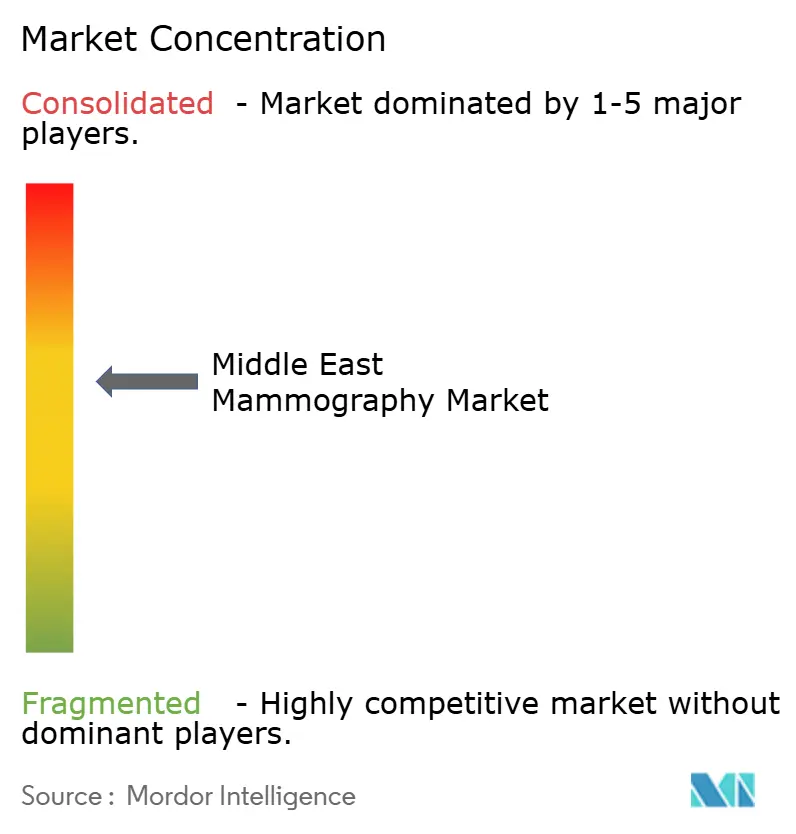
| Market Concentration | Medium |
Major Players *Disclaimer: Major Players sorted in no particular order Image © Mordor Intelligence. Reuse requires attribution under CC BY 4.0. | |
Middle East Mammography Market Analysis by Mordor Intelligence
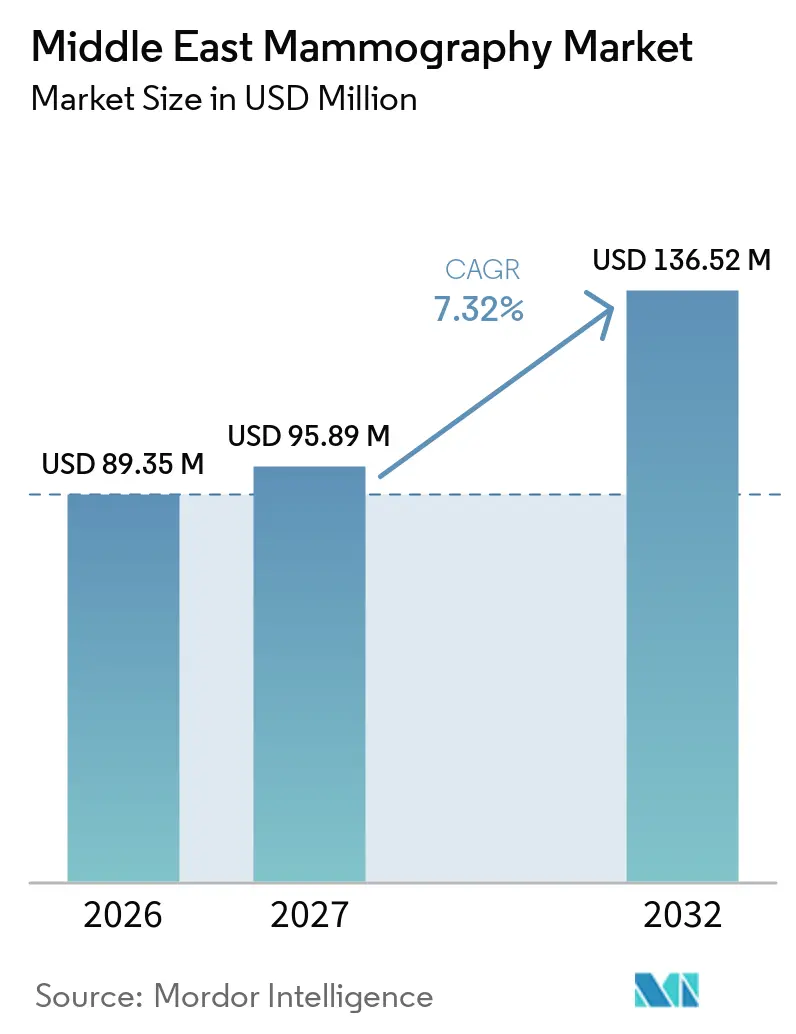
The Middle East Mammography Market size was valued at USD 89.35 million in 2026 and is estimated to grow from USD 95.89 million in 2027 to reach USD 136.52 million by 2032, at a CAGR of 7.32% during the forecast period (2027-2032).
A younger median age at breast cancer diagnosis, widening government screening mandates, and the fast diffusion of AI-enabled digital breast tomosynthesis are converging to keep demand resilient despite capital budget caution in parts of Egypt and Turkey. Three trends dominate: (1) multi-year equipment-refresh cycles at tertiary hospitals in Saudi Arabia and the United Arab Emirates that favor premium 3-D platforms with open APIs, (2) expanding public tenders for full-field digital mammography systems that balance cost and throughput, and (3) private-sector investments in CAD and AI workstations that promise shorter read times and lower recall rates. Competitive pressure is rising as Chinese entrants are undercutting list prices by 30-40%, forcing incumbents to defend their share through multi-year service contracts and bundled software subscriptions.
Key Report Takeaways
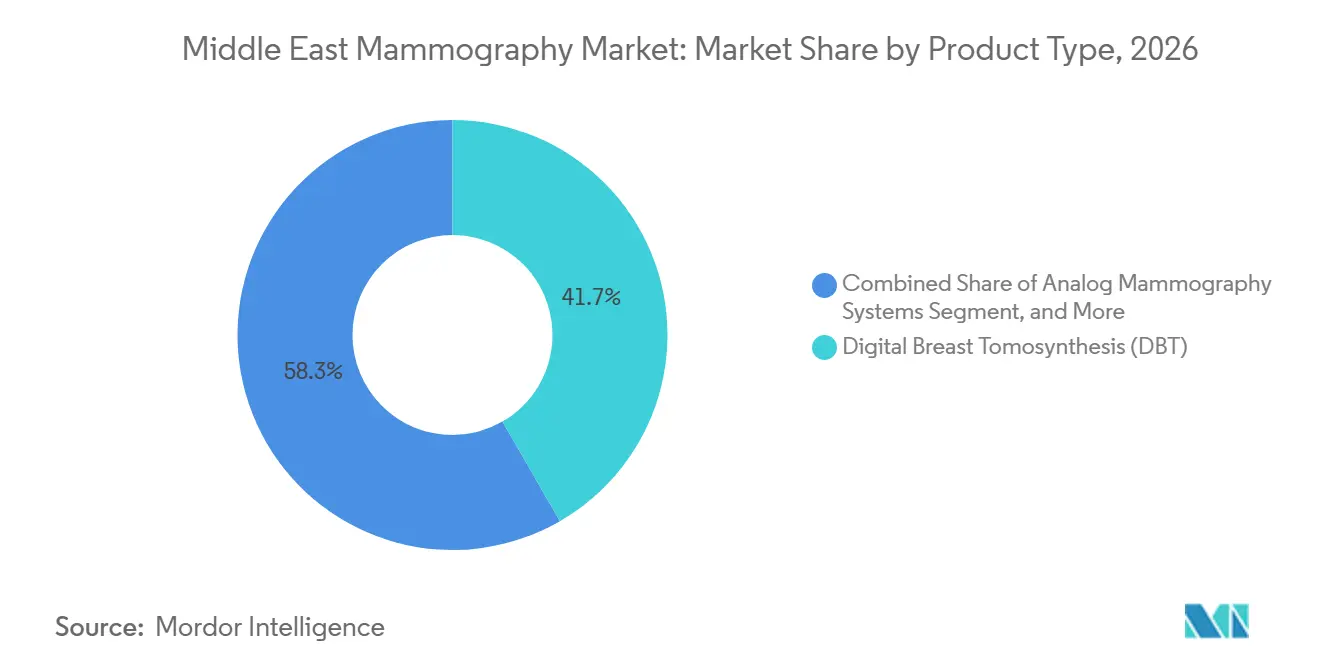
- By product type, digital breast tomosynthesis led with 41.67% of Middle East mammography market share in 2026, while full-field digital mammography is set to post the fastest 8.06% CAGR through 2032.
- By technology, 3-D digital tomosynthesis accounted for 46.21% of revenue in 2026, whereas CAD- and AI-assisted mammography is projected to expand at a 9.63% CAGR through 2032.
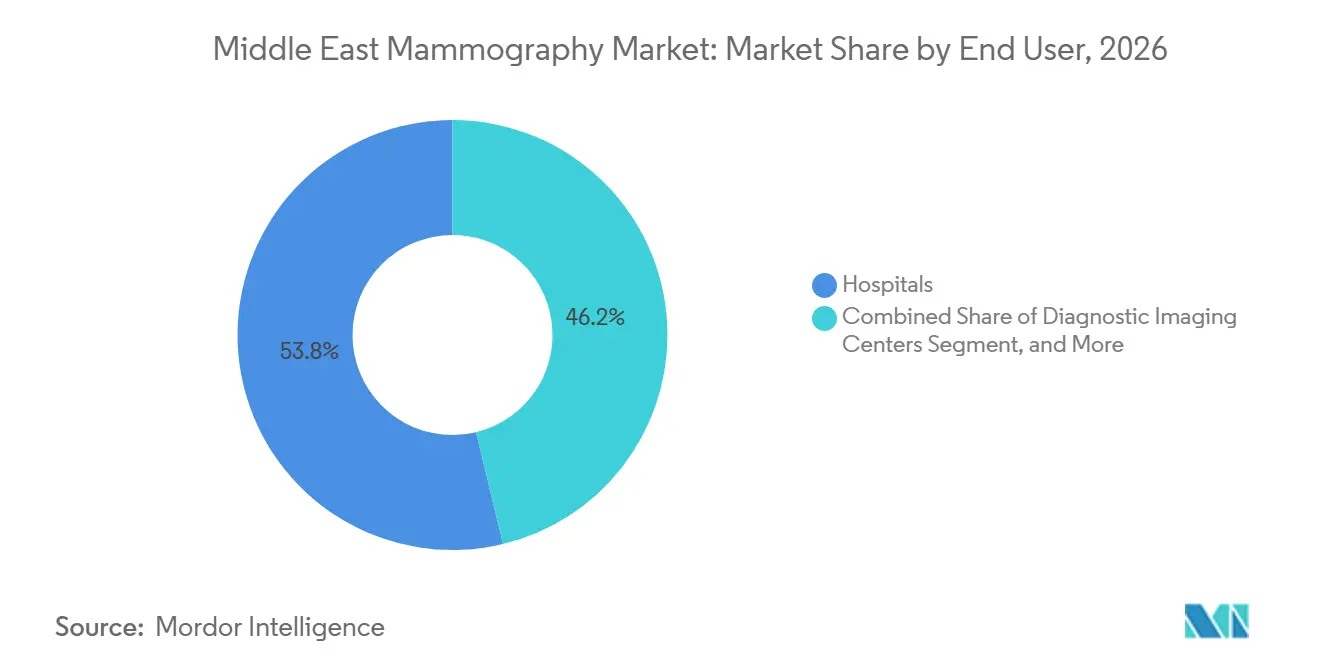
- By end user, hospitals captured 53.78% of 2026 revenue; breast care clinics are advancing at an 8.76% CAGR through 2032.
- By geography, Saudi Arabia accounted for 29.03% of 2026 revenue, while the United Arab Emirates is forecast to record the highest CAGR of 9.41% between 2027-2032.
Note: Market numbers in this report are based on Mordor Intelligence's proprietary estimation framework, which combines nine months of actuals with Q4 projections for base year 2026.
Market Trends and Insights
Drivers Impact Analysis of Middle East Mammography Market*
| Driver | (~) % Impact on CAGR Forecast | Geographic Relevance | Impact Timeline |
|---|---|---|---|
| Rising incidence of breast cancer across Middle East | +1.8% | GCC core, Egypt, Turkey | Long term (≥ 4 years) |
| Expansion of government-funded screening programs | +1.5% | Saudi Arabia, UAE, Qatar, Kuwait, Bahrain | Medium term (2-4 years) |
| Rapid adoption of digital breast tomosynthesis systems | +1.3% | UAE, Saudi Arabia, Qatar | Medium term (2-4 years) |
| Growing medical tourism for oncology diagnostics | +0.9% | UAE, Saudi Arabia, Turkey | Short term (≤ 2 years) |
| Surge in private-sector AI-enabled reading centers | +0.7% | UAE, Saudi Arabia, Qatar | Short term (≤ 2 years) |
| GCC-wide AI teleradiology reimbursement pilots | +0.5% | GCC countries | Long term (≥ 4 years) |
| Source: Mordor Intelligence | |||
Rising Incidence of Breast Cancer Across Middle East
Breast cancer is now the top malignancy among women in the region, and median diagnosis ages of 48-51 compress the screening window, driving urgent demand for higher-sensitivity imaging platforms.[1] Case numbers in Egypt climbed 12% between 2024-2025, prompting a USD 1.8 billion boost in oncology capacity and accelerating equipment procurement. Governments now mandate biennial screening from age 40, favoring digital breast tomosynthesis systems that detect small, dense-tissue lesions that are invisible on legacy analog units. The epidemiological shift anchors long-term demand for the Middle East mammography market.
Expansion of Government-Funded Screening Programs
Saudi Arabia aims to achieve 70% screening coverage by 2032 and has deployed mobile units across remote provinces to reach women who previously lacked access. The UAE integrated AI-equipped portable systems into school health checks, reducing diagnostic wait times to a single day and demonstrating cost-effective opportunistic screening.[2] Qatar’s partnership with Lunit demonstrates how integrating AI at the primary-care level improves sensitivity and throughput. Together, these programs expand the Middle East mammography market footprint and sustain vendor pipelines.
Rapid Adoption of Digital Breast Tomosynthesis Systems
Digital breast tomosynthesis accounted for 41.67% of 2026 product revenue, as facilities favored 3-D imaging that lowers recall rates in dense-breast cohorts. Hologic’s 3Dimensions with Genius AI, installed first in the UAE in 2025, claims up to 65% higher invasive-cancer detection, setting a new benchmark for premium platforms. Siemens and Fujifilm similarly stress workflow automation and dose optimization, attributes prized by administrators confronting technician shortages. High capital outlays persist, yet the upside of pay-per-scan leasing and medical tourism motivate adoption across the Middle East mammography market.
Growing Medical Tourism for Oncology Diagnostics
Dubai and Abu Dhabi attracted more than 600,000 medical tourists in 2024, with oncology evaluation gaining share as hospitals advertise AI-assisted same-day reporting. Saudi Arabia’s Vision 2030 seeks 1 million medical tourists annually, catalyzing joint ventures that bundle mammography with genetic testing and MRI follow-up. Turkey leverages competitive pricing and geographic proximity to Central Asia, further widening regional referral flows. Cross-border demand obliges hospitals to hold state-of-the-art equipment, reinforcing hardware refresh cycles in the Middle East mammography market.
Restraints Impact Analysis of Middle East Mammography Market*
| Restraint | (~) % Impact on CAGR Forecast | Geographic Relevance | Impact Timeline |
|---|---|---|---|
| High capital cost of advanced mammography equipment | -1.2% | Egypt, Turkey, Oman, Bahrain | Medium term (2-4 years) |
| Shortage of trained radiologists and technicians | -0.9% | Saudi Arabia, UAE, Kuwait | Long term (≥ 4 years) |
| Cultural barriers reducing screening uptake | -0.7% | Kuwait, Saudi Arabia, rural areas | Long term (≥ 4 years) |
| Supply-chain risks for flat-panel detectors | -0.4% | Global, acute in Egypt and Turkey | Short term (≤ 2 years) |
| Source: Mordor Intelligence | |||
High Capital Cost of Advanced Mammography Equipment
Premium 3-D systems carry price tags of USD 215,000-275,000 and annual service fees of up to USD 45,000, costs that many public hospitals cannot meet. Egypt’s 25% health-budget rise prioritizes brick-and-mortar expansion over equipment upgrades, sustaining two-dimensional demand at USD 55,000-75,000 per unit. Even in Gulf states, shifting resources to software subscriptions and teleradiology narrows the headroom for hardware capex, moderating the Middle East mammography market's acceleration.
Shortage of Trained Radiologists & Technicians
WHO projects a regional health-worker gap of 2.1 million by 2030, with breast radiology among the scarcest specialties.[3] Saudi Arabia houses fewer than 300 dedicated breast radiologists, insufficient for its screening targets. Reliance on expatriate staff increases turnover and lowers utilization rates, restraining growth in the Middle East mammography market.
*Our forecasts treat driver/restraint impacts as directional, not additive. The impact forecasts reflect baseline growth, mix effects, and variable interactions.
Middle East Mammography Market Segment Analysis
By Product Type:
Tomosynthesis Leads, FFDM AcceleratorsDigital breast tomosynthesis generated 41.67% of 2026 sales as tertiary hospitals upgraded to 3-D imaging to cut recall rates and attract medical tourists. Full-field digital mammography is forecast to log the fastest 8.06% CAGR through 2032, driven by public tenders in Egypt, Turkey, and emerging GCC markets seeking lower capex and proven throughput. Analog systems persist in rural clinics but are declining steadily as digital archiving and picture-archiving mandates spread. The Middle East mammography market size for full-field digital mammography is expected to climb alongside Egypt’s 58-hospital build-out, underscoring a budget-balanced adoption curve.

By Technology:
AI Platforms Outpace Legacy ModalitiesThree-dimensional tomosynthesis retained 46.21% of 2026 technology revenue, but CAD and AI-assisted mammography will record the highest 9.63% CAGR to 2032 as private networks monetize faster diagnostics. Hospitals continue to rely on two-dimensional digital units for mass screening; however, once AI reimbursement codes emerge, systems with vendor-neutral integration will command premium valuations across the Middle East mammography market. The Middle East mammography industry is thus pivoting toward software-centric value pools, even as hardware refreshes continue in parallel.
By End User:
Breast Care Clinics Gain ShareHospitals accounted for 53.78% of 2026 revenue, yet breast care clinics will expand at an 8.76% CAGR as patients gravitate toward specialized environments offering genetic counseling, MRI, and same-day biopsy. Diagnostic imaging centers and mobile units fill access gaps, particularly for self-pay expatriates and rural segments—but they battle thin margins and supply-chain risks. The Middle East mammography market for breast care clinics is set to grow fastest, capitalizing on private equity funding and AI-enhanced patient experiences.
Geography Analysis
Saudi Arabia Mammography Market
Saudi Arabia generated 29.03% of 2026 revenue, anchored by a population of 36 million and a government program aiming for 70% screening coverage by 2032. The Middle East mammography market share concentrated in the Kingdom benefits from tenders that stipulate domestic service hubs within 48 hours, favoring multinationals with regional logistics.
United Arab Emirates Mammography Market
The United Arab Emirates is forecast to post a 9.41% CAGR through 2032, underpinned by AI-enabled workflows that cut turnaround time from 19 days to 1 day and by medical tourism inflows seeking same-day breast imaging.
MEA Mammography Market
Qatar, Kuwait, Oman, and Bahrain together form a smaller yet strategically significant cluster. Qatar’s AI pilots aim for 30% faster reads; Kuwait grapples with low uptake, while Bahrain upgrades legacy units to boost the Middle East mammography market's size for dense-breast detection accuracy. Egypt’s 25% budget jump and Turkey’s medical-tourism windfall round out a region where political commitment, foreign-exchange volatility, and tourism pipelines shape procurement cycles.
Regulatory Landscape
Regulation for mammography systems in the Middle East combines medical-device marketing authorization with radiation safety and facility compliance, creating a multi-agency pathway that affects timelines for new installs and upgrades. In Saudi Arabia, the SFDA requires marketing authorization via its registration system, and in the UAE, MOHAP handles medical equipment registration while ionizing-radiation controls are enforced by FANR.
Competitive Landscape
The Middle East mammography market hosts multinationals Hologic, GE HealthCare, Siemens Healthineers, Fujifilm, and Philips, defending their installed bases through long-term service contracts and AI subscriptions, while lower-priced Chinese systems erode hardware margins. Blackstone and TPG’s USD 18.3 billion buy-out of Hologic in 2025 indicates rising private-equity confidence in AI-fortified breast imaging. Siemens’ MoU with Egypt’s Ministry of Health bundles hardware, training, and teleradiology in a pay-for-outcome model, reflecting a shift from transactional sales to lifecycle partnerships. Chinese entrants leverage 30-40% list-price discounts but struggle with ISO 13485 and data-localization compliance, barriers that Abu Dhabi’s 2024 standard has now codified. AI-native firms such as Lunit pursue software-as-a-service, bypassing hardware entirely and capturing value from algorithm licensing across the Middle East mammography market.
Middle East Mammography Industry Leaders
-
Hologic Inc.
-
Fujifilm Holdings Corporation
-
Planmed Oy
-
Siemens Healthineers AG
-
Koninklijke Philips N.V.
- *Disclaimer: Major Players sorted in no particular order
Middle East Mammography Market Companies Covered in this Report
- Canon
- Carestream Health
- Delphinus Medical Technologies Inc.
- Esaote S.p.A.
- Fujifilm Holdings Corpration
- GE HealthCare Technologies Inc.
- General Medical Merate
- Hologic
- Koninklijke Philips
- Metaltronica S.r.l.
- Mindray Bio-Medical Electronics Co. Ltd.
- Planmed
- Samsung Medison Co. Ltd.
- Siemens Healthineers
- Sonocine Inc.
Market Opportunities and Future Outlook
Organized population-scale screening programs continue to drive demand for high-throughput imaging and standardized QC workflows. In Jordan, the Ministry of Health has launched a national screening initiative that expands access to mammography services and tests the readiness of infrastructure and centralized reading workflows. In Saudi Arabia, national screening targets and SFDA quality assurance and dose-data expectations elevate the value of systems that can support structured QC, reporting, and lifecycle service agreements.
Recent Industry Developments in Middle East Mammography Market
- July 2026: Jordan's Ministry of Health launched an initiative to expand breast cancer screening services to 334,000 women. The scale of the program increases near-term requirements for standardized, high-throughput mammography capacity and strengthens the case for mobile screening units and centralized reading workflows across public providers.
- March 2025: Hologic expanded its framework with Saudi Arabia's Ministry of Health to supply AI-enabled imaging across primary-care centers, supported by technologist training and teleradiology infrastructure. The move aligns procurement with Vision 2030 screening expansion and helps sustain installed-base defensibility as new centers come online.
- January 2024: Fujifilm Middle East partnered with AlMana Group of Hospitals to implement AI-driven diagnostic and healthcare solutions, announced around the Arab Health conference in Dubai. The collaboration reinforces regional hospital networks as commercialization channels for AI-enabled imaging workflows and can accelerate adoption of integrated digital mammography platforms within large provider networks.
Middle East Mammography Market Report Scope and Research Methodology
Market Definition and Coverage
This market is defined as the revenues earned from mammography systems and related upgrades used for breast screening and diagnostic imaging across the Middle East, as these products are sold into hospitals, imaging centers, and similar care settings.
Scope exclusions: We exclude broader breast imaging modalities that are not mammography (such as ultrasound or MRI), as well as general radiology consumables not dedicated to mammography use.
Segments Covered in This Report
- By Product Type
- Analog Mammography Systems
- Full-Field Digital Mammography (FFDM)
- Digital Breast Tomosynthesis (DBT)
- By Technology
- 2-D Digital Mammography
- 3-D Digital Tomosynthesis
- CAD & AI-Assisted Mammography
- By End User
- Hospitals
- Diagnostic Imaging Centers
- Breast Care Clinics
- Mobile Screening Units
- By Country
- Saudi Arabia
- United Arab Emirates
- Qatar
- Kuwait
- Oman
- Bahrain
- Turkey
- Israel
- Egypt
- Rest of Middle East
Data Sources, Market Sizing, and Validation
Desk Research
Desk research was used to set the fact base and keep the model tied to observable signals for the region. We reviewed public health statistics and cancer screening references, then aligned these with medical device trade flows and macro health spending patterns to understand demand direction and affordability.
Common sources included non-paywalled publications such as World Health Organization cancer and health system indicators, International Agency for Research on Cancer (GLOBOCAN) incidence and mortality tables, World Bank population and health expenditure series, UN Comtrade import and export data for relevant device categories, and Ministry of Health portals and national screening program updates across key Middle East countries. Company annual reports, investor presentations, regulatory notices, and reputed press coverage helped validate rollout timing for 2D, 3D tomosynthesis, and CAD or AI-assisted upgrades. We also used paid subscriptions for company financials and intelligence, patents, and shipment-level trade checks where public series needed extra clarification. The sources listed here are illustrative only, and other public documents and datasets were also referred to for data collection, validation, and clarification.
Primary Interviews and Surveys
Primary interviews and surveys were used to pressure-test assumptions that desk research cannot fully confirm, especially around replacement cycles, procurement preferences, and the practical split between 2D digital and 3D tomosynthesis in day-to-day use. We spoke with a mix of device distributors, imaging center operators, hospital procurement and radiology leaders, and service partners across the Middle East, and then used their inputs to adjust adoption pacing and price progression before finalizing the model.
Distribution of primary research fieldwork respondents
| Company type | Respondent position |
|---|---|
| Top tier: 30% | CXOs: 13% |
| Mid tier: 52% | Functional/Unit leaders: 39% |
| Smaller Players: 18% | Managers: 48% |
Market-Sizing & Forecasting
Sizing started with a top-down reconstruction that links installed base expansion and replacement needs to country-level screening momentum and imaging capacity, then converts those volumes into value using realistic pricing ladders by technology. After building the demand pool, the market total was derived by aligning country shares to procurement reality and cross-checking import signals.
Key inputs used in the model included breast cancer incidence and screening awareness proxies, target age cohort growth, number and expansion pace of diagnostic imaging centers and hospital radiology departments, 2D versus 3D adoption mix (including CAD and AI-assisted attach rates), typical replacement cycles for mammography systems, and average selling price movement driven by tendering and service coverage. Bottom-up approximations were applied selectively, such as channel checks with distributors, sampled ASP timing aligned to unit placements, and consistency checks against trade flows for relevant equipment categories. Where coverage gaps existed for smaller countries, penetration and utilization assumptions were interpolated from similar health system profiles and then re-tested through follow-up calls.
For forecasting, we applied scenario analysis because screening programs, tender timing, and reimbursement changes can shift year to year, then used a simple regression-style sensitivity on variables like target cohort growth and technology mix to keep the forward path consistent. Assumptions were finalized only after they were echoed by multiple respondent types, so the forecast remains explainable and repeatable with the evidence collected.
Data Validation & Update Cycle
Validation was done by triangulating the model output against independent signals, including import directionality, known hospital expansion plans, and the expected technology shift from 2D digital to 3D tomosynthesis in the region. Outliers were flagged when country values implied unrealistic unit intensity or pricing, and then the driver assumptions were re-checked until the variance was explainable.
A multi-step review is followed before sign-off, where assumptions, calculations, and narrative logic are checked by another analyst and corrected where needed. The report is refreshed annually, and interim adjustments are made when material events occur, such as major tender awards, policy shifts in screening, or supply disruptions. Before delivery, a final pass is performed so clients receive the latest updated view consistent with the same model logic.
Mordor Intelligence's Middle East Mammography Market Sizing Compared With Other Published Estimates
Published numbers for the Middle East mammography space often do not match because the counted items and the timing assumptions are not the same. Differences usually show up around what is treated as mammography revenue, which countries are included under the region label, and whether the estimate follows procurement cycles or a smoother growth curve.
The main gap comes from scope expansion into adjacent breast imaging and broader service revenues, where Mordor Intelligence counts only mammography systems and mammography specific technology upgrades (including 2D, 3D tomosynthesis, and CAD or AI-assisted mammography) across the listed Middle East countries, rather than bundling in non-mammography imaging, generalized radiology services, or wider MEA totals.
Benchmark comparison
| Source | Market Size | Gaps in Research Methodology |
|---|---|---|
| Mordor Intelligence | USD 88.92 M (2026) | |
| Global Consultancy A | USD 0.45 B (2024) | Uses a broader spend view that appears to blend mammography with wider breast imaging and related services, and it anchors to a different base year which can overstate the comparable equipment-only value. |
| Industry Publisher B | USD 0.46 B (2024) | Includes a wider product basket and application framing (for example, film screen and additional monitoring or service elements), and it assumes a smoother demand curve that may not reflect tender-led purchasing cycles in the region. |
The spread in values mostly reflects what is being counted and how quickly pricing and adoption are allowed to move by year. By keeping the market build tied to specific technologies, country coverage, and procurement-linked demand signals, the estimate stays traceable to clear variables and can be rechecked as new screening and tender information becomes public.
Key Questions Answered in the Report
How large will screening demand be for digital breast tomosynthesis in Gulf hospitals by 2032?
Purchases of premium 3-D systems in Saudi Arabia and the UAE will keep annual sales growing at 7.32% overall, with tomosynthesis still holding the largest Middle East mammography market share by 2032.
Will AI-assisted mammography become reimbursable before 2032?
Regulatory pilots in Abu Dhabi and Saudi Arabia indicate fee codes could arrive around 2028, likely making AI capability a purchase prerequisite for new systems.
Which country is expected to grow fastest in breast-imaging capex?
The United Arab Emirates shows the highest forecast CAGR at 9.41%, driven by medical-tourism positioning and AI-enabled workflow investments.
Do mobile screening units offer a sustainable business model?
Mobile fleets fill rural gaps, yet diesel costs, staff turnover, and USD 400,000-600,000 vehicle prices limit profitability unless volumes are underwritten by government programs or corporate wellness contracts.
How severe is the radiologist shortage for breast imaging?
GCC nations employ fewer than 300 breast-focused radiologists in total; AI-assisted teleradiology is therefore key to scaling coverage without proportional workforce growth.