
Market Overview
| Study Period | 2020 - 2031 |
|---|---|
| Forecast Data Period | 2026 - 2031 |
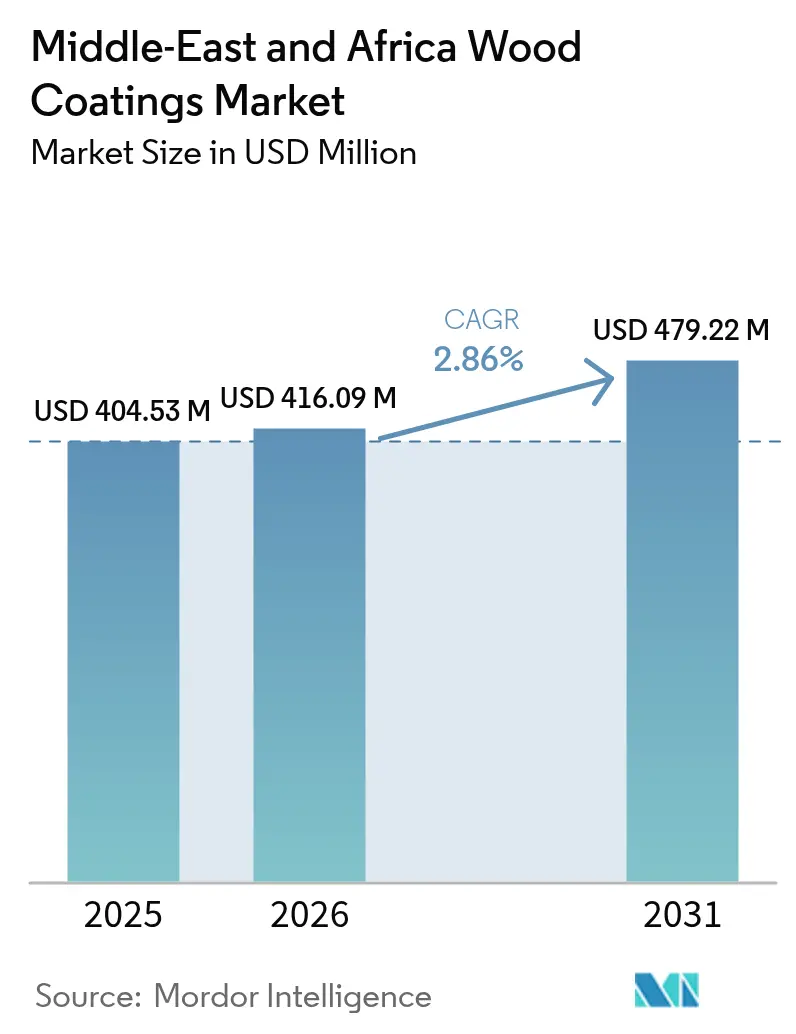
| Base Year Market Size (2025) | USD 404.53 Million |
| Market Size (2026) | USD 416.09 Million |
| Market Size (2031) | USD 479.22 Million |
| Growth Rate (2026 - 2031) | 2.86 % |
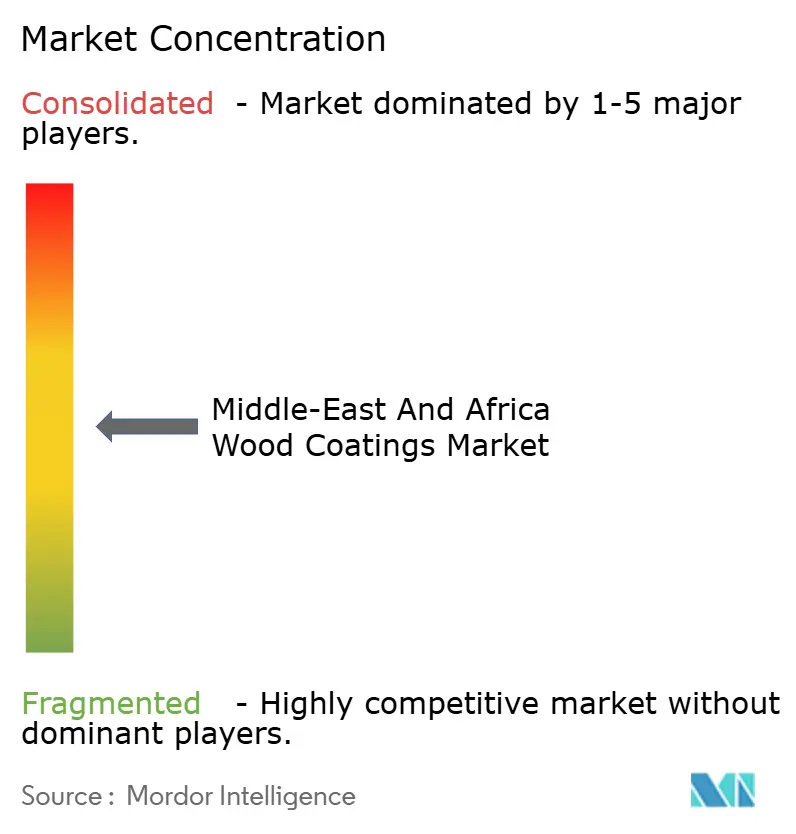
| Market Concentration | Medium |
Major Players *Disclaimer: Major Players sorted in no particular order Image © Mordor Intelligence. Reuse requires attribution under CC BY 4.0. | |
Middle-East And Africa Wood Coatings Market Analysis by Mordor Intelligence
The Middle East and Africa wood coatings market size is expected to grow from USD 404.53 million in 2025 to USD 416.09 million in 2026 and is forecast to reach USD 479.22 million by 2031 at 2.86% CAGR over 2026-2031. A widening gap is forming between Gulf Cooperation Council projects that demand premium, durability-focused finishes and East African furniture hubs that emphasize cost-efficient solvent systems. Global suppliers that can synchronize both ends of the spectrum capture share because contractors in Saudi Arabia and the United Arab Emirates specify two-component polyurethane for coastal humidity, while workshops in Kenya and Nigeria still depend on nitrocellulose to maximize daily throughput. Propylene-linked resin costs rose 30% in 2024, squeezing gross margins for formulators lacking long-term feedstock contracts. Meanwhile, Egypt, Morocco, and South Africa tightened VOC ceilings modeled on EU Directive 2004/42/EC, accelerating water-borne technology beyond 3.6% annual growth even as solvent-borne volumes remain dominant in price-sensitive inland markets.
Key Report Takeaways
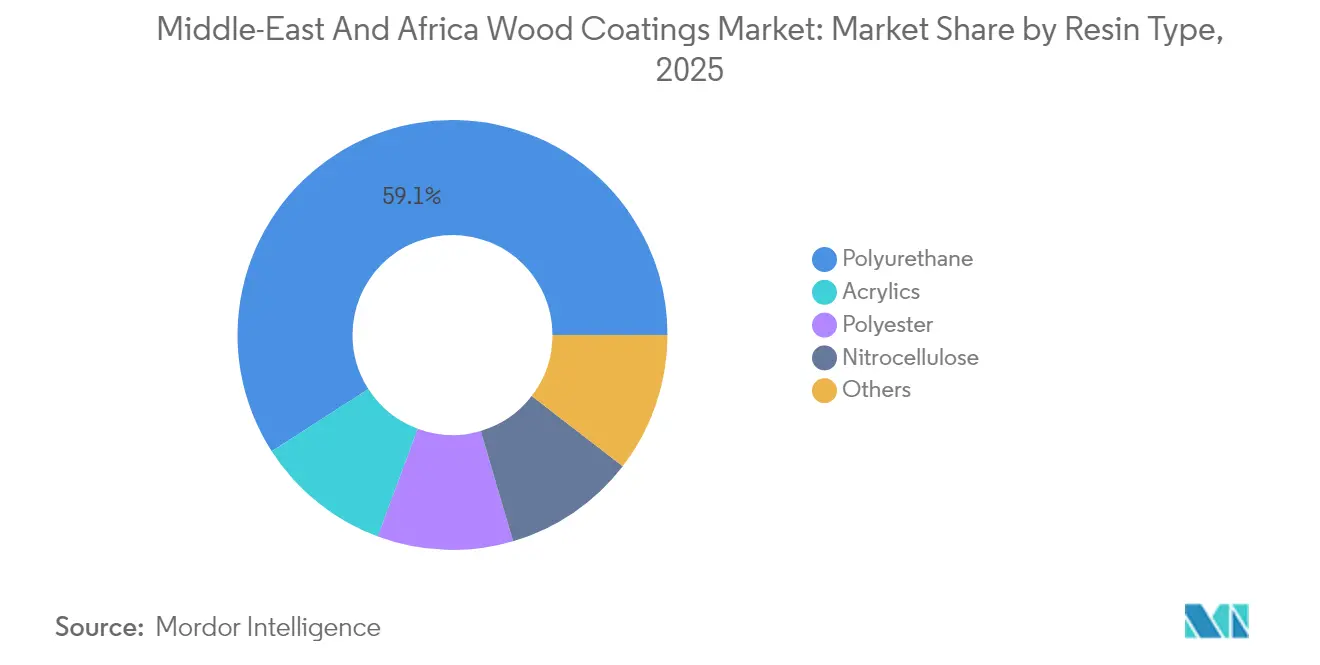
- By resin type, polyurethane led the Middle East and Africa wood coatings market with a 59.10% share in 2025 and is projected to expand at a 2.94% CAGR through 2031.
- By technology, solvent-borne products retained 55.90% revenue share in 2025, whereas water-borne offerings are set to grow at a 3.55% CAGR, the fastest among all technologies.
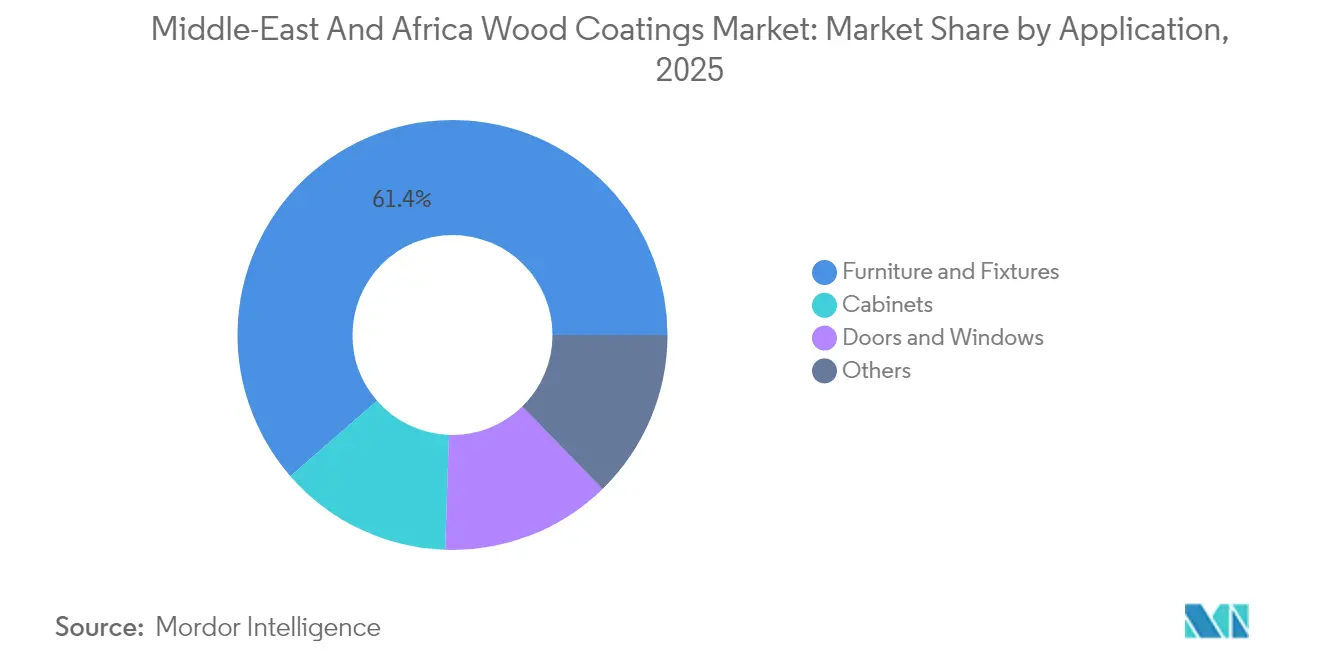
- By application, furniture and fixtures captured 61.40% of the 2025 demand; cabinets are advancing at a 3.02% CAGR through 2031, driven by the adoption of factory-finished MDF in Gulf residential towers.
- By geography, Saudi Arabia commanded a 21.40% share of the Middle East and Africa wood coatings market in 2025; the United Arab Emirates is forecast to post the fastest geographic growth at a 3.15% CAGR through 2031.
Note: Market size and forecast figures in this report are generated using Mordor Intelligence’s proprietary estimation framework, updated with the latest available data and insights as of 2026.
Market Trends and Insights
Drivers Impact Analysis of Middle-East And Africa Wood Coatings Market*
| Drivers | (~) % Impact on CAGR Forecast | Geographic Relevance | Impact Timeline |
|---|---|---|---|
| Surge in GCC and East Africa construction pipeline | +0.9% | Saudi Arabia, UAE, Qatar, Kenya, Ethiopia | Medium term (2-4 years) |
| Expansion of regional furniture manufacturing hubs | +0.7% | Egypt, Morocco, Kenya, South Africa | Short term (≤ 2 years) |
| Regulatory shift toward water-borne systems | +0.5% | Egypt, Morocco, South Africa, spillover to GCC | Long term (≥ 4 years) |
| Tourism mega-projects demanding premium wood finishes | +0.6% | Saudi Arabia, UAE, Egypt | Medium term (2-4 years) |
| Rise of digital printing on engineered wood | +0.3% | Saudi Arabia, UAE, Egypt | Long term (≥ 4 years) |
| Source: Mordor Intelligence | |||
Surge in GCC and East Africa Construction Pipeline
Public capital outlays are reshaping demand across building types. Saudi Arabia’s Public Investment Fund has directed USD 40 billion to projects that prioritize wood-intensive hospitality interiors, driving the specification of marine-grade polyurethane that withstands 90% humidity. Kenya’s affordable-housing program, which stipulates the use of locally sourced timber for the joinery, boosted interior-wood demand. Ethiopian customs tariffs discourage waterborne primer imports, so solvent lines remain dominant despite Addis Ababa’s real estate boom. Formulators therefore operate dual production lines to serve both high-performance Gulf projects and cost-sensitive East African housing.
Expansion of Regional Furniture Manufacturing Hubs
Morocco exported USD 358 million in furniture during 2024, led by Casablanca and Tangier plants that have adopted two-component polyurethane to meet European scratch-resistance standards. Kenya’s furniture sector, valued at USD 452 million, continues to struggle with a shortage of kiln-dried timber; reject rates for UV-cured finishes remain high, reinforcing nitrocellulose’s dominance. South Africa’s Western Cape manufacturers pivoted to engineered wood, reducing solvent emissions by 35% in line with provincial air-quality plans. Export-oriented hubs demand consistent, compliant coatings, whereas small workshops in Kenya and South Africa often prioritize price over performance.
Regulatory Shift Toward Water-Borne Systems
Egypt capped VOC content at 250 g/L for wood finishes, effective 2024, rendering 40% of nitrocellulose formulas non-compliant[1]. Morocco harmonized limits with EU Directive 2004/42/EC, driving local formulators to reformulate or import compliant lines. South Africa issued 14 compliance notices to furniture makers in 2024, accelerating the need for booth retrofits that cost USD 27,000-43,000 each. GCC contractors are increasingly pursuing LEED points, which indirectly raises the requirement for low-VOC materials. Adoption remains uneven because Kenyan operators resist longer drying times.
Tourism Mega-Projects Demanding Premium Wood Finishes
Saudi Arabia’s Red Sea Project mandates UV-inhibited polyurethane for exterior cladding, raising per-square-meter coating cost by 40%. Expo City Dubai specifies factory-finished panels with UV-cured topcoats to compress schedules across 438 hectares. Egypt’s North Coast resorts adopted digitally printed panels to cut lead times to 10 days. Qatar’s Lusail district maintained nitrocellulose for heritage screens because waterborne systems could not achieve the required gloss threshold. Premium projects account for 18-20% of revenue, despite comprising only 8-10% of the volume.
Restraints Impact Analysis of Middle-East And Africa Wood Coatings Market*
| Restraints | (~) % Impact on CAGR Forecast | Geographic Relevance | Impact Timeline |
|---|---|---|---|
| Stringent VOC / REACH-like regulations | -0.4% | Egypt, Morocco, South Africa, spillover to GCC | Medium term (2-4 years) |
| Petro-resin price volatility | -0.5% | Global, acute in Kenya and Nigeria | Short term (≤ 2 years) |
| Shortage of kiln-dried timber supply | -0.3% | Kenya, Nigeria, Ethiopia, South Africa | Long term (≥ 4 years) |
| Source: Mordor Intelligence | |||
Stringent VOC / REACH-Like Regulations
Egypt’s 250 g/L cap disqualified many nitrocellulose lines, forcing import of water-borne alternatives at 15-20% higher cost. Morocco now requires VOC declarations for exports to Europe, adding testing overhead that small workshops struggle to absorb. South African authorities issued 14 compliance notices in 2024; non-compliant plants faced shutdown threats. GCC projects increasingly request LEED-aligned low-VOC coatings, pushing water-borne penetration from 30% in 2022 to 48% in 2024. Capital costs for spray-line retrofits remain a hurdle, so many Kenyan and Nigerian shops keep solvent products despite lower margins.
Petro-Resin Price Volatility
Propylene spot prices surged sharply in 2024 following outages at Chinese crackers, which inflated acrylic and polyurethane costs. MDI and TDI prices increased by 18-22% following European capacity constraints, which hurt formulators without supply contracts. Solvent costs fluctuated in tandem with crude, swinging between USD 75-92 per barrel, yet small East African customers resisted quarterly repricing, squeezing working capital. Limited hedging liquidity in regional derivatives markets leaves most formulators exposed to price shocks.
*Our forecasts treat driver/restraint impacts as directional, not additive. The impact forecasts reflect baseline growth, mix effects, and variable interactions.
Middle-East And Africa Wood Coatings Market Segment Analysis
By Resin Type:
Polyurethane Dominance Anchored in Coastal DurabilityPolyurethane captured 59.10% of the Middle-East and Africa wood coatings market share in 2025 and is rising at a 2.94% CAGR through 2031. Contractors in Jeddah, Doha, and Dubai routinely specify two-component PU for exterior joinery where 90% humidity threatens delamination. Polyester, which holds around 10.20%, remains popular in dry, inland Saudi regions, but exhibits brittleness under thermal cycling. Nitrocellulose fell to 10% because Egypt’s VOC cap forced exporters to drop legacy formulas. Water-borne polyurethane dispersions, marketed under the Bayhydur and Laromer brands, experienced double-digit growth in North Africa after distributors highlighted their EU compliance. UV-cured acrylics are expanding fast thanks to digital printing at Turkish and Egyptian MDF plants.
Polyurethane’s premium tier coexists with a value tier of single-component acrylics and residual nitrocellulose, which dominate the East African domestic furniture market. The bifurcation pressures vendors to run parallel supply chains. Over the forecast horizon, polyurethane’s share may inch higher as Gulf tourism projects multiply, while nitrocellulose continues to retreat in export-oriented clusters.

By Technology:
Water-Borne Gains Pace Despite Solvent-Borne IncumbencySolvent-borne solutions retained 55.90% revenue in 2025, but water-borne volumes are set to grow 3.55% annually. Kenya and Nigeria still rely on solvent products because humidity-control infrastructure and reliable power remain scarce. UV-cured coatings, essential to digital printing, are gaining momentum at panel factories that now supply Gulf hospitality projects. Powder coatings remain pilot-scale, confined to NEOM tests where zero-VOC performance is critical. This two-speed transition enables multinational suppliers to leverage dual-cure portfolios, while regional firms pursue solvent substitution in export hubs.
By Application:
Furniture Remains Core, Cabinets ClimbFurniture and fixtures retained 61.40% of 2025 demand and will grow at a 2.90% CAGR to 2031. Egypt’s Damietta hub alone aims for 1 million units of annual capacity by 2026, centralizing finishing and cutting coating waste by 22%. Morocco’s exporters accept 15-20% cost premiums on PU systems to retain EU contracts. Kenya’s lack of kiln-dried feedstock, with only 40% dried to specification, propels nitrocellulose reversion for throughput.
Doors and windows see steady gains as Gulf residential towers specify pre-finished frames, while cabinets benefit from factory-finished MDF panels that cut fit-out time by 18% on Dubai high-rises. Flooring, paneling, and outdoor furniture together account for roughly 12.70% of volume, often using heritage-compatible formulations in Oman and Qatar. Furniture’s share may dip slightly as cabinets advance in Gulf housing, yet export momentum in Egypt and Morocco anchors its dominance.
Geography Analysis
Saudi Arabia and United Arab Emirates Wood Coatings Market
Saudi Arabia’s 21.40% share is based on its vast construction portfolio and tourism resorts, which require marine-grade polyurethane. Vision 2030 housing plans specify factory-finished doors for 40% of 300,000 annual units, cementing demand for high-durability coatings. The United Arab Emirates, projected to grow at a rate of 3.15% annually through 2031, relies on Expo City Dubai and Saadiyat Cultural District, both of which require UV-cured panels for color fidelity.
MEA Wood Coatings Market
Egypt’s Damietta consolidates 400 workshops, enhancing just-in-time delivery for export clients and raising waterborne adoption. Morocco’s USD 358 million export trade continues 3.06% growth as EU buyers audit VOC compliance. South Africa’s Western Cape has shifted to engineered wood that accepts acrylic emulsions, thereby reducing solvent emissions. Nigeria and Algeria face port and power bottlenecks; Lagos workshops lack humidity control, which constrains the use of waterborne transport, while Algerian mills struggle with six-week timber delays. Qatar still specifies nitrocellulose for heritage mashrabiya screens due to extreme heat.
MEA Markets
Premium demand clusters exist in Saudi Arabia, the UAE, and Qatar, where green-building goals reward low-VOC and UV-cured systems. Kenya, Nigeria, and Ethiopia remain price-driven with solvent incumbency. Egypt and Morocco straddle both worlds, exporting compliant furniture while serving domestic markets that still seek cost efficiency.
Regulatory Landscape
Wood-coatings market access across the GCC increasingly hinges on product conformity regimes and harmonized standards. In Saudi Arabia, paints and varnishes fall under SASO technical regulation and are routed through the SABER conformity platform, which elevates the role of third-party testing and documented compliance for VOC and hazardous-substance requirements referenced by Gulf standards. At the regional level, GSO 2655:2021 sets environmental criteria for indoor and outdoor paints, supporting more consistent procurement requirements across GCC markets.
In the UAE, MoIAT administers paints and varnishes conformity under the ECAS scheme (linked to Cabinet Decision No. 6/2016), while Dubai Municipality green-building requirements (including DMS 0020-2016) push low-emitting materials through VOC and heavy metal checks in major projects. In East Africa, EAC standards for emulsion paints add another compliance layer for suppliers selling into Kenya and neighboring markets, although practical enforcement and factory retrofit capability vary materially by country and customer segment.
Value Chain Analysis
The value chain starts with largely imported petrochemical and specialty inputs (acrylic monomers, isocyanates, solvents, additives, and photoinitiators for UV systems), followed by regional formulation and manufacturing hubs concentrated in Egypt, Saudi Arabia, and the UAE. Economic zones and port-adjacent industrial clusters are particularly influential because distributors use Dubai as a logistics and repackaging hub for blending inputs and finished coatings, then move supply into the GCC and onward into Africa. Local producers compete on lead time, tinting support, and contractor specification services.
Downstream, demand is pulled through two distinct channels: (i) contractor and fit-out specification for premium projects in the GCC (where two-component polyurethane and UV-cured systems are favored) and (ii) workshop-led furniture manufacturing in East Africa that prioritizes faster throughput and price-sensitive solvent chemistries. Investment signals a push toward deeper localization and capacity upgrading across the region. In April 2026, Jotun Abu Dhabi signed a 50-year lease with KEZAD Group for an 83,177-square-meter manufacturing facility in Musaffah, backed by a reported USD 122.5 million investment. In April 2026, International Group for Modern Coatings (MIDO) secured USD 45 million in mezzanine financing to refinance and expand capacity at its Alexandria facilities, tightening regional supply availability for compliant product lines.
Competitive Landscape
The Middle East and Africa wood coatings market is moderately consolidated, with global majors having exclusive GCC dealer networks that guarantee specification support and marine-grade tinting. National Paints in the UAE and Crown Paints in Kenya utilize domestic plants to circumvent tariffs and offer 48-hour delivery, aligning with localized procurement cycles. Multinationals deploy solvent, waterborne, and UV lines under one roof, while regional challengers focus on waterborne formulations priced below those of imported brands. White-space lies in integrating digital printing with a turnkey coating supply. Durst and Hymmen installed UV-LED inkjet systems at Turkish and Egyptian MDF facilities; however, no coatings producer offers a bundled ink-plus-topcoat service—an opportunity for dual-cure specialists at durst-group.com. Competitive intensity will intensify as VOC rules become stricter and exporters demand compliant chemistry without incurring cost spikes.
Middle-East And Africa Wood Coatings Industry Leaders
-
Akzo Nobel N.V.
-
Jotun
-
PPG Industries Inc.
-
The Sherwin-Williams Company
-
Kansai Paint Co., Ltd.
- *Disclaimer: Major Players sorted in no particular order
Middle-East And Africa Wood Coatings Market Companies Covered in this Report
- Akzo Nobel N.V.
- Asian Paints Ltd.
- Caparol Paints (DAW SE)
- Crown Paints Kenya PLC
- Hempel A/S
- IVM Chemicals SRL
- Jotun
- Kansai Paint Co., Ltd.
- KAPCI Coatings
- Mas Paints
- National Paints Factories Co. Ltd.
- Nippon Paint Holdings Co., Ltd.
- PPG Industries Inc.
- Ritver
- RPM International Inc.
- Sipes Egypt
- The Sherwin-Williams Company
Market Opportunities and Future Outlook
Compliance-driven reformulation and supply assurance are the clearest white-space in the region, especially where VOC ceilings and green-building requirements shape approved-vendor lists for large projects. Egypts move to a 250 g/L VOC cap for wood finishes (effective 2024) and Moroccos alignment with EU Directive 2004/42/EC are already pushing exporters and their suppliers toward water-borne and compliant polyurethane systems, while Dubai Municipality green-building specifications keep low-emitting materials central to tender requirements. Suppliers that combine compliant chemistry with application support (spray-booth process windows, drying-time optimization, and QA documentation) address a practical barrier for small and mid-sized workshops, which often struggle with retrofit costs and test reporting.
A second opportunity is at the intersection of manufacturing localization and faster project execution in the GCC. Capacity additions and new hubs indicate customers are placing a higher value on shorter lead times and local technical service: in April 2026, Jotun Abu Dhabi committed to a new KEZAD manufacturing hub, and in July 2024, Nippon Paint (NIPSEA Paint Kenya) expanded into Kenya to build an East African base that includes wood-coating products. Separately, the competitive landscape points to a service gap in digitally printed engineered wood, where UV-LED inkjet systems (installed by Durst and Hymmen at Turkish and Egyptian MDF facilities) are not yet paired with a coatings supplier offering a bundled ink-plus-topcoat solution. Dual-cure specialists and distributors can differentiate by integrating UV-cured topcoats, process qualification, and stocking models around these panel lines.
Recent Industry Developments in Middle-East And Africa Wood Coatings Market
- July 2026: Jotun announced an expansion of its manufacturing footprint in Egypt with investment reported to exceed USD 100 million, alongside plans to start local production of passive fire protection products. The change supports in-region supply and technical capability for performance coatings, helping large projects and export-oriented customers move faster on timelines.
- April 2026: Jotun Abu Dhabi signed a 50-year land lease with KEZAD Group for an 83,177-square-meter manufacturing facility in ICAD-KEZAD Musaffah, with a reported investment of USD 122.5 million. Establishing a larger local production base in Abu Dhabi strengthens GCC supply security and aligns product availability with tight construction and fit-out schedules.
- May 2025: Crown Paints Kenya introduced a water-borne wood-coatings range aligned to EU VOC Directive 2004/42/EC for manufacturers selling into export channels. The update supports Kenyan furniture producers facing buyer audits for VOC compliance and increases competitive pressure on solvent-heavy portfolios in East Africa.
Middle-East And Africa Wood Coatings Market Report Scope and Research Methodology
Market Definition and Coverage
For this study, the market includes coatings applied on wood substrates to protect and decorate items like furniture, doors, windows, cabinets, and other wood fixtures across the Middle East and Africa.
Scope exclusions: We exclude coatings primarily meant for metal, concrete, plastics, and glass, even when used in mixed-material furniture and interiors.
Segments Covered in This Report
- By Resin Type
- Polyurethane
- Polyester
- Nitrocellulose
- Acrylics
- Others
- By Technology
- Water-borne
- Solvent-borne
- UV cured
- Powder
- By Application
- Furniture and Fixtures
- Doors and Windows
- Cabinets
- Others
- By Geography
- South Africa
- Egypt
- Morocco
- Nigeria
- Algeria
- Kenya
- Saudi Arabia
- United Arab Emirates
- Iran
- Rest of Middle East and Africa
Data Sources, Market Sizing, and Validation
Desk Research
Desk work is used to set the frame for demand and pricing in wood finishing across the Middle East and Africa, before the model is finalized through interviews. We start by mapping where wood products are made and consumed in the region, and then align it with construction activity and furniture output trends.
Public sources that help with this include, such as national statistics offices, UN Comtrade trade tables for relevant resin and coating inputs, World Bank macro indicators, and industrial standards and regulatory references that influence technology choices (such as VOC limits). We also review company annual reports, investor decks, distributor websites, and credible industry news to understand product mix and changes in raw material costs. Where needed, subscription databases are used for company financials and intelligence, patent lookups linked to coating chemistries, and shipment-level trade checks for selected material flows. These sources are not exhaustive, and many other public documents were also referred to for cross-checking and clarification.
Primary Interviews and Surveys
Primary inputs are gathered through expert interviews and structured surveys with manufacturers, raw material participants, formulators, distributors, and large end users (such as furniture and joinery producers). For a multi-country market like this, conversations are balanced across GCC demand centers and key African hubs so assumptions on technology mix, channel margins, and typical pricing can be corrected where desk signals are weak.
Distribution of primary research fieldwork respondents
| Company type | Respondent position |
|---|---|
| Top tier: 35% | CXOs: 18% |
| Mid tier: 46% | Functional/Unit leaders: 37% |
| Smaller Players: 19% | Managers: 45% |
Market-Sizing & Forecasting
Sizing is built using a top-down approach where construction and woodwork activity is translated into a regional demand pool for wood finishing, and then split by typical application intensity. Once that demand pool is formed, we layer in technology and resin mix patterns that are observed locally, and then convert to value using market-consistent price ranges.
A few inputs that matter here include furniture and joinery production trends, building and renovation indicators, the share shift between solvent-borne and water-borne systems, adoption pace for premium two-component polyurethane in higher specification projects, and resin cost movement that impacts average selling prices. To keep the totals realistic, results are checked with selective bottom-up approximations, such as sampled manufacturer and distributor revenue bands, channel markups, and volume times ASP checks for common product families. Where direct company splits are not available, gaps are handled through peer group averaging, followed by interview-based adjustments.
For forecasting, scenario analysis is used, since demand can swing based on project cycles and import dependence for inputs. After the scenarios are set, yearly growth paths are anchored to consensus from interviews on construction starts, refurbishment activity, and expected technology substitution, and then smoothed to avoid unrealistic step changes.
Data Validation & Update Cycle
Model outputs are validated through triangulation across independent signals, such as trade movement for key inputs, construction activity direction, and observed pricing bands in the channel. If a country-level result looks off, the drivers are revisited, and the interview list is reopened to re-check the assumptions that caused the variance.
Before sign-off, the estimates go through multi-step analyst reviews that look for unit consistency, year-over-year jumps, and mix shifts that do not match market behavior. Reports are refreshed annually, and interim updates are added when material events occur, such as sharp raw material price swings or major regulatory changes. Right before delivery, a fresh pass is done so clients receive the most current view available.
Mordor Intelligence's Middle East and Africa Wood Coatings Market Size Versus Other Published Estimates
Published market values for this topic can look far apart because firms do not always count the same product set, countries, or pricing layers. Differences also show up when one estimate relies more on broad paints and coatings totals, while another tries to isolate wood finishing demand and then assigns a pricing curve.
The biggest gap driver is scope expansion into adjacent coating uses, where Mordor Intelligence counts wood coatings only when the coating is intended for wood substrates and wood applications, instead of bundling general architectural paints used around wood surfaces. Another common driver is how pricing is treated, since some estimates apply a single regional price that can overstate value in price-sensitive inland markets, while a more granular model reflects mix shifts between solvent-borne and water-borne systems and premium polyurethane usage in GCC projects.
Benchmark comparison
| Source | Market Size | Gaps in Research Methodology |
|---|---|---|
| Mordor Intelligence | USD 404.53 M (2025) | |
| Industry Publisher A | USD 1346.73 M (2024) | Likely broader scope that blends wood coatings with adjacent coating demand categories, and uses a longer forecast window with a different base year, which can inflate the value when regional price assumptions are applied uniformly. |
| Trade Journal B | USD 416.09 M (2026) | Appears to cite a single-year figure without clarifying whether it is a base year, a forward year, or an average, and may not separate application-specific mix effects that change ASP across GCC and African sub-regions. |
The spread across the table is mainly explained by what gets counted as a wood coating and how pricing is translated from product mix to value. When scope is kept tight to wood substrates and assumptions are checked against practical demand signals, the resulting number becomes easier to trace and repeat year to year.
Key Questions Answered in the Report
How big is the Middle East and Africa wood coatings market in 2026?
The Middle East and Africa wood coatings market is estimated at USD 416.09 million, with a forecast value of USD 479.22 million by 2031.
Which resin leads demand in the region?
Polyurethane holds a 59.10% share thanks to its high-humidity durability and is growing at a 2.94% CAGR.
Why are water-borne coatings gaining ground?
Egypt, Morocco, and South Africa set VOC ceilings modeled on EU rules, pushing water-borne volumes even though solvent products remain larger overall.
What is the fastest-growing geography?
The United Arab Emirates is expanding at a 3.15% CAGR through 2031 on the back of Expo City Dubai and other mixed-use projects.
How do raw-material prices affect margins?
Propylene and isocyanate volatility raised resin costs by up to 22% in 2024, squeezing formulators without long-term feedstock contracts.
Which new technology could disrupt the market?
Digital inkjet printing paired with UV-cured topcoats can cut labor 25% and is already piloted at Turkish and Egyptian MDF plants.