
Market Overview
| Study Period | 2020 - 2031 |
|---|---|
| Forecast Data Period | 2026 - 2031 |
| Base Year Market Size (2025) | USD 3.69 Billion |
| Market Size (2026) | USD 4.01 Billion |
| Market Size (2031) | USD 6.09 Billion |
| Growth Rate (2026 - 2031) | 8.70 % |
| Market Concentration | Low |
Major Players *Disclaimer: Major Players sorted in no particular order Image © Mordor Intelligence. Reuse requires attribution under CC BY 4.0. | |
Middle East And Africa Venture Capital Market Analysis by Mordor Intelligence
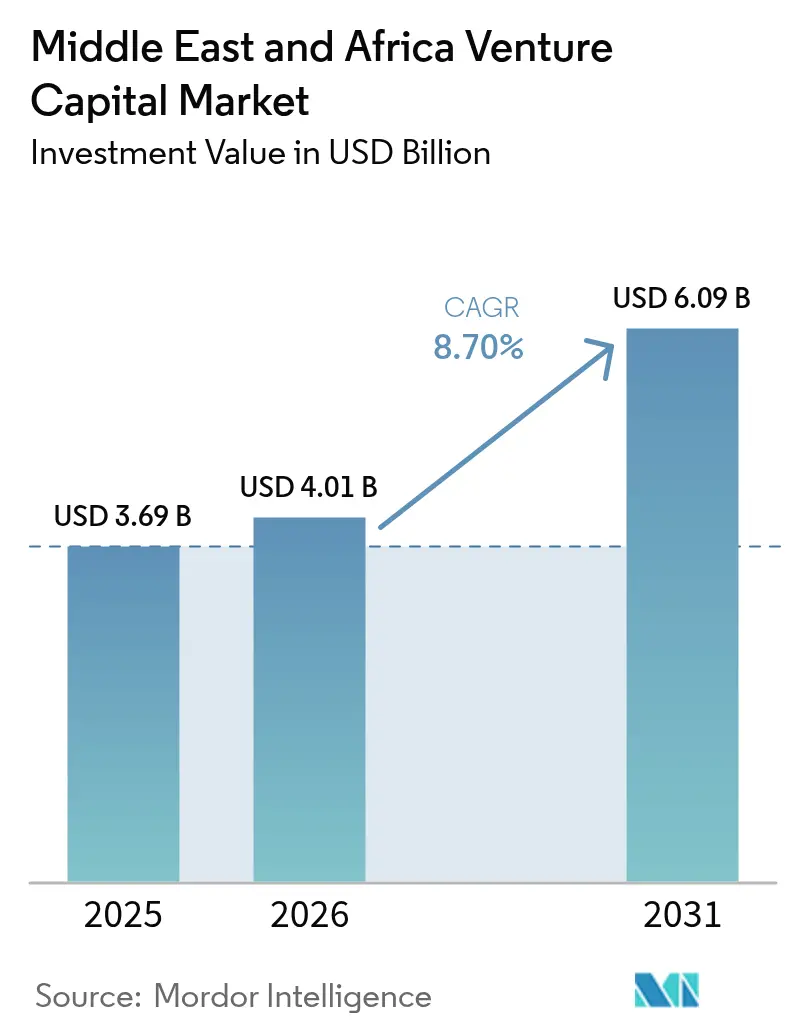
The Middle East and Africa venture capital market size is expected to grow from USD 3.69 billion in 2025 to USD 4.01 billion in 2026 and is forecast to reach USD 6.09 billion by 2031 at 8.70% CAGR over 2026-2031. Robust sovereign‐wealth funding, rapid financial-technology uptake, and regulatory modernization underpin growth despite recent global liquidity tightening. Patient domestic capital from Gulf sovereign funds, particularly the Public Investment Fund’s plan to deploy USD 70 billion annually after 2025, shields the ecosystem from interest-rate volatility. Sector leadership remains with fintech, yet healthcare delivers the fastest growth on the back of Vision 2030 reforms and dedicated vehicles such as the USD 250 million Afiyah Fund. Early-stage deal dominance continues, but rising venture-debt volumes and larger follow-on checks signal a transition toward scale-up finance sophistication.
Key Report Takeaways
- By stage, early investments captured 47.55% of the Middle East and Africa venture capital market share in 2025, while scale-up rounds are forecast to grow at 9.21% CAGR through 2031.
- By industry, fintech led with 34.18% revenue share in 2025; healthcare is projected to advance at 8.88% CAGR to 2031.
- By exit route, strategic mergers and acquisitions accounted for 57.20% of the Middle East and Africa venture capital market size in 2025, and IPOs are expanding at a 9.71% CAGR.
- By geography, the UAE commanded a 43.30% share in 2025, whereas Saudi Arabia is recording the highest forecast CAGR at 10.03% to 2031.
Note: Market size and forecast figures in this report are generated using Mordor Intelligence’s proprietary estimation framework, updated with the latest available data and insights as of 2026.
Market Trends and Insights
Drivers Impact Analysis of Middle East And Africa Venture Capital Market*
| Driver | (~) % Impact on CAGR Forecast | Geographic Relevance | Impact Timeline |
|---|---|---|---|
| Abundant sovereign-backed startup funds | +2.1% | UAE, Saudi Arabia, Qatar, Kuwait | Long term (≥ 4 years) |
| Rapid fintech adoption across MEA | +1.8% | Global MEA, concentrated in UAE, Saudi, Egypt, Nigeria | Medium term (2-4 years) |
| Business-friendly regulatory reforms | +1.4% | UAE (ADGM, DIFC), Saudi Arabia, Egypt | Medium term (2-4 years) |
| Surge in Sharia-compliant impact investing | +0.9% | GCC states, Muslim-majority African markets | Long term (≥ 4 years) |
| Diaspora-led angel networks catalyzing later rounds | +0.7% | Cross-border MEA-US, MEA-Europe corridors | Short term (≤ 2 years) |
| Cross-border CVC from telcos & energy majors | +0.6% | Regional GCC, selective African markets | Medium term (2-4 years) |
| Source: Mordor Intelligence | |||
Abundant Sovereign-Backed Startup Funds
Gulf sovereign funds collectively manage roughly USD 4 trillion and supply more than 54% of global sovereign deployment in 2024. Saudi Arabia’s Public Investment Fund earmarks over 70% of its rising annual outlays for domestic assets, channeling long-dated capital into local venture vehicles. Mubadala’s creation of MGX, with stakes in OpenAI and Databricks, exemplifies strategic technology investing that extends beyond traditional VC horizons[1]. Sovereign participation stabilizes valuations and offers follow-on certainty, mitigating global risk-off episodes. Development-finance institutions have joined these funds in blended-finance structures worth USD 213 billion, widening pools available to startups tackling social and climate challenges[2].
Rapid Fintech Adoption Across MEA
Fintech dominated with a 34.6% share in 2024 as regional e-commerce is set to hit USD 50 billion in 2025, lifting demand for digital payments. African mobile-money accounts surpassed 2.1 billion, providing a distribution backbone that venture-funded wallets can monetize. Outbound remittances of AED 145.7 billion from the UAE and USD 38.56 billion from Saudi Arabia highlight cross-border payment opportunities. Real-time transaction values in the Middle East are forecast to quadruple to USD 2.6 billion by 2027, reinforcing revenue visibility for payment-rail startups. Regulatory sandboxes and open-banking mandates in Bahrain and Saudi Arabia accelerate licensing, shortening go-to-market periods and attracting patient capital.
Business-Friendly Regulatory Reforms
The UAE’s 2023 federal e-commerce law and Saudi data-privacy sandbox streamline compliance and boost investor confidence. Free-zone regimes such as DIFC and ADGM offer 100% foreign ownership and fast-track fund licensing, lowering setup costs for general partners. Sustainable-finance guidelines crafted by the UAE’s inter-agency working group align disclosure rules across regulators, supporting ESG-oriented vehicles. Saudi renewable-energy targets of 58.7 GW by 2030 generate predictable demand for clean-tech solutions, widening sectoral scope for investors. GDPR-style data laws across Qatar and Saudi Arabia harmonize cross-border data flows, reducing operational friction for cloud-based startups.
Surge in Sharia-Compliant Impact Investing
Islamic-finance super-apps such as IMAN illustrate venture-backed avenues to meet the USD 13.2 billion SME financing gap in nine MENA economies. GCC green-sukuk issuance ballooned to USD 28.5 billion in 2022, offering structured exits for compliant startups via Nasdaq Dubai’s globally leading ESG-sukuk platform. ADGM now certifies “Green” or “Climate Transition” funds, giving clarity for impact-focused limited partners. Regulatory fee waivers on sustainability listings in Dubai cut capital-market access costs, enlarging the exit universe. The World Bank’s Global Findex shows sizeable unbanked Muslim-majority populations, underscoring demand for Sharia-compliant fintech backed by region-specific venture vehicles.
Restraints Impact Analysis of Middle East And Africa Venture Capital Market*
| Restraint | (~) % Impact on CAGR Forecast | Geographic Relevance | Impact Timeline |
|---|---|---|---|
| Limited exit avenues & shallow capital markets | -1.6% | Africa-focused, selective Middle East markets | Long term (≥ 4 years) |
| Political-economic instability in select markets | -1.2% | Fragile African states, conflict-affected regions | Short term (≤ 2 years) |
| Talent drain via global remote-work migration | -0.8% | Sub-Saharan Africa, emerging MENA markets | Medium term (2-4 years) |
| Currency volatility eroding exit returns | -0.7% | Nigeria, Egypt, South Africa, select African markets | Short term (≤ 2 years) |
| Source: Mordor Intelligence | |||
Limited Exit Avenues & Shallow Capital Markets
Africa recorded only 26 venture-backed exits in 2024, returning just USD 0.13 per invested dollar, underscoring liquidity headwinds[3]. MENA startups have raised USD 11 billion since 2021, yet fewer than 7.5% achieved exits, pointing to a growth-stage funding gap near USD 20 billion. UAE listing rules requiring two years of profitability curb IPO access for high-growth startups and skew exits toward strategic sales. Fragmented national exchanges raise cross-border compliance costs, discouraging dual listings that could broaden investor bases. Limited analyst coverage in post-IPO trading suppresses liquidity, dampening valuation multiples and recycle rates for venture funds.
Political-Economic Instability in Select Markets
Nigeria’s naira slid 40.9% in 2024 after deregulation, diluting USD returns for investors. High startup-formation costs equal to 36% of per-capita income in Sub-Saharan Africa compare poorly with 3% in OECD peers, restraining pipeline creation. Limited broadband (37% penetration) and unreliable electricity (43% access) cap technology addressable market, forcing investors to price infrastructure risk. Divergent ESG standards across jurisdictions complicate due diligence workloads, lengthening deal cycles for cross-border funds. Ongoing talent emigration, 30% of college-educated African youth, elevates recruitment costs for portfolio companies, eroding competitiveness.
*Our forecasts treat driver/restraint impacts as directional, not additive. The impact forecasts reflect baseline growth, mix effects, and variable interactions.
Middle East And Africa Venture Capital Market Segment Analysis
By Stage of Investment:
Early Dominance Drives Scale-Up AccelerationEarly-stage funding held 47.55% of the Middle East and Africa venture capital market share in 2025, reflecting generous sovereign seed programs and sandbox initiatives that derisk product validation. Scale-up rounds, though smaller in count, are projected to post the ecosystem’s fastest 9.21% CAGR to 2031 as breakout firms bridge the USD 10-15 million financing gap through rising venture-debt lines. Average initial checks of USD 500,000-1.5 million and reserve ratios near 45% position funds to support multiple follow-on cycles, sustaining portfolio momentum. Venture-debt deals jumped from USD 202 million in 2022 to USD 757 million in 2023, evidencing late-stage financing sophistication that nurtures scale-ups through capital-intensive growth phases. Strengthened valuation governance post-2022 ensures disciplined step-ups tied to institutional priced rounds, reinforcing market resilience.
Growth-stage scarcity has drawn global co-investors, with sovereign funds syndicating larger tickets alongside Silicon Valley and Asian firms, improving exit optionality. Early-stage abundance is enabled by angel collectives like COREangels MEA and fund-of-funds programs such as VC Grow that back first-time managers averaging USD 40 million vehicles. Breakout rounds benefit from enhanced third-party valuation services and updated governance codes introduced across DIFC and ADGM in 2024, lowering diligence friction for foreign limited partners. The Middle East and Africa venture capital market size devoted to scale-up deals is set to expand faster than any other stage as sovereign investors pursue domestic tech champions to advance industrial diversification agendas. Overall, stage distribution signals a maturing capital stack transitioning from pure company formation toward balanced growth-equity support.


By Industry:
Fintech Leadership Meets Healthcare InnovationFintech commanded 34.18% of 2025 funding, underpinned by soaring digital-payments penetration and regulatory clarity on open banking. Healthcare, while smaller, is forecast to post the highest 8.88% CAGR as Vision 2030 initiatives funnel patient capital into life-science infrastructure and biotech R&D, expanding the Middle East and Africa venture capital market size allocated to medical innovation. Enterprise software captures a steady share through AI and automation platforms aligned with billion-dollar national AI programs such as Saudi Project Transcendence. Energy transition plays attract sovereign backing, with Gulf funds investing USD 26.1 billion in renewables and hydrogen supply chains during 2023. Transportation and robotics secure niche allocations tied to smart-city megaprojects and manufacturing automation roadmaps across the GCC.
The Afiyah Fund expects to mobilize up to USD 500 million into Saudi health services, amplifying specialized capital depth and reinforcing the sector’s outsized growth trajectory. Nigerian fintech leader OPay neared a USD 3 billion valuation in 2024, showcasing scalable unit economics that entice cross-regional investors. Enterprise AI vendor DXwand raised USD 4 million to scale multilingual customer-engagement engines, spotlighting natural-language AI demand in Arabic markets. Energy and mobility startups leverage policy certainty—such as PIF’s target to develop 70% of Saudi renewable capacity—to de-risk project pipelines and entice blended-finance participation. Sectoral diversification beyond fintech strengthens portfolio risk profiles and aligns with sovereign imperatives to build knowledge-economy capabilities.
By Exit Type:
Strategic Acquisitions Dominate IPO AccelerationStrategic M&A delivered 57.20% of liquidity in 2025, reflecting the prevalence of corporate buyers seeking technology capabilities across telecom, energy, and banking verticals. Initial public offerings, though only a fraction of exits, are forecast to rise ata 9.71% CAGR as regional exchanges relax eligibility and deepen aftermarket support, expanding the Middle East and Africa venture capital market share realized via public routes. Secondary sales and continuation funds gain traction, mirroring global GP-led trends that peaked at USD 162 billion in 2024. Write-offs remain within historical norms despite 2022–2023 markdowns as valuation discipline and follow-on reserves temper impairment risk. Capital-market initiatives such as Dubai’s carbon-credit trading pilot and Abu Dhabi’s ESG index foster diversified investor bases, supporting future venture-backed listings.
Heightened IPO momentum aligns with sovereign privatization pipelines and global index inclusion efforts, which can lift free-float and liquidity thresholds. Corporate-venture participation, 13% of 2025 funding, creates natural acquirers, shortening average hold periods and improving cash-on-cash multiples for early-stage funds. Secondary sales benefit from growing fund-of-funds interest that provides recycling avenues without full public-market exposure. Exchange reforms tackling foreign-ownership caps and fast-track prospectus reviews in the UAE and Saudi Arabia are expected to further unlock IPO throughput by 2027. Collectively, exit-route diversification reduces portfolio-duration risk and underpins long-term return sustainability across the ecosystem.

Geography Analysis
United Arab Emirates Venture Capital Market
The UAE held a dominant 43.30% share in 2025, leveraging DIFC and ADGM frameworks that streamline fund licensing and enable 100% foreign ownership, making Dubai and Abu Dhabi regional launchpads. Sovereign vehicles such as Mubadala and ADQ accelerated venture deployment, with Mubadala’s deal value surging 175% in 2025, elevating local dry powder and boosting the Middle East and Africa venture capital market size centered in the Emirates. Harmonized sustainable-finance rules plus waiver incentives on green listings broaden exit avenues, reinforcing investor confidence. Outbound technology M&A by Emirati funds recycles capital and embeds global intelligence back into domestic portfolios, nurturing a virtuous funding loop. Large-scale AI investments, including Microsoft’s USD 1.5 billion into G42, create downstream deal flow for frontier-tech startups.
MEA Venture Capital Market
Saudi Arabia posts the fastest 10.03% CAGR through 2031, driven by Vision 2030, Jada Fund of Funds, and sandbox programs hosted by the Saudi Data & AI Authority. PIF’s USD 70 billion annual deployment goal, paired with Project Transcendence’s USD 100 billion AI ecosystem, lifts domestic demand for venture finance and boosts the Middle East and Africa venture capital market size allocated to Saudi startups. Healthcare vehicles such as the Afiyah Fund and renewable-energy mandates create sector-specific pull for investors targeting long-duration assets. Buy-now-pay-later adoption, growing from 3 million users in 2021 to over 10 million in 2022, illustrates rapid consumer-tech scaling potential. Regulatory clarity on data privacy and virtual assets positions the kingdom as an emerging hub for fintech and Web3 innovation. Nigeria and South Africa lead Africa’s venture landscape, with Nigeria attracting USD 520 million in 2025 (+11% YoY) as fintech giants such as OPay demonstrate four-fold customer growth. South Africa benefits from liquid capital markets and established governance standards, anchoring pan-African fund managers. Egypt, Kenya, and Tanzania headline the “Rest of MEA” opportunity set; Tanzania’s USD 52 million raise in 2025 equaled 1,150% growth, exemplifying base-effect acceleration. Diaspora capital bridges markets through initiatives like the US-MENA Tech Summit, expanding syndicate size, and derisking cross-border deployment. Combined, geographic spread allows portfolio diversification while tapping Saudi growth momentum and UAE infrastructure advantages, balancing return potential with risk mitigation.
Regulatory Landscape
Across the GCC, regulator-led modernization is shortening fund formation timelines and expanding permissible structures for alternative managers running venture capital strategies. In Saudi Arabia, the Capital Market Authority (CMA) issued Instructions of Simplified Investment Funds in March 2026, introducing more flexible, institutional-only vehicles with a notification-based launch process, alongside Instructions on Financing Investment Funds that consolidate financing approaches and permit public listing of financing fund units.
In the UAE, the capital markets framework was reset as Federal Decree-Law No. 32 of 2025 (CMA Law) and Federal Decree-Law No. 33 of 2025 (Capital Markets Law) entered into force in January 2026, replacing the earlier securities regime and establishing a reconfigured Capital Market Authority. In Africa, regulators also tightened intermediary and market-operator requirements, including Kenya's Capital Markets (Licensing Requirements) (General) Regulations, 2025, published in the Kenya Gazette in December 2025, which updates licensing and operational rules that shape how investment products are distributed and serviced locally.
Value Chain Analysis
The MEA venture capital value chain starts with capital formation from sovereign wealth funds, development finance institutions, corporates, and family offices, then moves through fund managers (GPs) that structure vehicles, raise commitments, and originate deals via accelerators, founder networks, and co-investor syndicates. Platforms and policy programs are increasingly prominent inputs to sourcing: Abu Dhabi launched the FinTech, Insurance, Digital and Alternative Assets (FIDA) cluster in December 2025, coordinating bodies such as ADGM and the Securities and Commodities Authority to support regulated financial and alternative-asset activity. Nigeria also moved toward a more direct LP role through the iDICE program, highlighted by Ventures Platform announcing a USD 64 million first close in November 2025 with Nigerian government participation.
Capital deployment typically concentrates in early-stage equity, then scales through follow-on rounds and an emerging layer of venture debt and private credit, with specialist providers extending runway for asset-heavy models. This shows up in transactions such as Ruya Partners providing a USD 15 million private credit facility to freight logistics platform TruKKer in July 2025 and Maalexi securing a USD 20 million Shariah-compliant facility from Amwal Capital Partners in August 2025. On the downstream side, value creation is driven by portfolio support, compliance and governance, and access to regulated markets and strategic buyers, while exits remain dominated by strategic M&A, reinforcing the role of corporate venture capital and cross-border acquirers in closing the cycle.
Competitive Landscape
Funding concentration remains moderate, with early-stage deals spread across various emerging managers. In contrast, growth rounds exceeding USD 10 million are primarily dominated by sovereign funds and a small group of established general partners (GPs). In 2024, investors from the UAE and Saudi Arabia contributed to over 90% of the GCC's deal volume, showcasing their significant influence in the region. Meanwhile, African investments were more dispersed, with capital flowing into key markets such as Nigeria, Kenya, South Africa, and Egypt. Co-investment has become a standard practice, as sovereign entities collaborate with global funds to bring in expertise and share the costs of due diligence. For instance, Mubadala's participation in Silicon Valley AI rounds through syndicates highlights this trend. Additionally, corporate venture capital accounted for 13% of total funding in 2024, with major telecom and energy companies leveraging their financial resources to secure strategic positions in emerging technologies. A gap in mid-ticket deals, particularly in the USD 10-15 million range, has created opportunities for specialized growth funds and debt providers to enter the market.
Regulatory expertise has emerged as a critical factor distinguishing market leaders. Firms with dedicated in-house policy teams are better equipped to navigate complex data-localization laws across the GCC and Africa. This capability enables them to close deals faster and ensures smoother compliance after investments are made. The adoption of advanced technologies, such as AI-driven deal sourcing and automated dashboards for limited partners (LPs), has further enhanced operational efficiency. These tools allow managers to oversee larger portfolios without needing to proportionally increase their workforce, providing a competitive advantage in managing resources effectively.
The market is also witnessing a rise in specialized investment vehicles, which cater to niche themes and counter the limitations of generic strategies. For example, TVM Capital’s Afiyah Fund focuses on healthcare, while MGX targets global AI infrastructure, reflecting a growing trend toward thematic investments. Additionally, diaspora-driven networks like COREangels MEA are playing a pivotal role in channeling overseas talent and capital into underserved African cities. This approach is expanding the competitive landscape and fostering growth in regions that have traditionally been overlooked, creating new opportunities for investors and entrepreneurs alike[4].
Middle East And Africa Venture Capital Industry Leaders
-
Wamda Capital
-
Middle East Venture Partners (MEVP)
-
Global Ventures
-
Partech Partners
-
Beco Capital
- *Disclaimer: Major Players sorted in no particular order
Middle East And Africa Venture Capital Market Companies Covered in this Report
- Wamda Capital
- Middle East Venture Partners (MEVP)
- 500 Global
- Partech Partners
- Sequoia Capital India & SEA (Surge)
- Global Ventures
- Beco Capital
- Flat6Labs
- Algebra Ventures
- Future Africa
- Sawari Ventures
- Endure Capital
- Y Combinator
- Mubadala Capital Ventures
- Chimera Capital
- QED Investors
- Tiger Global Management
- SoftBank Vision Fund
- IFC (International Finance Corporation)
- KdV Capital
Read Analysis of Middle East And Africa Venture Capital Companies
Market Opportunities and Future Outlook
Institutional capital formation is widening beyond local GPs as cross-border platforms gain traction, backed by sovereign and development financiers. April 2026 saw Speedinvest launch a dedicated Middle East and Africa fund backed by Mubadala, Qatar Investment Authority (QIA), and EIB Global, and in March 2026 the European Investment Bank committed EUR 40 million to Speedinvest to deepen seed and Series A financing for Africa. Together, these steps strengthen the pathway for non-regional LPs to access MEA venture exposure through an established manager.
Corporate and payments-led venture activity is also creating whitespace across fintech infrastructure, merchant enablement, and cross-border commerce, supported by visible capital commitments. PayPal announced a USD 100 million investment in Middle East and Africa digital services in January 2026, including minority stakes and PayPal Ventures funding, which adds strategic demand for investable startups and increases the scope for de-risked co-investment alongside large strategics. Impact and climate-oriented vehicles further broaden the opportunity set, highlighted by Catalyst Fund reaching USD 30 million in commitments by July 2026 with backing that includes IFC and We-Fi, expanding the pool of specialized capital beyond generalist fintech and consumer internet themes.
Recent Industry Developments in Middle East And Africa Venture Capital Market
- July 2026: Catalyst Fund completed the second close of its debut fund, reaching USD 30 million in total commitments, with backers including IFC, Shell Foundation, Trafigura Foundation, Speedinvest, Blink Impact, and We-Fi. The close channels more institutional and philanthropic capital into Africa-focused climate-tech and impact strategies, supporting larger initial checks and follow-on capacity for early-stage companies.
- June 2026: The European Commission, Germany's BMZ, and KfW Development Bank launched an EUR 80 million equity window under the Social Entrepreneurship Fund (SEF) for the MENA region, managed by Anara Impact Capital. The program increases dedicated equity financing for social enterprises and strengthens the pipeline for venture-style investment in inclusion and jobs-linked business models.
- December 2024: Saudi Venture Capital Company and Middle East Venture Partners announced a strategic collaboration to expand regional venture fund activity, enabling larger follow-on rounds and broader cross-border participation. The move signals deeper Saudi participation in MEA venture ecosystems and could unlock more aggressive capital deployment across the region.
Middle East And Africa Venture Capital Market Report Scope and Research Methodology
Market Definition and Coverage
This market covers venture capital funding deployed into startups across the Middle East and Africa, captured as the value of equity-led investments across stages, and mapped to where capital is raised and where companies are headquartered.
Scope exclusions: We exclude private equity buyouts, pure debt-only lending, and grant-only programs that do not create a venture-style equity financing round.
Segments Covered in This Report
- By Stage of Investment
- Early Stage
- Breakout Stage
- Scale-up
- By Industry
- Health
- Fintech
- Enterprise Software
- Energy
- Transportation
- Robotics
- Other Industries
- By Exit Type
- Initial Public Offering (IPO)
- Strategic M&A
- Secondary Sale / Buy-out
- Write-offs
- By Geography
- United Arab Emirates
- Saudi Arabia
- South Africa
- Nigeria
- Rest of Middle East & Africa
Data Sources, Market Sizing, and Validation
Desk Research
To set clean boundaries and a realistic demand pool, we first built a view of the region's startup funding environment using public indicators and policy signals. Useful inputs came from sources such as World Bank country and macro series, IMF data releases, UNCTAD investment statistics, national statistics offices in key MEA economies, and central bank publications where capital market conditions are discussed.
We then anchored venture activity context using ecosystem reporting, deal announcements, and investment trend trackers from regional startup associations and reputable media, followed by checks from company filings and investor presentations where portfolio activity is summarized. For cross-checking country coverage, sector mix, and multi-year deal cadence, we also referenced paid subscriptions we hold for company financials and intelligence, news and financials, and patent databases when innovation signals mattered. The desk sources listed here are illustrative, and we reviewed other public and paid sources to collect data, validate assumptions, and clarify open questions.
Primary Interviews and Surveys
We validated our assumptions through expert conversations and structured surveys with fund managers, limited partner advisors, accelerators, and startup finance leaders who actively track rounds across MEA. Since the market is regional and capital can be cross-border, we pressure-tested inputs across the Gulf, North Africa, and Sub-Saharan Africa so the final model reflects how deal values and stage definitions are applied in practice.
Distribution of primary research fieldwork respondents
| Company type | Respondent position |
|---|---|
| Top tier: 26% | CXOs: 15% |
| Mid tier: 58% | Functional/Unit leaders: 28% |
| Smaller Players: 16% | Managers: 57% |
Market-Sizing & Forecasting
Our core sizing starts with a top-down build that reconstructs annual venture funding from observed deal activity patterns, stage mix, and country-level investment intensity, then translates these into USD values using consistent exchange rate timing. Where reported values are missing, we apply stage-informed value bands and then recheck the implied totals against independent signals such as deal counts, known mega-rounds, and shifts in late-stage participation.
To keep the model grounded, selective bottom-up approximations are used as sanity checks, including roll-ups of sampled disclosed rounds by stage, country, and sector, followed by ASP-style checks on implied average ticket sizes per stage times estimated deal volumes. For MEA specifically, the key practical inputs are the share of undisclosed rounds, the split of early versus scale-up funding, concentration in key hubs (such as the Gulf versus broader Africa), currency conversion timing, and the pace of follow-on funding when exits slow down. Forecasts are produced using scenario analysis, because funding is sensitive to macro conditions, liquidity, and policy initiatives, and the scenarios are calibrated using expert expectations for deal flow recovery and ticket size normalization.
Data Validation & Update Cycle
Model outputs are cross-checked against multiple independent signals, such as published annual funding totals from ecosystem trackers, observed YoY shifts in deal count, and country-level concentration trends, and then variances are reviewed before sign-off. When a mismatch is identified, we revisit the assumptions that usually drive it, including undisclosed deal treatment, stage classification, and FX conversion windows, and we re-contact respondents if clarification is required.
We refresh the report annually, and we also run interim updates when material events occur, such as large policy programs, sudden FX moves in major markets, or a visible surge in late-stage rounds. Before delivery, an analyst completes a final pass so clients receive the latest updated view based on the most recent data points.
Mordor Intelligence's Middle East and Africa Venture Capital Market Size Compared With Other Published Estimates
Published market values for MEA venture capital can vary a lot, and the differences usually come from what is counted as a VC round, how undisclosed deal values are treated, and whether the estimate follows a funding-year view or a broader investment ecosystem definition.
A refresh-led issue is also common, because funding totals move quickly when a few large rounds close, and the currency conversion window can change the USD value even if local-currency deal sizes look stable. By freezing FX timing to the funding date window, rechecking stage-level average ticket sizes, and revalidating the undisclosed-round uplift before each annual refresh, Mordor Intelligence reduces drift that can happen when older datasets or a single-year snapshot is carried forward.
Benchmark comparison
| Source | Market Size | Gaps in Research Methodology |
|---|---|---|
| Mordor Intelligence | USD 4.01 B (2026) | |
| Regional Consultancy A | USD 3.80 B (2024) | This figure appears closer to a single-year funding snapshot and may rely more on publicly announced rounds, which can undercount undisclosed tickets and handle FX timing differently across countries. |
| Trade Journal B | USD 2.30 B (2024) | This estimate focuses on MENA startup investment value, so it can exclude parts of Africa and may mix equity and debt reporting choices, which shifts the total away from a VC-only, MEA-wide definition. |
The spread across sources is mostly explained by geography coverage, treatment of undisclosed rounds, and how currency conversion is timed around the funding date. With the scope kept to MEA venture funding and the key assumptions rechecked against deal flow and stage patterns, the final number stays traceable to repeatable inputs that users can revisit year after year.
Key Questions Answered in the Report
How large is the Middle East and Africa venture capital space today?
The market is valued at USD 4.01 billion in 2026 and is projected to reach USD 6.09 billion by 2031 at an 8.70% CAGR.
Which sector attracts the most funding?
Fintech leads with 34.18% of 2025 deployment thanks to booming digital-payments adoption and supportive regulation.
Where is growth fastest geographically?
Saudi Arabia is forecast to post the highest 10.03% CAGR through 2031, driven by Vision 2030 and PIF capital inflows.
What is the primary exit route for investors?
Strategic mergers and acquisitions delivered 57.20% of exits in 2025, although IPO activity is rising quickly.
What challenges most limit returns?
Shallow public markets and currency volatility, especially in select African economies, constrain exit valuations and recycle rates.
How are sovereign wealth funds influencing the landscape?
Gulf sovereigns manage about USD 4 trillion and increasingly channel patient, strategic capital into domestic startups, stabilizing funding across cycles.