
Middle East and Africa Pulp and Paper Market Size and Share
Market Overview
| Study Period | 2020 - 2031 |
|---|---|
| Forecast Data Period | 2026 - 2031 |
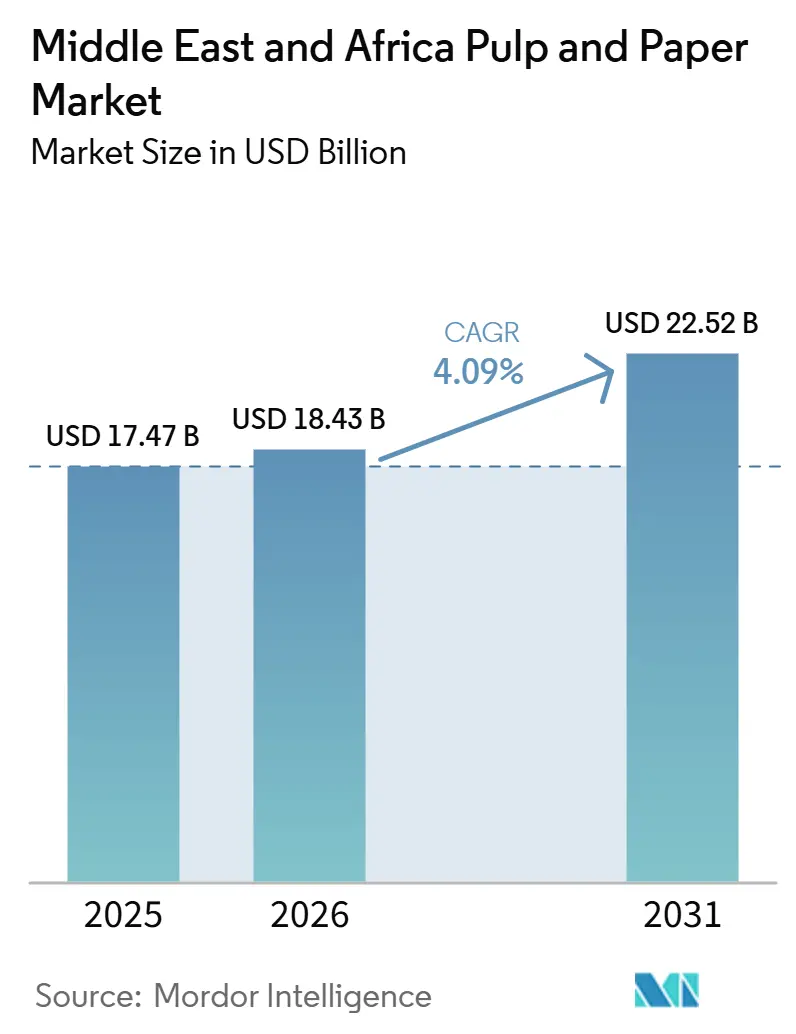
| Base Year Market Size (2025) | USD 17.47 Billion |
| Market Size (2026) | USD 18.43 Billion |
| Market Size (2031) | USD 22.52 Billion |
| Growth Rate (2026 - 2031) | 4.09 % |
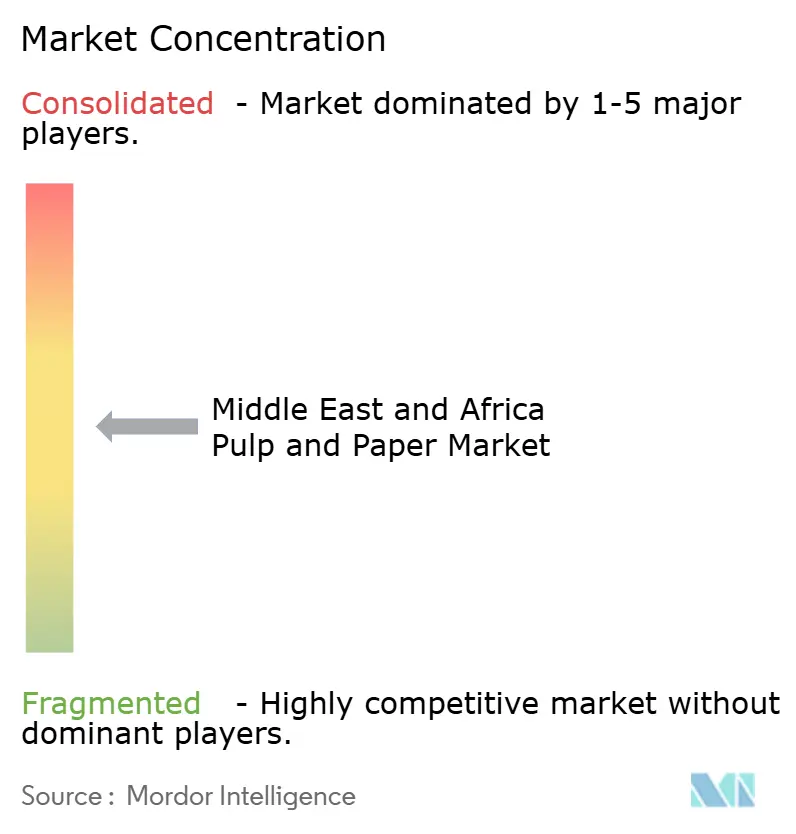
| Market Concentration | Medium |
Major Players *Disclaimer: Major Players sorted in no particular order Image © Mordor Intelligence. Reuse requires attribution under CC BY 4.0. | |
Middle East and Africa Pulp and Paper Market Analysis by Mordor Intelligence
The Middle East and Africa pulp and paper market size is projected to expand from USD 17.47 billion in 2025 and USD 18.43 billion in 2026 to USD 22.52 billion by 2031, registering a CAGR of 4.09% between 2026 and 2031. Fiber shortages keep many producers dependent on recovered-paper imports, while parcel deliveries and plastic restrictions are increasing demand for corrugated and paper-based formats. GCC investment is supporting integrated capacity, including cardboard and recycled containerboard projects that reduce dependence on imports. Currency depreciation in several African economies pressures converter margins, but it also supports investment in local feedstock, energy, and logistics assets. The Middle East and Africa pulp and paper market is shaped by different operating conditions across the GCC and Africa, where access to capital, fiber, and reliable electricity varies widely. Policy-led collection systems can gradually expand the availability of domestically recycled fiber and support local mills.
Key Report Takeaways
- By grade, bleached chemical pulp captured 32.07% of the Middle East and Africa pulp and paper market share in 2025.
- By application, the Middle East and Africa pulp and paper market size for containerboard is expected to expand at a 4.98% CAGR through 2031.
- By end-use industry, food and beverage packaging held 34.92% of the Middle East and Africa pulp and paper market share in 2025.
- By product type, the Middle East and Africa pulp and paper market size for packaging papers is forecast to grow at a 4.61% CAGR through 2031.
- By process technology, chemical pulping accounted for 48.39% of the Middle East and Africa pulp and paper market share in 2025.
- By geography, the Middle East and Africa pulp and paper market size for Africa is expected to grow at a 4.96% CAGR through 2031.
Note: Market size and forecast figures in this report are generated using Mordor Intelligence’s proprietary estimation framework, updated with the latest available data and insights as of 2026.
Market Trends and Insights
Drivers Impact Analysis of Middle East and Africa Pulp and Paper Market*
| Driver | (~) % Impact on CAGR Forecast | Geographic Relevance | Impact Timeline |
|---|---|---|---|
| Accelerating E-Commerce Fulfillment Volumes | +1.0% | GCC, South Africa, Kenya | Medium term (2-4 years) |
| Government Plastic Phase-Out Regulations | +0.9% | UAE, Kenya, Nigeria, Ethiopia, Egypt | Short term (≤ 2 years) |
| Rising Hygiene and Tissue Consumption | +0.7% | Sub-Saharan Africa, GCC | Medium term (2-4 years) |
| Fresh Produce Export Growth and Corrugated Demand | +0.5% | East Africa, Southern Africa | Medium term (2-4 years) |
| GCC Investment in Integrated Paper Capacity | +0.4% | Saudi Arabia, UAE | Long term (≥ 4 years) |
| Agricultural-Residue Fiber Commercialization | +0.2% | Turkey, Egypt, Saudi Arabia, Ethiopia | Long term (≥ 4 years) |
| Source: Mordor Intelligence | |||
Accelerating E-Commerce Fulfillment Volumes
Digital commerce is changing corrugated-box demand across the two subregions. Operators in Saudi Arabia and the UAE are adopting right-sized and die-cut corrugated formats that reduce shipment weight. This shift increases demand for lightweight fluting media and stronger testliners within the same production cycle. Saudi Arabia’s non-oil private-sector activity remained above 53 for much of 2025, which supported commercial activity and packaging demand outside the oil cycle. The AfCFTA digital trade protocol is supporting last-mile logistics in landlocked economies, creating additional demand for corrugated packaging, where reused or informal formats had been common.[1] The Middle East and Africa pulp and paper markets can benefit as mills invest in lighter, stronger grades that meet changing logistics needs.
Government Plastic Phase-Out Regulations
Plastic restrictions are making paper-based packaging necessary in several product categories. The UAE extended its restrictions in 2025 and 2026 to cover more food-service items, including cups, lids, cutlery, and plates. Kenya, Nigeria, Ethiopia, and Egypt also introduced measures that affect packaging materials and producer responsibilities in 2025. These measures influence food service, retail, and consumer goods packaging, where paper formats can replace restricted plastic products. The change also supports wider post-consumer paper collection through producer-responsibility systems. The Middle East and Africa pulp and paper market, therefore, gains demand support linked to compliance requirements rather than discretionary consumer preferences.
Rising Hygiene and Tissue Consumption
Urbanization and income growth are supporting tissue and hygiene grades in both subregions. Sub-Saharan Africa’s urbanization rate exceeded 43% in 2024, while household tissue consumption per person remained below the global average. New tissue machines in Saudi Arabia and Kuwait use through-air-drying and structured-roll technologies to improve softness while reducing fiber use per tonne. This helps regional mills compete with imported products on quality and cost. Hospital, clinic, hospitality, and tourism demand also broadens the customer base for premium tissue, diaper, fem-care, and adult incontinence grades. The Middle East and Africa pulp and paper market has room for higher-value tissue products, provided local production meets required quality standards.
Fresh Produce Export Growth and Corrugated Demand
Horticultural exports create recurring demand for high-performance corrugated trays and boxes. Kenya’s agricultural exports reached USD 4.3 billion in 2024, including USD 777.4 million in cut flowers and USD 161.8 million in avocados. These exports require moisture-resistant cartons with wet-strength and burst-performance characteristics. South Africa’s citrus and pome-fruit export season also supports demand for containerboard that meets food-contact and phytosanitary requirements. Sappi reported 8% year-on-year growth in packaging and specialty paper sales volumes in FY2025, supported by a strong citrus season. The Middle East and Africa pulp and paper market retains a role for virgin kraftliner in export packaging where recycled grades cannot consistently meet performance requirements.
Restraints Impact Analysis of Middle East and Africa Pulp and Paper Market*
| Restraint | (~) % Impact on CAGR Forecast | Geographic Relevance | Impact Timeline |
|---|---|---|---|
| Recycled-Fiber Import Price Volatility | -0.9% | MEA-wide, especially net-importing GCC mills | Short term (≤ 2 years) |
| Chronic Power Supply Instability in Sub-Saharan Manufacturing Hubs | -0.7% | Sub-Saharan Africa | Long term (≥ 4 years) |
| Limited Regional Forestry Resources | -0.5% | MEA-wide | Long term (≥ 4 years) |
| Maritime Logistics Disruptions and Currency Fluctuations | -0.4% | GCC and East Africa | Short term (≤ 2 years) |
| Source: Mordor Intelligence | |||
Recycled-Fiber Import Price Volatility
Many mills depend on imported old corrugated containers and mixed wastepaper from Europe, North America, and Asia. This dependence makes their cost base sensitive to changes in global fiber prices and shipping costs. The cost exposure is particularly important for Gulf mills using recycled furnish, where low-cost imports limit the ability to pass increases through to customers. Disruption along maritime routes during 2026 also raised freight and insurance costs for fiber shipments. Mills are responding by offering longer supply contracts, drum pulpers capable of processing mixed bales, and links to domestic collection systems. These measures can improve resilience, but they require working capital and are harder for smaller converters to fund.
Chronic Power Supply Instability in Sub-Saharan Manufacturing Hubs
Unreliable electricity remains a material cost and capacity constraint for manufacturers in sub-Saharan Africa. World Bank data showed that firms in the region experienced 56 hours of power outages per month in 2024, compared with 5 hours in South America and the Caribbean. Diesel backup generation raises operating costs when the grid supply is unavailable. This reduces the competitiveness of paper and converting facilities and complicates long-term investment planning. Dual-fuel boilers and solar-hybrid captive systems can reduce exposure, but they demand significant upfront capital. The constraint favors larger facilities with greater access to finance and slows the development of conversion capacity in emerging economies.
*Our forecasts treat driver/restraint impacts as directional, not additive. The impact forecasts reflect baseline growth, mix effects, and variable interactions.
Middle East and Africa Pulp and Paper Market Segment Analysis
By Grade:
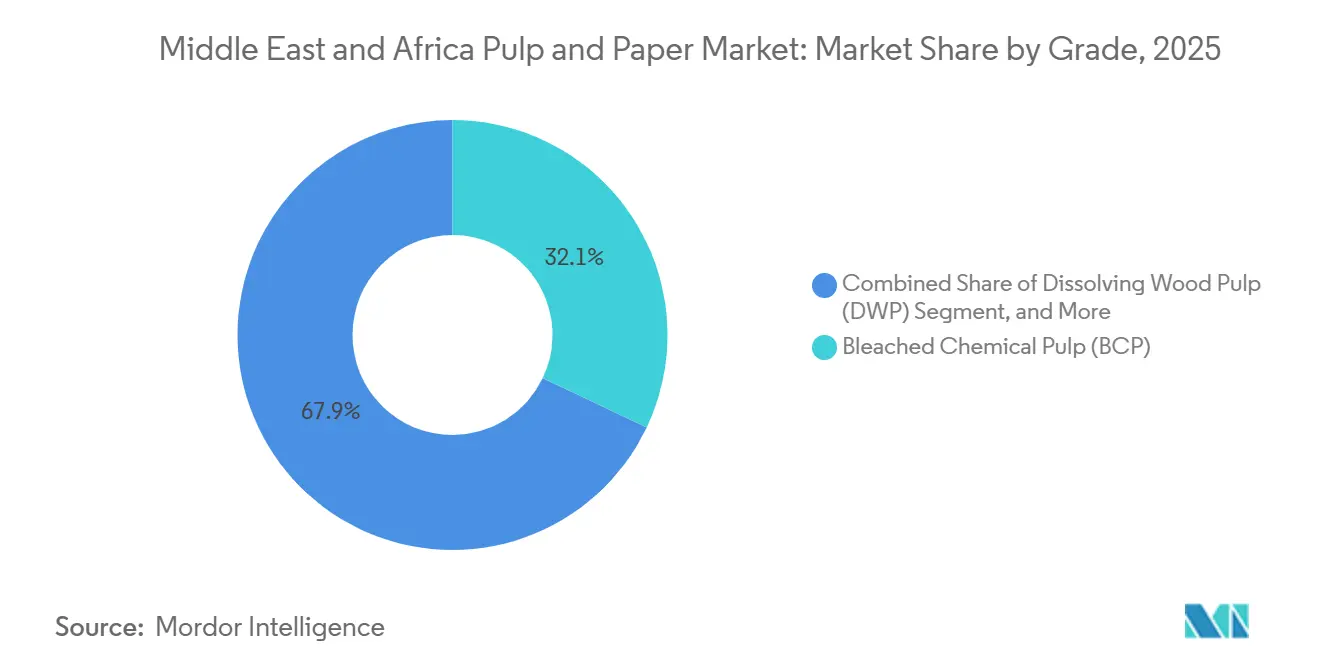
BCP Anchors the Furnish Mix as Recycled Grades AccelerateBleached Chemical Pulp accounted for 32.07% of revenue in 2025, making it the leading grade in the regional mix. It supplies tissue and high-brightness cartonboard mills that require consistent fiber quality and tensile performance. MEPCO’s Juthor subsidiary started construction of its TM6 tissue line at King Abdullah Economic City in 2025. The project is a USD 92 million investment and is designed to add 60,000 tonnes of annual tissue capacity. The line uses ANDRITZ equipment and was designed for an operating speed of 2,100 m/min. Dissolving Wood Pulp remains smaller, but Turkish and Egyptian viscose-staple-fiber clusters are increasing demand for traceable cellulose inputs. The 110,000-tonne Saiccor capacity addition supports
Sappi’s ability to serve this demand. Unbleached Kraft Pulp remains important for sacks and heavy-duty transit packaging where burst strength is more valuable than brightness.[2] Recycled Pulp is projected to be the fastest-growing grade at a 4.84% CAGR through 2031. Its expansion is linked to the development of collection networks under extended producer responsibility rules and to mill upgrades that process mixed-paper bales. Drum pulpers and improved screening lines can produce commercial furnish from a more varied range of input materials. Recycled Pulp is not expected to replace Bleached Chemical Pulp in applications that require premium performance. Instead, it can reduce use of Mechanical Pulp and secondary-grade imports. Agricultural-residue trials using wheat straw, date-palm fronds, and bagasse are under way in Saudi Arabia, Egypt, and Turkey.

By Application:
Containerboard Leads Both Share and GrowthContainerboard accounted for 32.12% of the Middle East and Africa pulp and paper market in 2025, making it the largest application category. It is also projected to record the fastest growth at a 4.98% CAGR through 2031. E-commerce fulfillment and fresh-produce exports are increasing demand for corrugated-board grades. Saudi Arabian and UAE operators are seeking right-sized formats that lower shipment weight. This raises demand for lightweight fluting media and stronger testliners. Tissue is the next-fastest-growing application, as GCC capacity serves African markets with limited per-capita consumption. New machines use through-air-drying technology to offer premium softness and improve the competitiveness of locally produced tissue. Cartonboard also benefits when consumer goods companies revise packaging specifications to meet plastic-reduction commitments.
Printing and Writing papers and Newsprint face declining volume as advertising and reading increasingly move to digital channels. Specialty Papers remain a smaller but higher-margin category for pharmaceutical labels, food-safe wraps, and industrial release liners. In South Africa and Turkey, some converting capacity originally used for Printing and Writing grades is being adapted for specialty barriers and functional coatings. This allows producers to use existing equipment while serving growing consumer-goods requirements. Produce exporters to European retail channels must meet traceability and packaging requirements that took effect in July 2025. These requirements can support a certification premium for Containerboard. The Middle East and Africa pulp and paper market continues to need certified corrugated grades for export-oriented agricultural supply chains. This protects demand for higher-performing packaging material despite pressure on lower-cost grades.
By End-Use Industry:
Food And Beverage Sets The Floor, Hygiene Leads The ClimbFood and Beverage Packaging accounted for 34.92% of the 2025 end-use revenue, making it the largest end-use category. It includes corrugated transit boxes, barrier cartons, and sack kraft used across fresh produce, dairy, beverages, and processed foods. The segment benefits from the steady movement of essential consumer goods through regional supply chains. Quick-service restaurants in the GCC moved from polystyrene clamshells to grease-resistant board wraps after plastic restrictions in 2025 and 2026. This shift creates demand linked to compliance requirements. Consumer Goods Packaging supports multinational producers that need primary and secondary packs aligned with plastic-reduction commitments. Industrial and Specialty Applications include sack kraft for cement and fertilizer. These uses also benefit from Gulf construction activity under Vision 2030 and comparable development programs.
Hygiene Products are projected to grow at a 5.15% CAGR through 2031, the highest rate among end-use categories. In sub-Saharan Africa, urbanization supports first-use adoption of disposable hygiene products. In the GCC, higher household income supports movement toward multi-ply tissue, adult incontinence, and fem-care grades. Tissue machines in Saudi Arabia and Kuwait are producing quality levels that previously depended more heavily on imports. Hotels, restaurants, and tourism facilities add demand for napkins and towels. Healthcare facilities in Dubai and Riyadh also purchase premium grades for diapers, fem-care, and adult-care uses. Publishing and Education remain comparatively stable because large school-age populations still require workbooks and textbooks. The Middle East and Africa pulp and paper market is therefore supported by a mix of essential packaging demand and gradually increasing hygiene consumption.
By Product Type:
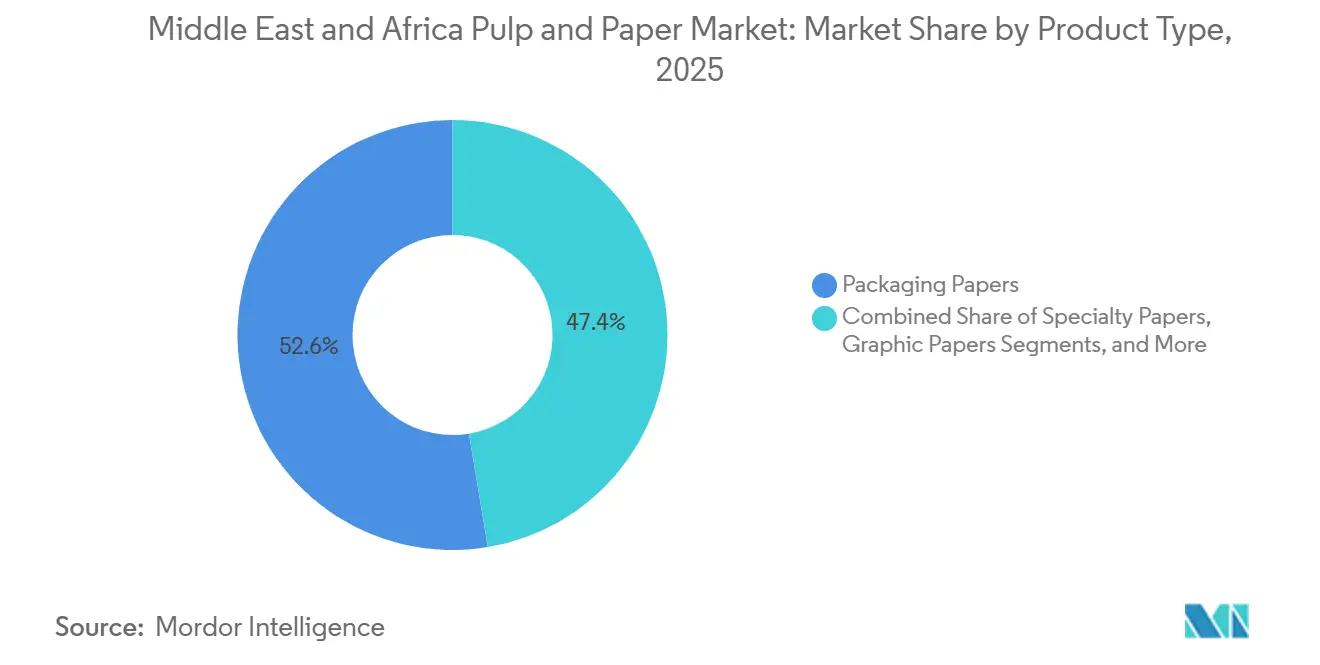
Packaging Papers Command Half the MarketPackaging Papers accounted for 52.63% of 2025 product-type revenue, the largest share in the market. The category serves agriculture, fast-moving consumer goods, e-commerce, and industrial activity through corrugated boxes and cartonboard. Domestic e-commerce grades increasingly use recycled-fiber furnish as collection systems develop. Export agricultural boxes still depend more on virgin-fiber kraftliner because moisture resistance and burst performance are essential. This difference limits complete substitution between domestic and export packaging grades. Packaging Papers accounted for more than half of product-type revenue in 2025. The category also remains closely connected to agricultural exports and regional logistics growth. Paper-based formats gain further support where plastic restrictions change food-service and retail packaging requirements.
GCC mills operate high-speed machines that improve quality and cost competitiveness simultaneously. Saudi Paper Group commissioned its PM5 tissue line in 2025 with an annual capacity of over 60,000 tonnes. The machine uses a TT SYD Steel Yankee Dryer and a high-efficiency hood designed to improve energy efficiency and process automation. Graphic Papers face structural pressure as digital media use rises across urban populations. Some South African and Turkish capacity is being redirected toward specialty barriers and functional coatings. Specialty Papers serve pharmaceutical labels, high-barrier food wraps, and industrial technical applications. The Middle East and Africa pulp and paper industry can defend margins in these niches through certification and consistent quality systems.
By Process Technology:
Chemical Pulping Leads as Recycled Fibre Processing SurgesChemical Pulping held a 48.39% share of 2025 process-technology revenue. South Africa’s kraft and bleached-chemical-pulp production supports this position, including Sappi’s Saiccor dissolving-wood-pulp facility. Turkey also has soda-pulp installations that use non-wood agricultural residues for specialty and printing grades. Tissue and hygiene mills require predictable fiber quality for high-speed Yankee-dryer operations. This was especially relevant when recovered-paper costs increased during the first half of 2026. Mechanical Pulping still serves lower-cost printing grades in North Africa and East Africa, but its base is contracting.
Recycled Fibre Processing is projected to grow at a 4.83% CAGR through 2031. Its growth is associated with extended producer responsibility programs in the UAE, Kenya, Egypt, and Nigeria. Star Paper Mill inaugurated a recycled-containerboard facility in Abu Dhabi in May 2026. The AED 200 million (USD 54 million) facility had an annual capacity of 135,000 tonnes and was designed to source up to 80% of its fiber from domestically collected waste paper. The project supports circular-economy objectives while reducing reliance on imported fiber. Facilities using drum pulpers and multistage screening can process mixed bales from varied collection systems. This operational flexibility lets mills use higher-contamination inputs without relying on premium upstream sorting.
Geography Analysis
Middle East Pulp and Paper Market
The Middle East held 55.86% of 2025 revenue, making it the leading regional geography. Saudi Arabia’s manufacturing base includes MEPCO, which reported a current annual output of 450,000 tonnes and plans to reach 900,000 tonnes by 2027. The UAE acts as a regional logistics and converting hub, while Turkey combines paper production from agricultural residues with demand for packaging and graphic grades. MEPCO’s PM5 project is designed to add 450,000 tonnes of cardboard capacity annually.[3] Saudi Arabia’s Public Investment Fund acquired a 23.08% stake in MEPCO in 2024, supporting industrial diversification and integrated paper manufacturing. The UAE’s plastic restrictions and collection systems support investment in recycled-fiber processing. The Middle East held the largest share of the Middle East and Africa pulp and paper market in 2025, driven by production, logistics, investment, and demand.
Africa Pulp and Paper Market
Africa is projected to grow at a 4.96% CAGR through 2031, the highest regional rate. South Africa is the continent’s most developed paper-based industry, with integrated production and converting activities led by companies including Sappi, Mpact, and Nampak. Sappi’s packaging and specialty paper volumes increased 8% in FY2025, helped by agricultural exports. Kenya has recurring containerboard demand tied to horticultural exports, including USD 4.3 billion of agricultural exports in 2024. Nigeria, Ethiopia, and other West and East African markets have plastic restrictions that can support converter investment. Electricity instability continues to limit the pace at which capacity can expand.
East and West Africa Pulp and Paper Market
Rest of Africa markets remain underpenetrated, with low per-capita consumption and substantial dependence on imports. The AfCFTA framework can encourage converters to serve several national markets from one production base as regional trade barriers decline. This can improve the economics of investment in smaller and landlocked markets. Plastic restrictions and producer-responsibility systems introduced in Kenya, Nigeria, and Egypt may be adopted by neighboring economies. Their spread can create additional demand for paper-based packaging across East African Community and ECOWAS markets. The Middle East and Africa pulp and paper market has longer-term opportunity in these markets, although local infrastructure and financing conditions remain important constraints.
Competitive Landscape
The Middle East and Africa pulp and paper market is moderately concentrated in GCC markets and South Africa, while the wider African converting base remains fragmented. Smaller converters commonly serve individual national markets without backward integration. Leading companies are increasing capacity, improving fiber security, and developing higher-value products to protect margins against low-cost imports. Smurfit WestRock reported performance improvement in its EMEA and APAC operations through H1 2026, supported by pricing, productivity, and customer-focused commercial execution.[4] These priorities reflect the need for consistent quality and reliable supply in packaging grades.
MEPCO contracted G.M. Voith for its PM5 cardboard line in April 2024. The SAR 1.78 billion (USD 474.67 million) project was designed to add 450,000 tonnes of annual capacity and lift the company’s total output to around one million tonnes when operational. The planned investment shows how sovereign-backed capital is supporting larger integrated paper platforms in the GCC. Star Paper Mill also opened its Abu Dhabi recycled-containerboard facility in May 2026, adding domestic recycled-fiber processing capacity. Sappi’s proposed graphic-paper joint venture with UPM-Kymmene illustrates consolidation in categories facing digital substitution. The transaction entered European Commission Phase II merger review in April 2026. Such consolidation can direct management attention and capital toward dissolving wood pulp, specialty papers, and African growth opportunities.
Certified export packaging is a key opportunity in East and Southern African agricultural corridors, where virgin kraftliner maintains a performance premium. Premium tissue converting in West Africa is another opening because demand is increasing faster than local capacity. Material recovery organizations with extended producer responsibility licenses may integrate into paper manufacturing, using access to recovered fiber to compete with imported old-corrugated-container supply. Mills are also adopting automated sorting, digital slitter-rewinder systems, and advanced process control to improve output from variable fiber inputs. The Middle East and Africa pulp and paper market remains divided between capital-intensive integrated producers and independent converters with narrower operating reach. This structure supports competition in established GCC and South African centers while leaving substantial fragmentation in many African markets.
Middle East and Africa Pulp and Paper Industry Leaders
-
International Paper Company
-
Mondi plc
-
Sappi Limited
-
Stora Enso Oyj
-
Metsä Group
- *Disclaimer: Major Players sorted in no particular order
Middle East and Africa Pulp and Paper Market Companies Covered in this Report
- Metsä Group
- Smurfit WestRock plc
- International Paper Company
- Mondi plc
- Sappi Limited
- Middle East Paper Company
- Mpact Limited
- Billerud AB
- Stora Enso Oyj
- Svenska Cellulosa Aktiebolaget SCA
- Nine Dragons Paper (Holdings) Limited
- Asia Pulp & Paper Co., Ltd.
- Kimberly-Clark Corporation
- Huhtamäki Oyj
- Nampak Limited
- United Carton Industries Company
- Arabian Packaging Co. L.L.C.
- Napco National Company
- Obeikan Investment Group
Recent Industry Developments in Middle East and Africa Pulp and Paper Market
- May 2026: Star Paper Mill officially inaugurated its AED 200 million (USD 54 million) recycled containerboard manufacturing facility in Khalifa Economic Zones Abu Dhabi, UAE, at the Make it in the Emirates 2026 event. The plant, spread across 90,000 square meters, has an annual production capacity of 135,000 tonnes and sources up to 80% of its fiber from domestically collected waste paper, supporting UAE circular economy and net-zero commitments.
- May 2026: UPM-Kymmene Corporation and Sappi Limited signed a definitive agreement on a EUR 1.4 billion (USD 1.58 billion) graphic paper joint venture, following entry into Phase II European Commission merger control review on April 28, 2026. Transaction closing is anticipated by year-end 2026, subject to regulatory approvals.
- December 2025: Saudi Paper Group commissioned its PM5 tissue line, supplied by Toscotec, at a facility in Saudi Arabia. The machine has a 5,600 mm sheet trim width, a maximum speed of 2,200 m/min, and an annual production capacity exceeding 60,000 tonnes, incorporating a TT SYD Steel Yankee Dryer and a high-efficiency hood designed for superior energy efficiency and process automation.
- June 2025: MEPCO’s subsidiary, Juthor Paper Manufacturing, commenced construction of the TM6 tissue production line at King Abdullah Economic City, Jeddah, a USD 92 million investment designed to add 60,000 tonnes of tissue capacity annually at an operating speed of 2,100 m/min, with ANDRITZ supplying advanced equipment and digital solutions under a turnkey services agreement.
Middle East and Africa Pulp and Paper Market Report Scope
The Middle East and Africa pulp and paper market covers the manufacture, conversion, distribution, and consumption of pulp, paper, paperboard, tissue, packaging paper, printing and writing paper, and specialty paper products across the region. The report assesses market performance, covering key demand trends, supply dynamics, trade flows, pricing influences, regulatory developments, and competitive strategies.
The Middle East and Africa Pulp and Paper Market Report is Segmented by Grade (Bleached Chemical Pulp (BCP), Dissolving Wood Pulp (DWP), Unbleached Kraft Pulp, Mechanical Pulp, and Recycled Pulp), Application (Printing and Writing, Newsprint, Tissue, Cartonboard, Containerboard, and Specialty Papers), End-use Industry (Food and Beverage Packaging, Consumer Goods Packaging, Hygiene Products, Publishing and Education, and Industrial and Specialty Applications), Product Type (Graphic Papers, Packaging Papers, Tissue Papers, and Specialty Papers), Process Technology (Chemical Pulping, Mechanical Pulping, and Recycled Fibre Processing), and Geography (Middle East (Saudi Arabia, United Arab Emirates, Turkey, and Rest of Middle East) and Africa (South Africa, Kenya, and Rest of Africa)). The Market Forecasts are Provided in Terms of Value (USD).
Segmentation Overview
| Bleached Chemical Pulp (BCP) |
| Dissolving Wood Pulp (DWP) |
| Unbleached Kraft Pulp |
| Mechanical Pulp |
| Recycled Pulp |
| Printing and Writing |
| Newsprint |
| Tissue |
| Cartonboard |
| Containerboard |
| Specialty Papers |
| Food and Beverage Packaging |
| Consumer Goods Packaging |
| Hygiene Products |
| Publishing and Education |
| Industrial and Specialty Applications |
| Graphic Papers |
| Packaging Papers |
| Tissue Papers |
| Specialty Papers |
| Chemical Pulping |
| Mechanical Pulping |
| Recycled Fibre Processing |
| Middle East | Saudi Arabia |
| United Arab Emirates | |
| Turkey | |
| Rest of Middle East | |
| Africa | South Africa |
| Kenya | |
| Rest of Africa |
| By Grade | Bleached Chemical Pulp (BCP) | |
| Dissolving Wood Pulp (DWP) | ||
| Unbleached Kraft Pulp | ||
| Mechanical Pulp | ||
| Recycled Pulp | ||
| By Application | Printing and Writing | |
| Newsprint | ||
| Tissue | ||
| Cartonboard | ||
| Containerboard | ||
| Specialty Papers | ||
| By End-use Industry | Food and Beverage Packaging | |
| Consumer Goods Packaging | ||
| Hygiene Products | ||
| Publishing and Education | ||
| Industrial and Specialty Applications | ||
| By Product Type | Graphic Papers | |
| Packaging Papers | ||
| Tissue Papers | ||
| Specialty Papers | ||
| By Process Technology | Chemical Pulping | |
| Mechanical Pulping | ||
| Recycled Fibre Processing | ||
| By Geography | Middle East | Saudi Arabia |
| United Arab Emirates | ||
| Turkey | ||
| Rest of Middle East | ||
| Africa | South Africa | |
| Kenya | ||
| Rest of Africa | ||
Key Questions Answered in the Report
What is the size of the Middle East and Africa pulp and paper market?
The Middle East and Africa pulp and paper market size is projected to increase from USD 18.43 billion in 2026 to USD 22.52 billion by 2031, at a 4.09% CAGR
What is driving demand for pulp and paper across the Middle East and Africa?
The Middle East and Africa pulp and paper market is supported by e-commerce fulfillment, plastic restrictions, hygiene consumption, and fresh-produce exports. Right-sized corrugated formats increase demand for lightweight fluting and stronger testliners. Plastic restrictions can shift food-service, retail, and consumer-goods demand toward paper formats. Agricultural exporters also require certified corrugated boxes with reliable moisture resistance and burst strength.
Which product type held the largest share in 2025?
Packaging Papers held 52.63% of 2025 product-type revenue. The Middle East and Africa pulp and paper market uses this category across agriculture, consumer goods, e-commerce, and industrial supply chains. Domestic e-commerce grades can use more recycled fiber as collection systems expand.
Which application is expected to grow the fastest through 2031?
Containerboard is projected to grow at a 4.98% CAGR through 2031. The Middle East and Africa pulp and paper market benefits from this growth because Containerboard serves parcel delivery, agricultural exports, and domestic consumer-goods supply chains.
Which geography is expected to grow the fastest through 2031?
Africa is expected to grow at a 4.96% CAGR through 2031. The Middle East and Africa pulp and paper market combines a developed South African production base with rising packaging demand in East and West Africa.
What constraints affect regional producers?
Recycled-fiber import price volatility, unreliable electricity, limited forestry resources, maritime disruption, and currency movement can increase costs. Mills using imported old corrugated containers are exposed to global fiber pricing and freight changes. Larger integrated facilities can reduce some exposure through longer supply contracts, domestic collection links, drum pulpers, and investment in energy resilience.