
Market Overview
| Study Period | 2020 - 2031 |
|---|---|
| Forecast Data Period | 2026 - 2031 |
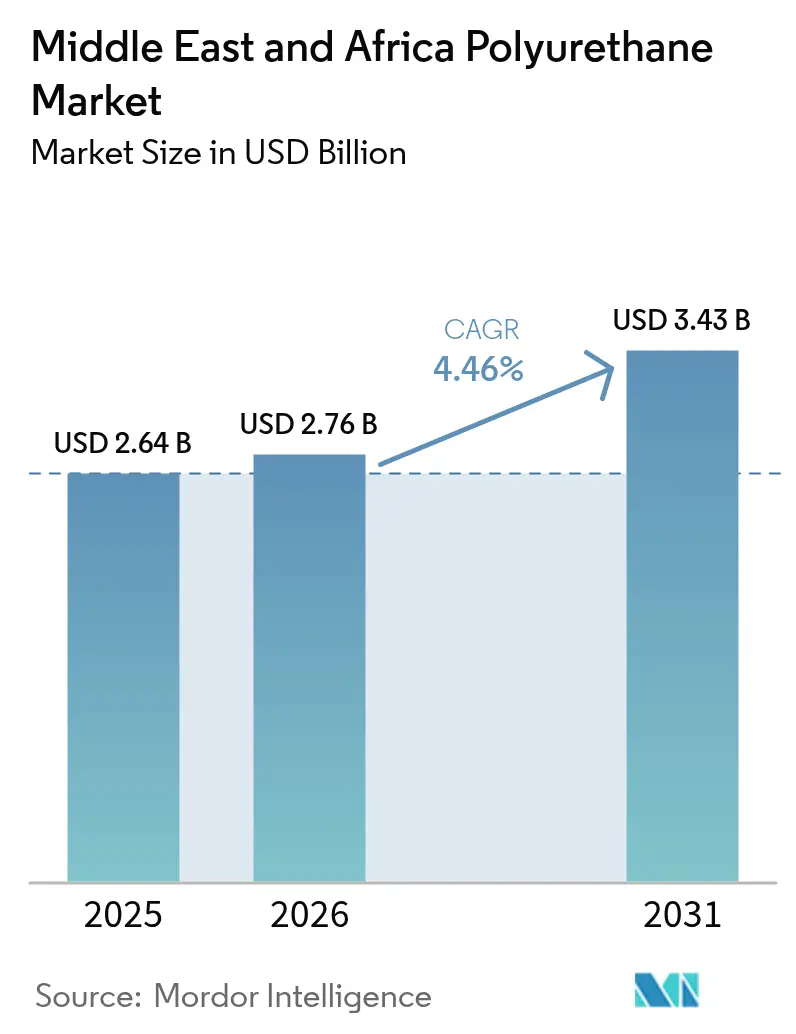
| Base Year Market Size (2025) | USD 2.64 Billion |
| Market Size (2026) | USD 2.76 Billion |
| Market Size (2031) | USD 3.43 Billion |
| Growth Rate (2026 - 2031) | 4.46 % |
| Market Concentration | High |
Major Players *Disclaimer: Major Players sorted in no particular order Image © Mordor Intelligence. Reuse requires attribution under CC BY 4.0. | |
Middle East And Africa Polyurethane Market Analysis by Mordor Intelligence
The Middle East And Africa Polyurethane Market size was valued at USD 2.64 billion in 2025 and estimated to grow from USD 2.76 billion in 2026 to reach USD 3.43 billion by 2031, at a CAGR of 4.46% during the forecast period (2026-2031). Rapid infrastructure expansion, sovereign-backed industrial localization, and stricter energy-efficiency norms are intensifying demand for rigid and flexible polyurethane solutions across construction, mobility, and cold-chain applications. The acquisition of Covestro by ADNOC has reinforced regional feedstock security, while synchronized price increases by major suppliers signal tighter supply–demand balances. Bio-based polyols are gaining momentum as regulators tighten carbon-reduction targets and end users pursue circularity strategies. At the same time, volatile isocyanate pricing and tougher worker-safety limits are pressuring margins and accelerating investment in process automation and exposure-control technologies.
Key Report Takeaways
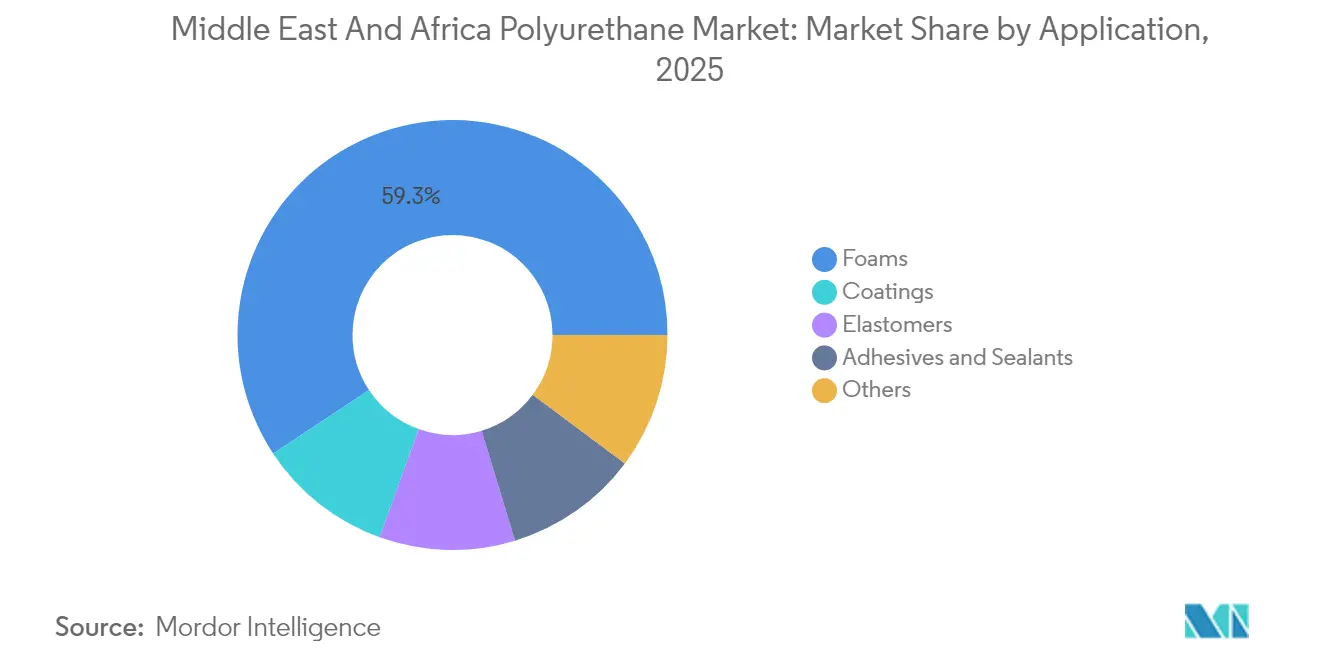
- By application, foams accounted for 59.28% of the Middle East and Africa polyurethane market share in 2025; coatings are projected to expand at a 5.19% CAGR through 2031.
- By end-user industry, the building and construction sector held 38.05% of the Middle East and Africa polyurethane market size in 2025, while the automotive sector is forecast to grow at a 5.38% CAGR between 2026 and 2031.
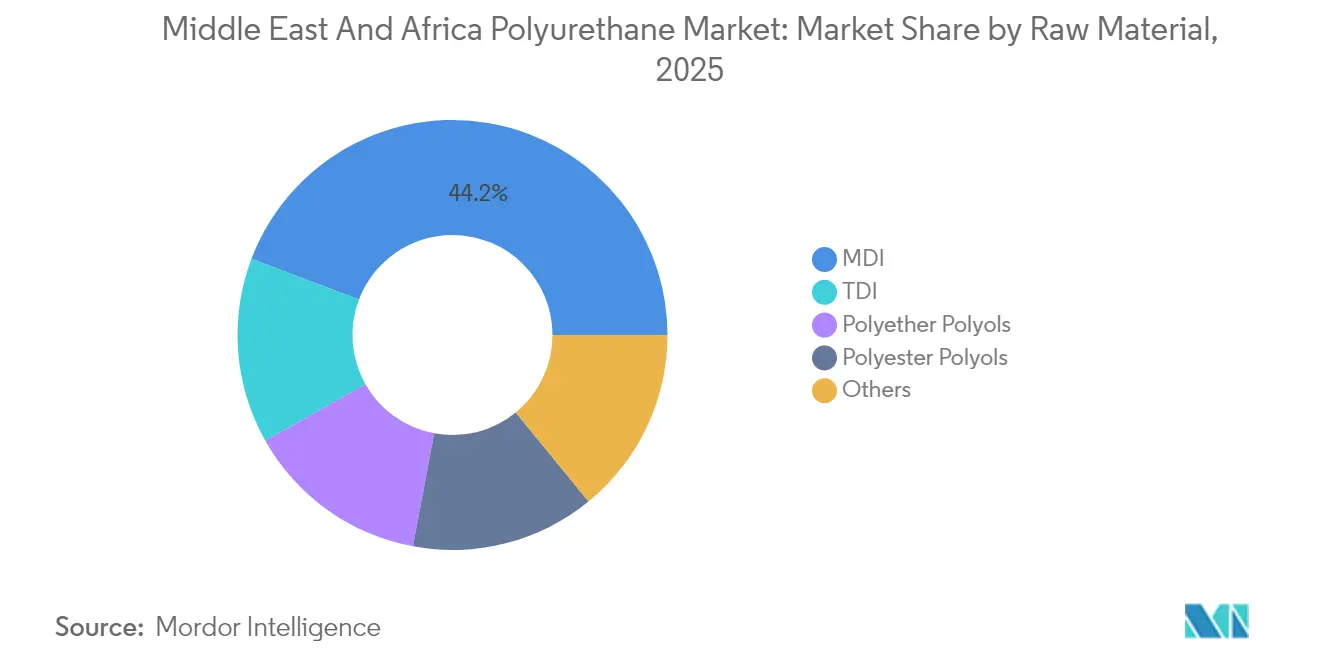
- By raw material, MDI led with 44.23% revenue share in 2025; bio-based polyols are expected to post the fastest 5.71% CAGR during the outlook period.
- By geography, Saudi Arabia commanded 24.05% market share in 2025, whereas the United Arab Emirates is projected to record a 4.84% CAGR to 2031.
Note: Market size and forecast figures in this report are generated using Mordor Intelligence’s proprietary estimation framework, updated with the latest available data and insights as of 2026.
Middle East And Africa Polyurethane Market Trends and Insights
Drivers Impact Analysis*
| Driver | (~) % Impact on CAGR Forecast | Geographic Relevance | Impact Timeline |
|---|---|---|---|
| Infrastructure-led construction boom in GCC | +1.20% | Saudi Arabia, UAE, Qatar | Medium term (2-4 years) |
| Expansion of cold-chain logistics | +0.80% | Sub-Saharan Africa, GCC | Long term (≥ 4 years) |
| Automotive and EV production localization | +0.60% | Saudi Arabia, UAE | Medium term (2-4 years) |
| Growth in regional furniture & mattress output | +0.40% | Saudi Arabia, Egypt, Morocco | Short term (≤ 2 years) |
| District-cooling mandates | +0.30% | UAE, Qatar, Kuwait | Short term (≤ 2 years) |
| Source: Mordor Intelligence | |||
Infrastructure-Led Construction Boom in GCC
The Gulf’s multibillion-dollar project pipeline is the single largest demand catalyst for rigid foams, sealants, and spray-applied insulation. Mega-developments such as NEOM, the Red Sea tourism corridor, and Dubai 2040 urban upgrades specify building-envelope solutions that cut operational emissions by at least 50%. Polyurethane panels and spray systems deliver the required thermal resistance and moisture control under prolonged desert exposure. Modular on-site worker housing and temporary logistics facilities add year-round volume for prefabricated panels containing rigid polyurethane cores. Mandatory local-content thresholds are already encouraging international formulators to build blending plants inside Saudi Arabia and the UAE, shortening lead times and lowering import tariffs. The Middle East and Africa polyurethane market therefore benefits directly from the region’s determination to diversify beyond hydrocarbons.
Expansion of Cold-Chain Logistics and Insulation Demand
Rising food-security priorities and vaccine-distribution programs are accelerating investment in temperature-controlled warehouses, solar-powered refrigeration kiosks, and insulated shipping containers. Roughly half of produce losses in sub-Saharan Africa are linked to inadequate cooling infrastructure. Distributed cold rooms equipped with polyurethane-insulated panels and phase-change storage modules cut spoilage, enhance farmer incomes, and meet climate-adaptation funding criteria. African start-ups have deployed thousands of solar refrigeration units since 2020, illustrating the scalable addressable volume for rigid foams. International development banks routinely stipulate high-R-value insulation to maximize energy savings, locking polyurethane into project specifications. These trends reinforce long-run demand visibility for the Middle East and Africa polyurethane market.
Automotive and EV Production Localization
Saudi Arabia targets 500,000 electric vehicles per year by 2030 and has allocated multi-billion-dollar incentives to lure global OEMs. Vehicle production in ambient temperatures exceeding 40 °C requires advanced battery potting compounds, lightweight interior foams, and weather-resistant coatings. Polyurethane systems offer the necessary dielectric stability and mechanical cushioning, reducing thermal stress on battery cells and occupants alike. Local-content mandates are prompting Tier-1 suppliers to co-locate molding and compounding lines, cutting lead times and import duties. Charging-station rollouts across six Gulf states add demand for polyurethane-coated cables, encapsulated electronic modules, and corrosion-resistant enclosure seals. As a result, automotive is the fastest-growing consumer segment in the Middle East and Africa polyurethane market.
Growth in Regional Furniture and Mattress Manufacturing
Residential completions, e-commerce adoption, and hospitality investments are stimulating regional furniture output. Flexible polyurethane foam dominates seating, bedding, and ergonomic office products due to its exceptional comfort-to-weight ratio and flame-retardant properties. Local producers save logistics costs and gain formulation flexibility by sourcing foam blocks regionally rather than importing finished goods. The relocation of value chains supports job creation and dovetails with government diversification agendas. Short product cycles in online retail further favor local suppliers capable of fast prototyping and customized density grades. In turn, these dynamics lift flexible-foam consumption inside the Middle East and Africa polyurethane market.
Restraints Impact Analysis*
| Restraint | (~) % Impact on CAGR Forecast | Geographic Relevance | Impact Timeline |
|---|---|---|---|
| Volatile isocyanate & polyol prices | -0.90% | Import-dependent MEA | Short term (≤ 2 years) |
| Stricter VOC & worker-safety limits on TDI/MDI | -0.40% | GCC industrial zones, South Africa | Medium term (2-4 years) |
| Reduced energy subsidies | -0.30% | Saudi Arabia, UAE, Egypt | Long term (≥ 4 years) |
| Source: Mordor Intelligence | |||
Stricter VOC and Worker-Safety Limits on TDI/MDI
The American Conference of Governmental Industrial Hygienists has cut the 8-hour exposure limit for TDI to 1 ppb. Regional factories will need real-time monitoring, specialized ventilation, and biomonitoring programs to remain compliant. Capital upgrades weigh heaviest on small and mid-sized converters that lack scale economies, potentially accelerating consolidation. Multinationals are revising SDS documentation and offering lower-monomer alternatives, but pricing uplifts are unavoidable. Compliance spending is expected to temper near-term margins inside the Middle East and Africa polyurethane market[1].
Reduced Energy Subsidies Inflating Processing Costs
Fiscal reforms across Saudi Arabia, Egypt, and the UAE are phasing out preferential energy tariffs. Polyurethane reactors and continuous-panel lines are electricity-intensive, and higher utility bills erode the historical cost advantage of Gulf producers. The issue is compounded by elevated shipping rates, pushing converters to optimize batch sizes and adopt energy-saving catalysts. Although subsidy removal supports long-term budget stability, it introduces near-term cost pass-through challenges for the Middle East and Africa polyurethane market.
*Our forecasts treat driver/restraint impacts as directional, not additive. The impact forecasts reflect baseline growth, mix effects, and variable interactions.
Segment Analysis
By Application: Foams Sustain Leadership as Coating Demand Intensifies
Foams generated 59.28% of revenue in 2025, cementing their role as the backbone of insulation, seating, and packaging. Rigid foams benefit most from district-cooling lines and energy-efficient building codes, while flexible foams ride the wave of automotive and furniture expansion. Spray foam usage is climbing in roof retrofits where seamless coverage outperforms board products under thermal-cycling stress. The coatings subsector, though smaller, is growing at a robust 5.19% CAGR on the back of marine anti-corrosion contracts and industrial floor refurbishments. Formulators are introducing zero-VOC polyurethane dispersion technologies to meet tighter emission caps. Collectively, these dynamics reinforce the revenue resilience of the Middle East and Africa polyurethane market.
Advances in elastomer chemistry are opening niches in oil-field pipeline pigs, mining screens, and conveyor belts that demand abrasion resistance. Adhesives and sealants profit from modular construction practices, with moisture-cured grades enabling rapid on-site assembly. Vertical integration by ADNOC after acquiring Covestro is expected to yield cost-optimized foam systems for local converters, enhancing supply-chain agility inside the Middle East and Africa polyurethane market.

By End-User Industry: Construction Dominates, Automotive Races Ahead
Building and construction consumed 38.05% of polyurethane output in 2025. Government-backed housing schemes, smart-city districts, and rail corridors specify high-R-value insulation and low-VOC coatings that align with green-building standards. The automotive sector is recording the quickest gains at a 5.38% CAGR, propelled by large-scale EV assembly plants and charging-infrastructure programs. Polyurethane’s light weight and vibration-damping qualities meet vehicle range and passenger-comfort targets, while thermal-interface foams safeguard battery modules. Electronics and appliances leverage rigid foams for refrigerator liners and HVAC ducting, aided by rising middle-class spending. Hospitality-driven mattress replacement cycles lift demand for flame-retardant flexible foams, sustaining volume across diverse uses within the Middle East and Africa polyurethane market.
Oil and gas, although a modest consumer, purchases premium elastomers and pipeline coatings that tolerate sour-gas exposure and desert temperatures. Packaging volumes are up as food-delivery apps and pharmaceutical distributors adopt insulated containers lined with polyurethane. North-African footwear clusters continue to source microcellular soling systems, capitalizing on duty-free access to European buyers. SABIC’s post-turnaround earnings are financing additional system-house capacity to target these value-added niches.

By Raw Material: MDI Retains Prime Position Amid Bio-Based Upswing
MDI accounted for 44.23% of total feedstock in 2025 thanks to its versatility in rigid insulation boards, structural panels, and molded auto parts. TDI remains key for flexible furniture and bedding foams, though occupational-exposure scrutiny is encouraging formulators to adopt low-monomer grades. Polyether polyols supply mass-market applications, while polyester polyols serve coatings that require chemical resilience. Bio-based polyols—sourced from plant oils and captured CO₂—are the most dynamic sub-category, expanding at 5.71% CAGR as brand owners set Scope 3 emission targets. A portfolio of carbon-negative polyols, commercialized by Aether Industries and deployed by HB Fuller, exemplifies emerging circular models inside the Middle East and Africa polyurethane market.
ADNOC’s integration with Covestro brings cutting-edge phosgene-free MDI technology and positions Abu Dhabi as a global export base. Meanwhile, Saudi Aramco’s research into CO₂-based polyols signals a long-run shift toward lower-carbon chemistries. Supply-chain resilience is moving up the agenda as Red Sea shipping routes face geopolitical disruptions, pushing converters to diversify sourcing for critical isocyanates and polyols.
Geography Analysis
Saudi Arabia contributed 24.05% of 2025 sales, anchored by NEOM’s giga-projects, a 500,000-unit EV target, and a robust housing program. Rigid insulation boards, spray foams, and specialty elastomers dominate local specifications, reflecting performance demands under extreme heat. The United Arab Emirates is the fastest-growing geography with a projected 4.84% CAGR thanks to district-cooling build-outs, free-zone logistics hubs, and Expo-legacy expansion projects. Dubai’s enforcement of certified insulation values has made polyurethane sandwich panels the default choice for new commercial towers.
South Africa remains the largest African buyer, leveraging its diversified manufacturing base and state-funded infrastructure upgrades. Local extrusion plants blend imported isocyanates with domestic polyols to serve refrigeration, automotive trim, and mining belts. Egypt’s construction recovery, buoyed by currency stabilization and multilateral financing, is spurring greenfield foam plants near Cairo’s industrial zones. Morocco benefits from proximity to European export markets and incentives for automotive wire-harness and seat-cushion production, keeping flexible-foam lines running near capacity. Collectively, these dynamics support geographically balanced growth for the Middle East and Africa polyurethane market. Regional integration initiatives, including the GCC single-market and the African Continental Free Trade Area, are streamlining customs regimes and accelerating cross-border raw-material flows. Logistics investments such as Saudi Arabia’s land-bridge rail and Kenya’s Lamu port strengthen supply-chain resilience against maritime disruptions. Climate-driven demand bifurcates by latitude: Gulf states mandate heat-reflective coatings, whereas sub-Saharan economies prioritize cold-chain infrastructure, diversifying application mixes inside the Middle East and Africa polyurethane market.
Value Chain Analysis
The Middle East and Africa polyurethane value chain starts with upstream petrochemical building blocks (aromatics, propylene/ethylene, chlorine) feeding isocyanates (MDI/TDI) and polyols, followed by regional system houses that formulate and tailor polyurethane systems for converters. Large integrated players influence availability and price discipline in MDI/TDI and polyols, while downstream converters manufacture rigid and flexible foams, coatings, adhesives and sealants, and elastomers for construction, appliances, automotive, cold-chain, and industrial maintenance.
Localization is increasingly visible in the midstream systems layer, where blending, technical service, and application development reduce lead times and help customers meet local-content requirements. Examples include BCI Group inaugurating a polyurethane systems plant in Riyadh (40,000 tons per year) and Pearl Polyurethane Systems inaugurating a formulations factory in Egypt's Sokhna Industrial Zone, aimed at home appliances and automotive. On the upstream side, TA'ZIZ, Covestro, and XRG feasibility work on a world-scale MDI plant in Ruwais (potentially 660,000 tonnes per year) points to efforts to reduce import reliance for critical raw materials and improve resilience against logistics disruptions that affect isocyanate flows into MEA.
Competitive Landscape
The Middle East and Africa polyurethane market is consolidated. ADNOC’s USD 16.4 billion purchase of Covestro delivers upstream-to-specialty integration, promising competitive feedstock pricing and R&D spillovers. Parallel price rises by Huntsman, BASF, and Wanhua signal disciplined supply management and reinforce oligopolistic tendencies. Regional champions such as SABIC are investing in low-carbon methanol and circularity platforms to secure customer loyalty under tightening ESG audits.
Technology differentiation is winning contracts: digital twin process controls reduce scrap rates, while novel catalysts cut curing times by 20% in high-throughput panel lines. Service-based business models, such as on-site foam cutting and cold-chain maintenance packages, deepen customer lock-in. Emerging start-ups focus on bio-based feedstocks and chemical-recycling pilots for mattress foam, attracting venture funds aligned with climate mandates. The competitive field is therefore a blend of integrated majors, agile regional specialists, and sustainability-driven disruptors, all seeking share in the Middle East and Africa polyurethane market.
Middle East And Africa Polyurethane Industry Leaders
-
BASF
-
BCI Holding SA
-
Covestro AG
-
Dow
-
Huntsman International LLC
- *Disclaimer: Major Players sorted in no particular order

Market Opportunities and Future Outlook
A core whitespace sits in regional feedstock security and local-for-local supply, because converters in many MEA markets still rely on imported MDI/TDI and polyols that can be disrupted by shipping volatility and pass-through surcharges. The June 2026 feasibility study announced by TA'ZIZ, Covestro, and XRG for a world-scale MDI plant at Ruwais Industrial City anchors an opportunity for integrated upstream-to-downstream clustering around the UAE chemicals hub, including storage, prepolymer production, and system-house expansion for construction insulation, appliances, and mobility applications.
Downstream, the opportunity is centered on adding formulation and converting capacity closer to end-use manufacturing to support industrial localization programs and fast-turnaround demand in insulation panels, refrigeration, and automotive components. Pearl's April 2026 inauguration of a polyurethane formulations factory in Egypt's Sokhna Industrial Zone (first-phase 10,000 tons per year) is a practical indicator of demand for locally tuned systems for appliances and automotive supply chains. In parallel, refurbishment and waterproofing activity in Gulf construction supports higher-value polyurethane and polyurea chemistries, as reflected in Covestro's 2026 roof restoration reference in Dubai using spray polyurea solutions based on its polyurethane raw-material platform.
Recent Industry Developments
- June 2026: TA'ZIZ, Covestro, and XRG announced a joint feasibility study for a world-scale MDI plant at the TA'ZIZ Industrial Chemicals Zone in Ruwais Industrial City, Abu Dhabi. The proposed project, cited at a potential 660,000 tonnes per year, underlines a push to localize a critical polyurethane feedstock and reduce reliance on imported isocyanates. It also strengthens the case for downstream system houses and converters to co-locate around Ruwais to improve lead times and supply assurance.
- October 2025: BASF started up a new production line for dispersions at its Dilovasi, Turkiye site serving the architectural coatings and construction industries across Turkiye, the Middle East, and Northwest Africa. This capacity addition supports regional coatings formulators that use polyurethane-related chemistries to meet tougher performance and application requirements in building envelopes and infrastructure. The increase raises competitive pressure for high-performance, lower-emission coatings solutions supplied into MEA.
- October 2024: ADNOC completed its USD 16.4 billion acquisition of Covestro, integrating upstream petrochemical feedstocks with specialty polyurethane technologies. The transaction improved the region's strategic control over key polyurethane value chain capabilities and reinforced Abu Dhabis positioning as a chemicals hub. For downstream buyers in MEA, the combination reshapes sourcing options, technical service coverage, and long-term investment pathways in isocyanates and polyurethane systems.
Research Methodology Framework and Report Scope
Market Definition and Coverage
For this methodology, the Middle East and Africa polyurethane (PU) market is defined as the value of polyurethane materials sold into end-use applications across the region, covering the key PU forms used in foams, coatings, adhesives and sealants, and elastomers.
Scope exclusions: Excludes downstream finished goods value (for example, a complete refrigerator or finished furniture item) and counts only the PU material component.
Segmentation Overview
- By Application
- Foams
- Rigid Foam
- Flexible Foam
- Spray Foam
- Coatings
- Adhesives and Sealants
- Elastomers
- Others
- Foams
- By End-user Industry
- Building and Construction
- Furniture and Bedding
- Automotive
- Electronics and Appliances
- Footwear
- Packaging
- Oil and Gas and Mining
- Others
- By Raw Material
- MDI
- TDI
- Polyether Polyols
- Polyester Polyols
- Others (Bio-based Polyols)
- By Geography
- Saudi Arabia
- United Arab Emirates
- South Africa
- Egypt
- Kuwait
- Qatar
- Morocco
- Rest of Middle-East and Africa
Data Sources, Market Sizing, and Validation
Desk Research
Desk research was used to set a consistent fact base for the region and to make sure each application line was grounded in real activity. We relied on public and official sources such as national statistics offices, customs and tariff portals for import and export trends, central bank and finance ministry releases for inflation and currency timing, and energy or building regulators for construction activity indicators.
We also used industry association publications (such as plastics and chemicals bodies), peer reviewed journals for technical adoption patterns (for example, insulation performance and formulation shifts), and public company annual reports and investor presentations to understand capacity additions and demand exposure by geography. In a few cases, company financials and intelligence subscriptions and an import and export shipment level database were referenced to cross-check volumes and pricing direction. These examples are not exhaustive, and many other sources were also consulted for data collection, validation, and clarification.
Primary Interviews and Surveys
Primary work focused on checking the demand logic by application and country, and then pressure-testing price and volume assumptions that desk sources do not fully explain. We spoke with a mix of raw material suppliers, formulators, distributors, and large end users in construction, appliances, automotive, and footwear, and coverage was balanced across the Middle East and Africa so regional averages did not hide country-level differences.
Distribution of primary research fieldwork respondents
| Company type | Respondent position |
|---|---|
| Top tier: 30% | CXOs: 15% |
| Mid tier: 49% | Functional/Unit leaders: 32% |
| Smaller Players: 21% | Managers: 53% |
Market-Sizing & Forecasting
Market sizing was built using a top-down and bottom-up structure, where regional polyurethane consumption is first reconstructed from application demand pools and then cross-checked with selective supplier and channel signals. In practice, we start from measurable activity in insulation and panels, bedding and furniture foam usage, footwear production, and coatings and adhesives consumption, and then convert this into PU demand using typical formulation and use-rate assumptions validated in interviews.
Key inputs used in the model include construction output and new build indicators, appliance production and import trends, automotive production and refurbishment activity, insulation adoption linked to building efficiency rules, and average selling price movement for core PU systems and downstream formulations. Forecasts were developed using scenario analysis, since construction cycles, energy prices, and currency moves can shift the near-term path, and the scenario weights were refined using expert views gathered during primary calls. Where bottom-up information was incomplete for smaller countries, gaps were handled through proxy indicators (such as construction permits and import intensity) and then normalized back to regional totals.
Data Validation & Update Cycle
Outputs were validated through triangulation across independent signals, so the final values aligned with both demand-side indicators and supply-side reality checks. We compared implied consumption against trade flows, capacity announcements, and country-level activity metrics, and then investigated outliers before numbers were finalized.
A multi-step review is followed, where assumptions are re-checked, sensitivities are run on key variables, and any large variance triggers follow-up outreach to re-confirm inputs. Reports are refreshed annually, and interim updates are made when material events occur that can change pricing, capacity, or downstream demand. Before delivery, a final analyst pass is completed so clients receive the most current view available at that time.
Mordor Intelligence's Middle East and Africa Polyurethane Pu Market Estimate Compared With Other Published Estimates
It is common to see different published numbers for the same polyurethane market because groups do not always count the same product scope, years, or pricing logic. Differences also come from how regional totals are built up, especially when some countries have limited public data and need proxy-based estimation.
Some estimates appear to blend a broader chemicals basket or include more downstream value linked to finished products, which pushes totals upward. In Mordor Intelligence, the value is limited to polyurethane materials revenue tied to defined applications across the covered MEA countries, and pricing is aligned to the study year so currency timing and inflation do not quietly inflate the market.
Benchmark comparison
| Source | Market Size | Gaps in Research Methodology |
|---|---|---|
| Mordor Intelligence | USD 2.64 B (2025) | |
| Regional Consultancy A | USD 2.55 B (2024) | Uses an earlier base year and may carry forward pricing with less adjustment for 2025 currency and inflation effects, which can change the value even if volumes are similar. |
| Global Consultancy B | USD 4.26 B (2025) | Typically reflects a wider scope for the region, and can include additional PU-related chemistries or broader application mapping that raises the counted revenue pool beyond core PU material sales. |
The spread in the table mainly comes from year alignment and what is included in the counted revenue pool, not from a single demand assumption. By keeping the demand drivers tied to visible application activity and then checking prices against market feedback, the estimate stays traceable and easier to repeat when clients refresh their planning assumptions.
Key Questions Answered in the Report
How large is the Middle East and Africa polyurethane sector in 2026?
The Middle East and Africa polyurethane market size is USD 2.76 billion in 2026, with a 4.46% CAGR outlook to 2031.
Which application generates the most polyurethane demand across the region?
Foams lead, capturing 59.28% revenue in 2025 thanks to construction insulation, furniture cushions, and automotive seating.
What is driving polyurethane usage in Gulf construction?
Mega-projects and district-cooling mandates require high-R-value rigid foams and coatings to meet stringent energy-efficiency targets.
Why are bio-based polyols gaining traction?
Corporate carbon-reduction commitments and new low-carbon procurement policies support a 5.71% CAGR for bio-based polyols through 2031.
How will ADNOC’s acquisition of Covestro affect regional supply?
The deal secures local isocyanate production, improves feedstock availability, and is expected to lower costs for downstream converters.
Which country offers the fastest growth opportunity?
The United Arab Emirates is projected to expand at a 4.84% CAGR to 2031, driven by logistics-hub expansion and stringent building codes.