
Market Overview
| Study Period | 2020 - 2031 |
|---|---|
| Forecast Data Period | 2026 - 2031 |
| Base Year Market Size (2025) | USD 26.39 Billion |
| Market Size (2026) | USD 26.80 Billion |
| Market Size (2031) | USD 30.41 Billion |
| Growth Rate (2026 - 2031) | 2.56 % |
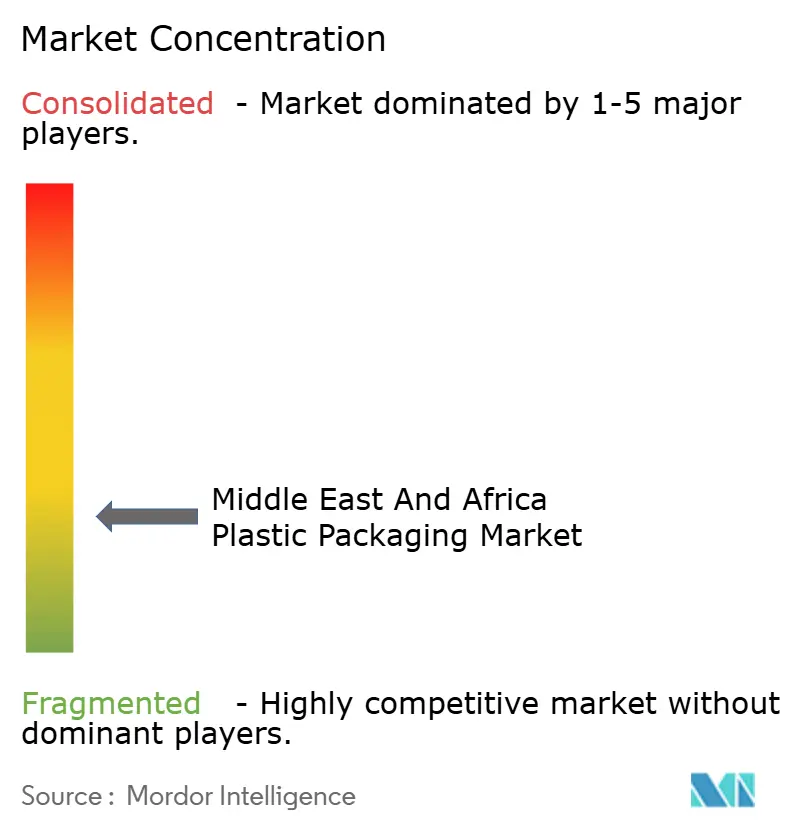
| Market Concentration | Low |
Major Players *Disclaimer: Major Players sorted in no particular order Image © Mordor Intelligence. Reuse requires attribution under CC BY 4.0. | |
Middle East and Africa Plastic Packaging Market Analysis by Mordor Intelligence
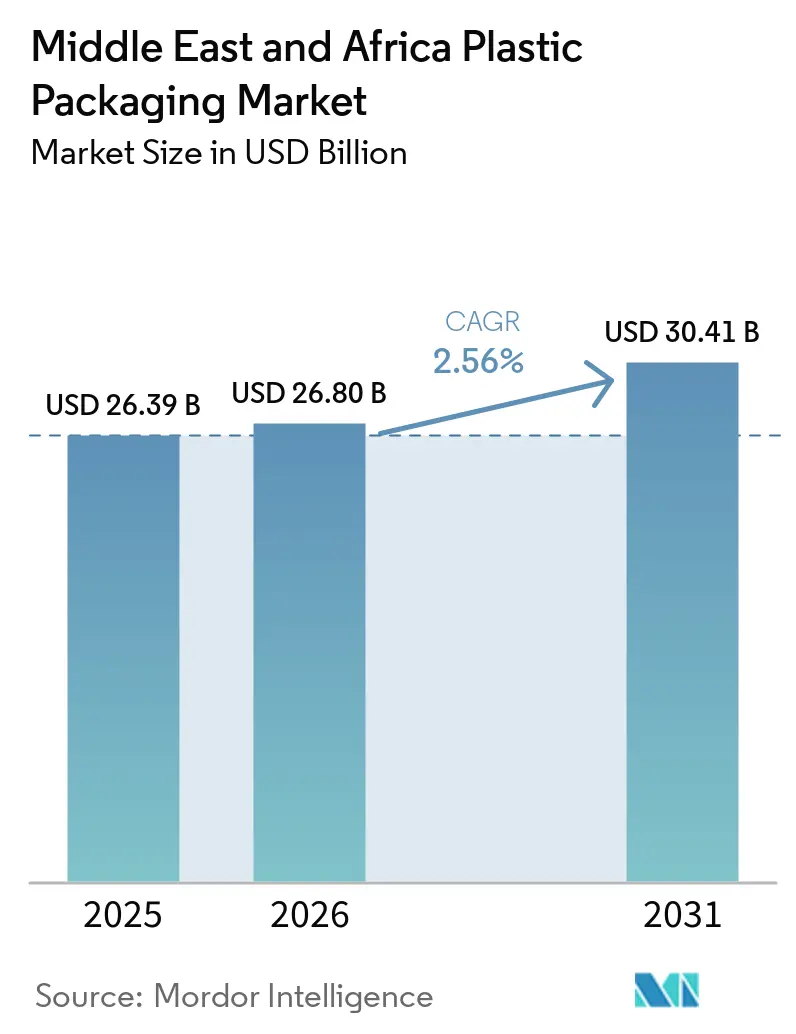
The Middle East and Africa plastic packaging market size is projected to expand from USD 26.39 billion in 2025 and USD 26.80 billion in 2026 to USD 30.41 billion by 2031, registering a CAGR of 2.56% between 2026 to 2031. Demand pivots toward lightweight formats for e-commerce, sovereign wealth funds finance large-scale recycling hubs, and Gulf regulators phase out single-use items, reshaping every link in the supply chain. Hot-fill beverages, premium cosmetics, and specialist healthcare lines favor polyethylene terephthalate (PET) due to its superior barrier properties, while polyethylene maintains volume leadership thanks to price advantages and converter familiarity. Flexible films, pouches, and flow-wrap formats gain ground at the expense of rigid bottles and jars as brand owners seek freight savings and lower carbon intensity. Multilayer coextrusion and digital printing enable converters to differentiate on the shelf without increasing material usage, and food-safety regulations in Saudi Arabia and the United Arab Emirates drive the adoption of high-barrier films.
Key Report Takeaways
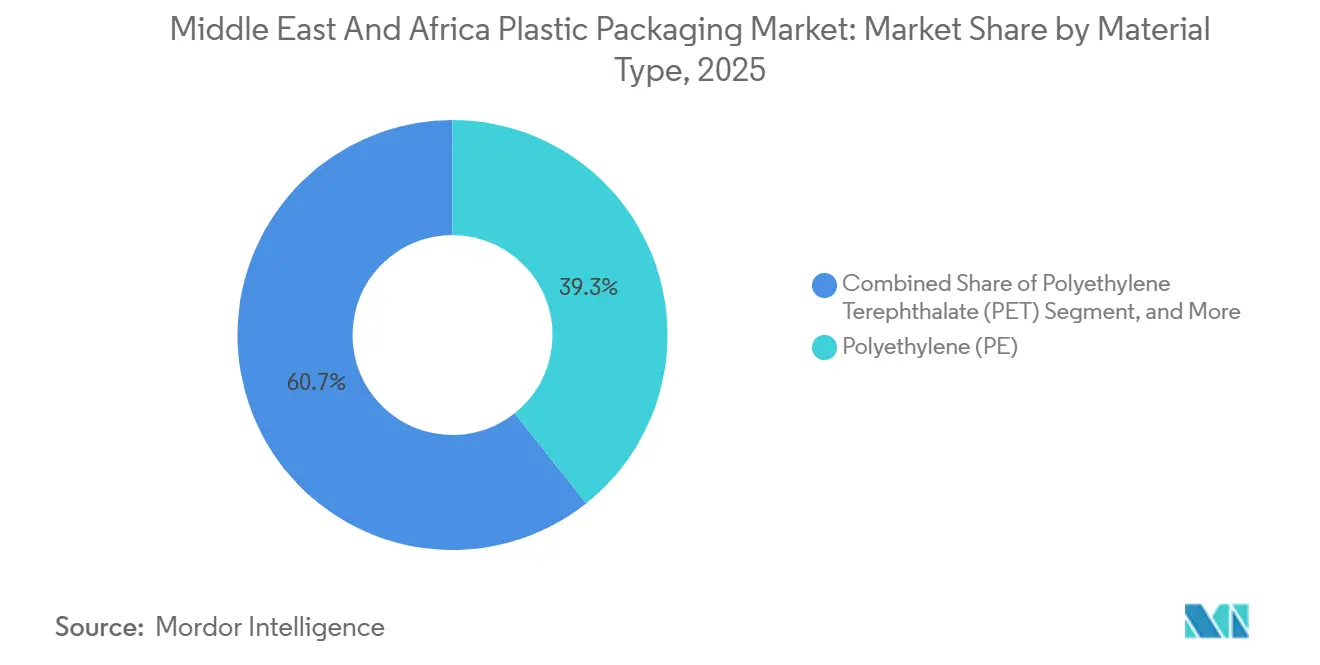
- By material, polyethylene captured 39.32% of Middle East and Africa plastic packaging market share in 2025, while PET is set to grow at a 3.56% CAGR through 2031.
- By packaging type, flexible formats accounted for 55.62% of Middle East and Africa plastic packaging market and are forecast to expand at a 3.87% CAGR through 2031.
- By product form, pouches and sachets accounted for 31.32% of demand in 2025, whereas films and wraps are poised to grow at the fastest rate, with a 4.22% CAGR to 2031.
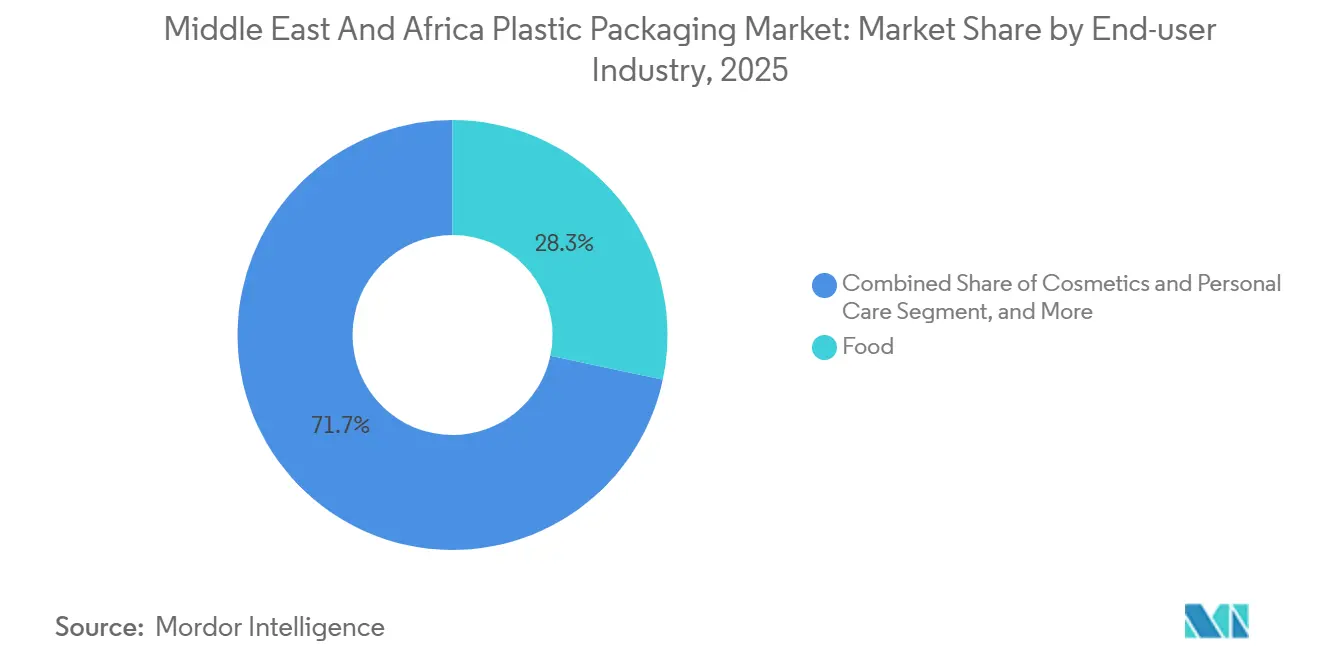
- By end-user industry, food retained 28.32% of the Middle East and Africa plastic packaging market in 2025, yet cosmetics and personal care are projected to accelerate at a 4.32% CAGR through 2031.
- By manufacturing process, extrusion represented 28.14% of activity in 2025 and is expected to rise at a 3.67% CAGR through 2031.
- By geography, the Middle East commanded 68.32% of 2025 sales and Africa is predicted to register a 3.45% CAGR up to 2031.
Note: Market size and forecast figures in this report are generated using Mordor Intelligence’s proprietary estimation framework, updated with the latest available data and insights as of January 2026.
Market Trends and Insights
Drivers Impact Analysis of Middle East and Africa Plastic Packaging Market*
| Driver | (~) % Impact on CAGR Forecast | Geographic Relevance | Impact Timeline |
|---|---|---|---|
| Demand for Oxo-Degradable Plastics | +0.3% | Gulf Cooperation Council states, South Africa | Medium term (2-4 years) |
| Steady Rise in Demand for Processed Food | +0.6% | Saudi Arabia, United Arab Emirates, Egypt, Nigeria, South Africa | Long term (≥ 4 years) |
| Accelerating Growth of E-Commerce Fulfilment Packaging | +0.7% | United Arab Emirates, Saudi Arabia, Egypt, Nigeria, Kenya | Short term (≤ 2 years) |
| Expanding Regional Healthcare Infrastructure | +0.4% | Saudi Arabia, United Arab Emirates, Egypt, Nigeria | Medium term (2-4 years) |
| Sovereign Wealth-Fund Backing for Recycling Capacity | +0.5% | Saudi Arabia, United Arab Emirates, Qatar, Kuwait | Long term (≥ 4 years) |
| Adoption of High-Barrier Films for Hot-Fill Beverages | +0.4% | Saudi Arabia, United Arab Emirates, Egypt, South Africa | Medium term (2-4 years) |
| Source: Mordor Intelligence | |||
Steady Rise in Demand for Processed Food
Urban migration, rising dual-income households, and climate-driven food-safety concerns lift demand for hermetically sealed, portion-controlled grocery lines across the region. Supermarket chains shift shelf space from loose staples to pre-packed meats, dairy, and snacks, pulling through multilayer barrier films that extend shelf life under 40 °C ambient temperatures.[1] Saudi Arabia already approaches Western European packaged-food consumption benchmarks, while Nigeria’s penetration lags below 15%, indicating significant headroom for new capacity. Converters respond with modified-atmosphere sachets and vacuum-skin trays that curb spoilage and shrink in-store waste. As distribution networks reach second-tier cities, small-format pouches allow retailers to balance affordability with hygiene, reinforcing adoption of flexible plastic solutions within the Middle East and Africa plastic packaging market.
Accelerating Growth of E-Commerce Fulfilment Packaging
Online retail expanded at 30% in 2024 and continues to outpace other channels, driven by consumers under 35 who dominate the Gulf workforce. Fragile supply routes that involve bumpy roads or multiple hand-offs increase breakage risk, pushing logistics operators to over-specify cushioning layers. Lightweight flow-wraps, air pillows, and stretch films safeguard orders without unduly raising freight costs, deepening penetration of plastics in last-mile distribution. Nigerian e-commerce alone is expected to add USD 5.71 billion in sales between 2023 and 2028, translating into millions of additional parcels that demand protective films and bubble mailers. Quick-commerce platforms in Dubai and Riyadh introduce a parallel stream for temperature-controlled shipments, spurring uptake of expanded polystyrene liners and vacuum panels. These dynamics collectively underpin above-average volume growth for the Middle East and Africa plastic packaging market.
Sovereign Wealth-Fund Backing for Recycling Capacity
Saudi Arabia’s Public Investment Fund created Saudi Investment Recycling Company to divert 82% of waste from landfills by 2035, allocating SAR 37 billion to new plants and collection systems. Development financiers reinforce the trend; the International Finance Corporation provided USD 37 million to the Mohinani Group for PET reprocessing sites in Ghana and Nigeria, demonstrating that circular-economy assets meet commercial hurdle rates.[2] Brand owners pay price premiums for recycled content to meet voluntary pledges and comply with emerging quotas, improving project economics. As sorting and washing capacity scales, mechanically recycled pellets feed back into bottles, films, and strapping, gradually closing material loops within the Middle East and Africa plastic packaging market.
Expanding Regional Healthcare Infrastructure
Vision 2030 reforms target 3.2 hospital beds per 1,000 residents in Saudi Arabia by 2030, triggering construction of clinics and specialized centers that utilize sterile blisters, surgical drapes, and diagnostic pouches. The United Arab Emirates upgrades oncology facilities that need gamma-stable polyethylene and polypropylene films validated under ISO 11607. Borouge commercialized a medical-grade low-density polyethylene in 2024 that withstands irradiation without discoloration, offering local substitutes for imported resins. Nigeria’s push for local drug manufacturing adds filling lines that depend on high-clarity PET vials and foil-laminated blister webs. The healthcare boom, therefore, channels steady, specification-sensitive demand into the Middle East and Africa plastic packaging market.
Restraints Impact Analysis of Middle East and Africa Plastic Packaging Market*
| Restraint | (~) % Impact on CAGR Forecast | Geographic Relevance | Impact Timeline |
|---|---|---|---|
| Environmental Concerns Over Recycling and Safe Disposal | -0.4% | Global pressure, acute in Gulf states and South Africa | Medium term (2-4 years) |
| High Raw-Material Costs and Limited Recycling Infrastructure | -0.5% | Sub-Saharan Africa, Egypt, smaller Gulf states | Short term (≤ 2 years) |
| Emerging Gulf Single-Use Plastic Bans | -0.6% | United Arab Emirates, Saudi Arabia, Qatar, Bahrain | Short term (≤ 2 years) |
| Currency Volatility Impacting Polymer Resin Imports | -0.3% | Egypt, Nigeria, Kenya, Ghana | Short term (≤ 2 years) |
| Source: Mordor Intelligence | |||
Emerging Gulf Single-Use Plastic Bans
The United Arab Emirates enforces Federal Decree-Law 36 of 2024, prohibiting single-use bags, cutlery, and straws from January 2026, with escalating fines through 2028. Saudi Arabia signals similar intent under its Green Initiative, though timelines remain fluid, generating investment uncertainty for converters. Compostable resin supply is nascent and priced 40% above conventional polyethylene, raising cost barriers for smaller firms. The possibility of asset write-offs on extrusion and injection lines tuned for single-use products threatens margins. Nonetheless, bans catalyze portfolio pivots toward reusable or certified-recyclable formats, prompting converters to reassess their single-use packaging portfolios while embedding higher specification standards across the Middle East and Africa plastic packaging market.
High Raw-Material Costs and Limited Recycling Infrastructure
Currency depreciation magnifies feedstock price swings; Egypt’s pound slide in 2024 lifted imported polyethylene costs by nearly 30% in local terms, squeezing converter profitability. Sub-Saharan African converters pay a premium of up to 20% for resins compared to their integrated Gulf peers, reflecting smaller order volumes and inland freight surcharges. The food-grade recycled PET capacity stands at below 5% of regional demand, forcing brand owners to import or downcycle the material. The resulting supply deficit limits the adoption of recycled-content mandates and raises compliance risk. Volatile inputs foster hand-to-mouth purchasing, undermining scale efficiencies and capping investment appetites within the Middle East and Africa plastic packaging market.
*Our forecasts treat driver/restraint impacts as directional, not additive. The impact forecasts reflect baseline growth, mix effects, and variable interactions.
Middle East and Africa Plastic Packaging Market Segment Analysis
By Material Type:
PET Gains on Barrier and Recyclability MandatesPolyethylene holds a 39.32% market share in the Middle East and Africa plastic packaging market in 2025, driven by its cost advantages and versatility across blown-film, injection, and rotational molding operations. Linear low-density polyethylene dominates the stretch-wrap and shrink-film segments that secure pallets traveling on dusty highways, while high-density polyethylene leads the way in detergent and lubricant bottles, which require chemical resistance. Polypropylene remains attractive for closures and woven sacks, particularly as tethered-cap regulations gain traction, although its recycling pathways lag behind those of PET. PET is forecast to expand at a 3.56% CAGR, surpassing the overall Middle East and Africa plastic packaging market. Indorama Ventures launched a lightweight PET bottle in 2024 that reduces preform mass by 15% while maintaining top-load strength, thereby lowering resin use and freight emissions. Hot-fill beverage lines prefer PET because it withstands 85 °C pasteurization without warping, unlike polyethylene. Extended producer responsibility schemes in South Africa and Kenya impose steeper fees on non-recyclable formats, prompting brand owners to shift toward PET.
Polyethylene’s resilience rests on local feedstock from Saudi petrochemical giants, ensuring timely supply and price leverage. Polypropylene benefits from growing demand for injection-molded reclosable lids in dairy and coffee. Polystyrene’s niche covers insulated food containers and protective cushioning, yet regulators scrutinize its micro-fragmentation tendencies. Meanwhile, mono-material PET lidding films enter ready-meal trays to improve recyclability. As recycled-content quotas tighten, converters weigh the security of captive polyethylene supply against end-market preference for PET circularity. This competitive interplay keeps both polymers central to the Middle East and Africa plastic packaging market, even as PET captures incremental growth.

By Packaging Type:
Flexible Formats Capture E-Commerce and Portion-Control DemandFlexible packaging commanded 55.62% share in 2025 and is projected to record a 3.87% CAGR, reflecting its weight efficiency and low shipping footprint. Stand-up pouches reduce landfill volumes and cut transportation emissions in half compared to glass jars, an attribute that retailers' marketing eco-scores leverage heavily. Huhtamaki rationalized its United Arab Emirates sites in 2024 to pool five-layer coextrusion assets, signaling a race toward higher throughput and thinner gauges.[3] Rigid containers maintain relevance in sauces, spreads, and household cleansers where controlled dispensing and tactile branding influence purchase decisions. Nonetheless, the rising demand for courier shipments of cosmetics sachets, nutraceutical powders, and meal kits amplifies the need for flow-wraps and mailer films. The Middle East and Africa plastic packaging market size for flexible formats will, therefore, remain on an expansion path relative to rigid counterparts.
Rigid solutions still dominate beverages, yogurts, and vitamins, where shelf impact and tamper evidence are critical. Injection stretch blow moulding of PET bottles ensures clarity and crack resistance, particularly important for premium juices sold across the Gulf’s travel retail channel. Blow-molded high-density polyethylene jerrycans secure agrochemicals and motor oils that require UN-certification for hazardous goods. Hybrid designs blur boundaries; paperboard sleeves bonded to thin polyethylene liners give brand owners improved stiffness and printability without compromising recyclability. The dual strategy allows converters to safeguard margins while meeting opposing pressures of regulatory compliance and consumer convenience.
By Product Form:
Films and Wraps Accelerate on Logistics and Sustainability PressuresPouches and sachets are projected to hold a 31.32% stake in 2025, targeting condiments, beverages, and shampoo dose packs aimed at low-income consumers. Yet, small-format litter concerns trigger retailer mandates for recyclable mono-material films, which constrain growth. Bottles and jars retain their dominance in carbonated soft drinks because aluminum and glass still outperform plastics in terms of barrier criteria. Trays and containers service chilled meats and ready meals, though some lines switch to vacuum pouches to pare material weights by up to 70%. Films and wraps are expected to register a 4.22% CAGR through 2031, emerging as the pace-setting product form. Stretch-film formulations utilize metallocene catalysts to achieve 20-micron gauges without tearing, allowing for pallet stability with minimal resin usage and supporting growth in the MEA plastic packaging films market. High-clarity flow-wrap encloses bakery goods, extending freshness during interstate distribution from Riyadh to Jeddah.
The Middle East and Africa plastic packaging market size for films and wraps is projected to widen as automated palletization gains ground in Egyptian and South African distribution centers. Retailers demand thinner stretch hoods compatible with high-speed lines to prevent bottlenecks. Conversely, multilayer pouches fight for regulatory breathing space; most waste-management systems lack sorting technology for metallized laminates. Converters experiment with high-barrier polyethylene films that forgo aluminum, but shelf-life sacrifices limit adoption in long-haul export SKUs. Bottles leverage deposit-return systems in South Africa to sustain high recovery rates, proving recyclability advantages against sachets. Ultimately, films and wraps rise fastest because they supply efficiency gains without requiring wholesale changes to consumer use behavior.
By End-User Industry:
Cosmetics and Personal Care Lead Growth on PremiumizationFood retains the largest revenue share at 28.32% in 2025, encompassing snacks, dairy, and ambient sauces; however, growth moderates as Gulf markets mature. Beverage packaging is migrating from glass to PET, driven by the lightweight benefits and shatter resistance, particularly on pilgrimage routes with strict safety protocols. The demand for cosmetics and personal care is forecast to grow at 4.32% through 2031, driven by young, affluent Gulf consumers who associate sophisticated packaging with product efficacy. Airless pumps, metallized closures, and velvet-surface films command price premiums that brands pass through to shoppers eager for curated aesthetics. McKinsey projects that the Middle East and North Africa beauty sector will reach over USD 60 billion by 2030, with Saudi Arabia contributing nearly USD 13.4 billion. Such momentum tilts converter portfolios toward injection-molded compacts, PETG bottles, and ultraviolet-blocking labels.
Pharmaceutical uptake tracks hospital investment; blister packs, IV solution bags, and sterile barrier pouches rely on ISO-certified cleanrooms that many African converters are now building with European technical partners. Industrial use cases, including lubricants and fertilisers, demand blow-molded drums that must endure 1.2-meter drop tests, a segment insulated from single-use bans. Agriculture absorbs woven polypropylene sacks for grain, while electronics importers deploy anti-static films for semiconductor boards transiting Jebel Ali free-zone. The diversity of end-use keeps the Middle East and Africa plastic packaging market resilient against cyclical swings in any single vertical.
By Manufacturing Process:
Extrusion Dominates on Versatility and Capital EfficiencyExtrusion generated 28.14% of activity in 2025 and is predicted to rise at a 3.67% CAGR, supported by continued demand for plastic packaging films across food, beverage, and consumer goods applications. A single blown-film line can toggle between die configurations to produce shrink sleeves during the day and stretch hoods at night, maximizing utilization. Huhtamaki’s South African five-layer line pushes 900 kilograms per hour, matching European benchmarks and confirming that capital, not capability, is the gating factor. Injection molding advances with all-electric presses that reduce cycle times for closures built to meet tether-cap legislation. Blow molding is divided into extrusion blow molding for commodity bottles and injection stretch blow molding for premium PET applications that require optical clarity. Thermoforming services produce trays and cups at lower mold costs, making them appealing to new entrants seeking rapid payback.
Energy tariffs shape geography; Egyptian converters pay double the Gulf average per kilowatt-hour, eroding competitiveness in extrusion and blow molding of heavy formats. West African operators compensate with lower wages but face grid instability, prompting firms to install diesel generators that add to their overhead. Automation is gaining traction as Saudi plants adopt automated material-feed systems, which trim labor and resin losses. Digital twin software enters maintenance schedules, predicting screw wear and preventing downtime. These process-level changes underpin productivity gains that help the Middle East and Africa plastic packaging market absorb input-cost volatility without wholesale price inflation.
Geography Analysis
GCC Plastic Packaging Market
Saudi Arabia, the United Arab Emirates, and Qatar together controlled 68.32% of 2025 regional revenue, underpinned by abundant feedstock and state-led downstream diversification. Saudi Arabia’s Public Investment Fund has earmarked SAR 37 billion for recycling infrastructure, spanning material recovery facilities and chemical depolymerization units. Hotpack Packaging Industries pledged SAR 1 billion for a mega complex in Riyadh and AED 250 million for a PET plant in Dubai, illustrating how family-owned groups match multinational investments to secure local supply. The United Arab Emirates’ single-use prohibition starting 2026 compels converters to diversify into reusable and compostable offerings, compressing product-development timelines. Smaller Gulf states benefit from customs unions and duty-free re-export networks that funnel raw materials and finished goods through Jebel Ali and Hamad ports, sustaining economies of scale in regional converting hubs.
Africa Plastic Packaging Market
Africa, forecast to post a 3.45% CAGR through 2031, offers the higher growth runway. Egypt attracted USD 200 million from UFlex for PET resin and aseptic packaging lines, targeting a 12 billion pack capex, positioning the Suez Canal Economic Zone as a gateway to European customers. Nigeria’s e-commerce boom lifts demand for bubble mailers and stretch wraps, yet imported resin premiums curb competitiveness. Coca-Cola Nigeria opened a 13,000-tonne PET collection hub, demonstrating brand owner willingness to seed recycling ecosystems. South Africa leads mechanical recycling with Alpla’s 35,000-tonne food-grade PET plant feeding both domestic and export markets.
MEA Plastic Packaging Market
Sub-Saharan markets face power outages, poor road links, and currency swings that discourage high-spec installations, tilting demand toward ambient-stable sachets and woven sacks. Still, demographic dividends attract converters willing to absorb risk for first-mover advantage. Gulf petrochemical cost leadership will preserve the Middle East’s numeric dominance, yet Africa’s consumption expansion should deliver a growing portion of incremental Middle East and Africa plastic packaging market revenue over the forecast horizon.
Regulatory Landscape
Regulation across the Middle East and Africa is tightening around extended producer responsibility (EPR), eco-modulated fees, and restrictions on selected single-use items, directly influencing material choices and packaging design. The United Arab Emirates enforces Federal Decree-Law 36 of 2024 from January 2026 to prohibit a defined set of single-use items, accelerating shifts toward reusable or certified-recyclable formats. In Kenya, the Sustainable Waste Management (Extended Producer Responsibility) Regulations, 2024 require producer registration and take-back mechanisms (including deposit-refund where applicable), increasing compliance and reporting requirements for brand owners and converters supplying the market.
South Africa continues to operationalize EPR via amendments published in November 2024 (Government Notices 5534 and 5535), which refine fee determination approaches and differentiate plastic types to support net cost recovery and eco-modulation (higher charges for hard-to-recycle formats). In the GCC, industry coordination around circular packaging has moved closer to formal governance, with Saudi Arabia's National Circular Packaging Committee (NCPC) positioned as an independent body under the Federation of Saudi Chambers (as of May 2024) to advance circular-packaging initiatives and inform EPR frameworks. Together, these measures are pushing converters toward auditable material declarations, improved recyclability, and clearer stewardship pathways for plastic packaging placed on the market.
Value Chain Analysis
The value chain starts with resin supply dominated by integrated Gulf petrochemical producers (notably Saudi Arabia and the United Arab Emirates) and continues through compounders/masterbatch suppliers, converters (extrusion, injection molding, blow molding, and thermoforming), and brand owners in food, beverage, healthcare, and personal care. Logistics and distribution are anchored by Gulf re-export corridors (including Jebel Ali and Hamad ports) and regional road networks that elevate demand for stretch films, flow-wrap, and protective formats used in e-commerce fulfillment. On the converting side, scale and certification (BRC, ISO 22000, HACCP) act as gatekeepers for multinational FMCG contracts, while high energy tariffs and grid instability in parts of Africa can raise operating costs and depress utilization, especially for heavy-format extrusion and blow molding.
Downstream, collection, sorting, and reprocessing remain the principal bottlenecks, with brand owners and financiers increasingly seeding infrastructure to close material loops. Circular feedstock supply is being strengthened through targeted moves such as the International Finance Corporation's USD 37 million financing to the Mohinani Group for PET reprocessing in Ghana and Nigeria, and Coca-Cola Nigeria's 13,000-tonne PET collection hub, yet food-grade rPET availability still trails demand. Value chain integration is also visible in industrial packaging and bulk handling: in February 2025, SCHUTZ and National Plastic Factory Company announced a partnership to produce ECOBULK IBCs near Dammam, with production starting in 2026, linking local manufacturing capacity with industrial end-use requirements. These developments are gradually connecting upstream resin advantages, midstream converting scale, and downstream recovery systems within the region.
Competitive Landscape
The Middle East and Africa plastic packaging market exhibits fragmentation. Alpla deepened its footprint by fully acquiring its Egyptian plant in December 2024 and purchasing a stake in Taba Plastic Industries in January 2025, prioritizing density over greenfield investment. Huhtamaki consolidated its United Arab Emirates sites to sharpen asset utilization amid intensifying flexible-pack competition, underscoring the premium on scale economies. Local champions counter through vertical integration; Hotpack’s twin projects in Riyadh and Dubai secure PET preform and film capacity, sheltering it from feedstock fluctuations. Certification to BRC, ISO 22000, and HACCP remains a gatekeeper for multinational fast-moving consumer goods contracts, and smaller converters struggle to fund audits, hindering entry.
Recycled resin supply is a white-space opportunity. International Finance Corporation financing for Ghana and Nigeria PET plants adds 30,000 tonnes but covers less than 5% of demand, leaving room for new entrants. Technology differentiators emerge in multilayer film recipes and digital print runs that reduce minimum order quantities, appealing to direct-to-consumer beauty labels searching for bespoke packaging.
Saudi petrochemical producers such as SABIC and Borouge provide home-field advantage through cost-plus resin deals, anchoring their captive converters in the low quartile of the global cost curve. Currency controls and import tariffs protect fledgling African firms, yet the absence of scale leaves them vulnerable when domestic demand softens, reinforcing consolidation trends within the Middle East and Africa plastic packaging market.
Middle East and Africa Plastic Packaging Industry Leaders
-
Zamil Plastic Industries Co.
-
Huhtamaki South Africa (Pty) Ltd
-
Takween Advanced Industries
-
Napco National
-
Constantia Flexibles Afripack
- *Disclaimer: Major Players sorted in no particular order
Middle East and Africa Plastic Packaging Market Companies Covered in this Report
- Zamil Plastic Industries Co.
- Huhtamaki South Africa (Pty) Ltd
- Takween Advanced Industries
- Napco National
- Constantia Flexibles Afripack
- Packaging Products Company (PPC)
- PrimePak Industries Nigeria Ltd (Enpee Group)
- Al Bayader International (H and H Group of Companies)
- Falcon Pack
- Arabian Flexible Packaging LLC
- Hotpack Packaging Industries LLC
- ENPI Group
- Gulf East Paper and Plastic Industries LLC
- Obeikan Investment Group (OIG Packaging)
- Sealed Air Corporation
- Taghleef Industries
- Alpla Group
- Greif Inc.
- RPC M&H Plastics
Read Analysis of Middle East and Africa Plastic Packaging Companies
Market Opportunities and Future Outlook
A major opportunity area is scaling reliable, compliant recycled-resin supply, particularly food-grade rPET and higher-quality recycled PE/PP, where reported capacity covers less than 5% of demand in several markets. Concrete investment signals include Polysmart Packaging's USD 60 million recycling facility initiative in Nigeria (announced January 2026) designed for 100,000 tons of mixed plastics annually, and ongoing Gulf circularity programs tied to sovereign-backed waste diversion targets (for example, Saudi Investment Recycling Company under the Public Investment Fund mandate to divert 82% of waste from landfills by 2035). As EPR regimes mature in markets such as South Africa and Kenya, converters that can document recycled content and provide verifiable recovery pathways gain clearer routes to brand-owner contracts.
Import substitution and feedstock security also present whitespace, especially in Africa where currency volatility and inland logistics raise effective resin costs. Nigeria is a focal point: Dangote Petroleum Refinery's partnership with Honeywell (April 2026) to deploy UOP Oleflex technology for 750,000 metric tons of propylene annually supports local availability of PP-linked value chains used in films, woven sacks, and closures. In the Gulf, vertical integration by end users is expanding: Al Ain Farms signed an agreement with Borouge (May 2026) for 3,500 tonnes per year of HDPE resin to support in-house caps, closures, and blow molding, reflecting demand for stable resin supply and tighter control of packaging specifications. Across the region, converters that can supply mono-material high-barrier films for hot-fill and processed foods, along with e-commerce protective films, are better aligned with the dual pressure of performance requirements and recyclability-driven procurement.
Recent Industry Developments in Middle East and Africa Plastic Packaging Market
- July 2026: Takween Advanced Industries received approval from Saudi Arabia's General Authority for Competition for its acquisition of Advanced Fabrics Factory Company. The clearance removed a key closing condition and supports Takween's move to consolidate capabilities that serve packaging-adjacent converting applications and localized supply.
- September 2025: Huhtamaki South Africa completed the installation of two Bimec TCA 64C+ duplex turret slitter rewinder machines at its Durban flexible packaging site. The equipment upgrade increased finishing productivity and supports faster throughput for film-based formats that dominate regional demand.
- December 2024: Alpla acquired full ownership of its Taba packaging and recycling joint venture in Egypt, consolidating operations in 10th of Ramadan City. The move strengthened local rigid-packaging production and recycling integration in a market that is positioning itself as a manufacturing and export gateway.
Middle East and Africa Plastic Packaging Market Report Scope and Research Methodology
Market Definition and Coverage
For this study, the market counts the value of plastic packaging sold in the Middle East and Africa, covering packaging that protects, contains, and transports products across major end uses.
Scope exclusions: Paper, glass, and metal packaging are excluded, and any recycling or waste-management services are not counted as part of this market value.
Segments Covered in This Report
- By Material Type
- Polyethylene (PE)
- Polypropylene (PP)
- Polyethylene Terephthalate (PET)
- Polystyrene and EPS
- Other Material Types
- By Packaging Type
- Flexible Plastic Packaging
- Rigid Plastic Packaging
- By Product Form
- Bottles and Jars
- Trays and Containers
- Pouches and Sachets
- Bags and Sacks
- Films and Wraps
- Other Product Forms
- By End-User Industry
- Food
- Beverage
- Pharmaceuticals and Healthcare
- Cosmetics and Personal Care
- Industrial
- Other End-user Industries
- By Manufacturing Process
- Extrusion
- Injection Molding
- Blow Molding
- Thermoforming
- Other Manufacturing Processes
- By Region
- Middle East
- Saudi Arabia
- United Arab Emirates
- Rest of Middle East
- Africa
- South Africa
- Egypt
- Nigeria
- Rest of Africa
- Middle East
Data Sources, Market Sizing, and Validation
Desk Research
Desk work starts with building the country and sub-region packaging context, and then narrowing it to plastics by format and end use. We typically rely on public statistics and technical references such as UN Comtrade trade flows, national statistics offices in the GCC and key African economies, World Bank macro indicators, FAO food supply signals, and peer-reviewed packaging and polymer journals to understand material usage and pack-type shifts.
After that, the model is anchored using company annual reports, investor presentations, official association websites (such as plastics and packaging bodies), and reputable business press to validate expansions, new capacity, and demand changes in food, beverage, healthcare, and personal care. Where needed, we also use a paid subscription for company financials and intelligence, and a shipment-level import/export database to cross-check resin and packaging product movements. These sources are not exhaustive, and additional public documents were also reviewed to collect data points, validate assumptions, and clarify items that were unclear at the start of the build.
Primary Interviews and Surveys
Primary inputs are used to convert secondary indicators into realistic packaging demand and pricing assumptions, especially where country reporting is uneven. We spoke with converters, resin and film suppliers, packaging distributors, and large end users across food, beverage, pharma, and industrial buyers, and the feedback was used to confirm utilization ranges, mix shifts between rigid and flexible formats, and typical pricing movements by polymer family across the region.
Distribution of primary research fieldwork respondents
| Company type | Respondent position |
|---|---|
| Top tier: 32% | CXOs: 14% |
| Mid tier: 49% | Functional/Unit leaders: 42% |
| Smaller Players: 19% | Managers: 44% |
Market-Sizing & Forecasting
Sizing is built using top-down and bottom-up checks, so the market stays tied to observable demand signals and does not drift due to one-off assumptions. The top-down side reconstructs plastic packaging consumption by linking packaged goods output and trade to packaging intensity, and then splitting that demand by rigid and flexible formats and the main polymer families.
A few inputs that are tracked closely include polymer price direction (PE, PP, PET, PS/EPS), packaged food and beverage volumes, healthcare and personal care production and import trends, growth in modern retail and e-commerce shipments, and converter capacity additions and utilization. These indicators help explain whether value growth is being driven more by volume, mix (for example, films and wraps versus bottles and jars), or price movements. Bottom-up approximations are then used as a reality check, using sampled converter revenues, channel checks on average selling prices, and format-level volume benchmarks where interview feedback is strong, with gaps handled by using conservative mix assumptions and country proxies that are later revisited during validation.
Forecasting is done using scenario analysis supported by a light multivariate regression on macro and end-use drivers, and then the outputs are reviewed with experts to keep assumptions realistic for each sub-region. Where short-term price swings are expected, smoothing is applied so the forecast reflects gradual pass-through rather than sudden step changes.
Data Validation & Update Cycle
Validation is done through multiple checks that compare the model outputs against independent signals such as resin trade movements, packaging product import patterns, and visible end-use demand trends. When a country estimate looks out of line, we recheck the driver series, review the mix split, and then re-contact sources if the variance cannot be explained by pricing or a known capacity event.
Before publication, the work is reviewed in stages so calculation logic, unit conversions, and currency treatment are consistent across countries. Reports are refreshed annually, and interim updates are made when major events occur such as large plant start-ups, regulatory shifts on single-use plastics, or sharp polymer price moves. Right before delivery, an analyst performs a fresh pass so the view reflects the latest available public data and validated assumptions.
Mordor Intelligence's Middle East and Africa Plastic Packaging Market Size Measured Against Other Published Estimates
Published estimates for MEA plastic packaging can look far apart because the geography split is not always consistent, and some studies treat pricing very differently across polymer types and packaging formats. Differences also come from whether value is captured at the converter selling price level or at broader wholesale and trade value levels.
Some sources roll up a broader spend figure that can mix packaging materials, downstream distribution margins, or a different set of countries. In Mordor Intelligence, the total is kept at the plastic packaging market level across the Middle East and Africa, and it is built from format and end-use demand signals with a separate treatment for polymer-linked pricing so adjacent non-plastic packaging and margin layers are not blended in.
Benchmark comparison
| Source | Market Size | Gaps in Research Methodology |
|---|---|---|
| Mordor Intelligence | USD 26.39 B (2025) | |
| Industry Analytics A | USD 45.88 B (2024) | Uses a different base year and appears to apply a broader revenue definition across MEA, which can inflate totals if wholesale value layers and wider packaging-related scope are included beyond converter-level plastic packaging. |
| Trade Intelligence B | USD 18.10 B (2024) | Covers Middle East only and is heavily tied to trade and nominal wholesale pricing, so it can understate the full MEA market and can move sharply with import price and currency timing choices. |
Taken together, the spread mainly reflects geography coverage, the value capture point in the supply chain, and how resin-linked pricing is carried into the final market value. By keeping the steps traceable to demand pools, format mix, and pricing logic that can be checked country by country, the resulting estimate remains practical to reproduce and easier to validate in updates.
Key Questions Answered in the Report
What is the projected value of the Middle East and Africa plastic packaging market in 2031?
The market is forecast to reach USD 30.41 billion by 2031, growing at a 2.56% CAGR.
Which packaging type is expected to expand the quickest through 2031?
Flexible formats, including pouches and flow-wrap films, are projected to advance at a 3.87% CAGR, outpacing rigid alternatives.
Why is PET gaining share within regional material demand?
PET combines hot-fill compatibility, high clarity, and established recycling streams, enabling brand owners to meet performance needs and recycled-content pledges.
How will Gulf single-use plastic bans affect converters?
The bans compel a pivot toward reusable, recyclable, or compostable designs, pressuring firms to invest in new materials and retool existing lines before 2028.
What growth opportunities exist for investors in the sector?
Food-grade recycled PET capacity, multilayer high-barrier film production, and e-commerce fulfilment packaging all present under-served niches with attractive demand trajectories.
How concentrated is the supplier landscape?
With the top five converters holding roughly 35% of revenue, the market remains moderately fragmented, allowing room for consolidation plays and specialist entrants.