
Market Overview
| Study Period | 2020 - 2031 |
|---|---|
| Forecast Data Period | 2026 - 2031 |
| Base Year Market Size (2025) | USD 25.42 Billion |
| Market Size (2026) | USD 26.83 Billion |
| Market Size (2031) | USD 35.13 Billion |
| Growth Rate (2026 - 2031) | 5.54 % |
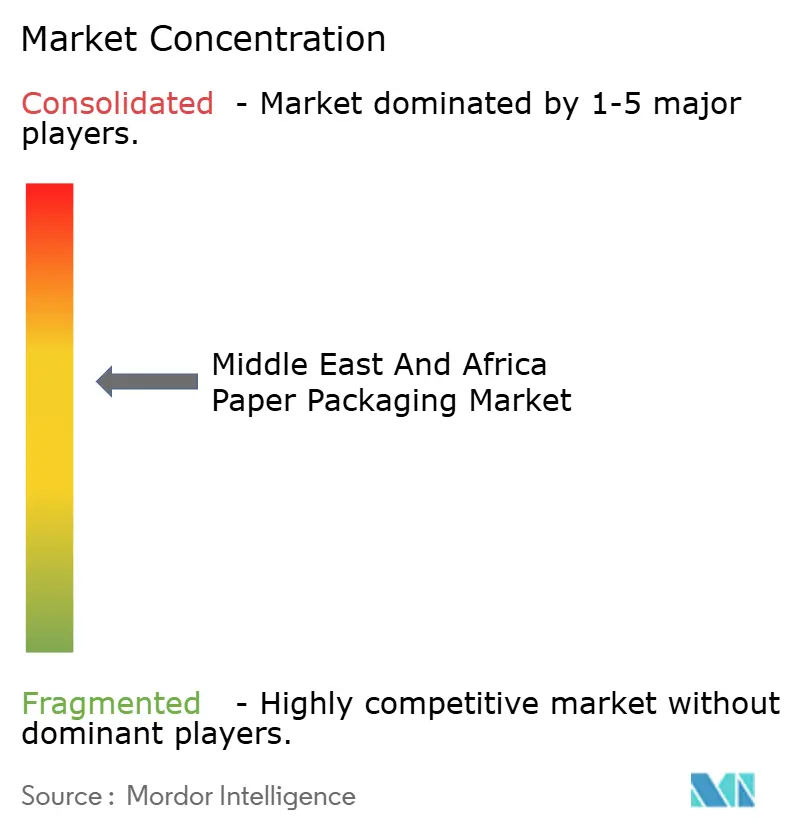
| Market Concentration | Medium |
Major Players *Disclaimer: Major Players sorted in no particular order Image © Mordor Intelligence. Reuse requires attribution under CC BY 4.0. | |
Middle East And Africa Paper Packaging Market Analysis by Mordor Intelligence
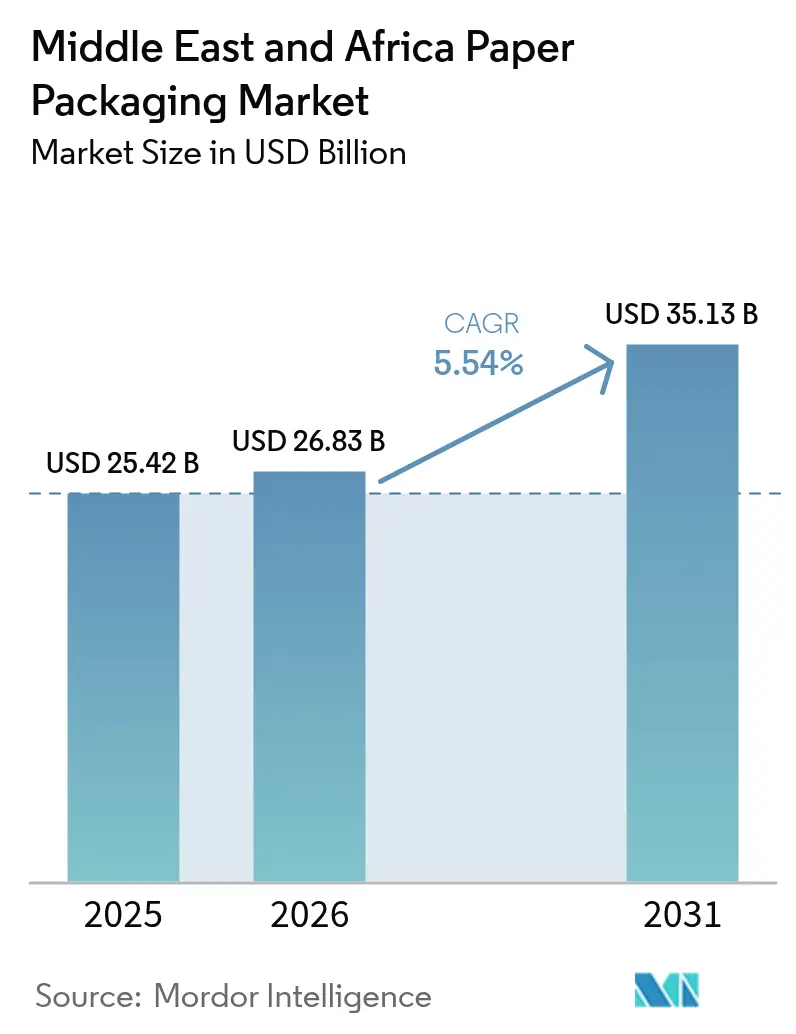
Middle East and Africa paper packaging market size in 2026 is estimated at USD 26.83 billion, growing from 2025 value of USD 25.42 billion with 2031 projections showing USD 35.13 billion, growing at 5.54% CAGR over 2026-2031. Structural shifts are accelerating as plastic-phase-out mandates coincide with e-commerce parcel volumes that doubled after 2024, prompting brand owners to favor fiber-based formats for regulatory compliance and fulfillment efficiency. Demand is tempered by the volatility of imported recycled-fiber prices and chronic power interruptions in Sub-Saharan hubs, which raise the cost of goods sold, prompting converters to secure long-term pulp contracts, invest in dual-fuel boilers, and digitize asset scheduling. Saudi Arabia remains the revenue anchor, while South Africa leads growth in Extended Producer Responsibility rules that stimulate the use of recycled content. Competitive tension intensifies as global integrated producers leverage vertical supply chains and sustainability credentials, whereas regional converters counter with Industry 4.0 automation and on-site digital presses. These factors collectively steer the Middle East and Africa paper packaging market toward optimized capacity deployment, innovation in water-barrier coatings, and renewed focus on feedstock security.
Key Report Takeaways
- By material type, corrugated board accounted for 55.01% of the Middle East and Africa paper packaging market share in 2025; paperboard is forecast to expand at a 7.32% CAGR through 2031.
- By product type, rigid paper packaging captured a 65.85% of the Middle East and Africa paper packaging market share in 2025, while flexible paper packaging is expected to advance at a 6.63% CAGR through 2031.
- By packaging format, secondary packaging accounted for 45.18% of the Middle East and Africa paper packaging market share in 2025, whereas primary packaging is projected to grow at a 7.12% CAGR through 2031.
- By end-use industry, food led with a 33.05% share of the Middle East and Africa paper packaging market in 2025; personal care and cosmetics aree forecast to expand at an 8.02% CAGR between 2025 and 2031.
- By geography, Saudi Arabia commanded a 35.05% of the Middle East and Africa paper packaging market share in 2025; South Africa is expected to record an 7.86% CAGR from 2025 to 2031.
Note: Market size and forecast figures in this report are generated using Mordor Intelligence’s proprietary estimation framework, updated with the latest available data and insights as of 2026.
Market Trends and Insights
Drivers Impact Analysis of Middle East And Africa Paper Packaging Market*
| Driver | (~) % Impact on CAGR Forecast | Geographic Relevance | Impact Timeline |
|---|---|---|---|
| Accelerating E-Commerce Fulfillment Volumes | +1.2% | Saudi Arabia, UAE, South Africa, Kenya | Short term (≤ 2 years) |
| Government Plastic Phase-Out Regulations | +1.5% | Nigeria, Kenya, UAE, Ethiopia, South Africa | Medium term (2-4 years) |
| Rising Fresh Produce Exports Requiring Corrugated Solutions | +0.8% | South Africa, Kenya, Morocco, Egypt | Medium term (2-4 years) |
| Rapid Expansion of Quick Service Restaurants | +0.7% | Saudi Arabia, UAE, Egypt, Nigeria | Short term (≤ 2 years) |
| Growing Adoption of Smart Water-Barrier Coated Papers | +0.6% | Saudi Arabia, UAE, South Africa | Long term (≥ 4 years) |
| On-Site Digital Printing on Corrugated for Brand Localization | +0.5% | Saudi Arabia, UAE, South Africa, Kenya | Medium term (2-4 years) |
| Source: Mordor Intelligence | |||
Accelerating E-Commerce Fulfillment Volumes
Mobile-enabled shopping, same-day delivery promises, and digital marketplaces have driven parcel counts sharply higher in major consumer corridors since 2024. Every additional shipped box raises corrugated demand, but rising SKU complexity now favors converters that integrate hybrid digital-flexo print lines capable of on-demand graphics. Order cycles have shortened from weeks to days, compelling plants to adopt AI-based planning tools that squeeze idle time and release working capital. Brand owners are increasingly specifying box formats that eliminate void-fill plastics and utilize lightweight containerboard to meet carrier weight thresholds and Extended Producer Responsibility fees. Converters can maintain consistent flute profiles while running variable graphics and capturing above-market margins by reducing clients’ inventory carry costs.
Government Plastic Phase-Out Regulations
Nigeria’s 2024 single-use ban, Kenya’s expanded restrictions, the UAE’s degradability rules, and Ethiopia’s Addis Ababa mandates have triggered a measurable shift to fiber solutions across food service and retail. Compliance accelerates the demand for dispersion-coated paper that withstands grease and moisture while remaining recyclable in existing mills. Enforcement inconsistencies create arbitrage opportunities: converters with ISO 14001 certifications secure public-sector tenders, whereas their non-certified peers face ad-hoc audits and contract penalties. Equipment upgrades to curtain-coating lines and inline barrier inspection systems are required investments; however, converters recover their costs through premium prices on certified mono-material formats. Regional chemical suppliers gain a pipeline of bio-based coating volumes that displace polyethylene laminations.[1]United Nations Environment Programme, “How African Countries Are Taking Action to Beat Plastic Pollution,” unep.org
Rising Fresh Produce Exports Requiring Corrugated Solutions
Record citrus and avocado harvests in Southern Africa demand ventilated, moisture-controlled cartons that survive chilled reefer voyages to Europe. Kenyan floriculture exporters prioritize low grammage yet high stacking strength to cut airfreight charges while meeting shelf-life specs. Corrugated converters co-locate warehouses in farm clusters to synchronize with harvest windows and run just-in-time production, minimizing inventory spoilage risk. Molded-pulp corner protectors are gaining traction to curb transit damage, creating incremental fiber demand and new revenue streams. As United Kingdom supermarkets toughen bruising tolerance limits, carton stiffness testing and ethylene-absorbing pads become differentiators for suppliers.[2]MDPI Editors, “Sustainability and Life Cycle Assessment of Corrugated Packaging for Fresh Produce,” mdpi.com
Rapid Expansion of Quick Service Restaurants
More than 200 new QSR outlets opened across Saudi Arabia, the UAE, Egypt, and Nigeria in 2024, each requiring grease-resistant wraps, folding cartons, and beverage carriers. The shift to delivery-first formats means that every meal occasion comes with incremental packaging, with lightweight cartons replacing plastic clamshells. Short-run seasonal artwork drives the adoption of digital presses that can swap graphics within minutes, feeding localized marketing campaigns. Grease-proof dispersion coatings now command a 15% price premium while reducing composting contamination, thereby aiding restaurant ESG targets. Suppliers able to preload inventory data into client ERP systems win multi-country master service agreements, signaling deeper integration in the Middle East and Africa paper packaging market.[3]Huhtamäki Oyj, “Huhtamaki Annual Report 2023,” huhtamaki.com
Restraints Impact Analysis of Middle East And Africa Paper Packaging Market*
| Restraint | (~) % Impact on CAGR Forecast | Geographic Relevance | Impact Timeline |
|---|---|---|---|
| Frequent Cost Volatility in Recycled Fiber Import Feedstock | -0.9% | Nigeria, Kenya, Egypt | Short term (≤ 2 years) |
| Chronic Power Supply Instability in Sub-Saharan Manufacturing Hubs | -0.7% | Nigeria, Kenya, Tanzania, Ghana | Medium term (2-4 years) |
| Limited Regional Forestry Resources Increasing Virgin Pulp Dependence | -0.6% | Saudi Arabia, Egypt, Ethiopia | Long term (≥ 4 years) |
| Maritime Logistics Disruptions and Currency Fluctuations Extending Lead Times | -0.5% | GCC, East Africa, Egypt | Short term (≤ 2 years) |
| Source: Mordor Intelligence | |||
Frequent Cost Volatility in Recycled Fiber Import Feedstock
European export restrictions and Asian buying spikes drove recycled fiber prices to EUR 1,380 per metric ton in April 2024, inflating raw-material costs for Middle East and African mills that import more than 70% of their feedstock. Gross margin compression of 200-300 basis points followed as converters absorbed surges to preserve long-term contracts. Buyers began requesting quarterly price-adjustment clauses, but smaller converters lacked the leverage to counter these demands and risked losing orders. Vertically integrated players with captive OCC collection offset volatility and gained share, widening the cost gap versus spot purchasers. Working-capital pressure forced some independents to temporarily shutter their lines, underscoring the feedstock risk premium inherent in the Middle East and Africa paper packaging market.
Chronic Power Supply Instability in Sub-Saharan Manufacturing Hubs
Grid uptime below 60% in Nigeria, Kenya, and Tanzania compels converters to run diesel gensets that lift energy costs by up to 18%, negating carbon advantages over plastics. Outages disrupt process consistency, elevate scrap, and extend lead times, eroding service-level scores. Capital-intensive solar-battery retrofits, typically USD 500,000-1.5 million per plant, pose funding hurdles for smaller firms. Hybrid systems deliver payback in four years but still require a diesel backup due to cloudy seasons, which locks in dual-fuel complexity. Policy focus on residential electrification leaves industrial users to self-fund resilience, reinforcing market consolidation around well-capitalized operators.
*Our forecasts treat driver/restraint impacts as directional, not additive. The impact forecasts reflect baseline growth, mix effects, and variable interactions.
Middle East And Africa Paper Packaging Market Segment Analysis
By Material Type:
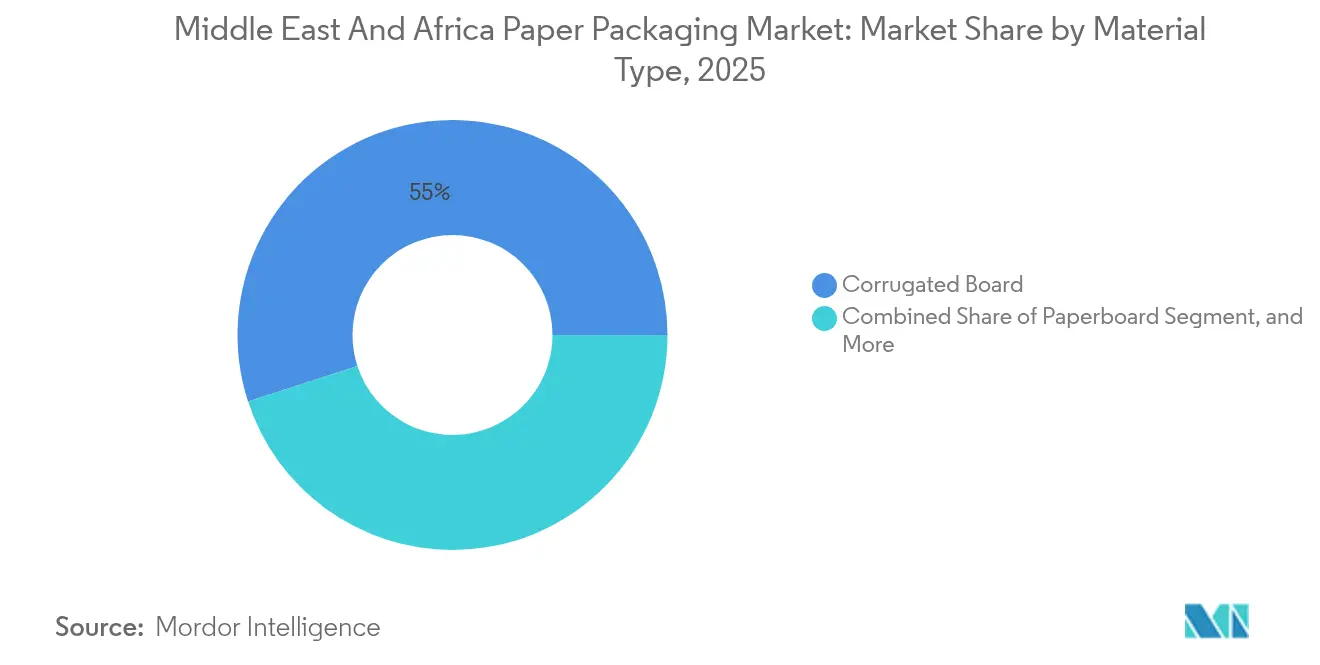
Corrugated Dominates but Paperboard Surges in Consumer-Facing CartonsCorrugated board generated 55.01% of 2025 material revenue thanks to sturdy, low-cost secondary and tertiary transit roles across food and industrial supply chains. The Middle East and Africa paper packaging market size for corrugated paper is projected to trail paperboard through 2031, as carton demand in the QSR and personal care sectors outpaces bulk shipping volumes. Paperboard’s 7.32% CAGR reflects lightweight substrates that support high-definition graphics, portion control, and shelf impact, enabling brand segregation in crowded retail aisles. Kraft paper continues to serve bakery wraps, yet faces substitution by coated paperboard, which delivers superior moisture barriers.
Converters installing inline coating and digital print stations on paperboard lines lock in higher margins by catering to premium cosmetic SKUs. MEPCO’s SAR 1.78 billion fifth line will add 450,000 metric tons of recycled containerboard, reinforcing corrugated supply, while molded-pulp niches rise in electronics protection. Integrated mills that optimize furnish recipes between testliner and medium grades can flex their output around e-commerce spikes, thereby buffering the Middle East and Africa paper packaging market against pulp shocks.


By Product Type:
Flexible Formats Accelerate on Mono-Material RecyclabilityRigid formats accounted for 65.85% of 2025 revenue, primarily driven by folding cartons and corrugated cases. However, flexible paper pouches, bags, and wraps are expected to post a 6.63% CAGR through 2031, as regulators increasingly clamp down on multilayer plastics. The Middle East and Africa paper packaging market size for flexible grades remains smaller but benefits from bio-dispersion coatings that enable high-moisture foods to shift away from laminated films without sacrificing shelf life. Bakery and confectionery packs are already shifting to paper-based pouches, which reduce system costs, as Extended Producer Responsibility fees penalize plastics.
Huhtamaki’s South African molded-fiber expansion signals demand for rigid trays that displace PET. Meanwhile, converters with gravure-coating towers introduce barrier wraps for frozen foods, adding premium throughput. Integrating digital presses on flexible lines enables suppliers to quickly batch-code promotions and language versions, which is vital in multi-lingual markets. Rigid corrugated will still dominate bulk transit, but flexible formats provide a double-digit margin opportunity where weight reduction, source reduction, and recyclability converge.
By Packaging Format:
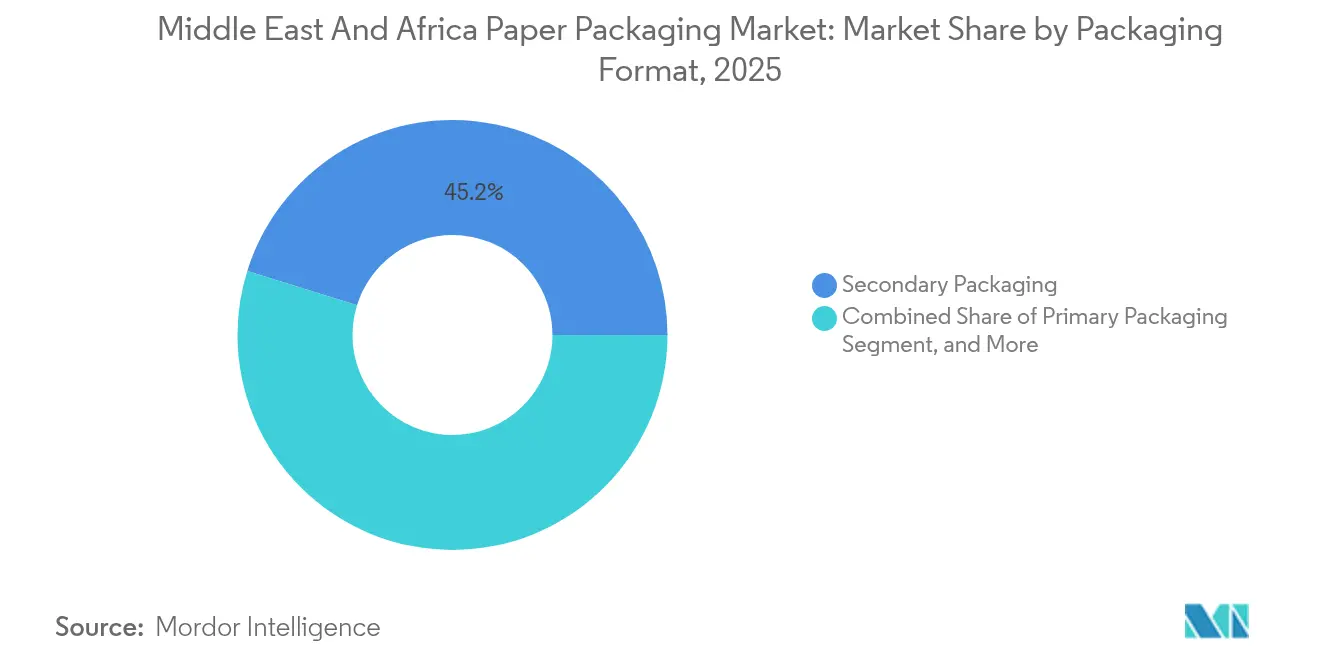
Primary Packs Rise as SKU Proliferation Shifts Shelf EconomicsSecondary packs represented 45.18% of the 2025 format share as corrugated shippers remained the distribution workhorse. Yet primary packs will rise at a 7.12% CAGR as personal-care and ready-meal brands increase the number of variants that require direct branding. The Middle East and Africa paper packaging market share for primary packs grows whenever retailers launch private labels that demand shelf differentiation and portioned formats. Tertiary pallets track overall market growth but face substitution from reusable plastic crate pools in grocery chains.
UCIC, controlling nearly 40% of Saudi corrugated, files for an IPO to fund the diversification of folding cartons, mirroring the market realignment toward consumer-facing packs. Converters with auto-platen die-cutters and gluing lines, capable of micro-flute and micro-perforation, win contracts for shelf-ready cartons. Primary formats with QR codes for authentication also support emerging anti-counterfeit policies in the pharmaceutical industry, increasing print complexity and value capture across the Middle East and Africa paper packaging market.
By End-Use Industry:
Personal Care Outpaces Food on PremiumizationFood accounted for 33.05% of 2025 demand, but personal care and cosmetics are projected to post an 8.02% CAGR to 2031, overtaking beverages and matching export-grade produce in absolute growth. Carton designs with foil stamping and tactile varnishes command higher unit prices and lower order volumes, aligning with the economics of digital presses. The Middle East and Africa paper packaging market size expansion in personal care stems from regional influencer brands launching limited SKUs that rotate quarterly.
Tetra Pak’s Egypt recycling joint venture demonstrates closed-loop interest from beverage players; however, competition from PET and aluminum restrains carton share in single-serve drinks. Industrial and electronics brands are increasingly specifying molded pulp and honeycomb inserts to meet corporate plastic reduction targets. Segment diversification highlights the versatility of fiber and entices investors to support new converting capacity in niche formats across the Middle East and Africa paper packaging market.
Geography Analysis
Saudi Arabia Paper Packaging Market
Saudi Arabia contributed 35.05% of the revenue in 2025, driven by Vision 2030 industrial policies that incentivize local containerboard production and import substitution. MEPCO’s forthcoming 450,000 metric-ton line and Arabian Paper Products’ expansion reinforce domestic supply, securing pulp imports via long-term offtakes and hedging currency swings. Industrial clusters around Jeddah offer access to feedstock through MSW collection rates exceeding 45% and port connectivity for intra-GCC exports. The Middle East and Africa paper packaging market benefits from these large-scale investments that anchor regional pricing.
United Arab Emirates Paper Packaging Market
The UAE accounts for 15-18% of regional demand and positions itself as a specialty carton hub serving the personal care and pharmaceutical sectors. Hotpack Global’s SAR 1 billion mega plant, set to be operational in 2025, bolsters its flexible packaging capability and adds 4,500 tons per month of coated paperboard extrusion. Free-zone infrastructure and zero-tariff re-export routes make Dubai an attractive consolidation point for multinational FMCG supply chains shipping into East Africa. Sustainable fiber branding resonates with hotel and airline groups pursuing zero-plastic commitments.
South Africa Paper Packaging Market
South Africa, forecast at an 7.86% CAGR, leads growth on Extended Producer Responsibility rules requiring recycled-content thresholds. Integrated majors Mondi, Mpact, Huhtamaki, Nampak, and Smurfit Kappa collectively command over 70% of the national output, enabling economies of scale in pulp integration and renewable energy retrofits. The Middle East and Africa paper packaging market size benefits from South Africa’s export-oriented citrus, wine, and forestry products, which utilize efficient rail-port corridors.
Africa Paper Packaging Market
Nigeria (8-10% share) shows rapid corrugated uptake as e-commerce scales, but power instability and forex devaluation deter heavy capital expenditure. Kenya (5-7%) capitalizes on horticulture exports and strict plastic bans, with converters installing high-speed digital presses for short-run localized labels. The rest of Africa remains underpenetrated, yet it offers white space for agile entrants able to deploy modular converting lines near seaports and leverage mobile collection technology for OCC feedstock. Multi-country operators that flex production between plants to offset currency shocks and energy costs will capture outsized gains in the Middle East and Africa paper packaging market.
Regulatory Landscape
Packaging policy across the Middle East and Africa is increasingly influenced by EPR-style requirements and plastic restrictions, which in turn pull demand toward fiber-based formats. In Kenya, Legal Notice 176 of 2024 introduced the Sustainable Waste Management (Extended Producer Responsibility) Regulations, bringing packaging materials (including paper and corrugated formats) under producer take-back and compliance-scheme obligations. In the UAE, single-use plastic restrictions tightened from January 1, 2026, covering items such as beverage cups, lids, cutlery, food containers, straws, and bags, which accelerates substitution to paper-based foodservice packaging when performance and recyclability requirements are met.
Conformity assessment and product-safety standards also shape market access and specification requirements for paper packaging. In Saudi Arabia, the Saudi Standards, Metrology and Quality Organization (SASO) Technical Regulation for Paper and Cardboard sets requirements for paper and cardboard packaging, including heavy-metal prohibitions and suitability for protective packing, and regulated packaging imports typically require SABER product certification aligned to SASO standards. In the UAE, the Ministry of Industry and Advanced Technology (MoIAT) administers conformity certificate services for regulated products, and policy activity under the Integrated Waste Management Agenda 2023-2026 includes an EPR pilot launched in July 2025 with 26 companies in Abu Dhabi and Dubai, raising expectations for traceability and post-consumer packaging outcomes.
Value Chain Analysis
The value chain starts with fiber sourcing, where many Middle East and Africa converters and mills rely on imported virgin pulp and recovered paper due to limited regional forestry resources and uneven collection systems. Integrated producers such as Mondi and Smurfit Kappa operate across paper production and converting, while regional manufacturers and converters such as INDEVCO Paper Containers and Arabian Packaging Co. L.L.C. supply FMCG, foodservice, and industrial demand using a mix of corrugated cases, cartons, and specialty formats. Feedstock risk remains structural: volatility in imported recycled-fiber pricing and Suez-linked maritime disruptions extend lead times and complicate procurement planning, pushing larger players toward captive recovery, longer-term supply agreements, and portfolio flexibility across testliner, medium, and cartonboard grades.
Midstream operations cover papermaking (containerboard and paperboard), coating and converting (printing, die-cutting, gluing, lamination/coating), and compliance testing where required by national standards and conformity systems. Downstream distribution runs through direct-to-brand contracts (food, personal care, QSR, pharma), industrial distributors, and e-commerce-focused supply chains that increasingly request short-run customization and faster replenishment cycles. Operational bottlenecks in parts of Sub-Saharan Africa, especially power and water instability, lift conversion costs and increase scrap risk, which in turn encourages resilience investments such as dual-fuel boilers and self-generation, alongside digital scheduling to protect service levels for export-linked channels such as fresh produce corridors.
Competitive Landscape
The top 10 suppliers account for an estimated 50-60% of regional revenue, indicating moderate concentration. Mondi, Smurfit WestRock, and International Paper integrate pulp through converting, offering one-stop procurement and sustainability reporting for multinational FMCG accounts. Regional champions Nampak, MEPCO, and UCIC defend turf with proximity advantages and agile line-change scheduling to serve emerging brands. Consolidation pressures mount: Smurfit WestRock targets EUR 400 million in synergies via network rationalization, and MEPCO’s fifth line shifts cost curves in the GCC toward lightweight containerboard.
Technology investments distinguish leaders: inline water-barrier coating, closed-loop wastewater, and predictive maintenance sensor arrays elevate operating margins. Digital printing on corrugated reaches 150 m per minute, letting converters offer variable SKUs without plate inventory, a decisive service edge. New entrants focus on molded pulp and mono-material pouches, segments that incumbents’ legacy assets cannot switch to economically. Sustainability credentials now rank alongside price in bid evaluations, compelling smaller converters to publish LCA data and secure FSC-certified fiber.
Specialty-chemical innovators and press OEMs dilute traditional boundaries, as Siegwerk, Solenis, and EFI partner directly with converters to embed barrier chemistries and workflow software. The Middle East and Africa paper packaging market thus evolves toward a segmented competitive schema: scale-driven corrugated giants on one side, and high-margin niche players on the other, both chasing differentiated ESG value propositions.
Middle East And Africa Paper Packaging Industry Leaders
Amcor Plc
International Paper Company
Mondi Plc
Smurfit WestRock
Tetra Laval International S.A.
- *Disclaimer: Major Players sorted in no particular order
Middle East And Africa Paper Packaging Market Companies Covered in this Report
- Amcor Plc
- International Paper Company
- Mondi Plc
- Smurfit WestRock
- Tetra Laval International S.A.
- Sonoco Products Company
- Stora Enso Oyj
- Huhtamaki Oyj
- Nippon Paper Industries Co., Ltd.
- Oji Holdings Corporation
- Metsä Board Corporation
- Georgia-Pacific LLC
- Nampak Ltd
- Indevco Group
- Al Bayader International LLC
- Rotopak LLC
- Sealed Air Corporation
- Crown Paper Mill Ltd
Read Analysis of Middle East And Africa Paper Packaging Companies

Market Opportunities and Future Outlook
Capacity additions and modernization projects across the region create room for converters that can secure recovered fiber, deliver consistent quality, and meet evolving compliance requirements. In the UAE, Star Paper Mill inaugurated a recycled containerboard plant in KEZAD with 135,000 tonnes of annual capacity, which strengthens local availability of recycled grades for corrugated and secondary packaging and supports faster lead times for FMCG and e-commerce shippers. In Algeria, General Emballage selected ANDRITZ to supply a complete PrimeLine paper production line for a greenfield mill in Naama with 350,000 tonnes of annual capacity, signaling scaled regional papermaking that can reduce reliance on imported board for North and West African converting networks.
Regulatory actions also translate into specific product opportunities, particularly in foodservice and retail where single-use plastic restrictions and EPR obligations tighten material selection and reporting needs. The UAE single-use plastics restrictions effective from January 1, 2026, and Kenya’s 2024 EPR regulations raise demand for mono-material, recyclable paper solutions, including dispersion-coated papers and fiber-based lidding and food containers, that perform under grease and moisture conditions while fitting local recycling streams. There is further demand for service-led offerings such as compliance-ready packaging specifications, documentation support for conformity systems, for example SASO/SABER-aligned requirements in Saudi Arabia, and localized digital printing for SKU proliferation in personal care and QSR, where converters can differentiate through speed-to-market and traceability rather than only price per ton.
Recent Industry Developments in Middle East And Africa Paper Packaging Market
- July 2026: Smurfit WestRock announced a partnership with Coca-Cola focused on World Cup packaging. The initiative highlights how multinational brand campaigns can pull through higher volumes of paper-based secondary and promotional packaging and reward suppliers with scalable converting networks.
- April 2026: Mediterrania Capital Partners signed a share purchase agreement to acquire 100% of Société Marocaine des Manufactures de Mohammedia (the holding company of Amcor Flexibles Mohammedia) from Amcor Group. The transaction reflects portfolio realignment in regional packaging assets and can reshape competitive positioning and investment priorities in Morocco-linked supply chains.
- September 2025: GPC Papier et Carton (Ynna Holding) announced a MAD 500 million modernization investment at its Mohammedia plant, including plans to raise capacity from 90,000 tons to 160,000 tons by 2030 and install a Kento Hybrid digital printing machine. The upgrade targets higher-spec corrugated and printed packaging demand and supports faster, more customized runs for consumer goods customers.


Middle East And Africa Paper Packaging Market Report Scope and Research Methodology
Market Definition and Coverage
This market covers paper-based packaging used to pack, protect, and transport goods across the Middle East and Africa. The market value is counted as the sales of paper packaging products delivered to end users across the region.
Scope exclusions: We exclude non-paper packaging materials (such as plastics, metal, and glass) and paper products that are not used as packaging.
Segments Covered in This Report
- By Material Type
- Kraft Paper
- Paperboard
- Corrugated Board
- Other Material Types
- By Product Type
- Flexible Paper Packaging
- Rigid Paper Packaging
- By Packaging Format
- Primary Packaging
- Secondary Packaging
- Tertiary / Transit Packaging
- By End-Use Industry
- Food
- Beverage
- Healthcare and Pharmaceuticals
- Personal Care and Cosmetics
- Industrial and Electronic
- Other End-Use Industries
- By Middle East and Africa
- By Middle East
- Saudi Arabia
- United Arab Emirates
- Rest of Middle East
- By Africa
- South Africa
- Nigeria
- Kenya
- Rest of Africa
- By Middle East
Data Sources, Market Sizing, and Validation
Desk Research
Desk research was used to set the regional context and to build an initial set of demand and supply signals for paper packaging across the Middle East and Africa. We referred to public sources such as UN Comtrade for paper and paperboard trade flows, World Bank and IMF indicators for macro demand trends, FAOSTAT for food production signals, and UNIDO industrial statistics for manufacturing activity proxies.
To make these signals usable for market sizing, the data was converted into inputs such as import reliance by country, exposure to packaged food and beverage demand, and broad production intensity. Company annual reports, investor presentations, and reputable press were also reviewed to understand capacity additions, product mix shifts, and pricing commentary. In addition, a paid subscription for shipment-level trade data and a patent database were used selectively to cross-check flows and spot material or process innovation signals. The sources mentioned above are illustrative only, and many other public and paid references were also used for data collection, validation, and research clarification.
Primary Interviews and Surveys
The primary work focused on validating the split across key paper packaging materials and formats, and pressure testing pricing and conversion spreads across major MEA markets. We spoke with participants from converters, paper and board suppliers, distributors, and large packaging buyers in food, beverage, and healthcare, covering the Middle East and Africa sub-regions so the assumptions reflect local realities, including import dependency and currency impacts.
Distribution of primary research fieldwork respondents
| Company type | Respondent position |
|---|---|
| Top tier: 31% | CXOs: 19% |
| Mid tier: 47% | Functional/Unit leaders: 24% |
| Smaller Players: 22% | Managers: 57% |
Market-Sizing & Forecasting
The sizing starts with a top-down build where packaging demand is reconstructed from country-level consumption and production indicators, and then allocated to paper packaging using adoption patterns by end use. In practice, we used signals like packaged food and beverage output, pharma and personal care manufacturing indicators, paper and paperboard import trends, and conversion activity cues in major hubs to arrive at a country-wise demand pool.
Those totals were then corroborated with selective bottom-up checks, such as sampling price ranges by format and material, applying typical weight and yield logic for paperboard and corrugated applications, and conducting channel checks on key user industries so volumes and value progress in a realistic way. When company disclosures were uneven across the region, gaps were handled through peer benchmarks within similar markets, followed by adjustments after interview feedback.
For forecasting, scenario analysis was used so growth can reflect different outcomes for plastic substitution policies, export-oriented manufacturing, and inflation-driven price movements. The final view was aligned to the most common expert expectations captured during interviews. Key variables tracked through the forecast include paper and board pricing direction, import dependence changes, packaged food growth, e-commerce shipment activity, and capacity additions for converting and paper production.
Data Validation & Update Cycle
Validation was done through multiple checks so outputs stay consistent with real-world signals. We compared the model results against independent indicators like trade direction, reported capacity changes, and end-use activity trends, and then reviewed any sharp swings by country or material to confirm they were explainable.
Before sign-off, the numbers go through step-by-step internal review, and follow-up outreach is triggered when interview inputs conflict with desk signals or when pricing and mix assumptions show unusual variance. Reports are refreshed each year, and interim updates are made when a material event occurs, such as a major capacity expansion, policy shift, or demand shock. Right before delivery, a final analyst pass is completed so clients receive the latest view available.
Mordor Intelligence's Middle East and Africa Paper Packaging Market Estimate Compared With Other Published Estimates
Published market sizes for MEA paper packaging do not always match because the underlying scope and pricing logic is not consistent across sources, and the reporting year can also differ. Differences tend to come from what share of the packaging value chain is counted, how grades and formats are grouped, and how currency timing is handled for countries with volatile exchange rates.
Some estimates appear to use a broader umbrella that can blend adjacent paper and paperboard activity beyond packaging, or they lean heavily on grade-level splits without tying them back to end-use demand signals. A narrower count is applied in Mordor Intelligence, where value is included only when it is tied to packaging formats and end uses across MEA, and it is reconciled against trade and conversion cues so non-packaging paper is not pulled into the total.
Benchmark comparison
| Source | Market Size | Gaps in Research Methodology |
|---|---|---|
| Mordor Intelligence | USD 25.42 B (2025) | |
| Global Consultancy A | USD 30.54 B (2025) | Often presented as grade-based revenue (virgin vs recycled) with limited clarity on packaging-format cutoffs, which can lift the total if non-packaging paperboard uses are captured indirectly. |
| Trade Publisher B | USD 28.63 B (2025) | Regional values are sometimes derived from global totals using broad allocation factors, and local country-level checks on imports, conversion activity, and pricing timing can be lighter, which shifts the MEA value. |
The spread in the table mainly comes from what gets counted as packaging and how the MEA number is built up from country signals. By keeping the scope tied to packaging formats and then checking it against demand indicators and trade-linked reality checks, the final estimate stays easier to trace and repeat when assumptions are refreshed.


Key Questions Answered in the Report
What is the forecast value of the Middle East and Africa paper packaging market by 2031?
The market is projected to reach USD 35.13 billion by 2031 based on current growth trajectories.
Which material type is expected to grow fastest through 2031?
Paperboard is forecast to expand at a 7.32% CAGR as quick-service restaurants and personal-care brands adopt lightweight folding cartons.
Why is South Africa the fastest-growing country in regional paper packaging?
Extended Producer Responsibility regulations and rising export-grade corrugated demand push South Africa’s market to an 7.86% CAGR.
How are power outages affecting converters in Sub-Saharan Africa?
Unreliable grids force investment in diesel or hybrid power systems, adding up to 18% to energy costs and impacting production stability.
Which end-use sector is outpacing food in packaging demand growth?
Personal care and cosmetics will grow at an 8.02% CAGR as premiumization and localized brand launches multiply carton SKUs.
What strategic moves are large companies making to secure feedstock?
Integrated producers are locking in long-term pulp contracts, investing in recycling plants, and expanding containerboard lines to stabilize raw-material supply.
Page last updated on:


 Your data is secure and never sold or shared.


