
Market Overview
| Study Period | 2020 - 2031 |
|---|---|
| Forecast Data Period | 2026 - 2031 |
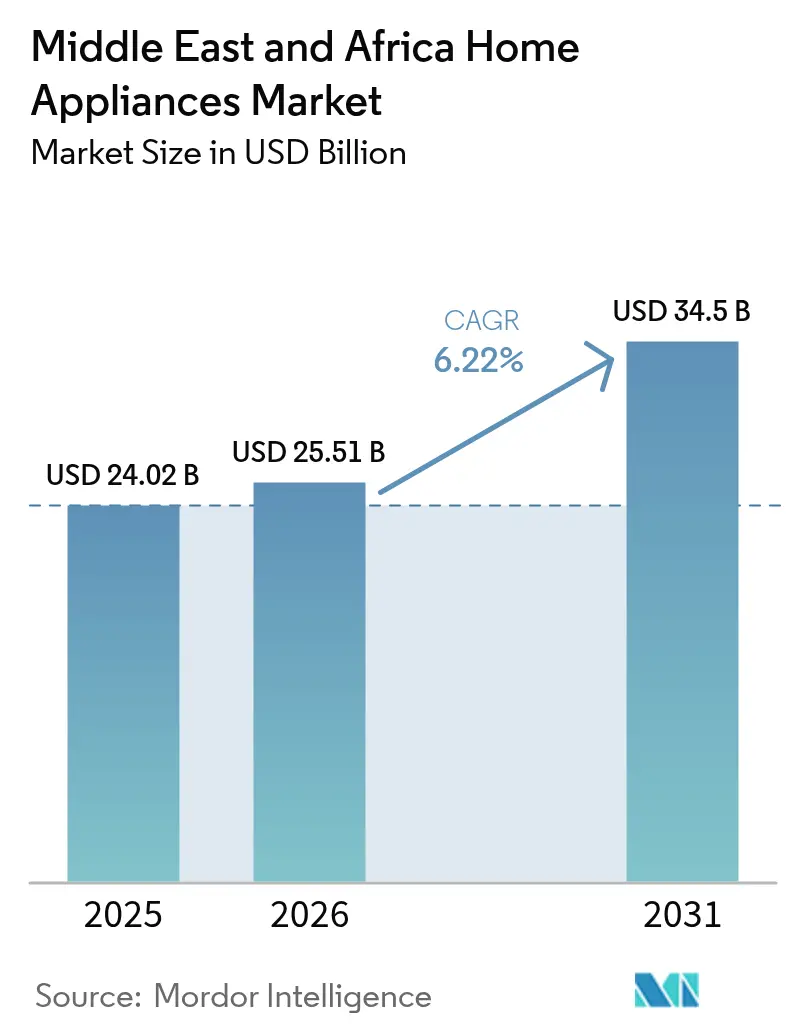
| Base Year Market Size (2025) | USD 24.02 Billion |
| Market Size (2026) | USD 25.51 Billion |
| Market Size (2031) | USD 34.5 Billion |
| Growth Rate (2026 - 2031) | 6.22 % |
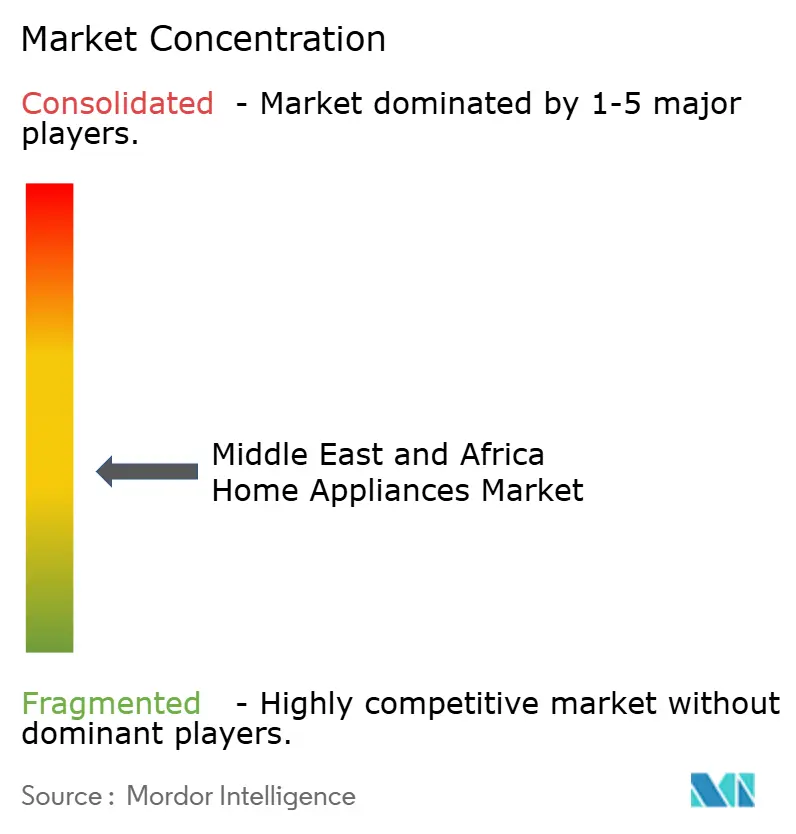
| Market Concentration | Medium |
Major Players *Disclaimer: Major Players sorted in no particular order Image © Mordor Intelligence. Reuse requires attribution under CC BY 4.0. | |
Middle East And Africa Home Appliances Market Analysis by Mordor Intelligence
Middle East and Africa home appliances market size in 2026 is estimated at USD 25.51 billion, growing from 2025 value of USD 24.02 billion with 2031 projections showing USD 34.5 billion, growing at 6.22% CAGR over 2026-2031. This market size trajectory rests on rapid urban migration, state-sponsored electrification projects, and widening e-commerce access that combine to create both first-time purchases and quicker upgrade cycles. Premium demand in Gulf Cooperation Council (GCC) states co-exists with value-driven growth in sub-Saharan Africa, giving the Middle East and Africa home appliances market a dual-speed profile that rewards smart-home innovators and cost-efficient producers. Energy-efficiency regulations across GCC states and South Africa accelerate replacements, while off-grid solar solutions open rural revenue streams where the grid lags. Currency swings, import duties, and water scarcity moderate growth but prompt global brands to invest in regional assembly and resource-efficient design.
Key Report Takeaways
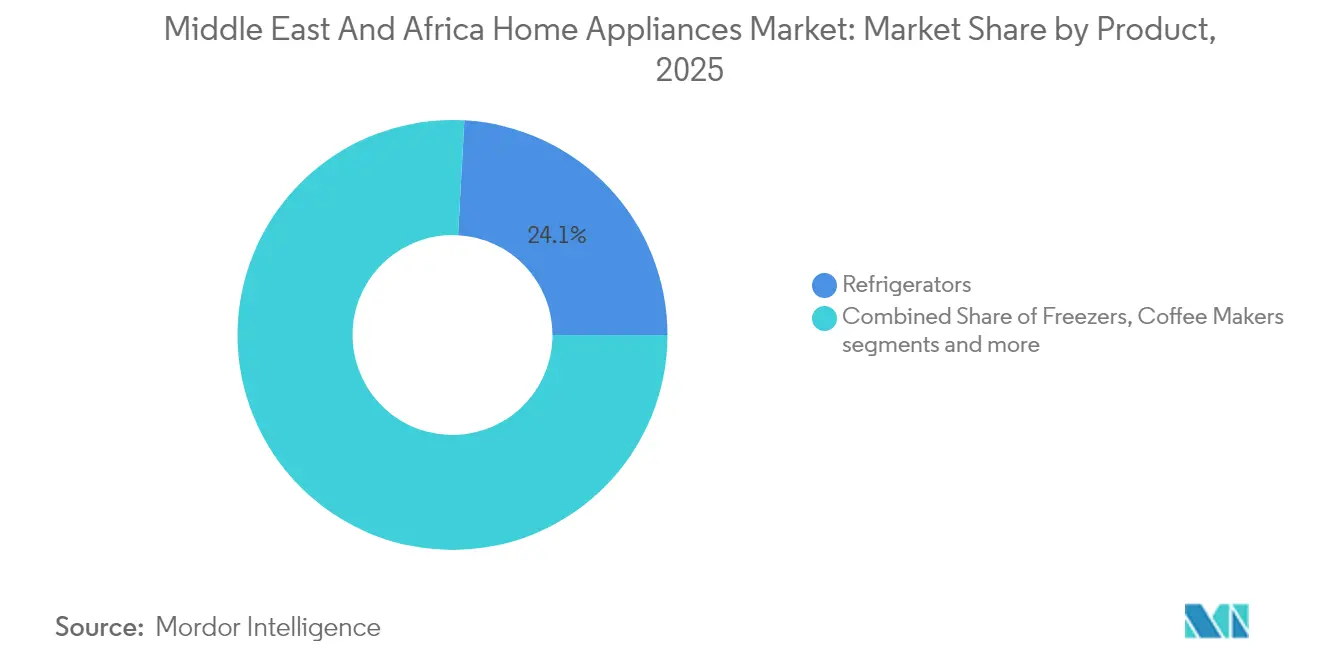
- By product category, refrigerators led with 24.12% revenue share of the Middle East and Africa home appliances market in 2025, while air fryers are forecast to expand at a 7.02% CAGR to 2031.
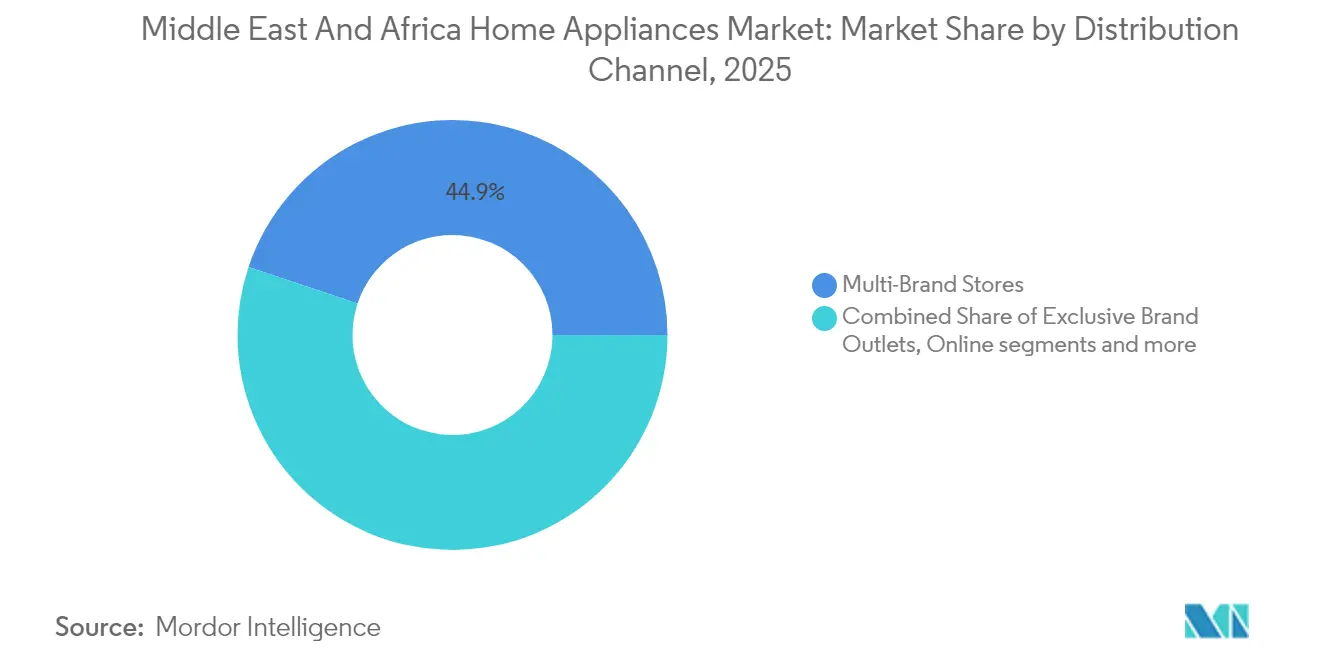
- By distribution channel, multi-brand stores accounted for 44.88% of the Middle East and Africa home appliances market size in 2025, and online channels are advancing at a 7.28% CAGR through 2031.
- By geography, Saudi Arabia led with a 14.35% share of the Middle East and Africa home appliances market in 2025, and Nigeria recorded the highest projected CAGR at 6.67% through 2031.
Note: Market size and forecast figures in this report are generated using Mordor Intelligence’s proprietary estimation framework, updated with the latest available data and insights as of 2026.
Market Trends and Insights
Drivers Impact Analysis of Middle East And Africa Home Appliances Market*
| Driver | (~) % Impact on CAGR Forecast | Geographic Relevance | Impact Timeline |
|---|---|---|---|
| Rising urbanization & disposable income | +1.8% | Nigeria, South Africa, and Saudi Arabia urban centers | Medium term (2-4 years) |
| Government electrification programs | +1.2% | Sub-Saharan Africa, rural Saudi Arabia | Long term (≥4 years) |
| Growing e-commerce penetration | +1.0% | UAE, Saudi Arabia, Nigeria's major cities | Short term (≤2 years) |
| Energy-efficiency regulations spurring replacements | +0.9% | GCC states, South Africa | Medium term (2-4 years) |
| Off-grid solar-powered appliances uptake | +0.6% | Rural Africa, Kenya, Ghana | Long term (≥4 years) |
| High-end smart-home adoption in Gulf states | +0.5% | UAE, Qatar, Saudi Arabia | Short term (≤2 years) |
| Source: Mordor Intelligence | |||
Rising Urbanization & Disposable Income
Accelerating urban migration strengthens demand nodes because city residents favor branded appliances that promise reliability and warranty coverage[1]. Wage growth in Riyadh, Jeddah, and Dubai feeds premium uptake, while burgeoning middle-class households in Lagos and Johannesburg focus on entry-to-mid tiers that blend functionality with affordability. Apartment living drives interest in space-saving washer-dryer combos, air fryers, and robotic vacuums. Higher residential density also lowers last-mile logistics costs, encouraging retailers to offer same-day delivery on large items. Manufacturers that provide micro-financing or buy-now-pay-later plans extend reach to credit-thin consumers, making urbanization a structural tailwind for the Middle East and Africa home appliances market.
Government Electrification Programs
Grid-extension schemes in Kenya, Ghana, and Nigeria collectively connect millions of rural homes each year, creating new first-time buyers for refrigerators and fans. Public incentives often package appliance discounts with energy-efficient bulbs, moving households immediately toward compliant products. Saudi Arabia’s air-conditioner replacement plan, which refunds up to SAR 1,000 per compliant unit, shows how government support can move volumes in months[2]. Electrification also attracts component suppliers, because reliable power reduces operational risk for local assembly. For the Middle East and Africa home appliances market, each electrified village represents demand that compounds as income rises.
Growing E-Commerce Penetration
The increasing adoption of smartphones and advancements in warehousing infrastructure have significantly boosted online conversion rates, even for bulky goods. Leading e-commerce platforms in Nigeria now offer two-day shipping for select refrigerators, enhancing accessibility in rural regions. These platforms provide detailed product information, enabling smaller manufacturers to compete effectively by showcasing energy efficiency and smart-home features alongside global brands. Shopper analytics are leveraged to design targeted advertisements, reducing customer acquisition costs and improving marketing efficiency. Hybrid purchasing behaviors are gaining momentum, as consumers research products online, verify dimensions in physical stores, and complete transactions through mobile apps that integrate delivery and installation services. This shift underscores the growing importance of omnichannel strategies in the market. The combination of improved logistics, data-driven marketing, and hybrid shopping models is reshaping the competitive landscape for bulky goods in Nigeria.
Energy-Efficiency Regulations Spurring Replacements
Ghana enacted 19 appliance efficiency standards in late 2023, joining the UAE and Saudi Arabia in banning low-efficiency imports[3]. Labels that translate kilowatt-hours into monthly cost comparisons nudge buyers toward inverter technology and eco modes. Utilities in South Africa offer top-up rebates, shortening payback periods for efficient washers that cut electricity and water consumption simultaneously. Compliance requirements favor incumbents with global R&D because they certify new models quickly. As replacements accelerate, the Middle East and Africa home appliances market gains incremental volume without waiting for population growth.
Restraints Impact Analysis of Middle East And Africa Home Appliances Market*
| Restraint | (~) % Impact on CAGR Forecast | Geographic Relevance | Impact Timeline |
|---|---|---|---|
| High import duties & tariffs | -1.1% | Nigeria, South Africa, Kenya | Short term (≤2 years) |
| Currency volatility in key African markets | -0.8% | Nigeria, Ghana, Kenya, Mozambique | Short term (≤2 years) |
| GCC water scarcity limiting washer demand | -0.4% | UAE, Saudi Arabia, Qatar | Medium term (2-4 years) |
| Vibrant second-hand appliance market | -0.3% | Nigeria, Ghana, Kenya, South Africa | Long term (≥4 years) |
| Source: Mordor Intelligence | |||
High Import Duties & Tariffs
Nigeria's tariff structure increases the landed costs of washers by up to 30%, reducing affordability and driving consumers toward refurbished products. To mitigate these costs, major manufacturers adopt semi-knocked-down kits, which qualify for lower duties but require investments in tooling, local labor, and skills development. Tariff volatility poses a significant challenge for quarterly forecasting, as shipments ordered under one tariff regime may arrive after rates have changed. This unpredictability disproportionately impacts smaller brands, which struggle to hedge against such risks. In contrast, larger multinational companies leverage their resources to gain a competitive advantage. However, these dynamics contribute to higher consumer prices across the Middle East and Africa home appliances market. The interplay of tariffs, supply chain adjustments, and market competition continues to shape the region's pricing landscape.
Currency Volatility in Key African Markets
The naira's successive devaluations have introduced significant volatility in retail prices, discouraging discretionary spending on appliances such as refrigerators and washers. Retailers are adopting strategies like dollar-indexed pricing or reducing inventory cycles to manage exposure, though these measures increase operating costs. Importers relying on foreign currency letters of credit face liquidity pressures, often resulting in shipment delays. Efforts by brands to localize production, such as manufacturing plastic parts and metal cabinets domestically, have been constrained by the continued reliance on imported compressors and electronics for key components. These currency fluctuations have hindered the adoption of premium models, shifting consumer demand toward lower-spec alternatives. The overall market dynamics reflect a challenging environment for both retailers and manufacturers, driven by currency instability and rising costs. Consequently, the focus remains on cost management and adapting to shifting consumer preferences.
*Our forecasts treat driver/restraint impacts as directional, not additive. The impact forecasts reflect baseline growth, mix effects, and variable interactions.
Middle East And Africa Home Appliances Market Segment Analysis
By Product:
Major Appliances Drive Volume, Small Appliances Capture GrowthRefrigerators held a 24.12% share of the Middle East and Africa home appliances market in 2025, reflecting their status as a durable necessity in hot climates. By contrast, air fryers led growth with a 7.02% CAGR, underscoring lifestyle shifts toward quick, oil-light cooking. Major appliances remain the revenue anchor because electrification and urban housing programs expand addressable households. Regulations that phase out inefficient compressors encourage repeat sales and lift the Middle East and Africa home appliances market size through premium tiers. Small appliances benefit from shorter innovation cycles; new coffee-grinder variants or multi-purpose blenders spark habitual upgrades. Chinese newcomers leverage global supply chains to introduce affordable smart-enabled models, raising competitive stakes.
Urban kitchens drive demand for compact microwave-oven combos and collapsible food processors. In GCC states, built-in appliances gain favor because luxury villas integrate open-plan kitchens. African buyers prioritize robustness and aftermarket parts availability when selecting major appliances, especially in countries where voltage fluctuations are common. Cross-selling strategies bundle kettles or toasters with refrigerator purchases, elevating basket value. Air conditioners and washers face divergent water-resource realities: high penetration in humid West Africa versus cautious adoption in arid Gulf cities. Energy labels stimulate competition around kWh savings, and marketing now frames purchase decisions around lifetime operating cost rather than upfront price.

By Distribution Channel:
Multi-Brand Dominance Faces Digital DisruptionMulti-brand retailers captured 44.88% of 2025 sales because shoppers rely on side-by-side comparisons and in-store demonstrations. Trained salespeople explain inverter technology, warranty terms, and financing options, sustaining trust with first-time buyers. Stores embed QR codes that link to virtual catalogs, extending shelf space without physical inventory. Yet the online channel posts a 7.28% CAGR, driven by improved courier networks and mobile wallets that lower payment friction. Cross-border e-commerce allows Gulf expatriates to ship gifts directly to African relatives, injecting incremental demand into the Middle East and Africa home appliances market.
Manufacturers now enforce price parity across outlets to deter grey imports. Exclusive brand boutiques showcase flagship refrigerators with AI temperature controls, creating experiential touchpoints that justify premium mark-ups. Hypermarkets still move large volumes of basic kettles and irons during monthly promotions. In Nigeria, where traditional trade remains 70% of retail, distributors deploy mobile vans as rolling showrooms for peri-urban areas. Consumer-to-consumer marketplaces facilitate resale, extending product life cycles but also cannibalizing new sales. Successful channel strategies synchronize inventory feeds, so online shoppers' views align with real-time store availability, boosting click-and-collect transactions.
Geography Analysis
Saudi Arabia and United Arab Emirates Home Appliances Market
Saudi Arabia leads the Middle East and Africa home appliances market with a 14.35% share, buoyed by Vision 2030 construction projects and generous consumer lending. Appliance importers benefit from predictable customs regimes and well-regulated after-sales networks. Sustainability mandates prompt households to replace old window air conditioners with inverter split units that save energy and qualify for rebates. UAE remains the region’s design trendsetter, as Dubai’s free-zone logistics shorten lead times and duty-free re-exports. Its multicultural consumer base embraces global brands and demands connected features that integrate with Arabic-language voice assistants.
Nigeria and South Africa Home Appliances Market
Nigeria records the fastest growth at 6.67% CAGR because its urban population expands by over 4 million people annually. The market’s fragmentation forces producers to segment offerings finely by state, income, and cultural cooking preferences. Currency risks deter premium expansion, yet local assembly projects counterbalance, positioning Nigeria as both a sales hub and a potential export base to neighboring ECOWAS states. South Africa contributes scale through nationwide retail chains, reliable credit bureaus, and repair-technician networks that accommodate extended warranties. Buyers protect budgets through holiday sales, but brand loyalty is strong when service is dependable.
Broader MEA Markets
Rest-of-Middle East and Africa markets vary widely. Kenya and Ghana leverage last-mile motorcycle couriers to distribute small appliances to rural households, while Egypt’s cluster of component factories anchors North African supply chains. Morocco integrates European efficiency norms quickly, giving EU-based appliance makers a staging ground. Qatar and Kuwait, though smaller, add premium volume via hospitality projects tied to the 2030 Asian Games and other mega events. Across this diversity, the Middle East and Africa home appliances market rewards manufacturers that calibrate feature sets—such as dual-voltage transformers or Arabic recipe libraries—by micro-region.
Regulatory Landscape
Energy efficiency and safety compliance requirements are tightening across the Middle East and Africa, increasing the role of pre-market conformity assessment, labeling, and country-specific approvals for major appliances and cooling products. In the GCC, the Gulf Standardization Organization (GSO) technical regulation for low-voltage electrical equipment and appliances provides a common baseline, while Saudi Arabia applies SASO programs including mandatory IECEE certification for electrotechnical products and SASO-issued energy efficiency requirements and labeling for regulated categories such as air conditioners, refrigerators, and washing machines.
Policy updates in 2025-2026 reinforce replacement cycles and raise compliance workloads for importers and local assemblers. The UAE Ministry of Industry and Advanced Technology (MoIAT) updated national conformity marks and efficiency labels in April 2025, and it continued tightening product control through regulated conformity and performance efficiency card processes. MoIAT also announced enforcement dates for new air conditioner energy efficiency standards in June 2026. In Nigeria, the Standards Organisation of Nigeria (SON) issued version 1.1 of its Mandatory Energy Labeling Scheme (SONMELS) guidelines in May 2026, adding another large market where labeling readiness and test documentation shape route-to-market for appliance brands and distributors.
Value Chain Analysis
The value chain in the Middle East and Africa home appliances market runs from component sourcing (compressors, motors, PCBs, displays) to finished-goods manufacturing or assembly, importation and customs clearance, and regional warehousing and re-export hubs. From there, distribution occurs through multi-brand retailers and e-commerce platforms, with after-sales service networks helping drive brand trust and repeat purchases. Imports still account for a large share of appliance supply in many markets, so procurement and inbound logistics affect availability and pricing, particularly for long-lead-time inputs such as compressors, display panels, and semiconductor components that can extend replenishment cycles.
Localization is expanding via contract manufacturing, semi-knocked-down assembly, and new plants in North Africa that serve both domestic demand and nearby export corridors. Egypt has strengthened its role as a manufacturing node, supported by BSH inaugurating its first African production facility in 10th of Ramadan City in June 2025 with a EUR 55 million investment and capacity of over 350,000 gas ovens annually. On the distribution side, UAE logistics infrastructure supports regional consolidation and re-exports, with Jebel Ali acting as a key hub backed by major Gulf ports. In parts of Sub-Saharan Africa, fragmented last-mile delivery and installation capability keeps retailers, installers, and service partners central to the go-to-market model for bulky appliances.
Competitive Landscape
The Middle East and Africa home appliances market demonstrates moderate concentration, with a few key players dominating the market. Samsung and LG maintain a stronghold in the premium segment by offering innovative features such as embedded cameras in refrigerators and seamless integration with their SmartThings and ThinQ ecosystems, enabling advanced remote diagnostics. Hisense and Midea capitalize on strategic manufacturing operations in Egypt and Ethiopia, which help mitigate tariff challenges and facilitate quicker product launches. Dreametech's planned entry into the major appliances category reflects a strategic shift among vacuum-focused brands, aiming to diversify their offerings and capture a larger share of consumer spending across the home appliances market.
Regional assemblers in Egypt, Kenya, and South Africa leverage duty shelters to produce refrigerator cabinets and washer drums locally, then import compressors and control boards. Such hybrids shorten lead times and enable mass customization, including Arabic interface panels and voltage stabilizers. Competitive strategy increasingly centers on sustainability claims such as R600a refrigerators and water-recycling washer cycles. Brands invest in customer-experience platforms that schedule service within 48 hours, trying to satisfy directly to repeat sales. Digital trade-in portals accept old appliances for recycling, a tactic that secures raw materials and reinforces green branding.
Strategic alliances dominate 2025 headlines. Hisense partners with Jumbo Electronics unlock GCC omnichannel reach, while Whirlpool aligns with regional developers to supply built-ins for new housing. Tuya Smart embeds its IoT modules in local OEM lines, ensuring smaller players offer smart-home compatibility. Price competition, while present, is moderated by import duties that limit the volume of ultra-low-cost entrants. Warranty duration, energy label ratings, and connectivity features thus emerge as decisive purchase criteria in the Middle East and Africa home appliances market.
Middle East And Africa Home Appliances Industry Leaders
-
Samsung Electronics
-
Whirlpool Corporation
-
Haier Smart Home (incl. Hisense)
-
BSH Hausgeräte
-
LG Electronics
- *Disclaimer: Major Players sorted in no particular order
Middle East And Africa Home Appliances Market Companies Covered in this Report
- Samsung Electronics
- LG Electronics
- Whirlpool Corporation
- Haier Smart Home
- BSH Hausgeräte (Bosch-Siemens)
- Electrolux AB
- Midea Group
- Hisense International
- Arçelik A.Ş. (Beko, Defy)
- Panasonic Corporation
- TCL Technology
- Gree Electric Appliances
- Nikai Group
- Al-Futtaim (Aftron)
- Sharp Corporation
- Kenwood Limited
- Philips Domestic Appliances
- Russell Hobbs
- Xiaomi Corporation
- Ramtons Appliances
Read Analysis of Middle East And Africa Home Appliances Companies
Market Opportunities and Future Outlook
Regulatory harmonization around minimum energy performance standards (MEPS) is creating a clearer compliance runway for cross-border portfolios. That, in turn, supports standardized energy-efficient cooling and refrigeration lines across multiple countries with fewer specification changes. SADC approved harmonized regional MEPS for cooling products in February 2024 for circulation to 16 member states, and the East African Community gazetted regionally harmonised MEPS for room air conditioners and residential refrigerators in July 2025. In the Gulf, the UAE moved refrigerator efficiency requirements forward through UAE.S 5010-3:2024 under MoIAT, while 2026 enforcement actions around air conditioner efficiency standards (UAE) and updated SASO energy efficiency standards (Saudi Arabia, with a confirmed mandatory enforcement date of December 1, 2026, for SASO-2663:2025 and SASO-2874:2025) support opportunities tied to compliant inverter platforms, efficient compressors, and better-insulated product designs.
Manufacturing and export-hub buildout in Egypt stands out as a practical whitespace lever for brands managing tariffs, currency risk, and lead times, while also enabling faster localization of user interfaces, voltage protection, and climate-adapted cooling. Beko inaugurated an industrial park and export hub in Egypt in September 2024 with a USD 110 million investment and 1.5 million units of annual capacity across categories including ovens and refrigerators, and BSH added local output in June 2025. Additional investment plans also point to deeper supplier development and contract-manufacturing pathways, including Unionaire announcing an EGP 6 billion factory designed for startup in 2026 and El Araby Group announcing a USD 480 million five-year expansion plan in March 2026 targeting higher local content. Together, these moves can broaden mid-tier availability across the Middle East and Africa while keeping compliance testing, labeling, and after-sales readiness integrated into regional go-to-market execution.
Recent Industry Developments in Middle East And Africa Home Appliances Market
- June 2026: Samsung outlined plans to accelerate home appliance sales in the Middle East, linking its push to major regional buildouts and HVAC-related demand from large development programs. The announcement reinforces vendor focus on project-led channels alongside retail, where specifications, installation readiness, and service networks can decide contract outcomes for cooling and major appliances.
- June 2025: BSH inaugurated its first African production facility in 10th of Ramadan City, Egypt, with EUR 55 million investment and capacity over 350,000 gas ovens annually. This expansion strengthens regional manufacturing capacity and supports local content goals.
- September 2024: Beko inaugurated an industrial park and export hub in Egypt with USD 110 million investment and 1.5 million units of annual capacity across ovens and refrigerators. This adds dedicated capacity for local output and regional distribution.
Middle East And Africa Home Appliances Market Report Scope and Research Methodology
Market Definition and Coverage
For this study, the market includes revenue generated from sales of home appliances used in households across the Middle East and Africa, covering both large appliances and small countertop or portable appliances.
Scope exclusions: Excludes installation services, extended warranties, and standalone spare parts that are sold separately from new appliance units.
Segments Covered in This Report
- By Product
- Major Home Appliances
- Refrigerators
- Freezers
- Washing Machines
- Dishwashers
- Ovens (Incl. Combi & Microwave)
- Air Conditioners
- Other Major Home Appliances
- Small Home Appliances
- Coffee Makers
- Food Processors
- Grills & Roasters
- Electric Kettles
- Juicers & Blenders
- Air Fryers
- Vacuum Cleaners
- Electric Rice Cookers
- Toasters
- Countertop Ovens
- Other Small Home Appliances
- Major Home Appliances
- By Distribution Channel
- Multi-Brand Stores
- Exclusive Brand Outlets
- Online
- Other Distribution Channels
- By Geography
- United Arab Emirates
- Saudi Arabia
- South Africa
- Nigeria
- Rest of Middle East And Africa
Data Sources, Market Sizing, and Validation
Desk Research
Desk work was used to set the basic demand and supply picture for appliances across MEA, and to ensure the model follows real world signals like housing activity and trade flows. We referenced public sources such as UN Comtrade for appliance trade, World Bank indicators for income and urbanization, IMF macro series for inflation and FX trends, and IEA energy access and electrification context that impacts usage.
To refine assumptions, we also reviewed government statistics and customs releases where available, selected central bank publications for currency and consumer credit direction, and trade association and standards bodies for efficiency labeling and product rules. Company annual reports and investor decks were used to understand pricing moves and channel shifts, and paid subscriptions for company financials and shipment level trade intelligence were used selectively to sanity check volumes and value mixes. The sources listed here are illustrative only, and many other public and paid references were used for data collection, validation, and clarification during the work.
Primary Interviews and Surveys
Primary interviews and surveys were used to validate what desk signals cannot fully explain, especially country level price ladders, channel splits, and informal retail effects. We spoke with a mix of manufacturers, distributors, large format retailers, e-commerce focused sellers, and service partners across key MEA demand centers, and we re-contacted stakeholders when outliers appeared in pricing or penetration assumptions.
Distribution of primary research fieldwork respondents
| Company type | Respondent position |
|---|---|
| Top tier: 31% | CXOs: 16% |
| Mid tier: 53% | Functional/Unit leaders: 35% |
| Smaller Players: 16% | Managers: 49% |
Market-Sizing & Forecasting
Sizing starts from a top-down build where household formation, electrification progress, and replacement cycles are combined to reconstruct a realistic demand pool by country and appliance group. Once the demand pool is formed, it is converted into value using observed price bands by channel, and then rolled up to the MEA total.
To keep the outputs grounded, bottom-up approximations were also used as cross-checks, mainly through selective supplier and distributor roll-ups, sampled average selling price (ASP) checks, and import value plus local production context where that signal is meaningful. Inputs that matter most in this market include housing completions and urban population growth, split of online versus store-based sales, air conditioner seasonality and heat-wave driven spikes, efficiency regulation push that changes the mix toward inverter and higher rated products, and FX and inflation effects that shift ticket sizes even when unit demand is steady.
Forecasts were run using scenario analysis supported by a light multivariate regression on macro drivers such as real income trends, urbanization, and consumer price inflation, and then the trajectories were adjusted using expert expectations gathered during interviews. When country data gaps appeared, proxy indicators such as trade intensity, retail expansion signals, and appliance penetration levels from similar markets were used, and the adjustments were documented so the steps stay repeatable.
Data Validation & Update Cycle
Model outputs are checked against independent signals such as import and export trends, channel expansion news, and visible price movements, and then variances are reviewed before sign-off. When a country or category shows a jump that cannot be explained by the tracked drivers, we revisit assumptions, re-check desk sources, and in some cases re-contact primary respondents to confirm what changed.
A multi-step review is followed where the build is peer-checked, the logic is tested for unit and value consistency, and the final market totals are validated to ensure category rollups match the regional sum. Reports are refreshed annually, with interim updates triggered by material events such as sharp currency moves, policy changes on efficiency and labeling, or large supply disruptions. Before delivery, a fresh analyst pass is completed so clients receive the latest updated view.
Mordor Intelligence's Middle East and Africa Home Appliances Market Estimate Compared With Other Published Estimates
Published estimates for MEA home appliances can look far apart, even when they point in the same growth direction, because the counted products, timing, and currency handling are not always aligned. We find that the biggest differences usually come from what is treated as an appliance sale versus an adjacent revenue stream, and from whether the estimate is built from demand signals or from broad revenue ratios.
Extended warranties and installation revenue sit outside Mordor Intelligence's scope, and that single exclusion can lift or lower totals in markets where bundled selling is common and retailer attach rates are high. Gaps also show up when some sources anchor to 2024 values but assume a different inflation and FX path into later years, or when they keep major and small appliances in one pool without stress-testing how the price mix changes with energy-efficiency upgrades and e-commerce discounting.
Benchmark comparison
| Source | Market Size | Gaps in Research Methodology |
|---|---|---|
| Mordor Intelligence | USD 24.02 B (2025) | |
| Global Consultancy A | USD 24.23 B (2024) | Uses a 2024 base with a major vs small split but provides limited clarity on country roll-up logic and FX timing, which can shift the MEA total when high-inflation markets are translated to USD. |
| Market Repository B | USD 34.63 B (2024) | Often reflects a wider household spending bucket that can fold in related services or broader consumer categories, and the longer forecast window can lead to different inflation and pricing assumptions being embedded in the stated base value. |
The spread in the table is mainly explained by scope add-ons and by how USD conversion and price progression are treated across MEA countries. By keeping the count tied to appliance product sales and then cross-checking the total with trade, pricing, and channel signals, the estimate is easier to trace back to clear drivers and repeatable steps.
Key Questions Answered in the Report
What is the projected value of the Middle East and Africa home appliances market by 2031?
The market is expected to reach USD 34.5 billion by 2031, reflecting a 6.22% CAGR.
Which product currently dominates sales in the region?
Refrigerators hold the largest share at 24.12% as of 2025.
Which country is expanding fastest in appliance demand?
Nigeria posts the highest forecast CAGR at 6.67% because of rapid urbanization and a growing middle class.
How are efficiency rules influencing buying behavior?
Mandatory standards in GCC and selected African states push consumers toward inverter air conditioners and energy-rated refrigerators, shortening replacement cycles.
Which channel is gaining the most traction for appliance purchases?
Online platforms lead growth at a 7.28% CAGR, helped by improved logistics and mobile payments.
How do import duties affect appliance pricing?
Duties as high as 30% in markets like Nigeria raise retail prices and encourage manufacturers to invest in local assembly to remain competitive.