
Market Overview
| Study Period | 2020 - 2031 |
|---|---|
| Forecast Data Period | 2026 - 2031 |
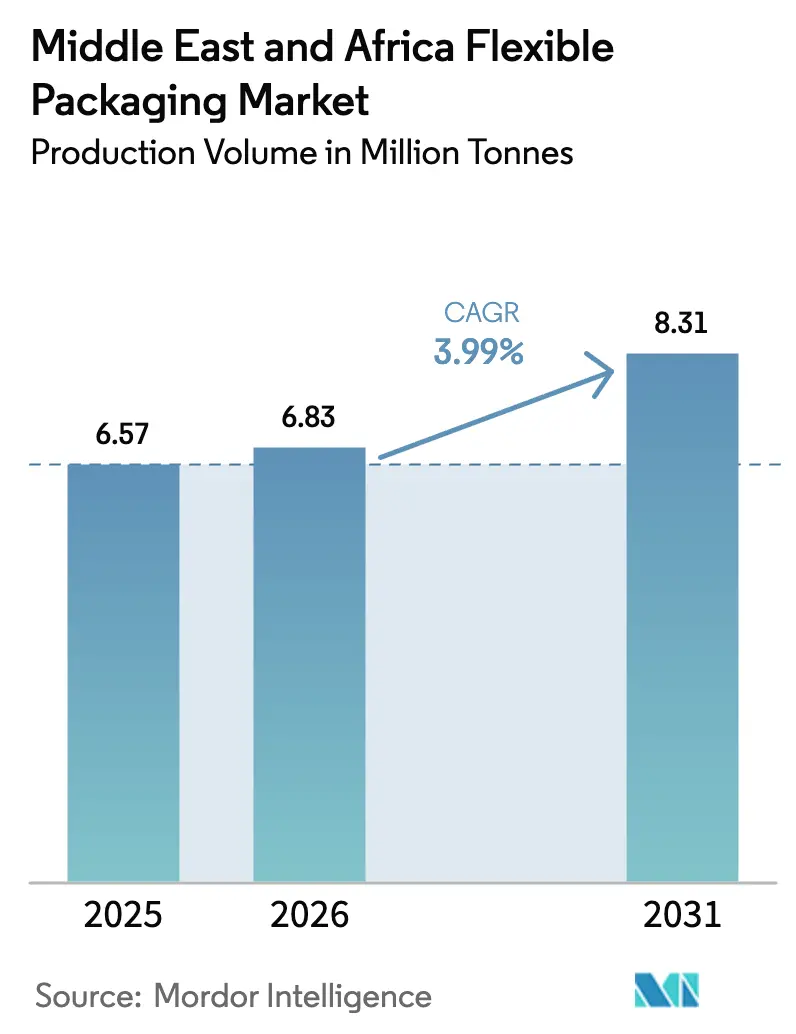
| Base Year Market Size (2025) | 6.57 Million tonnes |
| Market Volume (2026) | 6.83 Million tonnes |
| Market Volume (2031) | 8.31 Million tonnes |
| Growth Rate (2026 - 2031) | 3.99 % |
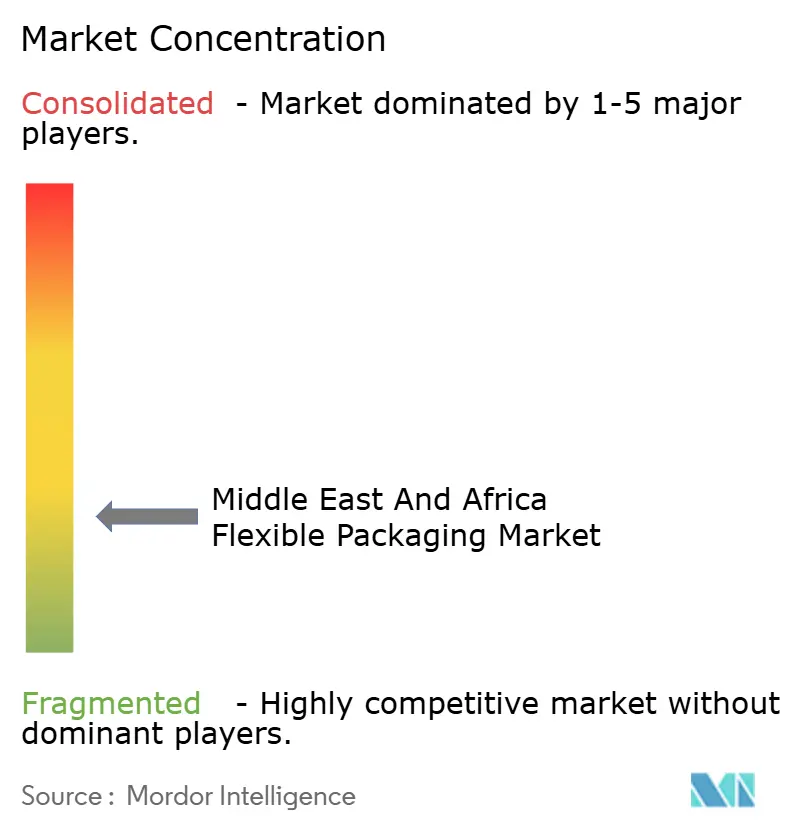
| Market Concentration | Low |
Major Players *Disclaimer: Major Players sorted in no particular order Image © Mordor Intelligence. Reuse requires attribution under CC BY 4.0. | |
Middle East And Africa Flexible Packaging Market Analysis by Mordor Intelligence
The Middle East and Africa flexible packaging market size is expected to grow from 6.57 million tonnes in 2025 to 6.83 million tonnes in 2026 and is forecast to reach 8.31 million tonnes by 2031 at 3.99% CAGR over 2026-2031. This solid up-trend mirrors an expanding processed-food base, escalating pharmaceutical serialization mandates, and a sharp rise in e-grocery logistics. Egypt’s 21% jump in 2024 processed-food exports propels demand for moisture- and oxygen-barrier pouches, while the UAE’s Federal Decree-Law No. 38 of 2024 obliges unit-dose pharmaceutical packs that require precise Arabic–English labeling and tamper evidence.[1] Saudi Arabia slots localisation subsidies under Vision 2030, spurring resin conversion investments and renewable-energy powered plants, such as the EUR 7.6 million solar-assisted beverage facility in Jeddah. South Africa anchors the continent’s high-growth curve on the back of food-processing upgrades and the African Continental Free Trade Area, while Nigeria’s gas-to-chemicals complex opens an indigenous PE and PP stream that trims import dependence. Parallel consolidation—exemplified by the Amcor-Berry Global union—reshapes competitive intensity and speeds up innovation as converters race toward circular-economy compliance.
Key Report Takeaways
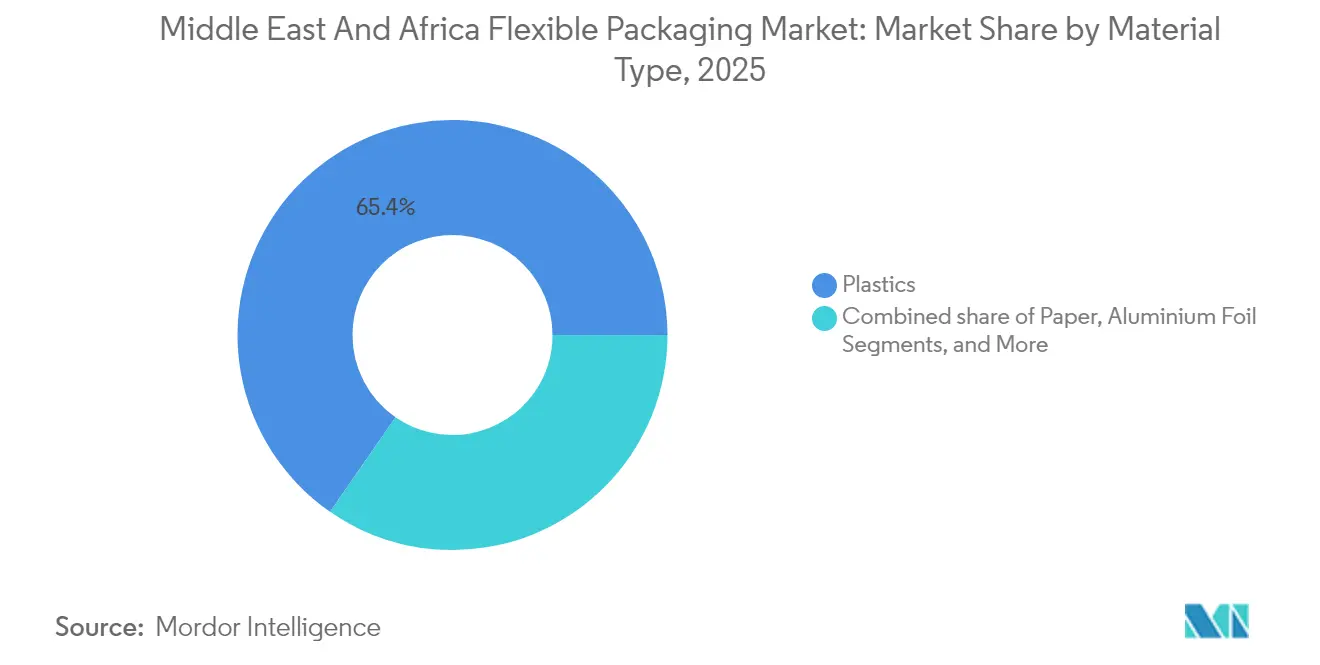
- By material type, plastics held 65.35% of the Middle East and Africa flexible packaging market share in 2025, whereas paper-based formats post the quickest 6.12% CAGR through 2031.
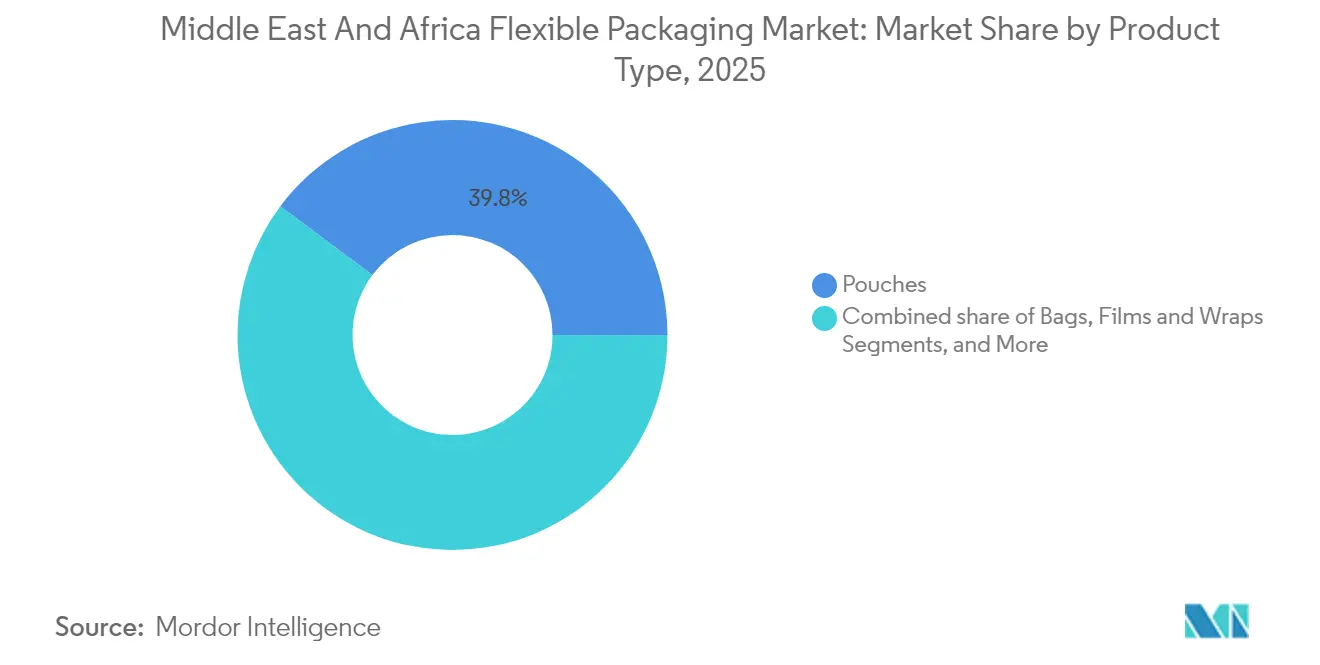
- By product type, pouches captured 39.78% of the Middle East and Africa flexible packaging market share in 2025; spouted pouches are expanding at a 7.18% CAGR for 2026-2031.
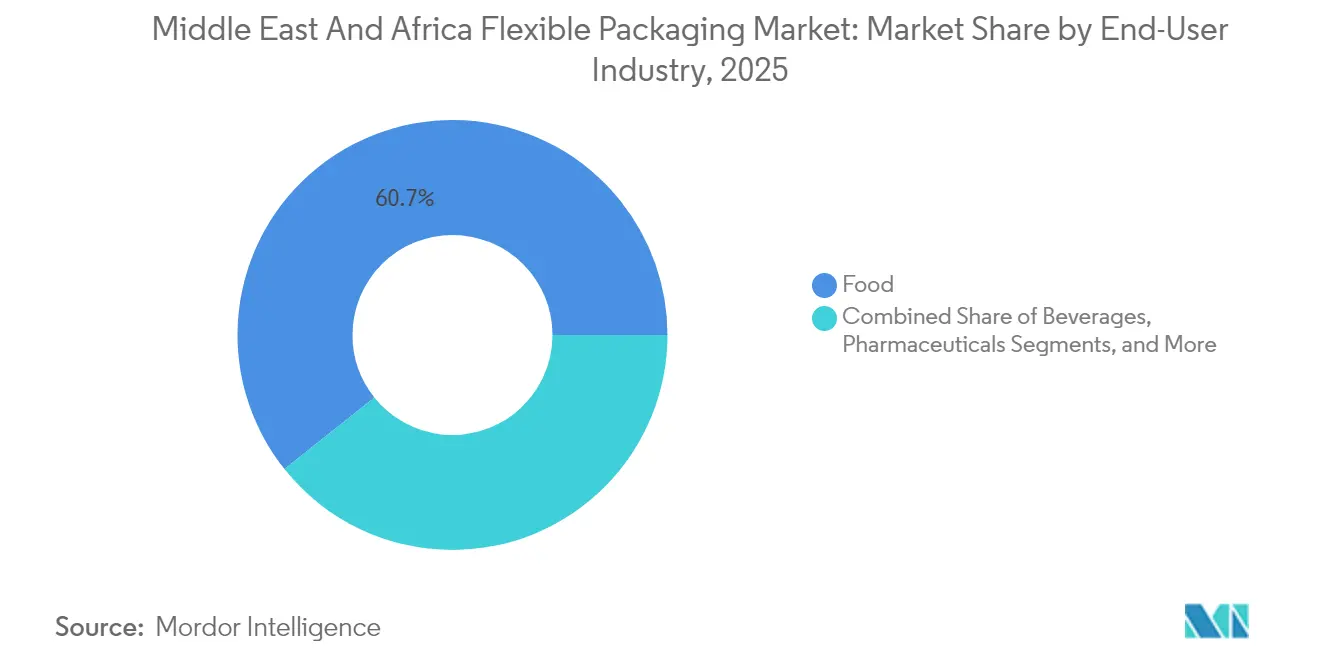
- By end-user industry, the food category accounted for 60.72% of the Middle East and Africa flexible packaging market size in 2025, while pharmaceuticals exhibit the leading 8.05% CAGR during the outlook period.
- By geography, Saudi Arabia commanded 44.98% revenue share in 2025; South Africa is set to progress at a 6.63% CAGR up to 2031.
Note: Market size and forecast figures in this report are generated using Mordor Intelligence’s proprietary estimation framework, updated with the latest available data and insights as of 2026.
Market Trends and Insights
Drivers Impact Analysis of Middle East And Africa Flexible Packaging Market*
| Driver | (~) % Impact on CAGR Forecast | Geographic Relevance | Impact Timeline |
|---|---|---|---|
| GCC unit-dose pharma packaging mandates | +0.8% | Saudi Arabia, UAE, Qatar, Kuwait | Medium term (2-4 years) |
| E-grocery boom driving mailer films | +0.6% | Saudi Arabia, UAE | Short term (≤ 2 years) |
| Halal processed-meat export expansion | +0.5% | Global focus on MEA | Medium term (2-4 years) |
| Mega food-park investments | +0.7% | Egypt, Nigeria, Africa | Long term (≥ 4 years) |
| On-the-go beverage surge | +0.4% | GCC, urban Africa | Short term (≤ 2 years) |
| FMCG localisation boosting converting capacity | +0.5% | Saudi Arabia, UAE, Egypt, Morocco | Medium term (2-4 years) |
| Source: Mordor Intelligence | |||
GCC Unit-Dose Pharma Packaging Mandates
The UAE’s decree-law imposes serialized, dual-language labeling that filters down to foil blisters, stick packs, and sachets. Saudi SASO halal marks add further validation layers, steering converters toward high-colour-strength CI-flexo and near-infra-red readable inks. Regionally harmonised codes mirror U.S. DSCSA rules, ensuring global alignment for biologics shipped in temperature-stable pouches. These conditions underpin persistent volume gains in the Middle East and Africa flexible packaging market.
E-Grocery Boom Driving Mailer Films in KSA and UAE
Grocery apps recorded USD 1.07 billion sales in the UAE during 2023; fulfilment centres now rely on padded mailers with ice-gel pockets for mixed ambient-chill orders.[2] Riyadh research confirms that hybrid stores beat dark-store models on cost per order when insulated zipper pouches cut spoilage ratios by 7%. This rapid fulfilment model magnifies short-cycle demand swings that agile converters within the Middle East and Africa flexible packaging market can capture through digital print runs and late-stage customisation.
Halal Processed-Meat Export Expansion Needing Barrier Pouches
Ethiopian chilled goat carcasses now target 150 tonnes weekly to GCC retailers, yet shelf-life constraints expose outdated packaging. Multi-layer pouches with EVOH sit at the core of upgraded cold-chain compliance, enabling African suppliers to compete with Brazilian processors. Similar dynamics play out in fruit purée pouches bound for Dubai smoothie bars, where pineapple concentrate backed by a 5.3% CAGR through 2026 demands foil-free high-barrier laminates. These flows reinforce scale for the Middle East and Africa flexible packaging market.
Mega Food-Park Investments in Egypt and Nigeria
Egypt allocates USD 153 million to Suez Canal grain silos, generating orders for PE-lined woven PP sacks and FFS films. Nigeria’s USD 20 billion Ogidigben park yields cracker capacity for ethylene and propylene, lowering resin transport costs into West African pouch and sachet plants by 12%. The integrated supply architecture cements long-run competitive cost curves inside the Middle East and Africa flexible packaging market.
Restraints Impact Analysis of Middle East And Africa Flexible Packaging Market*
| Restraint | (~) % Impact on CAGR Forecast | Geographic Relevance | Impact Timeline |
|---|---|---|---|
| Scarcity of food-grade recycled polymer feedstock | -0.6% | Global, acute in Africa | Long term (≥ 4 years) |
| Aluminium-foil import tariffs | -0.4% | Sub-Saharan Africa | Medium term (2-4 years) |
| Skill gap in CI-flexo high-speed printing | -0.3% | Middle East, North Africa | Medium term (2-4 years) |
| EU recyclability rules on multilayer exports | -0.5% | Export-focused MEA firms | Short term (≤ 2 years) |
| Source: Mordor Intelligence | |||
Scarcity of Food-Grade Recycled Polymer Feedstock
Only 14% of worldwide plastic waste enters recycling streams; EFSA-grade PCR pellets fetch premiums of up to USD 400 per tonne above virgin levels, squeezing converter margins. EU rules that demand 70% recyclability by 2030 and rising PCR thresholds choke export lanes for multi-material laminates. UFlex’s PCR-PET line in Egypt supplies 30,000 tonnes annually but still covers less than 5% of regional laminate demand. Without scaled chemical recycling, growth in the Middle East and Africa flexible packaging market could moderate.
Aluminium-Foil Import Tariffs in Key African States
US antidumping duties on Turkish foil mirror nascent moves by East African blocs considering 5%-7% safeguard tariffs to stimulate local rolling mills. For sachet coffee and blister drugs, converters face 3%-5% unit-cost hikes, nudging them toward SiOx coated films, yet these alternatives demand new validation cycles that slow deployment. This cost friction trims near-term tonnage additions in the Middle East and Africa flexible packaging market.
*Our forecasts treat driver/restraint impacts as directional, not additive. The impact forecasts reflect baseline growth, mix effects, and variable interactions.
Middle East And Africa Flexible Packaging Market Segment Analysis
By Material Type:
Plastics Lead, Paper Accelerates Toward CircularityPlastics retained 65.35% dominance inside the Middle East and Africa flexible packaging market during 2025 as PE and PP deliver cost-effective moisture barriers for staples such as couscous, rice, and UHT milk. Meanwhile, coated kraft and machine-glazed paper surge at 6.12% CAGR, spurred by retailer mandates for mono-material curbside collection. Polyethylene-terephthalate laminates grow within retort soup pouches, underscoring heat-resistance advantages. The Middle East and Africa flexible packaging market size for mono-material PE/PE laminates is expected to rise once tie-layer resins unlock higher oxygen-barrier thresholds without EVOH.
PLA and PBAT blends surface in Qatar’s take-away bags, while sugar-cane PE trials emerge in South African yogurt lids. Yet cost premiums and compost-site scarcity keep market shares low. Multilayer foil structures remain indispensable in lidding for hummus and high-acid juices. At the same time, paper–film hybrids that use aqueous coatings reach moisture barrier targets, helping confectionery firms meet 25% virgin-plastic-reduction goals. Through this dynamic interplay, the Middle East and Africa flexible packaging market continuously balances economics, performance, and sustainability.

By Product Type:
Pouches Dominate a Diversifying PortfolioPouches delivered 39.78% of 2025 shipment volume and continue to outperform with a 7.18% CAGR. Stand-up DOY pouches rule snack aisles, while quad-seal variants reinforce pet-food premiumisation. Retort pouches in Saudi halal soups illustrate thermal resilience, whereas spouted formats gain popularity in Nile Delta dairy drink launches. The Middle East and Africa flexible packaging market size for spouted pouches supporting beverage, paint, and agrochemical lines expands in tandem with filling-line flexibility. Mondi’s solvent-free re/cycle pouch line underscores the pivot to mono-material recyclability.
Films and wraps sustain bread-and-butter B2B contracts, covering stretch-hood pallets, shrink collation, and thermoform meat trays. Labels and sleeves enjoy digital-print uptake as HP Indigo 6K presses cut SKU changeover times for fast fashion yoghurt assortments. Lidding foils move toward PP-based easy-peel solutions, while zipper and slider components forge added convenience. Each development deepens product diversification in the Middle East and Africa flexible packaging market.
By End-User Industry:
Food Retains Volume, Pharma Tops GrowthFood applications composed 60.72% of the Middle East and Africa flexible packaging market share in 2025, supported by stable demand for wheat, pulses, and confectionery. Egypt’s jam processors select clear PET-PE pouches targeting export gains in regions aligning with halal standards. Pharmaceuticals accelerate at an 8.05% CAGR as GCC regulators compel serialized blister packs and cold-chain sachets.
Beverage pouches flourish on school-lunch convenience, while cosmetics firms in Dubai pivot to matte-finish stand-up pouches that pair shelf impact with recyclability. Household cleaners and agrochemical sachets hold steady volumes, illustrating demand spread that shields the Middle East and Africa flexible packaging market from single-category shocks.
Geography Analysis
MEA Flexible Packaging Market
TSaudi Arabia’s 44.98% slice of 2025 revenue springs from beefed-up halal meat, dairy, and snack lines served by newly installed 10-colour CI-flexo presses. Solar-powered filling halls in Jeddah highlight ecological commitments that resonate across the Middle East and Africa flexible packaging market. The UAE, often the test-bed for premium designs, leverages USD 1.07 billion e-grocery turnover to push mailer films, dry-ice pouches, and insulated liners. Bahrain, Qatar, Kuwait, and Oman remain niche yet profit-rich markets thanks to strict import rules that favour high-quality multilayer films. Tamkeen-supported expansion of United Paper Industries underscores micro-market capacity gains.
Africa Flexible Packaging Market
Africa commands the growth narrative. South Africa tops regional CAGR at 6.63%, propelled by snack-food and ready-meal adoption and bolstered by trade corridors linking ports to hinterland supermarket chains. Egypt blends Suez Canal geography with crop field modernisation, creating anchor demand for bulk sacks, pallet hoods, and pre-made pouches tied to its USD 6.1 billion processed-food export milestone. Morocco and Tunisia align with EU recycling thresholds, refitting lamination lines toward mono-material paper–PE hybrids to sustain citrus export packaging flows.
Gulf and North Africa Flexible Packaging Market
ALPLA’s facilities in KSA, UAE, and Egypt cut lead times for PET preforms, while renewable-energy projects in Morocco and the UAE reduce carbon intensity in blown-film extrusion. The Middle East Institute notes that green-power commitments target 52% renewable grids by 2030, lowering Scope 2 emissions for converters. Such regional integration ensures growth momentum across the Middle East and Africa flexible packaging market.
Regulatory Landscape
Packaging regulation across the Middle East and Africa is tightening around product safety, labeling, and end-of-life responsibility, directly influencing flexible pack structures and artwork. In Kenya, the Environmental Management and Co-ordination (Management and Control of Plastic Packaging Materials) Regulations, 2024 (Legal Notice 181 of 2024, commenced 4 Nov 2024) require authorization for plastic packaging manufacture/import/export/sale, prescribe labeling elements such as resin identification codes and producer contact details, and link compliance to approved extended producer responsibility (EPR) plans. This works alongside Kenya's Sustainable Waste Management (Extended Producer Responsibility) Regulations, 2024 (Legal Notice 176), which extends producer and importer responsibility across packaging materials including plastics, aluminum, composite, paper/corrugated, glass, and cardboard, raising compliance and reporting demands for converters and brand owners.
In the GCC, conformity and food-contact standards shape material selection and printing controls. The UAE Ministry of Industry and Advanced Technology (MoIAT) operates conformity assessment routes for regulated products, while Cabinet Resolution No. 83 of 2024 governs control of pre-packaged product quantities with optional registration pathways within the national conformity system. In Saudi Arabia, the Saudi Food and Drug Authority (SFDA) points food packaging to Gulf standards such as GSO 839 and GSO 1863, and SASO's Technical Regulation for Paper and Cardboard (approved 2021) restricts heavy metals, reinforcing the shift to compliant inks, substrates, and traceable documentation for suppliers serving food and pharmaceutical end users.
Competitive Landscape
Top Companies in Middle East and Africa Flexible Packaging Market
Huhtamaki, Constantia Flexibles, and Mondi hold technology edges in retortable, high-oxygen-barrier laminates and in-house recycling loops. The Amcor-Berry merger births a USD 24 billion revenue giant with planned USD 650 million synergies that will leverage backward-integrated film and converting assets to expand its footprint in the Middle East and Africa flexible packaging market. Sonoco’s USD 3.9 billion Eviosys deal and One Rock’s Constantia buyout further raise the bar for capital efficiency and R&D outlay.
Napco National and 3P Gulf Group win local tenders on Arabic artwork fluency and 24-hour technical service. Arabian Flexible Packaging rolls out solvent-free lamination lines to cut VOC emissions, matching retailer scorecards. ePac Flexibles scales digital print clusters in Johannesburg and Dubai, offering 10-day doorway delivery for minimum 5 kg jobs that serve SME spice blenders.
Bobst’s Florence competence centre trains 200 Middle Eastern operators yearly on precision gear settings to close skill gaps in CI-flexo. Hotpack’s USD 100 million New Jersey plant marks global ambition from a Gulf base, while ALPLA’s full takeover of its Egyptian JV cements integrated resin-to-bottle offerings that reduce cost-to-serve for beverage clients. Competitive intensity spurs sustained capex flows, keeping the Middle East and Africa flexible packaging market technologically current.
Middle East And Africa Flexible Packaging Industry Leaders
-
Napco National
-
3P Gulf Group
-
Platinum Packaging Ltd
-
ENPI Group
-
Aalmir Plastic Industries LLC
- *Disclaimer: Major Players sorted in no particular order
Middle East And Africa Flexible Packaging Market Companies Covered in this Report
- Huhtamaki Oyj
- Constantia Flexibles
- Napco National
- Mondi Group
- ENPI Group
- 3P Gulf Group
- Platinum Packaging Ltd
- Aalmir Plastic Industries LLC
- Amber Packaging Industries LLC
- Emirates Printing Press LLC
- Gulf East Paper & Plastic Inds. LLC
- Radiant Packaging Industry LLC
- Arabian Flexible Packaging LLC
- Integrated Plastics Packaging LLC
- SwissPac UAE
- Hotpack Packaging Industries LLC
- Falcon Pack
- Amcor plc
- Taghleef Industries
- Sealed Air Middle East
Market Opportunities and Future Outlook
Regulatory-driven redesign and compliance services create whitespace for converters that can deliver recyclable structures, traceable labeling, and EPR-ready documentation at scale. With Kenya implementing EPR obligations for packaging producers and importers under Legal Notice 176 of 2024, and tighter controls on plastic packaging under Legal Notice 181 of 2024, demand rises for resin-code labeling, recycled-content claims governance, and auditable material traceability, capabilities that favor organized converters and suppliers offering standardized specifications across multiple African markets.
A parallel opportunity comes from capacity localization and technology upgrades that shorten lead times for food and pharma-grade flexible packaging. In June 2026, Al Bayader International announced an AED 180 million integrated food packaging hub in Dubai's National Industries Park, targeting a 30,000-tonne annual capacity increase by 2028, signaling customer appetite for regional supply hubs that can support high-mix FMCG and foodservice formats. In Morocco, Mediterrania Capital Partners' May 2026 acquisition of the Amcor Flexibles Mohammedia facility underscores ongoing portfolio realignment toward assets serving food, pharmaceutical, and personal care segments, creating openings for toll conversion, specialty barrier films, and print/lamination upgrades that meet both GCC labeling rigor and EU-facing recyclability constraints for export-oriented producers.
Recent Industry Developments in Middle East And Africa Flexible Packaging Market
- June 2026: Al Bayader International announced an AED 180 million investment in a new integrated food packaging hub at Dubai's National Industries Park. The project targets an additional 30,000 tonnes of annual capacity by 2028, strengthening local supply for high-volume flexible formats used in food and foodservice. The move supports shorter lead times and larger-scale sourcing within the UAE for brand owners and distributors.
- August 2025: Napco National completed the acquisition of Arabian Flexible Packaging from the Ghurair Group, expanding its flexible packaging manufacturing footprint in the Middle East. The acquisition supports deeper participation in localization frameworks such as the UAE In-Country Value (ICV) program and broadens Napco's capability base for high-turn FMCG and industrial film demand. The deal also adds scale that can increase competitive pressure on smaller regional converters.
- September 2024: Napco National, SABIC, and FONTE collaborated on certified circular polyethylene bread bags for food packaging applications. The initiative showcased an in-market route to incorporate certified circular feedstock into flexible packaging without changing end-use performance expectations for everyday staples. It also raised the bar for traceability and certification readiness as sustainability requirements expand across brand owner procurement.
Middle East And Africa Flexible Packaging Market Report Scope and Research Methodology
Market Definition and Coverage
For this study, the Middle East and Africa flexible packaging market covers flexible packs used to protect, carry, and sell products across key end uses in the region, measured as converted packaging demand and reported in volume terms (tonnes).
Scope exclusions: We exclude rigid packaging formats and also exclude packaging machinery, labels, and printing services that are not part of the flexible pack itself.
Segments Covered in This Report
- By Material Type
- Plastics
- Polyethylene (HDPE, LDPE, LLDPE)
- Polypropylene
- Polyethylene Terephthalate (PET)
- Polyvinyl Chloride (PVC)
- Others (EVOH, PA, etc.)
- Paper
- Aluminium Foil
- Bioplastics / Compostables (PLA, PBS, PHA, PBAT)
- Plastics
- By Product Type
- Pouches
- Stand-up Pouches
- Retort Pouches
- Spouted Pouches
- Bags
- Films and Wraps
- Thermoforming film
- Stretch Films
- Shrink Film
- Laminate film
- Cling films ( limited to B2B like restaurants, hotels , etc )]
- Labels and Sleeves
- Lidding and Liners
- Blister Packaging
- Pouches
- By End-user Industry
- Food
- Meat and Poultry
- Dairy
- Snacks and Confectionery
- Fruits and Vegetables
- Beverages
- Alcoholic
- Non-alcoholic
- Pharmaceuticals
- Cosmetics and Personal Care
- Household and Industrial Care
- Tobacco
- Pet Food
- Others (Electronics, Chemicals, Agri-products)
- Food
- By Country
- Middle East
- Saudi Arabia
- United Arab Emirates
- Qatar
- Oman
- Kuwait
- Bahrain
- Rest of Middle East
- Africa
- Egypt
- Morocco
- Algeria
- Tunisia
- South Africa
- Rest of Africa
- Middle East
Data Sources, Market Sizing, and Validation
Desk Research
Desk work was used to build the starting view of packaging demand, material flows, and end-use growth across the Middle East and Africa. We relied on public references such as UN Comtrade for trade direction checks, World Bank and IMF macro series for consumption and income indicators, and national statistics offices for manufacturing and CPI series where available. For packaging and plastics context, we also used sources such as FAO food balance-style indicators, peer reviewed journals covering barrier film performance and recyclability, and regulator publications related to packaging waste rules and extended producer responsibility.
Along with these, we reviewed company annual reports, investor presentations, and reputable press coverage to understand capacity adds, closures, and conversion trends, which helps keep the volume curve realistic. Patent databases were also referenced to track whether high barrier structures and mono-material designs are being adopted, since that tends to influence downgauging and mix changes in tonnes. In a few places, paid subscriptions for company financials and intelligence and shipment-level trade databases were used to cross-check output where public reporting is thin. The sources listed here are illustrative only, and many other references were consulted for data collection, validation, and clarification during analysis.
Primary Interviews and Surveys
Primary inputs were collected through expert interviews and structured surveys across the flexible packaging value chain, including converters, material suppliers, distributors, and large end users in food, beverage, and personal care. These discussions helped confirm regional mix shifts (for example, film structures and downgauging), typical conversion losses, and realistic demand elasticity by end use. Where a single country appeared out of line, we adjusted the related assumptions to match the broader MEA direction.
Distribution of primary research fieldwork respondents
| Company type | Respondent position |
|---|---|
| Top tier: 31% | CXOs: 15% |
| Mid tier: 47% | Functional/Unit leaders: 26% |
| Smaller Players: 22% | Managers: 59% |
Market-Sizing & Forecasting
The core model uses a top-down approach where packaging demand is reconstructed from end-use consumption patterns and packaged product output across the Middle East and Africa, and then translated into flexible packaging tonnes using conversion factors. To keep totals grounded, we corroborated results with selective bottom-up approximations, such as converter capacity cues, sampled film and laminate throughput, and price to volume sanity checks when value signals were available.
Key inputs used in the model include packaged food and beverage output trends, population and urbanization shifts, polymer and paper price direction (since it affects downgauging and substitution), the share of modern retail and e-commerce that changes pack formats, and the pace of packaging sustainability rules that push material changes. Because the report is presented in tonnes, special care was taken to avoid mixing value inflation with volume growth, so inflation is treated as a supporting signal rather than a driver. Where gaps existed for smaller markets, assumptions were bridged using proxy indicators like import reliance, local conversion intensity, and peer-country packaging intensity, and then checked back with expert feedback.
For forecasting, scenario analysis was used, since it fits a region with uneven currency movements and different end-use growth speeds by country. Growth paths were built from consensus views from primary respondents on end-use demand, material mix shifts, and likely adoption timing for downgauging and mono-material structures, and then the scenario outputs were averaged into the final forecast curve.
Data Validation & Update Cycle
Validation is done through multiple checks so the final volume numbers remain consistent with independent signals, like trade direction changes, capacity announcements, and packaged goods demand trends. When an outlier appears, the driver is re-tested, assumptions are re-run, and we re-contact sources if the variance cannot be explained by a clear market event. Before publication, the model and narrative go through analyst reviews so that inputs, calculations, and conclusions align.
Reports are refreshed annually, and interim updates are made when a material event affects demand or supply, such as a major regulation change, a large capacity start-up, or a sharp currency and raw material shift. Before delivery, an analyst performs a fresh pass to ensure the latest public releases and market signals are reflected in the final output.
Mordor Intelligence's Middle East and Africa Flexible Packaging Market Size Measured Against Other Published Estimates
Published market sizes for MEA flexible packaging can vary because the unit of measure is not always the same, and because some authors mix value inflation with true pack consumption changes. Differences also show up when a study blends in adjacent scopes, such as all flexible plastics only, or includes downstream services that do not add to packaging tonnes.
When refresh timing and currency timing are handled differently, the implied average selling price path and conversion factors can drift, which then shifts the final market size even if the real demand pool is similar. In this report, refresh cadence and price logic were kept consistent through the forecast window and then checked against trade and capacity signals, a process applied by Mordor Intelligence.
Benchmark comparison
| Source | Market Size | Gaps in Research Methodology |
|---|---|---|
| Mordor Intelligence | USD 6.57 M (2025) | |
| Industry Association A | USD 7.10 M (2025) | Often uses converter production nameplate assumptions with limited loss factors, which can overstate tonnes when utilization is below normal or when exports are not netted out cleanly. |
| Trade Journal B | USD 6.10 M (2025) | Typically focuses on a narrower set of flexible formats and may undercount multi-layer laminates used in food and personal care, and it can apply conservative mix and downgauging assumptions without cross-checking against trade shifts. |
Overall, the spread across figures mainly comes from how volume is built, which signals are used to confirm it, and whether utilization and format coverage are treated carefully. Our approach stays traceable to end-use demand indicators and conversion logic, so the final market size can be repeated and updated without relying on one-off assumptions.
Key Questions Answered in the Report
What is the current size of the Middle East and Africa flexible packaging market?
The market stands at 6.83 million tonnes in 2026 and is projected to reach 8.31 million tonnes by 2031, translating into a 3.99% CAGR
Which material type dominates the Middle East and Africa flexible packaging market?
Plastics remain dominant with 65.35% share in 2025, though paper-based formats are growing fastest at a 6.12% CAGR through 2031.
Why are pharmaceuticals the fastest-growing end-user segment?
GCC regulators have enforced unit-dose serialization, dual-language labeling, and halal certification, boosting demand for high-barrier blisters and sachets and driving an 8.05% CAGR in pharma packaging.
How will local resin capacity additions in Nigeria affect regional supply?
Nigeria’s Ogidigben Industrial Park introduces indigenous PE and PP streams, lowering feedstock import reliance and freight costs for West African converters.
What impact will EU recyclability rules have on Middle East and Africa flexible packaging exporters?
Exporters of multilayer structures must shift toward mono-material and recyclable laminates to meet a 70% recyclability threshold by 2030, or risk losing EU market access.
How does the Amcor-Berry Global merger influence regional competition?
The USD 24 billion revenue entity increases scale and technology reach, heightening pressure on local players yet also introducing advanced recycling and downgauging solutions into the region.