
Market Overview
| Study Period | 2021 - 2031 |
|---|---|
| Forecast Data Period | 2026 - 2031 |
| Base Year Market Size (2025) | USD 1.77 Billion |
| Market Size (2026) | USD 2.26 Billion |
| Market Size (2031) | USD 7.65 Billion |
| Growth Rate (2026 - 2031) | 27.62 % |
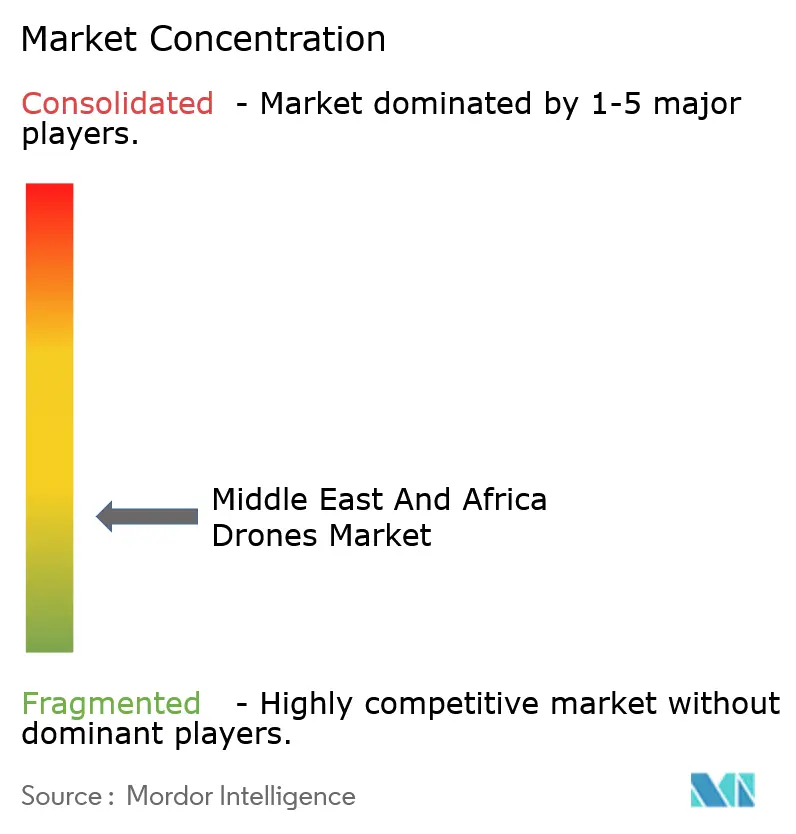
| Market Concentration | Low |
Major Players *Disclaimer: Major Players sorted in no particular order Image © Mordor Intelligence. Reuse requires attribution under CC BY 4.0. | |
Middle East And Africa Drones Market Analysis by Mordor Intelligence
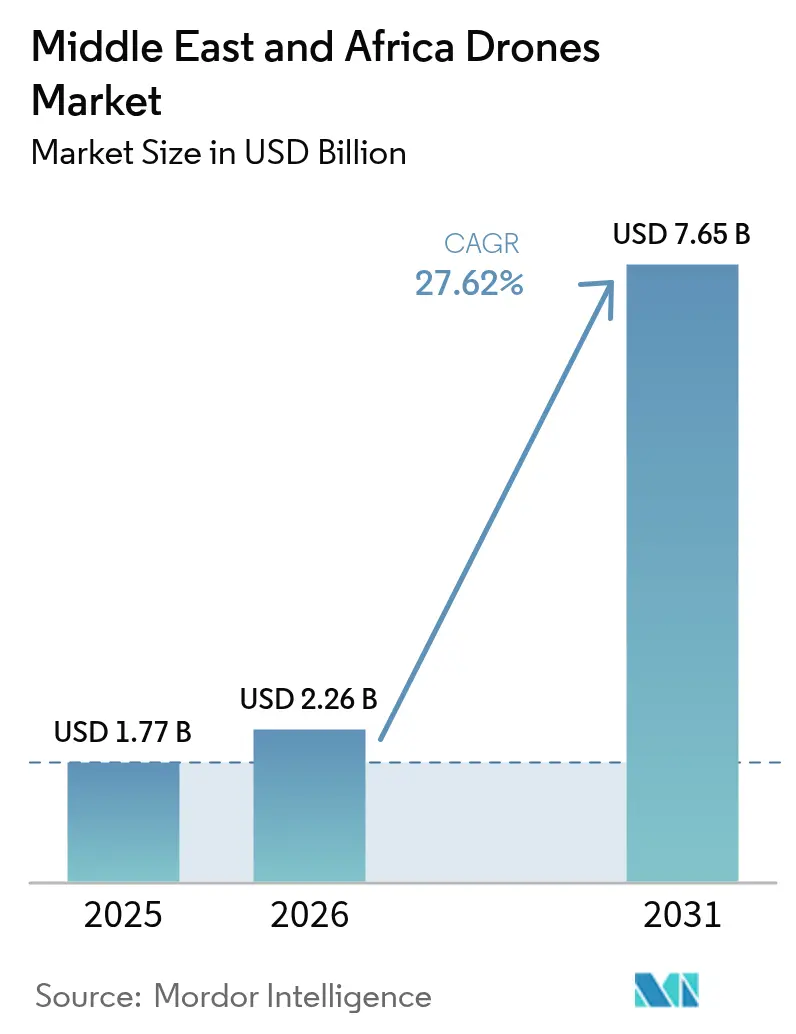
The Middle East And Africa Drones Market size is expected to grow from USD 1.77 billion in 2025 to USD 2.26 billion in 2026 and is forecast to reach USD 7.65 billion by 2031 at 27.62% CAGR over 2026-2031.
The demand for drones is experiencing significant growth across the Middle East and Africa. In the Middle East, countries such as the United Arab Emirates, Saudi Arabia, Turkey, Israel, and Egypt collectively account for over seventy thousand active major construction projects. The construction industry is driving drone adoption for applications including 2D and 3D modeling and mapping, land surveying, progress monitoring, waste reduction, and job site surveillance, thereby fueling market growth in the region.
In Africa, drone adoption is expanding across various sectors, particularly in postal delivery and agriculture. The agriculture sector in Africa is witnessing the highest demand for drones, with applications such as soil scanning (monitoring nitrogen content and electrical conductivity), crop monitoring, pesticide spraying, pest, weed, and disease detection, and fish population monitoring. Technological advancements, including hybrid propulsion systems in vertical take-off and landing (VTOL) drones to enhance loitering time, augmented reality (AR) technology for 2D and 3D mapping, and artificial intelligence (AI) for crowd control, are further driving the growth of the drones market in countries like Israel and South Africa.
Note: Market size and forecast figures in this report are generated using Mordor Intelligence’s proprietary estimation framework, updated with the latest available data and insights as of 2026.
Middle East And Africa Drones Market Trends and Insights
The Construction Segment to Exhibit the Highest Growth Rate During the Forecast Period
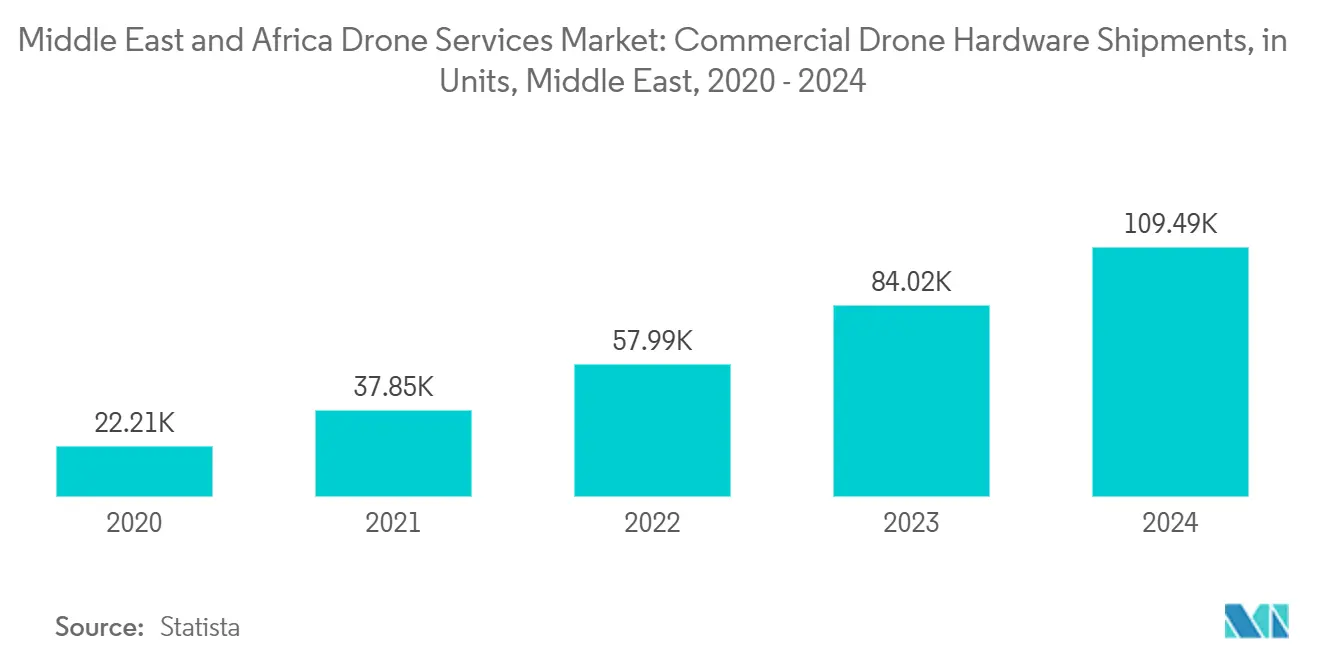
Amid rapid infrastructure development and advancements in construction monitoring technology, the construction application segment is poised to showcase the highest growth rate during the forecast period. Drones, a pivotal technology in this evolution, are revolutionizing the industry. They enable real-time insights, foster collaboration, aid in workforce and equipment planning, schedule maintenance, ensure safety, and facilitate mapping, all without disrupting operations. Their efficiency shines in scanning and monitoring vast construction sites, a task that surpasses the capabilities of human operators and traditional land-based scanners.
Terra Drone Arabia, a prominent provider of drone and satellite (remote sensing) technologies, participated in Cityscape Global 2024, which took place in November 2024 at the Exhibition and Convention Center in Malham, Riyadh. The event featured over 400 exhibitors and 500 speakers, focusing on “The Future of Living” and aligning with Saudi Arabia’s Vision 2030.
Terra Drone Arabia presented its innovative solutions that deliver value across various project phases. These include pre-construction data collection, where drones and satellite imagery are utilized to efficiently gather critical site data, providing high-resolution insights that enhance planning and decision-making before construction begins. The company also showcased its progress monitoring and site analysis capabilities, employing remote-sensing drones to track real-time project progress with precision. This approach captures essential metrics for each phase, ensuring accuracy, improved timelines, and seamless project management.
The MoU seeks to enhance cooperation between Terra Drone and Aramco to advance drone technologies that improve safety and operational efficiency within the energy sector. It establishes a framework for innovation in key areas such as research and development, technology piloting, training, and localization. This agreement aligns with the shared vision of both organizations to drive technological advancements while fostering local capabilities to support the Kingdom’s broader economic objectives.
Israel is Expected to Dominate the Market During the Forecast Period
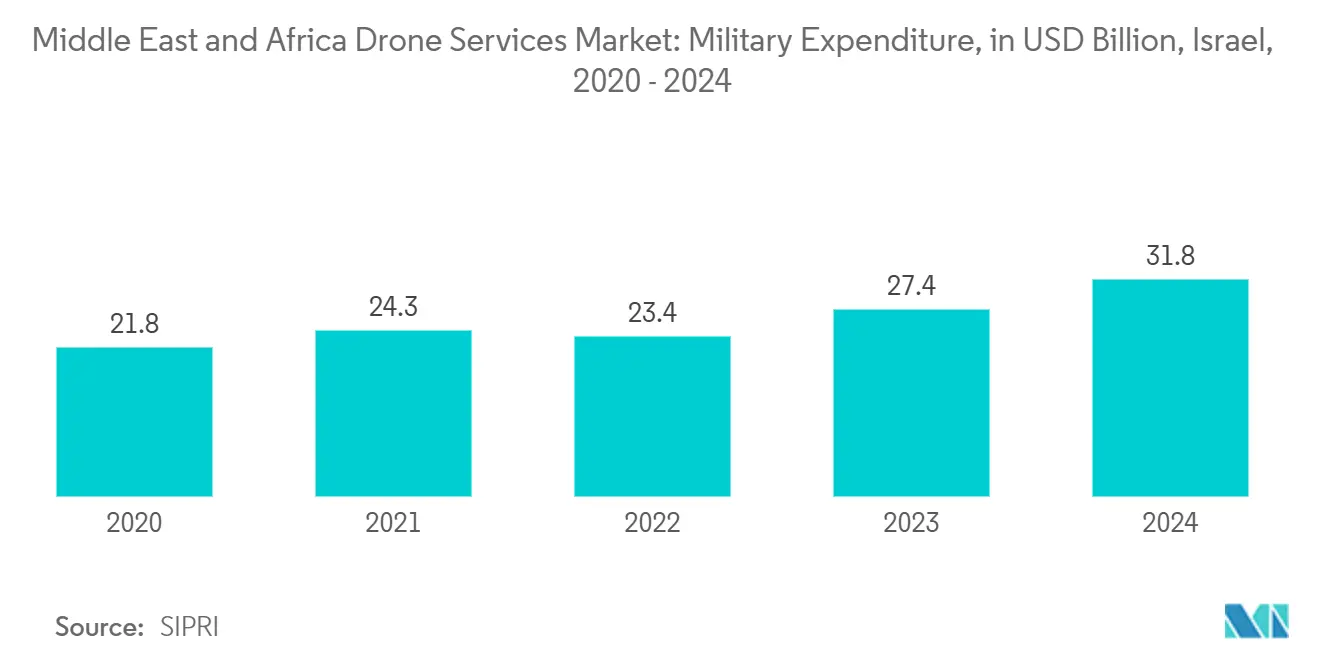
Israel hosts major R&D centers for technology leaders such as Microsoft and Google, which are increasingly investing in the commercial drone industry. The country’s supportive ecosystem fosters the growth of drone startups, particularly those developing technologies for sectors like construction, pharmaceutical delivery, agriculture, security, and surveillance.
The Israel Defense Forces' decision to replace Chinese DJI drones with locally developed alternatives is expected to drive market growth in the coming years. For example, startups like Flytrex are leading the way by offering software solutions that optimize delivery operations, provide essential topographical and weather data, and enable cloud-based management of in-flight drones.
Israel's strategic collaborations, including partnerships with the Ukrainian Postal Service and a pharmaceutical delivery company, highlight its commitment to testing advanced systems in challenging African environments.
As part of the Israel National Drone Initiative, multiple drone service providers participated in flight tests conducted by Vertiport in Rishon LeZion in March 2024. During these trials, Cando Drones demonstrated drone delivery operations and coordinated shared ground space with an air taxi and a heavy logistics drone. They facilitated visits from the mayor and the Israel Land Administration. This program aims to advance knowledge and drive the development of new capabilities. These innovations and strategic partnerships underscore Israel's growing prominence in the global drone services market.
Competitive Landscape
The Middle East and Africa drone market features key players like SZ DJI Technology Co. Ltd, Parrot SA, FalconViz, AeroVironment Inc., and Israel Aerospace Industries Ltd. Technological advancements in this industry are primarily steered by collaborations between drone manufacturers and solution providers.
To boost revenue, service providers are tailoring their offerings to meet the unique needs of industries like construction, infrastructure management, and security in the Middle East, while in Africa, companies like WeRobotics Inc. are eyeing the agricultural sector's future potential. Manufacturers are rolling out new drone models to entice Middle Eastern customers. For instance, in January 2025, Matternet, the developer of the world’s leading urban drone delivery system, announced that The Kingdom of Saudi Arabia had approved the company to operate its M2 drone within the region, the first operator to receive such approval.
Middle East And Africa Drones Industry Leaders
-
SZ DJI Technology Co., Ltd.
-
Parrot SA
-
FalconViz
-
AeroVironment Inc.
-
Israel Aerospace Industries Ltd.
- *Disclaimer: Major Players sorted in no particular order
Market Opportunities and Future Outlook
Localization-driven defense procurement and new production footprints are creating room for platform OEMs, subsystem suppliers, and MRO and training providers across the Gulf. In the UAE, EDGE Group received UAE Ministry of Defence contracts in January 2026 to supply 168 ANAVIA unmanned helicopters (HT-100 and HT-750), while Saudi Arabia is seeing manufacturing initiatives such as SR2Vector announcing a factory near Riyadh to produce the SKYWASP one-way attack drone (May 2026). These efforts support demand for local integration, test and evaluation, certification support, and lifecycle sustainment services tied to national localization programs.
Counter-UAS and air-defense integration is another opportunity area, spanning sensors, electronic warfare, kinetic effectors, and command-and-control software as regional governments and partners move into practical deployments and evaluations. In June 2026, the US Department of State approved a potential USD 1.98 billion sale of counter-unmanned aerial systems platforms to Kuwait, and US Africa Command conducted field demonstrations of the Curtain Call swarm counter-drone system (March 2026). Alongside defense use cases, commercial drone services are extending into construction and asset inspection across the Middle East and into agriculture and logistics across Africa, with service providers differentiating through software workflows and AI-enabled analytics rather than hardware-only offerings.
Recent Industry Developments
- June 2026: FalconViz announced a partnership to integrate DJI Enterprise and AERONEX hardware into its AI workflows, including StockViz for mining analytics and Gharsa.ai for agriculture use cases. The partnership supports end-to-end service delivery by bundling proven drone platforms with proprietary analytics, enabling repeatable deployments across industrial and agritech customers in the region.
- December 2025: AeroVironment secured a five-year USD 874.26 million U.S. Army Contracting Command IDIQ contract to deliver UAS and counter-UAS systems (including JUMP 20, P550, Puma, Raven, and Titan C-UAS) to allied and partner forces globally. This framework increases supply availability for partner nations and can lead to regional fielding, training, and sustainment activity across the Middle East and Africa.
- January 2024: Gulf Navigation (GULFNAV) signed a memorandum of understanding with Wings Logistics Hub to integrate drone technology into shipping agency operations in the UAE. The collaboration indicates expanding drone-enabled workflows in ports and maritime logistics, supporting inspection and operational visibility use cases beyond traditional land-based deployments.
Research Methodology Framework and Report Scope
Market Definition and Coverage
This market covers revenue generated from drones used across civilian and commercial missions in the Middle East and Africa. It includes sales and deployments of fixed-wing and rotary-wing platforms across common field applications.
Scope exclusions: We exclude toys and hobby-only products, and we do not count unrelated aerospace systems that are not operated as drones.
Segmentation Overview
- Application
- Construction
- Agriculture
- Energy
- Entertainment
- Law Enforcement
- Parcel Delivery
- Other Applications
- Type
- Fixed Wing Drones
- Rotary Wing Drones
- Geography
- Saudi Arabia
- United Arab Emirates
- Israel
- South Africa
- Rest of Middle East and Africa
Data Sources, Market Sizing, and Validation
Desk Research
Desk research was used to build the base facts that keep the sizing model grounded in real demand signals. We relied on public sources that help explain drone adoption and operating readiness in the region, such as civil aviation authority notices, defense procurement releases, and customs or trade statistics where reporting is available.
For quantitative anchors, we also reviewed sources such as World Bank and IMF macro indicators, UN Comtrade trade codes where they apply, selected patent databases to track technology direction, and aviation safety or regulatory publications that clarify allowed use cases. Company annual reports, investor decks, and trusted press coverage were then used to map supplier presence, partnerships, and pricing direction. This reduces guesswork in average selling price (ASP) assumptions.
Where needed, paid subscriptions focused on company financials and intelligence, news and financials, and global contracts and tenders were used to cross-check active programs and contract timing. The sources listed here are illustrative, and many other public documents and datasets were also referenced to collect, validate, and clarify inputs.
Primary Interviews and Surveys
Primary work focused on interviews and structured surveys with buyers, operators, service partners, and component and platform suppliers active across Middle East and Africa. These discussions helped confirm what is actually being deployed, how pricing moves with payload and endurance needs, and which applications are scaling fastest across the region.
Distribution of primary research fieldwork respondents
| Company type | Respondent position |
|---|---|
| Top tier: 36% | CXOs: 13% |
| Mid tier: 47% | Functional/Unit leaders: 30% |
| Smaller Players: 17% | Managers: 57% |
Market-Sizing & Forecasting
Sizing started with a top-down build where country-level demand pools were reconstructed from application activity and adoption levels, and then translated into value using typical platform mix and price bands. To keep the totals realistic, we corroborated the output with selective bottom-up checks, including supplier and channel sampling, along with ASP times volume approximations for a few high-visibility use cases.
Inputs were chosen because they can be tracked and explained clearly. For example, we used indicators such as the pace of regulatory approvals and operating restrictions, active use-case intensity in construction and energy inspection, uptake of drones in agriculture mapping, law enforcement procurement signals, and parcel delivery pilots that move from trial to routine use. Fixed-wing versus rotary-wing mix was treated as a key fingerprint because it directly changes unit pricing and replacement cycles.
For forecasting, scenario analysis was applied so growth paths reflect realistic constraints like airspace rules, import lead times, and training capacity, followed by expert consensus checks from primary discussions. When bottom-up evidence was incomplete for smaller countries, gaps were handled using proxy adoption rates tied to comparable economies and then adjusted after interview feedback.
Data Validation & Update Cycle
Validation was done through multiple checkpoints so outliers do not slip through. We compared model outputs with independent signals such as program announcements, trade movement patterns where visible, and shifts in application-level activity, and then investigated any sharp jumps before final sign-off.
Assumptions were reviewed in steps, starting with analyst self-checks, followed by a second-pass review that looks for variance across countries and platform types. If a major mismatch appeared, relevant experts were re-contacted to confirm whether it was a timing issue, a pricing shift, or a scope mismatch. Reports are refreshed annually, and interim updates are made when material events occur, followed by a final pre-delivery pass so clients receive the most current view.
Mordor Intelligence's Middle East and Africa Drones Market Estimate Compared With Other Published Estimates
Published market numbers for drones in the Middle East and Africa often differ because the scope is not always aligned, and the underlying price and volume assumptions can move quickly year to year. Differences also show up when some estimates lean heavily on a single demand proxy, or when currency timing and update cadence are not clearly stated.
The biggest gaps usually come from whether the figure is built around platform sales only, or if it blends in services and adjacent unmanned systems, which can inflate totals. Another common driver is how fast ASPs are assumed to drop as low-cost models spread, versus staying firm for longer-range platforms used in energy, security, and delivery trials. When application coverage is uneven across countries, totals can also swing. Using type mix and application activity as shared checkpoints keeps the model stable, which is the approach applied by Mordor Intelligence.
Benchmark comparison
| Source | Market Size | Gaps in Research Methodology |
|---|---|---|
| Mordor Intelligence | USD 2.26 B (2026) | |
| Industry Advisory A | USD 2.80 B (2024) | Often presented as a broad UAV figure that blends military procurement and civilian demand, and the base year is not always tied to a consistent application mix across MEA. |
| Regional Market Bulletin B | USD 1.85 B (2026) | Typically limited to small UAV platforms and excludes parts of the commercial demand pool such as delivery trials and heavier inspection platforms, which reduces the captured value. |
The table shows that the spread is mainly explained by scope choices and by how pricing and platform mix are treated. When the same geography is used, estimates move closer once application coverage is made explicit and ASP logic is tied to realistic fixed-wing versus rotary-wing shares. With clear inputs and repeatable checks, the final market value stays traceable to deployment signals rather than to broad labels.
Key Questions Answered in the Report
How big is the Middle East And Africa Drone Services Market?
The Middle East And Africa Drone Services Market size is expected to reach USD 2.26 billion in 2026 and grow at a CAGR of 27.62% to reach USD 7.65 billion by 2031.
What is the current Middle East And Africa Drone Services Market size?
In 2026, the Middle East And Africa Drone Services Market size is expected to reach USD 2.26 billion.
Who are the key players in Middle East And Africa Drone Services Market?
SZ DJI Technology Co., Ltd., Parrot SA, FalconViz, AeroVironment Inc. and Israel Aerospace Industries Ltd. are the major companies operating in the Middle East And Africa Drone Services Market.
What years does this Middle East And Africa Drone Services Market cover, and what was the market size in 2025?
In 2025, the Middle East And Africa Drone Services Market size was estimated at USD 2.26 billion. The report covers the Middle East And Africa Drone Services Market historical market size for years: 2020, 2021, 2022, 2023 and 2024. The report also forecasts the Middle East And Africa Drone Services Market size for years: 2026, 2027, 2028, 2029, 2030 and 2031.