
Market Overview
| Study Period | 2021 - 2032 |
|---|---|
| Forecast Data Period | 2027 - 2032 |
| Base Year Market Size (2026) | USD 294.52 Million |
| Market Size (2027) | USD 374.94 Million |
| Market Size (2032) | USD 685.63 Million |
| Growth Rate (2027 - 2032) | 12.83 % |
| Market Concentration | Low |
Major Players *Disclaimer: Major Players sorted in no particular order Image © Mordor Intelligence. Reuse requires attribution under CC BY 4.0. | |
Middle East and Africa Continuous Glucose Monitoring Market Analysis by Mordor Intelligence
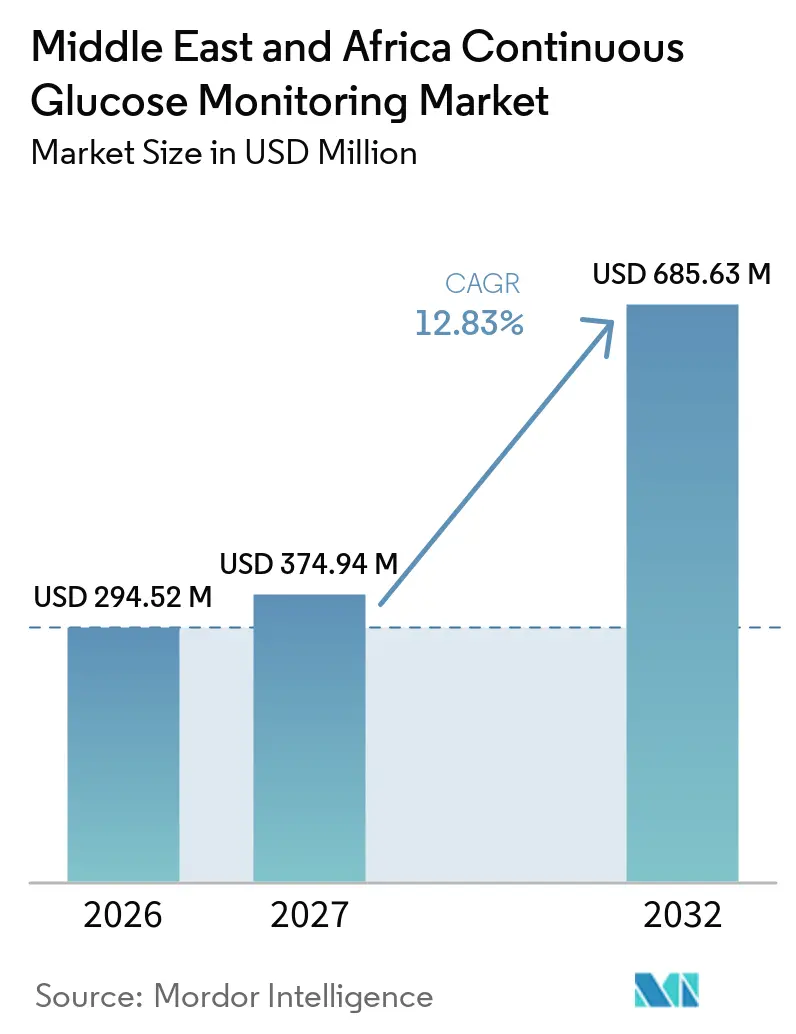
The Middle East And Africa Continuous Glucose Monitoring Market size is projected to be USD 294.52 million in 2026, USD 374.94 million in 2027, and reach USD 685.63 million by 2032, growing at a CAGR of 12.83% from 2027 to 2032.
During the COVID-19 pandemic patients with diabetes, infected experienced additional stress and increased secretion of hyperglycemic hormones. To avoid aggravation, a patient's blood glucose monitoring had to be considered during the COVID-19 patient's hospitalization which highlighted the importance of continuous glucose monitoring devices. Pandemic emergency created a surge in remote care from both patients and providers and removed many long-standing regulatory barriers. Thus, the COVID-19 outbreak increased the continuous glucose monitoring device market's growth.
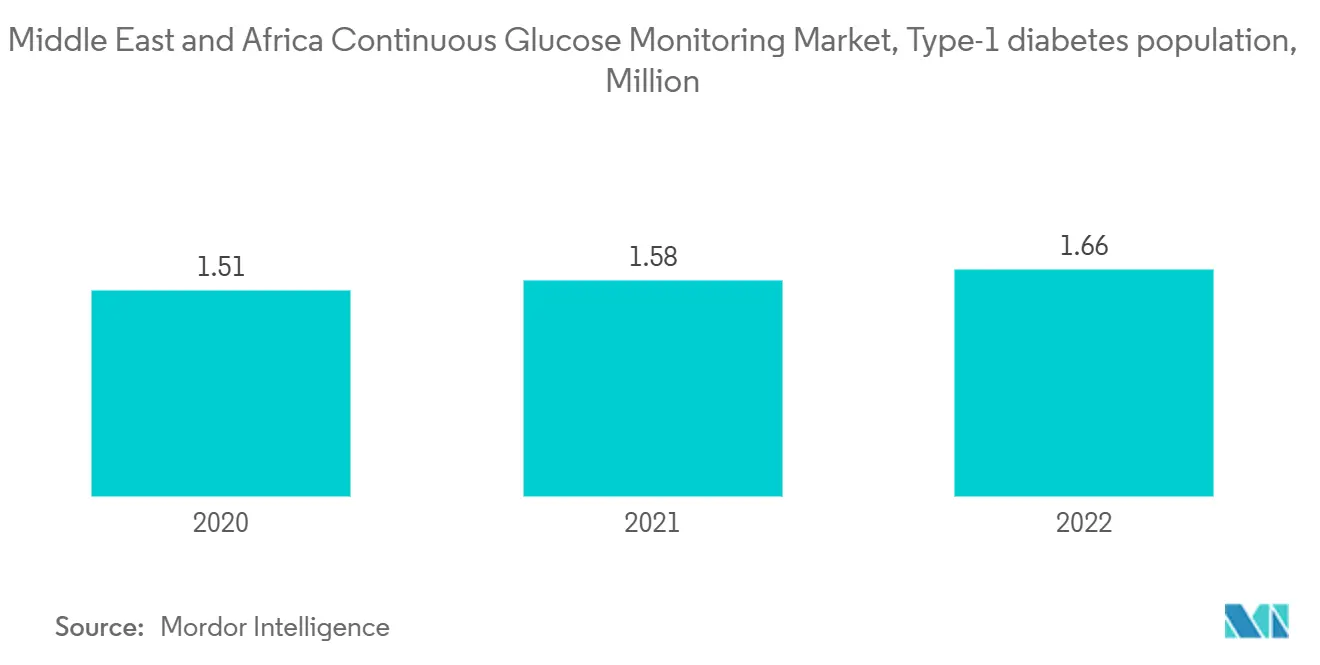
The Middle East and African region had witnessed an alarming increase in the prevalence of diabetes, in recent years, the rate of diabetes is at an all-time high, mainly due to lifestyle changes. Diabetes is associated with many health complications. Patients with diabetes require many corrections throughout the day to maintain nominal blood glucose levels, such as administering additional insulin or ingesting additional carbohydrates by monitoring their blood glucose levels. Diabetes poses an emerging healthcare burden across the region The Type 1 diabetes population completely depends on insulin therapy. Therefore, they constantly need to monitor their blood glucose levels. Some Type 2 diabetes patients also depend on insulin therapy and 90% of the diabetic population is type 2, most of them use Continuous glucose monitoring devices to monitor their insulin levels.
Owing to the aforementioned factors the studied market is anticipated to witness growth over the analysis period.
Note: Market numbers in this report are based on Mordor Intelligence's proprietary estimation framework, which combines nine months of actuals with Q4 projections for base year 2026.
Middle East and Africa Continuous Glucose Monitoring Market Trends and Insights
The sensors segment holds the highest market share in the Middle East and African Continuous Glucose Monitoring Market in the current year
Sensors hold the highest market share in the current year and are expected to register the fastest CAGR over the forecast period.
To use a CGM, a small sensor is inserted into the abdomen or arm with a tiny plastic tube known as a cannula penetrating the top layer of skin. An adhesive patch holds the sensor in place, allowing it to take glucose readings in interstitial fluid throughout the day and night. Generally, the sensors must be replaced every 7 to 14 days. A small, reusable transmitter connected to the sensor allows the system to send real-time readings wirelessly to a monitor device that displays blood glucose data. Some systems come with a dedicated monitor, and some display the information via a smartphone app.
CGM sensors have proven to be effective for patients with frequent hypoglycemic events, sensor-augmented pumps, and gestational diabetes treated with either continuous subcutaneous insulin infusion or a multiple daily injection insulin regimen. Researchers are trying to find and develop alternatives to electrochemical-based glucose sensors and create more affordable, minimally invasive, and user-friendly CGM sensors. Optical measurement is a promising platform for glucose sensing. Some technologies have been reported to have high potential for continuous glucose sensing, including spectroscopy, fluorescence, holographic technology, etc. Eversense, a CGM sensor based on fluorescence sensing developed by Senseonics Company, presents a much longer lifespan in comparison with electrochemical sensors.
Governments in the Middle East have identified the threat of diabetes and started to respond with various policies, initiatives, and programs. Six out of 15 countries in this region still do not have a national operational action policy for diabetes. Many countries still do not have a national strategy to reduce overweight, obesity, and physical inactivity, which are important risk factors for diabetes. Most counties have fully implemented national diabetes treatment guidelines. However, constant measures are being taken to minimize diabetic complications; therefore, owing to the aforesaid factors, the growth of the studied market is anticipated in the Middle East and African region.
Saudi Arabia is expected to dominate the Middle East and Africa Continuous Glucose Monitoring Market over the forecast period
Saudi Arabia holds the largest share in the continuous glucose monitoring market in the Middle East and African region and is expected to register the fastest CAGR over the forecast period.
More than one in ten people in Saudi Arabia were living with diabetes, and the prevalence of the disease was expected to almost double by 2045, according to the report by the IDF 2021. The IDF report 2021 mentioned that 4.27 million people in Saudi Arabia, which has a population of about 34.8 million, had diabetes, while a further 1.86 million people have the disease but are yet to be diagnosed.
It is imperative that CGM devices be used alongside insulin pumps. As the trends show a higher number of diabetic patients using insulin pumps for diabetes management, it can be predicted that the number of units of CGM devices sold will also follow. Type-1 patients require continuous monitoring to keep a close watch on their glucose levels, which is likely to generate demand in the coming years. Due to the adaptability of new technology and the high prevalence of diabetes in the population, Saudi Arabia dominates the market, among other countries.
Therefore, owing to the aforesaid factors, the growth of the studied market is anticipated in the Middle East and Africa region.
Competitive Landscape
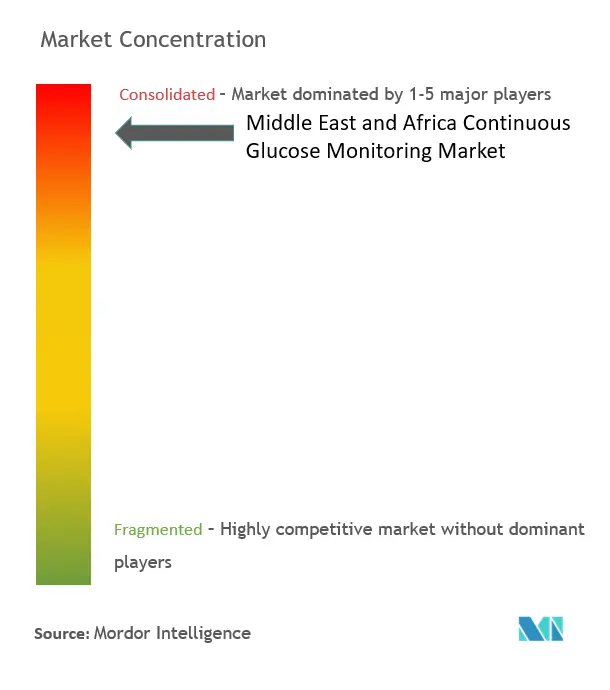
The Middle East and African continuous glucose monitoring market is consolidated, with a few major manufacturers like Dexcom, Medtronic, etc. present in the market.
Middle East and Africa Continuous Glucose Monitoring Industry Leaders
-
Dexcom
-
Medtronic
-
Senseonics
-
Abbott Diabetes Care
-
GlySens
- *Disclaimer: Major Players sorted in no particular order
Recent Industry Developments
- February 2023: Dexcom announced the launch of Dexcom G7 Continuous Glucose Monitoring in South Africa. The Dexcom G7 includes the Dexcom Share and Follow feature. The user of the Dexcom Follow app can also create customizable alerts and alarms. Additionally, the G7 system provides a more comprehensive view of glucose levels over time, giving people with diabetes and their healthcare providers more information to make decisions about treatment and diabetes management.
- June 2022: Abbott announced that it's developing a new bio-wearable that would continuously monitor glucose and ketone levels in one sensor. The glucose-ketone sensor was expected to be the same size as Abbott's FreeStyle Libre 3 sensor, the world's smallest and thinnest continuous glucose monitoring sensor, and will connect to Abbott's digital ecosystem, including personal and caregiver mobile apps and cloud-based data management software for remote monitoring by healthcare professionals.
Middle East and Africa Continuous Glucose Monitoring Market Report Scope
Continuous glucose monitoring is a wearable tool that makes it easier for people with diabetes to track their blood sugar levels over time and measures their glucose levels 24 hours a day while wearing the device. The Middle East and Africa continuous glucose monitoring market is segmented by components (sensors and durables) and geography (Saudi Arabia, Iran, Egypt, Oman, South Africa, and the rest of the Middle East and Africa). The report offers the value (in USD) and volume (in units) for the above segments. Further, the report will cover a segment-wise breakdown (value and volume) for all the countries covered under the table of contents.
Components
| Sensors |
| Durables |
Distribution Channel
| Online |
| Offline |
Geography
| Saudi Arabia |
| Iran |
| Egypt |
| Oman |
| South Africa |
| Rest of Middle East and Africa |
| Components | Sensors |
| Durables | |
| Distribution Channel | Online |
| Offline | |
| Geography | Saudi Arabia |
| Iran | |
| Egypt | |
| Oman | |
| South Africa | |
| Rest of Middle East and Africa |
Key Questions Answered in the Report
How big is the Middle East And Africa Continuous Glucose Monitoring Market?
The Middle East And Africa Continuous Glucose Monitoring Market size is expected to reach USD 374.94 million in 2027 and grow at a CAGR of 12.83% to reach USD 685.63 million by 2032.
What is the current Middle East And Africa Continuous Glucose Monitoring Market size?
In 2026, the Middle East And Africa Continuous Glucose Monitoring Market size is expected to reach USD 332.31 million.
Who are the key players in Middle East And Africa Continuous Glucose Monitoring Market?
Dexcom, Medtronic, Senseonics, Abbott Diabetes Care and GlySens are the major companies operating in the Middle East And Africa Continuous Glucose Monitoring Market.
What years does this Middle East And Africa Continuous Glucose Monitoring Market cover, and what was the market size in 2025?
In 2025, the Middle East And Africa Continuous Glucose Monitoring Market size was estimated at USD 294.52 million. The report covers the Middle East And Africa Continuous Glucose Monitoring Market historical market size for years: 2021, 2022, 2023, 2024, and 2025. The report also forecasts the Middle East And Africa Continuous Glucose Monitoring Market size for years: 2027, 2028, 2029, 2030, 2031, and 2032.