
Market Overview
| Study Period | 2019 - 2031 |
|---|---|
| Forecast Data Period | 2026 - 2031 |
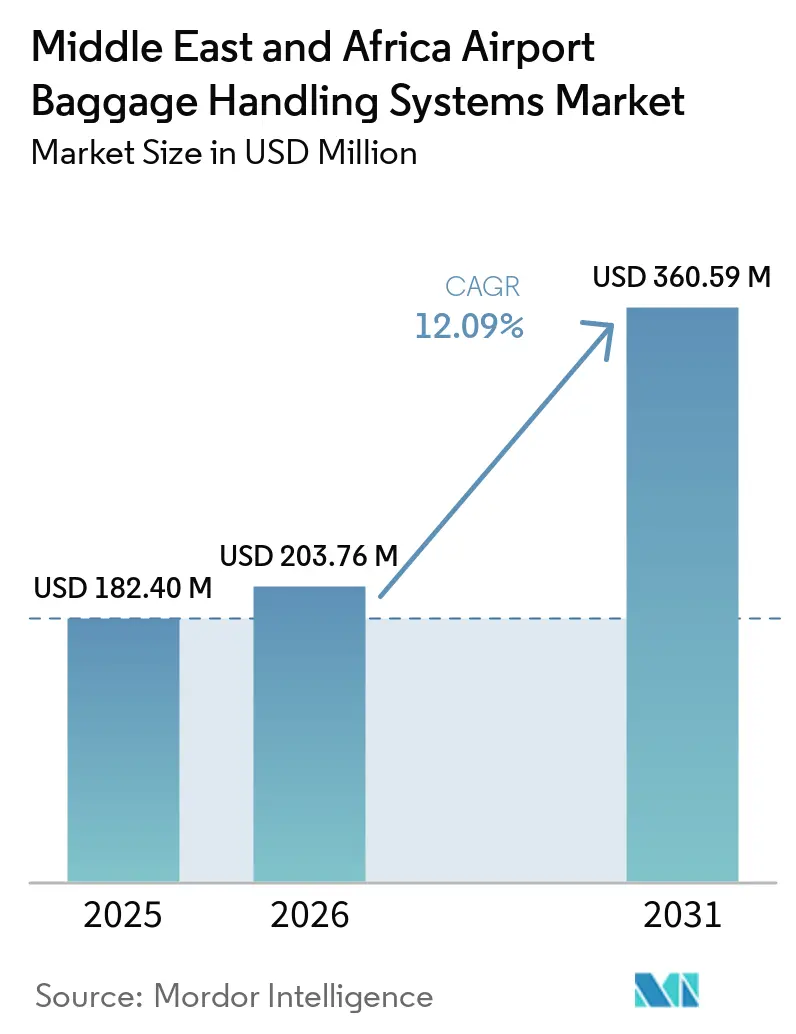
| Base Year Market Size (2025) | USD 182.40 Million |
| Market Size (2026) | USD 203.76 Million |
| Market Size (2031) | USD 360.59 Million |
| Growth Rate (2026 - 2031) | 12.09 % |
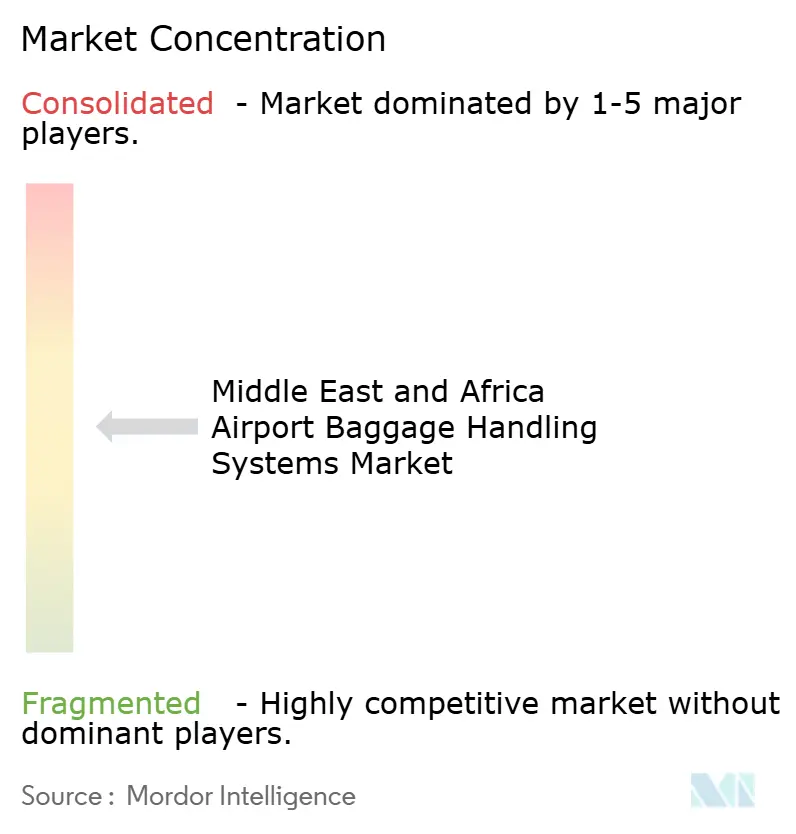
| Market Concentration | Medium |
Major Players *Disclaimer: Major Players sorted in no particular order Image © Mordor Intelligence. Reuse requires attribution under CC BY 4.0. | |
Middle East and Africa Airport Baggage Handling Systems Market Analysis by Mordor Intelligence
The Middle East and Africa airport baggage handling systems market size was valued at USD 182.40 million in 2025, and is projected to grow from USD 203.76 million in 2026 to USD 360.59 million by 2031 at a 12.09% CAGR between 2026 and 2031. Airport expansion programs in the Gulf are concentrating demand in large terminals that require integrated systems for conveying, screening, storage, tracking, and control. Greenfield terminals can incorporate automation at the design stage, whereas established airports must integrate new equipment into existing operations. Government aviation and tourism programs are shaping procurement schedules across Saudi Arabia, the UAE, Qatar, Egypt, and Turkey. This creates opportunities for suppliers that can combine hardware, software, commissioning, and long-term service support.
Key Report Takeaways
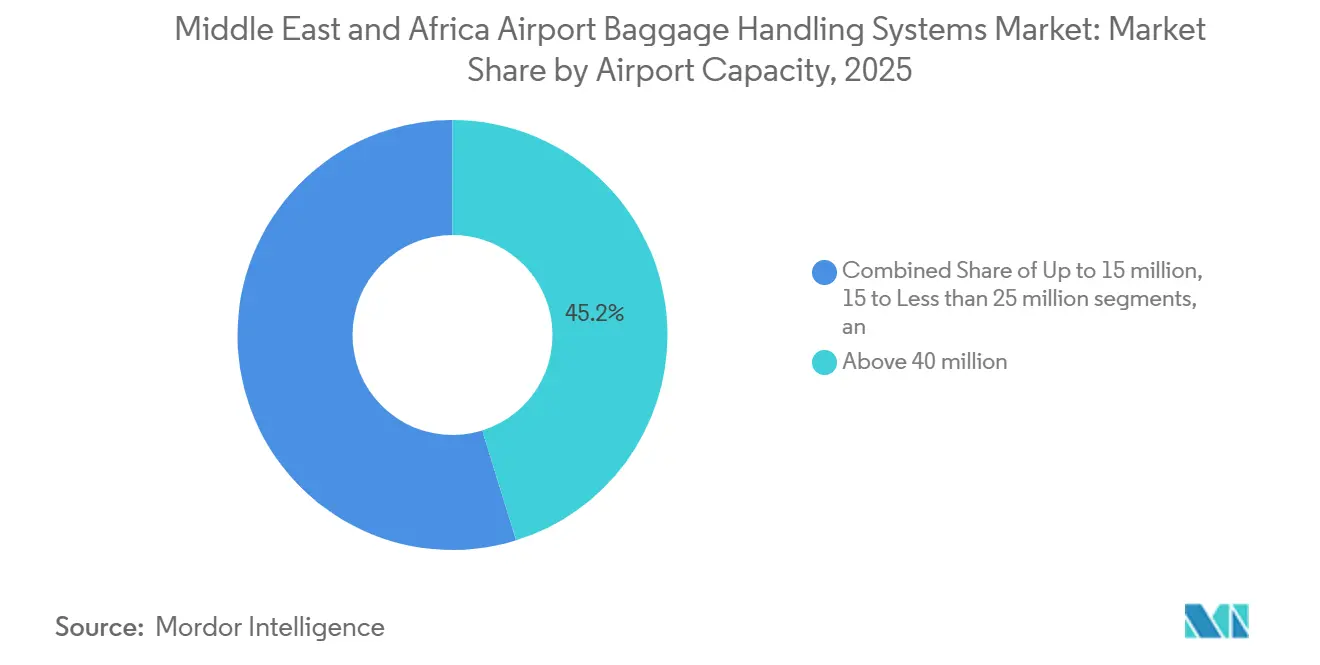
- By airport capacity, airports handling more than 40 million passengers accounted for 45.20% of market share in 2025, while this tier is forecast to expand at a 12.57% CAGR through 2031.
- By solution, conveying and sorting held 31.93% market share in 2025, while tracking and tracing is forecast to expand at a 13.03% CAGR through 2031.
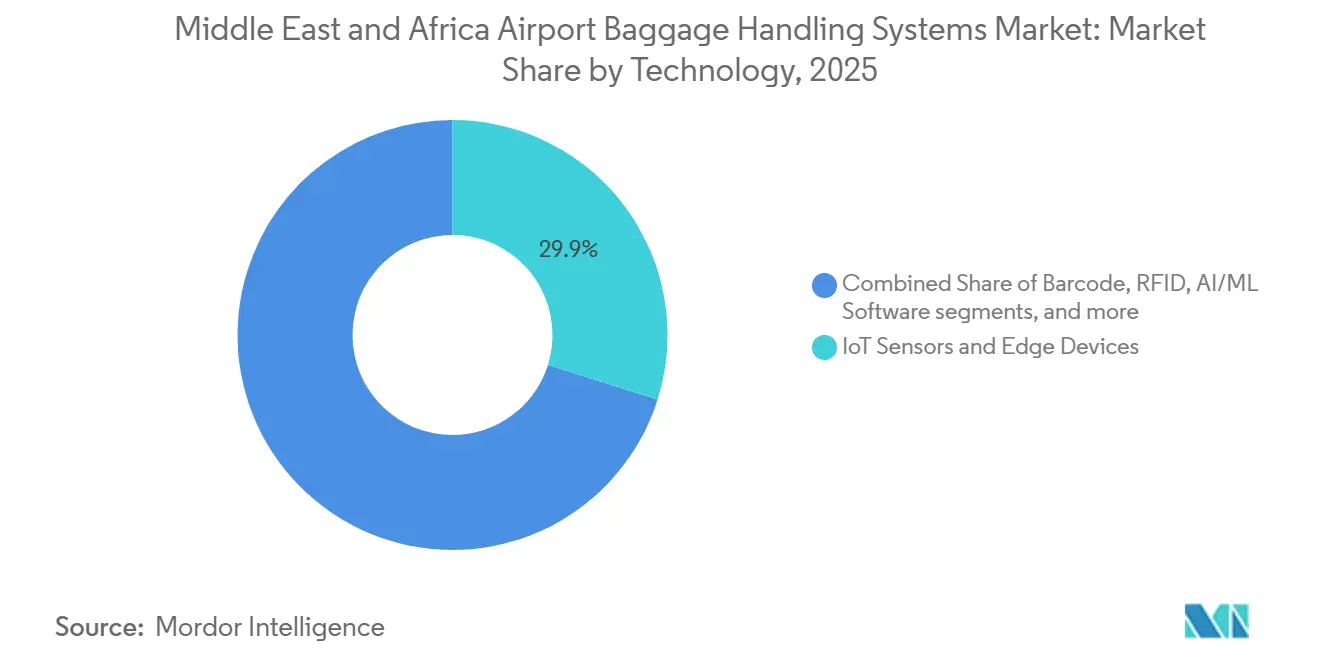
- By technology, IoT sensors and edge devices held 29.85% share in 2025, while AI/ML software is forecast to grow at a 17.86% CAGR through 2031.
- By system type, conveyor belt systems held 44.15% share in 2025, while hybrid and other emerging systems are forecast to grow at a 14.47% CAGR through 2031.
- By geography, Saudi Arabia held 24.15% share in 2025 and is forecast to grow at a 13.83% CAGR through 2031.
Note: Market size and forecast figures in this report are generated using Mordor Intelligence’s proprietary estimation framework, updated with the latest available data and insights as of January 2026.
Middle East and Africa Airport Baggage Handling Systems Market Trends and Insights
Drivers Impact Analysis*
| Driver | (~) % Impact on CAGR Forecast | Geographic Relevance | Impact Timeline |
|---|---|---|---|
| Rapid airport capacity expansions across the Gulf Cooperation Council (GCC) | +2.80% | GCC-wide, Saudi Arabia, UAE, Qatar, Kuwait, Oman, and Turkey | Long term (≥ 4 years) |
| Government-backed tourism diversification programs | +2.10% | Saudi Arabia, UAE, Qatar, and Egypt | Medium term (2-4 years) |
| AI-powered predictive maintenance to cut downtime | +1.90% | Dubai, Jeddah, Doha, Istanbul, South Africa, and Egypt | Long term (≥ 4 years) |
| Mandatory ICAO Annex 17 security compliance upgrades | +1.60% | GCC and North Africa, with spillover to sub-Saharan Africa | Short term (≤ 2 years) |
| Shift toward end-to-end self-service passenger journeys | +1.40% | UAE, Qatar, Saudi Arabia, South Africa, and Egypt | Medium term (2-4 years) |
| Green-airport mandates favoring low-energy conveyors | +1.20% | UAE, Qatar, Egypt, Morocco, and Turkey | Long term (≥ 4 years) |
| Source: Mordor Intelligence | |||
Rapid Airport Capacity Expansions Across the GCC
Dubai Aviation Engineering Projects confirmed in 2025 that contracts exceeding AED 55 billion (USD 14.97 billion) for Al Maktoum International Airport were scheduled to be awarded in 2026. Dedicated baggage-handling packages are among the earliest to be procured for the project. Al Maktoum and King Salman International Airport together target a capacity of over 445 million passengers annually. Such throughput requires sorters capable of handling 15,000 to 20,000 bags per hour. The market, therefore, favors automated sorting designs rather than conventional conveyor-only systems. Bechtel’s May 2025 agreement to manage 3 terminal packages at King Salman International Airport indicates that delivery is moving into active procurement.[1] Parsons also received delivery-partner contracts for the airport’s airfield and landside infrastructure in May 2025. Matarat Holding manages 22 regional airports and is also advancing capacity projects in Hail, Abha, Taif, and Qassim. This broadens demand beyond the flagship hubs. Commissioning-related awards for King Salman’s first terminal and Al Maktoum’s first phase support a sustained pipeline for the market.
Government-Backed Tourism Diversification Programs
Saudi Arabia recorded 123 million tourists and USD 81 billion in tourism revenue during 2025, according to the official Vision 2030 annual report.[2] The country revised its 2030 visitor target to 150 million after reaching the earlier 100 million target ahead of schedule. Passenger facilities must expand alongside this tourism program. Automated baggage handling supports the passenger experience required at transfer airports and visitor gateways. Consequently, tourism policy has become an upstream driver of market demand. It also shortens the interval between announced capacity plans and system tenders. Egypt is advancing Terminal 4 at Cairo International Airport, which is designed to handle at least 30 million passengers annually and incorporate AI, digital technologies, and smart airport operating systems. Separately, in March 2025, the International Finance Corporation advised Egypt on private sector participation across 11 airports, with Hurghada International Airport serving as the pilot PPP transaction. The program could create a pathway for private capital and operating expertise to support airport infrastructure, improve operational efficiency, and upgrade passenger services across the participating airports. SITA has also discussed a national airport digital transformation program with Egypt. These programs connect tourism expansion with operational modernization. They create demand for flexible suppliers in the market.
Mandatory ICAO Annex 17 Security Compliance Upgrades
Aviation security and baggage-tracking requirements are increasing the importance of compliant screening and baggage infrastructure. The UAE GCAA’s CAR Part VII Edition 05, issued in May 2025 and subsequently revised in February 2026, will require airport operators to consider advanced security equipment, integrate security requirements into airport design, and ensure appropriate screening of hold baggage. The ICAO Amendment 18 to Annex 14 Volume I also introduced updated provisions covering aerodrome design and, from November 2026, ground handling. IATA Resolution 753 requires member airlines to track baggage at acceptance, loading, transfer, and arrival, while its Global Baggage Roadmap, launched in May 2025, set a 10-year direction toward greater baggage visibility, automation, and standardized data exchange. Barcode scanning remains widely used, while RFID adoption continues to expand at larger airports. In May 2025, Dubai Aviation Engineering Projects awarded a contract for advanced CT checkpoint-screening systems, including HI-SCAN 6040 CTiX Model-S units, across the terminals at Dubai International Airport. Together, these requirements and investments are expected to support the continued modernization of baggage tracking, screening integration, and handling infrastructure across regional airports.
Shift Toward End-to-End Self-Service Passenger Journeys
In July 2026, Hamad International Airport, Qatar Airways, and SITA launched Fast Pass across more than 700 biometric touchpoints, enabling enrolled passengers to check in, drop off bags, clear security, and board using facial recognition. SITA’s self-service bag-drop units also perform facial verification, directly integrating biometric passenger processing with baggage acceptance. In November 2025, Emirates invested AED 85 million (~ USD 23.11 million) to install more than 200 biometrics-enabled cameras across Terminal 3 at Dubai International Airport, extending facial recognition across key passenger-processing stages. These deployments reflect a broader shift toward faster and increasingly self-service terminal processing across the Middle East. Automated check-in and bag drop can reduce queues and increase passenger throughput while changing the rate and pattern of baggage entry into airport handling systems. This shift increases the need to coordinate baggage acceptance with tracking, screening, sortation, and conveyor controls, particularly during peak periods. For baggage handling system providers, the opportunity extends beyond standalone kiosks to integrated platforms that can maintain baggage identification, routing visibility, and reliable processing as passenger flows become more automated.
Restraints Impact Analysis*
| Restraint | (~) % Impact on CAGR Forecast | Geographic Relevance | Impact Timeline |
|---|---|---|---|
| Sub-saharan capex constraints post-COVID-19 | -1.80% | Sub-Saharan Africa, Nigeria, Kenya, Tanzania, and Ethiopia before Bishoftu | Long term (≥ 4 years) |
| High integration complexity with legacy information technology (IT) and operational technology (OT) | -1.30% | Legacy hubs in Egypt, Turkey, and South Africa, with spillover across Middle East and Africa | Medium term (2-4 years) |
| Volatile regional supply chain for electromechanical parts | -0.90% | GCC procurement chains and sub-Saharan Africa | Short term (≤ 2 years) |
| Heightened cybersecurity and data-sovereignty legislation | -0.70% | UAE, Saudi Arabia, Egypt, and wider GCC projects | Medium term (2-4 years) |
| Source: Mordor Intelligence | |||
Sub-Saharan Capex Constraints Post-COVID-19
The African Union stated in October 2025 that Africa requires USD 25-30 billion over the next decade to close aviation infrastructure gaps. It identified USD 10 billion for airport and aerodrome infrastructure.[3] Many airport upgrades, therefore, depend on multilateral or concessional financing. This can delay contract conversion after tenders are issued. Kenya’s planned greenfield terminal remains tied to the confirmation of financing. The market has a distinct funding divide between Gulf mega-projects and sub-Saharan airport programs. South African airport tenders show that operational needs remain strong despite funding pressures. ACSA issued maintenance solicitations for baggage handling at Bram Fischer, King Shaka, and Cape Town International airports during 2025 and 2026. These procurements can maintain existing systems, but they do not always fund complete replacements. Suppliers need to assess financing certainty alongside the technical scope. Tender pipelines may be broader than the awarded-contract pipeline. This slows deployment schedules in parts of Africa. It also makes modular projects more relevant to the Middle East and Africa airport baggage handling systems market.
High Integration Complexity with Legacy IT and OT
Airport baggage handling systems integrate PLCs, supervisory controls, baggage reconciliation, and proprietary sortation software, creating a complex operational technology environment that must remain continuously available. Legacy devices and vendor-specific protocols can make cybersecurity upgrades difficult to implement without disrupting live operations. In July 2025, ACI EUROPE released dedicated OT and ICS penetration-testing guidance covering baggage handling systems, highlighting the additional planning, vendor coordination, and specialized testing required for legacy and proprietary airport systems. The guidance noted that OT testing can create operational risks and that dependence on equipment vendors can delay security assessments. The regulatory environment is also becoming more demanding. EASA Part-IS became applicable to aerodrome operators within its European scope in October 2025, while Saudi Arabia's Operational Technology Cybersecurity Controls and the UAE's information assurance framework reinforce cybersecurity requirements for relevant critical and operational systems. At the same time, the UAE rules introduced data sovereignty and cross-border data considerations rather than a blanket localization requirement. For baggage-system integrators, incorporating network segmentation, secure interfaces, monitoring, and security testing into existing equipment can increase engineering complexity and extend upgrade and commissioning schedules. These challenges can slow the conversion of demand for modernization into completed projects across the market.
*Our forecasts treat driver/restraint impacts as directional, not additive. The impact forecasts reflect baseline growth, mix effects, and variable interactions.
Segment Analysis
By Airport Capacity: Mega-Hubs Set the Pace, Regional Clusters Follow
Airports handling more than 40 million passengers accounted for 45.20% of the market share in 2025. Dubai, Doha, Riyadh, Istanbul, and Jeddah are key demand centers for high-capacity baggage handling infrastructure, as major hub airports expand passenger capacity and terminal operations. At Al Maktoum International Airport, the planned development includes an automated underground baggage handling system designed to support large-scale passenger expansion. In February 2025, Hamad International Airport opened Concourse E, adding 51,000 m2 and eight contact gates. The subsequent completion of Concourses D and E increased the airport’s overall capacity to more than 65 million passengers annually. These large hubs require extensive conveying, sortation, storage, screening interfaces, controls, and baggage tracking infrastructure.
Airports handling more than 40 million passengers are also the fastest-growing capacity segment, with a forecast CAGR of 12.57% through 2031. Software, monitoring, predictive maintenance, and high-level controls are also becoming increasingly important as operators aim to improve the performance of installed baggage infrastructure. Istanbul Airport demonstrates this requirement through its large-scale baggage system, which combines individual carrier technology, early baggage storage, integrated software, and continuous tracking. Smaller and mid-sized airports generally prefer scalable modernization approaches. However, technology selection depends on baggage volumes, transfer intensity, terminal configuration, screening requirements, and available investment, rather than passenger capacity alone.

By Solution: Conveying and Sorting as the Load-Bearing Layer
Conveying and sorting systems accounted for 31.93% of the market in 2025. The share reflects the trunk infrastructure needed in major terminal projects. High-capacity tilt-tray and cross-belt sorters can achieve up to 2,400 discharges each hour. These systems move bags between check-in, screening, storage, transfer, and reclaim areas. Their importance is greatest where large airports require continuous high-volume baggage flow. The segment remains the physical base for integrated baggage operations.
Tracking and tracing is the fastest-growing solution segment, with a forecast CAGR of 13.03% through 2031. Tracking and tracing are gaining importance as airports seek to improve baggage visibility and provide passengers with timely updates. In May 2025, IATA reported that 81% of travelers wanted better baggage tracking, while 74% expected real-time mobile updates. SITA also reported a 23% decline in mishandled baggage rates in 2025. At Hamad International Airport, BEUMER’s CrisBag system offers more than 10,000 storage positions and enables continuous baggage tracking across key handling stages.
By Technology: IoT as the Data Foundation, AI the Performance Engine
IoT sensors and edge devices led the technology segment with a 29.85% share in 2025. Sensors provide data from motors, conveyors, sorters, and screening equipment. This information supports predictive maintenance and operational monitoring. The Middle East and Africa airport baggage handling systems market uses IoT as the foundation for digital operational control. Hardware-related data collection remains important because other software tools rely on consistent field data. This gives connected devices a broad role across installed baggage systems.
AI/ML software is the fastest-growing technology segment, with a forecast CAGR of 17.86% through 2031. Its use cases include failure prediction, flow optimization, routing updates, and anomaly detection. A 2025 Scientific Reports study demonstrated the potential of computer vision in detecting baggage damage and operational anomalies. However, the approach remained experimentally validated rather than deployed at an airport scale. IATA reported that 27% of surveyed airports used RFID in 2024, with adoption rising to 54% among mega-airports, while barcode scanning remained the dominant tracking technology. Robotics and autonomous vehicles are also advancing, but airports continue to adopt them selectively across baggage operations.
By System Type: Conveyors Anchor Operations, Hybrid Models Rise
Conveyor belt systems held 44.15% share in 2025, reflecting their use as baseline infrastructure in both new and retrofit projects. Modular design, established maintenance requirements, and cost-effective operation continue to support the use of these systems across new terminals and retrofit projects. BEUMER states that modern individual carrier systems can reduce energy consumption by up to 60% compared with traditional baggage conveyors, making energy efficiency a key factor in lifecycle investment decisions.
Hybrid and other emerging systems are the fastest-growing system type, with a forecast CAGR of 14.47% from 2026 to 2031. Hybrid and emerging systems use architectures that combine conventional conveyors with DCVs, autonomous carriers, and other automated technologies. Tote-based individual carrier systems enable continuous baggage tracking and can improve energy efficiency and operational control. Istanbul Airport demonstrates this approach through Vanderlande’s TUBTRAX system, which provides 100% baggage tracking, integrated controls, and more than 10,000 early-bag storage positions.
Geography Analysis
Saudi Arabia held 24.15% of the market share in 2025 and is forecast to grow at a CAGR of 13.83% through 2031. GACA targets 330 million annual passengers, 4.50 million tons of cargo, and connections to 250 destinations by 2030. The country handled 140.90 million passengers in 2025, including 76 million international travelers. King Salman International Airport and MATARAT Holding’s broader Saudi airport portfolio are expected to drive demand across mega-hub and regional airport infrastructure. The UAE’s Al Maktoum International Airport also represents a major long-term capacity expansion program. In Qatar, Hamad International Airport entered 2026 with a stronger focus on optimization and system performance following its recent terminal expansion.
Türkiye remains a major demand center, with Istanbul Airport handling approximately 84.5 million passengers in 2025. The airport currently operates three main runways and two reserve runways, with its fourth main runway scheduled to enter service in Q4 2026. In July 2026, Lödige Industries was selected for Turkish Cargo’s SMARTIST 2.0 expansion, which will increase annual automated cargo-handling capacity from 2.0 million tons to 4.5 million tons. Egypt presents additional opportunities through Cairo Terminal 4 and, separately, the IFC-supported airport PPP program.
South Africa is advancing ACSA’s ZAR 21.70 billion (USD 1.14 billion) network-wide capital investment program, as well as a ZAR 14.50 billion (USD 0.90 billion) five-year infrastructure modernization program at O.R. Tambo International Airport. Ethiopia also moved into project execution when construction of Bishoftu International Airport officially began in January 2026, with financing support from the African Development Bank. Together, Saudi Arabia, the UAE, Qatar, Türkiye, Egypt, South Africa, and Ethiopia represent key regional centers for investment in airport infrastructure and handling systems.
Regulatory Landscape
Airport baggage-handling procurement in the Middle East and Africa is anchored in aerodrome certification and aviation security compliance. Many national civil aviation authorities align their requirements with ICAO Annex 14 (Aerodromes), which covers certified aerodrome oversight and operational baselines. In the UAE, the General Civil Aviation Authority (GCAA) framework, including Civil Aviation Regulations (CAR) Part VII (Aviation Security) and related ground-operations guidance (AMC/CAAP 46), embeds mandatory hold-baggage security controls such as screening before loading and protection of baggage from unauthorized interference across the handling chain.
Regulatory refresh cycles also influence upgrade timing and specification choices. ICAO issued Annex 14 Volume I Corrigendum No. 2 in March 2026, reinforcing the region-wide baseline for aerodrome design and operations, used by authorities such as the Oman CAA (CAR-139) and the Tanzania CAA (Aerodrome Design and Operations Regulations, 2024). In parallel, the UAE National Air Transport Facilitation Program (NATFP) Edition 3 (March 2026) coordinates actions by airport operators and government agencies that affect baggage and cargo processes, increasing the need for compliant system integration across screening, reconciliation, and operational data handling.
Value Chain Analysis
The value chain for airport baggage handling systems in the Middle East and Africa typically starts with system design and engineering, covering concept and detailed design for new terminals and retrofits. It then moves through equipment supply, including conveyors, sorters, DCVs/totes, early bag storage, and in-line screening interfaces, followed by software and controls such as high-level control, tracking, and reconciliation platforms. The chain continues with integration into airport IT/OT, followed by commissioning and lifecycle services.
For mega-hubs, contracting is often packaged as part of EPC-style terminal programs led by airport development bodies and prime contractors. Specialist BHS integrators deliver performance warranties and multi-year operations and maintenance agreements. Upstream dependencies include electromechanical components, sensors, and controls, while downstream value increasingly accrues in service, spares, and digital operations such as predictive maintenance, diagnostics, and cyber-secure operations. Program-scale procurement provides clear demand signals for integrators and sub-suppliers: Dubai Aviation Engineering Projects highlighted that over AED 55 billion (USD 14.97 billion) in contracts scheduled for award in 2026 for the Al Maktoum International Airport development include a dedicated baggage-handling system package. In Africa, large modernization programs and greenfield builds rely more heavily on external financing and large civil contractors, exemplified by the JKIA modernization contract in Kenya and the Bishoftu greenfield airport project in Ethiopia, both of which drive demand for turnkey integration and longer-term support capability.
Competitive Landscape
The Middle East and Africa airport baggage handling systems market is moderately concentrated, with BEUMER Group GmbH & Co. KG, Vanderlande Industries B.V., Smiths Group plc, and Alstef Group SAS holding strong positions in GCC mega-projects. Their offerings combine system design, automation, controls, commissioning, and long-term performance support. Vanderlande’s planned 2025 acquisition of Siemens Logistics’ operations in Europe, Asia, and the Middle East broadened its baggage, cargo, software, and service capabilities, strengthening its position in integrated airport automation. SITA competes through its baggage reconciliation, tracking, and data management platforms, while Smiths Detection and Rapiscan Systems remain key suppliers of screening technology. Leonardo, Alstef Group, and Pteris Global offer broader baggage-handling and automation capabilities.
In December 2024, SITA is set to partner with Red Sea International Airport to deploy Bag Manager for real-time baggage reconciliation and tracking. In July 2026, Lödige Industries was selected for Turkish Cargo’s SMARTIST 2.0 automation expansion. As a result, system integration, software, automation, and lifecycle support increasingly shape vendor competition.
Saudi localization is also becoming more relevant. METCO and Smiths Detection established local assembly and manufacturing capabilities for screening solutions, while MATARAT’s regional airport portfolio provides a broader pipeline for future airport modernization. Autonomous baggage transport is another emerging opportunity, with dnata already operating six autonomous electric baggage tractors at Dubai World Central and using the airport as a testbed for wider deployment.
Middle East and Africa Airport Baggage Handling Systems Industry Leaders
-
BEUMER Group GmbH & Co. KG
-
Vanderlande Industries B.V.
-
Smiths Group plc
-
Rapiscan Systems, Inc.
-
Alstef Group SAS
- *Disclaimer: Major Players sorted in no particular order
Recent Industry Developments
- July 2026: Airports Company South Africa (ACSA) initiated a ZAR 20 billion (USD 1.23 billion) capital expenditure program for OR Tambo International Airport, including baggage-handling and cargo-terminal upgrades through 2031. The move formalizes a multi-year funding envelope that can translate into phased BHS renewal, controls modernization, and expanded maintenance and spares contracts for suppliers active in South Africa.
- December 2025: Vanderlande completed a High-Level Control (HLC) upgrade for baggage handling systems across all terminals at Dubai International Airport. A controls-layer upgrade of this scale increases the role of software, data, and system orchestration in performance guarantees, and it creates follow-on demand for cybersecurity, analytics, and lifecycle services tied to uptime.
- May 2025: Smiths Detection, a part of Smiths Group, entered into a multi-year agreement with Dubai Aviation Engineering Projects to implement advanced checkpoint screening technologies (HI-SCAN 6040 CTiX Model-S) across all terminals at Dubai International Airport.
Research Methodology Framework and Report Scope
Market Definition and Coverage
This market covers baggage handling systems used at airports across the Middle East and Africa to move, screen, sort, track, store, and deliver passenger bags from check-in to reclaim, including the automation controls and software that run the system end to end.
Scope exclusions: Manual-only baggage handling tools and cargo or freight-only handling systems are not counted in this market sizing.
Segmentation Overview
- By Airport Capacity
- Up to 15 million
- 15 to Less than 25 million
- 25 to Less than 40 million
- Above 40 million
- By Solution
- Check-In and Ticketing Systems
- Security Screening Systems
- Conveying and Sorting Systems
- Early Baggage Storage (EBS)
- Baggage Reclaim/Unloading
- Tracking and Tracing
- By Technology
- Barcode
- RFID
- IoT Sensors and Edge Devices
- Robotics and Autonomous Vehicles (AVs)
- AI/ML Software
- By System Type
- Conveyor Belt Systems
- Tilt-Tray and Cross-Belt Sorters
- Destination-Coded Vehicle (DCV)
- Tote-based/Individual Carrier Systems (ICS)
- Hybrid and Other Emerging Systems
- By Geography
- Saudi Arabia
- United Arab Emirates
- Kuwait
- Egypt
- Oman
- Qatar
- Turkey
- Bahrain
- South Africa
- Rest of Middle East and Africa
Data Sources, Market Sizing, and Validation
Desk Research
Desk work starts with building a simple view of airport activity and planned infrastructure in the region, because baggage handling systems are mostly tied to terminal expansions and refurbishment cycles. We referenced public sources such as ICAO traffic statistics, IATA airport and airline publications, Airports Council International (ACI) datasets and briefs, national civil aviation authority releases, and government budget or project announcements where available.
Next, system demand was shaped using airport development plans, tender notices, and public project updates, followed by cross-checks against company filings, investor presentations, and reputable aviation press. Where it helped with consistency, we also used paid subscriptions for company financials and intelligence, patent databases, and global contracts and tenders. The desk source list here is illustrative only, and many other public and paid sources were reviewed to collect data, validate inputs, and clarify assumptions.
Primary Interviews and Surveys
Primary work used expert interviews and structured surveys with airport engineering and operations teams, system integrators, component suppliers, and maintenance service providers active across the Middle East and Africa. Our questions focused on confirming typical upgrade triggers, award-to-install timelines, and pricing ranges for conveying, sortation, screening interfaces, and tracking layers.
To keep assumptions grounded, feedback was compared across hub airports and secondary airports, and then rechecked when desk signals suggested a change in tender timing or capex priorities.
Distribution of primary research fieldwork respondents
| Company type | Respondent position |
|---|---|
| Top tier: 33% | CXOs: 16% |
| Mid tier: 45% | Functional/Unit leaders: 28% |
| Smaller Players: 22% | Managers: 56% |
Market-Sizing & Forecasting
The sizing logic uses a top-down build where airport capacity additions and modernization pipelines are reconstructed into a demand pool for baggage handling systems, and then converted into annual spending using typical system mix and pricing ranges. To keep totals realistic, we also ran selective bottom-up checks using sampled project values from public tenders, channel feedback on average selling price movement, and a reasonableness check on retrofit intensity at major hub airports.
Key inputs used in the model include passenger throughput trends at regional gateways, planned terminal expansion timelines, the share of projects requiring higher automation (such as cross-belt or tilt-tray sortation and early baggage storage), security screening compliance needs tied to airport upgrades, and currency conversion timing for contract values. When project detail was limited, spending was inferred using airport size proxies and typical cost per handling capacity, and then adjusted after interview feedback.
For forecasting, scenario analysis was applied because demand is lumpy and linked to award timing, procurement delays, and phased commissioning. The base case blended confirmed project pipelines with expected retrofit cycles, and sensitivity cases reflected slower awards or faster hub expansion where interview feedback indicated higher confidence.
Data Validation & Update Cycle
Validation is done in steps so big gaps are caught early and reviewed again before sign-off. Model outputs are compared with independent signals such as airport capex announcements, tender activity, and observed commissioning schedules, and then checked for unusual jumps that do not match known project phasing.
Where variances are found, assumptions are revisited, and targeted re-contacts are triggered with interviewees to confirm whether the change comes from scope, pricing, or timing. Reports are refreshed annually, with interim updates for material events like major project awards, cancellations, or large airport expansion re-scopes. Before delivery, we do a fresh pass on key inputs so clients receive the latest updated view.
Mordor Intelligence's Middle East and Africa Airport Baggage Handling Systems Market Size Compared Against Other Published Estimates
Published market values for this space often look far apart because each publisher makes different choices on what is counted as a baggage handling system, which years are used as the base, and how project timing is converted into yearly revenue. Differences in currency timing and how retrofit work is treated can widen the spread further.
A common gap driver is whether manual handling tools or cargo-only systems are included, since those can inflate totals without reflecting passenger baggage automation spending. Another driver is the level of reliance on long-range pipelines, where some estimates smooth multi-year projects too evenly or apply aggressive price escalation, which can raise a single-year market value.
Benchmark comparison
| Source | Market Size | Gaps in Research Methodology |
|---|---|---|
| Mordor Intelligence | USD 203.76 M (2026) | |
| Trade Journal A | USD 800.00 M (2023) | Uses a broader label that appears to blend passenger baggage systems with adjacent airport handling and automation spend, and it does not clearly separate cargo-only handling from terminal baggage systems. |
| Regional Consultancy B | USD 90.71 M (2022) | Looks conservative because many announced hub expansions and screening-driven retrofits are not visibly translated into spend, and the timing of award-to-revenue recognition is not explained. |
The table points to scope and timing as the biggest reasons for the spread, especially when cargo-only equipment or manual handling tools are blended into the totals. By counting only passenger baggage automation that runs from check-in through reclaim, and by linking revenue timing to tender awards and commissioning phases, the estimate stays traceable, which is how it is handled in Mordor Intelligence.
Key Questions Answered in the Report
What is the forecast growth rate for airport baggage handling systems in the Middle East and Africa?
The sector is forecast to grow at a 12.09% CAGR between 2026 and 2031, rising from USD 203.76 million in 2026 to USD 360.59 million by 2031.
Which country leads demand for airport baggage handling systems in the region?
Saudi Arabia led with 24.15% share in 2025 and is forecast to grow at a 13.83% CAGR through 2031.
Which solution is growing fastest in airport baggage handling?
Tracking and tracing is the fastest-growing solution segment, with a forecast CAGR of 13.03% through 2031.
Why are airports investing in baggage tracking technology?
IATA's baggage roadmap supports end-to-end tracking, while travelers expect accurate and real-time baggage updates.
Which technology has the highest forecast growth?
AI/ML software is forecast to grow at a 17.86% CAGR through 2031, supported by predictive maintenance and flow optimization uses.
Who are the main providers in this field?
Major providers include BEUMER Group, Vanderlande, Daifuku, SITA, Smiths Group, Leonardo, Rapiscan Systems, Alstef Group, and Pteris Global.