
Market Overview
| Study Period | 2020 - 2031 |
|---|---|
| Forecast Data Period | 2026 - 2031 |
| Base Year Market Size (2025) | USD 10.98 Billion |
| Market Size (2026) | USD 11.57 Billion |
| Market Size (2031) | USD 15.05 Billion |
| Growth Rate (2026 - 2031) | 5.41 % |
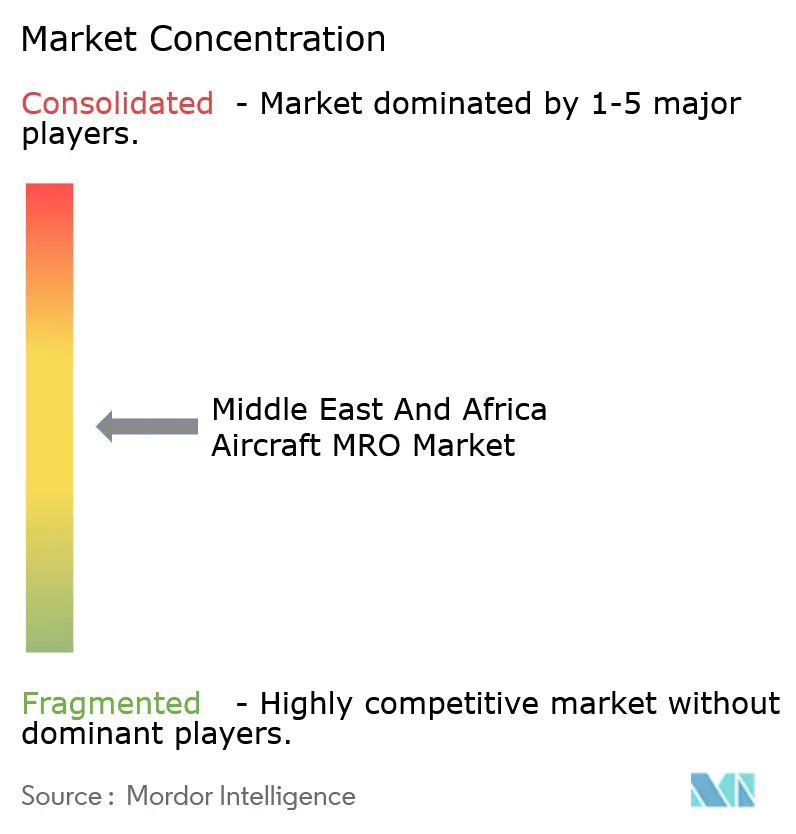
| Market Concentration | Medium |
Major Players *Disclaimer: Major Players sorted in no particular order Image © Mordor Intelligence. Reuse requires attribution under CC BY 4.0. | |
Middle East And Africa Aircraft MRO Market Analysis by Mordor Intelligence
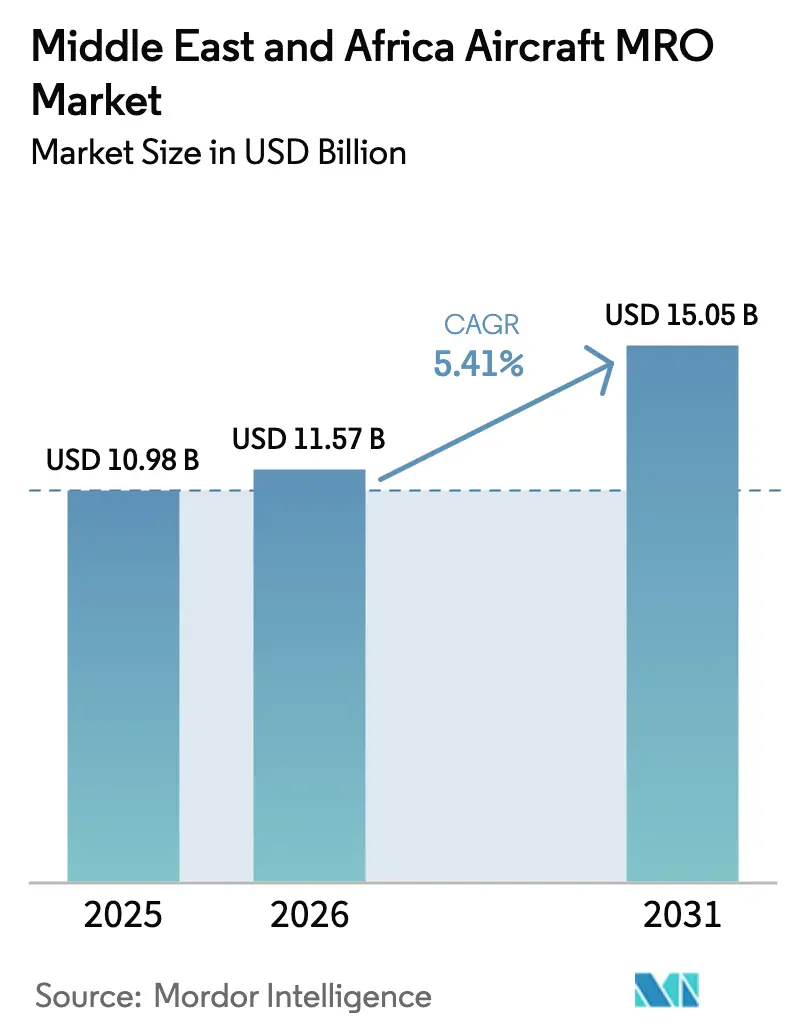
The Middle East and Africa aircraft MRO market size was valued at USD 10.98 billion in 2025 and estimated to grow from USD 11.57 billion in 2026 to reach USD 15.05 billion by 2031, at a CAGR of 5.41% during the forecast period (2026-2031).
Rising investments in Gulf MRO hubs, collaborative frameworks among African flag carriers, and faster adoption of predictive maintenance are widening the addressable workload for engines, components, and line maintenance. The momentum is reinforced by the growth of narrowbody fleets under low-cost carrier strategies, defense-sector localization mandates that channel military work to domestic suppliers, and OEM power-by-the-hour contracts that bundle digital twins with real-time health monitoring. At the same time, shortages of licensed technicians and geopolitical bottlenecks in parts logistics lengthen turnaround cycles and inflate AOG costs, prompting operators to stockpile rotables and negotiate pre-positioned inventory clauses. Competitive dynamics are shifting as OEM-affiliated providers embed analytics into long-term service agreements while independent third-party shops counter with flexible capacity and multi-platform authorizations, creating a nuanced landscape across the aircraft MRO market.
Key Report Takeaways
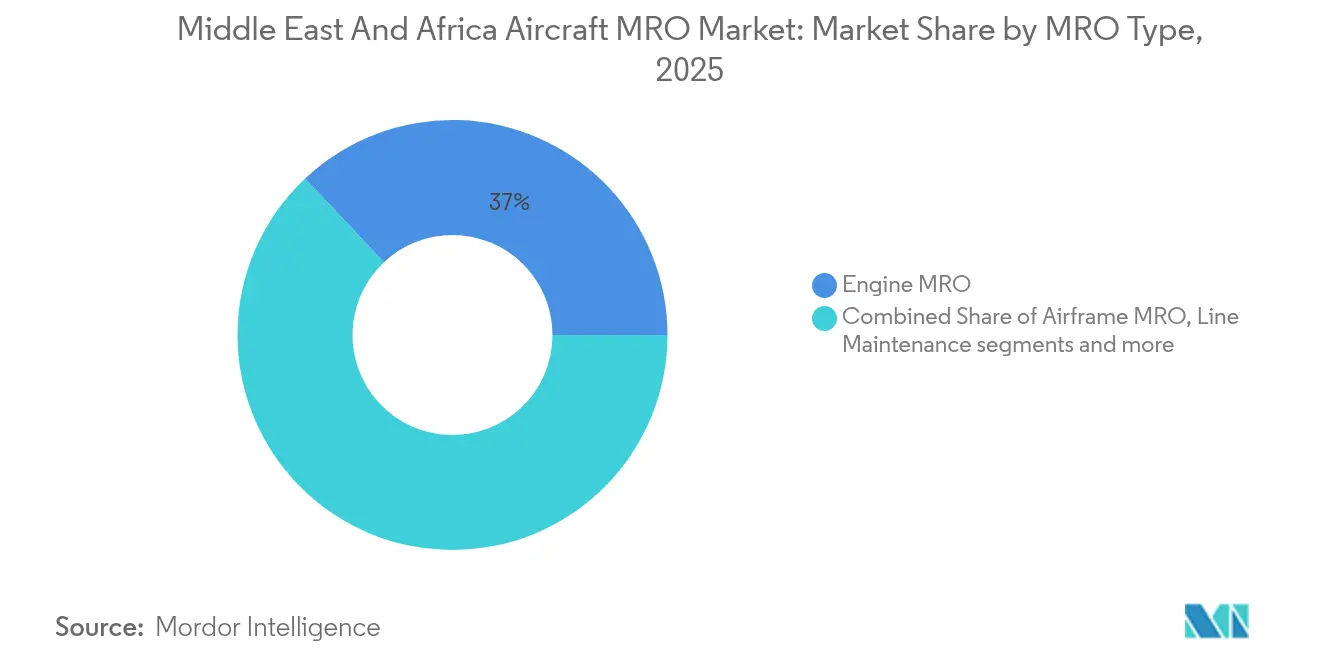
- By MRO type, engine work led with a 37.02% share in 2025, while line maintenance is forecast to post the fastest 6.05% CAGR through 2031, reflecting widespread on-wing service adoption.
- By aviation segment, commercial operations captured 64.72% of the revenue in 2025; military programs are set to log the quickest 6.92% CAGR, driven by localization targets in Saudi Arabia and the UAE.
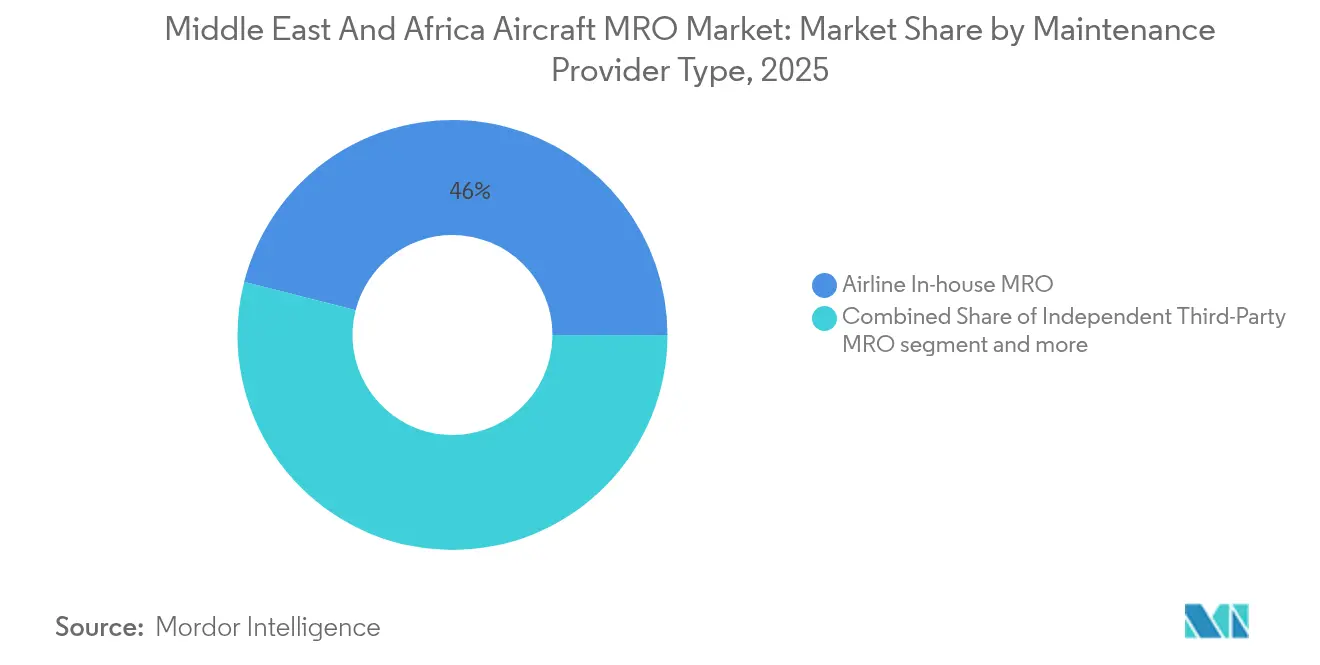
- By maintenance provider, airline in-house shops held a 46.02% share of the aircraft MRO market in 2025. Still, OEM-affiliated providers are advancing at a 6.7% CAGR by leveraging predictive analytics in power-by-the-hour agreements.
- By geography, the Middle East accounted for 68.01% of 2025 revenue, whereas Africa is on track to deliver the sharpest 6.95% CAGR to 2031, as five national carriers pool their engine and component resources.
Note: Market size and forecast figures in this report are generated using Mordor Intelligence’s proprietary estimation framework, updated with the latest available data and insights as of 2026.
Market Trends and Insights
Drivers Impact Analysis of Middle East And Africa Aircraft MRO Market*
| Driver | (~) % Impact on CAGR Forecast | Geographic Relevance | Impact Timeline |
|---|---|---|---|
| Fleet renewal programs by Gulf and African flag carriers | +1.2% | UAE, Saudi Arabia, Qatar, Ethiopia, Egypt | Medium term (2–4 years) |
| Expansion of low-cost carriers across the GCC and North Africa | +0.9% | UAE, Saudi Arabia, Egypt, Morocco | Short term (≤ 2 years) |
| Increasing adoption of OEM power-by-the-hour service agreements | +0.8% | Middle East, selected African hubs | Medium term (2–4 years) |
| Defense localization initiatives supporting domestic engine MRO capabilities | +0.7% | Saudi Arabia, UAE, Turkey, Egypt | Long term (≥ 4 years) |
| Growth of on-wing and mobile engine MRO service offerings | +0.6% | Dubai, Doha, Addis Ababa, Johannesburg | Short term (≤ 2 years) |
| Adoption of predictive maintenance analytics by regional MRO hubs | +0.5% | UAE, Qatar | Medium term (2–4 years) |
| Source: Mordor Intelligence | |||
Fleet Renewal Programs by Gulf and African Flag Carriers
Gulf and African airlines are re-equipping with A320neo, 737 MAX, 777X, and A350 aircraft, driving a surge in early-life engine shop visits for LEAP-1A, GEnx, and Trent XWB powerplants.[1] GE Aerospace invested USD 10 million in test-cell upgrades in Dubai and Doha to meet the next-generation workload.[2] Younger fleets deliver fuel savings but demand tighter adherence to OEM restoration intervals to safeguard operating-cost guarantees. Carriers that secure overhaul slots early gain dispatch reliability advantages, prompting competitors to book capacity years in advance. The resulting front-loaded demand accelerates engine-service revenue growth faster than global fleet expansion.
Expansion of Low-Cost Carriers Across the GCC and North Africa
Flydubai, Air Arabia, and Jazeera Airways operate high-utilization narrow-body fleets exceeding 11 flight hours daily, compressing A-check cycles and amplifying demand for line maintenance. Flydubai’s USD 190 million facility at Dubai World Central opened extra narrow-body bays that turn aircraft in 6 to 8 hours, keeping schedule disruptions low. Safran’s Casablanca LEAP shop mirrors this model for North-African LCCs, allowing operators to avoid ferry flights to Europe. Variable-cost maintenance plans, component pooling, and pay-by-the-hour contracts align with the LCC's cash-flow profile and redirect heavy-check revenue to regional hubs. The short booking horizons characteristic of LCCs benefit providers able to guarantee overnight returns, raising line-service volume across the GCC and North Africa.
Increasing Adoption of OEM Power-by-the-Hour Service Agreements
Emirates extended Rolls-Royce TotalCare to Trent 900 engines, Qatar Airways activated Honeywell GoldCare for its GEnx fleets, and Ethiopian Airlines operates CFM56 powerplants on a flight-hour basis. These agreements incorporate real-time engine-health feeds that predict unscheduled removals 30 to 60 days ahead, reducing revenue disruptions for airlines and allowing OEMs to stage parts at satellite stores. Independent MROs lacking data pipelines risk losing high-value engine work unless they become licensed channel partners. Operators value the budget certainty that PBH structures provide, evidenced by multi-year coverage clauses exceeding 15 years on widebody fleets. OEMs convert digital insights into lifecycle parts sales, increasing overall aftermarket penetration.
Defense Localization Initiatives Supporting Domestic Engine MRO Capabilities
Saudi Arabia’s GAMI targets 50% in-country sustainment by 2030, while the UAE’s AMMROC operates a 1.2 million sq ft complex in Al Ain, capable of civil-spec non-destructive testing and thrust measurement. Turkey’s Eskişehir base overhauls F-110 engines alongside civil-rated CFM56 units, facilitating skill transfers. Military capital budgets fund tooling, clean rooms, and certified test cells that are underutilized during peacetime, freeing capacity for civil customers. Widebody carriers secure overflow slots in these facilities, benefiting from defense-grade quality control.
Restraints Impact Analysis of Middle East And Africa Aircraft MRO Market*
| Restraint | (~) % Impact on CAGR Forecast | Geographic Relevance | Impact Timeline |
|---|---|---|---|
| Shortage of skilled maintenance technicians and retention challenges | -0.9% | Africa, emerging Middle East hubs | Short term (≤ 2 years) |
| Geopolitical instability affecting engine parts and material supply chains | -0.7% | Red Sea corridor, customs-intensive African markets | Short term (≤ 2 years) |
| Limited harmonisation of Part-145 maintenance standards across Africa | -0.6% | Multiple African CAAs, non-EASA territories | Medium term (2–4 years) |
| Extended customs clearance timelines for engine components in non-GCC markets | -0.5% | West and Central Africa | Long term (≥ 4 years) |
| Source: Mordor Intelligence | |||
Shortage of Skilled Maintenance Technicians and Retention Challenges
Boeing projects that Africa will require 22,000 new licensed technicians by 2042, yet current regional training pipelines graduate fewer than 500 engineers annually.[3] Gulf shops compete directly with their host airlines for EASA Part-66 and FAA-licensed talent, driving up base salaries by double digits and compressing MRO operating margins. Visa requirements and housing costs further constrain expatriate hiring, while poaching between carriers raises staff turnover rates above 15% in UAE free zones, and delays in workforce scale-up risk underutilizing new hangars, such as Joramco’s five-line expansion in Amman. The talent gap lowers adequate capacity, subtracting 0.9 percentage points from forecast CAGR across the aircraft MRO market.
Geopolitical Instability Disrupting Engine-Parts and Material Supply Chains
Red Sea shipping attacks in late 2024 extended voyage times around the Cape of Good Hope by 10 to 14 days, inflating freight costs for engine rotables and standard parts kits. African operators face additional customs clearance of up to three weeks owing to manual inspection regimes and non-harmonized tariffs. Airlines are stockpiling high-value components, including landing gear, avionics, and APUs, to hedge against delays, thereby tying up working capital that would otherwise be used to finance fleet expansion. Smaller MROs without bonded warehouses incur higher demurrage fees and lose AOG business to larger providers with pre-cleared parts inventories.
*Our forecasts treat driver/restraint impacts as directional, not additive. The impact forecasts reflect baseline growth, mix effects, and variable interactions.
Middle East And Africa Aircraft MRO Market Segment Analysis
By MRO Type:
Line Maintenance Gains MomentumEngine work represented the single-largest pool, capturing 37.02% of the aircraft MRO market share in 2025. Yet line maintenance, buoyed by on-wing borescope inspections and mobile repairs, is projected to outpace every other segment at a 6.05% CAGR to 2031. The aircraft MRO market size attributable to line services reached USD 2.94 billion in 2025 and is forecast to reach USD 4.19 billion by 2031, aided by GCC LCC fleets that prioritize rapid turnarounds. Providers invest in portable test cells, engine wash rigs, and mobile borescope suites to shrink downtime windows, with GE Aerospace and Lufthansa Technik leading deployment across Dubai and Doha hubs. High-cycle narrowbody fleets amplify demand for A-checks and corrective tasks, incentivizing MROs to base technicians across airport ramps rather than in hangar bays.
Line maintenance growth cascades through component provisioning; mobile engine teams often flag accessory gearbox leaks, bleed-valve failures, and minor hot-section distress that need immediate spares. Safran Landing Systems’ forthcoming East Africa office aims to provide predictive parts supply for landing gear interventions. Continuous line activity compresses shop-visit intervals, prompting providers to balance throughput against resource strain. Engine MRO remains capital-intensive; CFM56 and LEAP complete overhauls range from USD 2 to 4 million per shop visit. Therefore, operators will continue to assign deep maintenance to facilities with certified test cells and OEM licenses. These structural differences ensure both segments coexist, each anchoring distinct value pools within the aircraft MRO market.

By Aviation:
Commercial Demand Dominates, Military Works AccelerateCommercial aviation drove 64.72% of the 2025 value, underpinned by expanding A320neo and 737 MAX fleets, and is on track to maintain a 6.63% CAGR to 2031. Narrowbody engines, such as the LEAP-1A and CFM56-7B, require performance restoration every 6,000-8,000 flight cycles, generating predictable shop workloads. Emirates Engineering’s USD 950 million facility handles wide-body checks on A380 and 777 aircraft, while Ethiopian MRO operates a 100,000-pound-thrust cell for GEnx-1B testing, positioning both as hubs for regional third-party work. General aviation and business-jet activity, although smaller in volume, carries premium per-aircraft yields, tempting providers to add Gulfstream and Bombardier approvals.
Military workstreams, which were historically sent overseas, are localizing at a rapid pace. Saudi Arabia’s GE90 module program and AMMROC’s all-type authorization for UH-60, C-130, and F-110 engines redirect spending from Europe to the Gulf. The aircraft MRO market size aligned with military fleets is expected to rise from USD 3.85 billion in 2025 to USD 5.74 billion by 2031. Dual-use platforms, such as the C-130 Hercules and Airbus C295, allow defense shops to cross-sell capacity during peacetime lulls. Meanwhile, helicopter MRO, particularly for the AW139 and S-92 rotorcraft, adds a recurrent workload of dynamic-component overhauls. UAV sustainment is embryonic but growing: Boeing subsidiary Insitu opened a UAS center in Abu Dhabi for ScanEagle and Integrator platforms, indicating future diversification within the aircraft MRO market.
By Maintenance Provider Type:
OEM-Affiliated Shops Scale FastestIn-house airline organizations controlled 46.02% of the aircraft MRO market share in 2025, leveraging captive fleets and proximity to their home base for competitive slot allocation. Emirates Engineering, Saudia Technic, and Ethiopian MRO collectively managed over 4 million labor hours in 2024, while also pursuing third-party revenue to offset overhead. Yet OEM-affiliated networks are scaling at a 6.7% CAGR, fueled by data-rich service plans and engine health analytics. Lufthansa Technik’s AVIATAR integrates real-time aircraft data with job-card scheduling to cut turnaround times by up to 15%, enticing carriers to shift heavy checks under bundled agreements. GE Aerospace operates two On-Wing Support stations that now encompass LEAP and soon GE9X quick-turn lines, cementing its footprint across the aircraft MRO market.
Independent third-party providers, Joramco, Turkish Technic, and Sanad, bridge capability gaps with flexible slot offerings and multi-OEM coverage. Joramco’s Hangar 7 adds five narrowbody lines, pushing its parallel capacity to 22 aircraft, while Turkish Technic signed multiyear redelivery checks for IndiGo’s A320neos, underscoring the appetite for cost-efficient overhauls. Channel-partner agreements enable independents to maintain relevance: Sanad became the first non-OEM LEAP MRO in the SAMENA region, thereby strengthening its share of the aircraft MRO market.
Geography Analysis
Middle East Aircraft MRO Market
The Middle East generated 68.01% of 2025 revenue within the aircraft MRO market, driven by hub operations in Dubai, Doha, and Riyadh, which service more than 1,400 engines across 30 airlines. Emirates Engineering’s widebody docks handle A380 and 777 overhauls, while flydubai’s USD 190 million hangar focuses on rapid narrow-body throughput. Saudi localization programs are enhancing in-country value capture, exemplified by Saudia Technic’s partnership with Air France-KLM, which assigns at least 50% of GE90 module work to Jeddah shops. Qatar Airways’ forthcoming HGT1700 APU facility, the first in the MENA region, expands the region’s component skill set and adds capacity for Airbus A350 operators.
Africa Aircraft MRO Market
Africa, although smaller today, is expected to grow at the fastest rate, with a 6.95% CAGR, increasing from USD 3.49 billion in 2025 to nearly USD 5.22 billion by 2031. Ethiopian Airlines, EgyptAir, Kenya Airways, Royal Air Maroc, and SAA Technical formed an AFRAA consortium to pool procurement and develop joint engine test cells, aiming to slash foreign MRO outlay. Ethiopia’s Addis Ababa hub already processes CFM56, LEAP, and GEnx engines, while EgyptAir’s Helwan facility is expanding to support Russian-origin helicopters and C295 transports under defense agreements. Nigeria's plans to host Boeing-certified shops in Lagos and Abuja could convert USD 200 million of annual overseas spending into domestic value capture. However, success hinges on customs modernization and a stable power supply.
Regulatory Landscape
Aircraft MRO across the Middle East and Africa is supervised through national civil aviation authorities, using airworthiness and maintenance frameworks built around internationally recognized concepts, including requirements analogous to CAR-145 (Approved Maintenance Organization), CAR-M (continuing airworthiness), and licensing rules for certifying staff (for example, CAR-66 style provisions). In the UAE, the General Civil Aviation Authority (GCAA) maintains a Civil Aviation Regulations suite that covers AMO approvals, continuing airworthiness, and maintenance engineer licensing, giving operators and providers a reference point for cross-border credibility through EASA/FAA-aligned practices.
A near-term regulatory anchor is the UAE GCAA Safety Decision 2026-06, which introduced temporary airworthiness flexibility provisions and risk-based oversight measures for AMOs and CAMOs during the late-February to early-May 2026 window. The measures include allowing desktop or virtual audit methods when physical access is constrained. In Africa, country-level rulemaking continues to set the compliance baseline for MRO approvals, such as Kenya’s Civil Aviation (Approved Maintenance Organization) Regulations (2024), and different national interpretations and approval pathways maintain the restraint created by limited harmonization of Part-145-type standards across multiple jurisdictions.
Value Chain Analysis
The regional aircraft MRO value chain starts with operators, including commercial airlines, defense operators, and business aviation, which generate demand for scheduled and unscheduled maintenance. Planning and engineering functions then manage maintenance programs, records, and reliability, typically through CAMO or technical services. Delivery is handled through airline in-house MROs, independent third-party providers, and OEM-affiliated networks, covering line maintenance at airports, base maintenance in hangars, and specialized engine and component shop work supported by test cells, NDT, and calibrated tooling. Parts provisioning is a major value-chain driver, dependent on OEMs and licensed distributors for rotable pools, consumables, and repair management, where bonded warehousing and pre-positioned inventory help providers manage AOG exposure when customs and shipping delays become material.
Recent chain investments and partnerships point to deeper in-region capability and tighter supply integration. Emirates is breaking ground in May 2026 on a USD 5.1 billion engineering complex at Dubai South, and a May 2026 agreement with GE Aerospace to enhance piece-part repair capability for GE90 and GP7200 engines at the Emirates Engine Maintenance Centre shifts additional high-value work into local engine and component nodes. On the supply side, Proponent’s February 2026 extension of its strategic partnership with Joramco to support consumables and expendables procurement highlights how inventory access and streamlined sourcing are being used to compress turnaround times and stabilize material availability for heavy-check throughput.
Competitive Landscape
Three operating archetypes shape competition in the aircraft MRO market. Gulf hubs, such as Emirates Engineering, Abu Dhabi Aviation, and Saudia Technic (SAEI), pursue scale economics by integrating widebody docks, engine test cells, and component shops under a single campus to service intercontinental traffic. African carriers, recognizing the limited individual fleet scale, collaborate through AFRAA to pool resources, including tooling, approvals, and purchasing power, to narrow the cost gap with Gulf competitors. Defense-driven facilities in Saudi Arabia, the UAE, and Turkey utilize localization mandates to amortize military investments across commercial work, particularly on dual-use C-130 and helicopter platforms.
Technology integration differentiates providers. Lufthansa Technik’s AVIATAR, GE Aerospace’s FlightPulse, and Rolls-Royce’s Engine Health Management provide actionable analytics that cut unplanned removals and optimize parts inventories. Blockchain parts tracking is piloted in business aviation, though commercial uptake remains tentative. Regulatory scope governs addressable markets; dual EASA/FAA approvals unlock cross-border opportunities, while single-authority shops remain tied to domestic fleets. Consequently, top providers balance the breadth of certification with capacity specialization to sustain their pricing power.
Middle East And Africa Aircraft MRO Industry Leaders
-
Emirates Engineering
-
Abu Dhabi Aviation
-
EDGE Group PJSC
-
Joramco
-
Saudia Technic (SAEI)
- *Disclaimer: Major Players sorted in no particular order
Middle East And Africa Aircraft MRO Market Companies Covered in this Report
- Emirates Engineering
- Abu Dhabi Aviation
- Saudia Technic (SAEI)
- EDGE Group PJSC
- Joramco
- Lufthansa Technik AG
- General Aerospace (General Electric Company)
- Safran SA
- RTX Corporation
- Rolls-Royce Plc
- Sanad
- Turkish Technic Inc.
- Ethiopian Airlines
- South African Airways
- Qatar Airways
- AJW Group
Read Analysis of Middle East And Africa Aircraft MRO Companies
Market Opportunities and Future Outlook
A near-term whitespace centers on scaling next-generation engine and widebody heavy-check capability within the region, which reduces reliance on ferry flights and slot availability in Europe and Asia. In the Middle East, Emirates’ May 2026 groundbreaking of a USD 5.1 billion engineering complex at Dubai South, planned with a widebody hangar designed to service up to 28 aircraft simultaneously, and its May 2026 GE Aerospace collaboration to expand GE90 and GP7200 piece-part repair capability indicate investment aimed at higher-value workscopes beyond routine line maintenance. Abu Dhabi-based Sanad’s reported addition of full overhaul and testing capability for LEAP-1A and LEAP-1B engines during 1H 2026 also aligns with the region’s growing A320neo and 737 MAX-installed base.
In Africa, opportunities cluster around cross-border heavy maintenance and capability milestones that keep aircraft on-continent for major checks. Kenya Airways completing its first Boeing 787 D-check in June 2026 is a proof point for emerging East African widebody capability, while Ethiopian Airlines’ July 2025 commissioning of a USD 150 million MRO expansion at Addis Ababa, including additional hangars and an automated warehouse, strengthens the logistics and capacity layer needed for third-party work. Procurement pooling and spares logistics efficiency also remain an active focus, since customs and shipping disruptions increase the value of bonded warehousing, component pooling, and distributor partnerships that protect rotable availability for both GCC hubs and customs-intensive African markets.
Recent Industry Developments in Middle East And Africa Aircraft MRO Market
- May 2026: Emirates broke ground on a USD 5.1 billion ultra-modern engineering facility at Dubai South, designed to scale heavy maintenance capacity with a widebody hangar concept capable of servicing up to 28 aircraft simultaneously. The project anchors long-term regional slot availability and strengthens Dubai’s role as a consolidation hub for third-party checks alongside home-fleet work. The associated ecosystem buildout supports faster turnaround through integrated logistics and specialized workshops.
- February 2026: Joramco signed a five-year heavy maintenance agreement with Condor covering Airbus A320ceo, A320neo, and A330neo aircraft at its Amman facility. The deal adds multi-variant base maintenance volume and helps balance capacity utilization as new hangar lines come online. It also reinforces Amman’s competitiveness for carriers seeking cost-efficient heavy checks closer to Middle East and Europe traffic lanes.
- October 2024: Safran Aircraft Engines signed a memorandum of understanding with the Moroccan government to develop a 25,000 square meter LEAP engine maintenance workshop in Casablanca. The planned facility expands North Africa’s engine MRO footprint for a high-demand narrowbody platform and supports local access to OEM-aligned processes. It also strengthens Morocco’s role in serving regional low-cost carriers that operate LEAP-powered fleets.
Middle East And Africa Aircraft MRO Market Report Scope and Research Methodology
Market Definition and Coverage
This market covers spending on aircraft maintenance, repair, and overhaul services across the Middle East and Africa, including work done to keep aircraft and major parts airworthy through checks, repairs, replacements, and mandated modifications.
Scope exclusions: It excludes non-aviation maintenance, and it treats UAV-related activity as in-scope only when it is tied to military applications.
Segments Covered in This Report
- By MRO Type
- Airframe MRO
- Engine MRO
- Component and Modifications MRO
- Line Maintenance
- By Aviation
- Commercial Aviation
- Narrowbody
- Widebody
- Regional Jets
- Military Aviation
- Combat
- Transport
- Special Mission
- Helicopters
- General Aviation
- Business Jets
- Commercial Helicopters
- Unmanned Aerial Vehicles
- Commercial Aviation
- By Maintenance Provider Type
- Airline In-house MRO
- Independent Third-Party MRO
- OEM-Affiliated MRO
- By Geography
- Middle East
- Saudi Arabia
- United Arab Emirates
- Qatar
- Turkey
- Rest of Middle East
- Africa
- South Africa
- Egypt
- Rest of Africa
- Middle East
Data Sources, Market Sizing, and Validation
Desk Research
We start by building a fact base on fleet size, utilization, and maintenance activity that drives MRO demand across the Middle East and Africa. Public sources that help anchor this include ICAO air transport indicators, IATA publications, national civil aviation authority regulations and airworthiness directives, airport operator traffic statistics for major hubs, and customs or trade statistics for parts flows where available.
To convert activity into value, we also review sources like airline annual reports and investor presentations that discuss maintenance cost lines, outsourcing share, and capacity changes, followed by reputable aviation press and association websites that track certification and facility expansions. Paid subscriptions are used selectively for company financials and news tracking, aircraft and engine fleet intelligence at the tail level, patent databases for major repair technologies, and shipment-level import and export datasets to sanity-check parts movements. The desk research sources mentioned are not exhaustive, and many other sources were also referenced for data collection, validation, and clarification.
Primary Interviews and Surveys
Primary work was used to pressure-test the demand pool and the pricing logic behind major checks, shop visits, and rotable exchanges in the Middle East and Africa. We spoke with a mix of airline maintenance teams, independent MRO operators, parts and logistics specialists, and industry experts who track fleet plans and compliance-driven maintenance.
Inputs from these discussions were used to confirm utilization trends, the split between in-house and third-party work, and how labor rates and material costs are passed through within different sub-regions.
Distribution of primary research fieldwork respondents
| Company type | Respondent position |
|---|---|
| Top tier: 26% | CXOs: 16% |
| Mid tier: 54% | Functional/Unit leaders: 37% |
| Smaller Players: 20% | Managers: 47% |
Market-Sizing & Forecasting
Sizing is built using a top-down and bottom-up approach, starting with a top-down build where the regional fleet, flight activity, and maintenance interval patterns are used to reconstruct the maintenance workload, which is then converted to value using service mix and typical cost ranges. In practice, we map the active fleet by aircraft class, link it to expected check cycles and engine shop-visit frequency, and then allocate the workload across airframe, engine, components and modifications, and line maintenance.
To keep totals realistic, we corroborate the outputs with selective bottom-up approximations, such as sampled shop-visit volumes times typical event costs, channel checks on common rotable categories, and supplier roll-ups where public revenue splits are available. Key inputs that get modeled include aircraft deliveries and retirements, average flight hours and cycles in key hubs, engine exposure for high-utilization fleets, labor and material cost inflation, and the share of maintenance that is performed in-region versus sent to external facilities.
For forecasting, scenario analysis is applied around fleet growth and utilization recovery, and then the curves are stabilized using regression relationships between fleet metrics, utilization, and MRO spend, with expert feedback used to lock realistic pass-through and capacity assumptions.
Data Validation & Update Cycle
We validate the model through multiple checks, starting with internal consistency tests that reconcile fleet math, maintenance event counts, and the implied spend per aircraft. Results are also compared against independent signals like airline maintenance cost commentary, hangar capacity announcements, and reported engine-shop and heavy-check activity, and then variances are reviewed by another analyst before sign-off.
When a large deviation is seen, we re-check the service mix, the currency assumptions, and any outlier inputs, and then we re-contact sources if a change appears structural rather than timing related. Reports are refreshed annually, and interim updates are made when material events occur, such as major fleet order shifts, regulation changes affecting checks, or sharp changes in labor and material pricing. Before delivery, a final review pass is completed so clients receive the most current view available.
Mordor Intelligence's Middle East and Africa Aircraft MRO Market Size Compared With Other Published Estimates
Published market sizes for aircraft MRO in the Middle East and Africa can look different because the boundaries are not always set the same way, and the inputs used to convert maintenance activity into dollars vary by publisher. Differences commonly come from which aircraft categories are included, how component and modification work is treated, and how currency timing and price escalation are applied.
Fleet counts, flight-cycle intensity, and maintenance-interval checks are the evidence points used to keep Mordor Intelligence's estimate tied to aircraft-level demand in the region, including how engine shop-visit cadence and heavy-check timing translate into service workload.
Benchmark comparison
| Source | Market Size | Gaps in Research Methodology |
|---|---|---|
| Mordor Intelligence | USD 10.98 B (2025) | |
| Trade Journal B | USD 12.52 B (2022) | Uses an older base year and a different forecast window, and the scope description suggests broader component buckets that can blend upgrades and adjacent services into MRO, which lifts the starting value. |
| Regional Consultancy A | USD 12.15 B (2026) | Starts sizing from a later year, and the higher total can be driven by stronger assumptions on fleet utilization and cost escalation, especially if labor and material inflation is applied uniformly across sub-regions. |
Taken together, the spread is mainly explained by base-year choice, what gets bundled into component and modification work, and how cost inflation is carried into the forecast years. The most useful read-across is to align the year and scope first, and then sanity-check implied spend per aircraft against fleet activity and maintenance-cycle signals.
Key Questions Answered in the Report
How large is the Middle East and Africa aircraft MRO market in 2026?
The aircraft MRO market size stands at USD 11.57 billion in 2026 and is forecast to reach USD 15.05 billion by 2031.
Which MRO segment is growing the fastest in the region?
Line maintenance is projected to expand at a 6.05% CAGR through 2031, driven by on-wing repairs and mobile service teams.
Why are OEM-affiliated MRO providers gaining share?
They embed predictive analytics and power-by-the-hour contracts, enabling data-driven scheduling and risk transfer that appeal to airlines seeking cost visibility.
What challenges are constraining regional MRO growth?
Technician shortages and geopolitical supply chain disruptions increase turnaround times and raise working capital requirements for operators.
Which country is investing most heavily in defense-related MRO localization?
Saudi Arabia, through GAMI’s 50% localization mandate and major expansions at AMMROC and Saudia Technic, leads regional defense MRO investments.