
Market Overview
| Study Period | 2021 - 2031 |
|---|---|
| Forecast Data Period | 2026 - 2031 |
| Base Year Market Size (2025) | USD 1.43 Billion |
| Market Size (2026) | USD 1.52 Billion |
| Market Size (2031) | USD 2.03 Billion |
| Growth Rate (2026 - 2031) | 5.98 % |
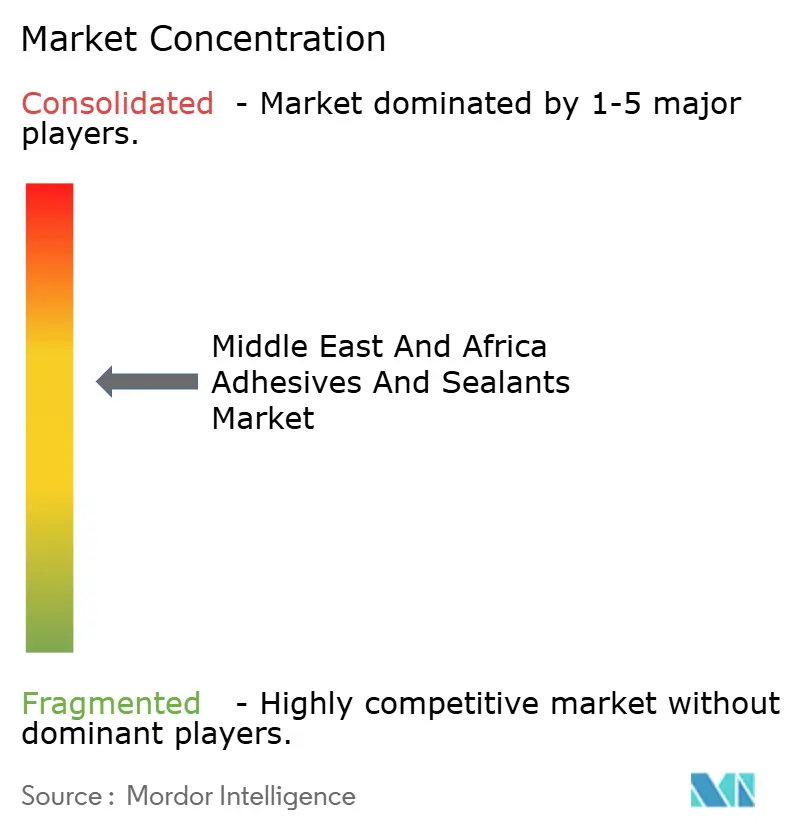
| Market Concentration | Medium |
Major Players *Disclaimer: Major Players sorted in no particular order Image © Mordor Intelligence. Reuse requires attribution under CC BY 4.0. | |
Middle East and Africa Adhesives and Sealants Market Analysis by Mordor Intelligence
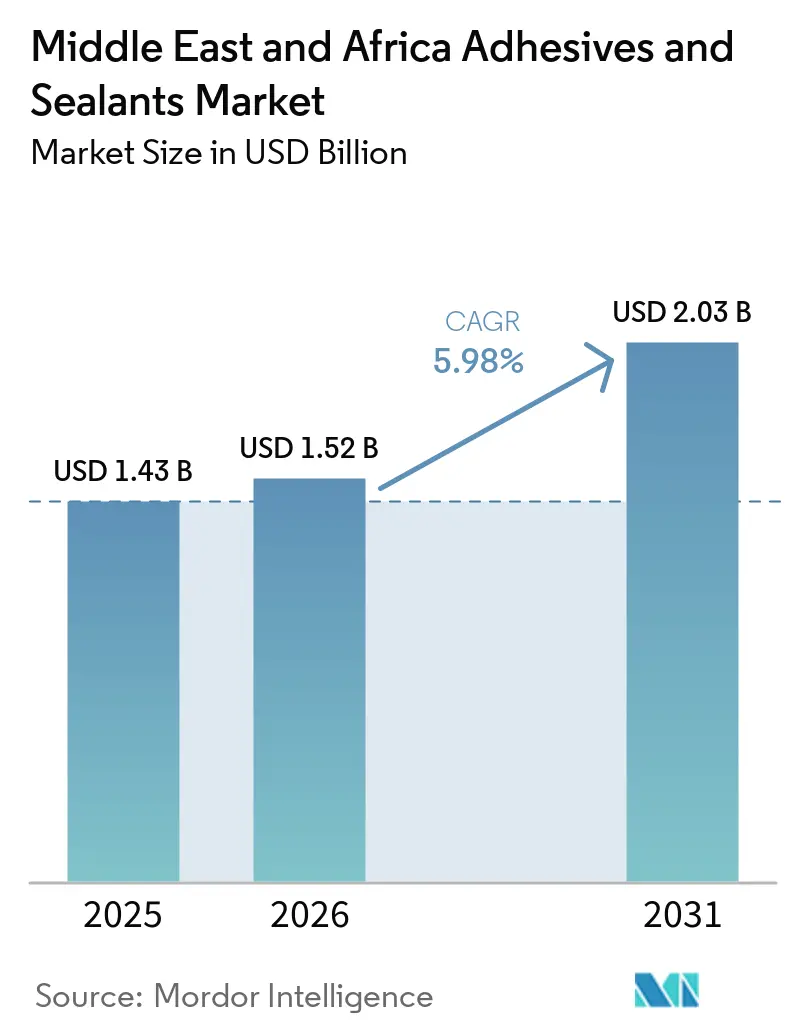
The Middle East And Africa Adhesives And Sealants Market size was valued at USD 1.43 billion in 2025 and is estimated to grow from USD 1.52 billion in 2026 to reach USD 2.03 billion by 2031, at a CAGR of 5.98% during the forecast period (2026-2031). Structural shifts toward water-borne and reactive chemistries, along with large-scale infrastructure spending in Saudi Arabia and tightening volatile-organic-compound (VOC) limits across the Gulf, underpin this expansion. Growing medical-device assembly in free zones, heightened e-commerce packaging demand, and rapid automotive output in Morocco and Egypt further lift demand. Multinationals use localized blending plants in Jeddah, Dubai, and Cairo to shorten lead times, while regional specialists safeguard their share with custom formulations and on-site technical support. Feedstock price swings and cold-chain gaps in East Africa remain headwinds, yet sustained capital inflows into modular housing, wind energy, and EV battery production continue to unlock new opportunities.
Key Report Takeaways
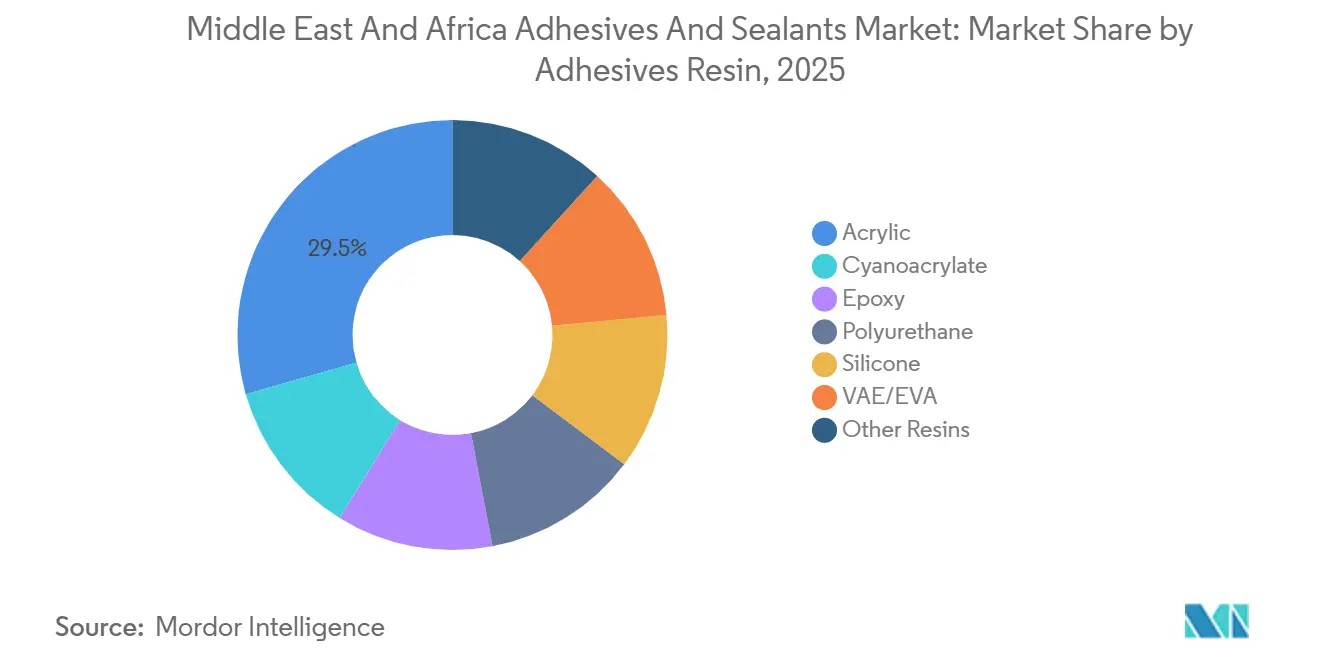
- By adhesive resin, acrylics captured 29.46% of 2025 demand, while polyurethanes are projected to post the fastest 6.24% CAGR through 2031.
- By adhesive technology, water-borne grades commanded 37.28% of 2025 demand; reactive systems expand at a leading 6.31% CAGR through 2031.
- By sealant resin, polyurethanes led with 41.37% share in 2025, whereas silicones are set to grow at 6.18% CAGR on façade and solar applications.
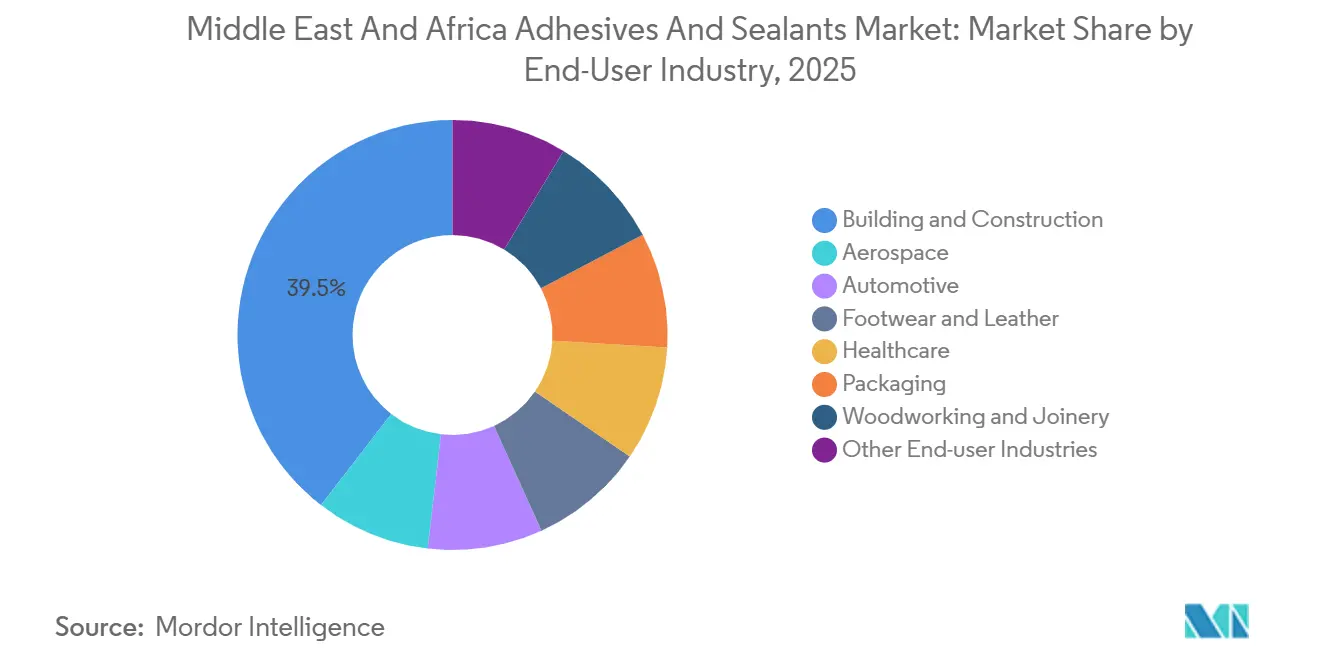
- By end-user, construction generated 39.52% of 2025 demand; healthcare adhesives deliver the fastest 6.27% CAGR thanks to wearable-sensor production in the UAE and Saudi Arabia.
- By geography, Saudi Arabia held a dominant 34.48% 2025 share, yet the United Arab Emirates is forecast to post a 6.12% CAGR on the back of Expo City and Masdar City projects.
Note: Market size and forecast figures in this report are generated using Mordor Intelligence’s proprietary estimation framework, updated with the latest available data and insights as of January 2026.
Market Trends and Insights
Drivers Impact Analysis of Middle East and Africa Adhesives and Sealants Market*
| Drivers | (~) % Impact on CAGR Forecast | Geographic Relevance | Impact Timeline |
|---|---|---|---|
| Construction mega-projects under Saudi Vision 2030 | +1.8% | Saudi Arabia, with spill-over to UAE and Qatar | Long term (≥ 4 years) |
| E-commerce–led packaging boom across GCC and Egypt | +1.2% | GCC core (UAE, Saudi Arabia, Kuwait), Egypt | Medium term (2-4 years) |
| Automotive OEM and aftermarket expansion in Morocco and Egypt | +0.9% | Morocco, Egypt, with exports to EU and sub-Saharan Africa | Medium term (2-4 years) |
| Modular construction uptake in East Africa | +0.6% | Kenya, Ethiopia, Tanzania | Long term (≥ 4 years) |
| Gulf localisation mandates for hygiene-product adhesives | +0.5% | Saudi Arabia, UAE, Bahrain | Short term (≤ 2 years) |
| Source: Mordor Intelligence | |||
Construction Mega-Projects Under Saudi Vision 2030
The Public Investment Fund deployed USD 40 billion in 2025 into anchor projects such as NEOM, Qiddiya, and King Salman Park[1]. Curtain-wall glazing at NEOM’s linear city uses structural silicone sealants formulated with UV-blocking additives to withstand 12 hours of daily sun exposure. Marine villas in the Red Sea Development rely on polyurethane adhesives able to resist 3,000-hour salt-fog cycles, prompting new one-component systems from Sika and Wacker Chemie. Fast-cure epoxies on precast panels accelerate schedules by 40%, reducing labor on mega sites. Similar specifications extend to Lusail City Phase II in Qatar, where reactive polyurethane sealants bond composite cladding on high-rise towers.
E-Commerce–Led Packaging Boom Across GCC and Egypt
United Arab Emirates e-commerce gross merchandise value reached USD 9.2 billion in 2025, boosting corrugated-box demand 18% year on year and pushing uptake of water-borne starch adhesives that satisfy food-contact regulations. Egyptian paperboard output climbed to 1.8 million metric tons in 2025 as Amazon and Noon scaled fulfillment hubs, driving hot-melt adhesive usage on 60-carton-per-minute lines. H.B. Fuller’s 2025 polyolefin hot-melt bonds recycled kraft liner at 15 °C lower temperatures, cutting converter energy use by 12%. Saudi e-commerce penetration doubled to 14% of retail sales, prompting Jowat to open a Riyadh technical center for tamper-evident tape formulations. Reactive polyurethane laminating adhesives are also displacing acrylic emulsions in retort pouches that survive 121 °C sterilization.
Automotive OEM and Aftermarket Expansion in Morocco and Egypt
Morocco built 535,000 vehicles in 2025, making it Africa’s top exporter, with 4,200 metric tons of structural adhesives consumed in body-in-white bonding and battery-tray assembly[2]. BYD announced a 150,000-unit EV plant in Tangier that will rely on conductive adhesives for lithium-iron-phosphate cell interconnects, a niche Henkel targets with its Loctite ECI 1020 series. Egypt granted golden licenses in 2025, allowing Volkswagen to produce 50,000 units yearly, using hot-melt adhesives for headliners and polyurethanes for windshield bonding. The aftermarket absorbs cyanoacrylate adhesives for mirror reattachment and acrylic tapes for emblem replacement, distributed through Petromin and TotalEnergies channels. Moroccan parts exports hit EUR 12 billion in 2025, with tier-1 suppliers meeting ISO 9001 and IATF 16949 via epoxy adhesives on airbag modules.
Modular Construction Uptake in East Africa
Kenya’s affordable-housing effort delivered 42,000 modular units in 2025, each using polyurethane adhesives to bond EPS-steel sandwich panels, enabling three-day on-site assembly. Ethiopia’s Hawassa and Mekelle industrial parks adopted precast concrete modules joined with epoxy adhesives that meet Ethiopian seismic code ES 8-2015. Tanzania’s construction sector grew 7.8% in 2025, with bus rapid-transit stations using structural acrylic adhesives that cure in humid conditions without primer, sourced from regional distributors. The East African Community’s Vision 2050 earmarks USD 100 billion for cross-border rail and port projects, specifying adhesive-bonded composites to lower maintenance. Despite progress, only 18% of Mombasa-Kampala freight routes offered refrigerated containers in 2025, limiting water-borne adhesive penetration.
Restraints Impact Analysis of Middle East and Africa Adhesives and Sealants Market*
| Restraints | (~) % Impact on CAGR Forecast | Geographic Relevance | Impact Timeline |
|---|---|---|---|
| Stringent VOC regulations and green-building codes | -0.7% | UAE, Saudi Arabia, South Africa | Medium term (2-4 years) |
| Petrochemical feedstock price volatility | -0.9% | Global, with acute impact on GCC solvent-borne producers | Short term (≤ 2 years) |
| Limited cold-chain logistics for water-borne chemistries | -0.4% | East Africa (Kenya, Ethiopia, Tanzania) | Long term (≥ 4 years) |
| Source: Mordor Intelligence | |||
Stringent VOC Regulations and Green-Building Codes
Dubai’s Green Building Regulations cap interior adhesive VOC content at 50 g/L and exterior at 100 g/L, steering formulators toward water-borne systems. South Africa’s Green Star rating introduced a 30 g/L incentive threshold that just 12% of imported products met in 2025. Saudi Arabia adopted GSO 2756 in 2024, mirroring EU limits and extending product-launch cycles by six weeks due to third-party tests. Reformulation costs reach up to USD 150,000 per product, deterring smaller players and consolidating share among multinationals with dedicated R&D budgets. Egypt deferred its proposed VOC law to 2027, injecting uncertainty into planned water-borne investment.
Petrochemical Feedstock Price Volatility
Propylene traded between USD 950 and USD 1,150 per metric ton in 2025 following outages at the Ras Tanura cracker, pressuring solvent-borne margins. Benzene averaged USD 1,020 per metric ton in Q4 2025, 18% above Q1, inflating costs for styrene-based adhesives. Dow’s SADARA venture moved to quarterly price resets that passed through 70% of volatility, squeezing smaller converters without hedging tools. Egyptian formulators faced additional foreign-exchange risk when the pound weakened 12% versus the U.S. dollar, lifting isocyanate import costs and causing six-week production pauses. Transport premiums from Rotterdam to Casablanca climbed USD 120 per metric ton after Red Sea shipping diversions, pushing Moroccan blenders to renegotiate feedstock contracts.
*Our forecasts treat driver/restraint impacts as directional, not additive. The impact forecasts reflect baseline growth, mix effects, and variable interactions.
Middle East and Africa Adhesives and Sealants Market Segment Analysis
By Adhesives Resin:
Acrylics Anchor Packaging, Polyurethanes AccelerateAcrylic adhesives held 29.46% of 2025 demand, the highest share within the Middle East and Africa adhesives and sealants market, owing to their fast-tack performance in pressure-sensitive tapes used for e-commerce parcels. Polyurethane grades are forecast to expand at a 6.24% CAGR, outpacing all other chemistries as automotive windshield bonding in Morocco and structural glazing in Saudi Arabia demand elongation-at-break above 400%. Epoxy systems are witnessing increased demand from wind-turbine blade and precast-concrete bonding, yet their two-hour pot life constrains uptake on rapid site schedules. Silicone adhesives find their applications mainly in high-temperature automotive and wearable-sensor applications where ISO 10993 biocompatibility is mandatory.
Wider substitution trends favor acrylics in packaging laminates for snack foods, while polyurethanes gain in modular-construction panel assembly. Cyanoacrylates remain niche in aftermarket repair, and VAE/EVA hot-melts dominate carton sealing with Jowat and H.B. Fuller controlling 60% regional supply. Phenolic and polyamide adhesives stay stable in brake-lining and textile lamination. As infrastructure megaprojects advance, the Middle East and Africa adhesives and sealants market size linked to polyurethane formulations is projected to rise disproportionately within overall growth, reinforcing supplier investments in local pre-polymer synthesis.

By Adhesives Technology:
Water-Borne Formulations Lead Compliance ShiftWater-borne chemistries accounted for 37.28% of 2025 demand following Dubai’s 50 g/L VOC ceiling, the largest technology share across the Middle East and Africa adhesives and sealants market. Reactive systems, including two-component epoxies and moisture-cure polyurethanes, are projected to grow at a 6.31% CAGR through 2031 as battery-pack assembly and composite panel bonding prioritize high strength with rapid cure. Hot-melts are used in high-speed packaging lines, where polyolefin bases reduce energy use by 12% over EVA options.
Solvent-borne grades face incremental regulation that restricts their expansion. UV-cured adhesives are witnessing rising demand after Sika introduced a silicone sealant that cures in eight seconds under LED lamps, halving automotive glass line dwell time. As compliance deadlines tighten, the Middle East and Africa adhesives and sealants market share of water-borne and UV platforms will rise, compelling legacy solvent formulators to retool or exit low-margin segments.
By Sealants Resin:
Polyurethane Dominates, Silicone Surges in FacadesPolyurethane sealants held a commanding 41.37% share in 2025, securing the highest stake in sealant demand within the Middle East and Africa adhesives and sealants market. Superior joint movement and paintability make them standard in Saudi expansion joints and Egyptian residential builds. Silicone sealants are predicted to grow at a 6.18% CAGR on the strength of curtain-wall glazing in UAE towers and solar-panel edge sealing in Morocco’s Noor complex, where −40 °C to 150 °C tolerance is essential. Acrylic sealants serve kitchens and bathrooms that value low odor but accept limited movement capability.
Epoxy sealants dominate industrial flooring and marine decks, where diesel and saltwater resistance offset their higher cost. Polysulfides fulfill niche aviation demand given MIL-S-8802 compliance. Wacker’s silane-terminated polyether range gains traction in bus and truck manufacturing, reflecting growing hybrid polymer interest. As façade area per building rises, the Middle East and Africa adhesives and sealants market size allocated to silicone systems is poised to widen, challenging polyurethane incumbency on life-cycle costs.
By End-User Industry:
Construction Leads, Healthcare AcceleratesBuilding and construction consumed 39.52% of 2025 demand, driven by Saudi Vision 2030 sites that specify structural silicones for glass facades and polyurethanes for insulated panels.
Automotive consumption in the region is centered on Morocco and Egypt, where structural bonding trims vehicle weight by up to 12 kg. The woodworking industry in the region mainly demands polyvinyl acetate emulsions, prominent in furniture manufacturing across South Africa and Saudi Arabia. Footwear and leather captured a considerable share, still solvent-intensive despite rising VOC scrutiny. Aerospace and other segments demand flame-smoke-toxicity-compliant adhesives used in cabin interiors. Shifting demographics and regulatory mandates will keep construction dominant, yet the healthcare slice of the Middle East and Africa adhesives and sealants market share will climb fastest through the forecast period.
Geography Analysis
Saudi Arabia and United Arab Emirates Adhesives and Sealants Market
Saudi Arabia commanded 34.48% of 2025 revenue, the largest portion of the Middle East and Africa adhesives and sealants market, energized by USD 40 billion in annual Vision 2030 disbursements for projects such as Trojena ski resort and King Salman Park. The United Arab Emirates is on track for a 6.12% CAGR to 2031 as Expo City pavilions and Masdar City Phase III embed low-VOC mandates favoring water-borne adhesives. Dubai’s Green Building Regulations, Masdar clean-energy targets, and a resurgent hospitality pipeline sustain broad adoption of water-borne acrylics and low-modulus silicones. Abu Dhabi’s industrial strategy now extends incentives to battery materials, opening fresh use cases for one-component moisture-cure adhesives. Free-zone duty exemptions lower landed raw-material costs, further boosting competitiveness.
Africa Adhesives and Sealants Market
South Africa, Egypt, and Morocco contribute diverse but smaller revenue blocks. South Africa couples infrastructure refurbishment with automotive glass encapsulation that uses UV-cured silicones. Egypt benefits from e-commerce packaging and new vehicle assembly, yet currency devaluation widens working-capital demands. Morocco’s automotive corridor draws conductive and structural epoxies into EV battery lines. East African markets offer modular housing as the main vector, although logistics hurdles cap water-borne growth. Collectively these patterns highlight how local regulations, currency dynamics, and industrial policy shape the trajectory of the Middle East and Africa adhesives and sealants market.
Regulatory Landscape
Regulation is increasingly shaping technology choices in the Middle East and Africa adhesives and sealants market, especially through product-conformity and low-emissions requirements linked to construction and the handling of imported chemicals. In Saudi Arabia, SASO enforces the Technical Regulation for Glue and Adhesive Materials, requiring registration and conformity assessment for products placed on the market through the SABER platform, which adds structured documentation and testing steps for importers and manufacturers.
In the UAE, green-building compliance and project approvals continue to influence formulation and labeling. Dubai applies low-emitting materials verification under its Green Building Regulations (Al Safat), where Dubai Central Laboratory (DCL) VOC testing is a common compliance gate for adhesives and sealants used in buildings. Abu Dhabi infrastructure projects reference Technical Approval Certificates through Abu Dhabi Quality and Conformity Council (QCC) requirements that are tied to project specifications and applicable international standards. Outside the Gulf, regulatory oversight is also tightening for controlled chemicals. Kenya enacted the Environment Management and Co-ordination (Controlled Substances) Regulations, 2025, requiring registration with NEMA for specified substances, while Oman requires permits for import and manufacture of hazardous chemical substances via the Bayan system under the Environment Authority.
Value Chain Analysis
Feedstocks (propylene derivatives, acrylic monomers, and isocyanate intermediates) underpin the upstream portion of the Middle East and Africa adhesives and sealants value chain, with a large share coming from GCC petrochemical integration and additional volumes routed in through global imports into regional logistics hubs. The Gulf Petrochemicals and Chemicals Association (GPCA) positions Saudi Arabia as a core anchor for GCC petrochemical output (74% share), supporting the economics of locally blended hot-melts, reactive polyurethanes, and construction sealants, while specialty additives and some intermediates remain import-dependent through nodes such as Jebel Ali.
Midstream conversion relies on regional compounding and blending, supported by application know-how to adapt products to local exposure conditions such as high heat, UV, humidity, and sand. Multinationals provide technical support footprints, and Wacker Chemie maintains a Dubai technical center established in 2002 for construction-chemistry testing. Manufacturing platforms in the UAE include Anchor Allied Factory (ASMACO brand) and Triton Middle East LLC (Umm Al Quwain facility producing silicone, hybrid PU, and acrylic sealants). Downstream demand is routed through construction-chemicals distributors, industrial/MRO suppliers, and packaging converters. Here, service speed and on-site troubleshooting are key for mega-project schedules, though port congestion and long payment terms in large projects can strain working capital and delivery reliability for smaller compounders.
Competitive Landscape
The Middle East and Africa adhesives and sealants market is moderately consolidated, with the top five holding a significant market size. Each leading player operates blending or compounding plants inside the region to reduce shipping lead times and tailor formulations to desert climates. Henkel’s 12,000-metric-ton hot-melt line in Jubail Industrial City came online in January 2025 to serve hygiene-product makers and meet Gulf localization quotas. Regional specialists, notably Permoseal in South Africa and The Industrial Group in Saudi Arabia, are delivering niche marine-grade and high-temperature gasket solutions with rapid on-site support. Technology differentiation leans on VOC compliance and cure-speed gains. Smaller players struggle with feedstock volatility after propylene price swings of 21% in 2025 forced three Egyptian blenders offline for six weeks. White-space opportunities span healthcare adhesives for wearable sensors and reactive polyurethanes for EV battery encapsulation, areas where regulatory approval paths are still forming.
Middle East and Africa Adhesives and Sealants Industry Leaders
-
Henkel AG & Co. KGaA
-
Sika AG
-
Dow
-
Arkema
-
H.B. Fuller Company
- *Disclaimer: Major Players sorted in no particular order
Middle East and Africa Adhesives and Sealants Market Companies Covered in this Report
- Arkema
- AVERY DENNISON CORPORATION
- 3M
- Dow
- H.B. Fuller Company
- Henkel AG & Co. KGaA
- Huntsman International LLC
- Illinois Tool Works Inc.
- Jowat SE
- MAPEI S.p.A
- Momentive Performance Materials
- Permoseal (Pty) Ltd
- PIDLITE
- RPM International Inc.
- H.B. Fuller Company.
- Sika AG
- Soudal Group
- The Industrial Group Ltd
- Wacker Chemie AG
Read Analysis of Middle East and Africa Adhesives and Sealants Companies
Market Opportunities and Future Outlook
Import substitution and supply security for reactive chemistries remains a clear whitespace in the region, particularly for polyurethane systems where isocyanate availability and price volatility affect cost and continuity. UAE industrial-chemicals investment provides the most tangible anchor for this opportunity. In May 2026, TA'ZIZ and Alpha Dhabi Holding announced a strategic collaboration agreement targeting USD 10 billion of industrial chemicals investment, and TA'ZIZ disclosed USD 28.5 billion in long-term offtake and feedstock agreements to support chemicals production. In June 2026, TA'ZIZ, Covestro, and XRG launched a feasibility study for a 660,000 tonnes per annum MDI plant in Al Ruwais, which is directly tied to polyurethane adhesives and sealants demand across construction, automotive, and insulation applications.
A second opportunity is deeper localization of manufacturing and technical service for high-throughput packaging and building envelopes, where customers are upgrading lines and specifications under VOC and green-building constraints. H.B. Fuller’s May 2025 actions support this supply shift through IMEA manufacturing expansion, including opening a facility in Cairo, Egypt, and expanding an existing site in the UAE for packaging, HVAC, waterproofing, woodworking, and industrial demand centers. For suppliers, the most actionable areas center on (i) fast-cure, low-VOC systems validated to Dubai and Saudi requirements, (ii) performance sealants and glazing silicones for mega-project facades, and (iii) conductive and encapsulation adhesives tied to EV assembly buildouts in Morocco and Egypt, where qualification to automotive standards and stable local supply carry weight in vendor selection.
Recent Industry Developments in Middle East and Africa Adhesives and Sealants Market
- February 2026: Sika agreed to acquire Akkim, a Turkey-based adhesives and sealants manufacturer with distribution coverage across the Middle East and North Africa. The deal expands Sika's channel access and product reach into the region, improving its ability to supply localized specifications for construction and industrial bonding. It also raises competitive pressure on regional formulators as global players add scale and technical resources through acquisitions.
- July 2025: Henkel acquired South Africa-based Nordbak (Pty) Ltd, a specialist in maintenance, repair, and overhaul (MRO) solutions serving mining, infrastructure, and industrial customers. The acquisition broadens Henkel's portfolio exposure beyond core construction adhesives into high-wear repair materials and site-applied solutions used across heavy industry. It also improves local customer proximity in a market where uptime and application support can matter as much as product price.
- July 2024: Henkel reported that its Adhesive Technologies sites in the Middle East and Africa reached a 100% renewable electricity milestone. This reinforces supply-chain sustainability credentials for adhesives and sealants sold into projects and customers with emissions reporting and green-building requirements. The step also supports product positioning as VOC and broader environmental compliance become more prominent in Gulf construction procurement.
Middle East and Africa Adhesives and Sealants Market Report Scope and Research Methodology
Market Definition and Coverage
For this study, the market covers revenues generated from adhesive and sealant materials sold for bonding and sealing uses across the Middle East and Africa, spanning industrial applications and construction demand, and then consolidated into a single value in USD.
Scope exclusions: We exclude sales outside the Middle East and Africa and exclude unrelated surface treatments that do not function as an adhesive or sealant product.
Segments Covered in This Report
- By Adhesives Resin
- Acrylic
- Cyanoacrylate
- Epoxy
- Polyurethane
- Silicone
- VAE/EVA
- Other Resins
- By Adhesives Technology
- Hot-Melt
- Reactive
- Solvent-Borne
- UV-Cured
- Water-Borne
- By Sealants Resin
- Polyurethane
- Epoxy
- Acrylic
- Silicone
- Polysulfide
- Other Resins
- By End-User Industry
- Aerospace
- Automotive
- Building and Construction
- Footwear and Leather
- Healthcare
- Packaging
- Woodworking and Joinery
- Other End-user Industries
- By Geography
- Saudi Arabia
- South Africa
- United Arab Emirates
- Qatar
- Bahrain
- Egypt
- Rest of Middle-East and Africa
Data Sources, Market Sizing, and Validation
Desk Research
Desk research started with mapping demand drivers that explain where adhesives and sealants are consumed in this region, and where they are not. We reviewed public sources such as national statistics offices and customs authorities for construction activity, trade flows, and industrial output signals that are directionally linked with bonding and sealing demand.
To keep assumptions grounded, we also referenced sources such as UN Comtrade, World Bank indicators, the International Energy Agency for industrial and infrastructure context, and peer reviewed chemistry and materials journals for technology shifts like waterborne and reactive systems. Company annual reports, investor presentations, and trusted trade press were used to confirm capacity changes, country footprints, and end use exposure. Where available, paid subscriptions for company financials and shipment-level trade intelligence were used selectively to normalize revenue splits and cross check import dependence. These desk research sources are illustrative only, and many other public documents and datasets were also used for data collection, validation, and clarification.
Primary Interviews and Surveys
Primary work was used to convert desk signals into usable inputs, especially around pricing, product mix, and channel practices that vary by country. We spoke with manufacturers, distributors, formulators, and downstream users in construction, packaging, and transportation, then re-checked uncertain points with follow up questions so the assumptions stayed consistent across the region.
Distribution of primary research fieldwork respondents
| Company type | Respondent position |
|---|---|
| Top tier: 33% | CXOs: 17% |
| Mid tier: 47% | Functional/Unit leaders: 24% |
| Smaller Players: 20% | Managers: 59% |
Market-Sizing & Forecasting
The market was first built using a top-down approach where construction and industrial activity indicators were translated into an addressable demand pool, then converted into value using region-typical consumption intensity and price ranges by chemistry and application. To keep the totals realistic, we then corroborated the outcome with selective bottom-up checks, such as rolling up a sample of supplier and distributor revenues, and validating implied volumes using ASP multiplied by estimated tonnage ranges.
Key inputs used in the model included construction spending and project starts in major MEA economies, packaging output trends, automotive and transport production signals, the split between waterborne, solvent-borne, hot melt, and reactive systems, and average selling price progression by resin family. Where company reporting was limited, gaps were handled by using proxy mixes from similar end use exposure and by applying conservative range caps until interviews confirmed the right direction.
For forecasting, scenario analysis was applied around a base case path, since demand can swing with infrastructure cycles and import pricing. The forward view was tuned using expert expectations on construction pipelines, industrial diversification programs, and the speed of technology replacement, then stress tested so growth does not outrun practical capacity and trade supply available in the region.
Data Validation & Update Cycle
Outputs were validated through triangulation across independent signals, including trade movements, construction activity direction, and implied per-sector consumption, then reviewed for outliers before sign-off. When a country-level number looked unusual, we checked the assumptions behind it, and we re-contacted primary respondents if the variance could not be explained by mix or pricing.
The report is refreshed annually, and interim checks are made when a material event occurs, such as a sharp currency move, a major plant addition, or a change in import duties that affects pricing. Before delivery, a final pass is done to ensure the latest public data and interview learnings are reflected, which helps keep the numbers current and comparable across years.
Mordor Intelligence's Middle East and Africa Adhesives and Sealants Market Size Compared Against Other Published Estimates
Published market values for MEA adhesives and sealants can differ even when the topic sounds the same, because the time stamp, the covered countries, and the pricing basis are not always aligned. Differences also come from how firms treat the split between adhesives and sealants, and whether end uses like construction and packaging are measured using consistent demand indicators.
In our work, the spread usually traces back to refresh cadence and currency timing, because USD conversion can shift the value meaningfully when exchange rates are volatile, and because ASP trends move with resin costs and technology mix. By re-validating ASP ranges with recent channel checks and applying a consistent FX timing, Mordor Intelligence reduces the risk of mixing older price points with current demand conditions, which is one reason the values below do not fully match each other.
Benchmark comparison
| Source | Market Size | Gaps in Research Methodology |
|---|---|---|
| Mordor Intelligence | USD 1.43 B (2025) | |
| Global Consultancy A | USD 1.51 B (2024) | Uses a Middle East-only frame and a 2024 base, which can shift the value when MEA is reported in USD and when Africa volumes and different channel mixes are not fully represented. |
| Regional Consultancy B | USD 3.12 B (2022) | Uses an older base year and a broader value build that can overstate totals if price levels, currency timing, and product scope are not refreshed in line with recent resin cost cycles and mix changes. |
The table shows that year selection and regional boundary choices explain a large part of the gap, and then the remaining difference usually comes from how pricing is kept current. With clear scope rules, practical demand indicators, and repeatable checks on ASP and currency timing, the estimate stays traceable and easier to update when market conditions change.
Key Questions Answered in the Report
How fast is demand expected to grow for adhesives and sealants across the Middle East and Africa?
The Middle East and Africa adhesives and sealants market is forecast to expand at 5.98% CAGR from 2026 to 2031, lifting value from USD 1.52 billion to USD 2.03 billion.
Which country contributes the largest revenue to regional consumption?
Saudi Arabia generated 34.48% of 2025 revenue, buoyed by Vision 2030 mega-projects that specify high-performance silicones and polyurethanes.
What resin type shows the quickest growth outlook?
Polyurethane adhesives lead growth with a 6.24% CAGR thanks to their expanding use in automotive bonding and structural glazing.
How are VOC rules shaping technology choices?
UAE, Saudi Arabia, and South Africa now restrict interior VOC content to as low as 30–50 g/L, accelerating the switch to water-borne and UV-cured technologies.
Which end-user vertical is advancing the fastest?
Healthcare applications—especially wearable sensors and medical-device assembly—are projected to post a 6.27% CAGR through 2031.
What tactics are suppliers using to protect margins amid feedstock swings?
Multinationals operate regional blending plants, lock long-term propylene contracts, and introduce low-temperature cure chemistries that cut customer energy costs.