
Market Overview
| Study Period | 2020 - 2031 |
|---|---|
| Forecast Data Period | 2026 - 2031 |
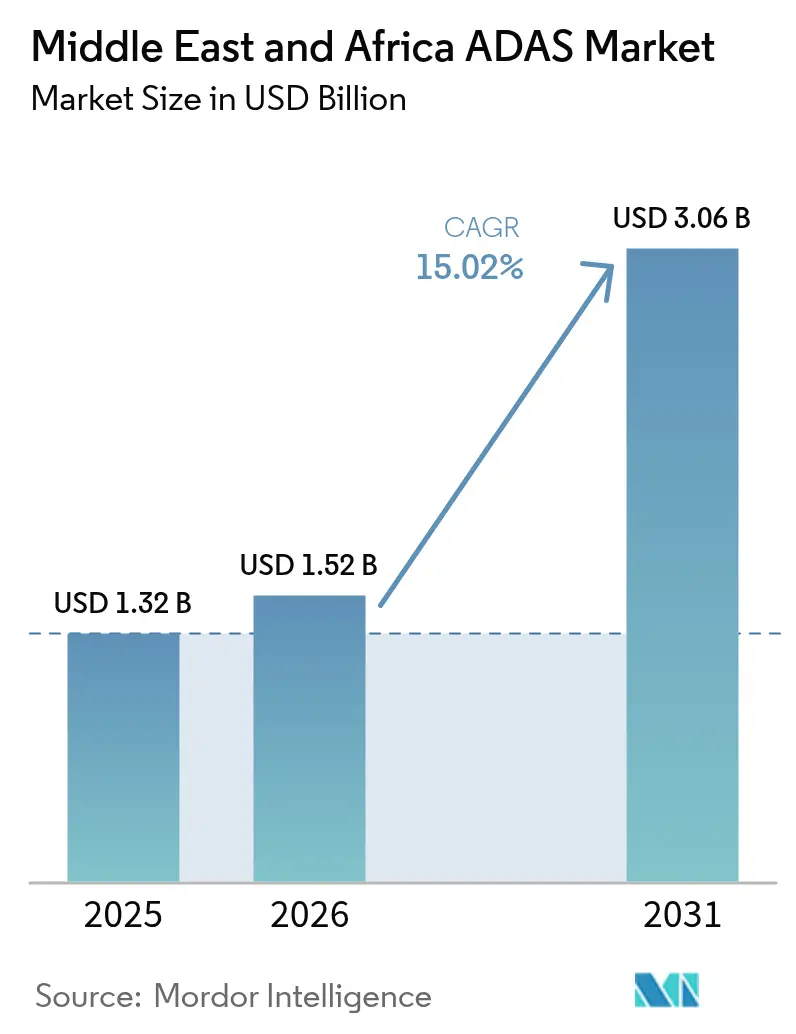
| Base Year Market Size (2025) | USD 1.32 Billion |
| Market Size (2026) | USD 1.52 Billion |
| Market Size (2031) | USD 3.06 Billion |
| Growth Rate (2026 - 2031) | 15.02 % |
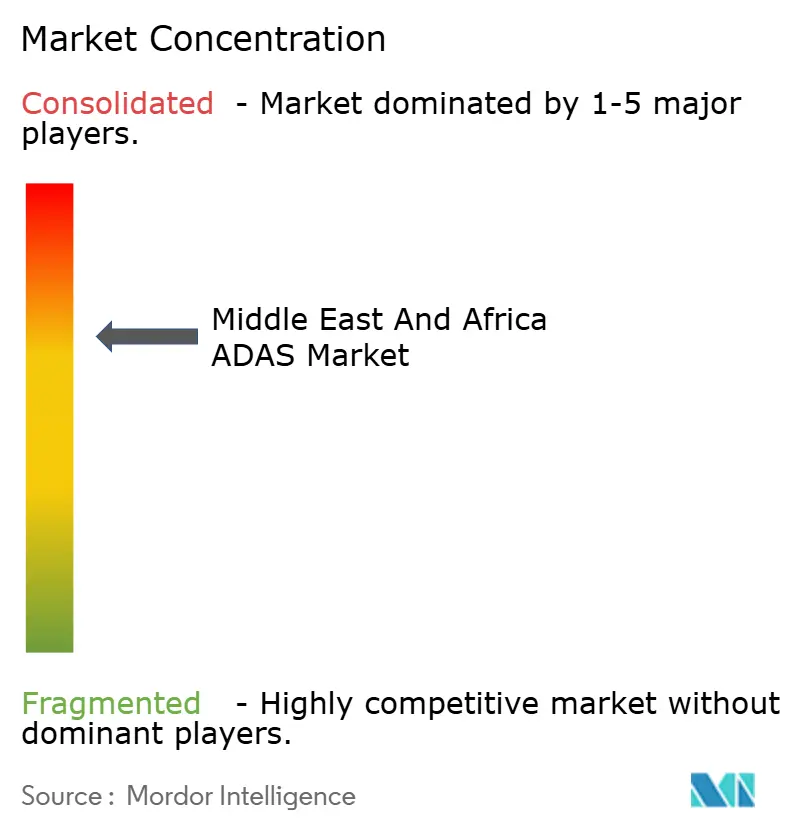
| Market Concentration | Medium |
Major Players *Disclaimer: Major Players sorted in no particular order Image © Mordor Intelligence. Reuse requires attribution under CC BY 4.0. | |
Middle East And Africa ADAS Market Analysis by Mordor Intelligence
The Middle East and Africa Advanced Driver Assistance Systems market size is expected to grow from USD 1.32 billion in 2025 to USD 1.52 billion in 2026 and is forecast to reach USD 3.06 billion by 2031 at 15.02% CAGR over 2026-2031. This sustained expansion underscores how Gulf governments treat ADAS as an essential pillar of their smart-mobility agendas rather than an optional premium feature. Regulatory catalysts such as Dubai’s Law No. 9 of 2023 and Saudi Arabia’s Vision 2030 targets, combined with sovereign-wealth-fund investments into autonomous technology corridors, create a predictable demand pipeline. Sensor innovation that endures high heat and dust, rising premium-vehicle registrations, and expanding 5 G-enabled V2X networks reinforce the region’s commercial logic for rapid ADAS adoption. As a result, the advanced driver assistance systems market is evolving from hardware-centric packages to software-defined platforms optimized for Middle-Eastern operating conditions.
Key Report Takeaways
- By system type, parking-assist systems led with 29.12% revenue share in 2025, while automatic emergency braking is projected to expand at a 18.74% CAGR through 2031.
- By sensor technology, camera solutions captured 42.75% share in 2025; LiDAR units are the fastest-growing at a 18.96% CAGR to 2031.
- By vehicle type, passenger cars accounted for 74.10% share in 2025, whereas medium and heavy commercial vehicles are set to grow at a 16.35% CAGR over the forecast period.
- By level of autonomy, Level 1 driver-assistance held 56.85% share in 2025; Level 2 platforms show the strongest momentum with a 17.22% CAGR through 2031.
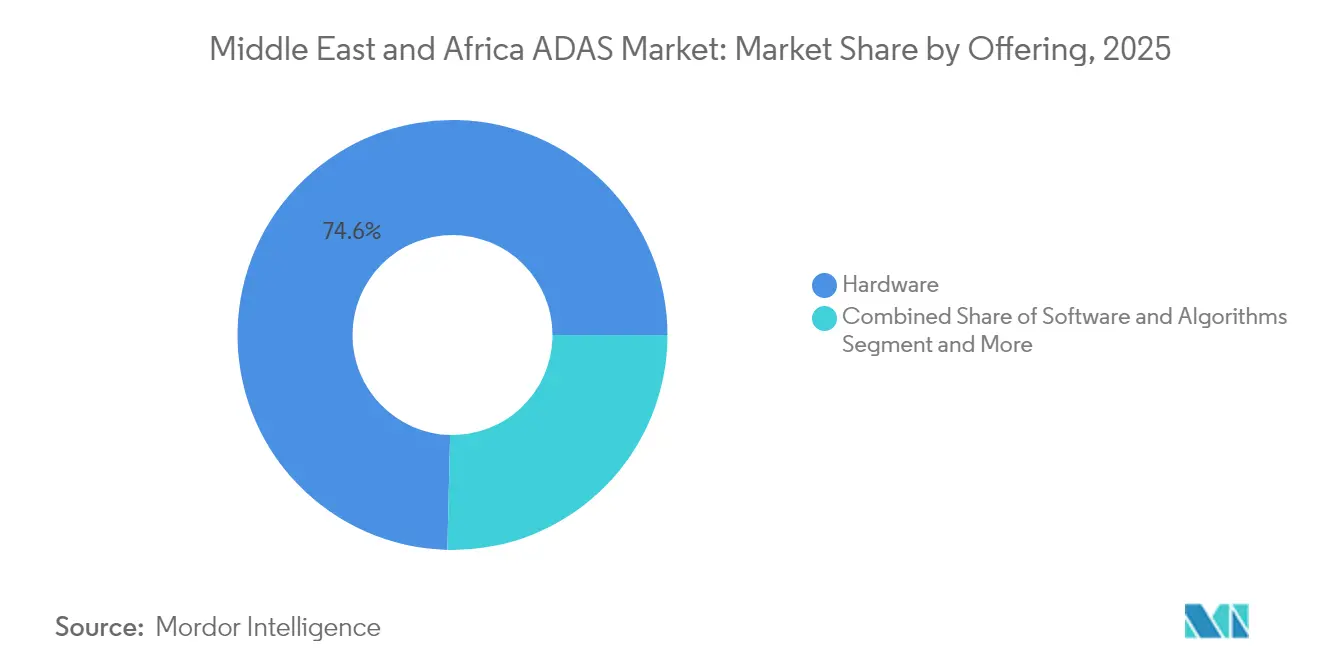
- By offering, hardware components represented 74.62% of 2025 revenue, while software and algorithms are forecast to rise at a 16.44% CAGR.
- By distribution channel, OEM-fit installations dominated with 84.10% share in 2025; the aftermarket segment is advancing at a 16.71% CAGR.
- By geography, Saudi Arabia commanded 28.20% regional share in 2025, and the United Arab Emirates is poised for the highest growth at a 15.38% CAGR to 2031.
Note: Market size and forecast figures in this report are generated using Mordor Intelligence’s proprietary estimation framework, updated with the latest available data and insights as of 2026.
Market Trends and Insights
Drivers Impact Analysis of Middle East And Africa ADAS Market*
| Driver | (~) % Impact on CAGR Forecast | Geographic Relevance | Impact Timeline |
|---|---|---|---|
| Mandatory NCAP-Style Safety Regulations | +3.2% | Gulf states with early adoption in UAE, Saudi Arabia | Medium term (2-4 years) |
| Premium-Vehicle L2+ Feature Penetration | +2.8% | UAE, Saudi Arabia, Qatar with spillover to Egypt, Morocco | Short term (≤ 2 years) |
| Sensor Cost Declines and Local Assembly | +2.1% | Egypt, Morocco manufacturing hubs, regional distribution | Medium term (2-4 years) |
| Smart-City V2X Infrastructure Corridors | +1.9% | Dubai, Riyadh, NEOM smart city projects | Long term (≥ 4 years) |
| Fleet Standardization of Safety Packs | +1.7% | Urban centers across GCC, North Africa | Short term (≤ 2 years) |
| Vision-2030 Mobility Tech Funding | +1.4% | Saudi Arabia with regional spillover effects | Long term (≥ 4 years) |
| Source: Mordor Intelligence | |||
Mandatory NCAP-style Safety Regulations & Fleet-fit Mandates
Regional transport ministries now embed Euro-NCAP-equivalent safety suites into type-approval frameworks. Dubai’s Roads and Transport Authority began requiring telematics in heavy trucks, and UN ECE’s Driver Control Assistance Systems regulation offers a harmonized technical rulebook [1]. Because operating licences increasingly hinge on compliance, fleet operators accelerate ADAS installation schedules, creating a predictable revenue stream for Tier 1 suppliers.
Premium-vehicle Uptake Boosting L2+ Feature Penetration
Affluent Gulf consumers value collision-avoidance and highway-pilot functions as lifestyle statements. Hyundai’s IONIQ range and Chinese brands like Changan now bundle Highway Driving Assist and automated lane-change features as standard on top trims. The demonstration effect shortens diffusion cycles, prompting mid-segment OEMs to offer stripped-down L2 packages at lower price points.
Sensor Cost Declines & Local Assembly Incentives
Governments in Egypt and Morocco tie import-duty relief and land grants to local electronics content. Investments such as Leoni’s EUR 40 million wiring-harness plant and Geely’s CKD facility decrease logistics costs and shorten lead times [2]. Component localization also builds a technician base to perform the intricate calibration of ADAS hardware demands.
Smart-city Corridors Enabling ADAS-ready V2X Infrastructure
Mega-projects, including NEOM and Dubai 5G corridors, integrate adaptive traffic signal networks with roadside units that broadcast real-time data. Partnerships among telecom carriers, Tier 1s, and municipal IT agencies deliver the latency thresholds required for cooperative lane-merge and signal-phase-timing applications. Controlled testbeds reduce supplier validation time, accelerating commercial release cycles.
Restraints Impact Analysis of Middle East And Africa ADAS Market*
| Restraint | (~) % Impact on CAGR Forecast | Geographic Relevance | Impact Timeline |
|---|---|---|---|
| High System Cost Vs Disposable Income | -2.3% | Sub-Saharan Africa, North Africa excluding Gulf states | Medium term (2-4 years) |
| Sparse Calibration and Servicing Networks | -1.8% | Rural areas across MEA, smaller urban centers | Long term (≥ 4 years) |
| Harsh Dust-Heat Environment Degrading Sensors | -1.4% | Desert regions across MEA, particularly Saudi Arabia, UAE, Egypt | Short term (≤ 2 years) |
| Tariff Swings and Supply Chain Disruption | -1.1% | Import-dependent markets, cross-border trade corridors | Medium term (2-4 years) |
| Source: Mordor Intelligence | |||
High System Cost Versus Disposable Income in Africa
In Sub-Saharan markets, the price uplift for ADAS can equal 5–10% of a new-vehicle invoice, a hurdle when average car-ownership costs already strain household budgets. Retrofit kits once addressed this gap, but Mobileye’s 2024 exit from aftermarket programs removed a key low-cost channel. Without local credit subsidies or deeper duty breaks, mass adoption lags behind Gulf peers.
Sparse Calibration and Servicing Networks
A shortage of trained technicians and specialized equipment outside tier-one cities slows repairs and raises total-cost-of-ownership fears. Frequent sandstorms and high ambient heat exacerbate sensor misalignment, requiring recalibration cycles that many workshops are unequipped to perform. This reliability concern discourages buyers in secondary markets until service-capacity gaps close.
*Our forecasts treat driver/restraint impacts as directional, not additive. The impact forecasts reflect baseline growth, mix effects, and variable interactions.
Middle East And Africa ADAS Market Segment Analysis
By System Type:
Emergency Braking Drives Safety EvolutionAutomatic emergency braking contributes the highest incremental value, expanding at 18.74% CAGR as regulators add forward-collision mitigation to inspection checklists. While already mainstream, parking-assist technology still holds a 29.12% share because dense urban cores in Dubai and Riyadh heighten low-speed collision anxiety. Tier 1 suppliers bundle these features to encourage higher take-rates, reinforcing the advanced driver assistance systems market’s momentum.
Integrated safety suites increasingly combine blind-spot detection, adaptive front lighting, and driver-monitoring cameras. Tier 1s such as Bosch overlay AI perception algorithms on modular hardware, enabling OEMs to deploy tailored packages without costly redesigns.


By Sensor Technology:
Camera Dominance Faces LiDAR ChallengeCameras remain the economic workhorse, controlling 42.75% of 2025 revenue. Yet Gulf operators contend with glare and dust, catalyzing LiDAR’s 18.96% CAGR as solid-state units drop below USD 500 per channel. Radar upgrades to 4D-imaging configurations add weather-resilient object classification, while ultrasonic rings stay vital for low-speed urban maneuvers.
Software-defined architectures let OEMs refine algorithms over the air, optimizing sensor fusion for regional driving idiosyncrasies. This capability shifts differentiation from hardware cost curves toward update cadence and data-science expertise, a hallmark of the advanced driver assistance systems industry.
By Vehicle Type:
Commercial Fleets Lead TransformationPassenger cars account for 74.10% of the advanced driver assistance systems market size in 2025, but commercial fleets deliver the highest growth logic with CAGR 16.35%. Cargo firms retrofit telematics-linked ADAS to cut insurance premiums and driver downtime. Dubai’s heavy-truck telematics mandate accelerates adoption among logistics operators seeking compliance certificates.
Ride-hailing companies leverage ADAS to elevate passenger-safety branding and reduce collision settlement expenses. Fleet data generated by these platforms feeds machine-learning loops that refine perception stacks, further differentiating service quality and fueling the advanced driver assistance systems market.
By Level of Autonomy:
L2 Systems Gain Regulatory MomentumLevel 1 functionalities still dominate with 56.85% share, but multi-function Level 2 packages post a 17.22% CAGR outlook as UN ECE regulations clarify design-validation rules. VW’s collaboration with Valeo and Mobileye targets 360-degree sensor coverage in mid-segment models by 2027 .
Driver-monitoring cameras become compulsory in L2 packages, ensuring that legal liability stays with attentive humans and enabling regulators to permit hands-off cruising lanes
By Offering:
Software Growth Signals Industry EvolutionHardware held the largest slice of 2025 revenue at 74.62% of the advanced driver assistance systems market share, reflecting the cost weight of sensors, electronic control units, and wiring harnesses in every new vehicle platform. This predominance mirrors OEM-design choices that still package safety functionality around physical components certified during type approval.
Though accounting for a smaller base in 2025, software and algorithms post the fastest 2026-2031 trajectory with a 16.44% CAGR. Over-the-air update capability, AI-driven perception stacks, and subscription monetization elevate code to a strategic asset, encouraging Tier 1s such as Aumovio to pivot toward software-defined vehicle roadmaps.
By Distribution Channel:
OEM Integration vs. Aftermarket AgilityFactory-installed systems captured 84.10% of 2025 deliveries, showing how in-line calibration, cybersecurity compliance, and tighter quality controls favor OEM-fit installations for the advanced driver assistance systems market size. The integrated approach also supports coordinated warranty coverage and life-cycle data collection that streamlines future feature upgrades.
The aftermarket segment, while representing the minority today, records the quickest advance at a 16.71% CAGR through 2031. Fleet retrofits of medium- and heavy-duty vehicles, extended asset life, and regulatory compliance mandates sustain demand even after Mobileye’s 2024 exit from retrofit programs. Independent service providers that invest in specialized calibration tools are positioned to capture this upswing, especially in commercial-vehicle corridors where downtime costs outweigh retrofit expenses.
Geography Analysis
Gulf and North Africa ADAS Market
Saudi Arabia commands 28.20% of 2025 revenue thanks to Vision 2030’s explicit ADAS and autonomous-mobility milestones. NEOM’s USD 100 million joint venture with Pony.ai supplies a testbed for Level 4 robo-taxis. The UAE records a 15.38% CAGR on the back of Dubai’s target to make 25% of trips autonomous by 2030. North-African manufacturing schemes improve affordability but will not close income gaps quickly, delaying mass uptake outside premium tiers.
United Arab Emirates ADAS Market
The United Arab Emirates operates as a regulatory sandbox, fast-tracking approvals for pilot projects by WeRide, Baidu, and Uber. Federal legislation provides a unified compliance ladder, giving suppliers scale benefits across the seven emirates. An expanding 5G and roadside-sensor grid supplies the low-latency backbone needed for cooperative perception applications.
North and Southern Africa ADAS Market
Beyond the Gulf, Egypt and Morocco prioritize supplier-park incentives to integrate ADAS wiring, camera brackets, and ECUs into CKD lines. This localization trims import duties and aligns with continental trade zones, progressively lowering retail pricing for mass-market trims. South Africa’s established export base offers engineering talent, though US tariff risks temper investment velocity.
Regulatory Landscape
GCC vehicle safety requirements for ADAS-equipped vehicles are increasingly anchored to UN/ECE-aligned GSO adoptions, tightening technical compliance while improving cross-border harmonization. Key anchors include GSO adoption of ECE R157:2024 for Automated Lane Keeping Systems (adopted 31 January 2024), ISO 34502:2024 for automated-driving test scenarios (adopted 14 October 2024), and ISO 21448:2025 (SOTIF) (adopted 14 October 2025). Together, these standards shift approvals toward scenario-based validation and safety-of-intended-functionality evidence for perception and decision-making stacks.
Country frameworks also add permitting and operational layers for automated and ADAS-enabled fleets. Dubai Administrative Resolution No. (939) of 2025 (effective 10 November 2025) formalizes autonomous vehicle certification and RTA-approved technical documentation requirements, while Saudi Arabia advanced its national framework with the SASO Board approval of the Technical Regulation of Self-Driving Vehicles on 17 July 2025. In parallel, regulatory updates such as the UAE move to Euro 6b emission limits from 1 January 2026 affect platform refresh cycles and type-approval planning, which supports OEM-fit integration where ADAS hardware and compliance documentation can be controlled end-to-end.
Value Chain Analysis
The MEA ADAS value chain is led by global Tier 1s supplying sensors (camera, radar, LiDAR, ultrasonic), ECUs, braking and steering actuation, and embedded software, while OEMs integrate these into factory-fit packages that dominate regional installation. Downstream, calibration and service capability (windscreen replacement, camera/radar alignment, ECU flashing, and diagnostics) remains a gating step outside top-tier cities. That dynamic keeps dealer networks and certified multi-brand workshops central to sustaining ADAS uptime.
Localization at the upstream and midstream stages is shaped by Africa-wide and sub-regional trade and industrial-policy anchors that influence where wiring harnesses, brackets, ECUs, and sub-assemblies are produced and how they move across borders. In February 2026, the African Union approved AfCFTA automotive Rules of Origin with a minimum 40% originating-content threshold for duty-free, quota-free treatment, creating a concrete incentive to deepen local value addition versus pure assembly. Egypt is also pushing localization through its National Automotive Industry Development Programme, including a stated 100,000-unit annual target and a 60% local content goal by 2030, which supports supplier-park activity relevant to ADAS wiring and electronic integration for OEM-fit systems.
Competitive Landscape
Market power is shifting from pure-play hardware vendors to vertically integrated platform players. Autoliv, Aumovio, and ZF still dominate restraint technologies, yet Chinese challengers such as WeRide and Pony.ai deploy full-stack solutions financed by Gulf sovereign funds. Consolidation manifests in software-centric alliances—exemplified by Volkswagen-Valeo-Mobileye—where perception algorithms, driver-monitoring logic, and OTA pipelines combine into turnkey Level 2+ suites.
Suppliers that master desert-tuned perception, in-field calibration, and cyber-security certification secure an edge. As shown by DENSO’s equity stake in Onsemi, strategic control of semiconductor supply mitigates chip-shortage volatility. As over-the-air feature licensing matures, recurring software revenue reduces margin dependence on ECU bill-of-materials, supporting sustainable profitability trajectories across the advanced driver assistance systems market.
Middle East And Africa ADAS Industry Leaders
-
Robert Bosch GmbH
-
Continental AG
-
Mobileye
-
Autoliv AB
-
Hyundai Mobis Co.
- *Disclaimer: Major Players sorted in no particular order
Middle East And Africa ADAS Market Companies Covered in this Report
- Autoliv AB
- Robert Bosch GmbH
- Continental AG
- Hyundai Mobis Co.
- Aptiv PLC
- Mobileye (Intel)
- ZF Friedrichshafen AG
- DENSO Corporation
- Valeo SA
- Magna International
- HELLA GmbH & Co. KGaA
- Veoneer
Market Opportunities and Future Outlook
Government-led autonomous mobility programs in the UAE and Saudi Arabia are converting pilot activity into structured demand for ADAS sensors, perception software, and calibration services, especially for L2 feature stacks that typically sit ahead of full autonomy in mass-market fleets. The 2025-2026 evidence trail includes the Dubai RTA MoU with Uber and WeRide (June 2025) for autonomous vehicle pilot operations, and Abu Dhabi Mobility (Integrated Transport Centre) announcing commercial operations of fully driverless Level 4 autonomous vehicles (November 2025). These programs create near-term whitespace for Tier 1s and integrators that can provide desert-tuned sensing and validation artifacts aligned with GCC standards.
Freight and logistics deployments also open an adoption pathway where safety compliance, uptime, and insurer requirements support use beyond passenger vehicles. In February 2026, Abu Dhabi Mobility oversaw the regions first pilot operation of autonomous logistics and freight trucks in Khalifa Economic Zones Abu Dhabi (KEZAD), highlighting a use case that increases demand for forward collision mitigation, driver monitoring, and sensor redundancy. At the same time, the expansion of GSO-aligned standards such as ECE R157:2024 and ISO 34502:2024, along with ISO 21448:2025 (SOTIF), widens opportunities for testing, validation, and in-market recalibration ecosystems, where service capacity and scenario-based verification can influence differentiation across OEM-fit and professionally installed retrofit solutions.
Recent Industry Developments in Middle East And Africa ADAS Market
- February 2026: Abu Dhabi Mobility (Integrated Transport Centre), supported by the Smart and Autonomous Systems Council, began overseeing Tesla Advanced Self-Driving (Supervised) road trials in Abu Dhabi. The program establishes a regulator-supervised pathway for validating ADAS performance in real traffic conditions, strengthening demand for compliant testing, calibration, and safety documentation across OEM-fit deployments.
- June 2025: Dubai Roads and Transport Authority (RTA) signed an MoU with Uber Technologies and WeRide to launch pilot operations of autonomous vehicles in Dubai. The initiative reinforces Dubai's role as a regional testbed, pulling more ADAS-enabled vehicles, mapping, and fleet-operations tooling into the market and accelerating local integration and servicing requirements.
- January 2024: The GCC Standardization Organization (GSO) adopted ECE R157:2024 covering Automated Lane Keeping Systems (ALKS). This step tightened the technical rulebook for higher-assistance functions, encouraging OEMs and suppliers to align ADAS architectures and validation processes to UN/ECE-style requirements across GCC markets.
Middle East And Africa ADAS Market Report Scope and Research Methodology
Market Definition and Coverage
For this study, the market covers revenue generated from ADAS hardware modules and the embedded control software sold with those modules, used to enable Level 1 and Level 2 driver-assistance functions in on-road vehicles across the Middle East and Africa.
Scope exclusions: We exclude software-only feature unlocks delivered over-the-air when no sensing hardware is added or replaced.
Segments Covered in This Report
- By System Type
- Parking Assist Systems
- Adaptive Front-lighting
- Night Vision
- Blind-Spot Detection
- Lane Departure Warning
- Automatic Emergency Braking
- Driver Monitoring & Drowsiness Detection
- By Sensor Technology
- Radar (24 / 77 / 79 GHz)
- Camera (Mono, Stereo, Surround)
- LiDAR (Solid-state, Mechanical)
- Ultrasonic & Infra-red
- By Vehicle Type
- Passenger Cars
- Light Commercial Vehicles
- Medium & Heavy Commercial Vehicles & Buses
- By Level of Autonomy
- L1 (Driver Assistance)
- L2 (Partial Automation)
- L2+ (Enhanced Partial Automation)
- By Offering
- Hardware (ECU, Sensors)
- Software & Algorithms
- Integration & Calibration Services
- By Distribution Channel
- OEM-fit
- Aftermarket Retrofit
- By Country
- Saudi Arabia
- United Arab Emirates
- Qatar
- Kuwait
- South Africa
- Egypt
- Morocco
- Nigeria
- Rest of Middle East and Africa
Data Sources, Market Sizing, and Validation
Desk Research
Desk research was used to build the starting demand pool for ADAS in the region, before assumptions were stress-tested through interviews. We relied on public data sources such as OICA vehicle production statistics, UNECE vehicle regulation texts relevant to safety systems, ITU updates on telecom readiness that can influence connected safety features, and national transport authorities and road safety agencies for crash and enforcement signals.
We also reviewed customs and trade releases where available, selected peer reviewed papers on ADAS sensor performance in heat and dust conditions, along with OEM and supplier annual reports, investor decks, and reputable automotive press for program launches and feature penetration commentary. For company financial mapping and patent activity checks, we used a paid subscription database focused on company financials and a separate paid patent database to avoid missing smaller but active technology filers. These sources are illustrative, and we also used other public and paid references to collect data, validate assumptions, and clarify open questions.
Primary Interviews and Surveys
We conduct interviews and surveys with vehicle manufacturers, importers, dealers, fleet operators, safety specialists, and ADAS technology professionals in the Middle East and Africa. Their input helps test secondary data and clarify feature fitment, aftermarket demand, pricing, and replacement timing. These discussions also support triangulation of the final market view when public data or supplier disclosures are incomplete.
Distribution of primary research fieldwork respondents
| Company type | Respondent position |
|---|---|
| Top tier: 30% | CXOs: 15% |
| Mid tier: 50% | Functional/Unit leaders: 30% |
| Smaller Players: 20% | Managers: 55% |
Market-Sizing & Forecasting
The sizing model starts from a top-down demand rebuild where vehicle parc additions and new registrations are translated into an addressable ADAS fitment pool for passenger cars and commercial vehicles across the region. Once that pool is set, we apply feature penetration and average content per vehicle to estimate revenue, and then we corroborate totals using selective bottom-up checks like sampled ASP times implied unit volumes for radar, camera, ultrasonic, and sensor-fusion ECUs.
Key inputs used in the model include new vehicle sales and mix by vehicle type, adoption rates of Level 1 and Level 2 functions, average number of sensors per vehicle, pricing trends by sensor type (including local duty effects where relevant), and the share of factory-installed versus professional retrofit routes. Where direct local data was thin, gaps were handled by using proxy indicators from similar vehicle programs and then adjusted based on interview feedback, before being accepted into the model.
For forecasting, we used scenario analysis supported by a simple multivariate regression overlay on vehicle sales, safety feature penetration, and expected pricing erosion, which were then refined through expert views on regulation timing and OEM platform refresh cycles. The final forecast path was only accepted after it matched realistic rollout speeds seen in the region for similar safety technologies.
Data Validation & Update Cycle
Outputs are validated by checking them against independent market signals, such as implied sensor shipment volumes, known platform launches, and the direction of ASP movement shared by channel participants. When results looked inconsistent, the assumptions were reopened, unusual jumps were flagged, and follow-up calls were triggered with respondents who could explain the variance.
Before sign-off, the model and key assumptions go through a multi-step internal review so calculation logic, units, and currency conversion timing are consistent. Reports are refreshed annually, and interim updates are made when major events materially change vehicle demand or ADAS fitment behavior. Right before delivery, a final pass is done so clients receive the latest updated view that matches recent developments.
Mordor Intelligence's Middle East and Africa Adas Market Size Compared Against Other Published Estimates
Published market sizes for ADAS in the Middle East and Africa can vary a lot, even when they appear to describe the same underlying product scope. Differences usually come from what gets counted as ADAS revenue, the year used for sizing, and how pricing and penetration are carried forward in the forecast.
The gap also comes from scope edges, where some estimates include software-only upgrades or adjacent in-vehicle electronics, while others assume faster adoption without checking it against real vehicle sales and trim-level availability. Currency timing can shift results too, especially when local currencies move versus the US dollar and when conversion rates are picked at different points in the year.
Benchmark comparison
| Source | Market Size | Gaps in Research Methodology |
|---|---|---|
| Mordor Intelligence | USD 1.32 B (2025) | |
| Global Consultancy A | USD 4.58 B (2025) | Likely counts broader vehicle electronics content and software-only feature activations as ADAS, and may use higher assumed sensor content per vehicle without anchoring to local fitment mixes. |
| Regional Consultancy B | USD 3.50 B (2024) | Uses a different base year and appears to present a more aggregated regional figure, which can blend passenger and commercial assumptions and apply flat ASPs instead of sensor-type specific price curves. |
The table shows a wide spread, and in Mordor Intelligence's model the market is limited to ADAS hardware modules plus embedded control software tied to those modules, with software-only upgrades excluded, which reduces the counted revenue versus broader definitions. Once scope is held steady, the remaining differences mostly come from how quickly penetration is assumed to rise and how pricing is converted and stepped down over time, which are items that can be traced back to clear inputs.
Key Questions Answered in the Report
What is the current value of the ADAS market in the Middle East and Africa?
The advanced driver assistance systems market size is USD 1.52 billion in 2026.
How fast will the regional ADAS market grow through 2031?
The ADAS market is forecast to expand at a 15.02% CAGR, reaching USD 3.06 billion by 2031.
What sensor technology is growing the quickest?
LiDAR solutions are advancing at a 18.96% CAGR, driven by resilience to dust and glare.
Why are commercial fleets investing in ADAS?
Fleet operators quantify benefits through lower insurance payouts, improved driver retention, and regulatory compliance incentives.
How does local manufacturing affect ADAS affordability?
New wiring-harness, ECU, and CKD plants in Egypt and Morocco cut import duties and logistics costs, gradually lowering retail prices across North Africa.