
Market Overview
| Study Period | 2021 - 2031 |
|---|---|
| Forecast Data Period | 2026 - 2031 |
| Base Year Market Size (2025) | USD 1.05 Billion |
| Market Size (2026) | USD 1.1 Billion |
| Market Size (2031) | USD 1.42 Billion |
| Growth Rate (2026 - 2031) | 5.18 % |
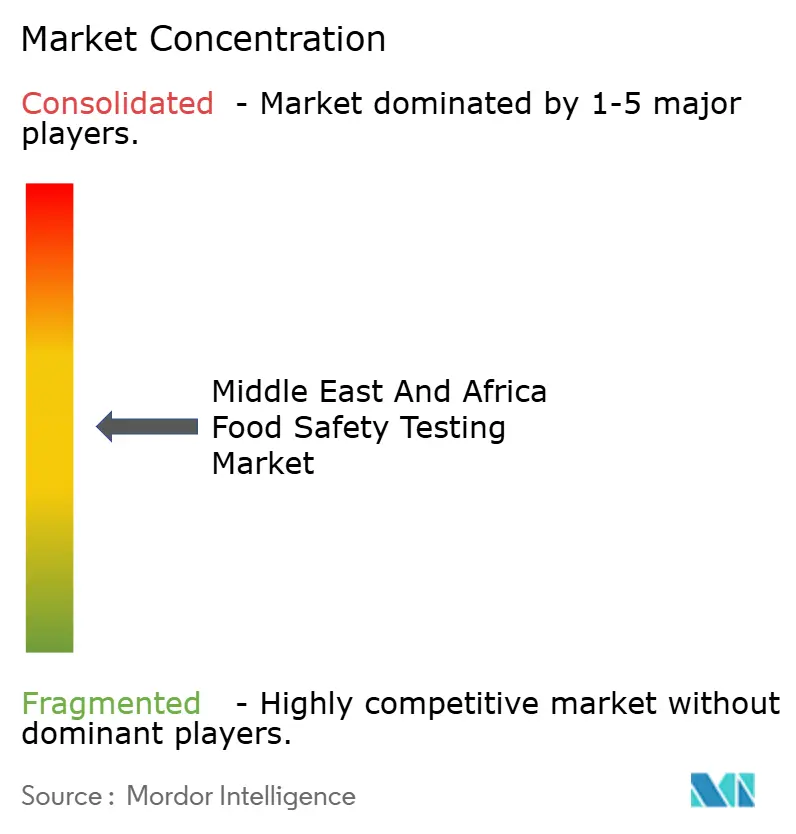
| Market Concentration | Medium |
Major Players *Disclaimer: Major Players sorted in no particular order Image © Mordor Intelligence. Reuse requires attribution under CC BY 4.0. | |
Middle East And Africa Food Safety Testing Market Analysis by Mordor Intelligence
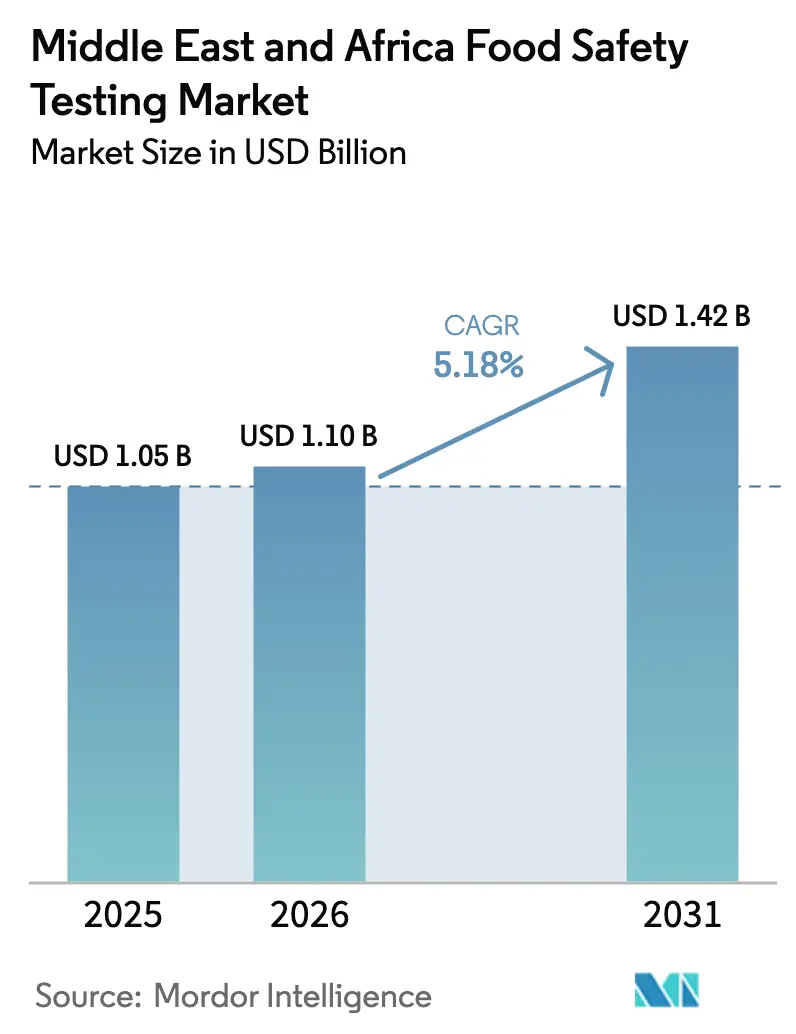
The Middle East and Africa food safety testing market size is expected to grow from USD 1.05 billion in 2025 to USD 1.10 billion in 2026 and is forecast to reach USD 1.42 billion by 2031 at 5.18% CAGR over 2026-2031. The increasing incidence of foodborne illnesses, higher import volumes, and stricter halal compliance regulations drive the demand for accredited laboratories in the region. Laboratory capacity expansion occurs through public sector investments, private equity funding, and international donor support, while technology providers introduce cost-effective rapid testing methods. Testing volumes are primarily driven by Saudi Arabia's import regulations and Egypt's export initiatives, with additional testing requirements from emerging pet food and animal feed supply chains. The market maintains moderate competition, with regional laboratories leveraging local regulatory expertise, while international companies emphasize network coverage, digital solutions, and rapid pathogen detection services.
Key Report Takeaways
- By contaminant type, pathogen testing captured 45.86% of the food safety testing market share in 2025; GMO testing is projected to expand at a 6.55% CAGR between 2026-2031.
- By technology, immunoassay platforms held 38.25% revenue share of the food safety testing market in 2025, while PCR techniques are forecast to grow at an 7.93% CAGR through 2031.
- By application, food products accounted for 82.10% of the food safety testing market size in 2025; pet-food and feed testing is advancing at a 7.05% CAGR to 2031.
- By geography, Saudi Arabia led with 27.88% of the food safety testing market in 2025, whereas Egypt is on track for the fastest 7.74% CAGR during the outlook period.
Note: Market size and forecast figures in this report are generated using Mordor Intelligence’s proprietary estimation framework, updated with the latest available data and insights as of 2026.
Market Trends and Insights
Drivers Impact Analysis of Middle East And Africa Food Safety Testing Market*
| Driver | (~) % Impact on CAGR Forecast | Geographic Relevance | Impact Timeline |
|---|---|---|---|
| Heightened burden of foodborne diseases and public health impact | +1.2% | Global, with acute impact in Egypt, Nigeria, Morocco | Short term (≤ 2 years) |
| Stringent food-safety regulations across Gulf Cooperation Council (GCC) and Africa | +1.8% | Gulf Cooperation Council (GCC) core, expanding to North Africa | Medium term (2-4 years) |
| Rising importance of food safety and food issues | +0.9% | Global | Long term (≥ 4 years) |
| Expansion of international trade and food imports/exports | + 1.1% | Saudi Arabia, United Arab Emirates, Egypt, South Africa | Medium term (2-4 years) |
| Halal-integrity convergence with contaminant testing | +0.8% | Gulf Cooperation Council (GCC), North Africa, Nigeria | Short term (≤ 2 years) |
| Increase in non-compliant food products to fuel market demand | +0.7% | Regional, with concentration in major import hubs | Short term (≤ 2 years) |
| Source: Mordor Intelligence | |||
Heightened burden of foodborne diseases and public health impact
The increasing incidence of foodborne illnesses across Middle East and Africa (MEA) necessitates robust testing protocols to ensure food safety and public health protection. According to WHO EMRO, contaminated food causes illness in approximately 100 million people annually in the Eastern Mediterranean Region, with children under five being the most affected[1]. Recent outbreaks in Jordan and Sudan highlight regional vulnerabilities, particularly from Salmonella and E. coli contamination, leading to increased hospitalization rates and strain on healthcare systems. Egypt's National Food Safety Authority has intensified the implementation of its 2023-2026 strategic plan, focusing on rapid detection capabilities and laboratory network expansion to address these challenges[2]. This significant public health challenge requires substantial government investment in testing infrastructure and regulatory frameworks, while food companies implement thorough testing protocols throughout their supply chains to prevent recalls, maintain consumer trust, and ensure compliance with regional food safety standards.
Stringent food-safety regulations across Gulf Cooperation Council (GCC) and Africa
The regulatory environment in the Middle East and Africa continues to drive the expansion of food safety testing requirements through stringent policies and standards. The United Arab Emirates Federal Law on Food Safety mandates comprehensive testing protocols for imported products, establishing strict quality control measures at entry points. Saudi Arabia's SFDA implements rigorous requirements for laboratory verification and detailed documentation for all food imports entering the kingdom. Egypt's decision to extend its halal dairy certification deadline to December 31, 2025, demonstrates the ongoing balance between implementing new testing requirements and maintaining efficient trade flows. The African Continental Free Trade Area implements extensive sanitary and technical standards across member states, with its Guided Trade Initiative now encompassing 24 countries and including a wide range of processed foods such as instant coffee, dried fruits, and meat products[3]. These evolving regulations require accredited testing services and sophisticated laboratory infrastructure, leading to significant capacity development across member countries to meet compliance standards.
Expansion of international trade and food imports/exports
The increasing food trade volumes across the Middle East and Africa (MEA) region drive the demand for food safety testing services due to stringent import-export requirements. The complexity of these requirements continues to evolve as countries implement more comprehensive food safety standards and quality control measures. Russia's grain exports to the Middle East and Africa (MEA) constitute approximately 70% of its total grain shipments, with projections indicating 55-57 million tonnes for 2024. This substantial volume requires extensive testing for mycotoxins, pesticide residues, and quality parameters to ensure compliance with international standards and regional regulations. The BRICS Grain Exchange initiative, connecting Russia, Brazil, India, China, and South Africa with East African buyers, aims to consolidate trade flows and establish uniform testing requirements across member markets. This standardization effort is expected to streamline the testing processes and enhance trade efficiency. Tunisia's infrastructure development, including the modernization of 206,000 tonnes of existing silo capacity and the addition of 181,000 tonnes of new storage facilities, necessitates comprehensive grain quality monitoring and testing protocols throughout the supply chain. These protocols encompass various stages from receipt and storage to pre-shipment verification, ensuring consistent grain quality and safety standards.
Halal-integrity convergence with contaminant testing
The combination of halal certification and traditional contaminant testing has established specialized market segments that command premium prices. The United Arab Emirates's halal certification requirements under UAE.S 2055 series mandate comprehensive testing for prohibited substances along with standard safety parameters. Egypt's halal dairy certification program, which extends through December 2025, requires laboratories to verify both microbiological safety and halal compliance. This integration increases the demand for multi-parameter testing capabilities and specialized analytical methods. The halal certification frameworks of Indonesia and Malaysia function as models for other Middle East and Africa countries developing similar programs, generating opportunities for technology transfer and laboratory capacity building.
Restraints Impact Analysis of Middle East And Africa Food Safety Testing Market*
| Restraint | (~) % Impact on CAGR Forecast | Geographic Relevance | Impact Timeline |
|---|---|---|---|
| High cost of advanced testing equipment | -0.8% | Sub-Saharan Africa, smaller Gulf Cooperation Council (GCC) markets | Long term (≥ 4 years) |
| Scarcity of ISO 17025-accredited local labs | -1.1% | Africa excluding South Africa, and smaller Middle East and Africa markets | Medium term (2-4 years) |
| Dependence on imported testing reagents and kits | -0.6% | Global | Medium term (2-4 years) |
| Resistance to change in traditional practices | -0.4% | Rural areas across Middle East and Africa | Long term (≥ 4 years) |
| Source: Mordor Intelligence | |||
High cost of advanced testing equipment
The high costs of laboratory equipment create barriers to market entry and expansion in Sub-Saharan Africa, where foreign exchange limitations restrict equipment purchases. While MALDI-TOF MS systems provide rapid bacterial identification, their significant initial investment requirements exceed many regional laboratories' budgets. The reliance on imported analytical instruments makes laboratories vulnerable to currency fluctuations and supply chain disruptions. The African Development Bank's commitment to food safety laboratory infrastructure development, along with emerging financing models and government procurement programs, helps address these challenges. Additionally, leasing arrangements and shared laboratory facilities enable cost distribution while maintaining access to advanced testing capabilities.
Scarcity of ISO 17025-accredited local labs
The limited availability of internationally accredited testing facilities creates bottlenecks and increases testing costs across the region. South Africa's food safety testing laboratories are concentrated primarily in Gauteng and Western Cape provinces, resulting in uneven geographic distribution and creating challenges for food producers in other regions to access testing services. The IAEA and FAO support Zimbabwe's Central Veterinary Laboratory and Uganda's Directorate of Government Analytical Laboratory to achieve ISO 17025 accreditation, highlighting the regional capacity limitations and the need for enhanced testing infrastructure. SADC and COMESA are working toward regional harmonization through mutual recognition agreements to reduce duplicate testing while maintaining quality standards, which could potentially improve testing efficiency and reduce costs for food manufacturers across member states.
*Our forecasts treat driver/restraint impacts as directional, not additive. The impact forecasts reflect baseline growth, mix effects, and variable interactions.
Middle East And Africa Food Safety Testing Market Segment Analysis
By Contaminant Type:
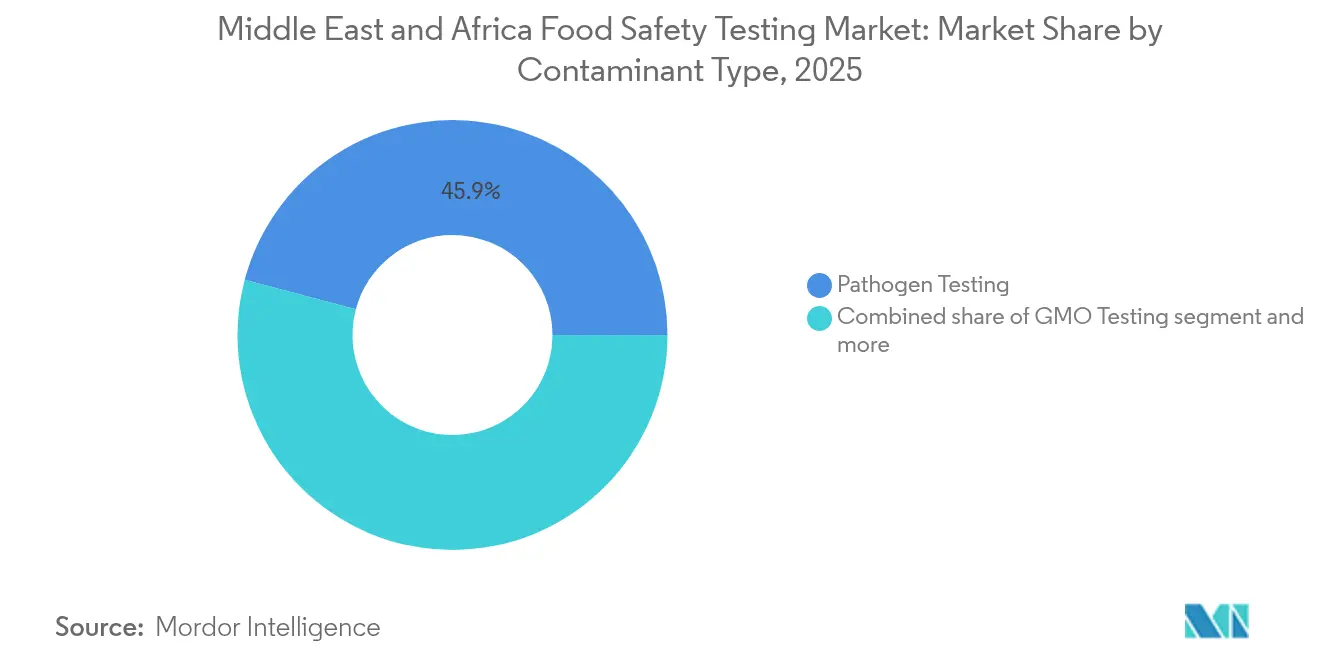
Pathogen Testing Dominates Amid Growing GMO ConcernsPathogen testing dominates with a 45.86% market share in 2025, as the region focuses on microbiological safety following significant foodborne illness outbreaks. Egyptian laboratories' implementation of MALDI-TOF MS technology for bacterial identification has achieved 75.8% species-level accuracy while reducing identification time to less than one hour. The demand for pesticide and residue testing remains consistent, driven by EU RASFF notifications and export market requirements. Allergen testing demand increases with the growth in processed food manufacturing.
GMO testing represents the fastest-growing segment with a 6.55% CAGR (2026-2031), due to increased use of bioengineered ingredients and export compliance requirements. The adoption of digital PCR technology for authenticity testing, as shown in oregano purity assessment studies, demonstrates the advanced analytical methods needed for GMO detection. Testing for other contaminants, including heavy metals and chemical residues, has improved through updates to the Codex Alimentarius MRL framework and regional standards harmonization. The integration of halal certification with traditional contaminant testing has created specialized testing protocols that generate higher pricing in the region's Muslim-majority markets.

By Technology:
Immunoassay Leadership Challenged by PCR InnovationImmunoassay-based technologies hold a 38.25% market share in 2025, driven by their cost-effectiveness and rapid turnaround times in resource-constrained laboratory environments across MEA. Lateral flow assays and ELISA platforms enable smaller laboratories to conduct reliable routine screening applications. The widespread adoption of these technologies is supported by established supply chains and minimal training requirements. Advanced immunoassay platforms with digital readout systems and multiplexed detection capabilities are gaining adoption in high-volume laboratories seeking enhanced throughput and data management capabilities. Polymerase Chain Reaction (PCR) technology shows the highest growth rate at 7.93% CAGR, expanding its applications in pathogen detection, GMO identification, and food authenticity verification.
Egyptian laboratories increasingly use real-time PCR for Salmonella detection, while multiplex PCR enables simultaneous species identification in meat products. Digital PCR represents an emerging technology frontier for quantitative applications, including oregano purity assessment and GMO quantification, offering improved precision and sensitivity. Chromatography and spectrometry maintain stable market positions through their essential role in pesticide residue analysis and nutritional labeling verification. Additional technologies, including biosensors and portable testing devices, are gaining market share by providing field-deployable solutions that reduce laboratory dependence and speed up decision-making processes.
By Application:
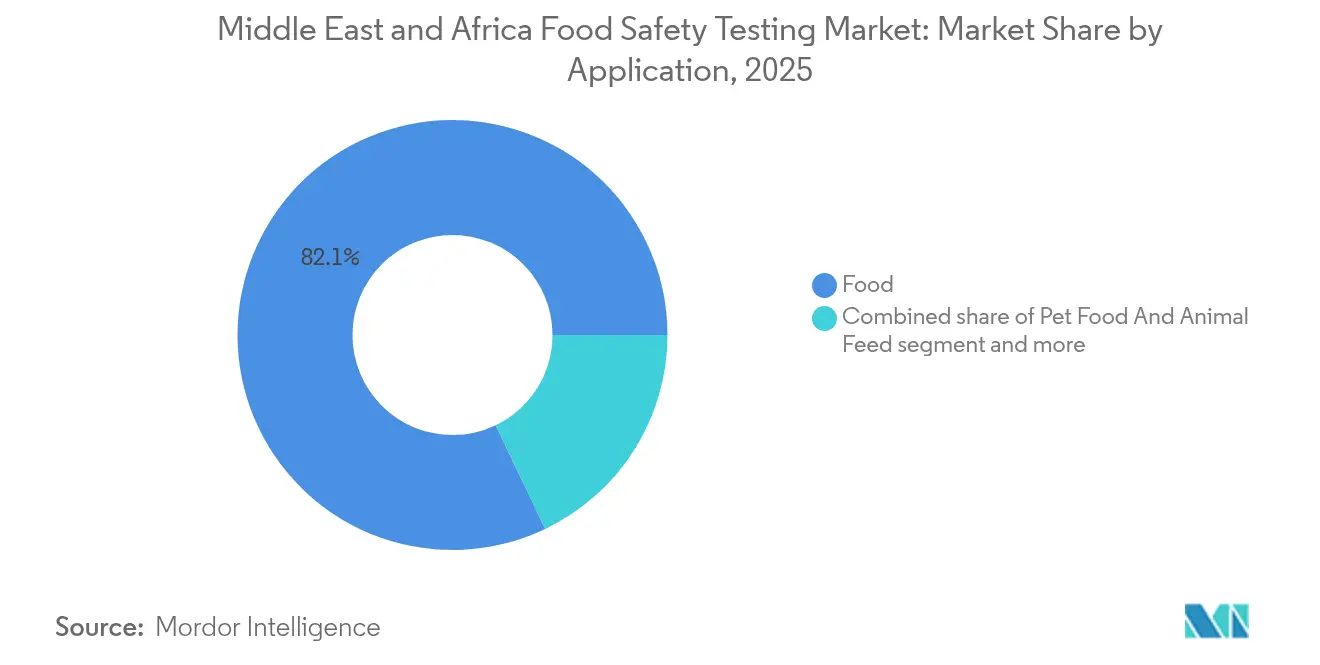
Food Segment Dominance with Emerging Pet Food GrowthThe food application segment holds 82.10% market share in 2025, encompassing comprehensive testing across meat and poultry, dairy, fruits and vegetables, processed foods, and crops. Meat and poultry testing generates significant volume through pathogen detection requirements, with Saudi Arabian slaughterhouse studies revealing high E. coli prevalence rates and antimicrobial resistance patterns that necessitate continuous monitoring and surveillance protocols.
Pet food and animal feed testing grows at a 7.05% CAGR, driven by premiumization trends. The incorporation of new ingredients, including insect proteins and algae-derived omega-3s, requires specialized testing for allergenicity, digestibility, and stability parameters. Kormotech's entry into Qatar and Nigeria demonstrates the regional expansion driving testing demand across the region. Modern processing technologies, including twin-screw extrusion and thermal retorting, create additional testing requirements for palatant stability and probiotic viability. The segment benefits from stringent import controls and growing consumer awareness of pet nutrition quality, driving demand for comprehensive analytical services, including mycotoxin detection, heavy metal analysis, and nutritional verification.
Geography Analysis
Saudi Arabia and GCC Food Safety Testing Market
Saudi Arabia holds 27.88% market share in 2025, driven by comprehensive regulatory frameworks and high import volumes requiring testing verification. The Saudi Food and Drug Authority implements strict import control procedures, generating consistent testing demand across product categories. Halal certification requirements create additional testing needs. The kingdom's Vision 2030 economic diversification plans focus on food security and local production capacity, leading to increased testing infrastructure investment. ALS Arabia's network of five laboratories in Saudi Arabia and additional facilities in Oman and Bahrain indicates strong market demand for testing services in the GCC region.
Egypt, Africa, APAC and Europe Food Safety Testing Market
Egypt records the highest growth rate at 7.74% CAGR, driven by processed food exports reaching USD 6.1 billion in 2024, representing 21% year-over-year growth. The National Food Safety Authority's 2023-2026 strategic plan strengthens laboratory capacity and regulatory enforcement. The establishment of Zewail City's food research center and the implementation of MALDI-TOF MS technology in laboratories reflect Egypt's investment in advanced testing capabilities. The country's position as a trade hub connecting Africa, Asia-Pacific, and Europe generates significant transit testing requirements.
EMEA and APAC Food Safety Testing Market
The United Arab Emirates maintains market strength through Dubai's position as a regional trade center and Federal Law food safety regulations. Nigeria's market growth stems from population expansion and increasing food imports, while Morocco benefits from agricultural exports and European market access. Turkey's geographical position between Europe and Asia-Pacific creates specific testing needs for transit and re-export activities. The Rest of Middle East and Africa includes diverse markets ranging from established South African laboratories to developing Sub-Saharan African facilities supported by international development funding and technical assistance.
Regulatory Landscape
Food safety testing in the Middle East and Africa is anchored around import control, national food laws, and regionally harmonized standards. In Saudi Arabia, the Saudi Food and Drug Authority (SFDA) governs imported food controls and associated documentation and laboratory verification, and as of April 2026, the Food Product Certificate of Conformity (PCoC) program for regulated food imports formalizes testing and certification via designated Conformity Assessment Bodies (CABs). In the GCC, the Gulf Standardization Organization (GSO) serves as the standards-setting backbone, with GSO standards adopted by member states to replace conflicting national requirements, reinforcing cross-border alignment for testing methods and acceptance.
Across North Africa, national authorities are tightening enforcement and extending program timelines where needed to maintain trade continuity. Egypt has been implementing its National Food Safety Authority (NFSA) 2023-2026 strategic plan focused on stronger controls and laboratory capability development, while halal-related compliance continues to influence test menus alongside contaminant testing (for example, the previously extended halal dairy certification deadline to December 31, 2025). At the regional cooperation level, the GCC Ministerial Committee for Food Safety held its 10th meeting on May 6, 2026 to advance unified approaches, adding momentum to standardized technical requirements that flow through to laboratory accreditation, method validation, and border inspection practices.
Value Chain Analysis
The MEA food safety testing value chain starts with upstream inputs such as instruments, consumables, and reagents (often imported), followed by method development and validation aligned to regulator-accepted standards and accreditation requirements (notably ISO/IEC 17025). Testing demand comes from food manufacturers, processors, exporters, and importers, with the highest transaction intensity at border entry points and export certification nodes. Risk-based surveillance and compliance workflows translate into recurring microbiology, residue, allergen, and authenticity testing, supported by documentation review and traceability data management.
A defining midstream layer in the GCC is the role of Conformity Assessment Bodies (CABs) supporting import compliance, including sampling, testing coordination, and factory or quality system verification (such as HACCP) tied to SFDA import controls and registration workflows. Laboratory service delivery is split between in-country accredited lab networks and cross-border hubs operated by multinational TIC and testing groups, with consolidation and network build-out also visible (for example, Eurofins Scientific expanded its presence through Ajal for Laboratories). Public-sector modernization programs shape capacity and routing decisions in the chain; in Saudi Arabia, municipal food safety laboratory PPP initiatives attracted 63 Expressions of Interest (53 Saudi and 10 international operators/consultancies), signaling active outsourcing and upgrade pathways that can shift volumes toward standardized, higher-throughput lab operations.
Competitive Landscape
The Middle East and Africa food safety testing market demonstrates moderate fragmentation, enabling both established global testing companies and specialized regional players to effectively gain and maintain market share. The market's diverse landscape creates opportunities for various participants to establish their presence while maintaining competitive dynamics that benefit end-users through service innovation and price competition.
Market leaders successfully utilize their extensive service portfolios and international accreditation standards to serve multinational food companies and export-oriented businesses, while regional firms strategically focus on their deep understanding of local regulatory frameworks and the provision of cost-competitive services. These distinct approaches to market participation ensure comprehensive coverage of testing needs across different market segments, from large-scale industrial operations to local food producers and processors.
Government certification programs create significant competitive advantages in the market, as evidenced by Intertek's strategic authorization as a Conformity Assessment Body by Iraq's COSQC and Saudi Arabia's SASO for vehicle inspection services, which clearly indicates the substantial expansion of regulatory compliance services throughout the region. Notable growth opportunities exist in mobile testing services, specialized halal certification testing, and comprehensive digital traceability solutions that effectively address and accommodate the region's specific regulatory requirements and unique cultural considerations. These emerging opportunities represent key areas for market expansion and service differentiation in the evolving Middle East and Africa (MEA) food safety testing landscape.
Middle East And Africa Food Safety Testing Industry Leaders
-
ALS Limited
-
Bio-Rad Laboratories
-
Eurofins Scientific S.E
-
Intertek Group plc
-
TÜV SÜD AG
- *Disclaimer: Major Players sorted in no particular order
Middle East And Africa Food Safety Testing Market Companies Covered in this Report
- SGS SA
- Eurofins Scientific
- Bureau Veritas Group
- Intertek Group Plc
- TÜV SÜD
- ALS Limited
- NSF International
- AsureQuality Limited
- UL LLC
- Institut Mérieux (Mérieux NutriSciences)
- Microchem Lab Services
- QIMA Ltd
- Neogen Corporation
- Romer Labs
- Microbiologics Inc
- Symbio Laboratories
- FoodChain ID
- FOSS A/S
- AgriFood Testing Laboratories
- Campden Bri MEA
Read Analysis of Middle East And Africa Food Safety Testing Companies
Market Opportunities and Future Outlook
Regulator-led import conformity programs and public lab modernization create clear whitespace for accredited capacity, digital workflows, and fast-turnaround testing at major trade nodes. Saudi Arabia’s PCoC framework (implemented April 2026) increases the importance of designated CAB networks and locally executable test menus, supporting opportunities for laboratories and TIC providers that can combine sampling logistics, documentation, and ISO/IEC 17025-aligned testing. In parallel, the municipal food safety laboratories PPP pipeline across five Saudi regions (Hafr Al Batin, Northern Borders, Tabuk, Qassim, and Al Ahsa), overseen by the National Center for Privatization and PPP and the Ministry of Municipalities and Housing, provides a structured route for private operators to add or upgrade facilities and embed multi-year service models.
On the technology side, the market is expanding beyond routine screening toward rapid and information-rich methods that fit border and high-volume processing use cases, including portable PCR, biosensors, and Next-Generation Sequencing (NGS) deployments via partnerships between global diagnostic players and regional distributors. Export-facing and higher-spec segments (processed foods, animal feed, and pet food) add demand for multi-parameter capability that blends microbiology, chemical residues, and authenticity checks, aligning with the region’s tighter halal-integrity and contaminant-testing convergence. These dynamics favor providers that can deliver integrated solutions across sites, including digitized reporting and traceability interfaces that reduce administrative friction for importers and exporters while maintaining regulator-required evidence trails.
Recent Industry Developments in Middle East And Africa Food Safety Testing Market
- May 2026: Intertek Group plc: The potential end date of the Intertek Testing Services (South Africa) (Pty) inspection contract (7200AA21C00057) for food and non-food humanitarian commodities was extended to May 18, 2030. This extension increases regional testing throughput and provides contract stability for government and humanitarian work, supporting reliability in MEA supply chains. The move strengthens Intertek's regional service network and supports continued regulatory compliance services across MEA markets.
- May 2026: Intertek Group plc: The potential end date of the Intertek Testing Services (South Africa) (Pty) inspection contract (7200AA21C00057) extended to May 18, 2030, according to federal contract data modified on May 22, 2026. The extension increases regional testing capacity and reinforces continuity for humanitarian commodity surveillance. It reinforces Intertek's footprint in MEA food safety and compliance services.
- January 2026: Eurofins Scientific S.E: Ajal Laboratories division in the Middle East grew by winning new tenders for food and feed testing and acquiring new customers in animal health during 2025. Tender wins diversify the MEA service mix and broaden the company's animal health testing capabilities. The developments expand Eurofins MEA presence and position in regulatory-driven testing segments.
Middle East And Africa Food Safety Testing Market Report Scope and Research Methodology
Market Definition and Coverage
For this study, the market covers revenue earned from food safety testing services and related test kits used to detect contaminants and verify compliance for foods traded and consumed across the Middle East and Africa.
Scope exclusions: In-house plant QA costs that are not billed as testing revenue, along with broader inspection and certification fees that sit outside lab testing, are excluded.
Segments Covered in This Report
- By Contaminant Type
- Pathogen Testing
- Pesticide and Residue Testing
- GMO Testing
- Allergen Testing
- Other Contaminant Testing
- By Technology
- Polymerase Chain Reaction
- Immunoassay-based
- Chromatography and Spectrometry
- Other Technologies
- By Application
- Pet Food And Animal Feed
- Food
- Meat And Poultry
- Dairy
- Fruits And Vegetables
- Processed Food
- Crops
- Other Foods
- By Geography
- South Africa
- Saudi Arabia
- United Arab Emirates
- Nigeria
- Egypt
- Morocco
- Turkey
- Rest of Middle East and Africa
Data Sources, Market Sizing, and Validation
Desk Research
Desk research starts with mapping the demand triggers for testing in the region, then translating them into measurable signals. We relied on public and official sources such as FAOSTAT for food production context, UN Comtrade for food trade direction and intensity, and Codex Alimentarius for food safety standards that influence testing requirements.
To ground country-level enforcement and import controls, we reviewed regulator and ministry publications and alerts, including food authority websites in key GCC markets, plus public health reporting where available through WHO. We also used lab accreditation and competence references, including ISO and national accreditation body listings, and we triangulated those with company filings, investor presentations, and reputable press for capacity expansion and service-mix cues. Where needed, paid subscriptions were used only for company financials and patent databases to confirm innovation and revenue exposure, and those inputs were checked back to public evidence. The sources listed here are illustrative, and we used additional references for data collection, validation, and clarification.
Primary Interviews and Surveys
Primary work was used to confirm how testing demand flows from import checks, export certification, and retail audits, and how that demand converts into lab volumes and pricing in practice. We spoke with laboratory operators, quality and compliance leads at food processors and importers, and technical managers who oversee method selection and turnaround targets. Input was collected across major MEA trade corridors so assumptions on sample volumes, service mix (pathogen, residue, allergen), and price realization could be tested against what buyers and labs are seeing.
Distribution of primary research fieldwork respondents
| Company type | Respondent position |
|---|---|
| Top tier: 31% | CXOs: 14% |
| Mid tier: 52% | Functional/Unit leaders: 30% |
| Smaller Players: 17% | Managers: 56% |
Market-Sizing & Forecasting
Sizing begins from a top-down reconstruction of the addressable testing pool, where food import and export flows, regulated commodity categories, and typical sampling frequency are used to approximate how many tests are ordered in a year. Those demand volumes are then priced using a blended ASP approach that reflects method choice and turnaround expectations, for example, rapid versus conventional microbiology and multi-residue chemistry panels.
To keep the totals realistic, we corroborate the output with selective bottom-up approximations, such as lab capacity and throughput checks, kit-consumption conversations, and sampled pricing for common test bundles. We then adjust for countries where data visibility is lower. The model is guided by inputs like cross-border food trade intensity, poultry and dairy production trends, enforcement actions or import alert patterns, the share of processed foods, and the penetration of accredited testing. For forecasting, we run scenario analysis around regulation tightening, import growth, and lab capacity additions, then narrow the scenario paths using what interviewees report in budgets, tender pipelines, and outsourcing behavior.
Data Validation & Update Cycle
Validation is handled through repeated checks that force the numbers to fit independent signals. We compare implied test volumes and ASPs against trade and production context, then run variance checks at the country level to flag outliers before final totals are locked.
A second analyst reviews assumptions, currency conversion timing, and any step changes introduced from interviews, and sends queries back to sources when gaps remain. Reports are refreshed annually, with interim updates when material events occur, such as major regulatory changes, sharp currency moves, or visible capacity expansions. Before delivery, a final pass is completed so clients receive the latest updated view.
Mordor Intelligence's Middle East Africa Food Safety Testing Market Size Measured Against Other Published Estimates
Published market sizes for MEA food safety testing can differ even when the topic sounds the same, because the included revenue streams and the timing of pricing assumptions are not consistent across publishers. Differences also come from how analysts convert local currencies, how they treat rapid testing kits versus lab services, and how quickly the model is refreshed when regulations or trade patterns shift.
In our refresh-led process, recent currency averages and updated ASP ladders by test type are re-checked during every annual refresh and again at sign-off using new interview validation. This is why the 2025 value published by Mordor Intelligence can sit apart from figures that rely on older pricing snapshots or one-time exchange rate points.
Benchmark comparison
| Source | Market Size | Gaps in Research Methodology |
|---|---|---|
| Mordor Intelligence | USD 1.05 B (2025) | |
| Industry Platform A | USD 0.93 B (2025) | Often applies a single blended price per test across countries and keeps currency conversions static, which can understate markets where higher-spec testing and faster turnaround pricing are becoming common. |
| Trade Journal B | USD 1.28 B (2026) | Tends to include adjacent quality and certification fees alongside testing and may project ASP increases aggressively without re-validating method mix and procurement behavior in the latest year. |
The spread in the table is mainly explained by what gets counted as testing revenue, how price per test is built up, and how recent the currency and service-mix assumptions are. By tying the model to visible demand signals and then re-validating price and mix with current interviews, we keep a repeatable estimate that can be reconciled back to clear drivers.
Key Questions Answered in the Report
How big is the food safety testing market in Middle East and Africa today?
The food testing market size in the region reached USD 1.10 billion in 2026 and is forecast to climb to USD 1.42 billion by 2031.
Which contaminant category is currently tested the most?
Pathogen assays lead, accounting for 45.86% of 2025 revenue, reflecting urgent efforts to curb Salmonella, Listeria, and E. coli outbreaks.
What technology is growing the fastest for food analysis?
PCR platforms, especially real-time and digital PCR, are projected to expand at an 7.93% CAGR owing to precision in pathogen and GMO detection.
Which country is the fastest-growing market for food testing services?
Egypt is expected to post an 7.74% CAGR over 2026-2031 as exports surge and the National Food Safety Authority scales lab capacity.