
Microlearning Market Size and Share
Market Overview
| Study Period | 2020 - 2031 |
|---|---|
| Market Size (2026) | USD 3.32 Billion |
| Market Size (2031) | USD 5.81 Billion |
| Growth Rate (2026 - 2031) | 11.83 % |
| Fastest Growing Market | Asia Pacific |
| Largest Market | North America |
| Market Concentration | Low |
Major Players *Disclaimer: Major Players sorted in no particular order Image © Mordor Intelligence. Reuse requires attribution under CC BY 4.0. | |
Microlearning Market Analysis by Mordor Intelligence
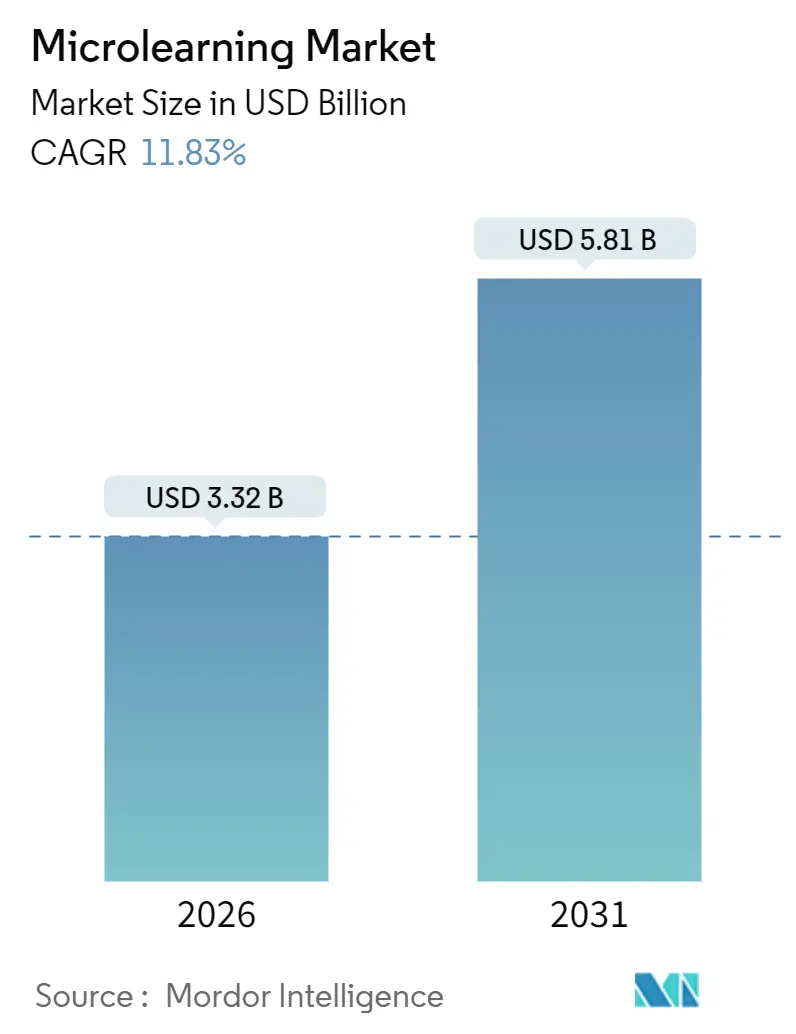
The microlearning market size reached USD 3.32 billion in 2026 and is forecast to advance at an 11.83% CAGR to USD 5.81 billion by 2031. Escalating demand for skills-based, just-in-time learning that fits the flow of work is steering enterprises toward mobile-first delivery models, especially in sectors with high turnover and stringent compliance needs. Platform vendors are atomizing courses into 3- to 10-minute modules that deskless and remote staff can launch on smartphones during natural workflow pauses, lifting adoption and cutting seat-time costs. ISO 27001 and SOC 2 Type II certifications have made cloud architectures credible with chief information security officers, while generative-AI authoring tools are shrinking development timelines for new content. Rivalry is intensifying as incumbent learning-management-system providers embed bite-sized content to shield installed bases, even as pure-play specialists leverage gamification and AI-driven personalization to win net-new accounts.
Key Report Takeaways
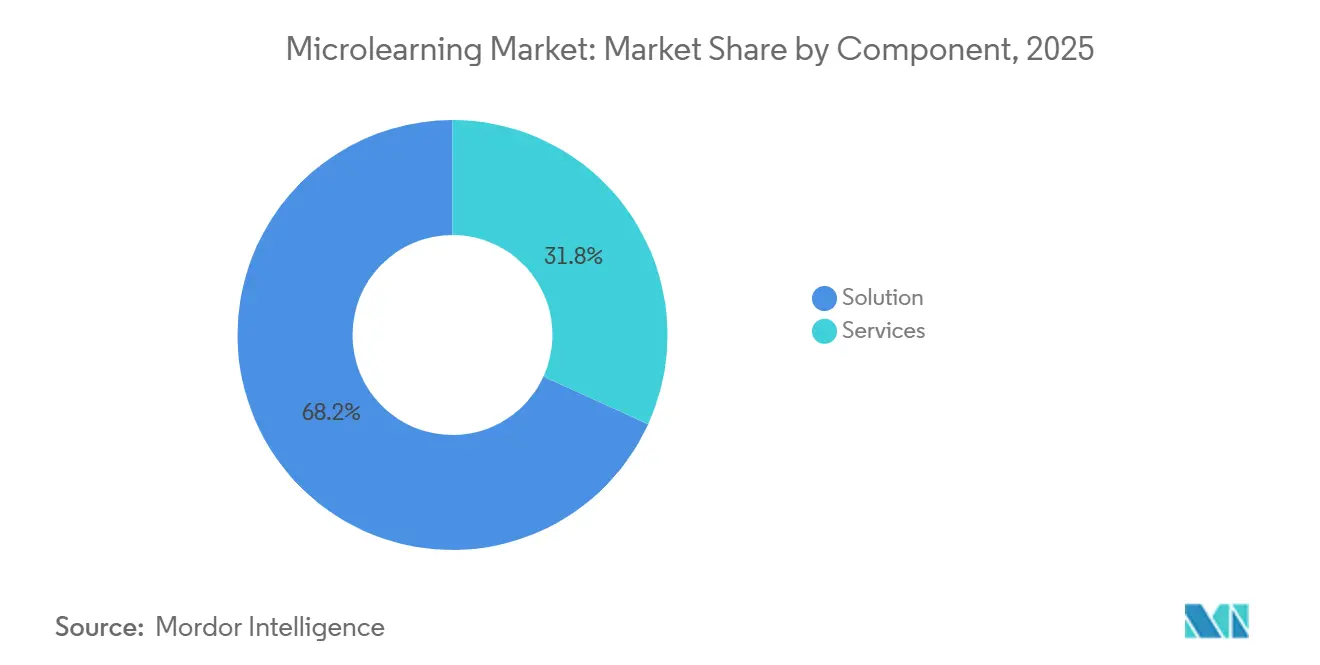
- By component, solution offerings led with 68.19% revenue share in 2025, and services are projected to grow at a 13.43% CAGR through 2031.
- By organization size, large enterprises commanded 54.72% of microlearning market share in 2025, whereas small and medium-sized enterprises are on track for a 14.59% CAGR to 2031.
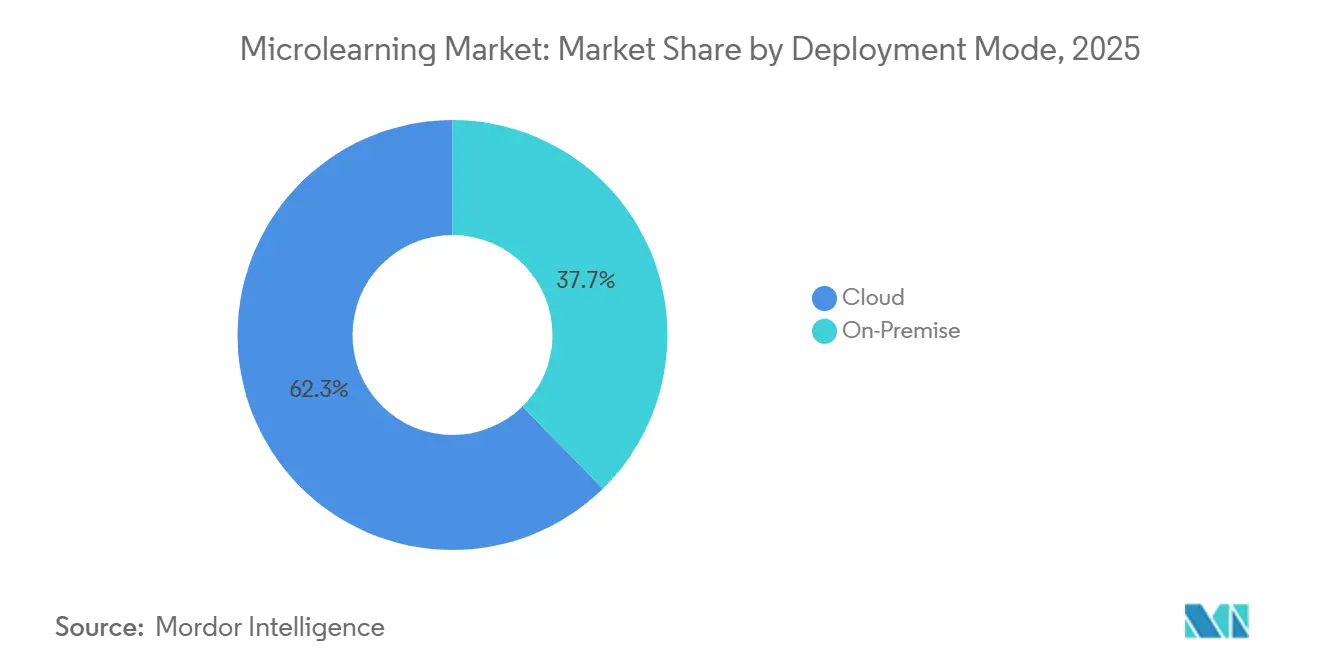
- By deployment mode, cloud platforms captured 62.33% share in 2025 and are poised to expand at a 15.19% CAGR through 2031.
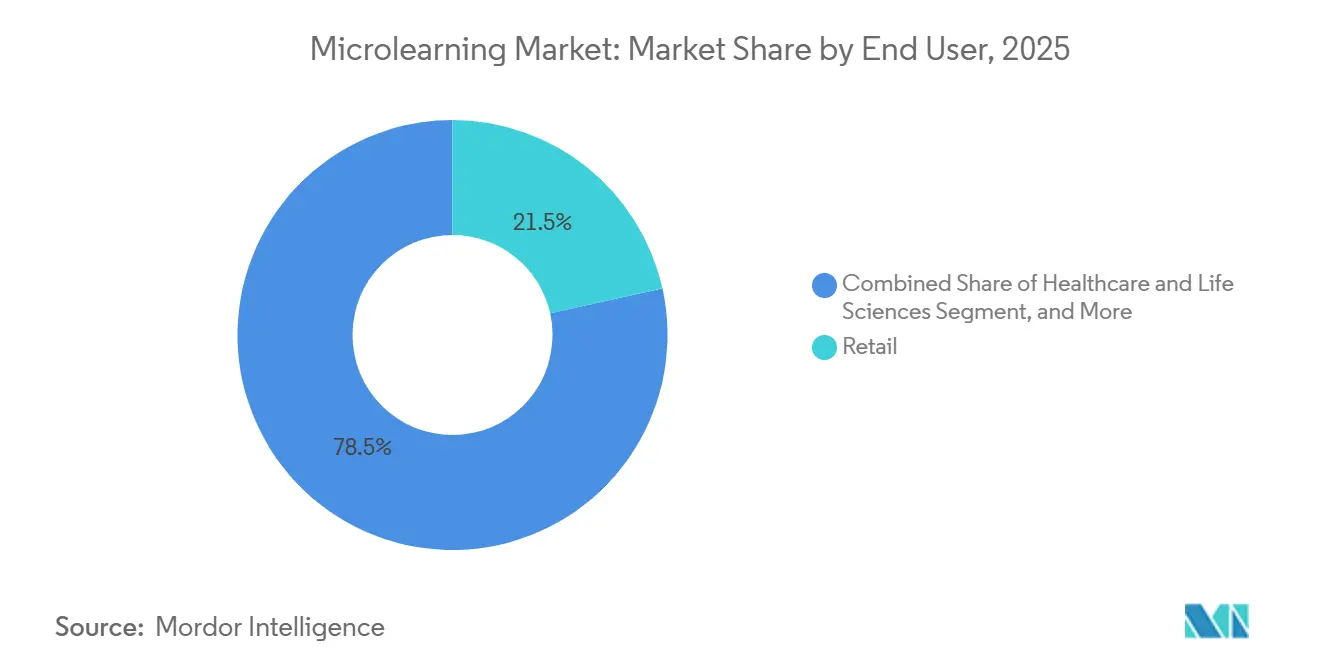
- By end user, retail held 21.53% of revenue in 2025, while healthcare and life sciences are forecast to post the fastest 15.22% CAGR.
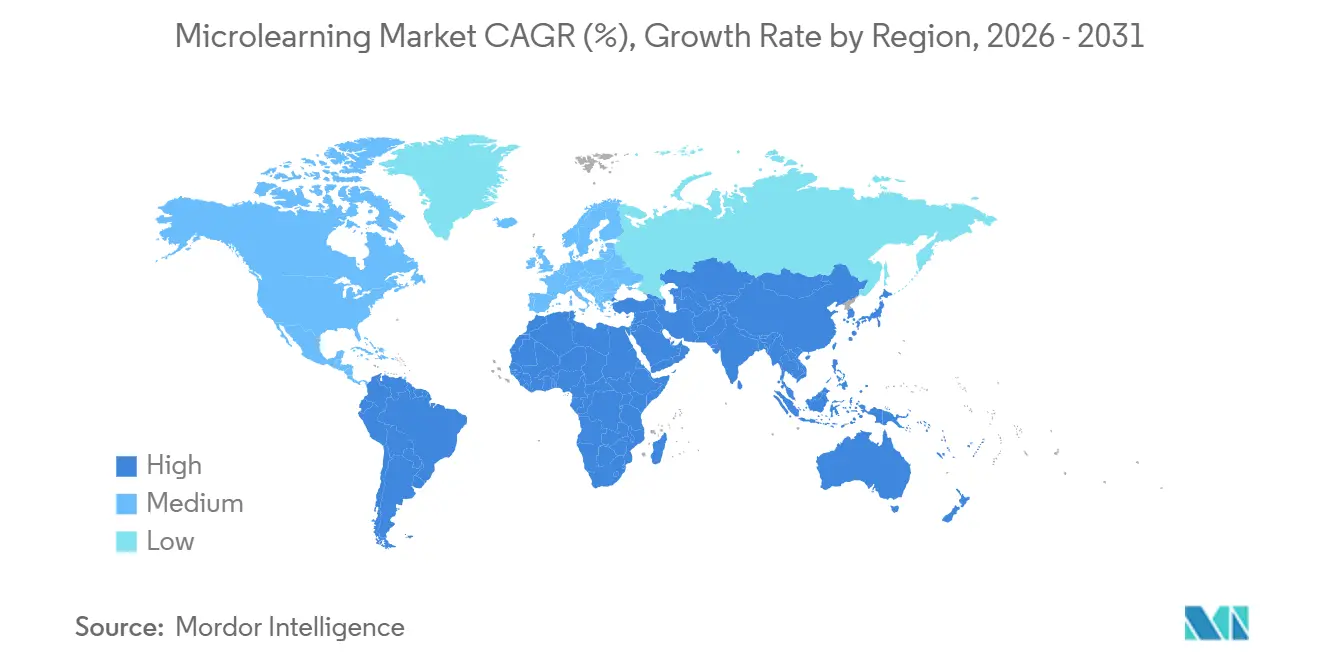
- By geography, North America accounted for 37.61% of 2025 revenue, yet Asia Pacific is expected to log a 14.81% CAGR to 2031.
Note: Market size and forecast figures in this report are generated using Mordor Intelligence’s proprietary estimation framework, updated with the latest available data and insights as of January 2026.
Market Trends and Insights
Drivers Impact Analysis of Microlearning Market*
| Driver | (~) % Impact on CAGR Forecast | Geographic Relevance | Impact Timeline |
|---|---|---|---|
| Proliferation of Mobile-First Workforce Learning Platforms | +2.80% | Global, with accelerated adoption in Asia Pacific and North America | Medium term (2-4 years) |
| Growing Need for Skills-Based, Just-in-Time Training | +3.10% | Global, particularly in manufacturing, retail, and logistics sectors | Long term (≥ 4 years) |
| Gamification Enhancing Learner Engagement and Retention | +1.90% | North America and Europe core, expanding to Asia Pacific | Short term (≤ 2 years) |
| AI-Driven Personalization of Micro-Content | +2.40% | North America and Europe early adopters, Asia Pacific following | Medium term (2-4 years) |
| Integration of Microlearning into Flow-of-Work Productivity Tools | +2.20% | Global, with enterprise concentration in North America and Europe | Medium term (2-4 years) |
| Regulatory Push for Continuous Compliance Training in Highly Regulated Industries | +1.70% | North America, Europe, Asia Pacific (BFSI and healthcare focus) | Long term (≥ 4 years) |
| Source: Mordor Intelligence | |||
Proliferation of Mobile-First Workforce Learning Platforms
Roughly 2.7 billion frontline and deskless employees now rely on smartphones for daily tasks, and adoption of microlearning market solutions that launch natively on iOS and Android removes the desktop bottleneck. Beverage chain Chatime reached 91% learner uptake with sub-5-minute modules accessed during pre-shift briefings, while Pet Supermarket logged 79% completion rates and cut turnover by 15% using similar tactics.[1] AWS projects Asia Pacific will require 5.7 billion digital training interventions by 2025, a scale only feasible with asynchronous mobile delivery.[2] Broader 5G coverage is enabling latency-free video and simulation on phones, making immersive formats viable for field technicians and clinicians.
Growing Need for Skills-Based, Just-In-Time Training
Enterprises moving away from annual course calendars toward role-triggered interventions are fuelling microlearning market demand. Workers asked to master new equipment, regulations, or product features benefit more from a 5-minute refresher than a half-day workshop. Internal mobility and retention gains of up to 3 times have been documented when skills-based pathways replace generic curricula. Tagging every module with competency metadata lets platforms surface content the instant an ERP or CRM system detects a workflow change, shortening time-to-productivity for new hires.
Gamification Enhancing Learner Engagement and Retention
Short lessons risk passive scrolling, so vendors deploy points, badges, and leaderboards to activate dopamine reward cycles. A 2024 TalentLMS survey showed gamified content boosting engagement by 83% and completion by 48% across retail, healthcare, and tech cohorts.[3] Extrinsic rewards best suit procedural or compliance topics, while narrative challenges foster deeper mastery in leadership and strategy programs. Spaced-repetition engines that surface quizzes at scientifically timed intervals further cement retention, yet over-gamification can dilute seriousness in safety-critical contexts.
AI-Driven Personalization of Micro-Content
Large language models integrated into microlearning market platforms generate adaptive paths that tailor sequence and difficulty to each learner’s prior knowledge. Adobe Learning Manager introduced retrieval-augmented recommendations that pull from proprietary wikis and policy libraries to serve 3-minute explainers exactly when performance data flags a skills gap.[4] Studies in 2024 recorded 23% better outcomes versus static playlists, with the greatest lift among below-average performers. Privacy concerns push banks and hospitals to deploy on-premises or private cloud instances, so training data stays inside controlled borders.
Restraints Impact Analysis of Microlearning Market*
| Restraint | (~) % Impact on CAGR Forecast | Geographic Relevance | Impact Timeline |
|---|---|---|---|
| High Cost of Transforming Legacy Content into Micro-Modules | -1.80% | Global, with acute impact on large enterprises in North America and Europe | Short term (≤ 2 years) |
| Difficulty in Measuring ROI Versus Traditional L&D Approaches | -1.20% | Global, particularly in organizations with immature learning-analytics capabilities | Medium term (2-4 years) |
| Data-Privacy and Security Concerns in Cloud-Based Learning Platforms | -0.90% | Europe (GDPR), Asia Pacific (data-residency laws), North America (sector-specific regulations) | Long term (≥ 4 years) |
| Content Fatigue from Over-Fragmentation of Learning Assets | -0.70% | Global, with higher incidence in organizations deploying high-frequency push notifications | Medium term (2-4 years) |
| Source: Mordor Intelligence | |||
High Cost of Transforming Legacy Content into Micro-Modules
Articulate benchmarking shows converting a single traditional course into micro-units’ costs USD 10,000 to USD 50,000 and demands up to 184 development hours per finished hour. Enterprises with 100-course libraries confront multiyear efforts that force them to run legacy and microlearning market platforms in parallel. Scarce subject-matter experts further slow progress, prompting buyers to favour vendors offering content-as-a-service bundles that slash lead times but may lack industry-specific nuance.
Difficulty in Measuring ROI Versus Traditional L and D Approaches
Legacy Kirkpatrick or Phillips models were built for classroom events, not continuous pipelines of 3-minute videos. Only a quarter of companies track post-training behaviour change, making it hard to justify microlearning market budgets to finance leaders. Correlating completions with promotion velocity, retention, or productivity requires data engineering many teams lack, and inconsistent vendor success metrics complicate platform comparisons. Until standardized dashboards emerge, skepticism around ROI will temper spending growth.
*Our forecasts treat driver/restraint impacts as directional, not additive. The impact forecasts reflect baseline growth, mix effects, and variable interactions.
Microlearning Market Segment Analysis
By Component:
Services Gain MomentumSolution licenses generated 68.19% of 2025 revenue, yet services are projected to outstrip the broader microlearning market at a 13.43% CAGR to 2031. As organizations re-platform, they increasingly outsource content audits, integration, and change management, favouring vendors that bundle advisory with technology. Consulting engagements map competencies, redesign learning pathways, and configure APIs, while support contracts provide ongoing upgrades and helpdesk access that convert into predictable annual recurring revenue.
Many large enterprises maintain catalogues exceeding 100 legacy courses, a workload internal teams cannot re-author quickly. Vendors such as Skillsoft and Cornerstone now position content-as-a-service to shrink deployment from 18 months to 6 months, addressing worries that microlearning sacrifices depth. The result is expanding professional-services pipelines that stabilize cash flows and deepen customer lock-in.
By Organization Size:
SMEs Accelerate AdoptionLarge enterprises held 54.72% of microlearning market share in 2025, leveraging bigger L&D budgets and IT support. However, SMEs are expected to grow at 14.59% through 2031 as cloud subscriptions remove upfront infrastructure costs. Freemium tiers from EdApp or TalentCards let firms pilot with ten users, while AI authoring converts PDFs and SOPs into mobile-ready modules, eliminating instructional-design bottlenecks.
The OECD found European SMEs allocate just 1.2% of revenue to training, so low-cost, high-impact interventions resonate. Yet subject-matter experts, not learning professionals, create most small-business content, risking pedagogical gaps. Vendors counter with template-driven storyboards and automated assessment generation that align microlearning market experiences with adult-learning principles without inflating budgets.
By Deployment Mode:
Cloud Captures Majority ShareCloud captured 62.33% of deployments in 2025 and is projected to post the fastest 15.19% CAGR, thanks to zero-trust compatibility and automatic feature upgrades. Native links to Okta and Azure Active Directory speed user provisioning, while ISO 27001 and SOC 2 Type II audits address security due diligence for regulated buyers. These traits make cloud offerings the default for fresh implementations, driving the microlearning market size at the platform layer.
On-premises persists in government and financial segments bound by data-sovereignty rules. GDPR and China’s Personal Information Protection Law force some buyers to keep learning records on national soil, so vendors maintain private-cloud and self-hosted editions. However, manual patching, capital spending for servers, and slower innovation cycles tilt economics toward SaaS wherever regulations permit.
By End User:
Healthcare Leads Growth CurveRetail remained the largest adopter at 21.53% revenue share in 2025, reflecting huge frontline populations and constant product updates. Yet healthcare and life sciences are forecast for the sharpest 15.22% CAGR, propelled by continuing-medical-education rules and Joint Commission competency standards. Ten-minute micro-modules let clinicians earn credits between patient rounds, making the microlearning market indispensable for hospitals facing staffing shortages.
BFSI institutions use bite-sized anti-money-laundering and cybersecurity refreshers to comply with FFIEC and FINRA rules, while telecom and tech firms employ microlearning for 5G and cloud skill gaps that evolve faster than certification bodies can update syllabi. Manufacturing and logistics embed short safety drills accessible on rugged tablets at the point of work, cutting incident rates without halting production lines.

By Delivery Format:
Interactive Simulations Gain TractionVideo remains the default because it conveys emotion and procedure effectively, but interactive simulations are growing for tasks where hands-on practice determines proficiency. Computers and Education reported simulation-based microlearning improving outcomes by 31% for troubleshooting and maintenance tasks. Simulations demand up to 300 development hours per finished hour yet deliver measurable performance lifts that justify investment in safety-critical settings.
Podcasts and audiobooks serve knowledge workers during commutes, while gamified quizzes reinforce compliance concepts that mainly require memorization. Infographics and micro-blogs communicate quick policy updates, although their static nature can dampen engagement. Blended format libraries enable learning leaders to match media to complexity and cognitive load, enriching the microlearning market ecosystem without overwhelming budgets.
Geography Analysis
North America Microlearning Market
North America generated 37.61% of 2025 revenue. High LMS penetration, dense vendor clusters, and stringent banking and healthcare regulations ensure steady recurring spend. The FFIEC’s 2024 update to Bank Secrecy Act guidance emphasized adaptive, role-based training, validating microlearning solutions for compliance workflows. Private-equity interest peaked with Cornerstone’s USD 5.2 billion take-private, signalling confidence in continued consolidation. Saturation is a looming headwind, so growth now hinges on upselling AI personalization and skills-intelligence modules.
APAC Microlearning Market
Asia Pacific is forecast to record the fastest 14.81% CAGR as smartphone ubiquity meets government upskilling mandates. Singapore’s Digital Enterprise Blueprint targets 95% SME tech adoption by 2025, funding AI courses that already trained 2,000 workers. Indonesia’s Kartu Prakerja enrolled 14.3 million citizens, supplying IDR 32 trillion (USD 2.1 billion) in grants for bite-sized digital skills courses. AWS estimates 819 million regional workers need new digital abilities by 2025, heralding massive microlearning market potential. Regional data-residency rules raise infrastructure costs, but vendors with in-country data centers gain first-mover advantage.
EMEA and LATAM Microlearning Market
Europe’s trajectory is shaped by GDPR, which classifies learning records as personal data, compelling vendors to keep servers inside the European Economic Area. Homegrown providers such as Valamis leverage regional hosting to win public-sector accounts, while global players invest in Frankfurt and Dublin regions to comply. Germany’s dual-training model encourages apprentices to use microlearning for theory between shop-floor rotations, and France’s medical-education requirements are boosting demand in healthcare. Latin America, the Middle East, and Africa remain early-stage but show promise as multinationals deploy standardized programs across subsidiaries, using the microlearning market to avoid travel costs and classroom downtime.
Regulatory Landscape
Microlearning platforms operate under overlapping regimes for learning quality, credential recognition, and data protection rather than a single global rulebook. In January 2026, the New Zealand Qualifications Authority (NZQA) brought Micro-credential Approval and Accreditation Rules 2026 into force, tightening requirements around outcomes, assessment, and provider accreditation for short-form credentials that can be delivered in modular, microlearning-friendly formats.
Cross-border delivery is further shaped by national frameworks and sector compliance rules. Turkiye advanced formal recognition with the Higher Education Board (YOK) issuing Procedures and Principles on the Micro-Credentials Framework in Higher Education Institutions, effective 10 June 2026, while Australia maintains a National Microcredentials Framework to guide consistency in how short courses are described and understood. Separately, regulated industries drive ongoing compliance-training demand, for example Singapore's Ministry of Manpower introduced an online micro-learning component for Safety Orientation Course recertification assessment in May 2024. For vendors, GDPR-aligned handling of learning records in Europe and US student-privacy expectations (FERPA and COPPA for education contexts) continue to influence deployment choices, security controls, and the pace of AI feature rollout.
Competitive Landscape
The top five suppliers account for roughly 35-40% of revenue, indicating moderate concentration. Cornerstone OnDemand, Docebo, Skillsoft, Udemy Business, and IBM lead by breadth of content, integrations, and enterprise footprint. Pure-play challengers such as Axonify, EdApp, and Qstream win deals with mobile-first design and rapid deployment times. Feature parity is narrowing: most platforms now support video, quizzes, gamification, and AI-driven recommendations, pushing price and customer success to the forefront.
Clearlake Capital’s purchase of Cornerstone provides capital for multi-year R&D, while Skillsoft’s acquisition of SumTotal adds performance-management modules to fight suite vendors like SAP SuccessFactors.
Docebo bundles APIs for Microsoft Teams and Salesforce so learning appears inside employee workflows, a tactic mirrored by IBM’s watsonx integration that answers natural-language questions with 3-minute clips. Vendors race to secure ISO 27001 and SOC 2 attestations as procurement teams bake security into RFP scoring. Emerging players harness generative AI to convert SOPs into lessons within hours, courting SMEs priced out of custom development. As scale becomes essential for continuous innovation, further mergers are likely.
Microlearning Industry Leaders
-
Mindtree Limited
-
IBM Corporation
-
SwissVBS
-
Axonify Inc.
-
Bigtincan Holdings Ltd.
- *Disclaimer: Major Players sorted in no particular order

Microlearning Market Companies Covered in this Report
- Axonify Inc.
- Cornerstone OnDemand Inc.
- IBM Corporation
- Bigtincan Holdings Ltd.
- Saba Software Inc.
- iSpring Solutions Inc.
- Epignosis LLC
- Qstream Inc.
- Mindtree Ltd.
- SwissVBS
- Skillsoft Corp.
- Docebo Inc.
- Articulate Global LLC
- EdApp (SafetyCulture)
- Gnowbe Pte. Ltd.
- TalentCards (Epignosis)
- Udemy Business
- Pluralsight LLC
- Valamis Group Oy
- Absorb LMS Software Inc.
- LearnUpon Ltd.
Market Opportunities and Future Outlook
A gap is emerging at the intersection of microlearning, workflow integration, and measurable performance support for frontline and distributed roles. Buyers increasingly want content delivered inside tools already used for daily execution, including Microsoft Teams and Slack integrations referenced in enterprise learning stacks, which favors vendors that can embed short modules, prompts, and knowledge checks directly into the flow of work while retaining auditability for regulated functions. Demand is also building around lowering the high cost of converting legacy courses into micro-modules, often benchmarked at USD 10,000 to USD 50,000 per course conversion, which elevates demand for services, AI-assisted authoring, and content-as-a-service bundles from large suppliers that can industrialize re-authoring at scale.
Government and employer-funded upskilling programs create another expansion lane where platforms can align with formal micro-credential frameworks and local data requirements. Asia Pacific examples such as Indonesia's Kartu Prakerja (14.3 million enrollees supported by IDR 32 trillion in grants) and Singapore's Digital Enterprise Blueprint (SME-focused digital adoption) point to active demand pools that match mobile-first, bite-sized learning delivery. Broader smartphone penetration, reported at 78% in 2024 in a 2026 academic review, supports richer micro-formats such as interactive simulations and immersive learning for deskless workers. At the same time, enterprise interest in AI-driven personalization for role and skills-gap targeting is increasing the need for strong security postures, including ISO 27001 and SOC 2 Type II controls that procurement teams are already using as decision anchors for cloud deployments.
Recent Industry Developments in Microlearning Market
- May 2026: Axonify announced AI-powered platform enhancements, including Immersive Microlearning, positioned to deliver frontline enablement closer to daily operations. The update broadens the format mix beyond basic video and quizzes, raising competitive pressure on vendors that rely on static micro-content libraries. It also reinforces the market shift toward AI-shaped experiences that connect learning to execution for deskless workforces.
- November 2025: Bigtincan introduced its Fall 2025 product release with expanded AI features, interface updates, and collaboration improvements across its platform. The release supports consolidation of sales enablement and readiness workflows into a single environment, which can reduce tool sprawl for enterprise buyers. Larger platforms with embedded AI and content tools increase pricing and packaging pressure on smaller, point-solution microlearning providers.
- April 2025: Vector Capital completed the acquisition of Bigtincan Holdings Limited for approximately A$183 million, taking the company private. The transaction provided financial backing to accelerate product development and portfolio integration, including broader AI capabilities used in enablement and training use cases. Private ownership also signals continued consolidation among adjacent learning, readiness, and revenue-effectiveness software categories that overlap with microlearning deployments.
Microlearning Market Report Scope and Research Methodology
Market Definition and Coverage
For this study, the microlearning market is defined as revenue earned from delivering short, bite-sized learning content and enabling technology that supports creation, delivery, tracking, and management of these learning experiences across organizations.
Scope exclusions: We exclude general long-form e-learning courseware, degree programs, and classroom training services when they are not packaged or sold as microlearning offerings.
Segments Covered in This Report
- By Component
- Solution
- Services
- Consulting and Implementation
- Support and Maintenance
- By Organization Size
- Large Enterprises
- Small and Medium-Sized Enterprises
- By Deployment Mode
- On-Premise
- Cloud
- By End User
- Retail
- Manufacturing
- Banking, Financial Services and Insurance
- Telecom and IT
- Healthcare and Life Sciences
- Logistics
- Education
- Media and Entertainment
- By Delivery Format
- Video-Based Learning
- Interactive Simulations
- Podcasts and Audiobooks
- Quizzes and Assessments
- Infographics
- Micro-Blogs and Text Nuggets
- By Geography
- North America
- United States
- Canada
- Mexico
- South America
- Brazil
- Argentina
- Rest of South America
- Europe
- Germany
- United Kingdom
- France
- Italy
- Spain
- Russia
- Rest of Europe
- Asia Pacific
- China
- Japan
- India
- South Korea
- Australia and New Zealand
- Southeast Asia
- Rest of Asia Pacific
- Middle East
- GCC
- Turkey
- Israel
- Rest of Middle East
- Africa
- South Africa
- North Africa
- Rest of Africa
- North America
Data Sources, Market Sizing, and Validation
Desk Research
Desk research was used to set the market boundary, understand adoption patterns, and collect reference indicators that can be checked against our model outputs. We relied on public sources such as U.S. Bureau of Labor Statistics workforce and occupation data, OECD education and skills publications, World Bank digital access indicators, UNESCO learning statistics, and WIPO patent filings to see where training demand and digital delivery readiness are moving.
We also reviewed company filings, investor presentations, product documentation, and reputable press coverage to map common pricing approaches (subscription, per user, and enterprise licensing) and to identify how microlearning is positioned versus broader learning platforms. In a few places, we complemented this with paid subscriptions for company financials and intelligence, patent databases, and news and financials, mainly to confirm revenue ranges and recent product or partnership activity. The desk sources listed here are illustrative, and many other public references were used during data collection and clarification.
Primary Interviews and Surveys
Primary work focused on validating what is actually being purchased as microlearning and how budgets are allocated across solutions and services. We spoke with a mix of solution providers, services partners, and enterprise buyers across APAC, EMEA, and the Americas to pressure test pricing, adoption pace, and deployment shifts between cloud and on-premise environments.
Distribution of primary research fieldwork respondents
| Company type | Respondent position | Region |
|---|---|---|
| Top tier: 37% | CXOs: 20% | APAC: 43% |
| Mid tier: 41% | Functional/Unit leaders: 23% | EMEA: 31% |
| Smaller Players: 22% | Managers: 57% | Americas: 26% |
Market-Sizing & Forecasting
Market sizing starts with a top-down build where spend pools are reconstructed by combining enterprise learning and development intensity with digital delivery adoption, then narrowed to purchases that are explicitly microlearning. This is checked with selective bottom-up approximations, where sampled vendor revenue ranges and typical pricing levels are applied to estimated user volumes to keep the totals realistic.
A few inputs used as practical fingerprints include enterprise training intensity by industry, cloud versus on-premise deployment preference, typical module duration and frequency for microlearning programs, relative demand for formats such as video nuggets, quizzes, and interactive simulations, and the share of spending routed through services for content creation and program rollout. Where direct revenue splits were not available, we filled gaps using observed pricing bands, buyer budget ranges, and a weighted mix of organization sizes, which we then rechecked in interviews.
Forecasting was run using scenario analysis supported by short trend lines on key drivers such as smartphone penetration, remote and hybrid workforce patterns, and compliance training frequency. Assumptions around pricing progression and service attach rates were reviewed with practitioners so the forecast reflects what buyers and providers expect to see over the next few years.
Data Validation & Update Cycle
Outputs are validated through cross checks against independent indicators, and then reworked when the implied spending per learner or implied adoption rates look out of line for a region or end user group. A second analyst review is completed to confirm that definitions were applied consistently across solutions, services, and delivery formats, and that currency conversion logic is applied in a comparable way across years.
The model is refreshed annually, and interim updates are triggered when there are material changes such as large acquisitions, major pricing shifts, or sudden swings in enterprise training priorities. Before delivery, we complete a final pass to incorporate the most recent public filings and news signals so clients receive an updated view.
Mordor Intelligence's Microlearning Market Estimate Compared With Other Published Estimates
Published microlearning market values can vary even when they describe similar growth stories, because the counted revenue lines and the chosen base year are often not aligned. Differences also show up when one estimate uses a fast-moving demand assumption, while another uses a slower budget cycle view.
The benchmark table shows a higher 2026 starting value than some earlier year estimates, and in Mordor Intelligence's model the total is tied to solution plus services revenue that is explicitly sold as microlearning, which is then split by deployment, organization size, end user, and delivery format before totals are rolled up.
Benchmark comparison
| Source | Market Size | Gaps in Research Methodology |
|---|---|---|
| Mordor Intelligence | USD 3.32 B (2026) | |
| Trade Journal A | USD 2.95 B (2024) | Uses an earlier base year and a shorter forecast window, and it can also blend microlearning with adjacent digital training spend when defining solutions versus services. |
| Industry Analyst B | USD 3.21 B (2025) | Often applies higher growth expectations from just-in-time learning adoption, and the split between platform revenue and services revenue is not always validated with buyer-side budget checks. |
Looking across the three figures, the spread is mainly explained by base year selection and what gets counted as microlearning revenue versus broader learning software or content. When the scope is kept specific and the inputs are checked against practical indicators like deployment mix and buyer budget ranges, the final number becomes easier to trace and to update year over year.
Key Questions Answered in the Report
How fast is the microlearning market expected to grow through 2031?
It is projected to advance at an 11.83% CAGR, lifting value from USD 3.32 billion in 2026 to USD 5.81 billion by 2031.
Which segment is expanding faster than the overall market?
Services, which include consulting, implementation, and support, are forecast to grow at a 13.43% CAGR to 2031, slightly ahead of the total market pace.
Why are small and medium-sized enterprises adopting microlearning?
Cloud subscriptions remove infrastructure costs, freemium pilots cut risk, and AI authoring converts existing documents into lessons, enabling SMEs to upskill staff without large budgets.
What drives healthcare to be the fastest-growing end user?
Continuing-medical-education requirements and Joint Commission competency standards push hospitals to deliver short, mobile modules clinicians can finish between patient appointments.
How do security certifications influence deployment choices?
ISO 27001 and SOC 2 Type II audits reassure risk officers, enabling 62.33% of buyers to favor cloud deployments while highly regulated entities keep limited on-premises instances.
Which regions offer the highest growth potential?
Asia Pacific leads with a forecast 14.81% CAGR, boosted by government upskilling grants and the region's large mobile workforce.