
Market Overview
| Study Period | 2020 - 2031 |
|---|---|
| Forecast Data Period | 2026 - 2031 |
| Base Year Market Size (2025) | USD 1.72 Billion |
| Market Size (2026) | USD 1.88 Billion |
| Market Size (2031) | USD 2.81 Billion |
| Growth Rate (2026 - 2031) | 8.37 % |
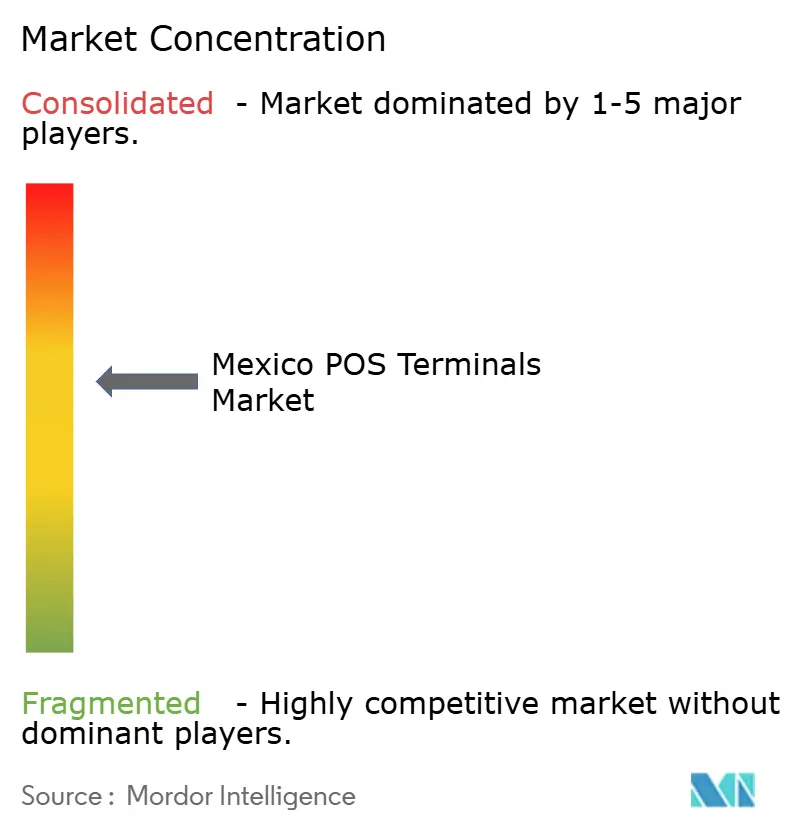
| Market Concentration | Medium |
Major Players *Disclaimer: Major Players sorted in no particular order Image © Mordor Intelligence. Reuse requires attribution under CC BY 4.0. | |
Mexico POS Terminals Market Analysis by Mordor Intelligence
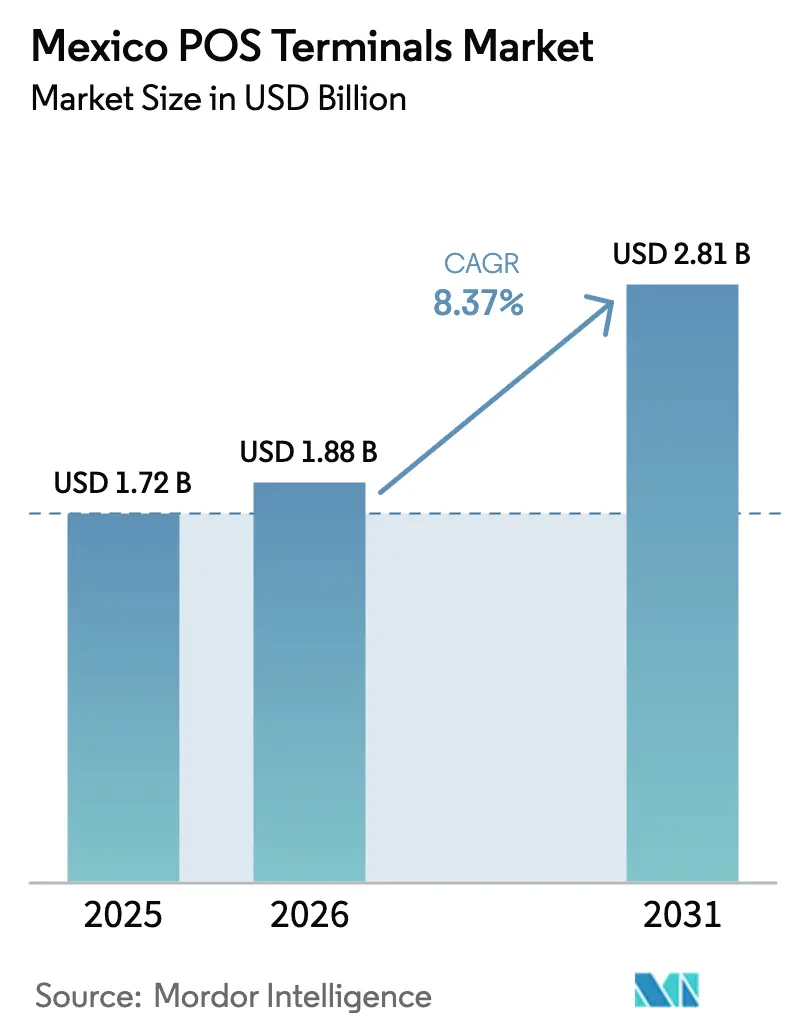
The Mexico POS terminals market size is projected to expand from USD 1.72 billion in 2025 and USD 1.88 billion in 2026 to USD 2.81 billion by 2031, registering a CAGR of 8.37% between 2026 to 2031. Steady migration away from cash, a dense pipeline of low-cost mobile readers, and pro-competition regulation are widening acceptance, yet informal commerce, network interoperability gaps, and fraud anxiety continue to temper the upside. Contact-based devices still anchor most checkout lanes, but near-field communication rollouts are compressing upgrade cycles, while embedded-financing bundles are tightening aggregator lock-in. Draft interchange caps promise to ease merchant costs, though they also compress acquirer margins and could spark price realignments. Hardware supply chains have largely stabilized ahead of the 2026 FIFA World Cup, easing the execution risk around planned terminal deployments.
Key Report Takeaways
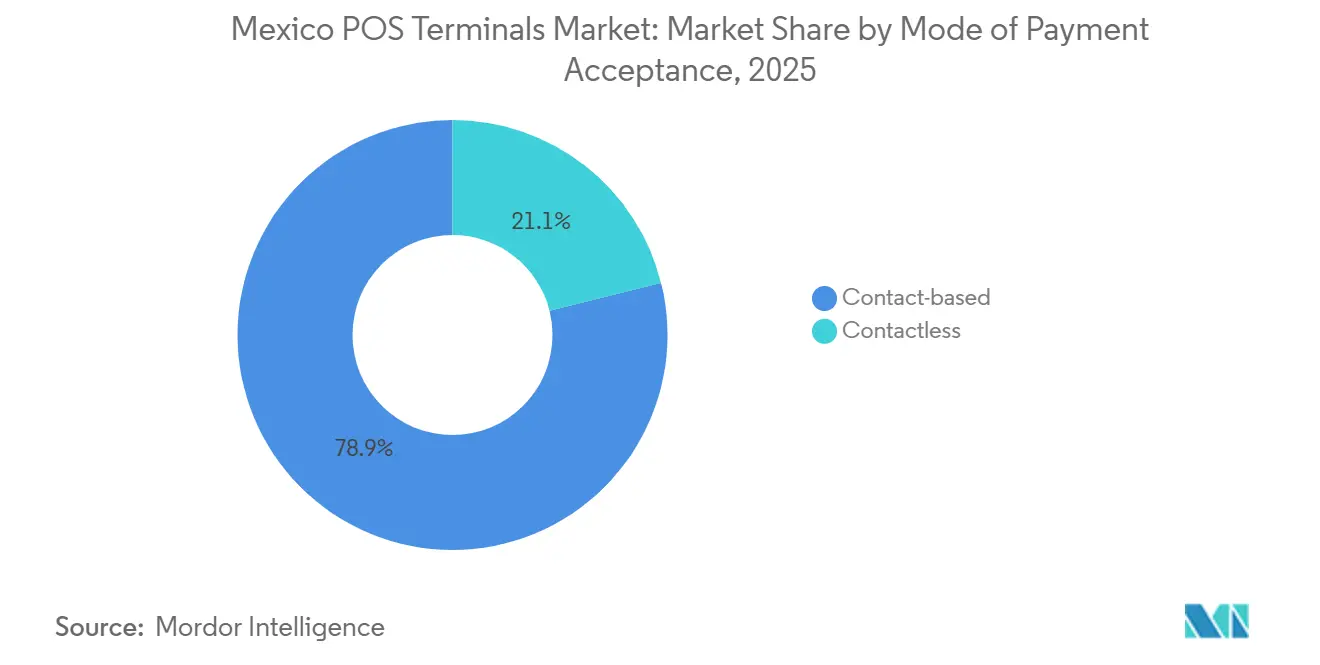
- By mode of payment acceptance, contact-based terminals led with 78.89% of the Mexico POS terminals market share in 2025, whereas contactless systems are projected to advance at a 10.18% CAGR through 2031.
- By POS type, mobile and portable devices accounted for 67.97% of the Mexico POS terminals market size in 2025 and are forecast to grow at a 9.04% CAGR between 2026-2031.
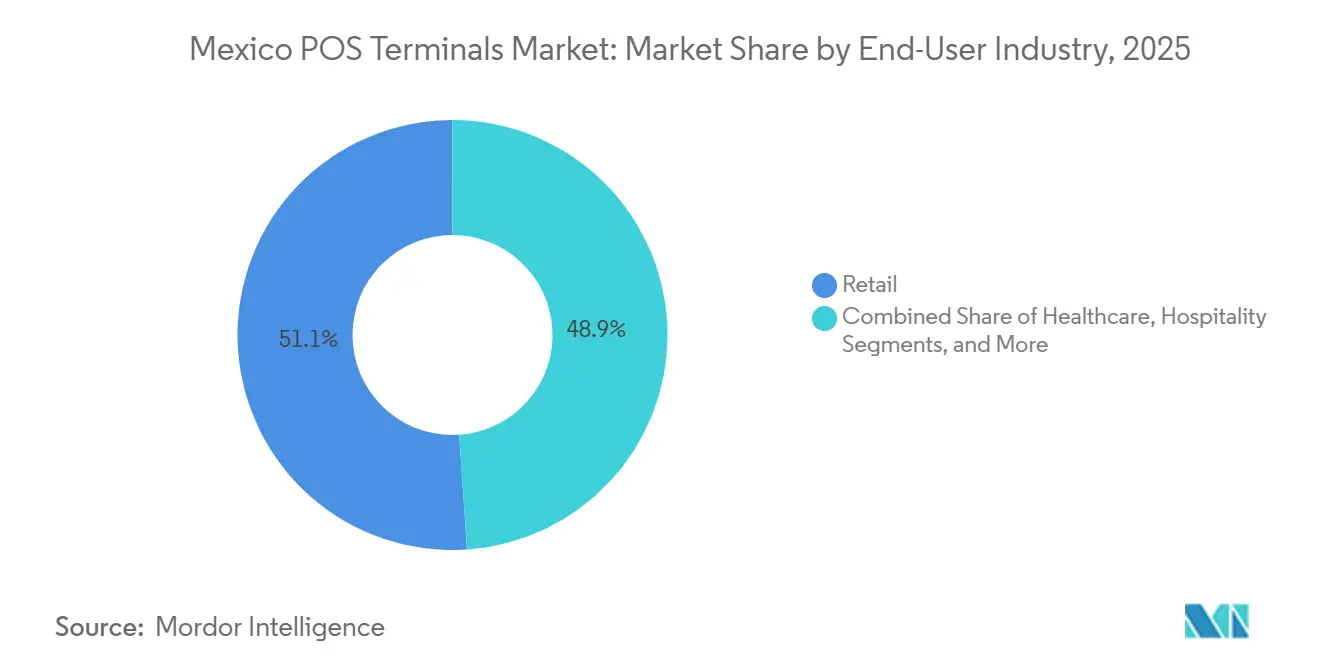
- By end-user industry, retail held 51.07% of demand in 2025, while healthcare is expected to post the fastest expansion at an 11.23% CAGR to 2031.
Note: Market size and forecast figures in this report are generated using Mordor Intelligence’s proprietary estimation framework, updated with the latest available data and insights as of 2026.
Mexico POS Terminals Market Trends and Insights
Drivers Impact Analysis*
| Driver | (~) % Impact on CAGR Forecast | Geographic Relevance | Impact Timeline |
|---|---|---|---|
| Surge in Contactless-NFC Transactions | +2.1% | National, Strongest in Mexico City, Guadalajara, Monterrey | Medium Term (2-4 Years) |
| SME Adoption of Mobile POS Aggregators | +1.9% | National, Concentrated in Urban and Peri-Urban Corridors | Short Term (≤ 2 Years) |
| CoDi and DiMo Real-Time Payment Rails | +1.3% | National, Pending Incentives | Long Term (≥ 4 Years) |
| MDR Caps Boost Card Acceptance | +1.5% | National, Acute Among Micro-Merchants | Medium Term (2-4 Years) |
| Embedded Lending and Data-Driven Analytics | +0.9% | National | Medium Term (2-4 Years) |
| Rise of Software-Only SoftPOS Solutions | +0.6% | National, Early Pilots | Long Term (≥ 4 Years) |
| Source: Mordor Intelligence | |||
Surge in Contactless-NFC Transactions
Contactless payment volume jumped 150% year-over-year in 2024, lifted by BBVA’s rollout of 45,000 NFC-enabled devices across 22,000 OXXO stores and the enablement of tap-to-pay on 70% of its card portfolio.[1] Mexico City, Guadalajara, and Monterrey together generate a disproportionate share of tap activity as commuters favor speed and hygiene, whereas rural municipalities trail because legacy mag-stripe readers remain serviceable. Acquirers benefit from 15% fewer chargebacks and faster settlement, trimming fraud reserves and float funding costs.[2] Vendors are racing for PCI PTS v7 certification, which hard-codes tokenization and secure elements into new hardware, effectively forcing merchants to refresh devices before enforcement deadlines.
SME Adoption of Mobile POS Aggregators
Aggregators operated more than 1 million active terminals by September 2025, with Mercado Pago alone hitting that milestone and Clip serving over 2 million merchants processing 4 million daily transactions.[3] Devices priced below MXN 1,000 (USD 54) and instant onboarding contrast sharply with the costly, paperwork-heavy model still common among banks. The Ministry of Economy’s December 2025 program promises zero-cost readers for 1 million MSMEs ahead of the 2026 World Cup, dramatically enlarging the funnel for first-time acceptance.[4] Embedded loans amplify loyalty, Mercado Pago issued 2.5 million small-ticket credits to 400,000 businesses, turning payment data into underwriting fuel that incumbents struggle to replicate.
CoDi and DiMo Real-Time Payment Rails
CoDi accumulated just 11.9 million transactions through Q1 2024, equating to under 1% of daily payment flows despite fee-free rules. DiMo added 7.5 million users within twelve months, but merchant acceptance remains patchy because user journeys lack receipt flows or refunds. The Federal Economic Competition Commission urged Banco de México to allow third-party overlays that could bundle loyalty or cash-back modules, mirroring Brazil’s Pix success where average merchant cost is 0.22% against 2.2% for cards.[5] If regulators green-light value-added layers and banks commercialize APIs, real-time rails could undercut interchange-based economics and remodel terminal demand.
MDR Caps Boost Card Acceptance
In October 2025, draft rules proposed slashing interchange to 0.3% on debit and 0.6% on credit, down from roughly 1.15% and 1.91% . Lower merchant discount rates should unlock acceptance among taco stands, laundromats, and pharmacies where average tickets have fallen to MXN 580 (USD 31). Aggregators are structurally advantaged because they already monetize thin spreads and upsell credit, whereas traditional acquirers face margin compression. Complementary surcharge bans enacted in April 2024 further neutralized a key merchant objection to taking cards.[6]
Restraints Impact Analysis*
| Restraint | (~) % Impact on CAGR Forecast | Geographic Relevance | Impact Timeline |
|---|---|---|---|
| Persistent Cash Preference and Unbanked Base | -1.8% | National, Acute in Rural Municipalities | Long Term (≥ 4 Years) |
| Card-Data Security and Fraud Exposure | -1.2% | National, Concentrated in E-Commerce | Short Term (≤ 2 Years) |
| Terminal Hardware Supply-Chain Volatility | -0.7% | National | Medium Term (2-4 Years) |
| Merchant Friction on DiMo/CoDi Fees and UX | -0.5% | National | Medium Term (2-4 Years) |
| Source: Mordor Intelligence | |||
Persistent Cash Preference and Unbanked Base
Nine of every ten adults still rely on cash for day-to-day spending, while 74.5% of households remain cash-exclusive. Half the population is unbanked, and 55% of workers earn income informally, short-circuiting the card issuance loop. Connectivity divides amplify the gap: 19 million adults lack internet, 18 million lack smartphones, and 14 million lack both. Pilot projects show upside, tortillerías using QR and contactless added up to USD 1,912 in monthly revenue, but adoption targets of 40% in year one underscore the gradual cultural shift.
Card-Data Security and Fraud Exposure
Fraud losses hit MXN 11.3 billion (USD 611 million) in 2024, with identity theft up 77% year-over-year and social-engineering scams driving 72% of incidents. Chargeback-prone e-commerce saw acceptance rates dip below 67% by value, eroding merchant confidence. New internal-control rules demand multi-factor authentication and near-real-time monitoring, straining small acquirers. Players with scale, Citibanamex cut fraud 70% via AI and Nu México earmarked USD 100 million for defenses, are fortifying, yet the compliance burden may slow onboarding at the long tail of micro-merchants.
*Our forecasts treat driver/restraint impacts as directional, not additive. The impact forecasts reflect baseline growth, mix effects, and variable interactions.
Segment Analysis
By Mode of Payment Acceptance: Contact-Based Dominance, Contactless Momentum
Contact-based terminals captured 78.89% of the Mexico POS terminals market share in 2025, a reflection of legacy mag-stripe and chip-and-PIN estates. Transaction stability caters to high-ticket verticals such as electronics and automotive service where customers still prefer PIN entry. Yet contactless sales grew triple digits in 2024 after BBVA deployed NFC readers chain-wide at OXXO, showing the velocity that subsidy-backed rollouts can reach. Because contactless clears faster and posts roughly 15% fewer chargebacks, supermarkets and quick-service restaurants view upgrades as throughput enhancers.
The Mexico POS terminals market size attributable to contactless devices is expected to expand at a 10.18% CAGR, helped by mandatory PCI PTS v7 compliance and multi-network acceptance rules under the National Banking and Securities Commission. Ingenico’s AXIUM and Verifone’s Victa families both ship with dual-interface antennas, biometric modules, and Android 14 operating systems, future-proofing merchants for loyalty, stablecoin acceptance, and identity verification. As acquirers refresh estates, mixed fleets will persist; the tipping point hinges on device financing programs that alleviate upgrade costs for micro-merchants.
By POS Type: Mobile Systems Shape Merchant Economics
Mobile and portable devices commanded 67.97% of 2025 installations, thanks to aggregator strategies that bundle low-cost card readers with instant KYC and same-day settlement. Clip’s Ultra ruggedized model and Mercado Pago’s smart terminal lineup illustrate the pivot from dongles to app-rich, Android-based hardware capable of inventory control and lending origination. The segment is projected to clock a 9.04% CAGR, outpacing the overall Mexico POS terminals market, as SumUp’s January 2026 entry intensifies price competition yet broadens reach among still-cash-only MSMEs.
Fixed countertop systems held the balance 32.03% share, entrenched in grocery chains, department stores, and gas stations where Ethernet reliability and integrated receipt printers remain non-negotiable. Still, cloud device-management suites such as Ingenico 360 enable remote diagnostics, narrowing the service-level gap with field-upgradable mobiles. SoftPOS solutions, Verifone Tap and the AXIUM software stack, introduce a hardware-less model that could cannibalize low-end mobile readers, though security certification and merchant trust keep widespread adoption a longer-term prospect.
By End-User Industry: Retail Volume, Healthcare Velocity
Retail generated 51.07% of transactions in 2025, buoyed by dense convenience-store networks and nationwide department-store footprints. Banorte, for instance, expanded its acquirer estate 18% year-over-year in underserved municipalities, signaling that even in peri-urban corridors card acceptance lifts basket sizes. Hospitality is adding tap-to-pay ahead of the World Cup, but healthcare is the fastest-growing vertical, set to advance at 11.23% CAGR through 2031 as public clinics digitize billing and private hospitals link POS data to patient records for real-time claims.
The Mexico POS terminals market size tied to healthcare remains smaller today but benefits from mandatory electronic payments for co-pays and prescriptions. Integrated patient-management suites boost revenue-cycle accuracy, trimming reconciliation delays. In parallel, pharmaceutical retail inside hospitals adopts mobile readers to reduce cash-handling, reinforcing hygiene and security imperatives. Regulatory data-privacy mandates elevate hardware requirements, tokenization, end-to-end encryption, raising switching costs and cementing vendor relationships.

Geography Analysis
Greater Mexico City, Guadalajara, and Monterrey host roughly 40% of the installed terminal base despite representing just one-fifth of the population, underscoring the urban skew of the Mexico POS terminals market. Card transactions nationwide totaled 10.662 billion operations valued at MXN 6.2 trillion (USD 335 billion) from July 2024 to June 2025, reflecting 18.4% volume growth and illustrating the widening digital footprint. Yet CoDi accounts for less than 1% of daily flows, emphasizing that infrastructure availability does not guarantee adoption.
Peri-urban belts now receive concentrated investment, with Banorte reporting 73% terminal growth in municipalities previously underserved by banks. Correspondent agents fill branch gaps, but their density is uneven: OXXO alone controls 46% of correspondent points, exposing geographic concentration risk. Southern states, Oaxaca, Chiapas, Guerrero, lag in both device penetration and card issuance, yet they represent the largest untapped pool where zero-fee device programs could unlock millions of merchants. Frontier states facing the United States perform above average, leveraging cross-border commerce and dynamic-currency conversion to attract dollar spend.
Preparations for the 2026 World Cup are catalyzing upgrades in host cities, spurring adoption of multi-wallet acceptance, offline fallback, and EMV QR to serve 5.5 million expected visitors. Whether those investments radiate into outlying boroughs will hinge on connectivity build-outs, as 19 million adults still lack internet, many of them living in high-marginalization zones. Banco de México’s interoperability oversight and the National Banking and Securities Commission’s acquirer licensing standards continue to push the market toward broader, more transparent coverage.
Regulatory Landscape
Mexico regulates POS acceptance through a multi-agency framework led by Banco de Mexico (Banxico) and the Comision Nacional Bancaria y de Valores (CNBV). Under the Law for the Transparency and Ordering of Financial Services, Banxico sets conditions for payment network services, including fee-related rules that influence merchant discount economics. A key compliance anchor for acquirers, payment networks, and terminal deployers is the joint regime for Redes de Medios de Disposicion (payment card and related acceptance networks), which sets participant obligations, device-use rules, and operational transparency expectations.
The Disposiciones de caracter general aplicables a las Redes de Medios de Disposicion were last modified on April 27, 2026, reinforcing supervisory attention on interoperability, transparency, and operational controls across the acceptance chain. In parallel, Banxico operates the SPEI real-time interbank transfer system, which supports instant transfer use cases and provides rails that QR and account-to-account solutions can leverage alongside card acceptance at the point of sale.
Competitive Landscape
Non-bank institutions operate 78% of the 6.3 million-plus terminals deployed as of December 2024, proving that platform-based models can outpace bank-centred distribution. Commercial banks still clear 91.3% of card value but are ceding hardware ground to aggregators that weave payment acceptance into credit, analytics, and loyalty. Mercado Pago’s estate surpasses 1 million active devices, 60% of which are smart, application-ready units, deepening ecosystem lock-in. Clip, having seeded micro-merchants, is climbing upmarket with API-enabled Pin Pad and rugged Ultra models, courting enterprise chains that demand ERP connectivity.
Global Payments’ July 2025 renewal with Banamex keeps a 900 million-transaction pipeline intact, illustrating that bank partnerships remain relevant where countertop estates and payroll clients converge. Meanwhile, white-space pivots around software-only acceptance: Ingenico’s SoftPOS-ready AXIUM suite and Verifone Tap convert commercial smartphones into terminals, chopping capital costs and potentially recoding economics for small traders. Biometric add-ons, Verifone’s PopID face and palm modules, promise faster checkout and identity assurance, yet certification and privacy hurdles could slow scaling.
PCI PTS v7 and mandatory multi-network acceptance rules create high fixed costs for certification, tilting advantage toward incumbents that can amortize across global volumes. Still, aggregators leverage nimble software stacks to iterate features, installments, pay-by-link, split bills, at speeds legacy acquirers rarely match. The competitive chessboard therefore pivots on ecosystem breadth rather than device counts alone, positioning data-rich platforms to capture the next wave of merchant adoption across the Mexico POS terminals market.
Mexico POS Terminals Industry Leaders
-
Ingenico Mexico SA De CV
-
Verifone Systems Inc.
-
PAX Technology Limited
-
Diebold Nixdorf Incorporated
-
BBPOS Limited
- *Disclaimer: Major Players sorted in no particular order
Market Opportunities and Future Outlook
The main headroom sits in first-time acceptance among micro and small merchants, and in peri-urban and southern states where terminal penetration and formal banking ties trail national averages. At the same time, the market already shows platform-scale traction: aggregators and non-bank institutions account for a large share of deployed terminals (78% of the 6.3 million-plus terminals as of December 2024). The Ministry of Economy led a December 2025 program with Visa, BBVA, and Santander to equip 1 million MSMEs with zero-cost devices ahead of the 2026 World Cup, creating a large, time-bound deployment funnel that supports entry-level mobile and portable terminals and low-friction onboarding.
Technology opportunities are centered on upgrades tied to security and device management. Vendors are pushing Android-based, application-ready terminals and cloud tooling that reduces field-service cost and enables value-added apps (inventory, loyalty, digital receipts, and embedded lending). Recent vendor actions, including Ingenico bringing its AXIUM family together with the Ingenico 360 cloud management platform, and PAX advancing PCI PTS v7-ready Android SmartPOS devices, point to managed, software-centric estates. That trend raises demand for remote device lifecycle services, multi-wallet acceptance, and fraud-mitigation features, which helps merchants address fraud anxiety while expanding digital checkout options.
Recent Industry Developments
- May 2026: PAX Technology unveiled restaurant-focused payment and POS solutions, including A360 and A380 PIN pads, at the National Restaurant Association Show. The release targets food service formats that prioritize fast checkout, table service workflows, and multi-lane deployments, and it adds competitive pressure in smart terminal and PIN pad refresh cycles.
- February 2026: Ingenico launched the AXIUM payment-device family alongside the Ingenico 360 cloud platform, pairing Android-based terminals with centralized fleet management. The update supports large-scale rollout readiness for acquirers and aggregators by streamlining device provisioning, updates, and monitoring, with security baselines such as PCI PTS v7.
- April 2024: Banca Afirme adopted Ingenico cloud-based solutions covering device management and digital receipt services. The bank-level deployment pointed to growing demand for managed terminal estates and value-added checkout services, shifting procurement from standalone hardware toward recurring software and operations layers around POS fleets.
Research Methodology Framework and Report Scope
Market Definition and Coverage
This market covers the revenue generated from POS terminal hardware used in Mexico to accept in person card and digital wallet payments at merchant locations, including fixed countertop units and portable or mobile devices.
Scope exclusions: We exclude pure software POS subscriptions, payment gateway fees, and ATM hardware because they do not represent POS terminal device revenue.
Segmentation Overview
- By Mode of Payment Acceptance
- Contact-based
- Contactless
- By POS Type
- Fixed Point-of-Sale Systems
- Mobile and Portable Point-of-Sale Systems
- By End-User Industry
- Retail
- Hospitality
- Healthcare
- Transportation and Logistics
- Other End-User Industries
Data Sources, Market Sizing, and Validation
Desk Research
Desk research sets the foundation for the model by confirming the demand backdrop, policy signals, and adoption constraints in Mexico. We used public sources such as Banco de Mexico publications, INEGI business and retail statistics, the World Bank Global Findex, and OECD digital economy indicators to understand payment behavior and formalization trends.
We also reviewed broader acceptance and regulation signals from sources such as the BIS payment statistics, Mexico government tax and invoicing guidance, and relevant standards updates from PCI Security Standards Council materials. To anchor direction on device rollouts, we used annual reports, investor presentations, and trusted press coverage on merchant acquiring and terminal deployment, then complemented it with paid subscriptions for company financials and a patent database to check product cycle timing. This list is illustrative only, and other public and paid sources were also consulted to collect data, validate assumptions, and clarify open questions.
Primary Interviews and Surveys
Primary interviews and structured surveys were used to confirm what drives terminal purchases in Mexico, including replacement triggers, average selling price movement, and the split between fixed and portable deployments. We spoke with participants across the merchant acquiring ecosystem, device channel partners, large merchants, and SMB focused service providers across Mexico, and the feedback was used to adjust adoption pacing and realistic shipment to installed base conversion.
Distribution of primary research fieldwork respondents
| Company type | Respondent position |
|---|---|
| Top tier: 38% | CXOs: 17% |
| Mid tier: 42% | Functional/Unit leaders: 27% |
| Smaller Players: 20% | Managers: 56% |
Market-Sizing & Forecasting
Our sizing starts with a top down build that reconstructs Mexico terminal spending from the addressable merchant base and electronic payment acceptance intensity, which is then translated into device demand through replacement cycles and expansion needs. After that, we check results using selective bottom up approximations, such as channel feedback on typical unit volumes by merchant size band and sampled ASP times volume calculations for key device categories, which helps correct for under reporting in informal segments.
Key model inputs included the pace of electronic payment adoption, merchant acceptance growth, contactless enablement upgrades, typical terminal replacement timing (for compliance and wear), and the shift toward portable devices in field service and micro merchants. We also tracked pricing direction through import mix signals and interview based ASP ranges, since low cost readers and bundled pricing can pull the average down even when unit volumes rise. For forecasting, scenario analysis was used so the outlook can reflect different paths for interchange and merchant fee pressure, connectivity expansion, and large event driven acceptance pushes that shorten deployment timelines.
Data Validation & Update Cycle
Model outputs are cross checked against independent signals, including consistency between implied device unit needs and observed merchant acceptance growth, and then reviewed for unusual jumps in ASP or adoption assumptions. When the numbers look off, we revisit the drivers, re check source inputs, and re contact relevant interviewees to confirm whether a change is real or a data timing issue.
Before sign off, another analyst reviews the logic, units, and conversions end to end so errors do not flow into the final totals. Reports are refreshed annually, and interim updates are made if a material event changes deployment behavior, regulation expectations, or pricing. Right before delivery, a final pass is completed to ensure the most recent public releases are reflected in the narrative and the model.
Mordor Intelligence's Mexico Pos Terminals Market Sizing Compared With Other Published Estimates
Published market sizes for Mexico POS terminals can look far apart because each source draws the line differently on what counts as terminal revenue and how fast the installed base is assumed to upgrade. The year chosen, the currency timing, and whether the model leans on shipment proxies or on acceptance demand signals also tends to move the final number.
Installed base growth checks, merchant acceptance indicators, and interview validated ASP ranges are the evidence that keeps Mordor Intelligence focused on a Mexico specific device revenue pool rather than a broader payments ecosystem total. Differences usually come from counting only smart payment terminals, mixing in software and processing revenue, or applying a single price curve without separating fixed versus portable devices and contactless upgrade cycles.
Benchmark comparison
| Source | Market Size | Gaps in Research Methodology |
|---|---|---|
| Mordor Intelligence | USD 1.72 B (2025) | |
| Industry Analyst Brief A | USD 1.00 B (2025) | Appears to use a narrower device definition and a shipment or installed base proxy, which can undercount higher value fixed deployments and multi lane retail rollouts. |
| Payments Study Summary B | USD 1.57 B (2024) | Uses an earlier base year and may reflect a payments program lens, which can shift pricing and adoption assumptions when device replacement cycles are not explicitly modeled. |
The spread in figures is mostly explained by scope boundaries and timing choices, and then by how pricing and replacement behavior are treated. With clear device only counting rules, practical demand checks, and repeatable conversions from acceptance growth to terminal spending, our estimate stays understandable and easier to reconcile to real market signals.
Key Questions Answered in the Report
How large will electronic payment acceptance become in Mexico by 2031?
The Mexico POS terminals market is expected to reach USD 2.81 billion by 2031 on an 8.37% CAGR, reflecting sustained device rollouts and regulatory cost relief.
Which terminal form factor is growing the fastest?
Mobile and portable readers lead growth, projected to expand at a 9.04% CAGR as aggregators push low-priced, Android-based devices to micro-merchants.
What regulations could reshape merchant economics most in the near term?
Draft interchange caps of 0.3% for debit and 0.6% for credit transactions would slash acceptance costs for low-ticket merchants if enacted in 2026.
Why is healthcare poised for rapid terminal adoption?
Public-sector mandates for electronic co-pay collection and private hospitals' drive to integrate payments with patient records support an 11.23% CAGR to 2031.
Are software-only SoftPOS solutions ready to replace hardware readers?
SoftPOS is certified for tap-on-phone in Mexico, but merchant trust and handset fragmentation mean it will complement, not immediately displace, dedicated mobile terminals.
How will the 2026 FIFA World Cup affect deployment?
An influx of 5.5 million visitors is accelerating upgrades in host cities, especially adding contactless and multi-wallet support across retail, hospitality, and transport venues.