
Mexico OTT TV And Video Market Size and Share
Market Overview
| Study Period | 2020 - 2031 |
|---|---|
| Forecast Data Period | 2026 - 2031 |
| Historical Data Period | 2020 - 2024 |
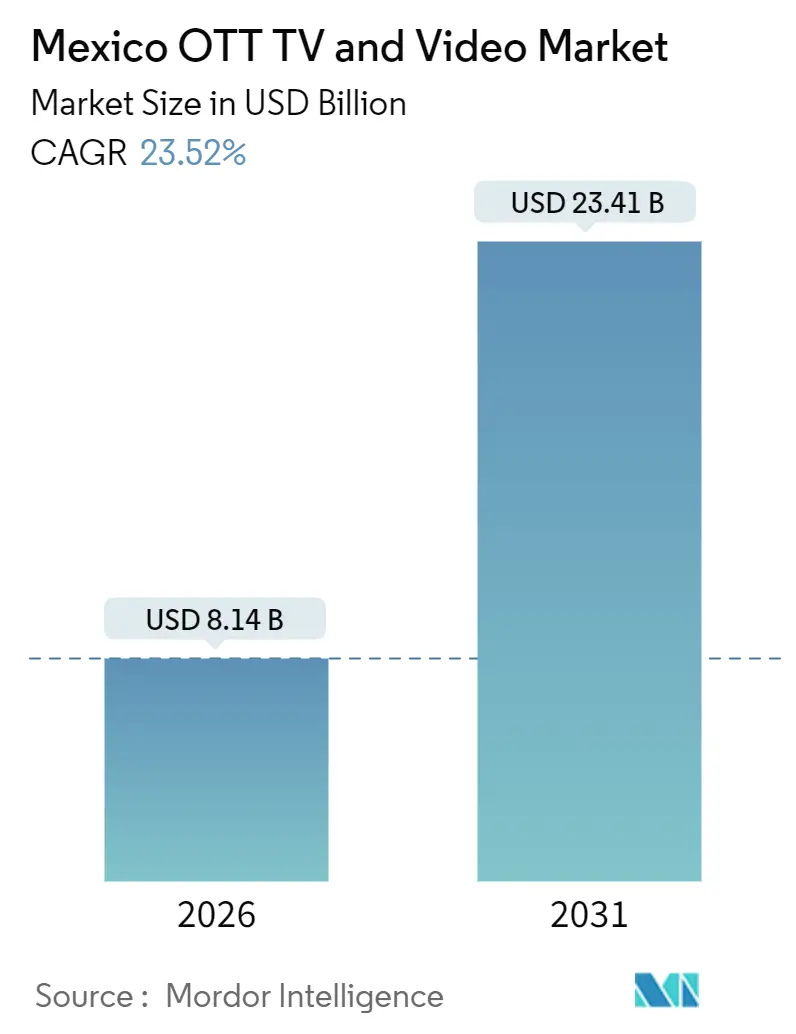
| Market Size (2026) | USD 8.14 Billion |
| Market Size (2031) | USD 23.41 Billion |
| Growth Rate (2026 - 2031) | 23.52 % |
| Market Concentration | High |
Major Players *Disclaimer: Major Players sorted in no particular order Image © Mordor Intelligence. Reuse requires attribution under CC BY 4.0. | |
Mexico OTT TV And Video Market Analysis by Mordor Intelligence
The Mexico OTT TV and Video market size stood at USD 8.14 billion in 2026 and is forecast to reach USD 23.41 billion in 2031, registering a robust 23.52% CAGR over the period. Structural changes in Mexican viewing habits, telco bundling of streaming services, and a USD 1 billion content commitment by Netflix are collectively accelerating adoption. Rapid fiber rollouts in high-density corridors, a nationwide shift toward hybrid ad-supported models, and intensified local production of Spanish-language originals deepen engagement and lift time-spent per viewer. Meanwhile, alternative payment rails such as OXXO Pay and SPEI expand the reachable base beyond the 40% credit-card penetration threshold, reducing friction for first-time payers. Advanced audience analytics elevate programmatic campaign efficiency, giving advertisers stronger return-on-investment signals and encouraging larger budgets. Simultaneously, piracy and macro volatility temper near-term profitability, prompting platforms to balance price points with household purchasing power.
Key Report Takeaways
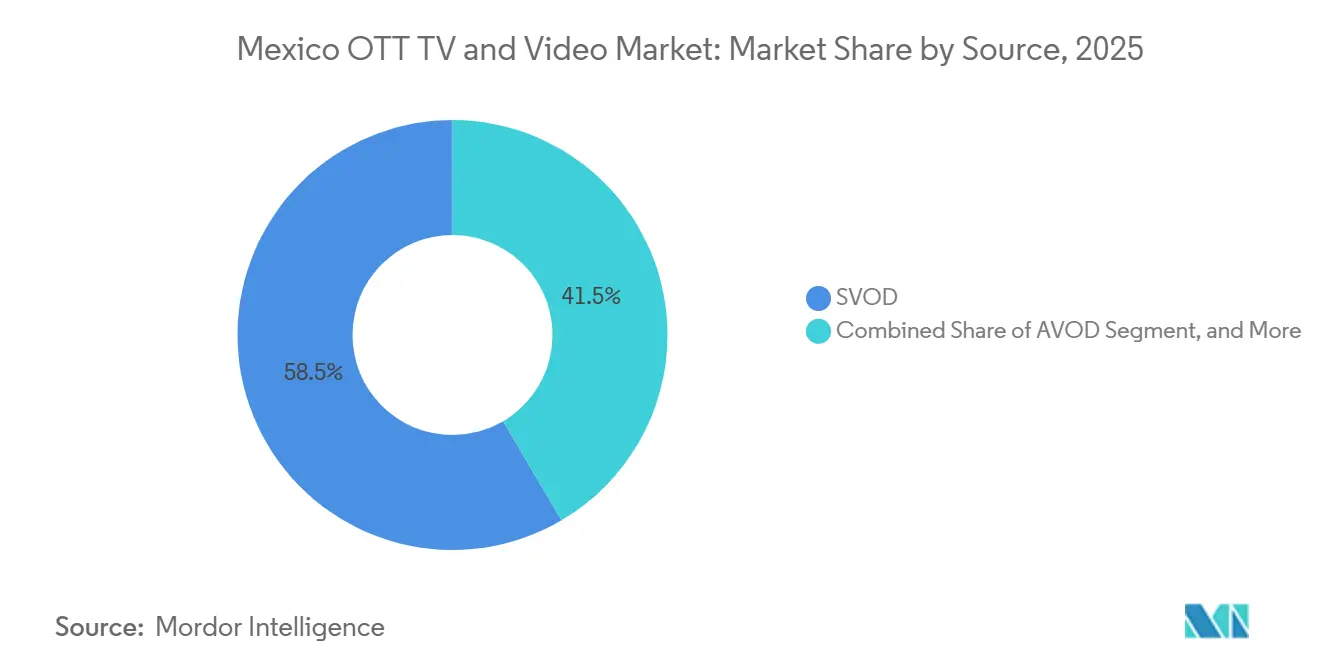
- By source, subscription video on demand led with 58.47% revenue share in 2025; advertising-supported video on demand is projected to advance at a 24.79% CAGR through 2031.
- By device type, smart televisions commanded 46.31% revenue share in 2025, while smartphones are set to grow at 24.11% CAGR to 2031.
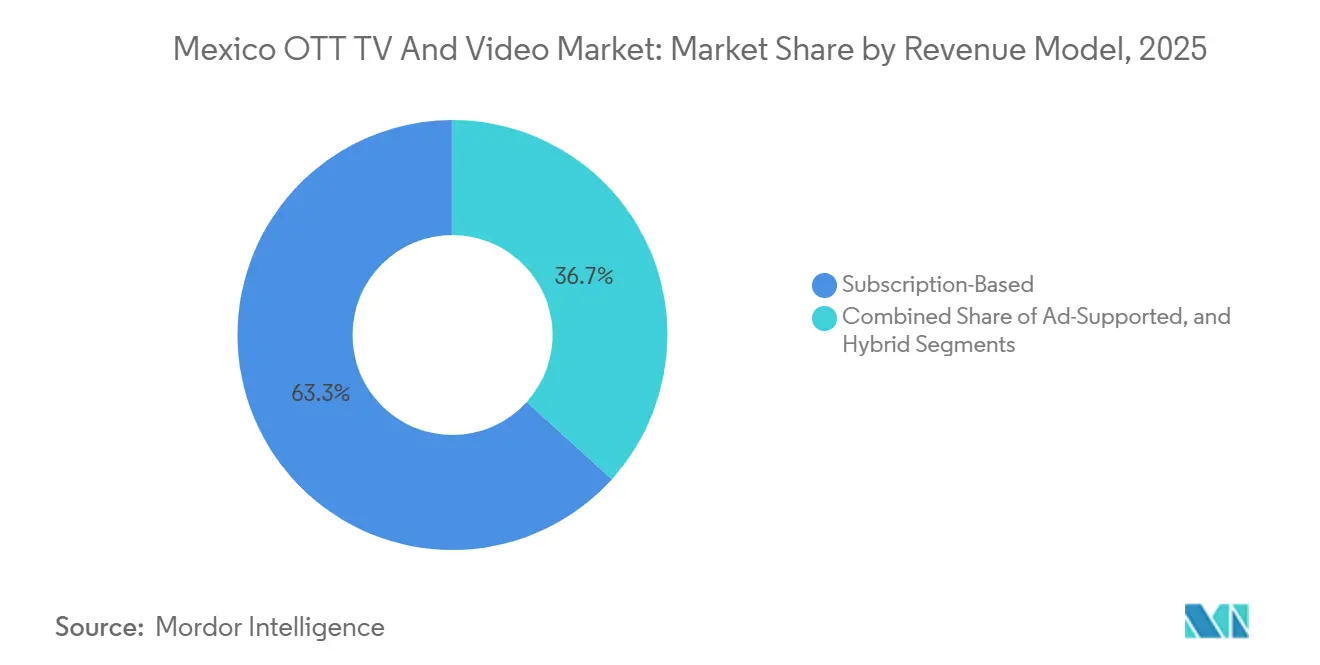
- By revenue model, subscription-based services accounted for 63.29% of the Mexico OTT TV and Video market size in 2025, whereas hybrid offerings are on track for 23.98% CAGR expansion.
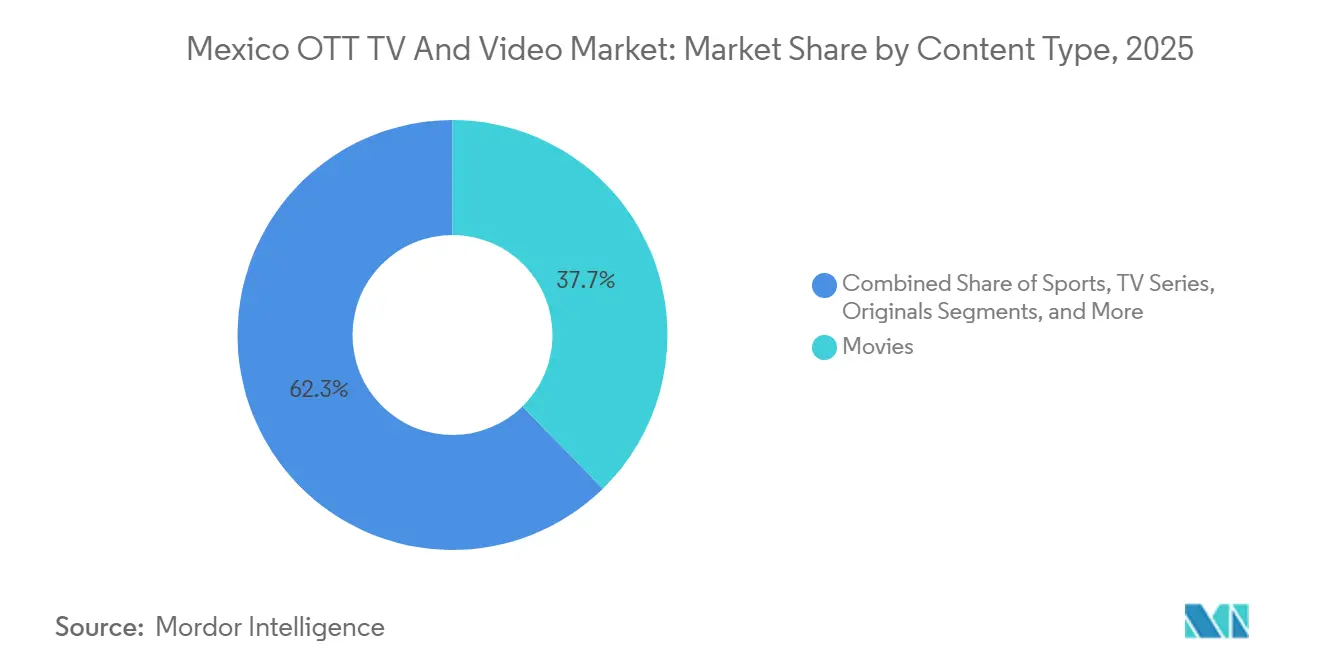
- By content type, movies held 37.67% of value in 2025, and originals are forecast to climb at a 24.78% CAGR to 2031.
- By end-user age group, millennials generated 41.22% of spending in 2025, but Generation Z shows the fastest momentum with a 25.03% CAGR outlook.
- By geography, Central Mexico captured 48.18% of revenue in 2025; Northern Mexico is projected to post the highest growth at 25.32% CAGR through 2031.
Note: Market size and forecast figures in this report are generated using Mordor Intelligence’s proprietary estimation framework, updated with the latest available data and insights as of January 2026.
Mexico OTT TV And Video Market Trends and Insights
Drivers Impact Analysis*
| Driver | (~) % Impact on CAGR Forecast | Geographic Relevance | Impact Timeline |
|---|---|---|---|
| High Penetration of Smart TVs and Ubiquitous Broadband | +4.20% | National, with concentration in Central Mexico urban centers | Medium term (2-4 years) |
| Rising Original Spanish-Language Content Investment | +5.10% | National, with production hubs in Mexico City and Guadalajara | Long term (≥ 4 years) |
| Growing Adoption of Hybrid AVOD-SVOD Models | +3.80% | National, accelerating in Northern Mexico | Short term (≤ 2 years) |
| Expansion of Mobile-First, Low-Cost Plans | +4.50% | National, with higher uptake in rural and lower-income areas | Medium term (2-4 years) |
| Telco Bundling of OTT Subscriptions | +3.90% | National, led by Telmex, Totalplay, Megacable footprints | Short term (≤ 2 years) |
| Advanced Audience Analytics Driving Targeted Ads | +2.70% | National, with early adoption in programmatic CTV inventory | Medium term (2-4 years) |
| Source: Mordor Intelligence | |||
High Penetration of Smart TVs and Ubiquitous Broadband
Smart-TV ownership passed the 46% threshold by 2025, while fixed broadband lines reached 27.9 million, underpinned by rapid fiber deployments that lift average download speeds above 50 Mbps.[1] Operators with faster, more stable networks can command premium fees from streaming partners and keep churn low by guaranteeing seamless 4K playback. Yet only 800 000 rural residents have consistent streaming access, revealing a digital divide. Price sensitivity remains acute: a budget handset still equals nearly three quarters of a monthly income in Chiapas, forcing platforms to offer adaptive bitrate streams and budget tiers.
Rising Original Spanish-Language Content Investment
Netflix’s four-year USD 1 billion pledge announced in 2025 accelerates a trend that already sees Mexico generate one quarter of all Spanish-language shows worldwide.[2] Local productions now obtain roughly half of their lifetime revenue from streaming rights, overturning box-office dependency. Amazon Prime Video strengthened the production ecosystem by installing Latin America’s first virtual-production LED stage at Churubusco Studios, cutting location costs and enabling complex visuals. Government alignment is visible in the 2025 Foreign Ministry agreement that lets Mexican embassies showcase domestic titles abroad, reinforcing cultural diplomacy.
Growing Adoption of Hybrid AVOD-SVOD Models
ViX’s freemium blueprint demonstrates the ceiling for ad-supported reach, logging more than 50 million monthly users worldwide by mid-2024 and converting a tenth into pay subscribers. Disney Plus followed with an MXN 149 (USD 8.51) ad tier in June 2025, mirroring HBO Max’s price point. Lower entry fees resonate in a country where less than 40% of adults hold credit cards, and cash still dominates small-ticket transactions. Platforms that marry first-party viewing data with programmatic buying secure premium CPMs, cushioning subscription erosion.[3]
Expansion of Mobile-First, Low-Cost Plans
Smartphone penetration is projected to reach at least 85% by 2030. Median mobile speeds rose nearly 39% year-over-year to 45.2 Mbps in 2024, enabling HD streaming during commutes. ViX, Disney Plus, and TelevisaUnivision exploit this mobility wave through bundles distributed via OXXO vouchers and Mercado Libre wallets, capturing users outside the banking mainstream. Compression codecs, download-for-offline options, and per-day passes become critical features in bandwidth-constrained provinces.
Restraints Impact Analysis*
| Restraint | (~) % Impact on CAGR Forecast | Geographic Relevance | Impact Timeline |
|---|---|---|---|
| Low Credit-Card Penetration Limiting Paid Conversions | -2.80% | National, most acute in southern and rural states | Medium term (2-4 years) |
| Piracy and Illegal Streaming Devices | -3.10% | National, with higher incidence in border states | Long term (≥ 4 years) |
| High Local Content Licensing Costs | -1.60% | National, concentrated in production hubs | Medium term (2-4 years) |
| Macroeconomic Volatility Impacting Disposable Income | -2.30% | National, with greater sensitivity in lower-income segments | Short term (≤ 2 years) |
| Source: Mordor Intelligence | |||
Low Credit-Card Penetration Limiting Paid Conversions
Only 58% of Mexicans held a formal financial account in 2025, and credit-card ownership lags even further, compelling platforms to weave in voucher-based or real-time transfer options.[4] The added friction raises customer-acquisition costs and slows recurring revenue growth. Netflix’s 2024 clamp-down on password sharing amplified price sensitivity, leading to higher churn among multi-household account sharers. Freemium and ad tiers serve as safety nets, but processing cash and bank transfers involves elevated commission fees and reconciliation complexity.
Piracy and Illegal Streaming Devices
Mexico ranked second globally for illicit camcording incidents in the 2024 USTR Special 301 Report. Pre-loaded set-top boxes and modified streaming adapters proliferate in open-air markets, undercutting legitimate services. Platforms counter with forensic watermarking and device authentication, yet aggressive controls risk alienating legitimate travellers and multi-device households. The 2025 telecom overhaul set up new regulators but left questions about enforcement priorities, creating uncertainty for long-term anti-piracy initiatives.
*Our forecasts treat driver/restraint impacts as directional, not additive. The impact forecasts reflect baseline growth, mix effects, and variable interactions.
Segment Analysis
By Source: Subscription Models Anchor Revenue, Ad-Supported Tiers Accelerate
Subscription video on demand held 58.47% revenue share in 2025 within the Mexico OTT TV and Video market. Hybrid ad-supported formats, however, are marching toward a 24.79% CAGR through 2031 as viewers seek flexible pricing and as advertisers chase incremental reach. ViX proves that free tiers can monetize at scale, while Disney Plus’ ad plan validates a dual-stream future. Transactional rentals and downloads cater to cinephiles looking for niche premieres, yet rampant piracy and deep catalogue subscription plans strip away their growth headroom. Platforms that integrate transparent brand-safety controls reassure advertisers and help throttle invalid traffic, a known pain point in the connected-television arena.
A second dynamic is regulatory: the 2025 ban on foreign government advertising on digital outlets removes a small but stable revenue slice for global news channels, nudging them toward diversified sponsorship models. Although this policy shift introduces short-term turbulence, the long-run impact on the Mexico OTT TV and Video market should be muted because domestic consumer brands remain highly active buyers.

By Device Type: Smart TVs Dominate Viewing Hours, Smartphones Expand Reach
Smart televisions contribute 46.31% of 2025 revenues and remain the centerpiece for evening co-viewing and live events. Roku continues to ship the majority of streaming sticks, but television OEMs embed native operating systems that push consumers straight into branded tiles, raising the bar for app storefront visibility. The Mexico OTT TV and Video market share tied to smartphones will accelerate behind a 24.11% CAGR, reflecting a nation where nearly all internet users carry a handset. Tablets, laptops, consoles, and legacy set-top boxes service specialized settings such as children’s bedrooms or gaming dens, but each faces cannibalization risk as multi-screen functionality improves.
Differentiation hinges on context-aware features: automatic bitrate adjustment on congested mobile networks, quick-resume tokens synchronized across screens, and 4K Dolby Vision support for living-room sessions. Operators like Totalplay, clocking 53.9 Mbps average downstream speeds, provide the bandwidth backbone that lets households stream concurrently on multiple devices without buffering.
By Revenue Model: Subscription Dominance Encounters Hybrid Disruption
Subscription-centric plans still delivered 63.29% of the 2025 value, but hybrid strategies are disrupting the status quo. ViX’s three-tier structure draws a wide funnel: free users, ad-tier subscribers, and premium ad-free households. Disney Plus mirrored the approach, pegging its ad plan at MXN 149 (USD 8.51) per month to entice cost-conscious families. The Mexico OTT TV and Video market size attributable to hybrid revenue architectures is projected to expand rapidly as advertisers demand audience reach that linear television can no longer guarantee. Elevated connected-television fraud rates in Mexico, however, force platforms to invest in verification tech before ad buyers accept higher CPMs.
Subscription-only players still hold leverage where blockbuster franchises or exclusive sports rights create must-see value. Yet even they increasingly view advertising as a downside hedge against macro shocks and currency swings that compress disposable income.
By End-User Age Group: Millennials Anchor Spending, Generation Z Fuels Mobile Growth
Millennials generated 41.22% of 2025 revenue as they straddle peak earnings and entrenched subscription habits. Generation Z, however, is the fastest riser, set for a 25.03% CAGR through 2031 as mobile-first behaviour aligns with shorter, snackable formats. Seniors and Boomers remain tethered to linear channels but are slowly sampling streaming via bundled ISP packages.
Content strategy must therefore balance serialized dramas and true-crime series for millennials with short-form influencer collaborations for younger viewers. ViX and Disney Plus harness cross-demographic appeal by packaging live football with animation and Hollywood tent-poles.
By Content Type: Movies Lead Share, Originals Differentiate
Movies commanded 37.67% of 2025 spend, buoyed by first-run studio titles and evergreen library hits. Originals, benefiting from Netflix’s USD 1 billion four-year pact and Amazon’s LED volume stage, are forecast to grow at 24.78% CAGR as platforms chase proprietary catalogues to curb licensing outlays. Long-form series bolster binge engagement and retention, while live sports such as Liga MX and UEFA Champions League create appointment viewing underpinned by dual-screen social chatter. User-generated video, epitomized by YouTube, already holds a double-digit share of total television minutes, blurring lines between professional and creator economies.
Economic stakes are substantial: a single tent-pole production such as Pedro Páramo injected USD 18 million into local supply chains in 2025, illustrating the multiplier effect of original content on jobs and ancillary sectors. Platforms that co-finance production infrastructure gain bargaining power, ensuring priority access to talent and IP pipelines.
Geography Analysis
Central Mexico generated 48.18% of 2025 revenues within the Mexico OTT TV and Video market, underwritten by dense fiber coverage, higher disposable incomes, and better payment-card availability. Mexico City’s role as a production hub also magnetizes original content spend. Yet saturation raises competitive intensity; every global and regional platform vies for stack position within telecom bundles.
Northern Mexico is forecast to post a stellar 25.32% CAGR through 2031. Industrial corridors and cross-border commerce lift earnings, while lower piracy rates and bilingual households encourage dual-language content consumption. Megacable’s investment surge, MXN 5.1 billion (USD 291 million) in first-half 2024, reflects a strategic bet on this region’s upside potential.
Southern and rural territories present a contrasting picture. Only 800 000 rural residents possess adequate connections for OTT viewing. Handset prices can swallow over half a monthly wage, and fixed broadband remains patchy. Nevertheless, mobile broadband at 58% penetration acts as an entry ramp. Bundles that integrate OXXO Pay vouchers or Mercado Libre wallets accommodate the high-cash culture prevalent in these areas, broadening the Mexico OTT TV and Video market reach.
Regulatory Landscape
Mexico's OTT TV and video ecosystem is shaped by telecommunications and broadcasting oversight that affects network access, competition rules, and consumer protections. A key inflection point came on July 16, 2025, when a new Federal Telecommunications and Broadcasting Law was published, dissolving the Instituto Federal de Telecomunicaciones (IFT) and establishing the Telecommunications Regulatory Commission (CRT) as the technical regulator, alongside the Digital Transformation and Telecommunications Agency (ATDT) for policy-making.
Because the transition is phased, the IFT continues operating until the CRT Plenary is formally integrated. This creates an interim period in which market participants look for continuity in enforcement priorities, including competition studies and how OTT-related service offerings and tariffs are handled. For OTT platforms and telco-bundled streaming packages, including offers distributed via Telmex, Totalplay, and Megacable footprints, the regulator transition becomes a variable for how quickly disputes, consumer-audience issues, and competition assessments are resolved during the 2026 base year.
Value Chain Analysis
The Mexico OTT TV and video value chain spans six core stages: content production (studios, producers, talent), content aggregation (rights holders and distributors assembling catalogs), distribution via digital platforms (global and local OTT services), network infrastructure provision (fixed and mobile broadband operators), user interface and discovery (smart TV OS and device platforms, app stores, recommendation layers), and consumer access (household devices, payments, and customer support). Vertical integration is visible in Mexico, with TelevisaUnivision covering content creation, broadcasting assets, and streaming through ViX, while telco-linked offerings such as Claro Video draw on telecom parent ecosystems.
Commercial execution increasingly depends on partnerships across the chain. Platforms use ISP and mobile operators for bundle-led acquisition and retention, while device ecosystems and smart TV placement influence discoverability in a market where smart televisions accounted for 46.31% of revenue in 2025. On the supply side, ongoing investment in local Spanish-language originals, including Netflix's multi-year USD 1 billion commitment announced in 2025 and Amazon Prime Video's virtual-production LED stage at Churubusco Studios, links production services, post-production, and local crews more closely to streaming demand, expanding downstream services tied to OTT releases.
Competitive Landscape
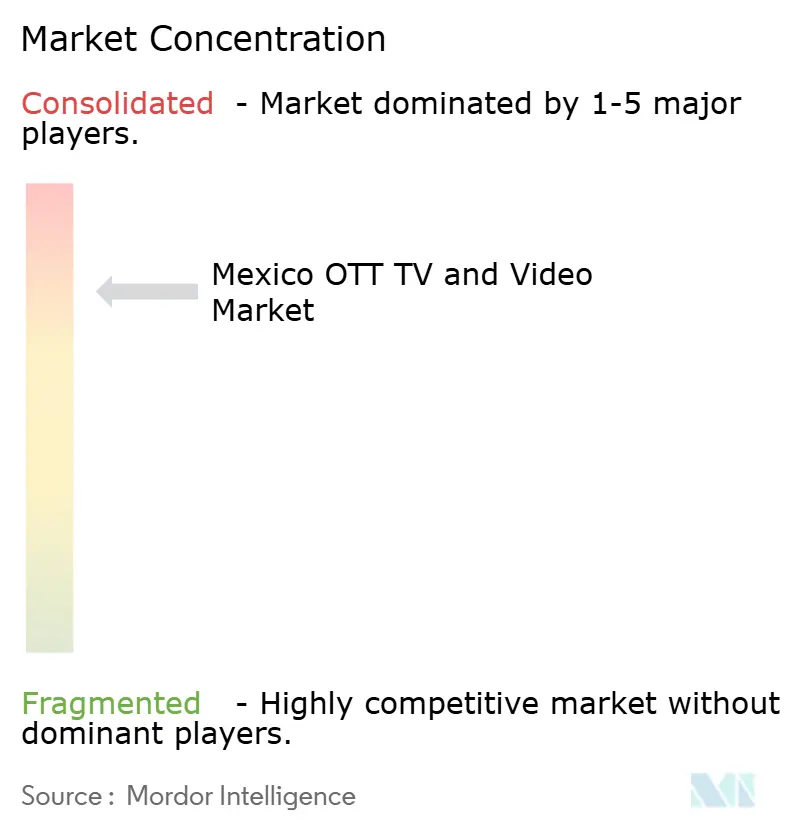
Competition is moderate, with Netflix, Disney Plus, Amazon Prime Video, and HBO Max sharing the field with Spanish-language specialist ViX and telco-backed Claro Video. Netflix still dominates premium SVOD catalogues, but ViX’s hybrid model and exclusive football rights render it the fastest climber. Telcos such as Totalplay and Telmex leverage broadband bundles to boost stickiness; Totalplay invoiced only MXN 8.5 million (USD 0.49 million) in direct OTT commissions during Q1 2025, signalling that bundles are more about churn control than immediate profit.
Sports streaming is the next battleground. Fox’s June 2025 acquisition of Caliente TV signals fresh bids for Liga MX fragments, while TelevisaUnivision holds an Olympic Games lock-in through 2032. User-generated platforms like YouTube capture significant viewing minutes but still trail in average revenue per user. Emerging niche players, from arthouse-focused Mubi to domestic film curator FilminLatino, add texture yet command limited scale.
Strategic levers that will define leadership include first-party data analytics, anti-piracy investments, co-financed local productions, and innovative payment integrations that offset low banking penetration. Platforms mastering this matrix can capture disproportionate Mexico OTT TV and Video market share.
Mexico OTT TV And Video Industry Leaders
-
Netflix, Inc.
-
Amazon.com, Inc.
-
América Móvil, S.A.B. de C.V.
-
Televisa, S. de R.L. de C.V.
-
Telefónica, S.A.
- *Disclaimer: Major Players sorted in no particular order
Market Opportunities and Future Outlook
A near-term opportunity is expanding the premium but affordable proposition for mass-market households through low-cost plans and tighter distribution partnerships. Roku's April 2026 launch of Howdy in Mexico, positioned as an ad-free subscription backed by partners including Lionsgate and TV Azteca, highlights whitespace for additional curated services that can secure connected-TV shelf space while complementing major global OTT catalogs. It also reinforces device platforms as an acquisition channel, not only an endpoint, which increases the value of merchandising, search placement, and bundled sign-ups within smart TV environments.
Local production capacity and exportable Spanish-language IP are another investable lane, supported by committed budgets and infrastructure upgrades. Netflix's four-year USD 1 billion content commitment announced in 2025, alongside Mexico-based production initiatives such as Amazon Prime Video's LED-stage deployment at Churubusco Studios, supports a deeper pipeline for originals that platforms can use to differentiate libraries and manage licensing costs. At the same time, the ad-supported and hybrid shift creates room for more tailored measurement and brand-safety tooling for connected TV in Mexico, especially as ViX scales freemium reach and global platforms introduce ad tiers. First-party data activation and verification capabilities are becoming more central to monetizing inventory.
Recent Industry Developments
- June 2026: YouTube (Alphabet) launched Primetime Channels in Mexico, enabling users to subscribe to ViX Premium directly through the YouTube platform. Direct platform integration expands streaming distribution in Mexico. Strengthens ViX Premium reach and monetization; enhances cross-platform bundling opportunities for Mexico OTT players
- June 2026: YouTube - Launched Primetime Channels in Mexico, enabling users to subscribe to ViX Premium directly through the YouTube platform. The cross platform expansion supports broader access to ViX content within YouTube, broadening audience reach. The initiative reinforces YouTube's role as a distribution partner for local OTT players
- June 2026: ViX - Unveiled five new original productions including Hotel Todo Incluido and the fourth season of La Casa de los Famosos Mexico. The expanded local slate boosts viewer engagement with Mexico centered content. This strengthens ViX positioning in a crowded market against global streaming platforms
Research Methodology Framework and Report Scope
Market Definition and Coverage
For this market, we size the revenue generated in Mexico from OTT TV and video services delivered over the internet, including subscription, advertising-supported, transactional, and rental or download-to-own formats, across connected devices.
Scope exclusions: We exclude traditional linear pay-TV carriage revenue, physical media sales, and pure broadcast advertising that is not tied to internet-delivered viewing.
Segmentation Overview
- By Source
- SVOD
- TVOD
- Rental
- Download to Own (DTO)
- AVOD
- By Device Type
- Smart TV
- Smartphone
- Tablet
- PC/Laptop
- Game Console
- Set-Top Box
- By Revenue Model
- Subscription-Based
- Ad-Supported
- Hybrid
- By End-User Age Group
- Generation Z (Up to 25 years)
- Millennials (26-41 years)
- Generation X (42-57 years)
- Baby Boomers (58-76 years)
- Seniors (Above 77 years)
- By Content Type
- Movies
- TV Series
- Sports
- User-Generated Content
- Originals
Data Sources, Market Sizing, and Validation
Desk Research
Desk research starts by pinning down the real-world viewing and spending pool in Mexico, so our assumptions stay tied to local context rather than drifting. Public sources such as Instituto Federal de Telecomunicaciones (IFT) publications, INEGI household and income statistics, World Bank macro indicators, OECD broadband metrics, and ITU connectivity series provide guardrails on internet access, device readiness, and affordability.
We then cross-check market mechanics using company filings and investor materials, platform pricing pages, app store disclosures, and reputable press coverage of plan changes and ad-supported launches. Where needed, paid subscription services are used for company financial intelligence, news and financials screening, and patent database checks to track product and monetization shifts. These examples are illustrative only, and many other sources were also reviewed for data collection, validation, and clarification.
Primary Interviews and Surveys
Primary work is used to test what desk sources cannot fully answer, especially for pricing behavior, bundle-driven uptake, and ad load acceptance across Mexican households. We speak with a mix of platform-side, advertising ecosystem, telecom distribution, and content value chain experts, and then we reconcile differences across viewpoints before locking the final assumptions.
Because this is a single-country market, interviews are balanced across major metro demand centers and secondary cities, so the model does not overfit to one purchasing pattern.
Distribution of primary research fieldwork respondents
| Company type | Respondent position |
|---|---|
| Top tier: 29% | CXOs: 19% |
| Mid tier: 49% | Functional/Unit leaders: 31% |
| Smaller Players: 22% | Managers: 50% |
Market-Sizing & Forecasting
Sizing begins with a top-down build where broadband households and smartphone and smart TV penetration are translated into an addressable OTT viewer base, which is then split by monetization types that are common in Mexico. To keep the model grounded, results are corroborated using selective bottom-up checks such as sampled monthly price points by plan tier, implied paid accounts and churn ranges from expert inputs, and ad-monetization sanity checks using estimated ad impressions and effective rates.
Key inputs that matter in this market include subscription pricing and tier mix (including ad-supported tiers), bundling prevalence through telecom offers, paid account sharing policies that shift effective users per subscription, advertising load and sell-through, and macro indicators that influence discretionary spend and FX conversion timing. Where direct volume indicators are incomplete, we use conservative ranges and then narrow them using interview consensus and observable price changes.
For forecasting, we rely on scenario analysis supported by simple time-series smoothing of key drivers, followed by expert review on inflection points such as major sports cycles, platform price resets, and shifts toward hybrid monetization.
Data Validation & Update Cycle
Outputs are validated through cross-checks against independent signals, including connectivity growth, household spending capacity, and public indicators of OTT adoption and plan pricing changes. Anomalies are flagged when implied revenue per user or ad yield moves outside realistic bands, and then assumptions are revisited, followed by a second analyst review before sign-off.
Reports are refreshed annually, with interim updates triggered by material events such as major plan restructures, regulatory developments, or sharp currency swings that can distort USD reporting. Before delivery, a final pass is completed to ensure the latest public data and interview learnings are reflected in the model.
Mordor Intelligence's Mexico Ott Tv and Video Market Sizing Compared With Other Published Estimates
Published numbers for Mexico OTT TV and video often vary because the included revenue streams are not consistent, and because analysts do not always use the same base year or currency timing. Differences also show up when ad-supported video is treated as a separate ad market in one model but counted as OTT video revenue in another.
The biggest gap drivers here are whether the estimate covers the full OTT stack (SVOD, AVOD, TVOD, rental, and download-to-own) or only subscription video, plus how bundles and discounted annual plans are normalized into a monthly revenue run rate. The refresh cadence also matters because plan price changes and the shift into ad-supported tiers can move the split quickly. This is why the benchmark uses the current forecast window and then checks it against adoption and pricing signals before finalizing, a modeling choice applied by Mordor Intelligence.
Benchmark comparison
| Source | Market Size | Gaps in Research Methodology |
|---|---|---|
| Mordor Intelligence | USD 8.14 B (2026) | |
| Industry Regulator Brief A | USD 4.06 B (2025) | Focuses on SVOD revenue only, which excludes AVOD, TVOD, and other paid transaction formats that can be material in total OTT video revenue. |
| Regional Consultancy B | USD 4.70 B (2024) | Uses an earlier base year and often applies a broader OTT label without clearly separating Mexico-only revenues from regional roll-ups, and plan-tier pricing updates can lag if not refreshed frequently. |
Across the sources, the spread is largely explained by scope and timing rather than a single right or wrong number. When the full set of OTT monetization streams is consistently counted, and pricing and adoption assumptions are re-checked against current market signals, the estimate becomes easier to replicate and track over time.
Key Questions Answered in the Report
How large is the Mexico OTT TV and Video opportunity today?
It generated USD 8.14 billion in 2026 and is projected to reach USD 23.41 billion by 2031 at a 23.52% CAGR.
Which revenue model is expanding the fastest in Mexico's streaming space?
Hybrid plans that blend ad-supported and subscription tiers are on a 23.98% CAGR path through 2031.
Why is Northern Mexico viewed as the next streaming growth hotspot?
Fiber roll-outs along industrial corridors, higher disposable incomes, and lower piracy exposure are propelling a 25.32% CAGR.
How are platforms overcoming low credit-card penetration?
They integrate voucher systems such as OXXO Pay, real-time SPEI transfers, and digital wallets to capture cash-reliant households.
What content strategy best differentiates services for local viewers?
Heavy investment in Spanish-language originals, Netflix alone committed USD 1 billion over four years - helps secure loyal audiences and reduce licensing costs.
Which age group is driving the biggest uptick in mobile streaming hours?
Generation Z, forecast to expand spending at 25.03% CAGR, streams mainly on smartphones and favors short-form and creator-led video.