
Market Overview
| Study Period | 2020 - 2031 |
|---|---|
| Forecast Data Period | 2026 - 2031 |
| Base Year Market Size (2025) | USD 1.19 Billion |
| Market Size (2026) | USD 1.25 Billion |
| Market Size (2031) | USD 1.58 Billion |
| Growth Rate (2026 - 2031) | 4.83 % |
| Market Concentration | Medium |
Major Players *Disclaimer: Major Players sorted in no particular order Image © Mordor Intelligence. Reuse requires attribution under CC BY 4.0. | |
Mexico Ophthalmic Devices Market Analysis by Mordor Intelligence
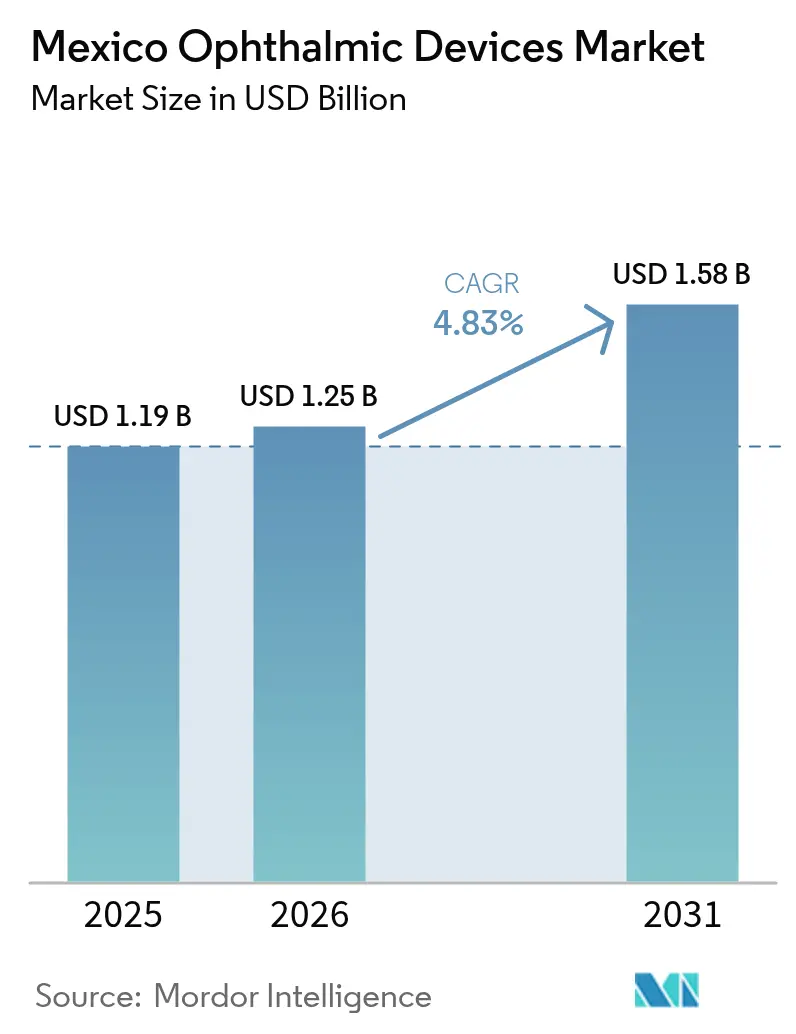
Mexico ophthalmic devices market size in 2026 is estimated at USD 1.25 billion, growing from 2025 value of USD 1.19 billion with 2031 projections showing USD 1.58 billion, growing at 4.83% CAGR over 2026-2031. Demand rises as nationwide diabetes screening uncovers sight-threatening complications, while new lens factories shorten import cycles for basic vision products. Refractive errors remain widespread, so retail chains expand fast-fit workshops that deliver prescription eyewear within hours. Artificial-intelligence modules embedded in diagnostic platforms raise reading speed and accuracy, pushing primary clinics to upgrade imaging suites. Urban hospital clusters anchor high-end surgical sales, yet many rural districts still operate below capacity because of limited infrastructure and clinical staff.
Key Report Takeaways
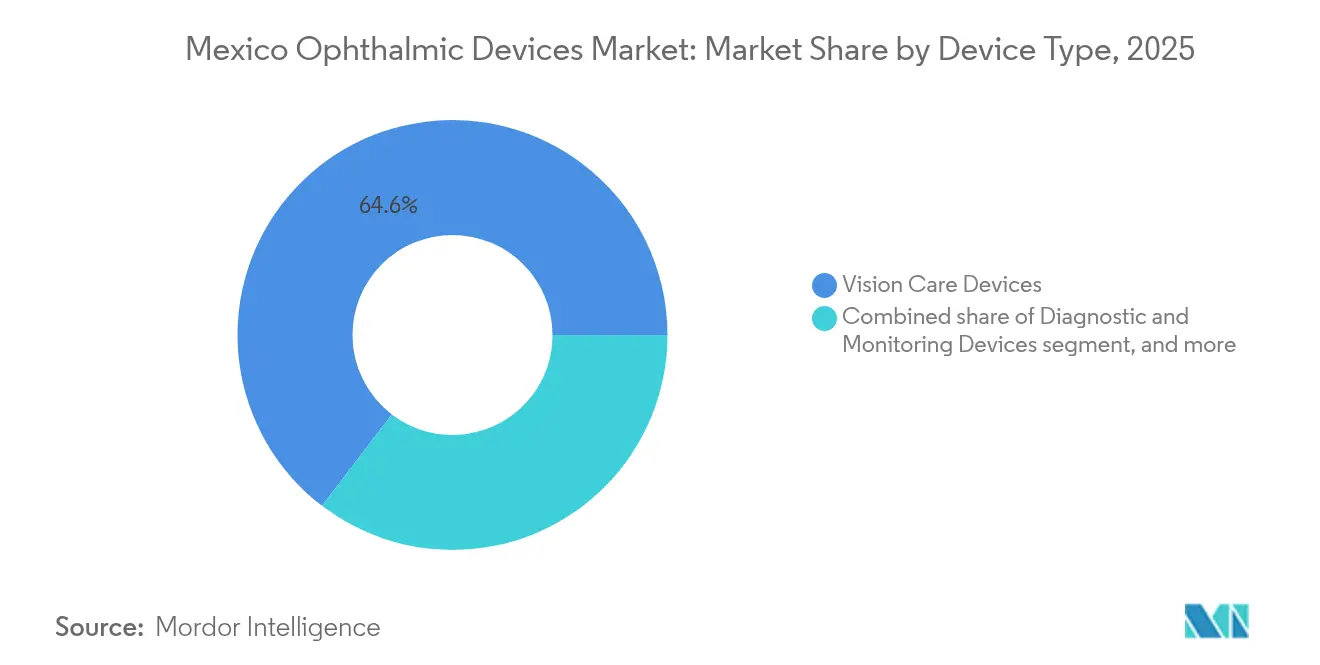
- By device type, vision care held 64.62% of the Mexico ophthalmic devices market share in 2025; diagnostic and monitoring devices are projected to grow at a 6.72% CAGR to 2031.
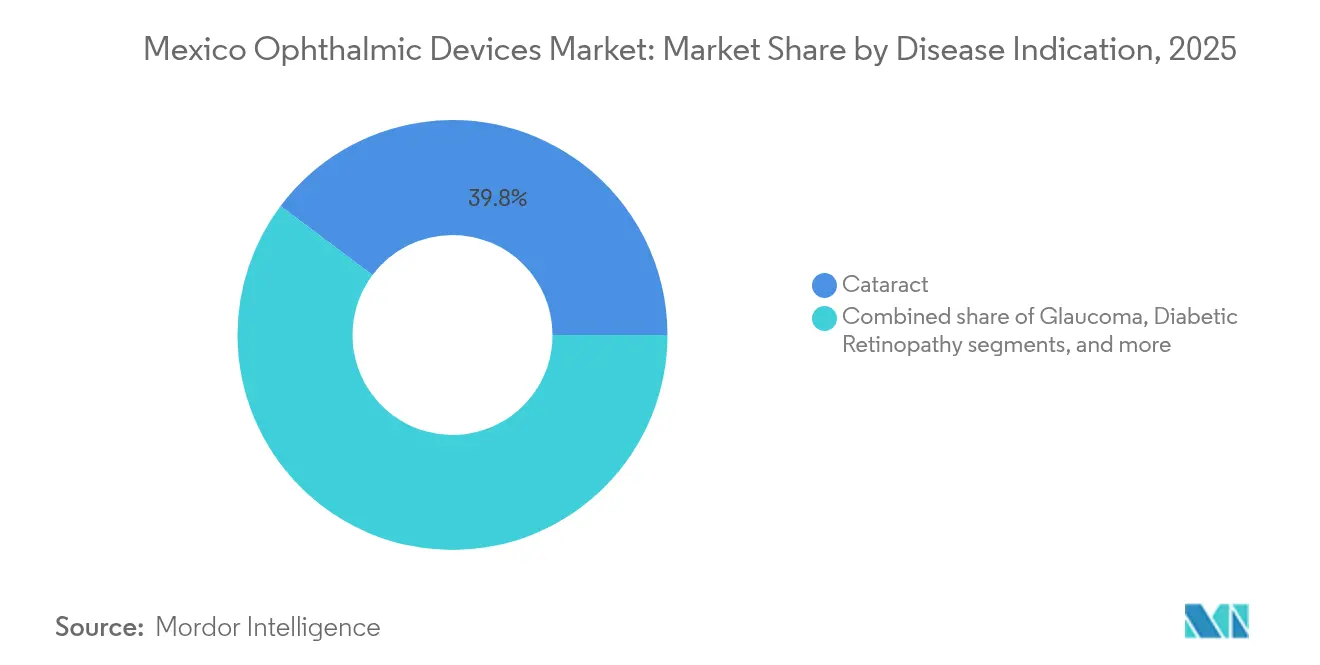
- By disease indication, cataract accounted for a 39.76% share of the Mexico ophthalmic devices market size in 2025, while diabetic retinopathy is set to expand at a 5.93% CAGR through 2031.
- By end-user, hospitals dominated with 45.85% revenue in 2025, whereas ambulatory surgery centers are expected to post a 5.76% CAGR between 2026 and 2031.
Note: Market size and forecast figures in this report are generated using Mordor Intelligence’s proprietary estimation framework, updated with the latest available data and insights as of 2026.
Mexico Ophthalmic Devices Market Trends and Insights
Drivers Impact Analysis*
| Driver | (~) % Impact on CAGR Forecast | Geographic Relevance | Impact Timeline |
|---|---|---|---|
| Rising prevalence of diabetic retinopathy & age-related cataract | +1.2% | Nationwide | Long term (≥ 4 years) |
| Government “Salud Visual” program boosting surgical volumes | +1.0% | Nationwide | Medium term (2-4 years) |
| Expansion of private ophthalmology chains in urban hubs | +0.8% | Mexico City, Guadalajara, Monterrey | Medium term (2-4 years) |
| Smartphone-driven myopia surge among Mexican youth | +0.6% | Urban school districts | Long term (≥ 4 years) |
| Adoption of femtosecond & SLT lasers post-COFEPRIS approvals | +0.5% | Major surgical centers | Short term (≤ 2 years) |
| Medical-tourism demand for premium IOLs in border states | +0.4% | Baja California, Nuevo León | Short term (≤ 2 years) |
| Source: Mordor Intelligence | |||
Escalating Diabetic Retinopathy Burden
One in three Mexican adults with type 2 diabetes shows retinal damage that requires routine optical coherence tomography and fundus photography[1]. Screening efficiency is high, with one positive case detected for every three patients evaluated, a ratio that justifies large equipment orders for public hospitals.
Federal “Salud Visual” and MAS-Bienestar Programs
The national health platform offers free primary eye care, while the “Vive Saludable, Vive Feliz” initiative screens 11 million schoolchildren for refractive errors. Mandatory electronic health records route patients to accredited centers, prompting procurement of interoperable autorefractors and pediatric diagnostic kits.
Expansion of High-Volume Private Ophthalmology Chains
salaUno and similar networks adopt standardized surgical lines that shorten cataract procedure times. High throughput raises demand for phaco machines, microscopes, and single-use consumables, though growth concentrates in urban hubs where disposable incomes are higher.
Smartphone-Related Myopia Surge among Youth
Long daily screen exposure correlates with faster axial length growth, pushing families toward specialty lenses that slow progression. Portable autorefractors accompany school outreach teams, introducing children to on-site vision testing.
Restraints Impact Analysis*
| Restraints Impact Analysis | (~) % Impact on CAGR Forecast | Geographic Relevance | Impact Timeline |
|---|---|---|---|
| Limited reimbursement for premium IOLs & refractive procedures | −0.7% | Nationwide | Medium term (2-4 years) |
| Shortage of trained ophthalmic surgeons in rural regions | −0.5% | Southern & central states | Long term (≥ 4 years) |
| Import tariffs & lengthy COFEPRIS registration timelines | −0.4% | Nationwide | Short term (≤ 2 years) |
| Peso depreciation inflates cost of imported equipment | −0.3% | Nationwide | Medium term (2-4 years) |
| Source: Mordor Intelligence | |||
Limited Reimbursement for Premium IOLs
Public insurance excludes multifocal and light-adjustable lenses, so patients finance upgrades themselves. A standard cataract intervention costs USD 1,045, which is a heavy burden for many households.
Shortage of Trained Ophthalmic Surgeons
Mexico averages fewer than 10 ophthalmologists per 100,000 inhabitants, with most practicing in major cities[2]. Rural hospitals often run modern equipment below capacity because certified specialists are unavailable every day.
*Our forecasts treat driver/restraint impacts as directional, not additive. The impact forecasts reflect baseline growth, mix effects, and variable interactions.
Segment Analysis
By Device Type: Vision Care Retains Scale, Diagnostics Gains Speed
Vision care generated 64.62% of overall revenue in 2025 as domestic factories supply low-cost spectacles and contact lenses. EssilorLuxottica’s USD 172 million Tijuana complex fabricates 10 million pairs annually, positioning the plant as a regional export hub Essilorluxottica.com. The Mexico ophthalmic devices market size for vision care is projected at USD 1.01 billion by 2031 alongside a steady replacement cycle.
Diagnostic and monitoring devices record the fastest trajectory with a 6.72% CAGR through 2031. Artificial-intelligence modules inside OCT scanners boost reading accuracy to 88.6%, surpassing early-career clinicians. Government diabetes initiatives add community clinics to the upgrade roster, pushing the Mexico ophthalmic devices market to install compact fundus cameras that upload images to cloud repositories.

By Disease Indication: Cataract Commands Volume, Diabetic Retinopathy Accelerates
Cataract interventions captured 39.76% of 2025 sales, supported by nonprofit caravans that yield 12 pesos in social value for every peso invested. Consumable kits tailored to mobile theaters ensure surgeries proceed despite unstable power supply.
Diabetic retinopathy is the fastest-growing segment with a 5.93% CAGR, reflecting the 33.6% prevalence among adults with type 2 diabetes. Intravitreal anti-VEGF therapy achieves marked visual gains, so demand rises for injectors and high-definition angiography modules.
By End-User: Hospitals Dominate, ASCs Scale Rapidly
Hospitals delivered 45.85% of 2025 revenue because multidisciplinary settings house complex vitreoretinal suites. MAS-Bienestar coverage lifts patient flow, boosting purchases of interoperable slit lamps and ultrasound biometers.
Ambulatory surgery centers grow at a 5.76% CAGR by offering bundled pricing and short waiting lists. Compact, touch-screen phaco consoles fit smaller theaters, allowing quick turnover. Private specialty clinics use cross-subsidy pricing to keep basic cataract fees low while funding premium upgrades.
Regulatory Landscape
Ophthalmic devices in Mexico are regulated by COFEPRIS under the General Health Law and the Reglamento de Insumos para la Salud, with product obligations shaped by risk class and the applicable Normas Oficiales Mexicanas (NOMs). A key compliance update is NOM-241-SSA1-2025 (Good Manufacturing Practices for medical devices), published in April 2025 and effective from November 30, 2025, which tightens quality system expectations across manufacturing and distribution and affects both imported platforms (e.g., imaging systems, lasers) and locally produced vision-care devices.
Regulatory change during 2025-2026 also includes COFEPRIS actions that can reduce or redirect the approval workload: COFEPRIS issued guidance in March 2025 on submitting GMP certificates or equivalent documentation (including recognition of documents from recognized regulatory authorities), and updated low-risk device lists in July 2025 that removed 2,088 products from sanitary registration requirements. Labeling requirements also advanced with the publication of NOM-137-SSA1-2025 for medical device labeling in May 2026, reinforcing the importance of compliant Spanish-language labeling and traceability for manufacturers and distributors serving hospitals, clinics, and optical retail chains.
Competitive Landscape
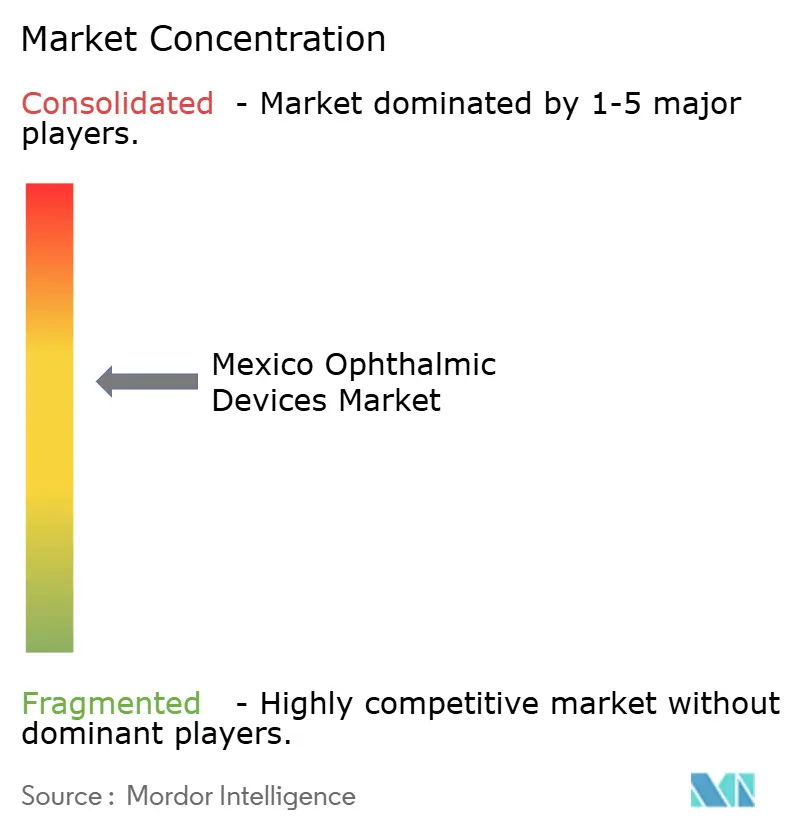
The Mexico ophthalmic devices market features moderate concentration; the five largest suppliers hold roughly 55% of revenue. EssilorLuxottica enjoys vertical integration across lens blanks, coatings, and retail distribution, ensuring stable margins even in price-sensitive tiers. Alcon posts 12% vision-care and 5% surgical growth for 2024, underpinned by the CENTURION phaco system and DAILIES contact lenses. Johnson & Johnson Vision differentiates through the iDesign Refractive Studio, which fuses topography and wavefront analysis to improve LASIK accuracy.
Specialist chains such as salaUno replicate lean surgical lines inspired by India’s Aravind model, achieving high cataract throughput while maintaining affordable fee structures. Domestic assemblers supply value-priced slit lamps and autorefractors to independent optometrists, rebranding Chinese OEM hardware under local trademarks. Venture capital activity signals future consolidation, with enterprise contracts likely to shift procurement toward cloud-linked inventory hubs.
Technology partnerships matter more each year. AI developers align with imaging firms to integrate on-device analytics that flag pathology in real time, shortening reading cycles in busy clinics. Training alliances between equipment makers and teaching hospitals supply fellowships and simulation labs that familiarize residents with proprietary platforms early in their careers.
Mexico Ophthalmic Devices Industry Leaders
-
Alcon Inc
-
Nidek Co. Ltd
-
Johnson & Johnson
-
Essilor International SA
-
Carl Zeiss Meditec AG
- *Disclaimer: Major Players sorted in no particular order
Market Opportunities and Future Outlook
A near-term whitespace sits in scaling diagnostic and monitoring capacity tied to nationwide diabetes and school vision screening pathways, where procurement favors portable, interoperable tools (e.g., autorefractors, pediatric kits, compact fundus cameras) that integrate with electronic health records used to route patients to accredited centers. With one in three Mexican adults with type 2 diabetes showing retinal damage that needs routine imaging, and IMSS screening 11 million schoolchildren for refractive errors under Vive Saludable, Vive Feliz, suppliers that can bundle devices, connectivity, and service coverage gain traction in public and private tenders.
On the surgical side, opportunities concentrate in standardizing high-throughput cataract workflows across urban hospital clusters and expanding ambulatory surgery center footprints, supported by COFEPRIS-gated introductions of next-generation microscopes, lens removal systems, and cataract platforms. The move toward reliance routes using Reference Regulatory Authority documentation and COFEPRIS simplification steps announced in 2025-2026 reduce friction for multinationals that maintain globally consistent technical files, while increasing the importance of in-country representation, post-market surveillance readiness, and training programs to address surgeon availability constraints outside major cities. Local production and regional hubs also create execution headroom in vision care: EssilorLuxottica's Tijuana complex (10 million pairs annual capacity) and similar localized supply chains shorten replenishment cycles for value-tier spectacles and specialty lenses, enabling faster retail fulfillment and broader rural outreach models.
Recent Industry Developments
- May 2026: Carl Zeiss Meditec announced COFEPRIS approval in Mexico for the ARTEVO 850 ophthalmic surgical microscope and the MICOR 700 lens removal device. The approvals broaden ZEISS ability to commercialize integrated cataract workflows centered on digital visualization and efficiency features, raising competitive intensity in premium surgical equipment for hospital and ASC accounts.
- March 2025: IMSS launched the Vive Saludable, Vive Feliz initiative to screen 11 million schoolchildren for refractive errors and initiated procurement activity for portable vision screening equipment. The program expands the addressable base for pediatric diagnostics and fast-fit optical solutions by pushing screenings upstream into schools and primary care pathways.
- January 2024: EssilorLuxottica inaugurated a USD 172 million lens manufacturing site in Tijuana, adding 2,000 jobs and 10 million pairs of annual capacity. The facility strengthens domestic availability of spectacle lenses and supports faster replenishment for retail and institutional channels, reducing dependence on longer import cycles for high-volume vision care products.
Research Methodology Framework and Report Scope
Market Definition and Coverage
For this study, the market is defined as the value of ophthalmic devices sold in Mexico for eye diagnosis, monitoring, surgery, and vision correction, counted at the manufacturer or brand level and converted to USD for a consistent view.
Scope exclusions: Services such as eye exams, surgical procedure fees, and aftercare are not counted as part of the devices market value.
Segmentation Overview
- By Device Type
- Diagnostic & Monitoring Devices
- OCT Scanners
- Fundus & Retinal Cameras
- Autorefractors & Keratometers
- Corneal Topography Systems
- Ultrasound Imaging Systems
- Perimeters & Tonometers
- Other Diagnostic & Monitoring Devices
- Surgical Devices
- Cataract Surgical Devices
- Vitreoretinal Surgical Devices
- Refreactive Surgical Devices
- Glaucoma Surgical Devices
- Other Surgical Devices
- Vision Care Devices
- Spectacles Frames & Lenses
- Contact Lenses
- Diagnostic & Monitoring Devices
- By Disease Indication
- Cataract
- Glaucoma
- Diabetic Retinopathy
- Other Disease Indications
- By End-user
- Hospitals
- Specialty Ophthalmic Clinics
- Ambulatory Surgery Centers (ASCs)
- Other End-users
Data Sources, Market Sizing, and Validation
Desk Research
We start by building a structured fact base on Mexico eye care demand and device supply, so later assumptions have a real reference point. Public sources such as Mexico health statistics releases, customs import and export data, World Bank macro indicators, peer reviewed ophthalmology publications, and relevant trade association portals were used to understand procedure volumes, disease burden, and purchasing patterns.
We then relied on company filings, investor presentations, product literature, and reputable press coverage to map the active device categories and typical price bands seen in Mexico. For consistency checks, we also referenced paid subscriptions for company financials and for shipment level import and export signals where available, which helped test whether the desk based totals are directionally reasonable. The sources listed above are illustrative only, and other public references were also used for data collection, cross checks, and clarification.
Primary Interviews and Surveys
Next, we validate the model through expert interviews and structured surveys with stakeholders across the value chain, including manufacturers, distributors, hospital procurement teams, ambulatory surgery centers, and specialty eye clinics. Because this is a Mexico focused market, discussions were spread across key states and major metro areas so our assumptions reflect where procedures are concentrated and where access is still developing. Respondent input from these conversations was used to confirm device mix, utilization patterns for diagnostic equipment, and realistic ASP movement by category before finalizing the market totals.
Distribution of primary research fieldwork respondents
| Company type | Respondent position |
|---|---|
| Top tier: 25% | CXOs: 13% |
| Mid tier: 59% | Functional/Unit leaders: 40% |
| Smaller Players: 16% | Managers: 47% |
Market-Sizing & Forecasting
Sizing is built using a combined top-down and bottom-up approach, where Mexico level demand pools are reconstructed first and then checked against supply side signals before totals are finalized. On the top-down side, we translate indicators such as cataract and glaucoma procedure volumes, the installed base and replacement cycle for diagnostic devices, contact lens and spectacle wear penetration, and the public versus private care mix into category wise revenue using practical ASP ranges.
Those totals are then corroborated with selective bottom-up approximations, such as rolling up a sample of supplier and distributor revenues, checking imported device and lens flows against expected consumption, and validating unit economics for high value surgical and diagnostic systems. When a category has limited visibility, gaps are handled using proxy volumes, such as procedure throughput at typical facilities, and then pressure testing the implied spend per patient with interview feedback. For forecasting, scenario analysis is used, and the scenarios are anchored to factors like aging population trends, diabetes prevalence signals, capital spending appetite at hospitals and clinics, and expected price movement from inflation and currency effects, followed by a final pass to keep growth paths consistent across categories.
Data Validation & Update Cycle
Before sign-off, results are triangulated across multiple independent checks, and any large variances are flagged for a deeper review. We compare the final outputs against outside signals such as procedure trends, import patterns for key device groups, and the implied per facility equipment spend, and then we re-contact sources when an assumption creates an outlier.
Each estimate goes through a multi step analyst review where inputs, formulas, and conversion factors are checked for consistency, followed by a final read through to ensure the story matches the numbers. Reports are refreshed annually, and interim updates are made when major policy changes, pricing shocks, or technology shifts materially change demand. Right before delivery, a fresh validation pass is run so clients receive the most current view possible.
Mordor Intelligence's Mexico Ophthalmic Devices Market Size Versus Other Published Estimates
Published market sizes for Mexico ophthalmic devices often look far apart because the included product basket is not consistent, and some sources also treat services and retail margins differently. Differences in currency timing, the base year chosen, and how procedure based demand is converted into revenue also push numbers in opposite directions.
Some estimates expand the scope into broader eye care spending and can inflate the total when retail and non-device items are blended in. In Mordor Intelligence, the count is limited to ophthalmic devices across diagnostic and monitoring systems, surgical devices, and vision correction devices (including spectacles and contact lenses), and the totals are cross checked using procedure and utilization signals before USD conversion is finalized.
Benchmark comparison
| Source | Market Size | Gaps in Research Methodology |
|---|---|---|
| Mordor Intelligence | USD 1.19 B (2025) | |
| Regional Consultancy A | USD 54.30 B (2024) | Uses a much broader spend pool that likely blends devices with wider eye care and retail value, which can multiply the headline figure beyond device only revenues. |
| Trade Journal B | USD 26.72 M (2024) | Tracks a narrow submarket focused on refractive surgery devices only, so the figure excludes vision correction products and most diagnostic and cataract related device revenues. |
The table shows that most of the spread comes from scope choices, not from small math differences. Once the device basket is kept consistent and key demand drivers like procedure volumes, installed base needs, and realistic ASP bands are applied, the resulting size becomes easier to trace and repeat across refresh cycles.
Key Questions Answered in the Report
What is the current value of the Mexico ophthalmic devices market?
The market stands at USD 1.25 billion in 2026 and is forecast to reach USD 1.58 billion by 2031 at a 4.83% CAGR.
Which device category leads revenue?
Vision care devices contribute 64.62% of 2025 revenue, buoyed by high demand for cost-effective spectacles and contact lenses.
Why is diabetic retinopathy an important growth area?
A 33.6% prevalence among adults with type 2 diabetes drives sustained demand for OCT scanners, fundus cameras, and intravitreal therapy systems.
How are government programs influencing demand?
MAS-Bienestar and IMSS school screenings enlarge patient pipelines, pushing hospitals and clinics to acquire diagnostic and pediatric devices.
What limits adoption of premium intraocular lenses?
Public insurance excludes multifocal and light-adjustable lenses, so high out-of-pocket costs confine uptake to affluent urban patients.
Where are investment opportunities strongest?
Diagnostic devices with AI support, ambulatory surgery centers, and rural outreach platforms offer the fastest growth potential through 2030.