
Market Overview
| Study Period | 2020 - 2031 |
|---|---|
| Forecast Data Period | 2026 - 2031 |
| Base Year Market Size (2025) | USD 41.52 Million |
| Market Size (2026) | USD 44.46 Million |
| Market Size (2031) | USD 62.56 Million |
| Growth Rate (2026 - 2031) | 7.07 % |
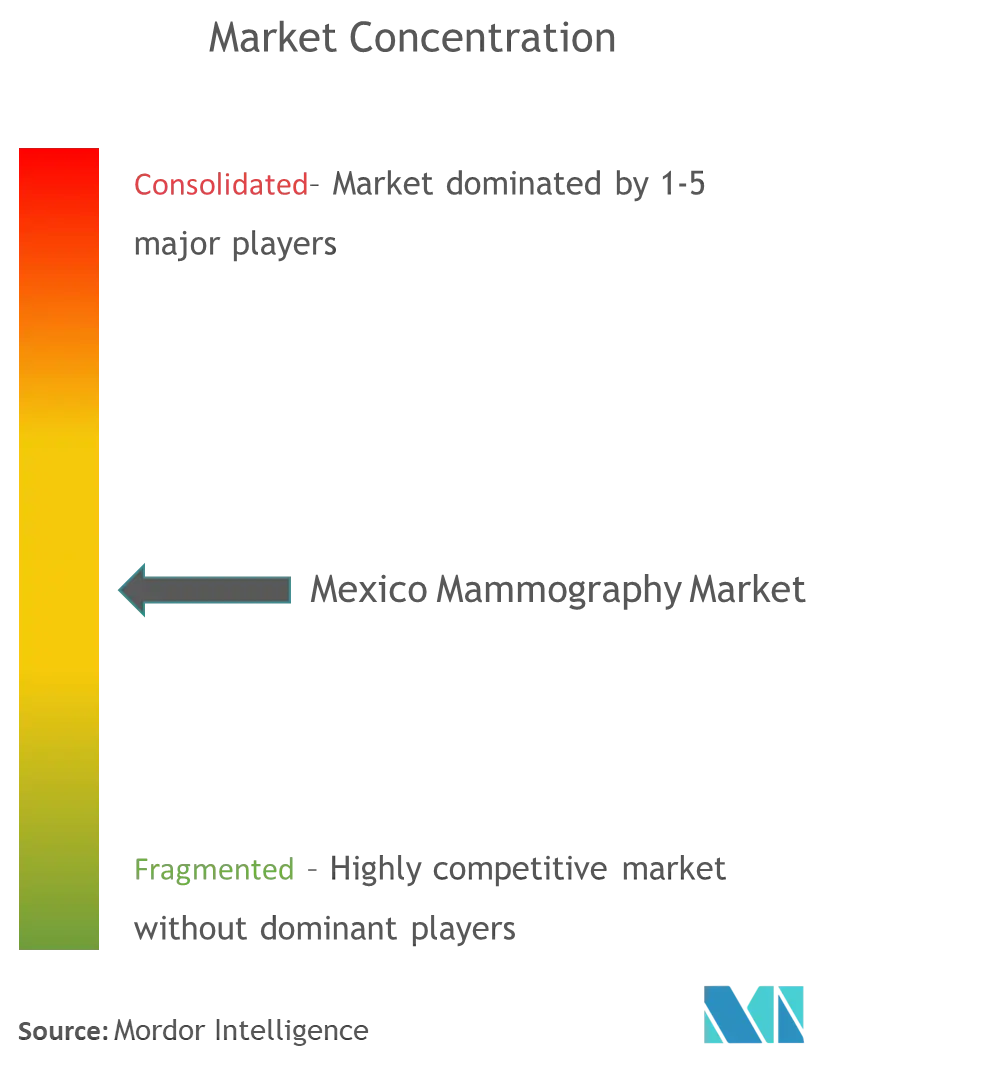
| Market Concentration | Medium |
Major Players *Disclaimer: Major Players sorted in no particular order Image © Mordor Intelligence. Reuse requires attribution under CC BY 4.0. | |
Mexico Mammography Market Analysis by Mordor Intelligence
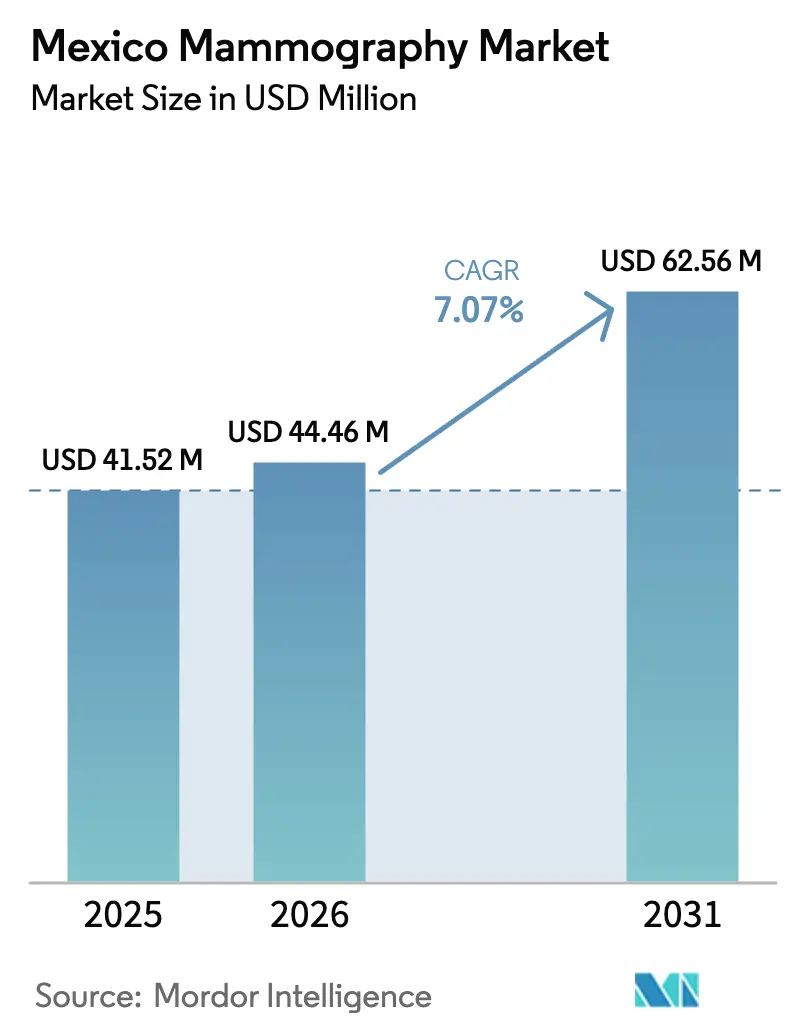
Mexico mammography market size in 2026 is estimated at USD 44.46 million, growing from 2025 value of USD 41.52 million with 2031 projections showing USD 62.56 million, growing at 7.07% CAGR over 2026-2031. A strong export-oriented medical-device ecosystem, the country’s position as the world’s eighth-largest device manufacturer, and more than 150,000 sector jobs collectively underpin demand for advanced breast-imaging solutions. Digital penetration accelerates because analog replacement cycles coincide with government procurement of full-field digital units for the vast IMSS-BIENESTAR hospital network, which manages over 10,500 primary health establishments and 576 hospitals across 23 states. Meanwhile, cross-border medical tourism from Central America funnels additional screening patients to northern clinics, and mobile units extend services to rural communities that lack resident radiologists. Artificial-intelligence integration remains nascent—only 9% of physicians currently employ AI tools—yet high-profile deployments such as Lunit’s roll-out across Salud Digna’s 230-plus sites point to wider adoption through 2030. Simultaneously, COFECE’s investigation into alleged cartel behavior in radiological equipment introduces pricing uncertainty that may reshape tender dynamics and spur new entrants.
Key Report Takeaways
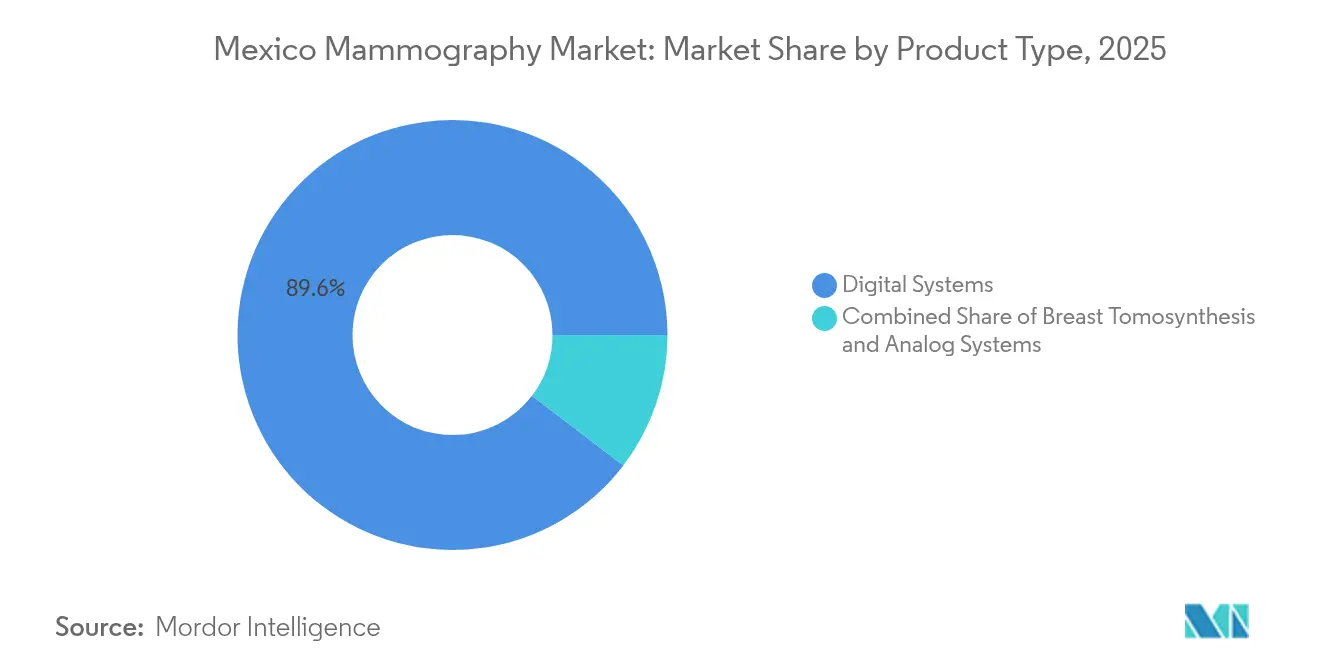
- By product type, digital systems captured 89.62% Mexico mammography market share in 2025 while breast tomosynthesis is advancing at an 7.78% CAGR through 2031.
- By technology, 2-D platforms accounted for 54.02% of the Mexico mammography market size in 2025 whereas 3-D mammography leads growth at 7.64% CAGR to 2031.
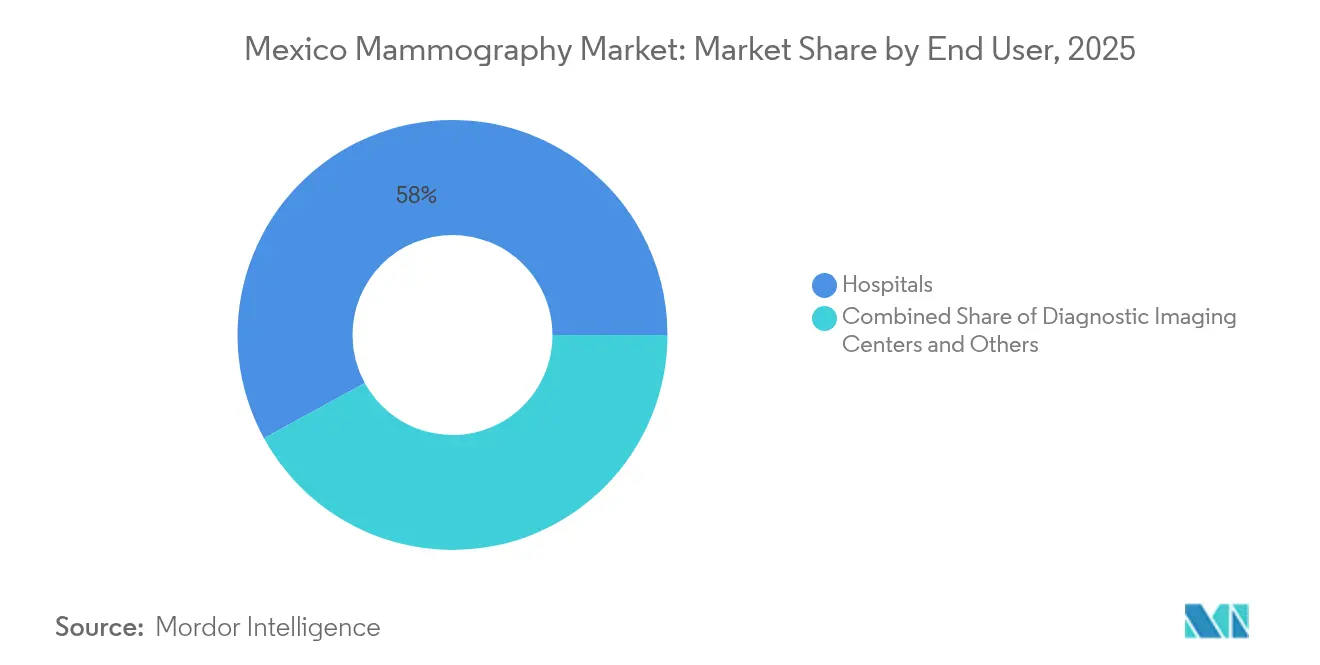
- By end user, hospitals held 57.98% Mexico mammography market share in 2025; diagnostic imaging centers record the highest projected CAGR at 7.95% through 2031.
Note: Market size and forecast figures in this report are generated using Mordor Intelligence’s proprietary estimation framework, updated with the latest available data and insights as of 2026.
Mexico Mammography Market Trends and Insights
Drivers Impact Analysis*
| Driver | (~) Impact on CAGR Forecast | Geographic Relevance | Impact Timeline |
|---|---|---|---|
| Rising Prevalence Of Breast Cancer Among Women ≥40 Years | +1.8% | National, concentrated in urban centers | Long term (≥ 4 years) |
| Rapid Replacement Of Analog By Full-Field Digital Systems | +1.1% | National, prioritizing public hospitals | Medium term (2-4 years) |
| Government's Expanding Mobile-Screening Programs | +1.2% | Rural states, northern border regions | Medium term (2-4 years) |
| Private-Sector Investment In AI-Powered Workflow Tools | +1.5% | Mexico City, Guadalajara, Monterrey metropolitan areas | Medium term (2-4 years) |
| Growing Availability Of CESM For Under-Served Dense-Breast Cohorts | +0.9% | Major urban hospitals, specialized imaging centers | Long term (≥ 4 years) |
| Cross-Border Medical Tourism From Central America | +0.6% | Northern border states, major metropolitan areas | Short term (≤ 2 years) |
| Source: Mordor Intelligence | |||
Rising Prevalence Of Breast Cancer Among Women ≥40 Years
Nationwide demographic shifts elevate the screening pool as age-period-cohort analyses reveal mortality increases beyond earlier projections, stimulating continuous demand for diagnostic capacity. Multidisciplinary treatment guidelines that now require genetic counselors intensify imaging needs for precise staging and surveillance. Survival disparities surface between states, with Guerrero registering 73% five-year survival despite high poverty, whereas younger women post poorer outcomes, underscoring the necessity for broader age inclusion in regular screening. Indigenous Otomí women cite cultural norms and discrimination as core barriers, confirming the importance of culturally sensitive outreach. The phased termination of welfare programs such as Prospera reduced subsidized care, encouraging private providers to design alternative access pathways. Regulatory standard NOM-229-SSA1-2002 ensures radiation safety compliance across expanding screening sites[1].
Rapid Replacement Of Analog By Full-Field Digital Systems
Analog units persist mainly in rural outposts; nevertheless, economic evaluations confirm digital systems’ superior lifetime cost-effectiveness when throughput exceeds 3,000 exams yearly, catalyzing systemic upgrades. Government tenders for consumables point to sustained operating budgets even where capital constraints slow replacement. Foreign direct investment of USD 126 million in 2022 expanded financing options for private clinics upgrading to digital suites. COFEPRIS labeling mandates under NOM-137-SSA1-2008 amplify confidence in imported detectors. Combined, these factors accelerate the Mexico mammography market’s digital transformation trajectory.
Government's Expanding Mobile-Screening Programs
State health authorities deploy mobile caravans such as Michoacán’s free unit visits to remote municipalities, closing physical-distance gaps and driving episodic demand spikes. Private-public collaborations like ADO’s 32% expansion of the Caravana Rosa widen outreach logistics. Fujifilm’s training hubs enhance technologist skills, increasing utilization of installed units. Federal coordination agreements guarantee budget transfers that underpin free exams in underserved zones. AI-enabled portable devices under evaluation promise workflow efficiencies, though evidence from Latin American settings remains limited.
Private-Sector Investment In AI-Powered Workflow Tools
Lunit’s partnership with Salud Digna introduces Insight MMG algorithms over a 10-million-image dataset, positioning Mexico as Latin America’s largest AI mammography incubator. Domestic developer HERA-MI’s Breast-Slim View screens positioning quality and density metrics, supporting quality assurance protocols. Grupo RIO’s adoption of deepc’s platform illustrates aggregator models that bundle over 70 AI applications within a unified PACS interface. Cost–utility studies predict AI-human task sharing can cut screening program costs by up to 30.1%, provided false-positive management remains controlled. Physician adoption lags due to infrastructure and training gaps, but industry partnerships with academic centers aim to close skill deficits.
Growing Availability Of CESM For Dense-Breast Cohorts
Contrast-enhanced spectral mammography offers higher contrast-to-noise ratios for malignant lesions versus conventional imaging, improving detection in dense tissue. Validation of the Mirai risk-prediction model in Mexican clinics achieved a C-index of 0.63, informing stratified screening that channels high-risk women toward CESM. Technical assessments confirm malignant tumors exhibit distinct enhancement patterns, enabling earlier intervention. Brazilian cost-effectiveness evidence for tomosynthesis plus synthetic views supports regional transferability of combined CESM–DBT workflows. Implementation challenges center on contrast agents and training, yet high-risk population benefits justify capital outlays for referral centers.
Restraints Impact Analysis*
| Restraint | (~) Impact on CAGR Forecast | Geographic Relevance | Impact Timeline |
|---|---|---|---|
| High Upfront Cost For 3-D/DBT Units In Public Hospitals | -1.3% | National public health system, rural hospitals | Long term (≥ 4 years) |
| Limited Number Of Certified Radiologists In Rural States | -0.8% | Northern and southern border states, rural municipalities | Medium term (2-4 years) |
| Risk Of Radiation Over-Exposure In Opportunistic Screening | -0.5% | National, particularly unregulated private facilities | Medium term (2-4 years) |
| Fragmented Reimbursement Rules Between IMSS, ISSSTE & Private Payors | -0.7% | National, affecting all healthcare sectors | Long term (≥ 4 years) |
| Source: Mordor Intelligence | |||
High Upfront Cost For 3-D/DBT Units In Public Hospitals
Economic analyses calculate an additional 5.4 million peso investment for each DBT system versus computed radiography units, straining public budgets despite available operating funds. The domestic device market valued at USD 15.6 billion in 2023 expands at 8.3% CAGR in local currency, which encourages vendor financing yet tender complexity delays roll-outs. IMSS purchases of consumables show utilization growth even where new-equipment procurement stalls [2]. Retrofittable flat-panel detectors like the RSM-2430C provide interim digitalization options. Cross-border leasing and vendor-managed inventory agreements emerge as alternative pathways for capital-constrained facilities.
Limited Number Of Certified Radiologists In Rural States
Workflow bottlenecks persist because 80% of hospitals still rely on outdated archiving systems that extend reading queues. Physician surveys note delays exceeding 90 days for breast-cancer care in 18% of public hospitals, with many clinicians unaware of standardized referral protocols. Fujifilm’s technology centers supply modular training, yet scaling remains insufficient for nationwide coverage. AI triage tools such as Eden Creator promise workload mitigation, though rural bandwidth constraints impede cloud-based model deployment. Regional collaboration with the Pan American Health Organization advocates tele-radiology hubs to pool expertise across Latin America.
*Our forecasts treat driver/restraint impacts as directional, not additive. The impact forecasts reflect baseline growth, mix effects, and variable interactions.
Segment Analysis
By Product Type: Digital Dominance Accelerates Tomosynthesis Adoption
Digital systems led the Mexico mammography market size for product type at USD 37.21 million in 2025, translating to a 89.62% share. Analog units remain in legacy public clinics yet decline swiftly as budget allocations prioritize image-quality gains and workflow integration. The Mexico mammography market benefits from detector innovations such as Fujifilm’s direct-conversion selenium panels that deliver full-resolution previews in 10 seconds, improving daily throughput. Retrofit panels like Rose-M permit cost-efficient digital migration, sustaining digital share growth. Breast tomosynthesis, either as stand-alone or upgrade kits, gains successive tender wins because clinical evidence shows superior detection for architectural distortions, supporting its 7.78% CAGR trajectory. Vendors bundle extended warranties, software‐upgrade pathways, and technologist training to justify higher acquisition prices. Demand tails in analog peripherals signal an imminent shift where secondary resale markets absorb decommissioned units, further consolidating digital primacy. Overall, the Mexico mammography market expects digital equipment revenues to surpass USD 53.47 million by 2031 as analog installs fall below 2% of total inventory.
Second-generation DBT systems create differentiated value propositions in high-volume imaging centers where reimbursement differentials offset capital costs. Innovative detector materials reduce dose while maintaining resolution, reinforcing physician confidence amid patient safety priorities. Hybrid product lines that support synthetic 2-D reconstruction enable facilities to meet screening guidelines without additional exposures, aligning with NOM-012-NUCL-2016 radiation requirements. Vendor-hosted PACS packages, inclusive of AI licences, bolster arguments for comprehensive digital system procurement. Consequently, digital platforms remain the cornerstone of Mexico mammography market revenue, with tomosynthesis leading performance-driven adoption curves.

By Technology: 3-D Innovation Challenges 2-D Incumbency
Technology segmentation shows 2-D platforms contributing USD 22.43 million for a 54.02% share of Mexico mammography market size in 2025, but growth moderates as 3-D systems advance at 7.64% CAGR. Siemens Healthineers’ Mammomat B.brilliant improves abnormality detection while cutting scan time by 35%, demonstrating dual emphasis on clinical efficacy and patient comfort. Healthcare providers adopt phased strategies, integrating synthetic 2-D from 3-D datasets to minimize per-exam radiation. CAD and AI-assisted modules overlay decision support, reducing reading times and false positives. Regulatory alignment with NOM-229 ensures dose-tracking logs, which strengthens quality management compliance.
Contrasted against entrenched 2-D fleets, 3-D units command premium pricing yet secure reimbursement in private insurance policies, promoting wider penetration in urban centers. Deployment of cloud-based AI models linked to 3-D datasets enhances clinical value, encouraging tele-diagnostic collaboration that compensates for radiologist shortages. CESM complements 3-D modalities in dense-breast cohorts, fostering a multi-technology ecosystem that maximizes detection accuracy across patient profiles. As a result, 3-D’s revenue contribution is projected to nearly equal 2-D by 2030, redefining the competitive playing field within the Mexico mammography market.
By End User: Imaging Centers Capitalize On Hospital Constraints
Hospitals generated USD 24.07 million, equal to 57.98% Mexico mammography market share in 2025, reflecting the state network’s breadth. Nonetheless, diagnostic imaging centers exhibit 7.95% CAGR due to shorter appointment windows and bundled value-added services. Private centers such as CMQ Hospital deploy advanced screening suites in tourism corridors like Riviera Nayarit, tapping expatriate and traveling patient segments. Established specialists like CEDIMMONT leverage two-decade reputations to attract local referrals within Yucatán.
Fragmented reimbursement between IMSS, ISSSTE, and private payors burdens hospital billing workflows, driving some beneficiaries to pay-per-service imaging centers for faster diagnostics. Centers differentiate through extended operating hours, AI-augmented reporting, and ancillary ultrasound or biopsy on the same visit. Mobile-unit operators enter employer wellness programs, offering on-site screening for maquiladora workforces, thereby broadening the other-users segment. Collectively, the end-user mix evolves toward a hybrid service landscape that balances public hospital capacity with agile private offerings, sustaining diversified demand across the Mexico mammography market.
Geography Analysis
Regional dispersion creates distinct procurement patterns. Northern border states leverage cross-border medical tourism, which supplies cash patients to private clinics equipped with advanced 3-D systems that align with United States screening standards. Proximity to U.S. distributors reduces delivery lead times for spare parts, strengthening uptime for high-throughput centers. Mid-continent urban clusters—Mexico City, Guadalajara, and Monterrey—concentrate tertiary hospitals and academic research hubs that pilot AI algorithms under vendor-academic collaborations, spurring early adoption curves. Metropolitan density also supports CESM adoption where dense-breast prevalence intersects with higher socioeconomic levels.
In contrast, southern and mountainous states confront limited road connectivity and low specialist density. Mobile units fill this gap, supported by federal resource-transfer agreements and state outreach campaigns that schedule rotating visits to remote municipalities. Indigenous regions require culturally tailored awareness messaging; bilingual technologists improve attendance among Otomí, Mixe, and Zapotec communities. Geography influences reimbursement complexities, as cross-state referrals often trigger insurance pre-authorization hurdles that dampen demand in border areas of Chiapas and Oaxaca.
Central states like Jalisco enjoy greater fiscal autonomy after the 2019 health-system reforms, enabling flexible equipment purchases responsive to local epidemiology . This empowerment fosters competitive bidding that includes emerging AI-enabled vendors, further diversifying the supplier base. Overall, geographic heterogeneity demands multi-pronged strategies ranging from high-tech urban centers with integrated AI worklists to resource-optimized mobile caravans in sparsely populated districts, ensuring Mexico mammography market growth remains inclusive.
Regulatory Landscape
Medical devices used for mammography in Mexico are regulated primarily by COFEPRIS under the General Health Law and the Reglamento de Insumos para la Salud, which covers sanitary registration, advertising controls, and manufacturing and import requirements. Clinical and technical operation in breast cancer screening is further framed by NOM-041-SSA2-2011 (prevention, diagnosis, treatment and epidemiological surveillance of breast cancer) and NOM-158-SSA1-1996, specifying performance and technical requirements for mammography equipment, including generator characteristics, kV range, and focal spot specifications.
Quality and distribution compliance is reinforced through NOM-241-SSA1-2021 for quality management systems for facilities involved in manufacturing, storage and distribution of medical devices. For ionizing-radiation equipment, additional authorizations apply, including licensing and oversight by CNSNS alongside COFEPRIS processes. In June 2026, COFEPRIS published guidance for an abridged (reliance) pathway aligned to prior approvals from select high-vigilance authorities, creating a more structured route for importing identical versions of already-approved devices into the Mexican market.
Value Chain Analysis
The Mexico mammography value chain begins with global OEMs, including Siemens Healthineers, Hologic, GE HealthCare and Fujifilm, along with technology partners that supply full-field digital systems, tomosynthesis upgrades, detectors, and associated software. Imports and in-country commercialization typically route through authorized holders of sanitary registrations and local distributors that handle tender participation, installation, and user training, while after-sales service and uptime commitments increasingly matter for public networks and high-throughput diagnostic chains.
Downstream, hospitals and diagnostic imaging centers drive utilization, while mobile screening programs extend access into underserved municipalities and shift demand toward ruggedized configurations, serviceable parts, and faster maintenance logistics. Across the chain, compliance requirements under COFEPRIS and NOM-241-SSA1-2021 influence supplier qualification for warehousing and distribution, and radiation-source equipment adds another layer of permitting and documentation that affects lead times and total cost of ownership. Software and workflow tools, including CAD and AI, increasingly operate as overlays to PACS and RIS environments, adding integration and validation work for vendors and service partners.
Competitive Landscape
Global manufacturers—Hologic, GE HealthCare, Siemens Healthineers, and Fujifilm—anchor the market with comprehensive portfolios, local service teams, and compliance readiness under NOM-241-SSA1-2025 quality-system mandates. AI specialists such as Lunit, HERA-MI, and deepc cultivate strategic partnerships to embed decision-support software inside multivendor PACS environments, differentiating on algorithm accuracy and cloud-scalability. Domestic innovators exploit familiarity with COFEPRIS processes, tailoring interfaces and documentation to Spanish-speaking radiologists.
COFECE’s ongoing cartel investigation heightens scrutiny over public-tender pricing, potentially leveling the playing field for mid-size entrants. Vendor responses include transparent cost-breakdowns and expanded training packages to demonstrate value beyond initial price tags. White-space remains in rural deployment where leasing models, portable detectors, and mobile configurations offer scalable penetration paths. Strategic moves in 2024-2025 include Lunit’s Latin America–wide AI roll-out with Salud Digna and Siemens’ FDA-cleared Mammomat B.brilliant marketing push, illustrating technology-plus-service integration as a winning formula.
Competitive intensity also manifests in after-sales support. Companies open regional parts depots and training academies to meet uptime SLAs demanded by large diagnostic chains. Platform ecosystems emerge, where equipment, AI plug-ins, and tele-radiology modules interoperate, enhancing switching costs for clients. Overall, the Mexico mammography market tilts toward moderate concentration as leading players defend share through bundled offerings while agile AI start-ups capture niche segments, balancing consolidation with innovation.
Mexico Mammography Industry Leaders
-
Siemens AG
-
Hologic Inc.
-
GE Healthcare
-
Planmed OY
-
Fujifilm Holdings Corporation
- *Disclaimer: Major Players sorted in no particular order
Market Opportunities and Future Outlook
A key opportunity centers on reducing time-to-market and installation friction for newer systems and software through regulatory and procurement pathways. In June 2026, COFEPRIS formalized an abridged (reliance) route, including a stated 30-business-day decision timeline for complete submissions when the device is identical to versions authorized by select high-vigilance regulators, such as the FDA, EMA, Health Canada, Swissmedic, ANVISA, TGA, MFDS, NMPA. This offers a practical opening for OEMs and software suppliers to align global launches with Mexico filings, and for distributors to expand portfolios while standardizing technical documentation and post-market responsibilities.
On the demand side, public-sector scale and private-chain standardization continue to support deployments that bundle equipment, training, and workflow software rather than hardware-only sales. Programmatic pull includes IMSS-BIENESTARs footprint of over 10,500 primary health establishments and 576 hospitals across 23 states, alongside enterprise deployments such as Lunit rolling out mammography AI across Salud Digna's 230-plus sites, which helps normalize AI-enabled reading workflows in high-volume settings. Opportunities cluster around (i) digital replacement in smaller public facilities, (ii) tomosynthesis upgrades for high-throughput urban sites that need faster exams and synthetic 2-D workflows, and (iii) service-led models, including leasing, managed service, and tele-radiology-enabled reading support, that address budget constraints and radiologist scarcity while staying aligned with NOM-driven quality and safety obligations.
Recent Industry Developments
- May 2026: GE Healthcare reported continued expansion of its medical imaging portfolio in Mexico, including specialized women-centric mammography equipment featuring remote compression control and AI-based image reconstruction. The expansion in the Mexico mammography portfolio strengthens competitive position in public-private tenders and AI-enabled imaging workflows.
- April 2026: Siemens Healthineers officially launched the Mammomat B.brilliant 3D mammography system in Mexico with high-speed 50-degree tomosynthesis and flying focal spot tube. The introduction of a high-end 3D system differentiates Siemens in hospital networks and shifts tender dynamics.
- March 2026: Siemens Healthineers introduced a new 3D tomosynthesis mammography system in Mexico. The new 3D tomosynthesis platform accelerates adoption of advanced imaging and heightens competition in the Mexican breast-imaging segment.
Research Methodology Framework and Report Scope
Market Definition and Coverage
For this methodology, the market covers revenues generated in Mexico from mammography imaging systems used to produce breast screening and diagnostic images in clinical settings, across public and private care points. Values are captured on a manufacturer and supplier sales basis in current US dollars.
Scope exclusions: The sizing excludes service contracts, extended warranties, consumables, and general-purpose imaging accessories that are not specific to mammography.
Segmentation Overview
- By Product Type
- Digital Systems
- Analog Systems
- Breast Tomosynthesis (Stand-alone)
- By Technology
- 2-D Mammography
- 3-D Mammography
- CAD & AI-Assisted Mammography
- By End User
- Hospitals
- Diagnostic Imaging Centers
- Others
Data Sources, Market Sizing, and Validation
Desk Research
Desk work started by mapping the demand pool for breast cancer screening and diagnosis, and then linking it to equipment placement and replacement needs. We used public health and epidemiology references such as GLOBOCAN, WHO, PAHO, and OECD health statistics to interpret screening participation signals, diagnostic intensity, and care capacity trends in Mexico.
To ground the equipment side, we reviewed policy and program documents, procurement and tender disclosures, and facility level references where available, including sources such as Mexico health authorities, official gazettes, and public hospital network updates. Company annual reports, product brochures, and press releases were used to frame technology mix shifts (2-D versus 3-D and AI assisted workflows) and typical system pricing bands, and then selective paid subscriptions were used only for company financials, patent signals, and tender tracking. The sources listed above are illustrative, and we also reviewed other public documents and datasets for data collection, cross-checking, and clarification.
Primary Interviews and Surveys
Primary conversations were used to validate how quickly facilities are moving from analog to digital, what the replacement cycle looks like in practice, and how state and provider budgets influence purchasing timing across Mexico. We also stress-checked assumptions with a mix of stakeholders, including radiology leaders, hospital procurement teams, imaging center operators, and service partners, so that pricing and adoption inputs could be adjusted where desk signals were thin.
Distribution of primary research fieldwork respondents
| Company type | Respondent position |
|---|---|
| Top tier: 36% | CXOs: 12% |
| Mid tier: 47% | Functional/Unit leaders: 39% |
| Smaller Players: 17% | Managers: 49% |
Market-Sizing & Forecasting
Sizing was built using a combined top-down and bottom-up logic. First, national imaging capacity and breast screening demand indicators were used to reconstruct likely equipment needs, then outputs were adjusted using supplier and channel feedback. The top-down path connected breast cancer screening guidelines and utilization behavior to expected exam volumes, which were then translated into installed base requirements using throughput and uptime assumptions.
To keep the model tied to actual purchasing behavior, we corroborated totals with selective bottom-up checks such as sampled average selling prices multiplied by estimated unit shipments, facility type channel checks, and replacement-driven purchases based on the age profile of installed systems. Key inputs included the digital versus analog mix, 2-D versus 3-D system share, typical equipment life and replacement cycles, public versus private procurement cadence, and pricing differences between hospitals and imaging centers (including stand-alone tomosynthesis where relevant). Forecasts leaned on scenario analysis, where adoption speed for 3-D and AI assisted tools was varied alongside budget timing and screening push intensity, and then aligned to what primary respondents described as the most likely path. Where direct shipment visibility was incomplete, gaps were handled using replacement logic plus observed procurement patterns, and then stress-testing the implied unit volumes against realistic capacity utilization ranges.
Data Validation & Update Cycle
Validation was done in layers to reduce single-source bias before final numbers were published. We compared market outputs against independent signals such as procurement announcements, installed base narratives from interviews, and whether the implied unit volumes matched realistic exam throughput for Mexico.
Outliers were reviewed, and assumptions were revisited when the model suggested sudden jumps in pricing, implausible replacement rates, or a technology mix shift that did not match what clinicians and buyers described. Reports are refreshed annually, and interim updates are made when major policy changes, procurement waves, or macro events materially shift demand. Before delivery, a final analyst pass is completed so clients receive the most current view available at that time.
Mordor Intelligence's Mexico Mammography Market Size Compared With Other Published Estimates
Published market sizes for mammography in Mexico can look far apart because each publisher makes its own calls on what counts as mammography revenue and how fast the technology mix is assumed to change. Differences often show up around whether values represent equipment only or include service and software, and whether shipments are smoothed over time or tied to observed procurement timing.
In Mexico, the biggest gaps usually come from how 3-D adoption is treated, how public sector purchases are timed, and whether CAD and AI assisted tools are priced as part of a system or counted as separate software revenue. Currency conversion timing also matters, since larger tenders can swing totals when converted at different average rates, and refresh cadence can shift the base year if the latest procurement news is not yet reflected.
Benchmark comparison
| Source | Market Size | Gaps in Research Methodology |
|---|---|---|
| Mordor Intelligence | USD 41.52 M (2025) | |
| Global Consultancy A | USD 49.10 M (2025) | Often expands scope to include multi-year service revenue and broader imaging software attached to mammography workflows, which can lift the total even when equipment shipments are flat. |
| Industry Association B | USD 34.80 M (2024) | Typically reflects reported unit placements or procurement activity in a single year and can understate private purchases, and it may not fully price in the shift toward 3-D systems and associated upgrade value. |
The spread in the table is mainly explained by what is counted around systems versus add-ons, and by whether the year is treated as procurement-heavy or normalized. By keeping the sizing anchored to equipment revenues and then checking unit-volume implications against throughput and replacement timing, the estimate stays traceable to repeatable inputs, a modeling choice applied by Mordor Intelligence.
Key Questions Answered in the Report
How big is the Mexico Mammography Market?
The Mexico Mammography Market size is expected to reach USD 44.46 million in 2026 and grow at a CAGR of 7.07% to reach USD 62.56 million by 2031.
Which product category dominates sales?
Digital mammography systems account for 89.62% of 2025 revenue thanks to their superior image quality and integration features.
Who are the key players in Mexico Mammography Market?
Siemens AG, Hologic Inc., GE Healthcare, Planmed OY and Fujifilm Holdings Corporation are the major companies operating in the Mexico Mammography Market.
How fast is breast tomosynthesis growing?
Breast tomosynthesis is expanding at an 7.78% CAGR, the fastest among product categories, propelled by better detection of subtle lesions.