
Mexico Heavy-Duty Truck Market Size and Share
Market Overview
| Study Period | 2019 - 2031 |
|---|---|
| Forecast Data Period | 2026 - 2031 |
| Base Year Market Size (2025) | USD 18.56 Billion |
| Market Size (2026) | USD 19.37 Billion |
| Market Size (2031) | USD 24.02 Billion |
| Growth Rate (2026 - 2031) | 4.39 % |
| Market Concentration | High |
Major Players *Disclaimer: Major Players sorted in no particular order Image © Mordor Intelligence. Reuse requires attribution under CC BY 4.0. | |
Mexico Heavy-Duty Truck Market Analysis by Mordor Intelligence
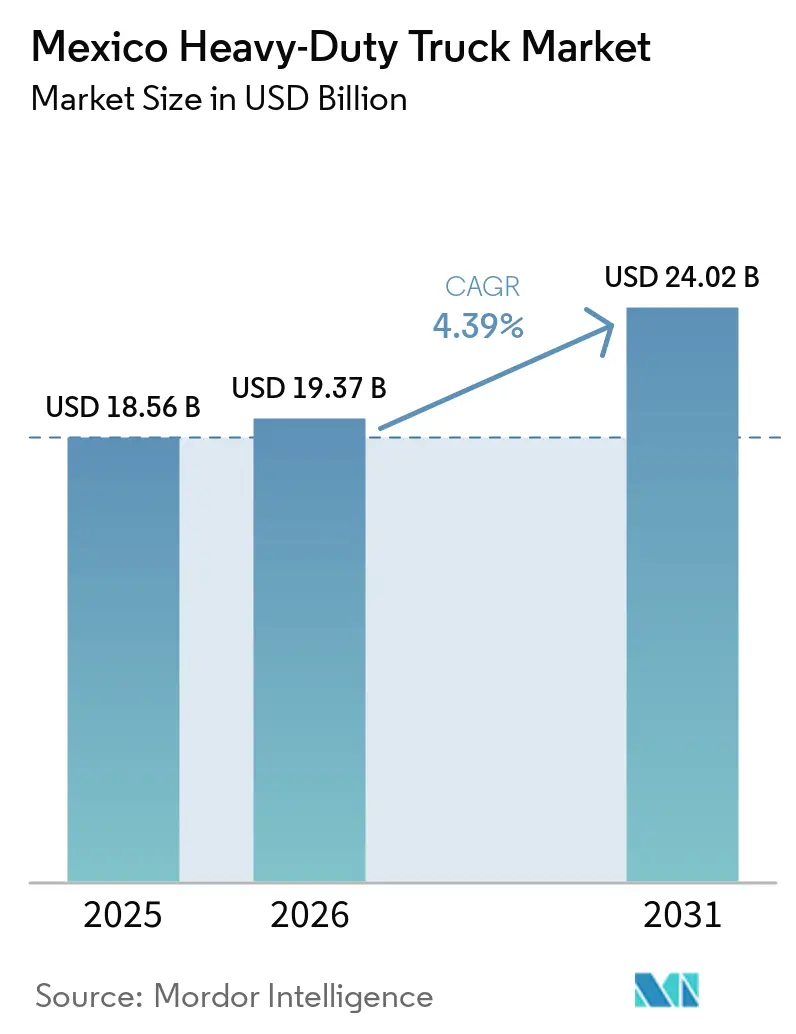
The Mexico heavy-duty truck market size grew from USD 18.56 billion in 2025 to USD 19.37 billion in 2026 and is projected to reach USD 24.02 billion by 2031, registering a CAGR of 4.39% between 2026 and 2031. Mexico has emerged as the leading trading partner for the U.S., bolstered by significant foreign direct investment driven by nearshoring. This surge in investment has kept freight demand robust, even amid a substantial drop in production. This decline was a direct consequence of new U.S. Section 232 duties, which increased per-unit export prices. Tariff-related uncertainties are prompting swift inventory adjustments at assembly plants in Saltillo, Monterrey, and Querétaro. Despite these challenges, rigid trucks servicing the Central-Bajío manufacturing loops are maintaining their pricing power, buoyed by the growth of e-commerce and the localization of suppliers. While electrified powertrains currently occupy a niche segment, Mexico's endorsement of the Global Memorandum of Understanding on zero-emission vehicles is spurring significant growth from a modest starting point. On a broader scale, initiatives like the Interoceanic project and upgrades to Gulf Coast ports are amplifying the demand for first- and last-mile drayage, rather than steering freight away from trucks.
Key Report Takeaways
- By gross vehicle weight, trucks above 26 tons held 48.22% of 2025 volume, while the 15–26 ton segment is forecast to lead growth at a 9.05% CAGR through 2031.
- By propulsion, internal-combustion engines accounted for 90.49% of 2025 sales, and battery-electric trucks are projected to grow at a 10.49% CAGR through 2031.
- By axle layout, the 6x4 configuration captured 53.16% of 2025 demand; the 4x2 layout is the fastest-growing at a 7.38% CAGR.
- By truck type, articulated vehicles dominated, accounting for 63.29% of 2025 shipments, while rigid trucks are set to expand at an 8.11% CAGR.
- By application, freight and logistics accounted for 54.31% of the 2025 volume, while urban freight will post the strongest CAGR at 8.29% through 2031.
- By region, Central-Bajío led with 39.54% revenue share in 2025; Western Mexico shows the highest 7.67% CAGR outlook to 2031.
Note: Market size and forecast figures in this report are generated using Mordor Intelligence’s proprietary estimation framework, updated with the latest available data and insights as of January 2026.
Global valuation is built by aggregating outputs from multiple countries and regions, with Mexico being one of the contributors. Our global heavy duty trucks market size represents that cumulative total.
Market Trends and Insights
Drivers Impact Analysis of Mexico Heavy-Duty Truck Market*
| Driver | (~) % Impact on CAGR Forecast | Geographic Relevance | Impact Timeline |
|---|---|---|---|
| Cross-Border Freight Boom | +1.8% | Northern Mexico, Central-Bajío, Western Mexico | Medium term (2-4 years) |
| Manufacturing-Export Expansion | +1.2% | Central-Bajío, Western Mexico, Northern Mexico | Long term (≥ 4 years) |
| Infrastructure Megaproject Pipeline | +0.9% | Western Mexico, Gulf Coast, South, and Southeast | Long term (≥ 4 years) |
| Stricter NOM-044 Emissions Norms | +0.7% | Central-Bajío, Northern Mexico, Western Mexico | Short term (≤ 2 years) |
| Growing CNG Corridor Network | +0.5% | Northern Mexico, Gulf Coast, Central-Bajío | Medium term (2-4 years) |
| "Truck-as-a-Service" Fintech Platforms | +0.3% | Central-Bajío, Northern Mexico, Western Mexico | Medium term (2-4 years) |
| Source: Mordor Intelligence | |||
Nearshoring-led Cross-Border Freight Boom
Bilateral trade has surpassed significant milestones, with Laredo accounting for a substantial portion of U.S.-Mexico truck traffic. Demand is shifting from autos to electronics in cross-border lanes, leading to an increased need for temperature-controlled tractors equipped with advanced telematics. A privately funded autonomous guideway could replace a significant share of truck movements between Laredo and Monterrey, compelling fleets to reallocate their assets to last-mile deliveries. Recent tariff announcements led to extended border queues, underscoring the importance of digital pre-clearance for trucks. Carriers that can ensure consistent dwell times are reaping pricing premiums, even amidst a sluggish export cycle.
Manufacturing-Export Expansion Lifting Domestic Demand
Plan México's domestic-content rule is channeling billions into localized supplier parks. This initiative is creating dense short-haul loops that favor medium-sized rigids. Jalisco has attracted significant new investments. Concurrently, cargo traffic at Guadalajara airport has surged, underscoring Western Mexico's growing influence on regional distribution fleets. While localized sourcing minimizes border exposure, a substantial portion of inputs still come from imports. This reliance means that fluctuations in the peso and unexpected tariff changes can swiftly diminish already slim carrier margins, dampening enthusiasm for fleet renewal. Despite fluctuations in long-haul volumes, e-commerce penetration ensures urban load factors remain elevated.
Federal Infrastructure Megaproject Pipeline
The Interoceanic Corridor will be fully operational, turning Salina Cruz–Coatzacoalcos into a crucial link between the Pacific and Atlantic. With significant container-handling capacity, the corridor is set to revolutionize trade routes. A pilot run showcased its potential, transporting vehicles coast to coast in a short time [1]. This underscores the rising demand for trucking services, especially for first- and last-mile logistics tied to intermodal expansion. The federal budget has allocated substantial funding for rail projects. It's also worth noting that every new rail terminal includes drayage lanes for both 4×2 and 6×2 trucks, ensuring seamless access to ports and warehouses. In Veracruz, an interchange under construction is progressing steadily and is expected to accommodate a high volume of vehicles daily.
Stricter NOM-044 Emissions Norms Driving Fleet Renewal
Prices for Euro VI-aligned NOM-044 6×4 tractors increased, reaching higher levels. However, an incentive program is accelerating the retirement of older units, which still make up a significant portion of the national fleet. States linked to U.S. export routes adopted ultra-low-sulfur diesel more quickly, creating a two-speed compliance landscape. Proposed regulations, including the new digital logbook (NOM-087) and Carta Porte rules, are steering fleets towards telematics-ready trucks. This shift gives OEMs offering factory-fitted connectivity an edge.
Restraints Impact Analysis of Mexico Heavy-Duty Truck Market*
| Restraint | (~) % Impact on CAGR Forecast | Geographic Relevance | Impact Timeline |
|---|---|---|---|
| Certified Heavy-Duty Driver Shortage | -1.1% | Northern Mexico, Central-Bajío, Western Mexico | Short term (≤ 2 years) |
| High Cost and Sparse Charging Facility | -0.8% | Central-Bajío, Western Mexico, Northern Mexico | Medium term (2-4 years) |
| Peso Volatility | -0.6% | Northern Mexico, Central-Bajío, Western Mexico | Short term (≤ 2 years) |
| Border Wait-Times | -0.4% | Northern Mexico, Western Mexico | Medium term (2-4 years) |
| Source: Mordor Intelligence | |||
Shortage of Certified Heavy-Duty Drivers
With training centers dwindling and total licensing costs increasing, the country faces a significant shortage of licensed operators. An aging workforce, coupled with frequent cargo robberies, not only dissuades new entrants but also inflates insurance premiums. While OEM-backed schools produce a limited number of graduates annually, that number falls far short of demand. Additionally, U.S. border violations linked to language requirements further reduce effective capacity.
High Upfront Cost and Sparse Charging for E-Trucks
Battery-electric Class 8 tractors command a premium, costing significantly more than their diesel counterparts. Public charging stations are predominantly concentrated in just a few central states. VEMO has unveiled a significant initiative, aiming to install numerous connectors. However, the focus is primarily on light- and medium-duty segments, which means long-haul carriers will continue to depend on depot charging. While early adopters like Transportes Marva have demonstrated the viability of fixed-route economics, widespread adoption is contingent on the arrival of megawatt chargers nationwide.
*Our forecasts treat driver/restraint impacts as directional, not additive. The impact forecasts reflect baseline growth, mix effects, and variable interactions.
Mexico Heavy-Duty Truck Market Segment Analysis
By Gross Vehicle Weight Rating:
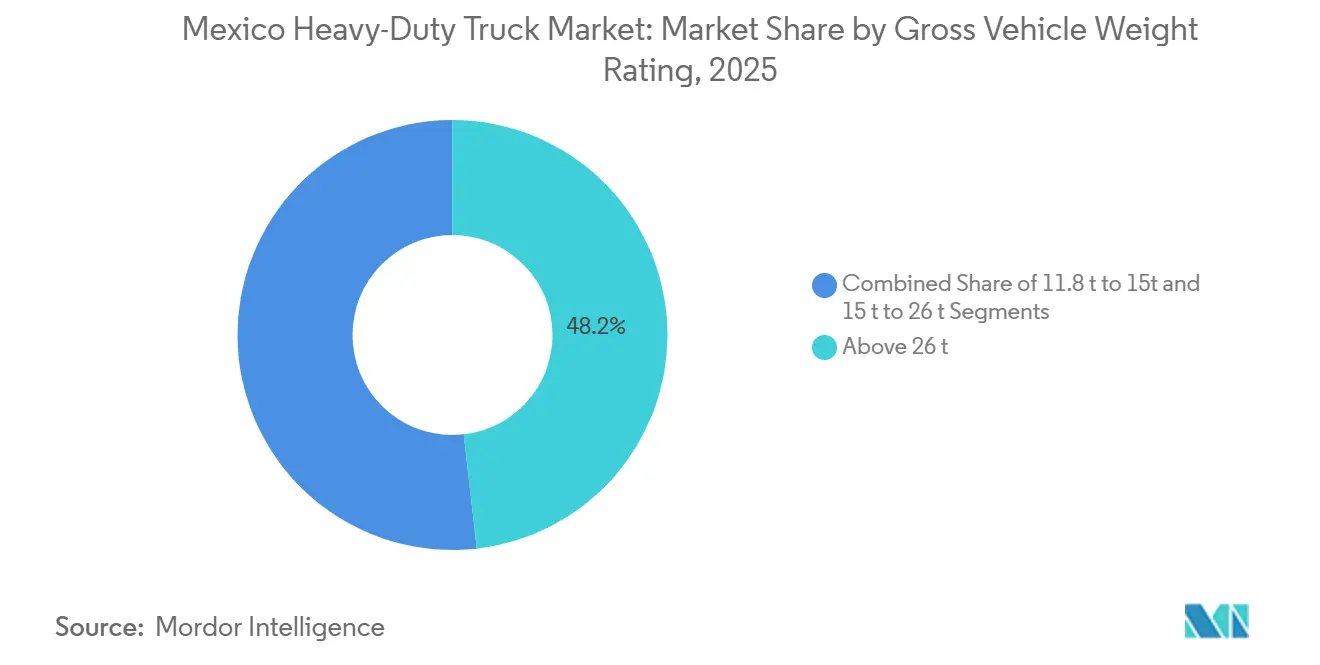
Heavy-Haul Dominance Drives DemandThe 15–26 ton class is projected to grow 9.05% annually to 2031, twice the overall Mexico heavy-duty truck market rate. This segment benefits from e-commerce and supplier shuttles inside Bajío industrial rings. Above-26-ton units accounted for 48.22% of 2025 shipments, reflecting dependence on cross-border lanes that now face tariff headwinds. Fleet renewals, spurred by NOM-044 and bolstered by a federal trade-in grant, have countered the impact of rising Euro VI list prices. This, in turn, has buoyed demand for mid-weight trucks, even amid broader economic fluctuations.
Trucks weighing between 11.8 and 15 tons, often used for construction supplies and municipal services, benefit from more lenient licensing regulations. In the Central Bajío region, where just-in-sequence loops are prevalent, these agile trucks navigate congested areas with ease. While a weakening peso might hinder truck replacements, government incentives for fleet scrappage provide a buffer, ensuring consistent demand in this segment of Mexico's heavy-duty truck market.

By Propulsion Type:
ICE Dominance Faces Electric DisruptionInternal-combustion engines retained 90.49% of sales in 2025 because diesel infrastructure spans every freight corridor. Still, battery-electric are forecast to post a 10.49% CAGR through 2031, outpacing the wider Mexico heavy-duty truck market. Kenworth's X15N natural-gas models, built locally, achieve a significant reduction in nitrogen oxides and can travel long distances on a single fill. This efficiency is drawing the attention of regional carriers looking to shield themselves from diesel price fluctuations.
Mexico's market for electrified heavy-duty trucks has substantial growth potential. This expansion hinges on the development of depot charging and megawatt corridors. While pilots like Delectrico's Marva fleet demonstrate cost parity on fixed urban routes, challenges such as range anxiety and payload limitations hinder wider adoption. Hybrid models have found a specific market in refuse and municipal fleets, yet fuel-cell technologies are notably absent from the landscape.
By Axle Type:
Configuration Flexibility Meets Operational DemandsThe 6x4 layout captured 53.16% of 2025 demand thanks to construction, mining, and heavy cross-border haulage that need traction on varied grades. HOWO Max’s February 2025 debut, sporting a Euro VI Weichai 460 hp engine, underscores the segment’s continued innovation pipeline.
Conversely, 4x2 configurations should record a 7.38% CAGR as urban delivery and regional distribution intensify. Fleet managers report that tire wear is lower and fuel savings are greater than with their 6x4 counterparts on paved routes. While 6x6 and 8x8 trucks cater to specialized off-road applications, Scania's autonomous mining pilot signals a slow but steady shift towards intelligent, electric multi-axle platforms, diversifying the tech landscape of Mexico's heavy-duty truck market.
By Truck Type:
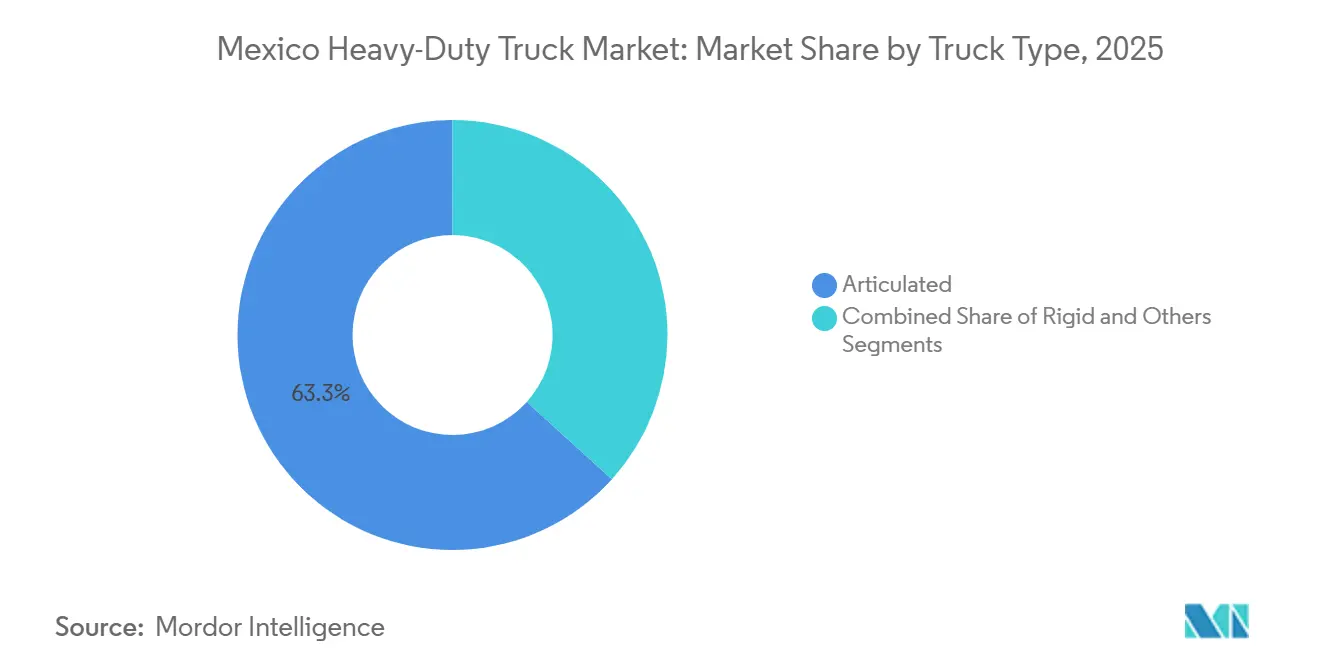
Articulated Leadership Reflects Long-Haul FocusArticulated trucks delivered 63.29% of 2025 registrations, mirroring their dominance in long-haul corridors, yet tariff pressures and border logjams erode near-term momentum. In contrast, rigid trucks are set to expand at an 8.11% CAGR to 2031 as localized supplier parks and e-commerce hubs proliferate. Rigid units account for a significant share of the Mexican heavy-duty truck market, with further growth expected. The appeal of rigids, bolstered by lower capital requirements and straightforward regulations, draws small fleets targeting short-haul niches.
Premium articulated models continue to dominate value segments, with features such as improved fuel efficiency and automated gearboxes ensuring their appeal to service-focused carriers. Though specialized bodies—ranging from tankers and mixers to refuse rigs—hold a modest yet stable market share, they remain resilient against broader economic fluctuations, thanks to consistent municipal procurement cycles.
By Application:
Freight-Logistics Dominance Amid Urban GrowthFreight and logistics maintained 54.31% of 2025 volume, yet urban freight’s 8.29% projected CAGR leads all use cases, driven by warehouse decentralization beyond Mexico City. The Mexican market for heavy-duty urban freight trucks is projected to grow significantly. While the long-haul segment grapples with challenges such as tariffs and driver shortages, the emergence of new rail corridors offers intermodal synergies that help mitigate some of these volume risks.
Spending on megaprojects leads to cyclical rises in construction and mining. Projects like the Mayan Train and the Interoceanic works bolster demand, though fluctuations in commodity prices introduce volatility. Municipal services tend to follow a consistent pattern, yet gaps in airport connectivity—like those seen at AIFA—extend time-critical cargo delivery and increase costs. This discrepancy results in heightened truck trip counts as shippers opt to pad their inventories.
Geography Analysis
In 2025, Central-Bajío dominated the Mexican heavy-duty truck market with a commanding 39.54% share, solidifying its reputation as the nation's industrial nucleus. Its strategic location, nestled between the Pacific and Gulf ports and surrounded by dense OEM clusters, not only curtails empty miles but also ensures optimal tractor utilization. Carriers, capitalizing on tollway redundancies, guarantee timely border crossings, bolstering their ability to command premium contract rates.
Western Mexico is poised for a 7.67% CAGR, driven by upgrades at the Manzanillo port and by a flood of foreign direct investment into Jalisco's tech sector. As exporters sidestep congestion at Gulf gateways by opting for swifter routes to Asia, the heavy-duty truck market in this corridor is witnessing notable growth. Additionally, highway expansion projects along the Guadalajara–Colima route amplify the region's logistical allure.
While Northern Mexico serves as the primary hub for cross-border activities, its growth rate trails behind that of the Pacific coast. However, reforms in border processing and the introduction of pre-clearance programs are slashing truck idling times, enhancing fleet productivity. Meanwhile, burgeoning demand in the Gulf Coast and South/Southeast regions, driven by LNG projects and tourism-focused rail lines, hints at future diversification in the geographic revenue streams for the Mexican heavy-duty truck market.
Coverage of the heavy duty trucks market by Mordor Intelligence spans a wide geographic footprint, with regional analysis available for Europe and Africa, alongside detailed country-level intelligence for United States and Saudi Arabia, each shaped by local operating conditions.
Competitive Landscape
The top three OEMs command a significant combined share, underscoring a high concentration. Scale advantages enable incumbents to amortize NOM-044 compliance costs across larger build volumes, thereby reinforcing their price leadership. Daimler’s digital-services bundle attaches AI-driven fuel-efficiency analytics and predictive maintenance to each truck sale, converting one-off hardware deals into annuity revenue streams.
Software-defined truck architectures are emerging; Daimler Truck and Volvo Group have formed a joint venture to co-develop common code platforms that enable over-the-air feature unlocks. Such moves raise switching costs for fleet operators who become embedded in proprietary ecosystems.
Challenger brands from China are building CKD plants to localise cost structures, while fintech start-ups finance working capital gaps among small carriers [2]. The confluence of new capital models and lower-priced imports could erode incumbent share at the margin, yet entrenched after-sales networks and resale-value reputations still tilt buyer preference toward legacy OEMs within the Mexico Heavy-Duty Truck Market.
Mexico Heavy-Duty Truck Industry Leaders
-
PACCAR Inc
-
Navistar International
-
Volvo Trucks
-
Mack Trucks
- *Disclaimer: Major Players sorted in no particular order

Mexico Heavy-Duty Truck Market Companies Covered in this Report
- Daimler Trucks AG
- PACCAR Inc.
- Navistar International
- Volvo Trucks
- Scania AB
- MAN Truck and Bus
- Mack Trucks
- Isuzu Motors
- Hino Motors
- Iveco Group
- Foton Motor
- Sinotruk
- Shacman (Shaanxi Auto)
- FAW Jiefang
- Dongfeng Motor
Recent Industry Developments in Mexico Heavy-Duty Truck Market
- May 2026: Foton Mexico delivered 20 Galaxy units to TUM Transportistas as part of the company’s fleet renewal strategy in Mexico. The vehicles feature X13 engines and comply with Euro VI emissions standards, supporting efforts to improve operational efficiency and reduce the environmental impact of freight transport.
- December 2025: In Puebla, Mexico, Shacman has teamed up with Spain's Sesé to inaugurate an SKD assembly plant. The duo aims to roll out 1,000 units in the plant's inaugural year, with ambitions to ramp up production to 4,000 units by 2028. This facility marries Chinese manufacturing prowess with the benefits of local labor. Further enhancing its offerings, the plant boasts a cutting-edge after-sales platform, ensuring features like repair traceability, remote fleet oversight, and digital training sessions.
Mexico Heavy-Duty Truck Market Report Scope
The Mexico heavy-duty truck market report is segmented by gross vehicle weight rating (11.8 to 15 t, 15 to 26 t, and above 26 t)), propulsion (internal-combustion engine (ICE) and electric), axle type (4x2, 6x2, 6x4, 6x6, 8x6, 8x8, and others ), truck type (rigid, articulated, and others), application (construction and mining, freight and logistics, long haul and others) and region. The market forecasts are provided in terms of value (USD) and volume (units).
Segmentation Overview
| 11.8 to 15 t |
| 15 to 26 t |
| Above 26 t |
| Internal-Combustion (ICE) | Diesel |
| Natural Gas (CNG/LNG) | |
| Electrified | Battery-Electric (BEV) |
| Hybrid and Plug-in Hybrid (HEV and PHEV) | |
| Fuel-Cell Electric (FCEV) |
| 4x2 |
| 6x4 |
| 6x2 |
| 6x6 |
| 8x6 |
| 8x8 |
| Others |
| Rigid |
| Articulated |
| Others |
| Construction and Mining |
| Freight and Logistics |
| Long Haul |
| Others |
| Northern Mexico |
| Central-Bajío |
| Western Mexico |
| Gulf Coast |
| South and Southeast |
| By Gross Vehicle Weight Rating | 11.8 to 15 t | |
| 15 to 26 t | ||
| Above 26 t | ||
| By Propulsion Type | Internal-Combustion (ICE) | Diesel |
| Natural Gas (CNG/LNG) | ||
| Electrified | Battery-Electric (BEV) | |
| Hybrid and Plug-in Hybrid (HEV and PHEV) | ||
| Fuel-Cell Electric (FCEV) | ||
| By Axle Type | 4x2 | |
| 6x4 | ||
| 6x2 | ||
| 6x6 | ||
| 8x6 | ||
| 8x8 | ||
| Others | ||
| By Truck Type | Rigid | |
| Articulated | ||
| Others | ||
| By Application | Construction and Mining | |
| Freight and Logistics | ||
| Long Haul | ||
| Others | ||
| By Region | Northern Mexico | |
| Central-Bajío | ||
| Western Mexico | ||
| Gulf Coast | ||
| South and Southeast | ||
Key Questions Answered in the Report
How large will the Mexico heavy-duty truck market be by 2031?
It is forecast to reach USD 24.02 billion, advancing at a 4.39% CAGR from 2026 to 2031.
Which truck weight class is growing fastest?
The 15–26 ton segment should expand 9.05% each year, twice the overall market pace.
Where is demand for rigid trucks strongest?
Central-Bajío and Western Mexico, where supplier parks and e-commerce hubs require high-frequency regional deliveries.
What is the outlook for electric heavy-duty trucks?
Battery-electric units remain below 10% share but are projected to grow at a 10.49% CAGR as charging corridors expand.