
Market Overview
| Study Period | 2020 - 2031 |
|---|---|
| Forecast Data Period | 2026 - 2031 |
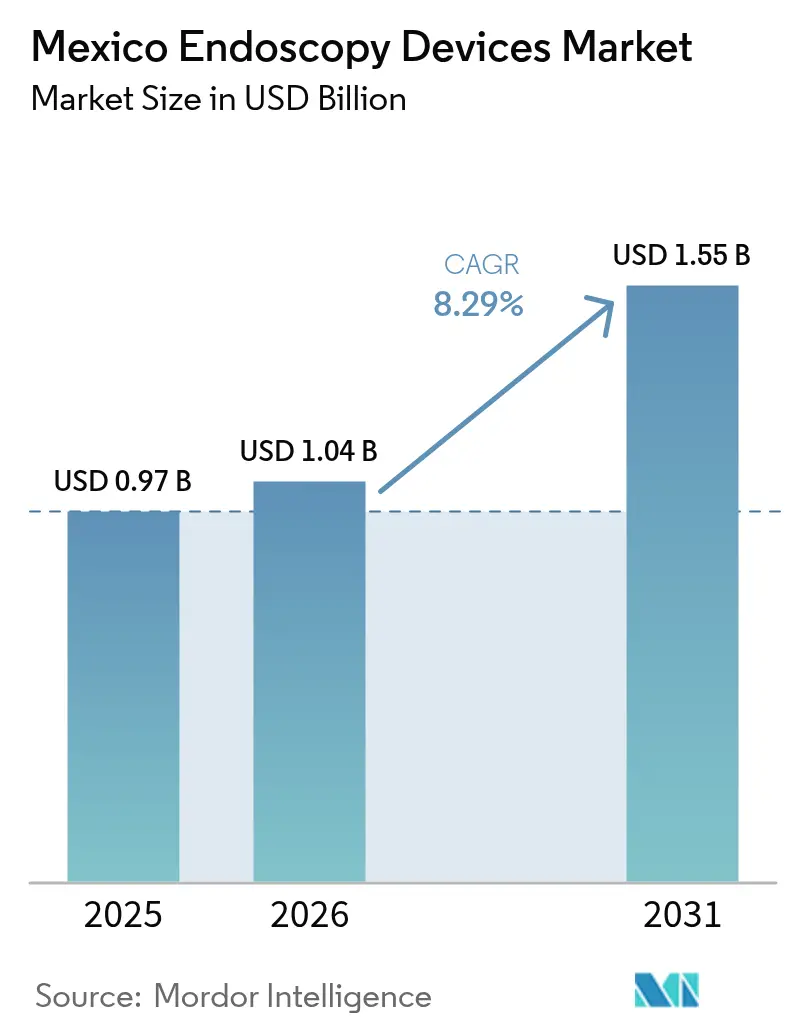
| Base Year Market Size (2025) | USD 0.97 Billion |
| Market Size (2026) | USD 1.04 Billion |
| Market Size (2031) | USD 1.55 Billion |
| Growth Rate (2026 - 2031) | 8.29 % |
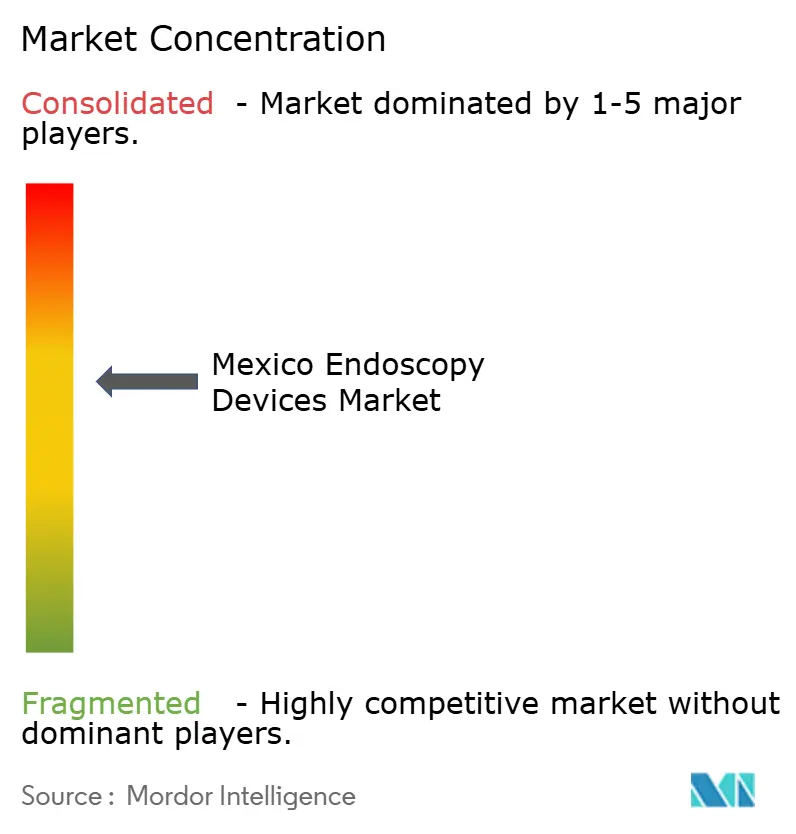
| Market Concentration | Medium |
Major Players *Disclaimer: Major Players sorted in no particular order Image © Mordor Intelligence. Reuse requires attribution under CC BY 4.0. | |
Mexico Endoscopy Devices Market Analysis by Mordor Intelligence
The Mexico Endoscopy Devices Market size is projected to be USD 0.97 billion in 2025, USD 1.04 billion in 2026, and reach USD 1.55 billion by 2031, growing at a CAGR of 8.29% from 2026 to 2031.
Strong private spending, which now accounts for about 55% of national health outlays, is reshaping procedure volumes as patients shift toward fee-for-service hospitals and ambulatory centers. Public purchasers are responding with an MX$4 billion program that will open 31 hospitals and upgrade 256 operating rooms by the end of 2026, adding procurement momentum on the institutional side. Demand is also boosted by fast-imaging upgrades as tertiary networks adopt 4K and artificial-intelligence visualization, while tightening infection-control rules create early pull for single-use platforms. Competitive pressure is intensifying as Medtronic, Olympus, KARL STORZ, Fujifilm, Johnson & Johnson MedTech, and Intuitive Surgical expand bundled offerings that pair visualization, energy devices, and software analytics. Finally, COFEPRIS’ abbreviated approval pathway, released in 2025, is shortening market-entry times for multinational products that already hold IMDRF or MDSAP credentials.
Key Report Takeaways
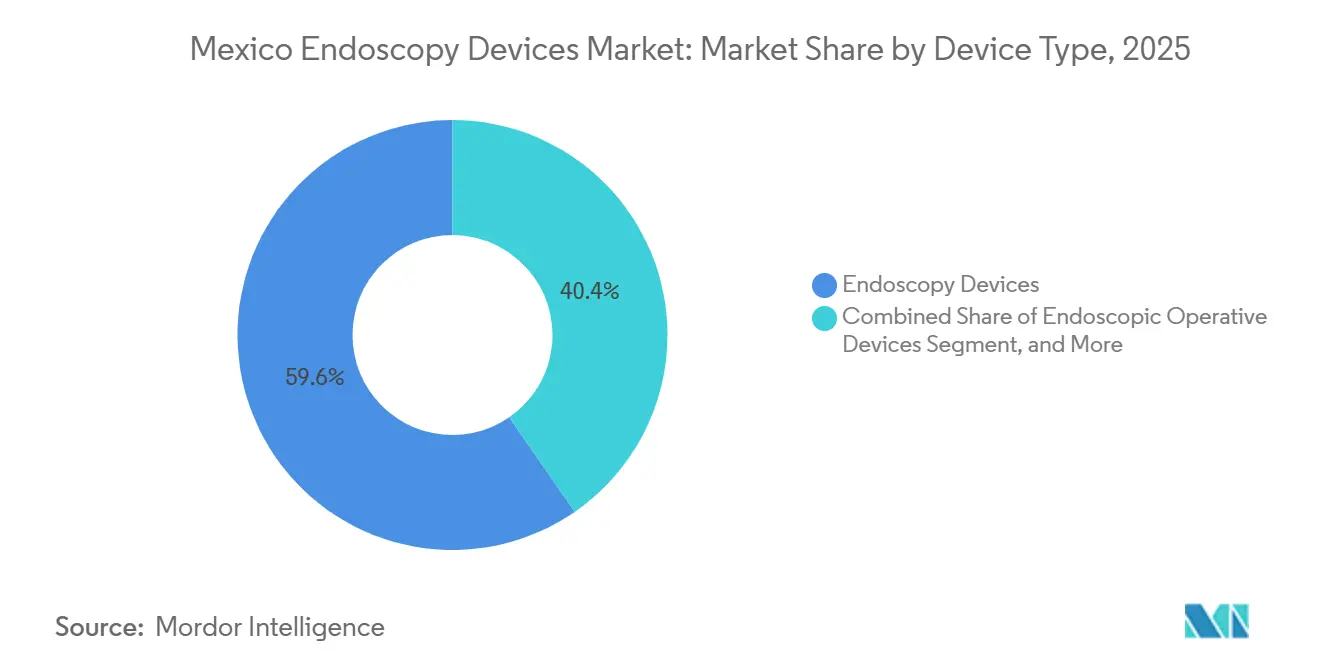
- By device type, endoscopes led with 59.62% of Mexico endoscopy devices market share in 2025, while endoscopic operative devices are forecast to post the highest 8.62% CAGR through 2031.
- By application, gastrointestinal endoscopy accounted for 42.03% of revenue in 2025; gynecology procedures are projected to grow at a 9.69% CAGR through 2031.
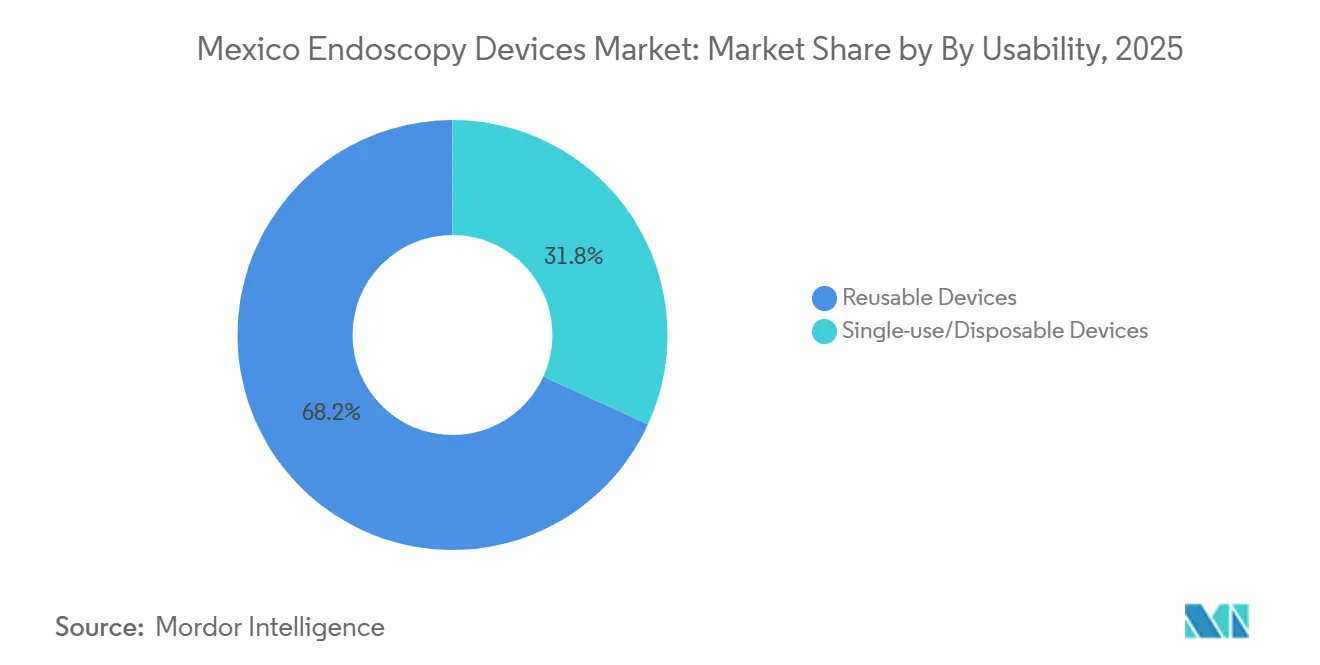
- By usability, reusable equipment dominated at 68.18% in 2025, yet single-use systems are expected to rise at a 9.01% CAGR over the same period.
- By end user, hospitals accounted for 68.18% in 2025, whereas specialty clinics are set to grow fastest at a 11.01% CAGR through 2031.
Note: Market size and forecast figures in this report are generated using Mordor Intelligence’s proprietary estimation framework, updated with the latest available data and insights as of 2026.
Mexico Endoscopy Devices Market Trends and Insights
Drivers Impact Analysis*
| Driver | (~) % Impact on CAGR Forecast | Geographic Relevance | Impact Timeline |
|---|---|---|---|
| Rising Prevalence of Gastrointestinal (GI) Disorders | +1.8% | National, with early gains in Mexico City, Guadalajara, Monterrey | Medium term (2-4 years) |
| Expansion of Private Hospitals & ASCs | +2.1% | Urban centers and border regions (Tijuana, Ciudad Juárez, Monterrey) | Short term (≤ 2 years) |
| Government-Backed Early Cancer-Screening Programs | +1.3% | National, pilot programs in select states | Long term (≥ 4 years) |
| Rapid HD/4K & AI-Enabled Imaging Upgrades | +1.6% | Tertiary hospitals in major metros, private hospital networks | Medium term (2-4 years) |
| Medical-Tourism Inflow to Border Cities | +1.2% | Tijuana, Ciudad Juárez, Monterrey, Cancun | Short term (≤ 2 years) |
| Growth In Gastroenterology Fellowship Seats | +0.9% | National, concentrated in teaching hospitals | Long term (≥ 4 years) |
| Source: Mordor Intelligence | |||
Rising Prevalence of Gastrointestinal Disorders
More than 16,000 new colorectal cancer cases were logged in 2025, and mortality continues to edge upward despite local pilot screening successes. Instituto Mexicano del Seguro Social data show that small bowel bleeding accounted for 65.2% of capsule procedures, with a diagnostic yield of 75.6%, underscoring the need for earlier detection technologies.[1]Secretaría de Salud, “Revisión Rápida de las Tecnologías de Tamizaje para el Cáncer Colorrectal en México,” gob.mxWhile technical performance is comparable to global benchmarks, fragmented procurement across IMSS, ISSSTE, and private payers delays the adoption of standardized solutions. The resulting backlog pushes hospitals to retrofit existing suites with flexible endoscopes capable of advanced imaging, reinforcing baseline demand for core platforms. Device manufacturers that can pair high-diagnostic-yield technologies with capital-light financing are best positioned to convert latent clinical need into installed base growth.
Expansion of Private Hospitals and Ambulatory Centers
Private operators have accelerated construction in major metros, supported by investor confidence in self-pay and insured demand. Large chains such as Star Médica standardized 20 OR1 integrated theaters in 2025, improving workflow and staff utilization while locking in service contracts with KARL STORZ. Smaller specialty clinics focus on high-volume colonoscopy and upper GI cases, capitalizing on shorter scheduling windows than public institutions. This facility mix upgrades visualization hardware cycles every three to four years, compared with five-plus years historically. High throughput also favors the adoption of energy devices and suction-irrigation tools, reinforcing cross-selling opportunities across the Mexican endoscopy devices market.
Government-Backed Early Cancer-Screening Programs
Pilot fecal immunochemical test projects delivered a 77.7% colonoscopy follow-through rate, but remain confined to a handful of states. Expansion to a national mandate would immediately scale procedure volumes and accelerate equipment turnover. Public tenders, however, still prioritize reusable fleets to minimize upfront cost. Vendors that align their proposals with value-based procurement metrics, such as reduced adverse-event rates or faster room turnover, may gain an edge as outcome-linked reimbursement pilots mature.
Rapid HD, 4K, and AI-Enabled Imaging Upgrades
Olympus rolled out its VISERA ELITE III 4K platform in 2025, offering backward compatibility that lowers the upgrade hurdle for hospitals already holding large, rigid, and flexible inventories.[2]Olympus Latin America, “Olympus Showcases Next-Generation EVIS X1 Endoscopy System,” olympusamerica.com Johnson & Johnson MedTech embedded real-time analytics into staplers and visualization towers, signaling a market shift toward connected operating rooms that feed data to quality dashboards. Hospitals view modular imaging as a hedge against rapid innovation cycles, further boosting replacement demand within the Mexico endoscopy devices market.
Restraints Impact Analysis*
| Restraint | (~) % Impact on CAGR Forecast | Geographic Relevance | Impact Timeline |
|---|---|---|---|
| High Capital Cost of Endoscopy Platforms | -1.4% | National, acute in public hospitals and rural facilities | Medium term (2-4 years) |
| Constrained Reimbursement for Outpatient Scopes | -0.9% | National, IMSS/ISSSTE service areas | Long term (≥ 4 years) |
| Shortage of Skilled Endoscopy Staff Outside Metros | -0.7% | Rural and secondary cities | Long term (≥ 4 years) |
| Import-Tariff Uptick on Selected Flexible Scopes | -0.6% | National, with supply-chain impacts on Mexicali manufacturing | Short term (≤ 2 years) |
| Source: Mordor Intelligence | |||
High Capital Cost of Endoscopy Platforms
Robotic systems such as da Vinci and Hugo require investments exceeding USD 1 million, a figure beyond the means of many secondary hospitals. Proposed 25% United States tariffs on Mexican-made instruments risk inflating accessory prices in 2026, which could delay purchasing decisions at both public and private facilities. Public infrastructure funds through 2026 favor bricks-and-mortar projects, leaving limited room for premium imaging in annual budgets. Financing models that bundle equipment, service, and training into multi-year operating leases may partially offset the spending bottleneck.
Constrained Reimbursement for Outpatient Scopes
Bulk-purchase frameworks run by Birmex fix procedure tariffs that barely cover staff and reprocessing costs, restraining hospitals from adopting higher-priced single-use consumables.[3]Organización Panamericana de la Salud, “Manual de Esterilización para Centros de Salud,” pediatria.gob.mx Delays of 12–18 months before new devices appear in the National Compendium further lengthen payback periods. Private insurers offer more flexibility, yet they insure a minority of the population. Until outcome-based payment scales nationally, margins for advanced consumables will stay tight outside large private networks.
*Our forecasts treat driver/restraint impacts as directional, not additive. The impact forecasts reflect baseline growth, mix effects, and variable interactions.
Segment Analysis
By Device Type: Endoscopes Sustain Core Volume, Operative Devices Outpace
Endoscopes generated 59.62% of Mexico endoscopy devices market revenue in 2025. Growth remains tethered to flexible platforms that cover gastrointestinal, pulmonology, and urology procedures. Robotic-assisted scopes, clustered in 27 tertiary hospitals, raise procedural precision but still command a premium. Visualization extensions that pair high-definition camera heads with existing scopes broaden the addressable budget without requiring full fleet replacement.
Endoscopic operative devices are forecast to expand at an 8.62% CAGR, the fastest growth rate in the market. Hospitals favor integrated bipolar sealers such as Olympus POWERSEAL that streamline instrument exchanges and reduce smoke generation. As procedure volume rises, suction-irrigation systems and wound protectors see parallel demand curves, cementing cross-category sales within the Mexico endoscopy devices market.


By Application: GI Holds Lead, Gynecology Scales Quickly
Gastrointestinal procedures represented 42.03% of the total market in 2025, anchored by colonoscopy volumes tied to rising colorectal cancer incidence. Capsule endoscopy remains niche but shows potential for expansion as reimbursement mechanisms evolve.
Gynecology is projected to grow at a 9.69% CAGR to 2031, supported by robotic hysterectomy programs in Guadalajara, Mexico City, and Monterrey. Medtronic’s Hugo RAS launch is expected to democratize access beyond the three metro clusters, lifting procedure counts and, by extension, the Mexico endoscopy devices market size for women’s health applications.
By Usability: Reusable Dominates, Single-Use Gains Momentum
Reusable equipment accounted for 68.18% of revenue in 2025, consistent with public-sector cost priorities. Nevertheless, single-use devices are set to rise at a 9.01% CAGR as updated disinfection guidelines highlight reprocessing gaps that pose infection risks. Hospital administrators increasingly weigh the full cycle cost of washers, tracking software, and staff time, opening a path for disposables in high-risk procedures within the Mexico endoscopy devices market.
By End-User: Hospitals Anchor Demand, Clinics Accelerate
Hospitals held a 68.18% share during 2025, buoyed by federal spending on new facilities and operating room upgrades. Integrated theater rollouts, exemplified by Star Médica’s deployment, favor turnkey vendor ecosystems.
Specialty clinics are projected to grow at 11.01% CAGR through 2031, reflecting urban migration trends and the appeal of shorter wait times. Their lean structures favor modular towers and single-use scopes, reducing reprocessing overhead and reinforcing downstream sales trajectories for suppliers active in the Mexican endoscopy devices market.
Geography Analysis
Concentration in Mexico City, Guadalajara, and Monterrey remains pronounced, with these metros housing every certified da Vinci proctor and most 4K visualization suites. Public and private tertiary hospitals in this corridor account for the bulk of robotic hysterectomies and complex GI work.
Border states such as Baja California and Chihuahua benefit from nearshoring of device manufacturing, including Intuitive Surgical’s Mexicali plant and Ambu’s gastroscope facility in Ciudad Juárez. Faster factory-to-facility supply lines shorten service intervals and can cushion tariff shocks on finished goods.
Secondary cities still lag due to workforce scarcity and tighter reimbursement. The national plan to open 31 new hospitals can shift the map if equipment budgets follow construction timelines. Vendor-led virtual training from Johnson & Johnson and Olympus aims to narrow skill gaps, a prerequisite for balanced regional growth across the Mexico endoscopy devices market.
Regulatory Landscape
Endoscopy devices in Mexico are regulated as medical devices by COFEPRIS under the Secretaría de Salud framework (Ley General de Salud and the Reglamento de Insumos para la Salud), with sanitary registration and post-market surveillance obligations that apply to both imported systems and locally manufactured scopes and accessories. In 2025, COFEPRIS formalized an Abbreviated Regulatory Pathway that recognizes prior authorizations from selected international reference authorities and related reliance mechanisms, shortening administrative cycles for multinational endoscopy platforms already cleared in those markets.
Compliance requirements relevant to endoscopy OEMs and distributors include NOM-241-SSA1-2021 for quality management and manufacturing controls, NOM-240-SSA1-2012 for tecnovigilance reporting, and labeling provisions such as NOM-137-SSA1-2008. In June 2026, COFEPRIS consolidated expectations through a requirements guide for sanitary registration that compiles criteria for equivalence agreements and the abbreviated pathway, raising the importance of dossier completeness, harmonized technical documentation, and consistent labeling across reusable and single-use endoscopy system configurations.
Competitive Landscape
Olympus, KARL STORZ, Fujifilm, Medtronic, Intuitive Surgical, and Johnson & Johnson command the high-value tiers through ecosystem offers that combine imaging, energy, and data analytics. KARL STORZ’s OR1 integration across Star Médica underscores the stickiness of bundled deals, while Olympus secures back-end revenue with single-use energy disposables matched to its 4K towers.
Medtronic positions Hugo RAS as a lower-cost robotic alternative, courting ISSSTE and IMSS which seek to scale minimally invasive surgery without overextending capital budgets. Intuitive Surgical faces tariff exposure on Mexicali-produced accessories, although its entrenched installed base provides short-term insulation.
White-space opportunities lie in single-use scopes and capsule systems where adoption is still low. Ambu leverages domestic manufacturing to sidestep potential tariff costs, and Pentax Medical builds share through training partnerships in public institutes. Competitive depth therefore widens, but high service requirements keep the Mexico endoscopy devices market moderately consolidated.
Mexico Endoscopy Devices Industry Leaders
Olympus Corporation
Boston Scientific Corporation
Fujifilm Holdings
Karl Storz SE & Co. KG
Medtronic
- *Disclaimer: Major Players sorted in no particular order

Market Opportunities and Future Outlook
COFEPRIS procedural modernization supports a near-term execution opportunity for manufacturers and local distributors that can align technical files, labeling, and quality documentation to reliance-based submissions, especially after the June 2026 requirements guide consolidated equivalence and abbreviated-pathway expectations. Faster registration throughput can expand the addressable pipeline for 4K visualization, operative energy devices, and single-use scope platforms, particularly where hospital groups want standardization across sites and shorter refresh cycles without extending internal evaluation timelines.
Procurement whitespace is also linked to facility expansion and operating room upgrades already underway, including the public MX$4 billion program to open 31 hospitals and upgrade 256 operating rooms by end-2026, alongside continued private network integration investments (for example, OR integration standardization programs within large chains). Infection-control enforcement and the practical burden of reprocessing in high-throughput settings support a clearer commercial path for single-use systems and tracking-enabled workflows, while vendor strategies that bundle visualization towers, energy devices (such as advanced bipolar sealers), service, and training match how private hospitals and ambulatory centers purchase and deploy endoscopy suites in Mexico.
Recent Industry Developments
- May 2026: Olympus Corporation signed an exclusive global distribution agreement with EndoRobotics Co., Ltd. to add robot-assisted technologies into its EndoTherapy portfolio. The agreement expands Olympus coverage across therapeutic endoscopy and adjacent minimally invasive workflows, reinforcing platform-based selling that can influence tower, instrument, and service pull-through in Mexico.
- April 2025: Olympus Latin America announced the launch of the POWERSEAL Sealer/Divider family in Mexico. Adding advanced bipolar energy into the local portfolio supports cross-selling into integrated operating rooms where endoscopy visualization and operative devices are increasingly purchased together.
- March 2024: Olympus Latin America announced the launch of the VISERA ELITE III endoscopic visualization platform in Mexico. The rollout supports an upgrade cycle toward 4K visualization and provides an installed-base pathway for hospitals standardizing imaging performance across multiple endoscopy rooms.


Research Methodology Framework and Report Scope
Market Definition and Coverage
This market tracks the value of endoscopy device systems sold into Mexico for diagnostic and minimally invasive therapeutic procedures across major clinical settings, counted in current USD and aligned to actual procurement and replacement behavior.
Scope exclusions: refurbished endoscopes, open-surgery cameras, stand-alone imaging carts not bundled with an endoscope, and disposable accessories sold separately from a complete endoscopic system are excluded.
Segmentation Overview
- By Device Type
- Endoscopes
- Rigid Endoscopes
- Flexible Endoscopes
- Capsule Endoscopes
- Robotic-assisted Endoscopes
- Endoscopic Operative Devices
- Irrigation / Suction Systems
- Access Devices
- Wound Protectors
- Other Endoscopic Operative Devices
- Visualization Equipment
- Endoscopes
- By Application
- Gastrointestinal Endoscopy
- Laparoscopy
- Pulmonology / Bronchoscopy
- ENT / Otolaryngology
- Urology
- Gynecology
- Cardiology
- Other Applications
- By Usability
- Reusable Devices
- Single-use / Disposable Devices
- By End-User
- Hospitals
- Ambulatory Surgical Centers
- Specialty Clinics
Data Sources, Market Sizing, and Validation
Desk Research
We start by mapping the care delivery and procurement environment in Mexico so the model is grounded in what is actually bought and used. Common starting points include public health statistics and procedure trend references from sources such as Mexico's health ministry publications, OECD health indicators, the World Bank, and peer-reviewed gastroenterology and surgery journals.
To translate demand signals into a spend view, we also review import and customs trade series, medical device registration or safety notices from regulators, and trade association updates where relevant. Company annual reports, investor presentations, and reputable press releases help us cross-check product mix shifts like flexible versus rigid scopes and the move toward single-use use cases. For sanity checks on pricing bands and shipment momentum, we selectively refer to paid subscriptions that provide company financials and intelligence, import and export shipment-level details, and patent activity patterns. These desk research sources are illustrative, and other public references are used to collect, validate, and clarify the data.
Primary Interviews and Surveys
Next, we validate assumptions through expert calls and surveys with hospital procurement staff, clinicians who routinely use endoscopy, distributors, and service partners active in Mexico. Discussions focus on demand by procedure setting, replacement cycles, typical bundling of towers and visualization, and how prices change across tender cycles and warranty terms. Any gaps from desk research are corrected before we finalize the model.
Distribution of primary research fieldwork respondents
| Company type | Respondent position |
|---|---|
| Top tier: 30% | CXOs: 16% |
| Mid tier: 53% | Functional/Unit leaders: 37% |
| Smaller Players: 17% | Managers: 47% |
Market-Sizing & Forecasting
Sizing is built using a top-down reconstruction of the Mexico demand pool, where procedure volumes and care setting capacity are translated into likely device utilization and then into spending. Inputs tracked include endoscopy procedure mix across GI, urology, gynecology, and arthroscopy, installed base aging and replacement cadence, tender timing in public systems, the share of flexible versus rigid platforms, and the degree of tower and visualization bundling in typical purchases.
Once the macro view is established, we cross-check it with selective bottom-up approximations such as sampled average selling price bands multiplied by expected unit demand, distributor channel checks, and a limited supplier roll-up for major device categories. When a data gap appears, such as limited visibility on bundled versus unbundled pricing in smaller facilities, we apply conservative ranges anchored in interview feedback, then normalize those ranges to match observable trade and procurement signals.
For forecasting, we use scenario analysis tied to variables decision-makers in the market can recognize, including procedure growth, public and private capex trends, replacement cycles, and pricing progression under inflation and currency movements. The final forecast path is set only after primary experts confirm whether the assumed penetration and replacement steps feel realistic for Mexico over the forecast period.
Data Validation & Update Cycle
Outputs are checked against independent signals, such as import trends, major tender announcements, and visible changes in procedure demand, so totals do not drift away from real-world activity. Variances are investigated at the category level, then a second analyst review is completed to confirm assumptions and arithmetic before sign-off.
Reports are refreshed annually, and interim updates are made when material events occur, such as policy shifts, sharp currency changes, or major supply interruptions. Before delivery, we do a final data pass so the client receives the most current view available at that time.
Mordor Intelligence's Mexico Endoscopy Devices Market Estimate Compared With Other Published Estimates
Different publishers often report different Mexico market sizes because they count different product baskets and anchor their models to different demand signals and price timing. In practice, the spread usually comes from what is treated as a full endoscopy system versus adjacent equipment, and how strongly procedure growth is allowed to translate into device revenue.
Disposable accessories sold separately from a complete endoscopic system sit outside Mordor Intelligence's scope, which can pull the total lower versus sources that include recurring consumables alongside capital equipment. Another common gap is how imaging is counted, since some estimates fold in stand-alone carts and open-surgery camera revenue, and pricing assumptions can also differ when FX conversion timing and tender-driven discounts are not validated through local interviews.
Benchmark comparison
| Source | Market Size | Gaps in Research Methodology |
|---|---|---|
| Mordor Intelligence | USD 0.97 B (2025) | |
| Industry Publisher A | USD 0.75 B (2024) | Uses an earlier base year and a broader type list that can blend visualization components and operative devices without consistently separating bundled system sales from accessory-heavy revenue, which shifts the counted value. |
| Regional Research Desk B | USD 0.75 B (2022) | Anchors the model to an older demand baseline and provides limited clarity on whether refurbished units and unbundled imaging carts are excluded, which can move totals and growth comparisons across years. |
Viewed together, the table shows that year choice and what gets counted as system revenue versus adjacent categories explain most of the difference. By tying spending to procedure-linked utilization, observed procurement behavior, and clearly stated exclusions, the resulting estimate stays traceable to inputs that can be rechecked and repeated.


Key Questions Answered in the Report
How large is the Mexico endoscopy devices market in 2026?
It is valued at USD 1.04 billion and is on track to reach USD 1.55 billion by 2031.
What is the expected CAGR for Mexico endoscopy devices through 2031?
The market is projected to grow at 8.29% between 2026 and 2031.
Which device category is expanding fastest?
Endoscopic operative devices are forecast to grow the fastest, at an 8.62% CAGR.
Why is single-use adoption increasing in Mexico?
Updated infection-control guidelines and rising reprocessing costs are driving hospitals toward disposable options.
Which region has the highest concentration of advanced platforms?
Mexico City, Guadalajara, and Monterrey host most robotic systems and 4K visualization suites.
Page last updated on:


 Your data is secure and never sold or shared.


