
Methylene Diphenyl Di-isocyanate (MDI) Market Size and Share
Market Overview
| Study Period | 2021 - 2031 |
|---|---|
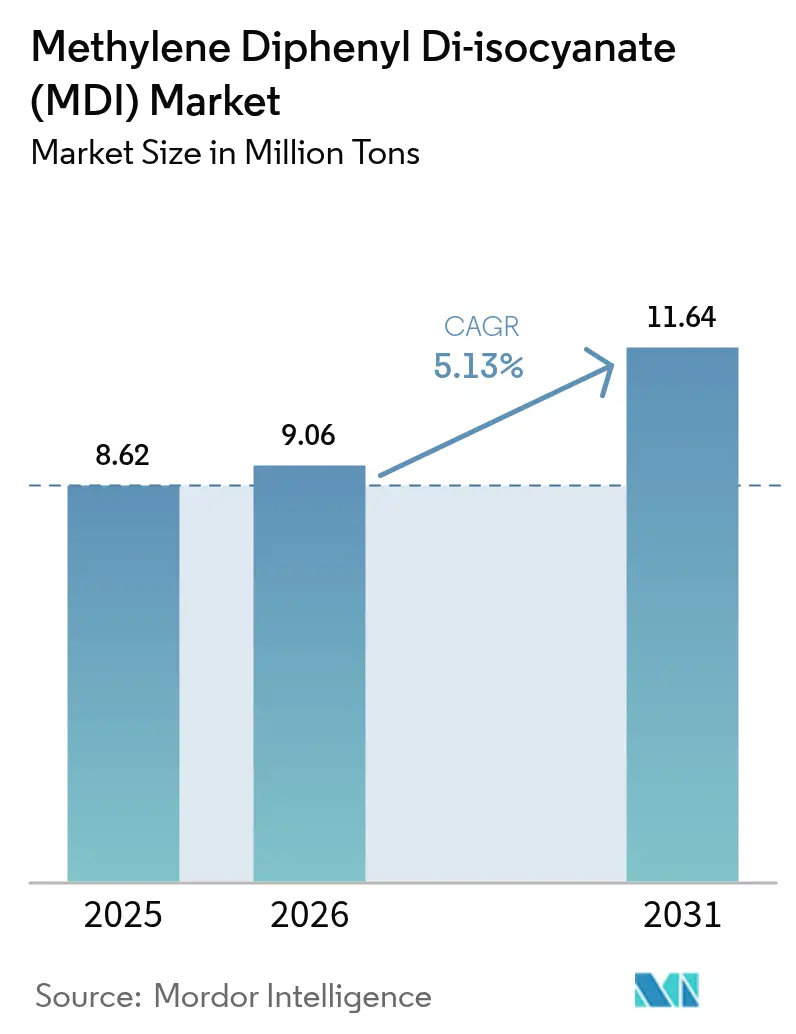
| Market Volume (2026) | 9.06 Million tons |
| Market Volume (2031) | 11.64 Million tons |
| Growth Rate (2026 - 2031) | 5.13 % |
| Fastest Growing Market | Asia Pacific |
| Largest Market | Asia Pacific |
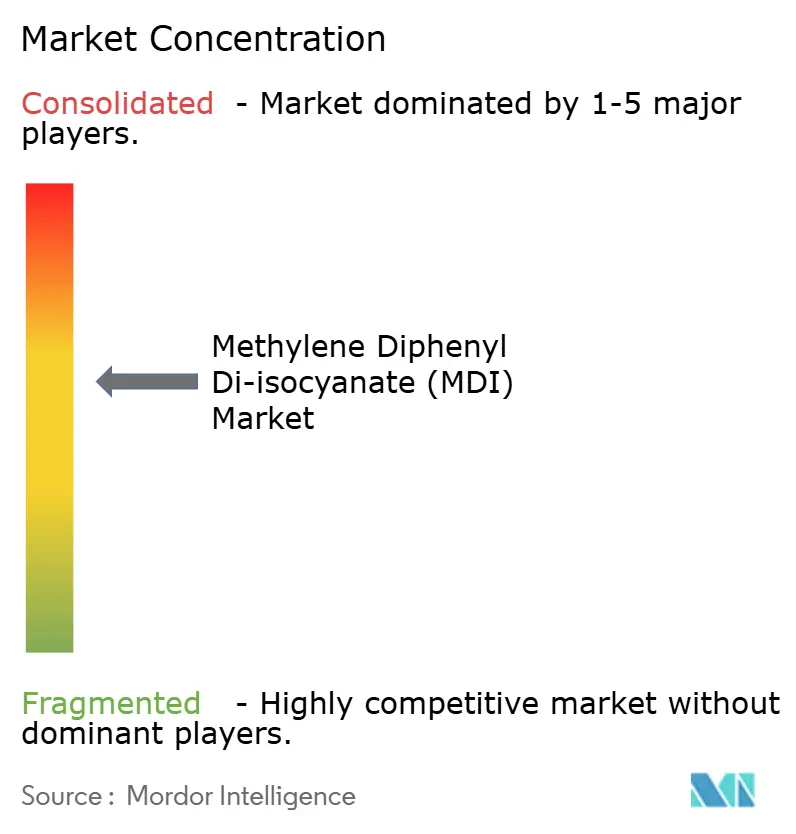
| Market Concentration | Medium |
Major Players *Disclaimer: Major Players sorted in no particular order Image © Mordor Intelligence. Reuse requires attribution under CC BY 4.0. | |
Methylene Diphenyl Di-isocyanate (MDI) Market Analysis by Mordor Intelligence
The Methylene Diphenyl Di-isocyanate Market size is expected to grow from 8.62 million tons in 2025 to 9.06 million tons in 2026 and is forecast to reach 11.64 million tons by 2031 at a 5.13% CAGR over 2026-2031. Code-driven insulation upgrades, the build-out of pharmaceutical and food cold-chain logistics, and rising electric-vehicle (EV) battery safety requirements are creating a steady pull on demand. Continuous polyisocyanurate (polyiso) boards now dominate commercial roofing because they hit mandatory R-values without adding structural weight, while spray-foam retrofits seal air leaks that account for a significant portion of residential heating losses. Appliance makers have switched to low-GWP hydrocarbon blowing agents, a move that favors polymeric MDI systems able to preserve closed-cell integrity at thinner thicknesses. In parallel, automotive platforms are embedding flame-retardant MDI foams between lithium-ion cells to delay thermal runaway, creating an emerging yet fast-scaling niche. Tight labor markets and stricter worker-exposure limits are nudging fabricators toward low-free-monomer grades that simplify compliance and cut insurance premiums.
Key Report Takeaways
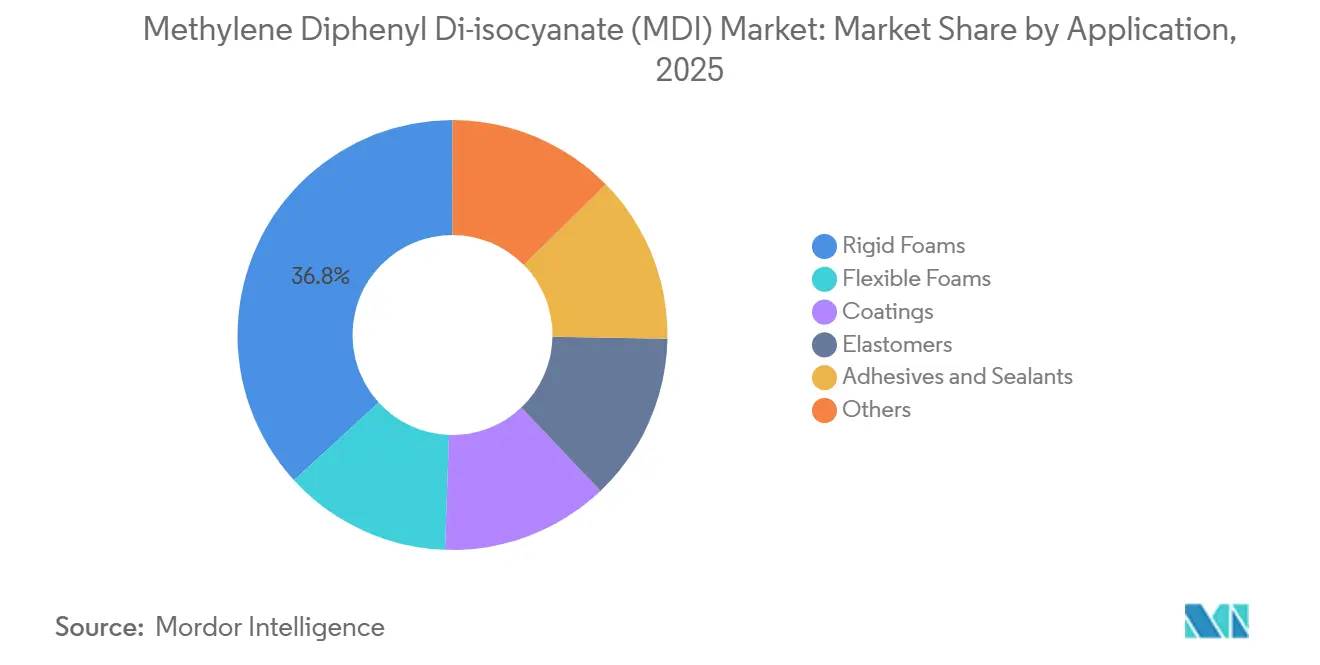
- By application, rigid foams held a 36.81% share of the MDI market in 2025 and are advancing at a 5.69% CAGR through 2031.
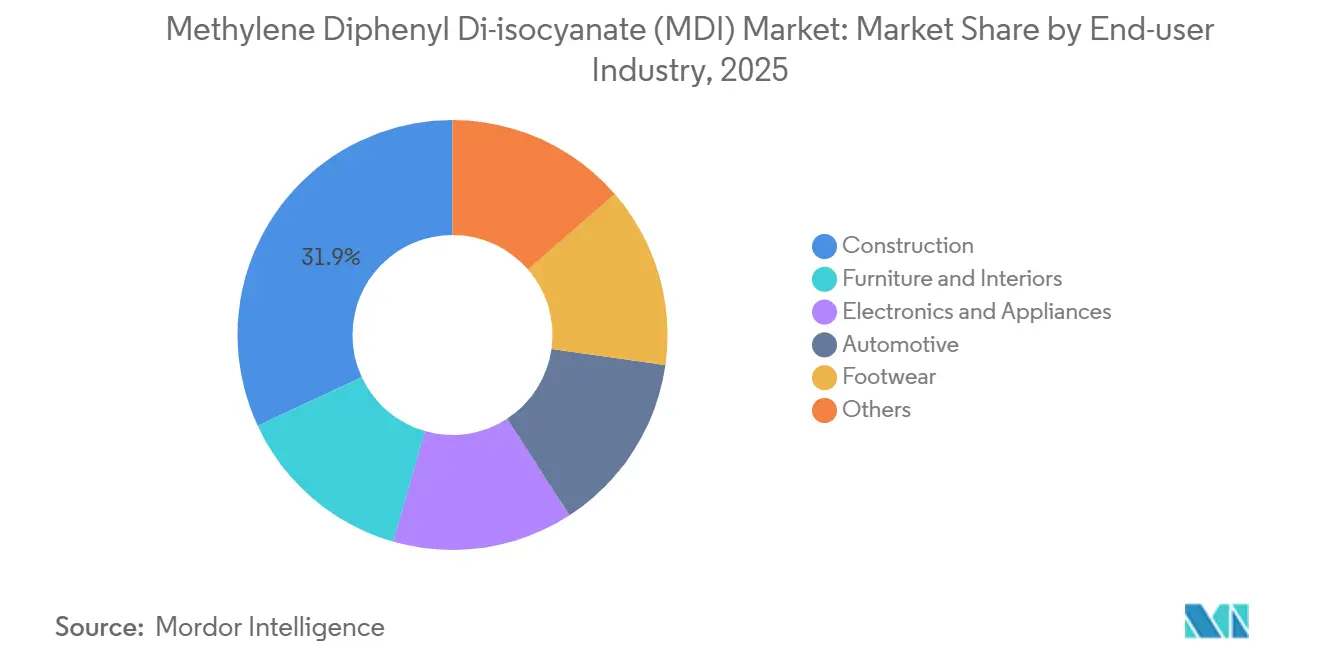
- By end-user, construction commanded 31.94% of the MDI market size in 2025, while the same segment is projected to expand at a 5.31% CAGR to 2031.
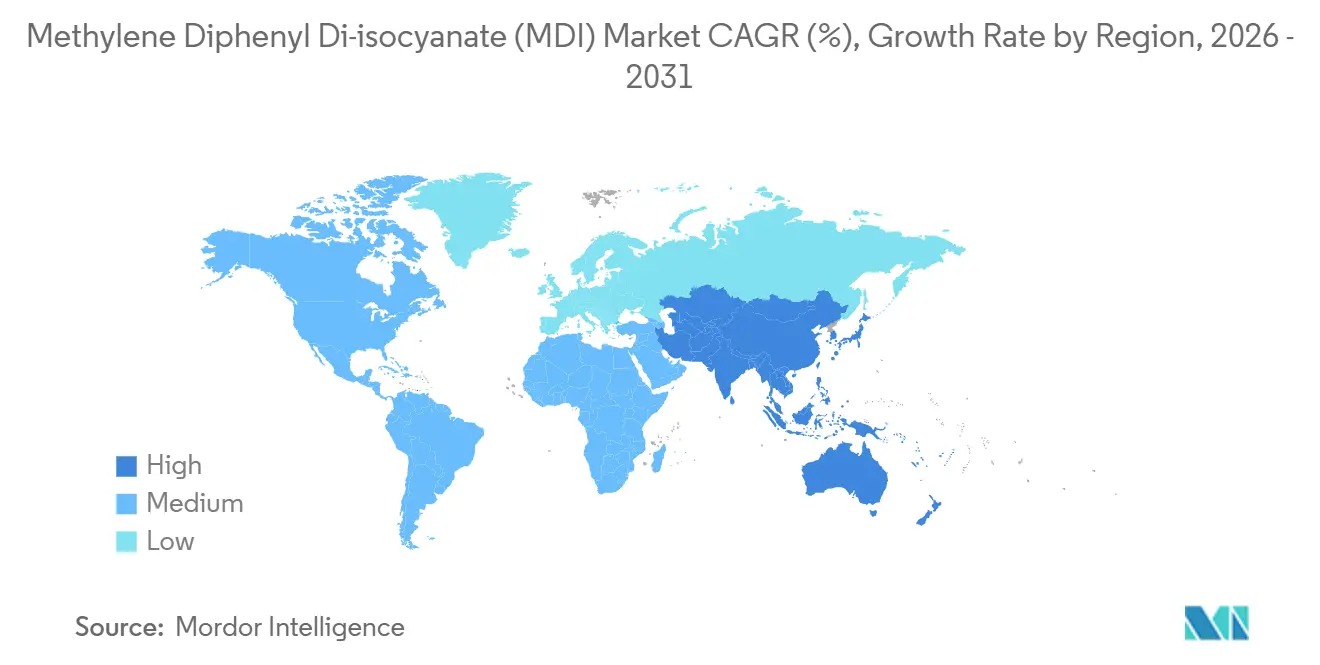
- By geography, Asia-Pacific captured 46.77% of the MDI market share in 2025 and is on track for the fastest 5.97% CAGR during 2026-2031.
Note: Market size and forecast figures in this report are generated using Mordor Intelligence’s proprietary estimation framework, updated with the latest available data and insights as of 2026.
Market Trends and Insights
Drivers Impact Analysis of Methylene Diphenyl Di-isocyanate (MDI) Market*
| Drivers | (~) % Impact on CAGR Forecast | Geographic Relevance | Impact Timeline |
|---|---|---|---|
| Surge in polyurethane-insulation demand from net-zero buildings | +1.2% | Europe, North America, APAC urban clusters | Medium term (2-4 years) |
| Cold-chain capacity build-out for food and pharma | +0.9% | Global, with concentration in APAC and North America | Long term (≥ 4 years) |
| HVAC efficiency regulations boosting appliance foams | +0.7% | North America, EU, Japan, South Korea | Short term (≤ 2 years) |
| Rise of battery-thermal-management foams in EV packs | +0.6% | APAC (China, South Korea), Europe, North America | Medium term (2-4 years) |
| Mass-balanced / ISCC-Plus certified MDI gaining traction | +0.5% | Europe, North America | Long term (≥ 4 years) |
| Source: Mordor Intelligence | |||
Surge in Polyurethane-Insulation Demand From Net-Zero Buildings
Across Europe, the U.S., and parts of Asia, energy codes mandate wall R-values between 20 and 30. This benchmark is achieved using polyiso boards, as opposed to opting for thicker mineral wool. The EU Energy Performance of Buildings Directive is set to drive upgrades in millions of homes. This initiative is projected to boost the consumption of rigid foam in the coming years. Starting January 2026, California’s Title 24 update will elevate roof R-values statewide, solidifying the demand for Class A fire-rated polyiso boards. Passive House certifications in Germany and Austria saw a significant increase, underscoring a homeowner trend towards continuous insulation, which curtails heating loads annually.
Cold-Chain Capacity Build-Out for Food and Pharma
Biologic drugs and mRNA vaccines mandate storage temperatures between 2 °C and 8 °C, frequently dipping below –70 °C during transit. Cencora pledged an investment to quintuple its refrigerated space in Alabama, employing spray-applied MDI foam to ensure temperature stability[1]. Global refrigerated-warehouse volume is projected to increase, with rigid MDI boards continuing as the preferred insulation choice.
HVAC Efficiency Regulations Boosting Appliance Foams
Starting in 2027, U.S. standards will limit refrigerator energy use to below a certain threshold annually. This pushes brands to either enhance cabinet insulation or switch to lower-lambda foams. Meanwhile, Europe's F-gas regulation is steering the industry towards cyclopentane blowing agents, which align seamlessly with the cell-stabilizing chemistry of polymeric MDI. Similarly, Japan's updated Top Runner benchmarks and South Korea's more stringent energy labels are both leaning towards advanced MDI foam cores in their premium models.
Rise of Battery-Thermal-Management Foams in EV Packs
In 2024, tests revealed that an MDI foam layer can delay thermal propagation between cells, providing occupants with crucial extra time to exit. A two-component system launched in 2025 achieves a glass-transition temperature, aligning with forthcoming Chinese regulations that mandate fire-retardant separators in packs exceeding a specific capacity. Additionally, automakers are integrating these foams into seat frames, resulting in a reduction in cabin noise.
Restraints Impact Analysis of Methylene Diphenyl Di-isocyanate (MDI) Market*
| Restraints | (~) % Impact on CAGR Forecast | Geographic Relevance | Impact Timeline |
|---|---|---|---|
| Stricter worker-exposure limits for di-isocyanates | -0.8% | Europe, North America, Japan | Short term (≤ 2 years) |
| Crude-oil volatility hitting aniline feedstock | -0.6% | Global | Short term (≤ 2 years) |
| Emerging non-isocyanate PU chemistries | -0.4% | Europe, North America | Long term (≥ 4 years) |
| Source: Mordor Intelligence | |||
Stricter Worker-Exposure Limits for Di-Isocyanates
aREACH Annex XVII has introduced a mandate: users processing more than 0.1% di-isocyanate by weight must undergo certified training every five years. This requirement has led to an increase in site compliance costs and has also necessitated upgrades to ventilation systems[2]. In 2024, the United Kingdom set similar airborne limits, and Japan is in the process of finalizing comparable regulations, targeting a 2027 implementation. While larger converters are able to absorb these added costs, smaller operations are feeling the pinch on their margins, leading to a trend of consolidation in the industry.
Crude-Oil Volatility Hitting Aniline Feedstock
Benzene, accounting for a significant portion of aniline's production costs, closely follows Brent crude prices. Specifically, an increase in oil prices results in a notable uptick in aniline prices within a three-month window. In 2025, spot aniline prices fluctuated, squeezing margins for producers lacking in-house aromatic resources. However, Wanhua's integration of coal-to-aniline provides a buffer against such cost pressures.
*Our forecasts treat driver/restraint impacts as directional, not additive. The impact forecasts reflect baseline growth, mix effects, and variable interactions.
Methylene Diphenyl Di-isocyanate (MDI) Market Segment Analysis
By Application:
Rigid Foams Dominate Insulation MandatesRigid foams captured 36.81% of the methylene diphenyl di-isocyanate market share in 2025 and will rise at a 5.69% CAGR through 2031. Continuous-panel insulation achieves R-20 wall targets with a thinner profile compared to extruded polystyrene, steering architects towards polyiso boards. Spray-foam retrofits gained significant traction due to increased funding support. Additionally, as appliance foams transition to hydrocarbon blowing agents, there's an increased preference for polymeric MDI’s closed-cell density.
Among the rigid-foam options, spray-foam insulation emerged as the fastest-growing choice, with contractors prioritizing its air-sealing and vapor-barrier benefits. Rigid MDI boards are also the go-to for commercial baking ovens, refrigerated trailers, and walk-in coolers aiming to maintain sub-zero temperatures. While elastomers and coatings cater to niche markets, they remain steady, being utilized in high-abrasion rollers and chemically resistant floor finishes. Furthermore, adhesives derived from MDI prepolymers are bonding turbine blades and automotive composites, capitalizing on their high shear strength during thermal cycling.

By End-User Industry:
Construction Fuels the Volume UpswingConstruction accounted for 31.94% of the methylene diphenyl di-isocyanate market size in 2025 and is on track for a 5.31% CAGR to 2031. Europe's push for zero-emission new builds by 2030, coupled with its goal for class-D retrofits, is fueling a surge in deep-energy renovations that emphasize the need for continuous insulation. In India, a mandate for insulation in high cooling-degree zones is set to boost the demand for rigid foam significantly by 2028.
As North American and European markets reach maturity, the furniture and interiors sector witnesses steady growth. In contrast, Southeast Asia is ramping up its capacity annually, primarily to cater to the export of sofas and mattresses. Electronics and appliance manufacturers are increasingly opting for thicker foams to comply with energy labels. Meanwhile, the automotive sector is broadening its horizons, venturing into battery-thermal foams. In the footwear industry, MDI-based thermoplastic polyurethane midsoles are becoming the go-to choice for endurance running shoes, with Adidas now incorporating bio-polyols in a portion of its production.
Geography Analysis
APAC Methylene Diphenyl Di-isocyanate (MDI) Market
Asia-Pacific held 46.77% of the global methylene diphenyl di-isocyanate market volume in 2025 and is set for a 5.97% CAGR through 2031. China's ambitious addition of urban housing annually, paired with Wanhua's expansive complex, solidifies the region's supply foundation. In India, a push for insulation codes and enhanced cold-storage facilities is driving volume expansion. Meanwhile, Vietnam and Indonesia are becoming hubs for relocated furniture and footwear industries. Japan and South Korea are prioritizing appliance insulation upgrades, driven by initiatives like Top Runner and energy labeling.
North America Methylene Diphenyl Di-isocyanate (MDI) Market
North America, holding a significant share in demand, sees rising consumption buoyed by weatherization retrofits and a transition to cyclopentane-blown refrigerator foams, even with a mature housing stock. In Canada, revised codes are spurring a surge in spray-foam adoption, especially in provinces experiencing more than 5,000 heating degree-days.
EMEA and South America Methylene Diphenyl Di-isocyanate (MDI) Market
Europe, accounting for a notable portion of the global volume, grapples with high energy costs impacting local producers. However, stringent building directives pave a clear retrofit pathway extending through 2033. The remaining market is split between South America and the Middle-East and Africa. Brazil is poised for a rebound with easing interest rates, while Saudi Arabia's Sadara is strategically exporting competitively priced cargoes from Jubail to Europe and Asia.
Regulatory Landscape
Regulation is tightening around worker exposure and product stewardship for diisocyanates, which affects how MDI is handled, trained on, and documented. In the European Union, the REACH Annex XVII restriction for diisocyanates has been in force since August 2023, requiring mandatory training for industrial and professional users processing products containing more than 0.1% diisocyanates by weight. This has supported a shift toward lower-free-monomer systems and tighter shop-floor controls. MDI is also addressed under EU REACH/CLP hazard frameworks, including inhalation and respiratory irritation statements, which drives downstream labeling, SDS updates, and safe-use communications across foams, coatings, and adhesives.
Trade and reporting rules continue to shape regional compliance spend and supply choices. In the United States, MDI remains subject to EPA Toxics Release Inventory (TRI) reporting obligations, raising the importance of emissions tracking and recordkeeping for producers and large users. On trade defense, the United States concluded the antidumping investigation of MDI from China in 2026, with the U.S. Department of Commerce issuing a final affirmative determination in April 2026 and the U.S. International Trade Commission issuing its final injury determination in May 2026. This increased barriers for Chinese-origin imports and changed procurement strategies for U.S. formulators and distributors.
Value Chain Analysis
The MDI value chain begins with aromatic feedstocks and intermediates, then proceeds into highly integrated, capital-intensive manufacturing. Key inputs include aniline and formaldehyde to make methylenedianiline (MDA), followed by phosgenation to produce crude MDI, then purification and blending into polymeric MDI, monomeric grades, and prepolymers. Because phosgenation requires tightly controlled chlorine and carbon monoxide handling and specialized asset design, production tends to cluster at integrated chemical complexes, and proprietary process know-how limits entry.
Downstream, MDI is sold to polyurethane system houses, formulators, and large converters supporting rigid and flexible foams, coatings, elastomers, and adhesives for construction, appliances, automotive, and industrial uses. Distribution splits between direct contract supply to major OEMs and insulation producers, and regional distribution for smaller converters, with logistics and storage governed by hazardous-material requirements. The chain is dominated by large global producers, including Wanhua, BASF, Covestro, Huntsman, and Kumho Mitsui Chemicals. Recent footprint moves such as Kumho Mitsui Chemicals' planned Yeosu, South Korea expansion (announced December 2025) underline how scale, integration, and proximity to end-use manufacturing hubs support cost and service competitiveness.
Competitive Landscape
The methylene diphenyl di-isocyanate (MDI) market is moderately consolidated. Wanhua’s coal-to-aniline chain underscores cost leadership; BASF and Covestro monetize process know-how through technology licensing in China and India. Huntsman and Dow focus on low-free-monomer prepolymers to meet airborne exposure caps. Venture-funded NIPU start-ups remain in the pilot phase but are closely watched by OEMs hedging regulatory risk.
Methylene Diphenyl Di-isocyanate (MDI) Industry Leaders
-
Wanhua
-
Covestro AG
-
BASF
-
Huntsman International LLC
-
Dow
- *Disclaimer: Major Players sorted in no particular order
Methylene Diphenyl Di-isocyanate (MDI) Market Companies Covered in this Report
- BASF
- Covestro AG
- Dow
- Hexion Inc.
- Huntsman International LLC
- Karoon Petrochemical Company
- Kumho Mitsui Chemicals Inc
- KURMY CORPORATIONS
- Sadara
- Shanghai Lianheng Isocyanate Co. Ltd
- Sumitomo Chemical Co. Ltd
- Tosoh Corporation
- Vardhman Chemicals
- Wanhua
Market Opportunities and Future Outlook
Opportunities are emerging where policy-driven insulation upgrades, cold-chain expansion, and battery safety requirements overlap with tighter handling rules for diisocyanates. On the demand side, code-driven roofing and building-envelope upgrades, including California's Title 24 roof R-value changes starting January 2026, support higher-throughput rigid-foam systems and continuous insulation formats. Refrigerated logistics for food and biologics also favors spray-applied MDI foams and rigid panels that maintain thermal performance at low temperatures.
At the same time, REACH training obligations for diisocyanates in Europe, which has been in force since August 2023, push converters toward lower-free-monomer grades and more standardized, auditable application processes. This creates space for suppliers that pair compliant formulations with training and documentation support. On the supply and product roadmap, capacity and decarbonization programs are opening new sourcing and qualification pathways for downstream users. BASF signed a cooperation agreement in November 2025 with Air Liquide and Shenergy in Shanghai to produce bio-based MDI using biomethane-derived industrial gases with ISCC PLUS certification, aligning mass-balance offerings with customer sustainability specifications across construction and appliances. In June 2026, Covestro announced a strategic MDI investment program that includes a new 660,000 tonnes per year plant at its integrated Shanghai site, and a feasibility study for a similarly sized MDI project in Al Ruwais Industrial City, United Arab Emirates with TA ZIZ and Fertiglobe, expanding regional options for large-volume buyers. In North Asia, Kumho Mitsui Chemicals announced in December 2025 a 100,000 tonnes per year capacity increase at Yeosu, South Korea, supporting shorter lead times for automotive and insulation chains connected to Korea and nearby export manufacturing hubs.
Recent Industry Developments in Methylene Diphenyl Di-isocyanate (MDI) Market
- June 2026: Covestro announced a strategic investment program for MDI, including plans for a new world-scale MDI plant at its integrated Shanghai site and a feasibility study for an MDI project in the UAE. The moves broaden Covestro's manufacturing optionality across Asia and the Middle East and raise the bar on scale for competitors serving construction, appliance, and industrial foam value chains.
- March 2026: BASF increased prices for its Lupranate MDI and TDI products by USD 500 per metric ton in East Asia (excluding Chinese mainland). The adjustment signals continued sensitivity of polyurethane raw material economics to energy, logistics, and regional supply-demand balance, influencing contract negotiations for foam producers and system houses.
- August 2024: BASF and STOCKMEIER Urethanes USA, Inc. commenced commercial production of polyurethane binders for recreational surfacing using 100% domestically produced Biomass Balance (BMB) Lupranate MDI at BASF's Geismar, Louisiana site. This expands availability of mass-balance MDI-based solutions for infrastructure and construction-adjacent applications that require documented sustainability attributes.
Methylene Diphenyl Di-isocyanate (MDI) Market Report Scope and Research Methodology
Market Definition and Coverage
This market covers the global consumption of methylene diphenyl diisocyanate (MDI) measured in tons, across the major uses where MDI is reacted into polyurethane and related materials that then enter industrial and consumer end products.
Scope exclusions: This sizing excludes downstream polyurethane finished goods value, distributor markups, and non-MDI isocyanates unless they are explicitly sold and consumed as MDI volumes.
Segments Covered in This Report
- By Application
- Rigid Foams
- Flexible Foams
- Coatings
- Elastomers
- Adhesives and Sealants
- Others
- By End-user Industry
- Construction
- Furniture and Interiors
- Electronics and Appliances
- Automotive
- Footwear
- Others
- By Geography
- Asia-Pacific
- China
- India
- Japan
- South Korea
- Rest of Asia-Pacific
- North America
- United States
- Canada
- Mexico
- Europe
- Germany
- United Kingdom
- France
- Italy
- Russia
- Rest of Europe
- South America
- Brazil
- Argentina
- Rest of South America
- Middle-East and Africa
- Saudi Arabia
- South Africa
- Rest of Middle-East and Africa
- Asia-Pacific
Data Sources, Market Sizing, and Validation
Desk Research
Desk work started with building the demand and supply map for MDI using public references that are easy to verify, then translating those references into a volume-based model. We leaned on sources such as UN Comtrade trade statistics, USITC import and export dashboards, the European Chemicals Agency (ECHA) dossiers and regulatory notes, and national statistical offices that publish construction and industrial production indices.
To make the inputs more practical, we also reviewed company annual reports, investor presentations, and reputable press coverage for capacity additions, shutdowns, and maintenance cycles, because those events can change available tons in a given year. A paid subscription for company financials and intelligence was used selectively to cross-check plant ownership and operating footprint, and an import and export shipment-level database was used to sanity-check trade flow direction and timing. These desk sources are illustrative, and many other public and paid references were also consulted for data collection, validation, and clarification during the study.
Primary Interviews and Surveys
Primary calls and surveys were used to pressure-test the tonnage split by key applications like rigid foam and CASE uses, and to confirm how pricing and operating rates behaved in the base year. We spoke with producers, distributors, formulators, and large end-use buyers, then re-checked the biggest assumptions across APAC, EMEA, and the Americas so the model reflects differences in supply chains and demand cycles.
Distribution of primary research fieldwork respondents
| Company type | Respondent position | Region |
|---|---|---|
| Top tier: 31% | CXOs: 15% | APAC: 48% |
| Mid tier: 52% | Functional/Unit leaders: 29% | EMEA: 31% |
| Smaller Players: 17% | Managers: 56% | Americas: 21% |
Market-Sizing & Forecasting
Market sizing was built mainly through a top-down volume reconstruction, where end-use demand pools for polyurethane (especially insulation-led rigid foam) are translated into implied MDI consumption using typical formulation intensity and conversion factors, then normalized to trade and production signals. Once that estimate was formed, we ran selective bottom-up checks by rolling up known regional capacities, typical operating rates, and net trade to see if the implied supply could realistically support the demand total.
Key inputs used in the model include polyurethane insulation activity indicators in construction, appliance production trends (a steady user of rigid foam), automotive build cycles, and observed regional shifts in MDI trade flows. We also applied a simple ASP-to-volume reasonableness check for large swings so tons do not move in a way that contradicts known feedstock and logistics constraints. For forecasting, scenario analysis was used because MDI volumes are sensitive to construction cycles and operating rate discipline, and the scenarios were aligned to what experts described as conservative and expansion cases for capacity and demand. Where bottom-up inputs were incomplete for smaller consuming countries, we filled gaps using proxy indicators like import dependence and nearby regional consumption patterns, then reviewed those proxies again during validation.
Data Validation & Update Cycle
Validation was done by triangulating the final tonnage against independent signals, such as net trade direction, regional capacity utilization narratives, and end-use output indices that should move in the same direction as MDI demand. If a country estimate looked out of line, the drivers were re-checked, and follow-up questions were sent back to primary contacts before sign-off.
Each report goes through multiple analyst review steps so obvious unit, conversion, and currency-timing issues are removed early. The dataset is refreshed annually, and interim updates are triggered when material events occur, such as major capacity start-ups, prolonged outages, or sharp demand shocks. Before delivery, we do a fresh pass on the key assumptions so clients receive the latest updated view.
Mordor Intelligence's Methylene Diphenyl Di Isocyanate Mdi Market Size Versus Other Published Estimates
It is common to see different published numbers for MDI because sources do not always size the same scope, and they also use different base years and reporting units. Some studies are value-based and embed price movements into the total, while others focus on physical consumption in tons.
Many external figures fold in downstream polyurethane value or use broad revenue assumptions that can shift quickly with feedstock-linked pricing. Mordor Intelligence reports this market in million tons and counts MDI volumes consumed into polyurethane applications only, which keeps the estimate tied to end-use output and trade balanced checks instead of price-only expansion.
Benchmark comparison
| Source | Market Size | Gaps in Research Methodology |
|---|---|---|
| Mordor Intelligence | USD 9.06 M (2026) | |
| Global Consultancy A | USD 28.90 B (2024) | Value-based sizing can rise with price and may include broader revenue elements beyond pure MDI tonnage, which makes comparisons to a volume-defined market uneven. |
| Industry Publisher B | USD 27.89 B (2024) | Uses USD revenue figures across a different base year and may treat product scope and formulation mixes more broadly, so the total is influenced by assumed pricing and category inclusion choices. |
The spread in the table mainly comes from unit choice and what gets counted as market value, rather than a disagreement that can be solved by one input. By keeping the model anchored to tons, trade direction, and application demand signals, our estimate stays traceable to physical consumption steps that can be repeated and re-checked each year.
Key Questions Answered in the Report
How fast will global demand for methylene diphenyl di-isocyanate grow through 2031?
Volume is forecast to climb from 9.06 million tons in 2026 to 11.64 million tons by 2031, a 5.13 % CAGR driven by insulation codes, cold-chain logistics, and EV battery safety needs.
Which application contributes the largest tonnage of MDI?
Rigid polyurethane foams, used in continuous boards and spray-foam insulation, led with 36.81 % of 2025 demand and will remain the growth engine.
Why are appliance manufacturers switching to polymeric MDI foams?
Hydrocarbon blowing agents mandated by F-gas rules pair best with polymeric MDI, allowing refrigerators to hit 2027 energy-efficiency targets without thicker walls.
What makes Asia-Pacific the fastest-growing region?
China’s huge insulation retrofit program and India’s cold-storage expansion push Asia-Pacific MDI consumption toward a 5.97 % CAGR through 2031.
Could non-isocyanate polyurethanes displace MDI by 2031?
Pilot trials show promise, but slower cure speeds and higher costs mean commercial substitution is improbable before 2030, keeping MDI dominant this decade.