
Metering Pumps Market Size and Share
Market Overview
| Study Period | 2020 - 2031 |
|---|---|
| Market Size (2026) | USD 7.79 Billion |
| Market Size (2031) | USD 9.44 Billion |
| Growth Rate (2026 - 2031) | 3.92 % |
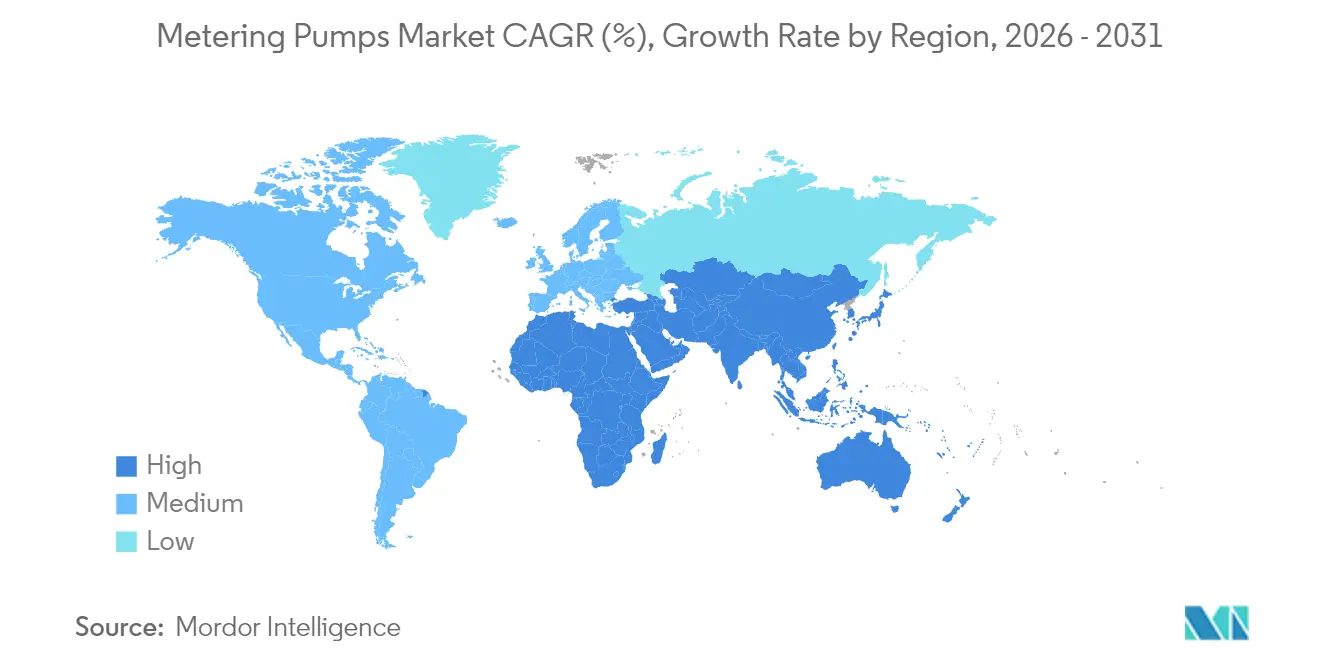
| Fastest Growing Market | South America |
| Largest Market | Asia-Pacific |
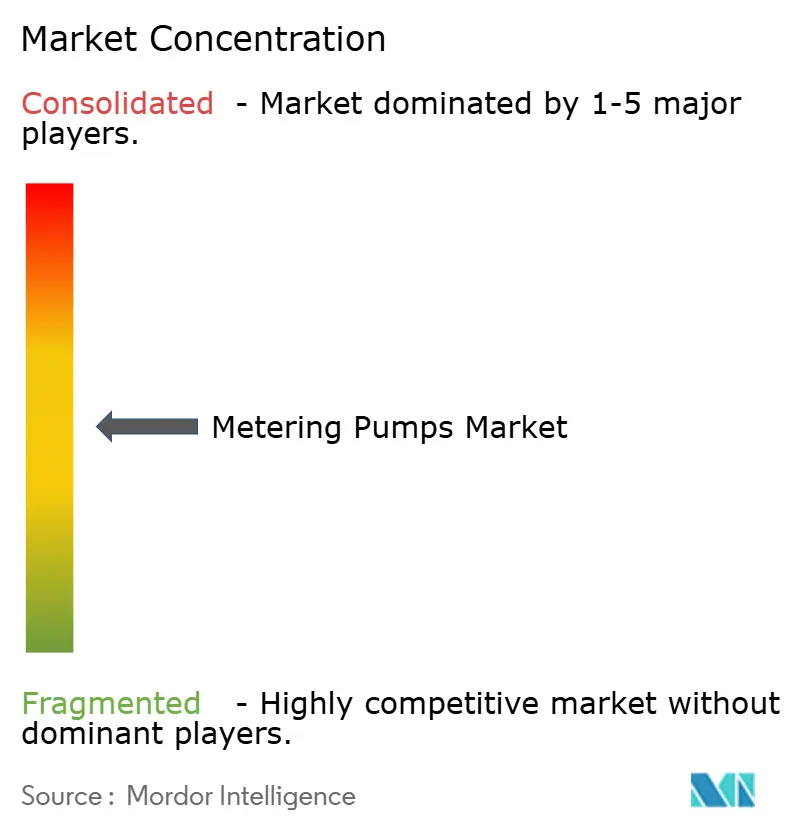
| Market Concentration | Medium |
Major Players *Disclaimer: Major Players sorted in no particular order Image © Mordor Intelligence. Reuse requires attribution under CC BY 4.0. | |
Metering Pumps Market Analysis by Mordor Intelligence
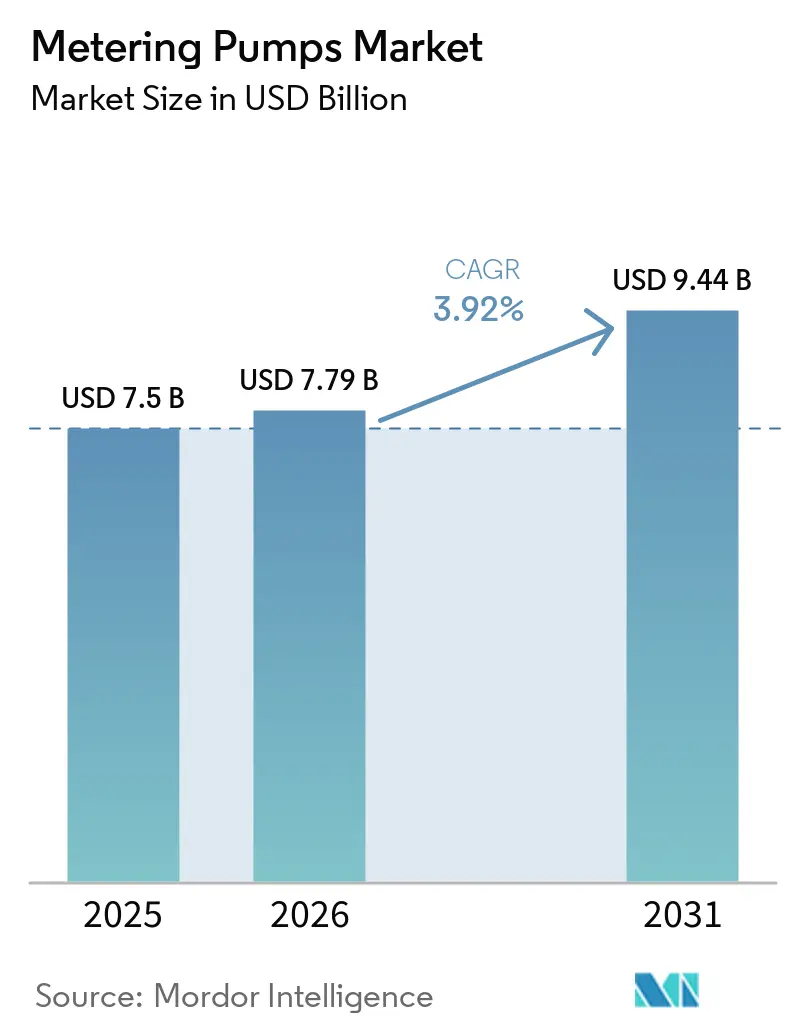
The Metering Pumps Market size is expected to grow from USD 7.5 billion in 2025 to USD 7.79 billion in 2026 and is forecast to reach USD 9.44 billion by 2031 at 3.92% CAGR over 2026-2031.
Steady growth reflects the technology’s entrenched role in precision fluid handling for water, chemicals, and high-purity manufacturing. Water treatment remains the single largest demand center, accounting for 41% of 2024 revenue, backed by tightening global discharge limits. Pharmaceutical plants are the fast expanding user group as continuous-flow production lines seek ultra-accurate dosing. Asia-Pacific leads the metering pumps market because China and India continue to invest in wastewater upgrades and stricter effluent controls. Competitive dynamics are shifting toward IIoT-enabled smart dosing systems, a trend that is accelerating sales of solenoid-driven units.
Key Report Takeaways
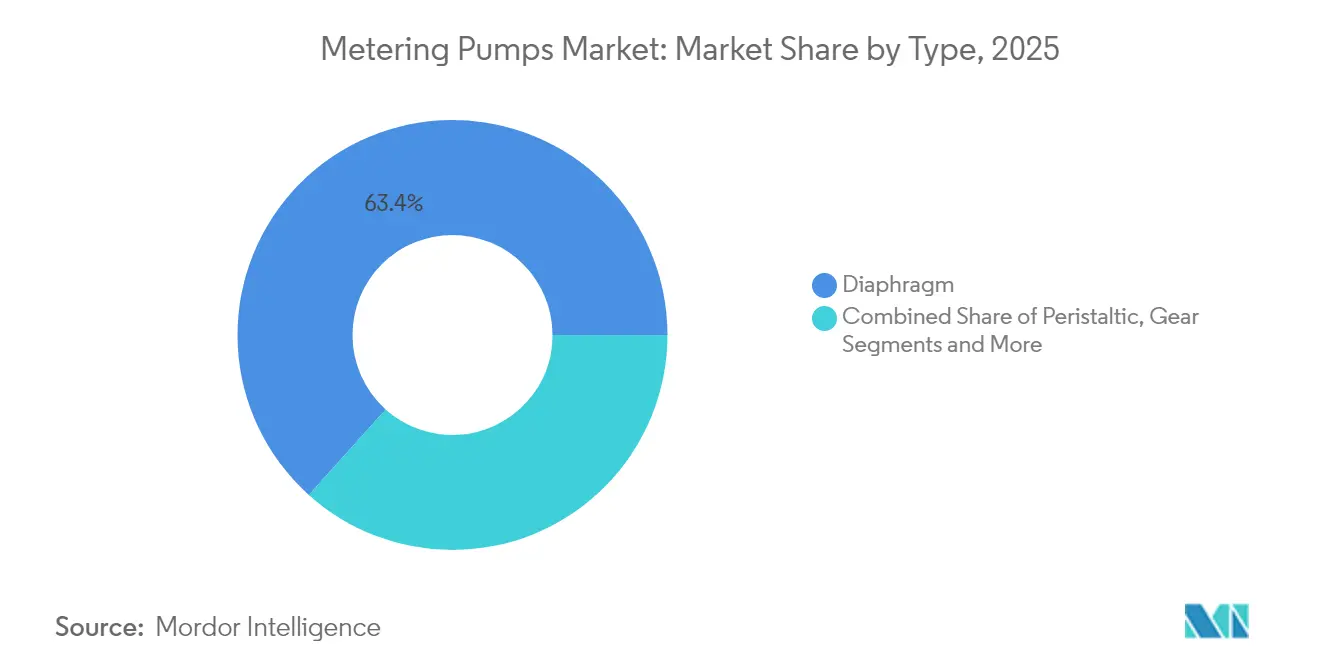
- By pump type, diaphragm units held 63.35% of the metering pumps market share in 2025, while plunger/piston designs are projected to post the fastest 7.02% CAGR through 2031.
- By drive mechanism, motor-driven pumps led with 54.45% revenue share in 2025; solenoid-driven variants are on track for a 5.88% CAGR over the same period.
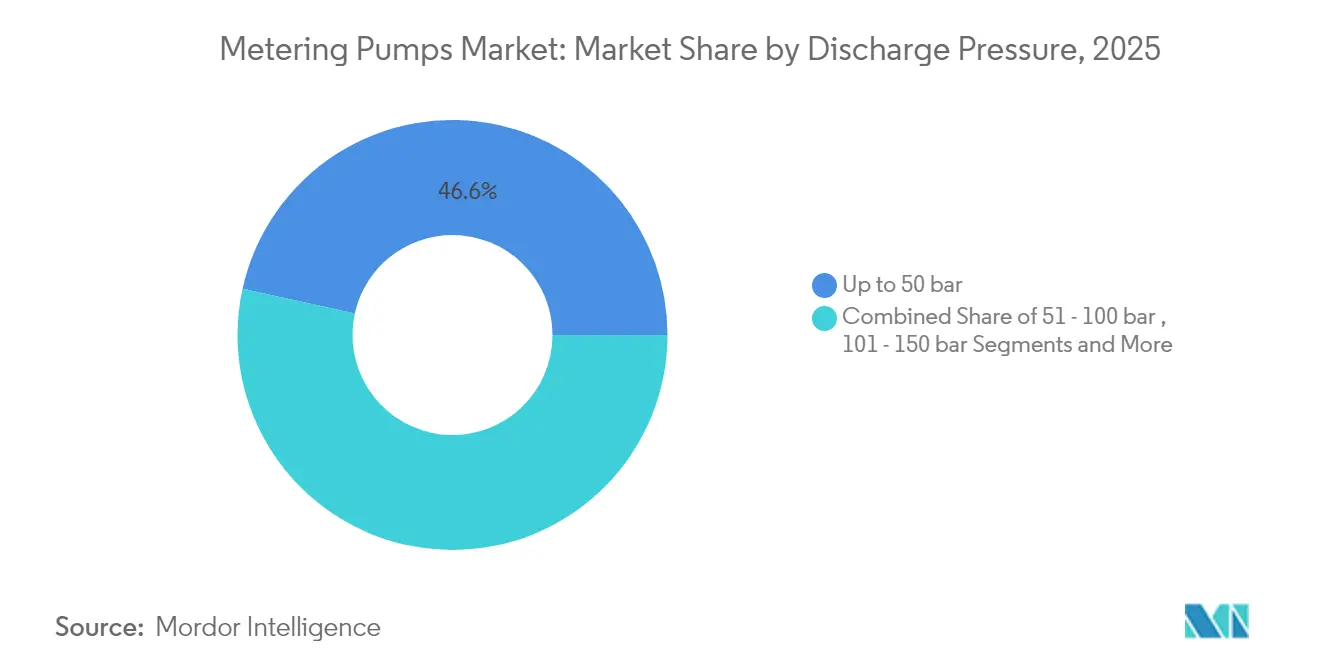
- By discharge pressure, the up-to-50 bar range accounted for 46.55% of the metering pumps market size in 2025; the 51-100 bar tier is expected to record the highest 5.18% CAGR between 2026 and 2031.
- By end-user, water treatment secured 40.62% of 2025 revenue, whereas pharmaceuticals will rise the fastest at a 6.42% CAGR through 2031.
- By geography, Asia-Pacific dominated with 39.55% of 2025 revenue, while South America is set to expand at a 5.27% CAGR to 2031.
Note: Market size and forecast figures in this report are generated using Mordor Intelligence’s proprietary estimation framework, updated with the latest available data and insights as of 2026.
Market Trends and Insights
Drivers Impact Analysis of Metering Pumps Market*
| DRIVER | (~) % IMPACT ON CAGR FORECAST | GEOGRAPHIC RELEVANCE | IMPACT TIMELINE |
|---|---|---|---|
| Strict Industrial Waste-water Norms Accelerating Chemical Dosing in Asia | 1.5% | Asia-Pacific, with spillover to Middle East & Africa | Medium term (2-4 years) |
| Rapid Digitalization of Water Utilities Demanding Smart Dosing Accuracy | 1.2% | North America, Europe, Advanced Asia-Pacific economies | Medium term (2-4 years) |
| Fertigation Boom in High-Value Horticulture across the Middle East | 0.8% | Middle East, North Africa, Mediterranean Europe | Short term (≤ 2 years) |
| Increasing Offshore Enhanced-Oil-Recovery (EOR) Chemical Injection Needs | 0.6% | North America, South America, Middle East | Long term (≥ 4 years) |
| Growing Use of High-Purity API Skids in Continuous-Flow Pharma Plants | 0.6% | North America, Europe, Advanced Asia-Pacific economies | Medium term (2-4 years) |
| Extensive Demand from Chemical Plants | 0.6% | Global, with concentration in Asia-Pacific | Medium term (2-4 years) |
| Source: Mordor Intelligence | |||
Strict Industrial Waste-water Norms Accelerating Chemical Dosing in Asia
Sweeping 2024 amendments to China’s Water Pollution Prevention and Control Law cut allowable effluent loads by 40%, forcing roughly 65,000 factories to add multiple chemical dosing points and digital data logging. Upgrades across electroplating, textile, and pharma corridors now account for 35% of all new installs in Asia, with IIoT-ready pumps preferred to satisfy record-keeping mandates mee.gov.cn. These standards are expected to ripple through Southeast Asia and India over the next three years, underpinning consistent demand growth within the metering pumps market.
Rapid Digitalization of Water Utilities Demanding Smart Dosing Accuracy
Utilities integrating SCADA and IoT platforms have uncovered 15-22% chemical savings when pumps adjust doses in real time. The shift is shortening replacement cycles from 12 years to near 8 years and raising average selling prices by one-quarter. Regions facing water scarcity, such as the US Southwest and parts of Spain, are early adopters as they balance quality assurance with chemical cost control. Service-based revenue models around predictive maintenance are emerging, enlarging the opportunity set for vendors.[1]
Fertigation Boom in High-Value Horticulture across the Middle East
Controlled-environment farms in UAE and Saudi Arabia rely on multi-channel dosing stations that fine-tune nutrients by crop stage. Yield gains of 25-40% and fertilizer use cuts of 30% justify higher outlays, stimulating a niche yet vibrant demand pocket for corrosion-resistant pumps able to withstand aggressive fertilizer concentrates.
Increasing Offshore Enhanced-Oil-Recovery Chemical Injection Needs
Maturing offshore fields now deploy high-pressure polymer and surfactant injection systems exceeding 150 bar, valuing compact API 675-compliant packages with redundant designs. The premium nature of these orders, often priced 3-4 times higher than standard models, sustains a lucrative sub-segment within the broader metering pumps market despite lower volumes.
Restraints Impact Analysis of Metering Pumps Market*
| RESTRAINTS | (~) % IMPACT ON CAGR FORECAST | GEOGRAPHIC RELEVANCE | IMPACT TIMELINE |
|---|---|---|---|
| Requirement of Frequent Maintenance | -0.5% | Global, with higher impact in emerging markets | Medium term (2-4 years) |
| Growing Customization Demands (Fluid-Property-Driven Design Tweaks) | -0.3% | Global, with concentration in specialty chemical and pharmaceutical sectors | Short term (≤ 2 years) |
| Cavitation Risk in High-Viscosity Peristaltic Lines Limiting Adoption | -0.4% | Global, with particular impact in polymer processing and food industries | Medium term (2-4 years) |
| Availability of Low-cost Chinese Knock-offs Eroding Margins Globally | -0.6% | Global, with highest impact in price-sensitive emerging markets | Long term (≥ 4 years) |
| Source: Mordor Intelligence | |||
Requirement of Frequent Maintenance
Mechanical diaphragm pumps often need service after 4,000-6,000 hours, interrupting continuous processes that can lose USD 5,000-15,000 per hour during downtime. Emerging markets suffer most because skilled technicians are scarce, prompting some operators to consider less precise but lower-maintenance alternatives.[2]
Growing Customization Demands (Fluid-Property-Driven Design Tweaks)
Custom builds now exceed 40% of OEM order books, driving up inventories and extending lead times. Smaller suppliers lacking broad engineering benches struggle to meet prescriptions for high-viscosity polymers or shear-sensitive biologics, dampening overall throughput within the metering pumps market.
*Our forecasts treat driver/restraint impacts as directional, not additive. The impact forecasts reflect baseline growth, mix effects, and variable interactions.
Metering Pumps Market Segment Analysis
By Type:
Diaphragm Dominates While Plunger AcceleratesDiaphragm pumps controlled 63.35% of global revenue in 2025. Their leak-free architecture fits corrosive water-treatment chemistries, cementing leadership across compliance-driven markets. Plunger/piston models are expanding at 7.02% annually as upstream operators push injection pressures above 100 bar. This differential signals a migration toward high-pressure niches where flow stability under extreme conditions outweighs higher lifecycle costs. Gear, rotary lobe, and peristaltic designs address narrower needs such as pulse-free polymer blending or hygienic pharma fills.
Recent elastomer advances have extended peristaltic tube life by 40%, elevating their appeal in sterile dosing lines. Gear and lobe pumps maintain steady uptake in polymer compounding where continuous, shear-controlled feed rates matter. Collectively, these trends support a diverse technology mix inside the metering pumps market.

By Drive Mechanism:
Motor-Driven Reliability Meets Solenoid InnovationMotor-driven units captured 54.45% of 2025 sales thanks to rugged construction and simple integration with legacy control loops. Solenoid-driven pumps, though smaller in absolute value, are climbing 5.88% per year on the back of energy efficiency and digital-native design. New magnetic circuit geometries raise their flow and pressure ceiling by almost one-third while trimming power draw roughly 30%. Pneumatic and hydraulic drives retain roles in hazardous or power-poor sites, yet their share is stable rather than rising.
Solenoid evolution dovetails with the surge in smart water and chemical plants, positioning this architecture as a growth engine for the metering pumps market through 2031
By Discharge Pressure:
Mid-Range Pressure Applications AccelerateApplications below 50 bar represented 46.55% of 2025 revenue and remain the volume backbone for municipal water and general chemical processing. The 51-100 bar tier is advancing at 5.18% CAGR as intensified industrial chemistries demand tighter control under higher heads. Above 100 bar remains a premium enclave in oil and gas and high-pressure synthesis. Ceramic plunger inserts and duplex alloys now extend service life at 150 bar plus, safeguarding accuracy even with abrasive or acidic reagents.
By End-User Industry:
Water Treatment Leads While Pharmaceuticals SurgeWater treatment held 40.62% revenue in 2025, driven by new disinfection and nutrient-removal mandates. Pharmaceuticals will post the swiftest 6.42% CAGR on rising continuous-manufacturing capacity and GMP demands for closed, cleanable dosing skids. Oil and gas maintains cyclical yet sizable orders for corrosion inhibitors and hydrate-control chemicals, especially in offshore installations. Food and beverage processors are specifying sanitary diaphragm pumps for flavor, acid, and enzyme dosing, expanding the addressable base. Agriculture is an emerging niche, aligning with Middle-Eastern fertigation schemes that improve water efficiency per hectare.
Geography Analysis
APAC Metering Pumps Market
Asia-Pacific dominated the metering pumps market with 39.55% of 2025 revenue. China’s latest five-year plan earmarks widespread industrial effluent upgrades, while India’s Jal Jeevan Mission drives rural water quality investments. High-purity pharma growth in Singapore and South Korea stimulates demand for skid-mounted, digitally certified dosing modules. Local manufacturers undercut imported models in commodity ranges, yet Western brands keep premium share in high-pressure or exotic-material builds.
South America Metering Pumps Market
South America is the fastest-growing geography at a 5.27% CAGR to 2031. Brazil’s new sanitation law triggers chlorination and pH control rollouts, and other countries in South America export manufacturing sector increases solvent recycling and wastewater neutralization installations. Vendors emphasize voltage-tolerant drives and simplified service kits to suit local infrastructure.
North America and EMEA Metering Pumps Market
North America and Europe are mature but innovation-intensive. Utility operators here spearhead integration of pumps with cloud-hosted dashboards, favoring solutions that broadcast status over MQTT or OPC UA. The US EPA’s lead and copper rule revisions and Europe’s tightening of PFAS discharge limits both raise dosing accuracy thresholds. Meanwhile, Gulf producers and arid African nations channel spending toward desalination and reuse, preserving a steady pipeline of orders for corrosion-resistant PVDF and super-duplex pumps.
Regulatory Landscape
Regulation affecting metering pumps is increasingly combining machinery safety, process standards, and cybersecurity expectations as dosing skids add digital connectivity. In the EU, the Machinery Regulation (EU) 2023/1230 replaces the Machinery Directive and tightens conformity expectations for machinery with safety-critical digital functions. It also introduces mandatory third-party conformity assessment requirements for certain AI-integrated machinery taking effect by January 20, 2027. For connected dosing systems, enforcement activity around the EU Cyber Resilience Act (EU) 2024/2847 brings vulnerability reporting obligations into procurement checklists, which reinforces the role of industrial security frameworks such as IEC 62443 for buyers in utilities and critical infrastructure.
Standards and trade compliance also affect specifications and delivery timelines for internationally supplied metering systems. API STD 675:2012 remains a key reference for controlled-volume positive displacement pumps used in petroleum, chemical, and gas services, while ANSI/HI 7.1-7.5:2023 supports controlled-volume metering pump nomenclature and application guidance used in industrial procurement. On cross-border supply, industrial pump systems typically fall under HTS 8413, and 2026 saw tighter export-control and documentation requirements for certain dual-use components and assemblies, alongside active EU trade scrutiny of Chinese-origin industrial pumps and valves that increased origin documentation burden for some OEM supply chains.
Value Chain Analysis
The metering pumps value chain starts with raw materials and precision components, including corrosion-resistant alloys such as 316 stainless steel, specialty elastomers, and fluoropolymers such as PVDF. It then moves through machining, diaphragm or plunger assemblies, motor or solenoid drive integration, and final skid-level packaging with sensors, valves, and controls. Digitalization is broadening the bill of materials to include PLC/SCADA-ready electronics and connectivity modules, aligning with buyer demand for smart dosing functions and interoperability with plant automation. Materials and electronics sourcing is also sensitive to trade policy and certification requirements, which drives added supplier qualification steps for components included in CE/UKCA-marked packages.
Go-to-market typically combines direct sales to EPCs, water utilities, and industrial plants with distributor coverage for standardized up-to-50 bar units. High-pressure and pharma-grade packages rely more on application engineering, validation support, and factory acceptance testing. Aftermarket service, calibration, and spares logistics are key value-capture points because many installations run continuously and maintenance cycles can constrain uptime. During 2025-2026, manufacturers emphasized regionalization and dual sourcing for alloys, polymers, and control modules to reduce exposure to tariffs, shipping delays, and variable lead times on automation components, with local service coverage acting as a differentiator in water treatment and process industries.
Competitive Landscape
The metering pumps market is moderately concentrated. The five largest suppliers—Grundfos, IDEX, Dover (PSG), SPX Flow, and LEWA—command about 45% of revenue, protected by strong brands, application know-how, and extensive service coverage. Asian entrants gain ground in standardized ≤50 bar products through cost advantages, but high-pressure and pharmaceutical niches remain dominated by incumbents. The competitive contest is now rooted in digital fluency. Grundfos iSOLUTIONS and ProMinent DULCONNEX exemplify the pivot from hardware sales to holistic chemical-management platforms featuring predictive maintenance and dosing optimization.
Mid-sized specialists exploit white-space opportunities. Blue-White Industries’ multi-diaphragm innovation mitigates vapor lock in sodium hypochlorite dosing, capturing share among US utilities. Niche firms focused on ceramic plungers or expendable pump cartridges also outflank larger rivals in specialized chemistries. Mergers, typified by IDEX’s 2025 purchase of Mott Corporation, reflect a race to assemble broader fluid-handling portfolios that stretch from dosing pumps to filtration and sensing.
Metering Pumps Industry Leaders
-
Grundfos Holding A/S
-
IDEX Corp. (Milton Roy, Pulsafeeder)
-
PSG – Dover Corp. (Neptune, Wilden)
-
SPX Flow, Inc.
-
ProMinent GmbH
- *Disclaimer: Major Players sorted in no particular order
Metering Pumps Market Companies Covered in this Report
- Grundfos Holding A/S
- IDEX Corporation
- PSG - Dover Corp.
- SPX Flow, Inc.
- LEWA GmbH (Nikkiso)
- ProMinent GmbH
- Milton Roy (Ingersoll Rand)
- Seko S.p.A
- Watson-Marlow Fluid Tech Grp. (Spirax-Sarco)
- Seepex GmbH
- Verder Group
- Blue-White Industries
- Xylem Inc.
- Flowserve Corporation
- Iwaki Co., Ltd.
- Netzsch Pumpen GmbH
- Atlas Copco (Lewa-Triplex)
- Roto Pumps Ltd.
- Haosh Pump Co.
- Swelore Engineering
- Tacmina Corp.
- Ingersoll Rand (Haskel)
- Idemitsu Kosan (Eagle Industry)
Market Opportunities and Future Outlook
White-space is opening fastest where regulatory compliance and digital operating models intersect, especially in water and wastewater treatment, the largest demand center in the market. Utilities deploying SCADA and IoT platforms are actively seeking dosing packages that reduce chemical waste and improve auditability, which strengthens the case for IIoT-ready metering pumps, controllers, and service subscriptions connected to dosing optimization and predictive maintenance. China also continues to be a concrete demand catalyst in Asia-Pacific, where 2024 amendments to the Water Pollution Prevention and Control Law tightened effluent loads and drove factories to add chemical dosing points and data logging, favoring connected pumps that support record-keeping.
In industrial applications, opportunities cluster in premium niches that require higher pressure, higher safety integrity, and validated operation. Offshore chemical injection packages aligned to API 675 and high-purity dosing skids in continuous-flow pharmaceutical production are pulling demand toward multi-layer safety diaphragms, modular multi-head architectures, and standardized communication protocols that integrate into DCS/SCADA environments. At the same time, expanding cybersecurity obligations in the EU (CRA) and tighter machinery conformity requirements (EU Machinery Regulation) increase the premium on secure-by-design connectivity and documentation, which creates room for suppliers that can deliver compliant digital dosing systems with local service and faster certification pathways.
Recent Industry Developments in Metering Pumps Market
- July 2026: Grundfos entered into an agreement to acquire Newterra, a Pittsburgh-based water and wastewater treatment company, with closing planned in the second half of 2026 subject to regulatory approvals. The move broadens Grundfos water treatment capabilities and supports a shift toward packaged solutions and lifecycle services, which can pull through dosing and metering equipment in municipal and industrial projects.
- January 2025: IDEX Corporation completed the acquisition of Mott Corporation for USD 295 million, expanding its portfolio in precision filtration and flow control. The deal strengthens IDEXs positioning in high-purity applications that often combine filtration, sensing, and accurate chemical dosing, supporting more integrated skids around its fluid and metering platforms.
- December 2024: IDEX China introduced the PulsaMax 8480 series hydraulic diaphragm metering pump in China, designed to meet API 675 requirements. The launch targets demanding chemical injection duties and reinforces the push toward higher-performance, standards-aligned metering solutions in industrial and energy end uses.
Metering Pumps Market Report Scope and Research Methodology
Market Definition and Coverage
For this study, the metering pumps market covers revenue earned from pumps used to inject or dose a controlled, repeatable volume of fluid into a process, across industrial and municipal end users, and across key drive and pump designs.
Scope exclusions: We exclude upstream raw material value and aftermarket services such as installation labor, long-term maintenance contracts, and unrelated control-system hardware when it is sold as a standalone item.
Segments Covered in This Report
- By Type
- Diaphragm
- Piston / Plunger
- Peristaltic
- Gear
- Rotary Lobe
- By Drive Mechanism
- Motor-Driven
- Solenoid-Driven
- Hydraulic-Driven
- Pneumatic-Driven
- By Discharge Pressure
- Up to 50 bar
- 51 - 100 bar
- 101 - 150 bar
- Above 150 bar
- By Pump Material
- Metallic (Stainless-steel, Alloy-20, Duplex)
- Non-Metallic (PVC, PVDF, PP)
- By End-User Industry
- Water Treatment
- Oil and Gas
- Chemical Processing
- Pharmaceuticals
- Food and Beverage
- Pulp and Paper
- Agriculture and Fertigation
- Mining and Minerals
- Textiles
- Power Generation and Others
- By Geography
- North America
- United States
- Canada
- Mexico
- Europe
- United Kingdom
- Germany
- France
- Italy
- Rest of Europe
- Asia-Pacific
- China
- Japan
- India
- South Korea
- Rest of Asia-Pacific
- Middle East
- Israel
- Saudi Arabia
- United Arab Emirates
- Turkey
- Rest of Middle East
- Africa
- South Africa
- Egypt
- Rest of Africa
- South America
- Brazil
- Argentina
- Rest of South America
- North America
Data Sources, Market Sizing, and Validation
Desk Research
Desk work started with building the demand backdrop for dosing needs in water, chemicals, and energy, and then mapping where metering pumps are specified versus standard pumps. We leaned on public sources such as the US EPA (water and wastewater standards), the USGS (industrial and municipal water use), the International Energy Agency (energy and refining indicators), UN Comtrade (trade flows for relevant pump categories), and Eurostat (industrial output and environmental compliance data).
To translate activity into a value model, we reviewed company annual reports, investor presentations, product catalogs, and reputable trade press coverage on dosing accuracy, materials of construction, and pressure classes. A paid subscription focused on company financials and a shipment-level trade database were used selectively to cross-check regional mix and implied pricing ranges when public disclosures were thin. These desk sources are illustrative and not exhaustive, and we used additional references to collect data, validate assumptions, and clarify open questions.
Primary Interviews and Surveys
Primary interviews and structured surveys were used to confirm what gets counted as a metering pump sale, how buyers specify flow rate and pressure, and how pricing shifts with materials, drive type, and certification needs. We spoke with a mix of manufacturers, distributors, EPC-facing sellers, and end-user maintenance and process teams across major regions, so desk assumptions on adoption and replacement cycles could be adjusted where needed.
Distribution of primary research fieldwork respondents
| Company type | Respondent position | Region |
|---|---|---|
| Top tier: 33% | CXOs: 13% | APAC: 42% |
| Mid tier: 48% | Functional/Unit leaders: 30% | EMEA: 36% |
| Smaller Players: 19% | Managers: 57% | Americas: 22% |
Market-Sizing & Forecasting
Sizing was built using a top-down approach where industrial activity and treatment capacity indicators were reconstructed into a metering-pump demand pool, and then converted into value using fit-for-purpose pricing logic. The model was subsequently checked using selective bottom-up approximations, such as sampling pump price bands from catalogs and quotes, and then applying them to estimated unit demand by end-use and region.
Key inputs that moved totals included water and wastewater treatment capacity additions, chemical processing output trends, oil and gas capex signals for injection systems, replacement cycles tied to duty severity, and the mix shift between diaphragm and plunger designs in higher-pressure applications. Average selling prices were treated as a range by pump type, drive mechanism, and materials, and then adjusted for inflation and currency effects rather than assuming a flat global price.
For the forecast, scenario analysis was applied around capex intensity in water treatment and process industries, and then the scenarios were reconciled against expert views on lead times, inventory normalization, and automation adoption in dosing skids. Where bottom-up checks had gaps, such as limited price disclosure in some countries, we used regional proxy price bands validated by distributors and service teams, and then stress-tested the outcome so no single assumption dominated the total.
Data Validation & Update Cycle
Outputs were triangulated by comparing the modeled totals against independent signals such as import and export directionality, industrial production trends in key end markets, and the implied revenue per installed capacity in water and process applications. Outliers were flagged when regional growth or ASP movement broke the logic expected from policy changes, capex cycles, or known supply constraints, and then the assumptions were reviewed in a second analyst pass.
We refresh the report annually, and interim updates are triggered when there are material changes such as sharp currency moves, major regulatory shifts affecting chemical dosing, or step-changes in end-market capex. Before delivery, a final review is done to re-check the latest public indicators and to re-contact experts when a variance cannot be explained cleanly.
Mordor Intelligence's Metering Pumps Market Size Versus Other Published Estimates
Published market sizes for metering pumps can look far apart because analysts may count different product boundaries, treat dosing skids and accessories differently, or apply different price ladders across pump types and pressure classes. Another common reason is timing, since the year used for currency conversion and the update cadence can shift a USD total even when unit demand is similar.
In our work, price logic is tied to pump design and duty (for example, diaphragm versus plunger, pressure range, and materials), and then checked against channel feedback so a single global ASP does not skew the outcome. When exchange rates and inflation factors are refreshed close to publication and the totals are re-tested against trade and industrial signals, the spread usually narrows. That refresh-led approach is what shaped the USD 7.79 B (2026) figure in Mordor Intelligence.
Benchmark comparison
| Source | Market Size | Gaps in Research Methodology |
|---|---|---|
| Mordor Intelligence | USD 7.79 B (2026) | |
| Industry Data Platform A | USD 7.20 B (2025) | Uses an earlier base year with limited clarity on exchange-rate timing and appears to treat average prices as flatter across pump types, which can understate high-pressure and specialty-material mixes. |
| Trade Journal B | USD 8.48 B (2029) | Reports a later-year number that likely embeds a more aggressive growth path and may include adjacent dosing packages or bundled components beyond the pump unit, which lifts the headline value. |
Across the three figures, most of the gap comes from year alignment and what gets bundled into the counted revenue, followed by how pricing is stepped up for higher-spec applications. By keeping the boundary on pump revenue clear and by re-checking prices and macro signals during updates, the estimate stays traceable to repeatable inputs rather than one-off assumptions.
Key Questions Answered in the Report
What is the current size of the metering pumps market?
The metering pumps market stands at USD 7.79 billion in 2026 and is expected to reach USD 9.44 billion by 2031.
Which end-user industry generates the most demand?
Water treatment leads, representing 40.62% of 2025 revenue due to stricter global water quality regulations.
Which region is growing the fastest?
South America is projected to post the highest 5.27% CAGR between 2026 and 2031, driven by water infrastructure upgrades in Brazil and Mexico.
What technology segment is expanding most quickly?
Plunger/piston pumps are forecast to grow 7.02% per year as high-pressure chemical injection applications increase.
How are smart features influencing procurement?
Utilities adopting IoT platforms prefer digitally enabled pumps that can interface with SCADA, shortening replacement cycles and raising average selling prices.
Who are the leading players in the market?
Grundfos, IDEX, Dover (PSG), SPX Flow, and LEWA account for about 44.70% of global revenue, reflecting moderate concentration.