
Metalized Film Market Size and Share
Market Overview
| Study Period | 2020 - 2031 |
|---|---|
| Market Size (2026) | USD 4.01 Billion |
| Market Size (2031) | USD 5.09 Billion |
| Growth Rate (2026 - 2031) | 4.92 % |
| Fastest Growing Market | Asia-Pacific |
| Largest Market | Asia Pacific |
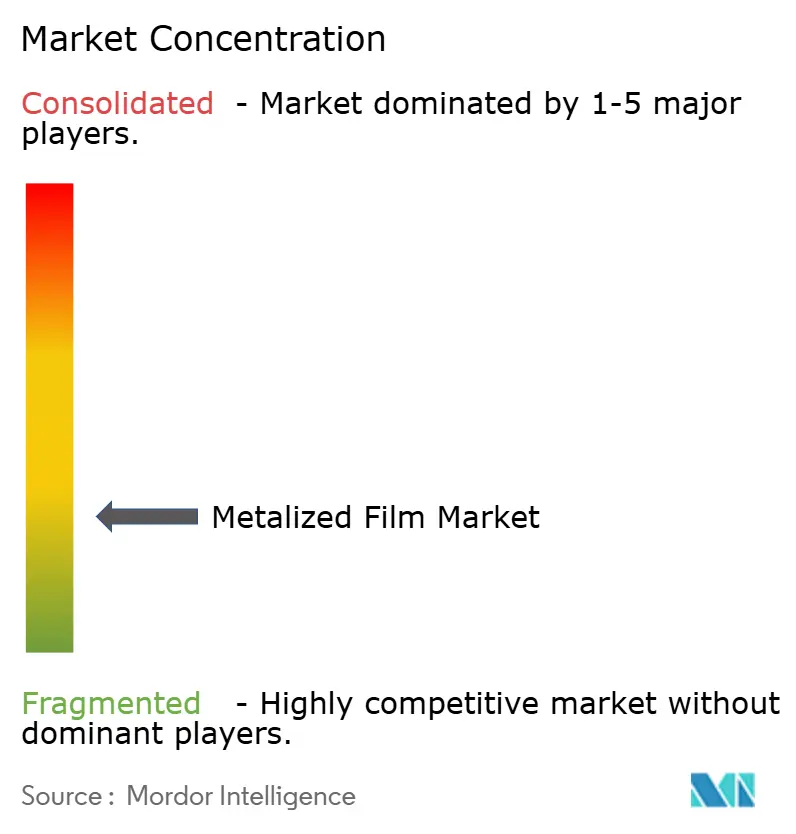
| Market Concentration | Low |
Major Players *Disclaimer: Major Players sorted in no particular order Image © Mordor Intelligence. Reuse requires attribution under CC BY 4.0. | |
Metalized Film Market Analysis by Mordor Intelligence
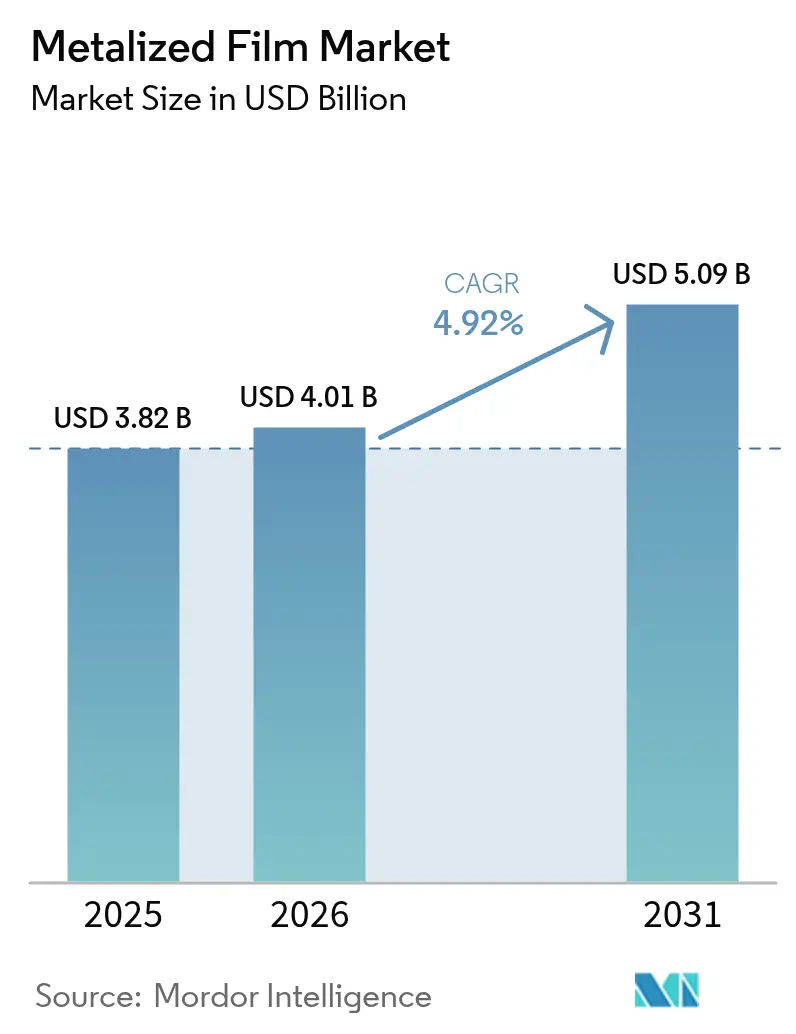
Metalized Film market size in 2026 is estimated at USD 4.01 billion, growing from 2025 value of USD 3.82 billion with 2031 projections showing USD 5.09 billion, growing at 4.92% CAGR over 2026-2031. Rising demand for lightweight barrier packaging, rapid electrification of vehicles, and expanding printed electronics output are the main forces lifting the metalized film market. Established converters are investing in wider, faster coating lines to gain scale and contain cost inflation, while material innovators focus on recycling-ready structures that meet tightening regulatory targets. Copper coatings for battery pouches and high-frequency circuitry are growing quickly, yet aluminum retains a clear cost and supply advantage in most food and consumer goods uses. Asia-Pacific retains the largest production and consumption base, and its policy support for renewable energy and electric mobility widens the regional demand gap over North America and Europe.
Key Report Takeaways
- By metal type, aluminum led with 78.10% of the metalized film market share in 2025; copper is the fastest-growing metal at a 5.55% CAGR through 2031.
- By film type, polyethylene held 66.70% of the metalized film market share in 2025, whereas other film types are projected to expand at a 5.72% CAGR to 2031.
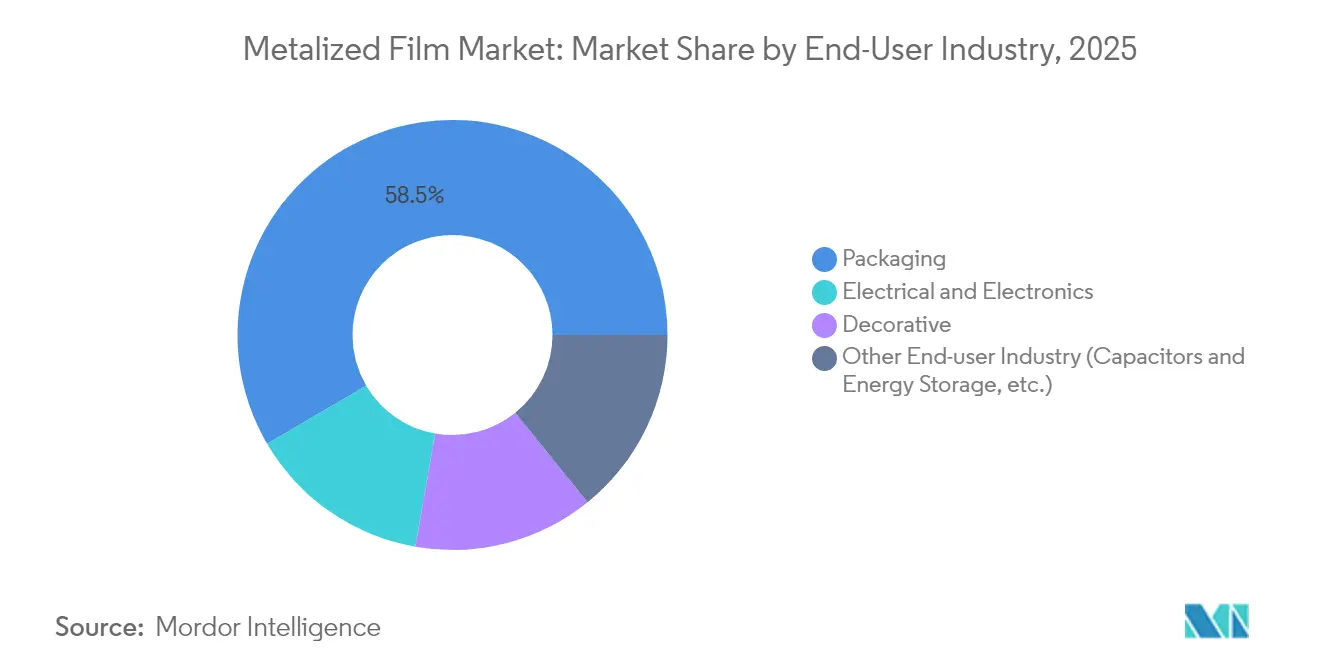
- By end-user industry, packaging commanded 58.45% of the metalized film market size in 2025; energy storage and capacitor applications are advancing at a 5.78% CAGR to 2031.
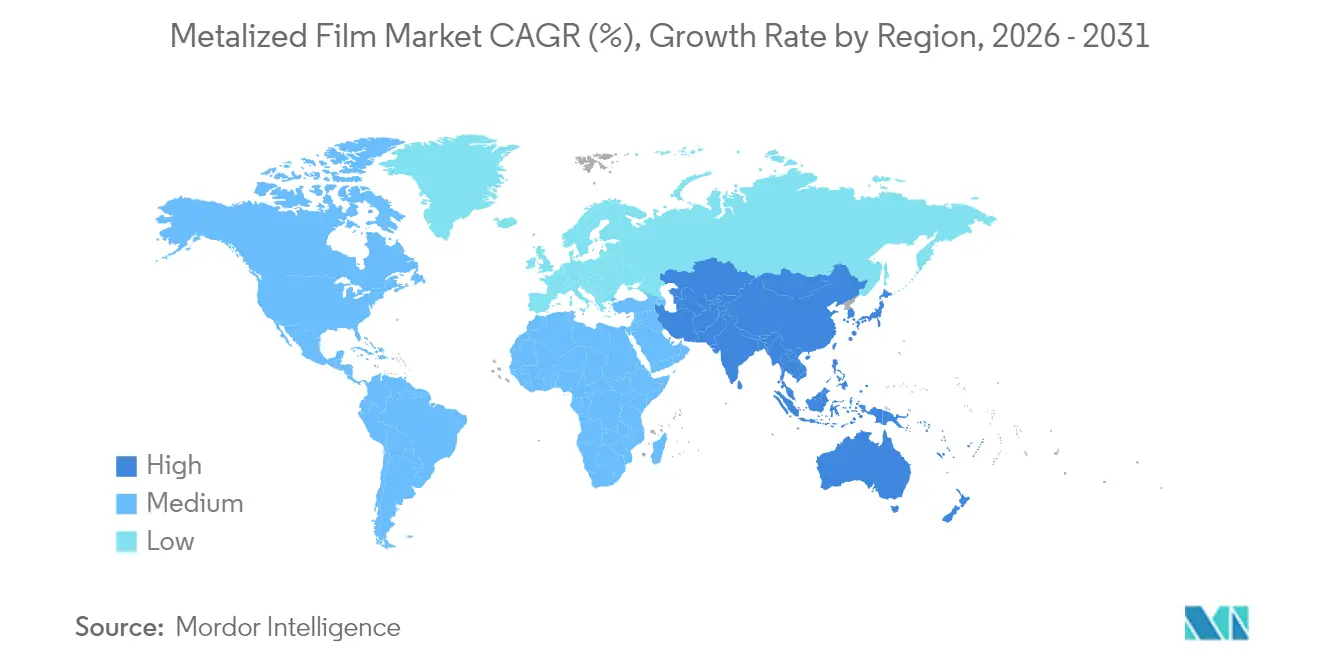
- By geography, Asia-Pacific captured 53.20% of the metalized film market share in 2025 and is set to grow at the highest regional CAGR of 5.61% to 2031.
Note: Market size and forecast figures in this report are generated using Mordor Intelligence’s proprietary estimation framework, updated with the latest available data and insights as of 2026.
Market Trends and Insights
Drivers Impact Analysis of Metalized Film Market*
| Driver | (~) % Impact on CAGR Forecast | Geographic Relevance | Impact Timeline |
|---|---|---|---|
| Surging demand for high-barrier flexible food packaging | +1.20% | Global, with strongest growth in APAC and emerging markets | Medium term (2-4 years) |
| Rapid substitution of aluminium foil with lightweight metallized films | +0.80% | North America & EU, expanding to APAC manufacturing | Short term (≤ 2 years) |
| Expansion of EV battery insulation and pouch cell applications | +0.60% | Global, concentrated in China, US, and Germany | Long term (≥ 4 years) |
| Growth of smart labels and printed electronics on flexible substrates | +0.40% | APAC core, spill-over to North America and EU | Medium term (2-4 years) |
| Adoption in solar‐backsheet and reflective insulation products | +0.30% | Global, with early gains in China, India, and southwestern US | Long term (≥ 4 years) |
| Source: Mordor Intelligence | |||
Surging Demand for High-Barrier Flexible Food Packaging
Food brands are switching from rigid containers to flexible packs that deliver long shelf life, lower transport emissions, and premium shelf appeal. Aluminum-coated polyethylene and polypropylene films supply the oxygen and moisture barriers needed to keep ready-to-eat meals safe during lengthy global supply chains. Retailers in Europe and North America set aggressive food waste reduction targets that favor barrier laminates produced in the metalized film market. Asian processors benefit from high-speed vapor deposition lines that cut coating costs without sacrificing performance. Government food-safety rules also push converters to adopt metalized structures that resist contamination while remaining lightweight.
Rapid Substitution of Aluminum Foil with Lightweight Metallized Films
Vehicle makers and aircraft suppliers pursue weight reduction to comply with carbon regulations. Vapor-deposited aluminum films provide barrier levels close to foil at a fraction of the mass and can wrap contoured parts easily. Their roll-to-roll coating process boosts throughput, lowering unit costs for converters active in the metalized film market. Battery pack builders prefer these films for thermal pads because the material conforms around prismatic cell edges without cracking. Producers that control both polymer extrusion and metallization gain resilience against primary aluminum price swings.
Expansion of EV Battery Insulation and Pouch Cell Applications
Electric-vehicle battery pouches rely on aluminum-coated polymer films to manage heat and stop short circuits[1]. Surging EV output in China and the United States drives large-volume contracts that lock in metallized substrate demand to 2030. Copper-coated films show promise as high-current collectors that improve energy density, though moisture stability remains a design hurdle. Film makers are entering joint-development programs with battery OEMs to refine adhesion layers and functional coatings. Strong safety rules enforced by German authorities further accelerate the uptake of flame-retardant metallized laminates in European gigafactories.
Growth of Smart Labels and Printed Electronics on Flexible Substrates
Brands now embed RFID antennas, freshness sensors, and QR-based engagement tags on package surfaces. Silver or copper grid traces printed on aluminum-coated PET enable these circuits without major tooling changes, and roll-to-roll printing keeps unit economics attractive. Asian display makers leverage the same substrate know-how to produce foldable screens, adding another pull on the metalized film market. Logistics companies adopt temperature-logging labels to monitor cold-chain performance, reinforcing demand for conductive yet transparent coatings. As internet-connected packaging moves mainstream, converters with electronics-grade cleanliness stand to capture premium margins.
Restraints Impact Analysis of Metalized Film Market*
| Restraint | (~) % Impact on CAGR Forecast | Geographic Relevance | Impact Timeline |
|---|---|---|---|
| Recycling complexity of multi-layer metallized laminates | -0.70% | EU and North America, expanding globally due to regulations | Medium term (2-4 years) |
| Aluminium price volatility squeezing converter margins | -0.50% | Global, with highest impact in cost-sensitive markets | Short term (≤ 2 years) |
| Copper-layer reliability issues in high-frequency electronics | -0.30% | APAC core (China, Japan, South Korea), spill-over to North America and EU electronics hubs | Medium term (2-4 years) |
| Source: Mordor Intelligence | |||
Recycling Complexity of Multi-Layer Metallized Laminates
European regulators require packaging to reach 70% recyclability targets, yet thin aluminum layers fused to polymers remain difficult to separate. Waste sorters often misclassify shiny films as paper-plastic composites, sending valuable material to landfill[2]. Brands respond by testing clear-coat barrier films, but performance still trails conventional vapor-deposited structures. Chemical delamination pilot plants operate in Germany and the Netherlands, yet scale economics are unproven. Until reliable recovery routes emerge, environmental scrutiny will curb growth in regions with strict extended producer responsibility fees.
Aluminum Price Volatility Squeezing Converter Margins
Spot aluminum prices spiked in 2024 and 2025, catching mid-size converters with limited hedging capacity. Packaging contracts fixed for 12 months expose suppliers to sizeable cost swings, prompting margin erosion. High-energy smelting costs in Europe are transmitted rapidly to thin-gauge coil feedstock used in the metalized film market. Manufacturers respond by localizing material sourcing and raising automation levels to offset raw-material risk. Persistent volatility may spur further consolidation as scale becomes critical for purchasing leverage.
*Our forecasts treat driver/restraint impacts as directional, not additive. The impact forecasts reflect baseline growth, mix effects, and variable interactions.
Metalized Film Market Segment Analysis
By Metal Type:
Aluminum Dominance Faces Emerging Copper GrowthAluminum accounted for 78.10% of the metalized film market in 2025, reflecting its balanced barrier, cost, and recycling profile. The segment’s large installed vacuum-coating base secures a predictable supply to food and personal-care packers. Copper, however, is on a 5.55% CAGR trajectory through 2031 as high-power battery packs and 5G devices need superior conductivity. The metalized film market size for copper coatings in battery pouches is projected to increase, supported by gigafactory investments in China and the US. Although copper films risk corrosion in humid environments, multilayer adhesion promoters are improving durability.
Technological refinements such as plasma-assisted vapor deposition deliver tighter thickness tolerances that enhance electrical performance in fine-line circuits. Aluminum remains favored for decorative wraps and capacitor foils because of its oxide layer stability and ample scrap recycling infrastructure. Niche metals such as silver and aluminum oxide serve optical filters and antimicrobial wraps, where value per square meter outruns raw metal cost. Producers balancing a dual-metal portfolio can hedge demand shifts and maintain utilization rates across diverse end-uses in the metalized film market.


By Film Type:
Polyethylene Leadership Challenged by InnovationPolyethylene held 66.70% of the metalized film market in 2025, thanks to regulatory clearance for direct food contact and compatibility with heat-seal lines. The polymer’s low melting point supports energy-efficient processing, which keeps total conversion costs competitive. Yet high-temperature electronics and electric drives call for films that retain dimensional stability above 150 °C. Consequently, other film types, including polyimide and others, are growing at a 5.72% CAGR to 2031.
Barrier enhancements applied through atomic-layer deposition now bring water vapor transmission rates below 0.05 g/m²/day, closing the gap with aluminum foil. Polypropylene, while entrenched in capacitor and label uses, faces slower growth as converters shift to recyclable mono-PE laminates favored by brand owners targeting circularity metrics. Bio-based PLA and cellulose films with vacuum-deposited aluminum coatings are under early commercialization, signaling future competition for incumbent polyolefins. Film makers that master both commodity and engineered resins will defend share across fast-changing customer specifications.
By End-User Industry:
Packaging Dominance Amid Electronics ExpansionPackaging absorbed 58.45% of the metalized film market in 2025, reflecting steady consumer demand for snack foods, confectionery, and ready meals that need a moisture-oxygen barrier. Shelf-life extension cuts wastage and supports retail category growth, locking in baseline volume for aluminum-coated PE and PP laminates. Meanwhile, the energy storage and capacitor cluster is accelerating at a 5.78% CAGR to 2031 as global EV output tops 20 million units and solar farms add higher-voltage inverters.
Electronics assembly requires ever-thinner dielectric barriers to fit into wearable devices and foldable screens. Metallized PET and PEN films under 8 µm thickness answer that need, pushing coating uniformity limits once thought impractical. Decorative wraps for appliances and car interiors still book reliable volume, yet growth is modest because OEM styling cycles are lengthening. The rise of smart packaging blurs lines between traditional packaging and electronics, encouraging converters to offer integrated barrier and circuit-printing services under one roof.
Geography Analysis
APAC Metalized Film Market
Asia-Pacific generated 53.20% of the metalized film market revenue in 2025, backed by China’s dominance in both polymer extrusion and thin-film vacuum deposition. Annual capacity additions across Jiangsu and Zhejiang provinces keep unit costs low through economies of scale and captive aluminum coil. India’s consumer packaged goods sector expands fast, lifting domestic demand and inviting upstream investment in new BOPP and BOPET lines. South Korea and Japan focus on high-precision copper and silver coatings for semiconductor carriers, sustaining premium export niches. The region’s policy emphasis on electric mobility further propels the consumption of battery-grade metallized films.
North America Metalized Film Market
North America remains a key regional block, led by US food and beverage brands that specify high-barrier pouches for frozen entrees and pet foods. Incentives under the Inflation Reduction Act spur battery plant construction, which raises local sourcing requirements for metallized separators and insulation wraps. Canada’s abundant clean energy and rising aluminum billet production provide a stable supply base for converters operating in Ontario and Quebec. Mexico benefits from near-shoring trends as electronics and auto suppliers move assembly closer to US consumers, creating fresh pull for metallized packaging and capacitor films.
Europe Metalized Film Market
Europe’s stringent circular-economy directives accelerate R&D into de-lamination technologies and mono-material barrier structures. Germany is leading in high-speed capacitor film slitting for industrial drives and wind turbines. France and the United Kingdom prioritize recyclable food wraps and have launched retailer-led collection pilots for shiny snack packs. Nordic countries champion bio-based substrates paired with thin aluminum oxide coatings to lower total carbon intensity. However, elevated power prices in continental Europe challenge profit margins for energy-intensive metallization plants, prompting some capacity relocation to Eastern Europe, where electricity tariffs are lower.
Value Chain Analysis
The metalized film value chain starts with upstream feedstocks for base films and coatings: petrochemical-derived polymers (notably polyethylene, polypropylene, and PET) and metal inputs dominated by aluminum (78.10% share by metal type in 2025). Base-film production (BOPP, BOPET, BOPE, CPP and specialty films) is followed by vacuum metallization, where thin metal layers are deposited onto a moving web. Industry process references commonly cite high-vacuum operation (below 5 x 10^-3 Pa) and high web speeds (up to ~800 m/min) to control optical density and barrier performance. Equipment and consumables suppliers (vacuum pumps, deposition sources, process-control systems, surface-treatment chemistries, primers and lacquers) are key nodes, since coating uniformity and adhesion influence yield, particularly for electronics and battery-related specifications.
In the midstream, metallized film producers and integrated film makers combine extrusion and orientation, coating, and downstream services such as slitting, rewinding, warehousing, and inventory programs to meet converter and brand lead-time needs in packaging. Converters and laminators then build multilayer structures for food, personal care, labels, and industrial uses, while electronics and energy-storage customers pull for tighter tolerances and cleaner surfaces. End-of-life handling and recycling systems remain a constraint point for many multilayer metallized laminates, which raises the value of redesign toward mono-material concepts and delamination routes, supported by collaboration through industry bodies and networks focused on thin-film and foil-related sustainability and technology agendas (for example, EAFA, GLAFRI, and EFDS).
Competitive Landscape
The metalized film market shows moderate fragmented concentration, with the top five converters estimated to hold roughly 33% of global capacity. Large players integrate backward into polymer resin and upstream aluminum to cushion commodity swings and ensure quality traceability. Capital expenditure in 2025 favors wider, 10.5 m vacuum coaters that raise throughput by 20% versus earlier lines. Firms such as Cosmo Films and JPFL commission greenfield lines in India aimed at both export and booming domestic food brands. In Europe, Treofan and Innovia test plasma-enhanced reactors that deposit ultra-thin aluminum oxide layers for transparent barrier applications.
Strategic partnerships emerge along the battery value chain, where film makers cooperate with cell producers to tailor substrate roughness and thermal conductivity. Patent filings covering adhesion-promoter chemistry and sputtered copper layer stacks have risen 18% year-on-year, suggesting a technology race for next-generation EV designs. Niche specialists concentrate on antimicrobial silver coatings for medical packaging and on laser ablation patterns for in-mold labeling, carving high-margin pockets outside commodity snack food wraps.
Competitive intensity also surfaces in sustainability claims. Converters publish life-cycle assessments to prove lower greenhouse-gas footprints than rigid alternatives. Facilities in Asia install rooftop solar and waste-heat recovery to meet multinational brand procurement standards. Recycling alliances such as CEFLEX enroll multiple film producers to design compatible barrier structures. Smaller regional participants may struggle to fund these upgrades, leading to further consolidation or joint ventures with resin majors that can underwrite technology shifts.
Metalized Film Industry Leaders
-
Cosmo Films
-
JPFL Films Private Limited
-
Polyplex
-
Taghleef Industries
-
UFlex Limited
- *Disclaimer: Major Players sorted in no particular order
Metalized Film Market Companies Covered in this Report
- Bollore Inc.
- Cosmo Films
- DUNMORE
- ESTER INDUSTRIES LIMITED
- Futamura Group
- JPFL Films Private Limited
- Kendall Packaging Corporation
- Mitsubishi Chemical Group Corporation.
- Oben Group
- Polinas
- Polyplex
- Taghleef Industries
- Toray Industries, Inc.
- UFlex Limited
- Vpipl
Market Opportunities and Future Outlook
The largest whitespace is in recycling-ready, high-barrier structures that preserve metallized performance while reducing multilayer complexity and improving sortability, especially for packaging, which holds 58.45% of the metalized film market share in 2025. Technology collaborations are forming around mono-material oriented polyolefin concepts that combine film orientation, surface primers, and vacuum metallization. In June 2026, BOBST and Michelman expanded their collaboration into recyclable PE-based packaging structures using MDO-PE film, ultra-thin primers, and vacuum metallization positioned for EU Packaging and Packaging Waste Regulation (PPWR) requirements. This points to a practical validation pathway for converters that can test barrier, sealability, and recyclability at commercial speeds, while also reinforcing demand for advanced process control that supports thinner, more uniform metal layers without degrading oxygen and moisture barrier performance.
A second opportunity area is performance-driven metallized films serving electrification and electronics, where copper-coated and specialty-stack films are being refined to address conductivity and reliability requirements, while aluminum retains a cost and supply advantage in many high-volume uses. Investments in wider, faster coating lines and specialty-film R&D, noted among established converters, map to unmet needs in battery insulation wraps, pouch-related functional layers, and printed electronics substrates that require tighter thickness tolerances, cleaner surfaces, and application-specific adhesion layers. Where firms integrate film making, metallization, and downstream finishing (slitting, controlled logistics, and rapid changeovers), they can better target higher-specification pockets as packaging customers move away from foil-heavy laminates.
Recent Industry Developments in Metalized Film Market
- April 2026: Polyplex Corporation Limited completed the acquisition of a 51% stake in TechNova Printrite Products Private Limited for about INR 620.975 million. The move broadens Polyplex exposure to digital print media solutions adjacent to packaging and labeling, supporting more integrated offering potential for converters that pair metallized films with printed functionality.
- June 2025: Cosmo First Limited commissioned a new BOPP film line at its Aurangabad, Maharashtra facility with capex above INR 4 billion, raising annual capacity by about 40% to 277,000 MT. The added base-film scale strengthens in-house feedstock availability for downstream metallization and improves responsiveness for high-volume flexible packaging programs.
- May 2025: JPFL Films Private Limited announced a capital commitment above INR 7 billion to expand capacity at its Nashik plant across BOPP, PET, and CPP film lines, with commissioning planned over 2 to 3 years. This investment expands regional supply of base films that are commonly metallized for barrier packaging, increasing competitive intensity and customer options in India-centric sourcing.
Metalized Film Market Report Scope and Research Methodology
Market Definition and Coverage
This market covers polymer films that are coated with a thin metal layer (most commonly aluminum) to improve appearance and barrier performance, and it is sized based on revenue generated from selling these metalized film products across end users.
Scope exclusions: We exclude aluminum foil, vacuum metallization equipment and services, and downstream converted packaging formats when the film is not sold as a film product.
Segments Covered in This Report
- By Metal Type
- Aluminium
- Copper
- Other Metal Types (Aluminium-Oxide-coated (AlOx), Silver, etc.)
- By Film Type
- Polypropylene
- Polyethylene
- Other Film Types (Polyimide, etc)
- By End-user Industry
- Packaging
- Electrical and Electronics
- Decorative
- Other End-user Industry (Capacitors and Energy Storage, etc.)
- By Geography
- Asia-Pacific
- China
- India
- Japan
- South Korea
- ASEAN Countries
- Rest of Asia-Pacific
- North America
- United States
- Canada
- Mexico
- Europe
- Germany
- United Kingdom
- France
- Italy
- NORDIC Countries
- Rest of Europe
- South America
- Brazil
- Argentina
- Rest of South America
- Middle East and Africa
- Saudi Arabia
- South Africa
- Rest of Middle East and Africa
- Asia-Pacific
Data Sources, Market Sizing, and Validation
Desk Research
Desk work starts by mapping how metalized films are produced and where they get used, so the demand pool is not mixed up with foil or fully converted packs. We rely on public references such as US Census Bureau trade and manufacturing tables, UN Comtrade customs statistics, Eurostat industrial and external trade series, and national statistics offices in major producing countries to understand volume direction and trade flows.
To anchor assumptions that do not show up in official statistics, we also use industry association publications for packaging films, peer-reviewed papers on barrier coatings and film structures, and patent databases to track coating and deposition activity. Company annual reports and investor presentations are used for capacity additions, end market exposure, and price commentary. When needed, paid subscriptions help cover company financials and intelligence, and for shipment level import-export checks, mainly to confirm supplier presence and to keep implied volumes realistic. These examples are not exhaustive, and many other public sources were also referred to for data collection, validation, and clarification.
Primary Interviews and Surveys
Primary work is used to confirm what is really counted as a metalized film sale across packaging, insulation, decorative, and electrical and electronics uses, and to stress test pricing and mix assumptions. Interviews and surveys include film producers, converters, distributors, and downstream buyers across APAC, EMEA, and the Americas, and then we revisit a subset of contacts when any variable moves outside a reasonable range.
Distribution of primary research fieldwork respondents
| Company type | Respondent position | Region |
|---|---|---|
| Top tier: 31% | CXOs: 19% | APAC: 50% |
| Mid tier: 47% | Functional/Unit leaders: 28% | EMEA: 32% |
| Smaller Players: 22% | Managers: 53% | Americas: 18% |
Market-Sizing & Forecasting
The core model is built using a top-down approach where packaging and industrial film demand signals, production and trade data, and end use adoption patterns are reconstructed into an addressable metalized film pool. Once that pool is formed, we corroborate it with selective bottom-up approximations such as a supplier roll up for major countries, channel checks on typical selling prices, and sampled volume times ASP math to adjust totals when the two views diverge.
Inputs used in the model include packaging film consumption trends, flexible packaging penetration in food and personal care, changes in barrier requirements (oxygen and moisture performance targets), resin and metal coating cost direction that influences ASP movement, and capacity utilization and new line additions reported by producers. For forecasting, scenario analysis is used so growth can flex with variables like packaged food volumes, lightweighting trends, and substitution between foil and coated films, and those variable paths are reviewed with interview feedback before being locked. Where country level volume signals are incomplete, gaps are handled by proxying from trade patterns and regional consumption indicators, and then normalizing using observed pricing bands.
Data Validation & Update Cycle
Outputs are checked against independent signals such as import-export direction, visible capacity changes, and whether implied pricing stays within realistic bands for the film types covered. If a country total moves sharply without a matching production, trade, or demand cue, the drivers are rechecked and the assumption is reopened, followed by a second pass by another analyst before sign off.
The report is refreshed annually, and interim updates are done when material events occur such as major capacity starts, regulatory shifts that change packaging structures, or sustained resin and energy price moves. Before delivery, a final review pass is completed so clients receive the most current view available at that time.
Mordor Intelligence's Metalized Film Market Size Compared With Other Published Estimates
Published market values for metalized film often do not line up because the scope line is drawn differently, and because pricing and end use mix assumptions are updated at different times. Differences also show up when one estimate focuses mainly on packaging, while another includes decorative, insulation, and electrical and electronics uses in the same total.
The key gap drivers in this market are usually whether metallized flexible packaging is treated as the whole market, how foil substitution is handled, and how ASP changes are modeled when resin and coating input costs move quickly. In our work, the spread is reduced by counting only metal coated polymer film product revenue across end uses and by refreshing country price bands and trade checks close to publication, which is a modeling choice applied by Mordor Intelligence.
Benchmark comparison
| Source | Market Size | Gaps in Research Methodology |
|---|---|---|
| Mordor Intelligence | USD 4.01 B (2026) | |
| Global Research Publisher A | USD 2.72 B (2024) | This figure is built around a different time base and is typically more packaging weighted, which can undercount non packaging demand like insulation and some electronics uses and can also apply a different ASP path into the base year. |
| Industry Research Publisher B | USD 1.94 B (2024) | The scope and conversion approach can be narrower by film types and reported applications, and the estimate can be sensitive to how decorative and specialty films are treated and whether country trade signals are used to correct for local supply gaps. |
Across the three figures, most of the spread can be explained by year alignment and by what is counted inside the metalized film definition, especially packaging only versus a broader end use set. By keeping the variables visible and rechecking them against trade, capacity, and interview reality checks, the final number stays easier to trace and repeat when new data arrives.
Key Questions Answered in the Report
What is the current size of the metalized film market?
The metalized film market is valued at USD 4.01 billion in 2026 and is set to reach USD 5.09 billion by 2031.Film Market is projected to register a CAGR of 4.92% during the forecast period (2026-2031)
Which segment holds the largest metalized film market share?
Aluminum-based films led with 78.10% of the metalized film market share in 2025.e Inc, Clifton Packaging Group Limited, Flex Films, Polinas and Jindal Films are the major companies operating in the Metalized Film Market.
Which region is growing fastest in the metalized film market?
Asia-Pacific is expanding at a 5.61% CAGR through 2031 and already represents 53.20% of global revenue.
How is the metalized film market addressing recycling challenges?
Producers are developing delamination technologies and mono-material barrier structures to meet circular-economy rules, particularly in Europe.
Why is copper metallization gaining interest?
Copper coatings deliver superior electrical conductivity, attracting battery and high-frequency electronics makers, and are projected to grow at 5.55% CAGR.