
Medium Voltage Transformer Market Size and Share
Market Overview
| Study Period | 2021 - 2031 |
|---|---|
| Market Size (2026) | USD 22.58 Billion |
| Market Size (2031) | USD 31.63 Billion |
| Growth Rate (2026 - 2031) | 6.97 % |
| Fastest Growing Market | Asia Pacific |
| Largest Market | Asia Pacific |
| Market Concentration | Medium |
Major Players *Disclaimer: Major Players sorted in no particular order Image © Mordor Intelligence. Reuse requires attribution under CC BY 4.0. | |
Medium Voltage Transformer Market Analysis by Mordor Intelligence
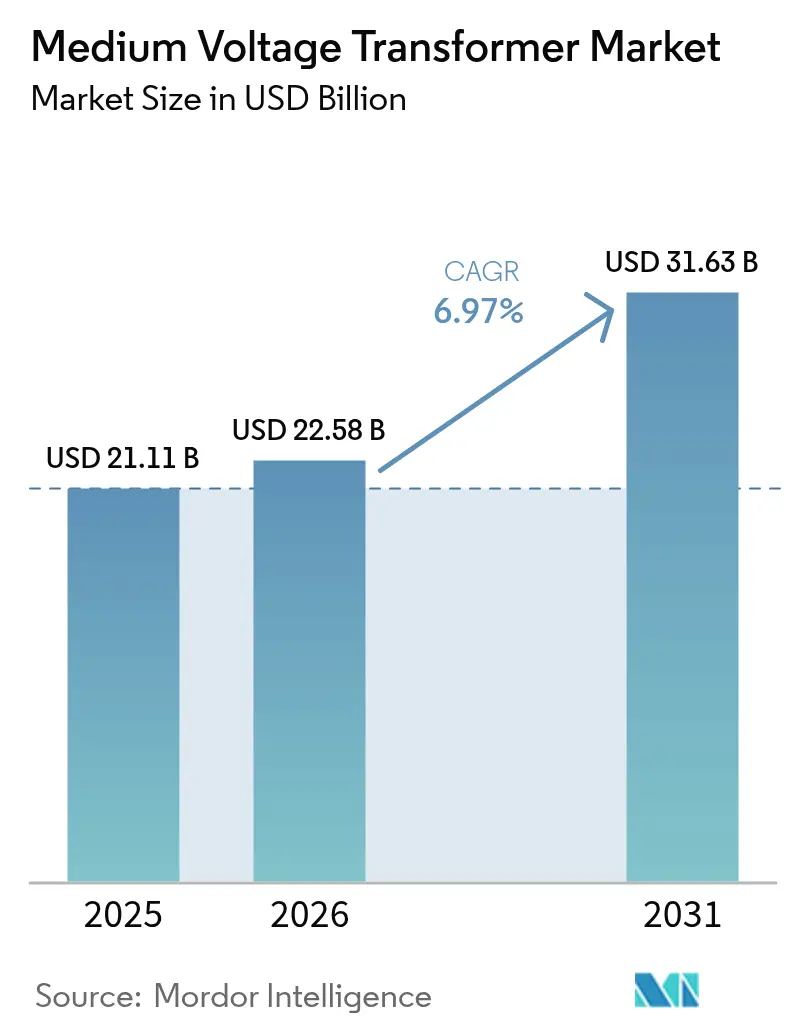
Medium Voltage Transformer market size in 2026 is estimated at USD 22.58 billion, growing from 2025 value of USD 21.11 billion with 2031 projections showing USD 31.63 billion, growing at 6.97% CAGR over 2026-2031.
The expansion reflects simultaneous grid modernization mandates, large-scale renewable integration, and the electrification of industrial loads, all of which require robust medium-voltage infrastructure. Utilities are replacing aging assets—about 70% of installed transformers in the United States are over 25 years old—while Asia–Pacific and the Middle East commission new capacity at an unprecedented pace. Supply constraints have lengthened delivery lead times to more than two years, prompting buyers to adopt early procurement frameworks and multi-vendor strategies. Meanwhile, commercial users, such as hyperscale data centers, are shifting their design specifications toward fire-safe, cyber-resilient, and eco-friendly units that command premium pricing.
Key Report Takeaways
- By cooling type, oil-cooled units held 61.70% of the medium voltage transformer market share in 2025, while air-cooled models are growing at the fastest rate, with a 7.75% CAGR through 2031.
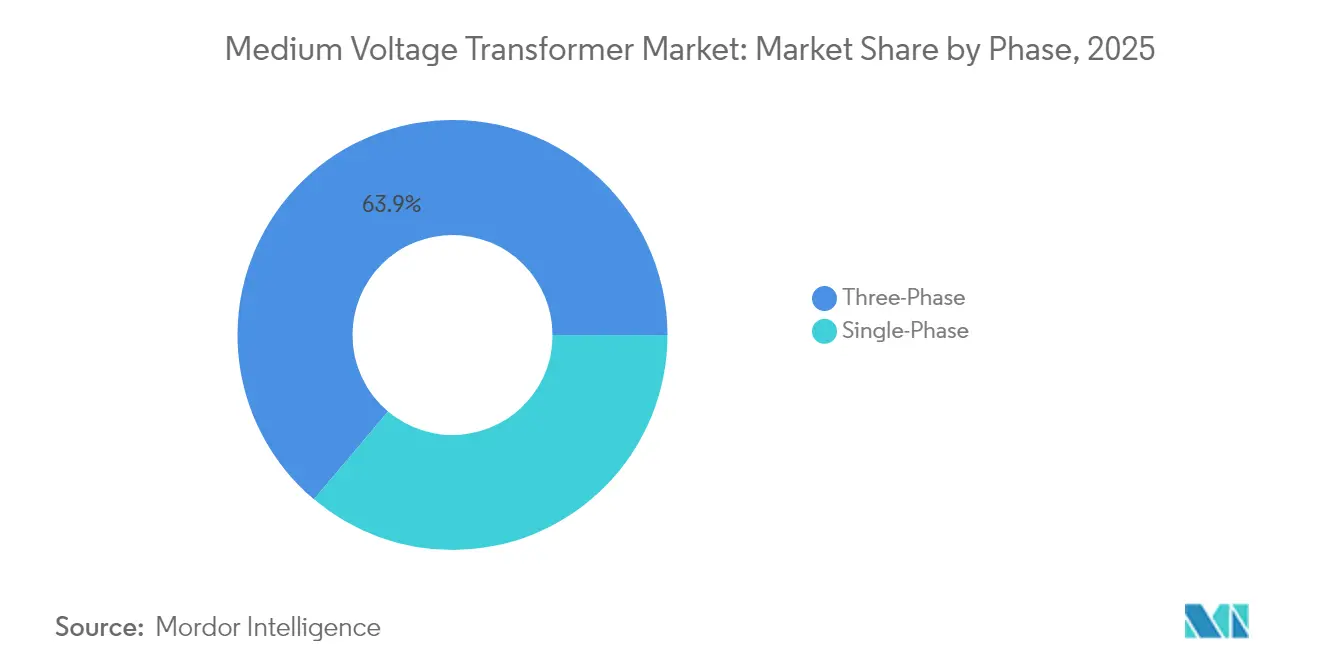
- By phase, three-phase products led with 63.85% revenue share in 2025; single-phase alternatives are expected to progress at 7.21% CAGR to 2031.
- By transformer type, distribution units accounted for 60.20% of the medium voltage transformer market size in 2025, whereas power units are expected to advance at a 7.78% CAGR during 2026-2031.
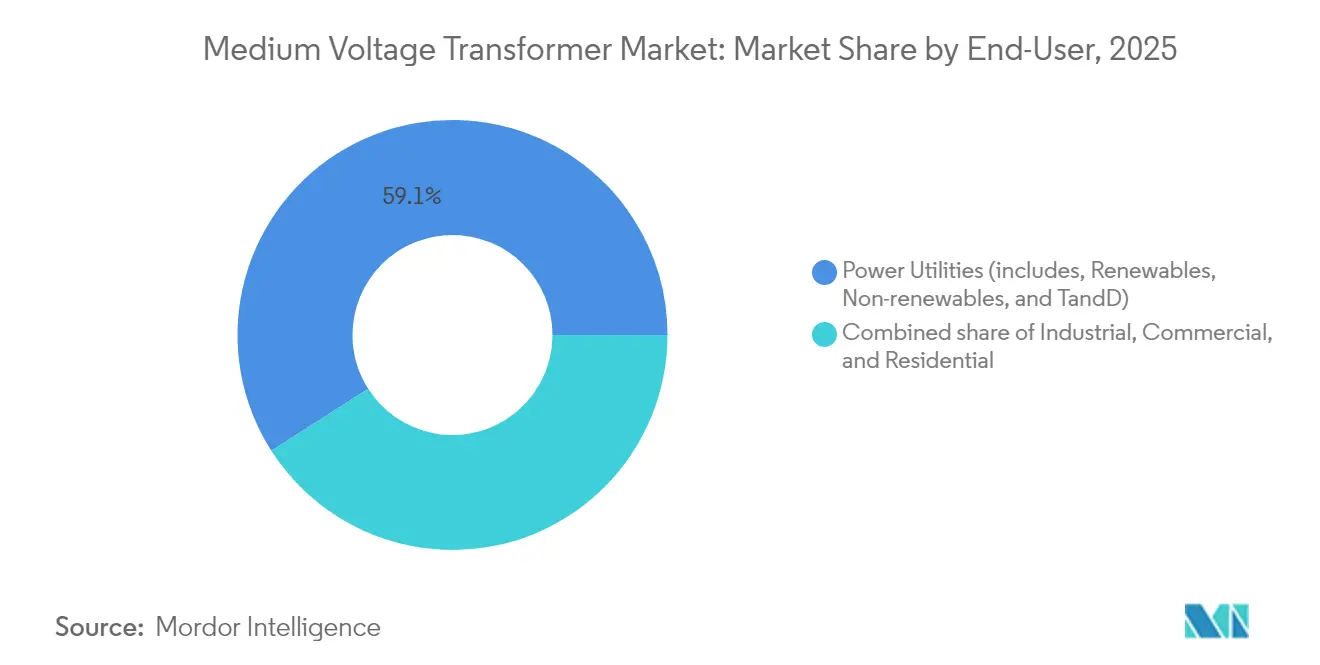
- By end-user, power utilities commanded a 59.05% share in 2025; the commercial segment is projected to record the fastest CAGR at 8.12% through 2031.
- By geography, the Asia-Pacific region captured 48.90% of 2025 revenues and is forecast to expand at a 7.63% CAGR through 2031.
- Hitachi Energy, Siemens Energy, and Schneider Electric together controlled just under 35% of global shipments in 2024.
Note: Market size and forecast figures in this report are generated using Mordor Intelligence’s proprietary estimation framework, updated with the latest available data and insights as of 2026.
Market Trends and Insights
Drivers Impact Analysis of Medium Voltage Transformer Market*
| Driver | (~) % Impact on CAGR Forecast | Geographic Relevance | Impact Timeline |
|---|---|---|---|
| Grid-modernization & aging-asset replacement | +2.1% | North America, Europe, global spillover | Medium term (2-4 years) |
| Renewable-integration push (utility & C&I) | +1.8% | Asia–Pacific core, Middle East & Africa spill-over | Long term (≥ 4 years) |
| Urban/industrial electricity-demand growth | +1.4% | Asia–Pacific, Middle East, North America | Medium term (2-4 years) |
| Data-center microgrid build-out | +0.9% | North America, Europe, advanced APAC markets | Short term (≤ 2 years) |
| Electrolyzer-grade hydrogen projects | +0.6% | Middle East, Europe, selective APAC | Long term (≥ 4 years) |
| Cyber-resilient hardened MV units | +0.2% | North America, Europe | Medium term (2-4 years) |
| Source: Mordor Intelligence | |||
Grid-Modernization & Aging-Asset Replacement
More than two-thirds of U.S. medium-voltage transformers were installed before 2000, with a similar pattern emerging in Western Europe. As utilities face an equipment obsolescence cliff, they bundle replacement orders with digital monitoring, eco-design compliance, and cyber-resilience features that raise the bill of materials. The European Union’s Regulation 548/2014 already enforces published loss parameters with zero upward tolerance, steering buyers toward higher-efficiency cores and natural-ester insulation. This replacement super-cycle tightens global supply, enabling manufacturers to operate plants at near-full capacity and secure multi-year order books.(1)Bruno Melles, “Hitachi Energy Successfully Tests Groundbreaking 765 kV Transformer,” Hitachi Energy, hitachienergy.com
Renewable-Integration Push (Utility & C&I)
Utility-scale solar and wind farms now exceed 2 GW per site in several Asian and Middle Eastern markets, each requiring dozens of step-up transformers, as well as collection substations. Bidirectional power flow, variable voltage support, and rapid islanding are standard specification points as hybrid plants pair battery storage with intermittent generation. Corporate power-purchase agreements drive similar needs behind the meter, where distributed rooftop arrays or on-site turbines connect to private medium-voltage networks. The result is a sustained demand for intelligent transformers equipped with digital tap changers and edge analytics.
Urban/Industrial Electricity-Demand Growth
Industrial electrification—ranging from steel arc furnaces to green-hydrogen electrolyzers—concentrates multi-megawatt loads inside single campuses. Cities add strain as electric vehicle charging plazas and rail transit systems draw on the same feeders. Medium-voltage substations must therefore handle higher fault currents while fitting into space-restricted footprints. Operators are increasingly specifying dry-type or natural-ester units, which reduce fire risk and simplify permitting. Over the medium term, these dense load pockets keep pressure on both distribution and power-class transformer demand curves.
Data-Center Microgrid Build-Out
Hyperscale sites in the United States and Northern Europe now budget 130 kW per rack, adopting 800 V HVDC backbones for efficiency. Owners deploy on-site gas turbines or fuel cells in microgrid layouts that require bidirectional, low-loss medium-voltage conversion. Transformer manufacturers respond with hermetically sealed windings, forced-air cooling, and embedded fiber sensors that monitor hotspot temperatures in real-time. Availability contracts often impose penalties for annual downtime exceeding 1 hour, so buyers prefer suppliers with demonstrated reliability records.
Restraints Impact Analysis of Medium Voltage Transformer Market*
| Restraint | (~) % Impact on CAGR Forecast | Geographic Relevance | Impact Timeline |
|---|---|---|---|
| Copper & steel price volatility | -1.2% | Global, most acute in emerging markets | Short term (≤ 2 years) |
| High cap-ex & supply-chain delays | -0.8% | North America, Europe | Medium term (2-4 years) |
| Wildfire-risk insurance premiums | -0.3% | North America, Australia, Southern Europe | Medium term (2-4 years) |
| PCB-legacy liability on refurbishments | -0.2% | North America, Europe | Long term (≥ 4 years) |
| Source: Mordor Intelligence | |||
Copper & Steel Price Volatility
Copper constitutes roughly one-quarter of a medium-voltage transformer’s cost stack, so tariff announcements or mining disruptions quickly inflate bid prices. Electrical-steel grades—particularly grain-oriented sheets—face similar challenges due to the limited number of mills worldwide that produce high-permeability material. Volatility forces suppliers to shorten quotation validity from 90 days to 30 days, and encourages formula-based adjustment clauses, which complicates buyer budgeting.
High Cap-ex & Supply-Chain Delays
Current order backlogs extend up to 130 weeks for conventional units and exceed 200 weeks for extra-high-capacity models. Even though manufacturers have announced USD 1.8 billion of new North American capacity since 2023, factory lead times remain elevated due to tooling, workforce training, and certification cycles. Financing costs rise when projects must fund multi-year inventory buffers, which dampens near-term installation schedules despite long-term demand strength.
*Our forecasts treat driver/restraint impacts as directional, not additive. The impact forecasts reflect baseline growth, mix effects, and variable interactions.
Medium Voltage Transformer Market Segment Analysis
By Cooling Type:
Environmental Safety Drives Air-Cooled AdoptionOil-immersed designs held 61.70% of the medium voltage transformer market in 2025, yet the air-cooled segment is pacing ahead at a 7.75% CAGR through 2031. Utilities in wildfire-prone regions prefer dry-type or natural-ester units that mitigate fire and spill risks. Hitachi Energy’s successful 765 kV ester-filled prototype demonstrates that fire-safe fluids can now address very high-voltage applications without thermal penalties. Air-cooled products eliminate oil containment pits and reduce maintenance, appealing to data centers and metro rail projects where floor space commands a premium. Efficiency advances—such as vacuum-cast coils, amorphous-metal cores, and active fan modules—help narrow the historical losses of oil-filled counterparts. As insurers attach higher premiums to mineral-oil equipment, the trend toward dry-type units is expected to hold.
Air-cooled transformers also avoid lengthy environmental permitting processes, which accelerates site schedules for commercial developers. The cumulative effect positions the segment to capture a steadily rising share even though oil-cooled models continue to dominate large-capacity substation builds. Utilities looking to modernize legacy sites often blend both cooling types, using ester or dry technology inside city centers while deploying conventional oil units on the transmission perimeter. This hybrid approach generates steady, recurring demand for suppliers that maintain diversified product portfolios within the medium-voltage transformer market.
By Phase:
Three-Phase Dominance Reflects Grid ArchitectureThree-phase equipment accounted for 63.85% revenue in 2025 and is expected to grow at a 7.18% CAGR, mirroring the prevalence of three-wire distribution grids worldwide. Balanced loading reduces conductor mass and neutral currents, giving three-phase designs natural cost and efficiency advantages for high-density feeders. Applications such as data centers, electrolyzers, and rail traction systems require a three-phase supply for stable power quality. Single-phase units remain essential for rural step-down or single-wire-earth-return schemes; however, their growth tracks broader grid extension pacing rather than demand spikes.
Digital monitoring further tilts the field toward three-phase designs because sensor data can be leveraged for phase-imbalance analytics and dynamic capacity forecasting. Vendors bundle harmonic-filtering capability to address rising inverter-based generation, reinforcing the three-phase proposition. Consequently, network planners expect the three-phase share to stay above 60% of the medium voltage transformer market size through 2031.


By Transformer Type:
Power Units Accelerate with RenewablesDistribution transformers represented 60.20% of installations in 2025; however, power-class units are advancing at a faster rate, with a 7.78% CAGR. Massive solar and wind complexes in Saudi Arabia, India, and Australia require multiple high-MVA step-up transformers to tie generation to transmission backbones. Grid interconnection codes also promote low-loss cores and online dissolved-gas analysis, adding extra value to each purchase.
Despite the faster expansion of power units, replacement cycles in suburban feeders keep distribution volumes high. Smart-grid mandates now include sensors, LTE modems, and arc-fault interruption, which lifts average selling prices and allows suppliers to defend margins even in commoditized rural segments. Together, these trends sustain balanced growth across both transformer classes within the medium voltage transformer market.
By End-User:
Commercial Demand Surges on Data & EV InfrastructurePower utilities retained a 59.05% share in 2025, but the commercial category—data centers, campuses, shopping complexes—leads with an 8.12% CAGR outlook. AI training clusters routinely exceed 80 MW per building and require N-1 redundancy at the substation level, resulting in twin or triple 50/70 MVA medium-voltage transformers per site. Similarly, urban EV charging depots incorporate megawatt chargers that need dedicated 13.2 kV feeders.
Industrial users, particularly those in the metals and chemicals sectors, maintain a steady baseline due to decarbonization retrofits. Residential volume growth primarily occurs in Asia and Africa through rural electrification, while rooftop solar and efficient appliances mitigate per-household demand. Overall, non-utility segments collectively generate the fastest incremental revenue within the medium voltage transformer market.
Geography Analysis
APAC Medium Voltage Transformer Market
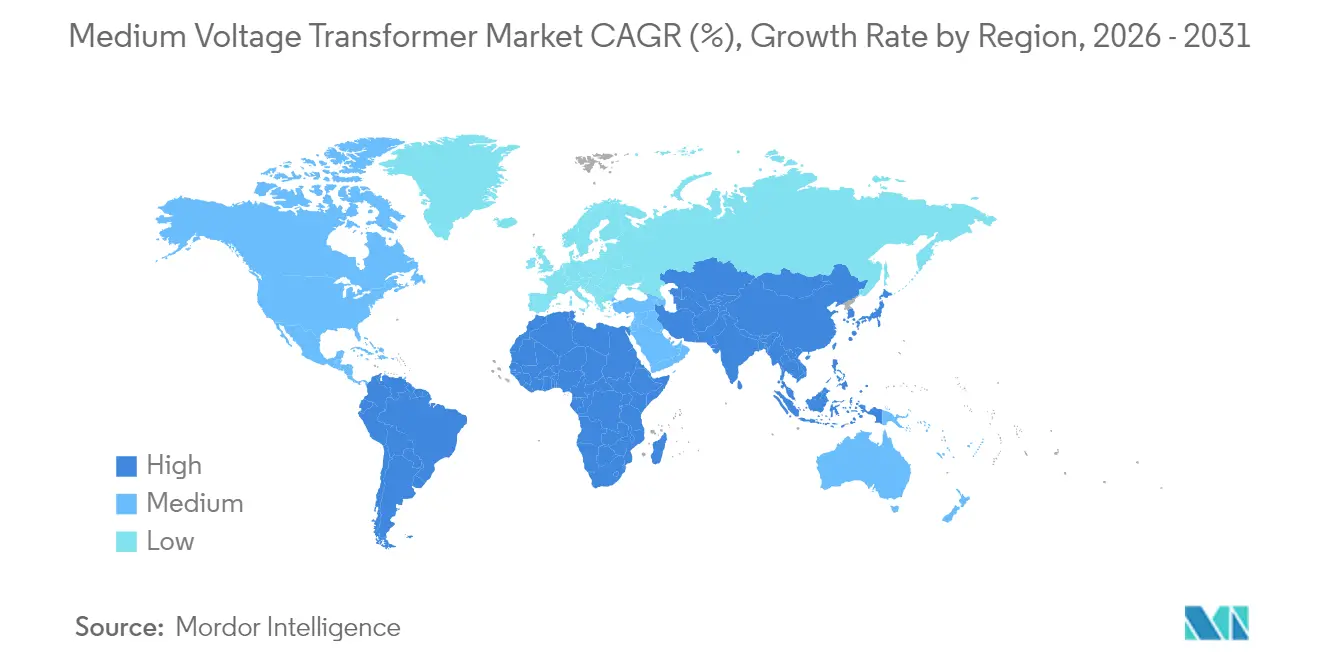
Asia–Pacific commanded 48.90% of global revenue in 2025 and is forecast to post a 7.63% CAGR through 2031. China replaces end-of-life 110 kV assets while installing new 220 kV corridors to evacuate renewables from inland provinces. India’s Production-Linked Incentive scheme accelerates domestic manufacturing, ensuring shorter lead times for local state utilities. Southeast Asian nations roll out electrification and metro rail programs that further amplify regional demand. Japan and South Korea contribute technology-intensive orders, particularly for solid-state prototypes and ester-filled units.
North America Medium Voltage Transformer Market
North America ranks second by revenue, driven by aging fleets and federal stimulus for grid resilience. The United States faces a 30% shortfall in power-class units by 2025, and imports still satisfy roughly half of distribution-class demand. New factories in Texas, Alabama, and Ontario aim to cut lead times, yet most will only reach scale after 2026. Cybersecurity directives and wildfire risk are pushing buyers toward dry-type or ester-filled designs, lifting average selling prices across the medium-voltage transformer market.
Europe Medium Voltage Transformer Market
Europe sustains steady demand through renewable build-outs and cross-border interconnectors. The Continent enforces EcoDesign Tier 2 efficiency from July 2025, compelling utilities to adopt ultra-low-loss cores. Offshore wind hubs in the North Sea and Baltic require 66 kV collection networks, opening fresh opportunities for medium-voltage step-up units. Eastern Europe focuses on grid reliability upgrades supported by EU cohesion funds, while Southern Europe channels investment into wildfire mitigation, favoring dry-type products.
South America and MEA Medium Voltage Transformer Market
South America and the Middle East & Africa together comprise a fast-growing but smaller base. Brazil’s distributed generation boom and Chile’s copper mining electrification continue to drive demand for pad-mounted distribution units. The Middle East channels USD 9.5 billion into solar-plus-storage complexes and green-hydrogen projects, each employing custom medium-voltage step-ups. In Africa, donor-funded rural electrification underpins volume, albeit with extended payment terms that pose challenges to vendor liquidity.

Regulatory Landscape
Regulation and standards continue to raise baseline efficiency and interchangeability requirements for medium-voltage transformer designs used in distribution networks. In the United States, the Department of Energy (DOE) finalized amended energy conservation standards for distribution transformers in April 2024 (10 CFR Part 431, Subpart K), with mandatory compliance starting April 23, 2029; this timeline affects MV distribution-class procurement specifications and drives core-material selections. In June 2026, DOE issued a Request for Information (Docket EERE-2026-BT-STD-0133) to reconsider the April 2024 rule in light of national security and domestic manufacturing capacity constraints, indicating ongoing scrutiny of both supply availability and efficiency targets.
Internationally, technical specifications are tightening component standardization and acceptance testing norms, which influences how global OEM product platforms map to tender requirements. The IEC published IEC TS 63493-1:2025 in December 2025 to standardize dimensions for medium-voltage transformer bushings (12 kV to 52 kV), supporting interchangeability across markets and enabling more multi-vendor maintenance strategies. In June 2025, the International Association of Oil & Gas Producers (IOGP) released Addendum 1 to S-720 (Version 1.01), adding supplementary design, manufacturing, and testing specifications applicable to both liquid-filled and dry-type transformers, reinforcing documentation and verification requirements in industrial and energy-project procurement.
Competitive Landscape
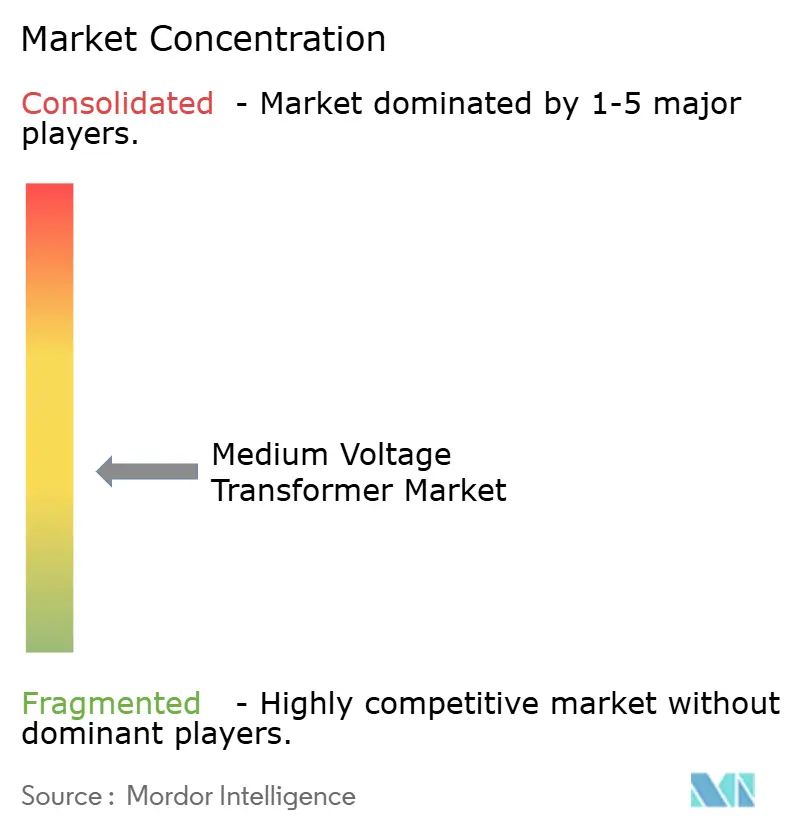
The medium voltage transformer market remains moderately consolidated, with the top five vendors controlling roughly 55% of global shipments in 2024. Hitachi Energy strengthens its lead with a USD 250 million multi-site expansion focused on natural-ester and digital-ready units. Siemens Energy co-locates winding and core fabrication in its Virginia plant to cut logistics time, while Schneider Electric deploys predictive-maintenance software that locks customers into recurring analytics contracts.
New entrants target niches such as silicon-carbide-based solid-state transformers or modular skid solutions for data centers. Barriers to entry rise, however, because buyers demand proven long-term reliability and IEEE/IEC certification. Existing players, therefore, allocate 4-5% of their revenue to R&D, far above the historical average, to maintain a competitive edge. Supply-chain localization is another battleground; vendors positioning copper and steel stockpiles near final assembly sites gain bidding advantages amid raw-material volatility.
Strategic alliances also surface. Samsung C&T partners with Hitachi Energy to pursue undersea HVDC links, while Mitsubishi Electric transfers its legacy transformer lines into a focused subsidiary, enabling it to invest more heavily in high-speed rail traction converters. These moves signal that scale alone is insufficient; technology specialization and regional proximity are increasingly defining the competitive edge within the medium voltage transformer market.(4)Sang Hoon Sung and Jin-Won Kim, “HD Hyundai Electric to Invest $274 mn in Transformer Output Ramp-Ups,” KED Global, kedglobal.com
Medium Voltage Transformer Industry Leaders
Schneider Electric SE
General Electric Company
Eaton Corporation PLC
Siemens AG
Hitachi Energy
- *Disclaimer: Major Players sorted in no particular order
Medium Voltage Transformer Market Companies Covered in this Report
- Hitachi Energy
- Siemens Energy
- Schneider Electric
- Eaton
- General Electric
- Mitsubishi Electric
- CG Power & Industrial Solutions
- Hyosung Heavy Industries
- TBEA Co. Ltd
- Toshiba Energy Systems & Solutions
- WEG SA
- Hammond Power Solutions
- SPX Transformer Solutions
- Jinpan International
- Hyundai Electric
- Bharat Heavy Electricals Ltd.
- Fuji Electric
- Olsun Electrics
- Pioneer Power Solutions
- Ermco
- Central Moloney
- Pearl Electric

Market Opportunities and Future Outlook
A key whitespace is lead-time relief and localized capacity that can support fast-cycle commercial and industrial electrification projects specifying medium-voltage distribution equipment with tighter delivery windows. Several in-scope manufacturers have directed capital toward regional production: ABB announced a USD 200 million investment (May 2026) to expand medium-voltage equipment production across Europe, including a new facility in Dalmine, Italy, and upgrades across several countries, while Schneider Electric confirmed higher capex at its Kolkata facility (July 2026) to increase annual production capacity for medium-voltage components to 250,000 units. In North America, Virginia Transformer broke ground on a Georgia Transformer expansion in Rincon, Georgia (April 2026) to raise production capacity by 50%, and it also announced a new 600,000 square-foot power transformer plant in Muscle Shoals, Alabama (May 2026), reflecting buyer demand for shorter supply chains and multi-site sourcing.
A second opportunity is specification-driven upgrade demand. Higher efficiency requirements, fire-safety preferences, and digital diagnostics increase the content per unit and favor suppliers with standardized, testable designs. Standards work in IEEE transformer committees, including activity related to dry-type standards (IEEE C57.12.50, IEEE C57.96) and diagnostic field testing for fluid-filled power transformers (IEEE C57.152), supports broader adoption of condition assessment and commissioning practices, which translates into sensor-ready and test-friendly designs. Beyond conventional MV transformer demand for grid modernization and renewables interconnection, medium-voltage solid-state transformers (often using silicon carbide power devices) offer a differentiation pathway for vendors and integrators in data-center and industrial power-quality applications where compactness, controllability, and monitoring are procurement priorities.
Recent Industry Developments in Medium Voltage Transformer Market
- July 2026: ABB completed its acquisition of Italy-based Specialtrasfo S.p.A., adding specialized transformers for industrial applications to its portfolio. The deal expands ABBs access to niche MV transformer designs used in industrial electrification projects, where custom engineering and short delivery cycles can influence supplier selection.
- July 2025: Hitachi Energy signed a deal with E.ON in Germany valued up to USD 700 million for critical grid infrastructure. The agreement provides multi-year procurement visibility for transformer and grid equipment suppliers as European utilities accelerate replacement and reinforcement programs tied to energy security and renewable integration.
- September 2024: Hitachi Ltd. announced a transaction involving its power grid business (including transformer-related operations) as part of portfolio actions in the energy segment. The transaction highlights ongoing reshaping of large OEM operating models around grid equipment, with implications for investment focus, product roadmaps, and regional manufacturing footprints.


Medium Voltage Transformer Market Report Scope and Research Methodology
Market Definition and Coverage
This market covers revenue earned from supplying medium voltage transformers used to step voltage up or down within medium voltage distribution networks, including sales across utility, industrial, commercial, and residential settings.
Scope exclusions: It does not count broader electrical balance-of-plant items such as switchgear, cables, protection relays, or installation-only services unless they are priced as part of the transformer supply.
Segments Covered in This Report
- By Cooling Type
- Air-cooled
- Oil-cooled
- By Phase
- Single-Phase
- Three-Phase
- By Transformer Type
- Power
- Distribution
- By End-User
- Power Utilities (includes, Renewables, Non-renewables, and T&D)
- Industrial
- Commercial
- Residential
- By Geography
- North America
- United States
- Canada
- Mexico
- Europe
- Germany
- United Kingdom
- France
- Italy
- Spain
- Russia
- Rest of Europe
- Asia-Pacific
- China
- India
- Japan
- South Korea
- ASEAN Countries
- Australia and New Zealand
- Rest of Asia-Pacific
- South America
- Brazil
- Argentina
- Chile
- Rest of South America
- Middle East and Africa
- Saudi Arabia
- United Arab Emirates
- South Africa
- Egypt
- Rest of Middle East and Africa
- North America
Data Sources, Market Sizing, and Validation
Desk Research
Desk work started with public, repeatable signals that reflect transformer demand and replacement cycles. We reviewed sources such as national energy agencies and grid regulators for T&D investment direction, international trade statistics for transformer-related import and export movement, and customs tariff notes to avoid mixing adjacent equipment categories.
Along with these, we used utility planning documents, company annual reports and investor presentations, and coverage from reputable press to understand shipment timing, backlog behavior, and pricing direction. Patent databases were also checked in a light way to track design shifts that may affect bill-of-material costs, for example efficiency and insulation related filings. When needed, a paid subscription for company financials and a news and financials platform were used to speed up fact checks on revenue splits and expansion announcements. These desk sources are illustrative, and many other public references were also used for data collection, validation, and clarification.
Primary Interviews and Surveys
Primary discussions were used to pressure-test what we saw in public data, especially around medium voltage transformer ASP movement, order lead times, and how utilities and large sites phase replacement programs. We spoke with a mix of manufacturers, distributors, EPC-related stakeholders, and end users across major regions so assumptions on mix, utilization, and procurement cycles could be corrected before final sizing.
Distribution of primary research fieldwork respondents
| Company type | Respondent position | Region |
|---|---|---|
| Top tier: 29% | CXOs: 17% | APAC: 44% |
| Mid tier: 53% | Functional/Unit leaders: 41% | EMEA: 36% |
| Smaller Players: 18% | Managers: 42% | Americas: 20% |
Market-Sizing & Forecasting
Sizing was built using a top-down approach that reconstructs the demand pool from power network expansion and refurbishment activity, then translates it into medium voltage transformer spending through mix and pricing assumptions. To keep totals grounded, selective bottom-up checks were done using sampled supplier revenue splits, channel conversations, and ASP multiplied by plausible unit volumes for key applications.
Inputs were chosen because they can be tracked year over year without relying on hard-to-access data. In this market, the model leans on indicators such as utility T&D capex direction, electrification and industrial connection additions, renewable integration and substation upgrade pace, oil versus dry-type mix shifts, and lead-time driven shipment deferrals that change revenue timing. Where a bottom-up view was incomplete for smaller local supply, gaps were handled by applying region-specific coverage factors that were validated in interviews, and then rechecked against trade movement and utility procurement patterns.
For forecasting, scenario analysis was used so the base case can be flexed using a few practical drivers, including grid modernization budgets, replacement intensity, and expected ASP progression. The scenarios were aligned with what industry participants described as realistic ranges for order intake, project slippage, and pricing normalization over the forecast window.
Data Validation & Update Cycle
Validation was done through multiple checks that compare the modeled totals with independent signals, then flag outliers for follow-up. When a region's outcome looked too high or too low, assumptions were revisited, and clarifying calls were triggered around mix, pricing, or timing so the same issue did not flow into the forecast.
Before sign-off, the model and narrative go through multi-step analyst reviews, including variance checks across years and consistency checks against known grid investment direction. Reports are refreshed annually, and interim updates are made when material events occur that can change pricing, supply availability, or project timelines. Right before delivery, a final pass is completed so clients receive the most recently updated view available.
Mordor Intelligence's Medium Voltage Transformer Market Size Compared With Other Published Estimates
Published market sizes for medium voltage transformers can look far apart, even when the topic sounds identical, because the underlying counting rules are not always the same. Differences usually come from how each study treats voltage boundaries, which transformer families get included, and whether value is recognized at shipment, order booking, or installed project spend.
Evidence like the 2025 to 2026 step-up on the report page, plus cross-checks on end-user buying cycles and regional grid investment direction, are the checks that keep Mordor Intelligence's estimate tied to actual medium voltage transformer revenue rather than adjacent electrical equipment totals. Another common driver is ASP handling, where some estimates assume a straight-line price increase, even though interview feedback often points to mix-driven swings between oil and dry-type units and timing effects from long lead times.
Benchmark comparison
| Source | Market Size | Gaps in Research Methodology |
|---|---|---|
| Mordor Intelligence | USD 22.58 B (2026) | |
| Global Consultancy A | USD 14.18 B (2025) | Uses a different base year and segmentation lens that can narrow what is counted as medium voltage, and the value capture can skew toward a smaller demand pool depending on how mounting and application splits are interpreted. |
| Industry Publisher B | USD 21.23 B (2025) | Base-year choice and pricing progression assumptions can shift the implied 2026 level, and the boundary between transformer supply value and broader project spend is not always clearly separated. |
In practical terms, the spread in published values mostly traces back to year selection, scope boundaries around what counts as a medium voltage transformer, and how pricing and timing are treated when lead times are long. By keeping the model anchored to observable demand signals and then confirming mix and ASP logic through interviews, the final estimate stays traceable to clear steps that can be repeated during each refresh.


Key Questions Answered in the Report
What is the projected value of the medium voltage transformer market in 2031?
The market is forecast to reach USD 31.63 billion by 2031, growing at a 6.97% CAGR.
Which region leads current demand for medium-voltage transformers?
Asia-Pacific holds the top position with 48.90% revenue share in 2025 and the fastest 7.63% CAGR outlook.
Why are air-cooled transformers gaining traction?
They reduce fire risk, simplify permitting, and comply with stricter environmental standards, leading to a 7.75% CAGR through 2031.
What is driving commercial-segment growth?
Hyperscale data centers and EV charging depots create high-density load centers, boosting commercial demand at an 8.12% CAGR.
How long are transformer delivery lead times today?
Standard medium-voltage units can require 115-130 weeks for delivery, with larger ratings extending beyond 200 weeks.
Which companies are expanding capacity in North America?
Hitachi Energy, HD Hyundai Electric, and Siemens Energy have each announced major investments to shorten regional lead times.
Page last updated on:


 Your data is secure and never sold or shared.


