
Market Overview
| Study Period | 2019 - 2031 |
|---|---|
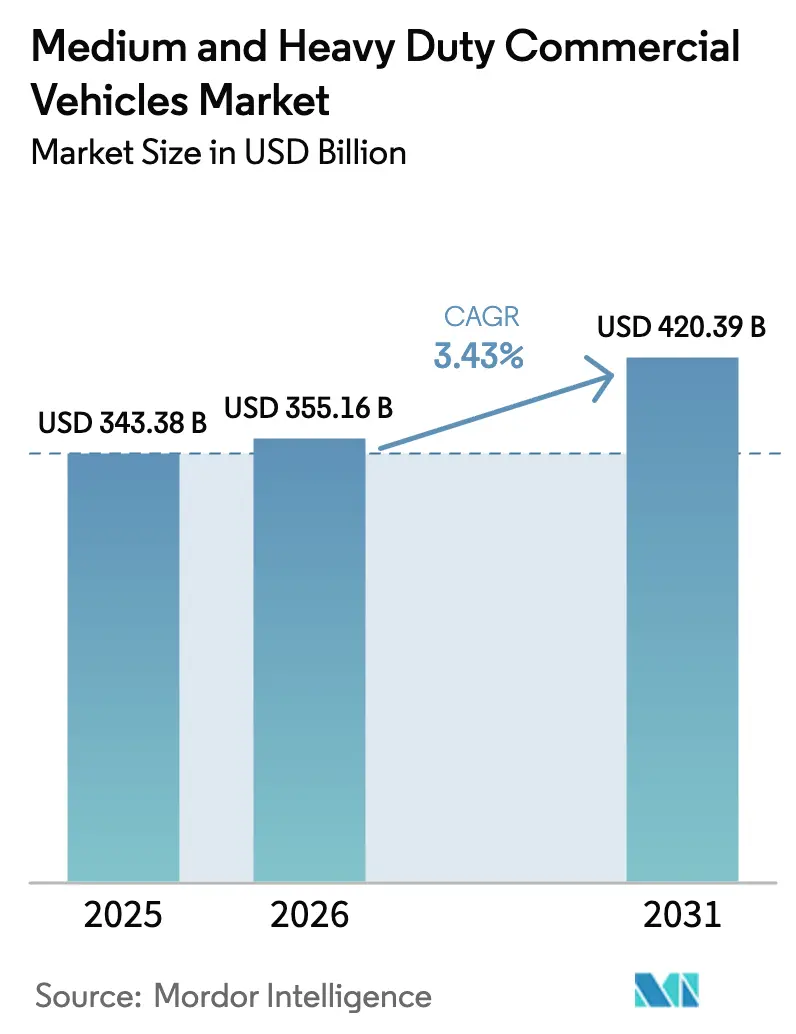
| Market Size (2026) | USD 355.16 Billion |
| Market Size (2031) | USD 420.39 Billion |
| Growth Rate (2026 - 2031) | 3.43 % |
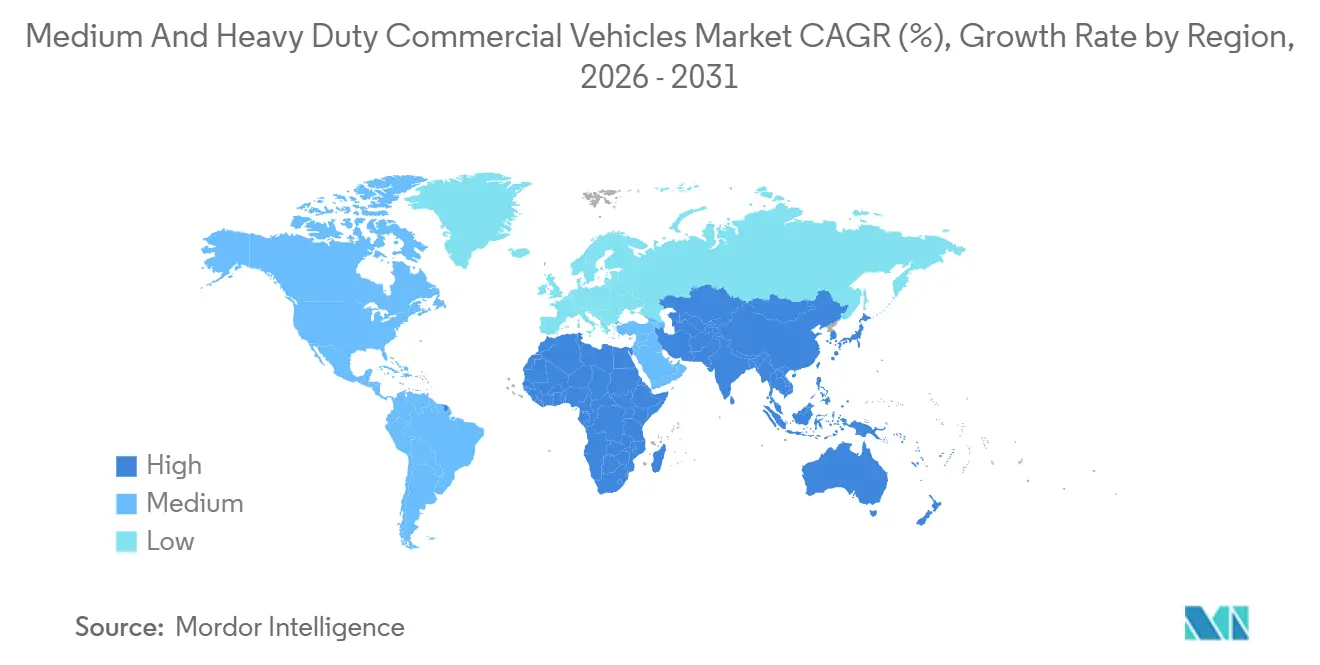
| Fastest Growing Market | Middle East and Africa |
| Largest Market | Asia Pacific |
| Market Concentration | Medium |
Major Players *Disclaimer: Major Players sorted in no particular order Image © Mordor Intelligence. Reuse requires attribution under CC BY 4.0. | |
Medium And Heavy Duty Commercial Vehicles Market Analysis by Mordor Intelligence
The medium and heavy duty commercial vehicles market size is expected to grow from USD 343.38 billion in 2025 to USD 355.16 billion in 2026 and is forecast to reach USD 420.39 billion by 2031 at a 3.43% CAGR over 2026–2031. Fleet owners are absorbing higher upfront prices for battery-electric and fuel-cell trucks to secure lower lifetime operating costs, spurred by Euro-VII and U.S. EPA Phase 3 rules that render legacy diesel platforms uneconomical by the decade’s end. Chinese battery costs, U.S. infrastructure incentives, and Gulf infrastructure programs are reshaping procurement strategies as operators balance emission compliance with payload needs. Manufacturers have accelerated in-house battery production and software-defined vehicle programs to retain margin control while offering telematics-linked service contracts that reduce downtime and insurance premiums. Competitive dynamics now hinge on the speed of powertrain electrification, vertical integration, and access to megawatt-level charging infrastructure across long-haul corridors.
Key Report Takeaways
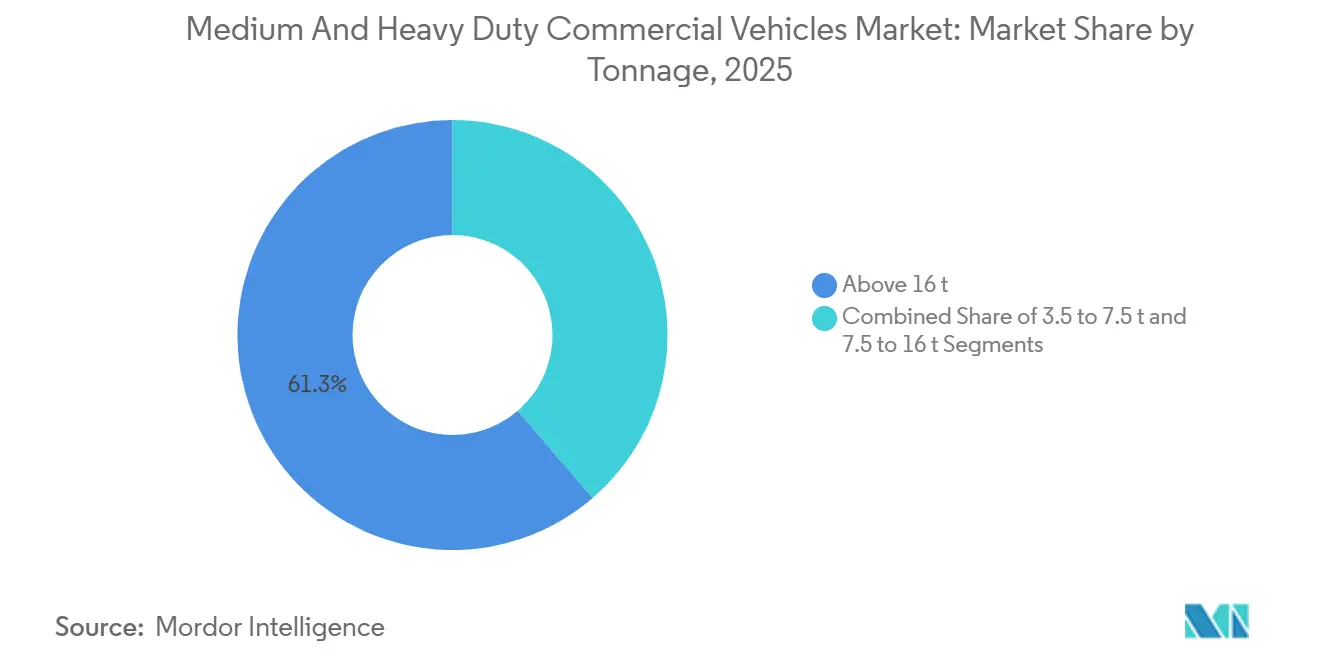
- By tonnage, vehicles above 16 tonnes led with 61.27% of the medium and heavy-duty commercial vehicles market share in 2025, while the 3.5 to 7.5 tonne class is forecast to expand at a 3.45% CAGR through 2031.
- By propulsion, internal-combustion engines accounted for 87.71% of volume in 2025; battery-electric trucks recorded the fastest 3.55% CAGR to 2031.
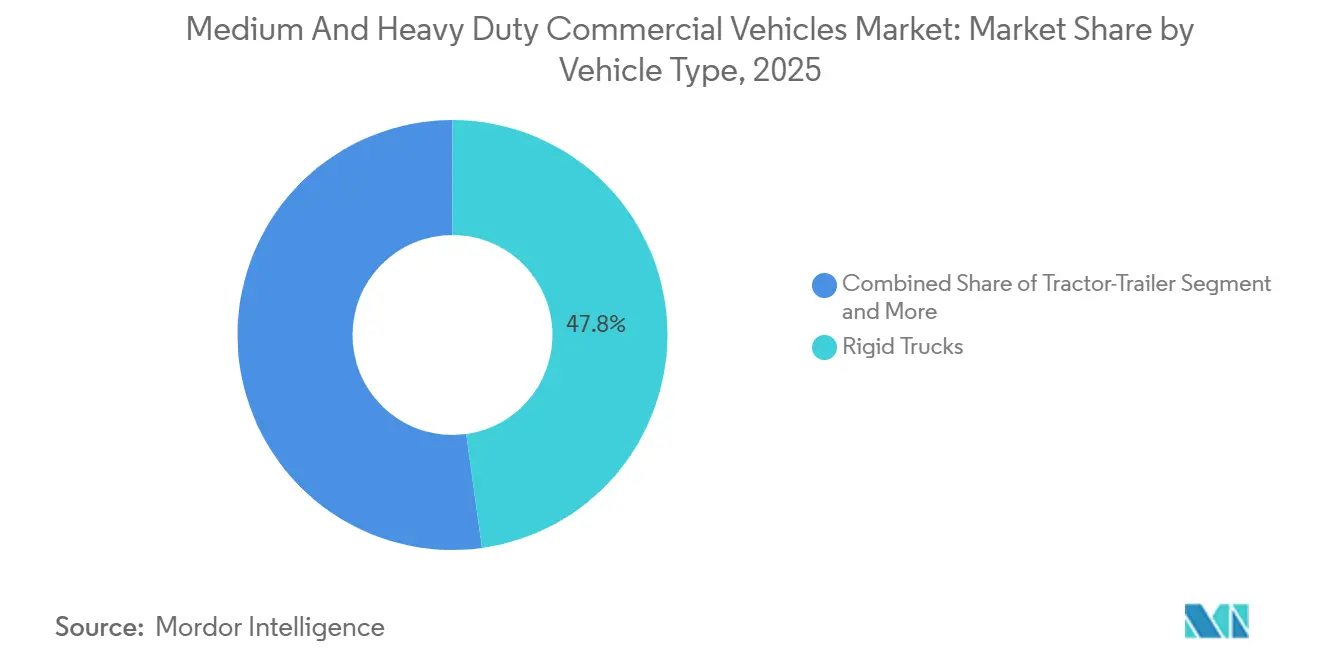
- By vehicle type, rigid trucks held a 47.75% share of the medium and heavy-duty commercial vehicles market size in 2025, and tractor-trailers are advancing at a 3.58% CAGR through 2031.
- By end-user, logistics and transportation commanded 45.17% of revenue in 2025; the segment continues at a 3.48% CAGR on the back of e-commerce demand.
- By geography, Asia-Pacific generated 43.16% of global revenue in 2025, while the Middle East and Africa are the fastest-growing regions at 3.51% CAGR to 2031.
Note: Market size and forecast figures in this report are generated using Mordor Intelligence’s proprietary estimation framework, updated with the latest available data and insights as of January 2026.
Market Trends and Insights
Drivers Impact Analysis of Medium And Heavy Duty Commercial Vehicles Market*
| Driver | (~) % Impact on CAGR Forecast | Geographic Relevance | Impact Timeline |
|---|---|---|---|
| Fleet Renewal Driven by Euro-VII & EPA 2027 Emission Rules | +0.6% | North America and Europe, with spillover to export markets | Medium term (2-4 years) |
| Infrastructure Stimulus | +0.5% | Asia-Pacific (India, Southeast Asia), Middle East, Latin America | Long term (≥ 4 years) |
| E-Commerce Logistics Expansion | +0.4% | Global, concentrated in urban corridors of North America, Europe, China | Short term (≤ 2 years) |
| Mining Sector's Push for Battery-Electric Haul Trucks | +0.3% | Middle East and Africa, Latin America (Chile, Peru), Australia | Medium term (2-4 years) |
| Telematics-Enabled Usage-Based Insurance Lowers TCO | +0.3% | North America and Europe, early adoption in Asia-Pacific | Short term (≤ 2 years) |
| Secondary-Use Battery Leasing Models | +0.2% | Europe, pilot programs in North America and China | Long term (≥ 4 years) |
| Source: Mordor Intelligence | |||
Fleet Renewal Driven by Euro-VII & EPA 2027 Emission Rules
In the near future, stricter Euro-VII limits will significantly reduce nitrogen-oxide thresholds. These limits will also introduce real-world urban stop-and-go testing and, for the first time, impose caps on brake and tire particle emissions. Meanwhile, the U.S. EPA's Phase 3 greenhouse-gas rule aims for a substantial reduction in intensity over the next decade. However, achieving this target is impossible through mere incremental improvements in diesel. In California, along with several other states, there is a mandate for a significant portion of Class 7-8 sales to be zero-emission within the next decade. This move jeopardizes the resale value of new diesel tractors [1]. In response, manufacturers are channeling R&D into battery-electric and fuel-cell platforms. They're also bolstering regenerative braking and battery-health diagnostics to adhere to durability standards. Fleets that purchase compliant trucks ahead of the deadline stand to gain from enhanced resale values and better financing terms linked to ESG metrics [2].
Infrastructure Stimulus in Emerging Economies
India's National Infrastructure Pipeline is set to invest a substantial amount by mid-decade, primarily focusing on upgrading roads and ports. This initiative has significantly boosted the demand for rigid trucks across various freight corridors. Meanwhile, both Indonesia and Vietnam have allocated significant resources for highway projects. These investments are driving a surge in the purchases of concrete mixers and dump trucks, fueling a construction boom in both nations. In the Middle East, Saudi Arabia is channeling considerable funding into its Vision 2030, specifically targeting the development of NEOM logistics corridors. Simultaneously, the United Arab Emirates is ambitiously scaling Khalifa Port's capacity to handle a much larger volume of containers in the coming years, ensuring a steady intake of tractor-trailers.
E-Commerce Logistics Expansion
In 2025, parcel volumes in the Asia-Pacific region experienced significant growth year on year, prompting a shift in fleet-renewal cycles from the traditional longer timelines to a more accelerated schedule. Amazon's substantial order of electric delivery vehicles, coupled with UPS's deployment of a large fleet of electric vans, underscores a pronounced shift towards medium-weight platforms, adept at maneuvering through low-emission zones. Currently, numerous cities across Europe impose restrictions on diesel trucks, mandating compliance with stringent emission standards. Moreover, many of these cities are planning a complete ban on internal combustion engines (ICE) in the near future, positioning battery-electric delivery vans as the primary choice for urban logistics. The demands of same-day delivery are pushing fleets to either select vehicles that can complete multiple urban cycles on a single charge or to implement opportunity charging at micro-hubs. Additionally, telematics-driven route optimization is curbing empty kilometers, bolstering the case for electrification by enhancing daily utilization rates.
Mining Sector Push for Battery-Electric Haul Trucks
By the mid-term, Anglo American aims to significantly reduce diesel use at its Mogalakwena site through a hydrogen retrofit on its Komatsu 930E, marking a substantial step in heavy-haul decarbonization. In trials conducted in Chile and Australia, Caterpillar's 793 XE demonstrated notable cost efficiency, aided by regenerative braking during downhill hauls. BHP's fleet policy, which prohibits the introduction of new diesel trucks in the long term, underscores a steadfast commitment to zero-emission equipment in its copper and iron-ore operations. While the initial capital investment is considerably higher, the tightening margins from escalating carbon prices and ESG-linked lending bolster the argument for early adoption. Additionally, emerging battery swap systems promise a rapid turnaround time, ensuring minimal disruption during high-duty production cycles.
Restraints Impact Analysis of Medium And Heavy Duty Commercial Vehicles Market*
| Restraint | (~) % Impact on CAGR Forecast | Geographic Relevance | Impact Timeline |
|---|---|---|---|
| High Upfront Cost of Zero-Emission Trucks | -0.4% | Global, acute in emerging markets with limited subsidies | Short term (≤ 2 years) |
| Supply-Chain Bottlenecks | -0.4% | Global, concentrated in North America and Europe | Medium term (2-4 years) |
| Depot-Level Grid-Capacity Limitations | -0.3% | Urban centers in North America, Europe, Asia-Pacific | Medium term (2-4 years) |
| Skilled-Technician Shortage | -0.2% | North America, Europe, emerging in Asia-Pacific | Long term (≥ 4 years) |
| Source: Mordor Intelligence | |||
High Upfront Cost of Zero-Emission Trucks
In 2025, battery-electric Class 8 tractors remain significantly more expensive than their diesel counterparts. Additionally, fuel-cell variants come with an even higher cost. While incentives like the U.S. Inflation Reduction Act's credit and Germany's KsNI subsidy help reduce the price disparity, they do not fully bridge the gap. For smaller fleets without access to affordable capital, the extended payback periods pose a challenge, particularly in long-haul segments. Although leasing models and battery-as-a-service options provide some relief, their feasibility depends on residual-value forecasts, which are still unproven in secondary markets. Operators face a difficult decision, balancing the higher upfront investment against the increasing restrictions in emission zones, which threaten the resale value of diesel assets.
Supply-Chain Bottlenecks for Power Electronics & Batteries
In 2025, wafer fabs grappled with automotive demand, leading to significantly long lead times for silicon-carbide inverter modules. With a few cell makers dominating a majority of the global output, a concentrated risk emerged as OEMs simultaneously ramped up truck programs. Amidst Indonesian export curbs, nickel prices experienced substantial fluctuations, injecting volatility into battery cost projections. Daimler's large-scale cell plant in Europe won't commence operations for several years, creating near-term supply gaps. In response, OEMs are hedging by dual-sourcing and redesigning packs for LFP chemistry, capitalizing on its energy density advantages.
*Our forecasts treat driver/restraint impacts as directional, not additive. The impact forecasts reflect baseline growth, mix effects, and variable interactions.
Medium And Heavy Duty Commercial Vehicles Market Segment Analysis
By Tonnage:
Urbanization Favors Lighter ClassesVehicles above 16 tonnes captured 61.27% of the medium and heavy-duty commercial vehicles market share in 2025, reflecting their dominance in intercity freight and mining haulage. The 3.5–7.5 tonne band is growing at a 3.45% CAGR to 2031, fueled by e-commerce operators that prioritize maneuverability in dense city cores and can profit from single-charge delivery cycles.
Rigid emission standards apply uniformly across weights above 3.5 tonnes, nullifying any compliance advantage of mid-duty categories and nudging fleets toward battery-electric or fuel-cell upgrades in every bracket. Hyundai’s XCIENT fuel-cell tractor exceeded 10 million km in Swiss and California service by 2025, proving viability for long-haul payloads where battery weight remains a hurdle. The medium and heavy-duty commercial vehicles market now sees OEMs co-designing charging hubs and route planning software specific to tonnage class, aligning investment decisions with urban zoning policies.

By Propulsion Type:
Diesel Dominance Erodes as BEV ScalesInternal-combustion engines commanded 87.71% of 2025 volume, yet battery-electric trucks expand at a 3.55% CAGR to 2031, the fastest rate in the segment. Combined output of Daimler eCascadia, Volvo VNR Electric, and BYD 8TT exceeds half a lakh vehicles annually by 2026, marking the largest coordinated capacity build-out in the medium and heavy-duty commercial vehicles market context.
Plug-in hybrids occupy a transition niche but remain under 3% share due to complexity and marginal fuel savings over optimized diesel models. Fuel-cell trucks secure footholds in regions with hydrogen corridors, but large-scale uptake hinges on sub-USD 4/kg green hydrogen pricing. Alternative fuels such as LNG and CNG act as interim solutions across agriculture and forestry where charging infrastructure is sparse. China’s dual-credit system accelerates BEV penetration, with domestic OEMs launching 15 new models across 2024-2025.
By Vehicle Type:
Tractor-Trailers Gain as Range Anxiety EasesRigid trucks maintained 47.75% of 2025 shipments, yet tractor-trailers achieved a leading 3.58% CAGR through 2031 because emerging fuel-cell and plug-in hybrid systems now deliver 500–700 km range without megawatt charging stops. Nikola Tre and Hyundai XCIENT deployments validate hydrogen’s role for intercity freight and position tractor-trailers to overtake rigid truck growth within the medium and heavy-duty commercial vehicles market.
Tipper and dump-truck electrification advances quickest in underground mining, where zero tailpipe emissions cut ventilation costs that can exceed USD 50 per hour. Specialized vocational trucks lag due to body-integration complexity, though ISO 15118 vehicle-to-grid standards create revenue opportunities through ancillary grid services. OEMs collaborate with body builders to pre-engineer electric power-take-off solutions, trimming integration lead times.
By End-User Industry:
Logistics Leads, Mining ElectrifiesLogistics and transportation accounted for 45.17% of 2025 demand and sustained a 3.48% CAGR, driven by parcel growth and low-emission-zone mandates. UPS, DHL, and Amazon collectively committed to more than a lakh zero-emission vans and trucks by 2030, locking in a baseline volume for light and medium classes within the medium- and heavy-duty commercial vehicles market.
Mining operators pilot battery-electric haul trucks at copper and iron-ore sites in Chile, Australia, and South Africa, while agriculture and forestry fleets rely on CNG and biodiesel until grid access improves. Public utilities are adopting battery-electric refuse trucks under the European Clean Vehicles Directive, which stipulates a minimum zero-emission procurement target by 2030. These collective moves shift supplier roadmaps toward modular powertrains adaptable to diverse duty cycles.
Geography Analysis
APAC Medium and Heavy Duty Commercial Vehicles Market
Asia-Pacific delivered 43.16% of global revenue in 2025, driven by China's policies encouraging new-energy-vehicle production and India's large-scale infrastructure initiatives. Chinese commercial NEV sales saw significant growth as major manufacturers introduced multiple electric truck models to comply with regulatory requirements. While India's logistics-driven economic growth sustained truck demand, the adoption of electric vehicles remained minimal due to inadequate charging infrastructure and financing challenges for smaller operators. Meanwhile, Japan and South Korea's substantial subsidies for fuel-cell trucks supported the rollout of advanced models, boosting the region's electrification efforts.
North America and Europe Medium and Heavy Duty Commercial Vehicles Market
North America and Europe collectively accounted for a significant share of the 2025 revenue, with their growth shaped by regulatory frameworks mandating early electrification. In the United States, policies targeting a substantial portion of truck sales drove the transition, while in Europe, stricter emissions standards limited the viability of diesel platforms. Key European markets registered notable adoption of battery-electric trucks, particularly in medium-duty models serving municipal and parcel delivery routes.
EMEA and LATAM Medium and Heavy Duty Commercial Vehicles Market
The Middle East and Africa lead growth at 3.51% CAGR through 2031, buoyed by Gulf diversification projects and mining electrification pilots. Saudi Arabia’s USD 500 billion NEOM investment and UAE port expansion underpin tractor-trailer demand, while South African mines retrofit haul trucks with hydrogen powertrains to cut diesel expense. Turkey emerges as an export base for medium-duty trucks into Europe, exploiting lower labor costs and favorable logistics. Latin America’s truck fleet expands with agricultural exports from Brazil and Argentina, though currency volatility tempers electrification investment.
Regulatory Landscape
Medium and heavy-duty commercial vehicles are being shaped by tighter emissions and CO2-performance rules in North America and Europe, accelerating the shift away from legacy diesel platforms. In the United States, the Environmental Protection Agency (EPA) finalized Phase 3 greenhouse gas (GHG) standards for heavy-duty highway vehicles with emission reductions starting in model year 2027, covering both tractors and vocational vehicles under a unified compliance framework.
In the European Union, Regulation (EU) 2024/1610 amended Regulation (EU) 2019/1242 and strengthened CO2 emission performance standards for new heavy-duty vehicles. The framework extends coverage across additional vehicle groups and anchors targets to 2030 climate goals, while retaining a 15% CO2 reduction target versus 2019 levels for the 2025-2029 reporting period. It also sets a wider 2030 target (43% reduction) for a broader set of heavy-duty vehicles, including lorries over 5 tonnes and buses above 7.5 tonnes, reinforcing the move toward zero-emission powertrains and tighter compliance and reporting expectations for OEMs.
Value Chain Analysis
The value chain covers upstream raw materials and energy inputs (steel, aluminum, electronics, battery materials), tier suppliers for conventional and zero-emission systems (engines, aftertreatment, e-axles, inverters, battery packs, fuel cells, hydrogen tanks), and OEM assembly and integration. Downstream, sales and lifecycle services are delivered through dealer networks, leasing and finance, fleet telematics, and maintenance ecosystems. Power-electronics and battery supply availability are increasingly influential, and OEMs are using dual-sourcing models while expanding in-house capabilities to protect margins and manage lead-time risks.
Decarbonization is also pulling new participants into the value chain via multi-party collaborations that bundle vehicles with energy and infrastructure. Daimler Truck partnering with KEYOU on hydrogen internal combustion technology, with a planned 2027 market launch pathway, is one example. On fuel cells, Toyota, Daimler Truck, and Volvo Group are moving toward equal shareholding in cellcentric to develop and commercialize fuel cell systems for heavy-duty applications. In batteries, Iveco Group and Microvast expanded their collaboration to scale next-generation battery technologies for European heavy-duty platforms, showing how cell and pack partnerships are becoming central to product cadence and regional supply assurance.
Competitive Landscape
In the mid-2020s, the medium and heavy-duty commercial vehicles market saw a moderate concentration, with the leading manufacturers holding a significant share of the global volume. Chinese firms, capitalizing on integrated battery supply chains, are strategically undercutting established players in regions sensitive to pricing. In a move to navigate EU tariffs, BYD inaugurated a plant in Hungary during this period, while Sinotruk is making waves in Africa and Latin America by offering diesel-electric hybrids at a notable discount compared to Western competitors.
In response to these challenges, traditional industry leaders are turning to vertical integration. Daimler has pledged a substantial investment in European battery production, while PACCAR is collaborating with Cummins to co-develop fuel-cell stacks, ensuring they aren't overly reliant on suppliers. Moreover, with the advent of telematics and software-defined architectures, companies are now generating recurring revenues through predictive maintenance and usage-based insurance, helping to counterbalance the declining margins on hardware.
Emerging opportunities lie in areas like battery-as-a-service and megawatt charging stations, where early entrants can secure exclusive contracts with fleets. Disruptors like Nikola are eyeing the long-haul hydrogen market, and Rivian is carving a niche with last-mile battery-electric vans. Both are on a quest for scale but are grappling with profitability hurdles. Meanwhile, patent activity in solid-state batteries and wireless charging indicates that the next competitive frontier will be rapid recharge technology capable of supporting substantial driving ranges - a potential game-changer for existing powertrain strategies.
Medium And Heavy Duty Commercial Vehicles Industry Leaders
-
PACCAR Inc
-
Daimler AG
-
Volvo Group
-
Tata Motors Limited
-
Traton SE
- *Disclaimer: Major Players sorted in no particular order

Medium And Heavy Duty Commercial Vehicles Market Companies Covered in this Report
- Daimler Truck AG
- Volvo Group
- Traton SE (MAN, Scania, Navistar)
- PACCAR Inc.
- Tata Motors Ltd.
- Hyundai Motor Co.
- CNHTC (Sinotruk)
- Dongfeng Motor Corp.
- FAW Group
- Renault Trucks
- Isuzu Motors Ltd.
- Hino Motors
- Ashok Leyland
- Iveco Group
- Kamaz PJSC
- Shacman (Shaanxi Auto)
- UD Trucks
- BYD Auto
- Nikola Corp.
Read Analysis of Medium And Heavy Duty Commercial Vehicles Companies
Market Opportunities and Future Outlook
Regulation-driven fleet renewal is creating near-term whitespace for OEMs and solution providers that can package compliant vehicles with financing, charging or hydrogen supply, and uptime-focused service contracts. The US EPA Phase 3 program ties model year 2027 onward requirements to steep category-dependent CO2 reductions through model year 2032, which is pushing fleets and manufacturers to assess battery-electric, fuel cell, and cleaner diesel and gas pathways in parallel. In Europe, the 2024 amendment to heavy-duty CO2 standards (Regulation (EU) 2024/1610) and related credit-earning adjustments for the 2025-2029 period support demand for compliance-oriented product roadmaps and reporting-ready telematics, particularly for high-utilization logistics and municipal duty cycles.
Manufacturing and industrial investments are also generating more concrete opportunities around regionalized supply, flexible production, and localized component ecosystems. In January 2026, MAN Truck and Bus announced a nearly EUR 1 billion investment program in German sites through 2030 focused on electrification, digitalization, and automation, while Scania disclosed a EUR 70 million investment in June 2026 to adapt its Angers, France facility for electric truck production. In North America, Volvo Group advanced toward the launch of its USD 1 billion heavy-duty truck plant in Nuevo Leon, Mexico, and began production at the Monterrey plant in July 2026, strengthening localized supply for fleets facing tighter emissions compliance and shorter procurement lead times.
Recent Industry Developments in Medium And Heavy Duty Commercial Vehicles Market
- July 2026: Volvo Group commenced production at its Monterrey, Mexico, heavy-duty truck plant, strengthening North American supply coverage through a new regional manufacturing footprint. The start-up supports faster delivery cycles for fleets securing near-term build slots and provides a platform for OEMs to balance product mix as powertrain requirements tighten.
- May 2026: Volvo Trucks announced a global product launch that included a new 13-liter engine platform for diesel and gas powertrains, with sales starting in Q3 2026, and also expanded electric truck capabilities for its North American VNR Electric range. The launch refreshes the conventional powertrain offering while expanding battery-electric duty-cycle coverage, giving fleets more options to align purchases with emissions constraints and operational needs.
- March 2025: Tata Motors commenced trials of hydrogen-powered trucks, expanding its alternative-powertrain validation for long-haul applications. The trials add competitive pressure around hydrogen pathways and indicate broader OEM investment in parallel decarbonization routes beyond battery-electric platforms.
Medium And Heavy Duty Commercial Vehicles Market Report Scope and Research Methodology
Market Definition and Coverage
This market covers the sales value of newly built medium and heavy-duty commercial vehicles used on public roads, counted when the vehicle gross weight is above 3.5 tons. The scope includes trucks (rigid, tractor-trailer, tipper/dump, and vocational) and road-worthy buses, tracked across major regions.
Scope exclusions: Light commercial vans at or below 3.5 tons GVW and off-highway equipment such as agricultural tractors and mining haul trucks are excluded.
Segments Covered in This Report
- By Tonnage
- 3.5 to 7.5 t
- 7.5 to 16 t
- Above 16 t
- By Propulsion Type
- Internal-Combustion Engine (Diesel & Gasoline)
- Battery Electric
- Plug-in Hybrid Electric
- Fuel-cell Electric
- Alternative Fuels (CNG, LNG, Bio-fuel, LPG)
- By Vehicle Type
- Rigid Truck
- Tractor-Trailer
- Tipper / Dump Truck
- Specialized & Vocational Trucks
- By End-user Industry
- Logistics & Transportation
- Construction & Mining
- Agriculture & Forestry
- Utilities & Municipal Services
- By Geography
- North America
- United States
- Canada
- Rest of North America
- South America
- Brazil
- Argentina
- Rest of South America
- Europe
- Germany
- United Kingdom
- France
- Italy
- Spain
- Rest of Europe
- Asia Pacific
- China
- India
- Japan
- South Korea
- Rest of Asia Pacific
- Middle East and Africa
- United Arab Emirates
- Saudi Arabia
- South Africa
- Turkey
- Rest of Middle East and Africa
- North America
Data Sources, Market Sizing, and Validation
Desk Research
Desk research was used to build the base structure of the model and to anchor key demand signals to public data series before assumptions were tested. We leaned on sources such as national transport and vehicle registration statistics, customs and trade databases for vehicle and component flows, and road freight and logistics indicators published by multilateral agencies.
To keep the inputs consistent across countries, we also referred to standards and policy releases from transportation and emissions regulators, plus industry association publications that track commercial vehicle production and sales. Company annual reports, investor presentations, and reputable press were used to understand product mix shifts and pricing direction by weight class and propulsion. Where needed, paid subscriptions supporting company financials and intelligence, import and export shipment-level records, and automotive vehicle sales datasets were used to cross-check missing data points. The sources listed here are illustrative and not exhaustive, since many other public documents were reviewed for data collection, validation, and clarification.
Primary Interviews and Surveys
Primary work focused on interviews and structured surveys with OEM-facing executives, fleet and logistics decision-makers, body builders, distributors, and component ecosystem participants who track demand by route type and duty cycle. We used these discussions to validate vehicle class splits above 3.5 tons, typical replacement cycles, and how pricing moves with technology mix, regulation timing, and financing conditions across APAC, EMEA, and the Americas.
Distribution of primary research fieldwork respondents
| Company type | Respondent position | Region |
|---|---|---|
| Top tier: 29% | CXOs: 17% | APAC: 46% |
| Mid tier: 51% | Functional/Unit leaders: 28% | EMEA: 29% |
| Smaller Players: 20% | Managers: 55% | Americas: 25% |
Market-Sizing & Forecasting
Sizing starts with a top-down build where vehicle production, registrations, and trade indicators are used to reconstruct the annual sales pool for road-worthy medium and heavy vehicles above 3.5 tons, and then converted into value using price bands by class. Once the demand pool was shaped, results were corroborated with selective bottom-up checks like sampled unit volumes by key countries multiplied by average selling price ranges, along with distributor and fleet channel checks, and then the totals were adjusted where the gap stayed persistent.
Key model inputs included the share of vehicles by tonnage band (3.5 to 7.5 t, 7.5 to 16 t, and above 16 t), the split between rigid trucks, tractor-trailers, and vocational bodies, and the bus share where applicable. We also tracked freight activity and construction intensity as practical demand proxies, along with replacement cycle assumptions and the pace of electrified powertrain adoption in city and regional routes. For forecasting, scenario analysis was used so that growth could be flexed based on expert consensus for GDP-linked freight movement, infrastructure spending direction, and regulation-led powertrain mix changes. When country-level unit data was incomplete, gaps were filled using regional peer ratios and historic continuity checks, followed by re-validation with interview feedback.
Data Validation & Update Cycle
Model outputs are stress-tested using triangulation across independent signals, so unit trends, pricing movement, and mix shifts do not contradict each other at a regional level. Outliers are reviewed country by country, and if a variance cannot be explained by policy timing, trade shocks, or one-time fleet renewals, the assumptions are revisited and a re-contact is triggered with relevant respondents.
Before sign-off, the work goes through multiple analyst review steps, including arithmetic checks and reasonability checks versus macro indicators and reported production trends. Reports are refreshed annually, and interim updates are made when major regulatory changes, supply disruptions, or demand shocks materially alter the outlook. Right before delivery, we do a fresh review pass so clients receive the latest updated view.
Mordor Intelligence's Medium and Heavy Duty Commercial Vehicles Market Size Measured Against Other Published Estimates
Published market sizes for medium and heavy-duty commercial vehicles often look different because not everyone counts the same vehicle set, the same selling point in the value chain, or the same year as the starting point. Differences also show up when one estimate leans heavily on shipment proxies, while another relies more on production or registration signals.
The main gap comes from scope choices around what qualifies as an in-scope vehicle and what gets grouped into the same revenue pool, especially around off-highway construction and mining equipment and light commercial vehicles near the weight threshold. Some publications also use faster near-term growth assumptions based on a strong rebound year, and then keep that pace running forward without checking it against replacement cycles, fleet finance availability, and the actual mix shift by tonnage band and propulsion.
Benchmark comparison
| Source | Market Size | Gaps in Research Methodology |
|---|---|---|
| Mordor Intelligence | USD 355.16 B (2026) | |
| Global Industry Report A | USD 395.33 B (2026) | Often expands the definition to include construction and mining equipment revenue within the same MHCV pool and uses a factory-gate revenue construct, which can lift totals versus a road-vehicle-only view. |
| Syndicated Study B | USD 163.96 B (2025) | Appears to use a narrower demand pool and different inclusions by vehicle type, with some coverage that can mix in vans and specialty vehicles, which compresses comparability with a GVW above 3.5 tons, road-vehicle-only scope. |
The table shows that the spread is mostly explained by what is included with trucks and buses and by how value is counted across the chain, rather than by a simple math difference. The main gap comes from excluding construction and mining equipment and keeping the threshold at GVW above 3.5 tons for road vehicles, which is how Mordor Intelligence keeps the estimate tied to registrations, production signals, and realistic replacement-driven demand.
Key Questions Answered in the Report
What is the projected value of the medium and heavy-duty commercial vehicles market in 2031?
The sector is forecast to reach USD 420.39 billion by 2031.
Which vehicle class is growing fastest within the global truck landscape?
The 3.5–7.5 tonne bracket leads growth at a 3.45% CAGR to 2031, driven by urban e-commerce demand.
How large is Asia-Pacific’s contribution to global medium and heavy-duty truck revenue?
Asia-Pacific generated 43.16% of worldwide revenue in 2025, the largest regional share.
Which propulsion technology records the highest growth rate?
Battery-electric trucks post the fastest 3.55% CAGR, supported by regulatory mandates and falling battery costs.
What regulatory milestones accelerate fleet renewal in North America and Europe?
Euro-VII standards, effective in 2027, and the U.S. EPA Phase 3 rules for model year 2027 onward compel OEMs to electrify drivetrains.
How are fleet operators mitigating the high upfront costs of zero-emission trucks?
Leasing models such as battery-as-a-service lower initial outlay by 30% and shift residual-value risk to lessors.