
Medical Tapes And Bandages Market Size and Share
Market Overview
| Study Period | 2020 - 2031 |
|---|---|
| Market Size (2026) | USD 9.09 Billion |
| Market Size (2031) | USD 11.12 Billion |
| Growth Rate (2026 - 2031) | 4.12 % |
| Fastest Growing Market | Asia Pacific |
| Largest Market | North America |
| Market Concentration | Medium |
Major Players *Disclaimer: Major Players sorted in no particular order Image © Mordor Intelligence. Reuse requires attribution under CC BY 4.0. | |
Medical Tapes And Bandages Market Analysis by Mordor Intelligence
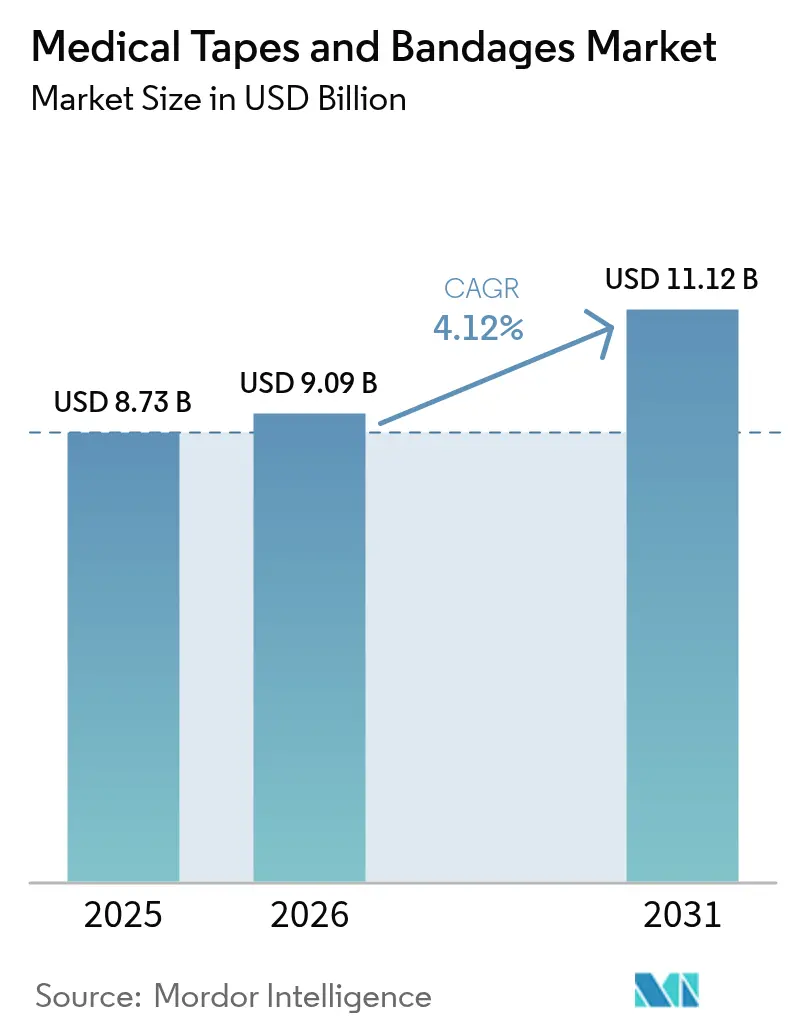
Medical Tapes And Bandages market size in 2026 is estimated at USD 9.09 billion, growing from 2025 value of USD 8.73 billion with 2031 projections showing USD 11.12 billion, growing at 4.12% CAGR over 2026-2031.
Stable growth reflects aging populations, rising surgical volumes, and wider acceptance of advanced wound management technologies. Smart sensors, biodegradable films, and controlled-release antimicrobial layers are shifting demand from passive coverings to interactive dressings that shorten healing time and cut follow-up visits. Cost pressure on hospitals and payers is prompting interest in products that enable earlier discharge and home-based self-care without compromising clinical outcomes. Sustainability mandates are also influencing material choices, guiding manufacturers toward solvent-free adhesives, compostable backings, and reduced packaging waste. The medical tapes and bandages market is therefore evolving along two axes—digital connectivity and environmental stewardship—while maintaining focus on skin-sparing adhesion and broad infection control.
Key Report Takeaways
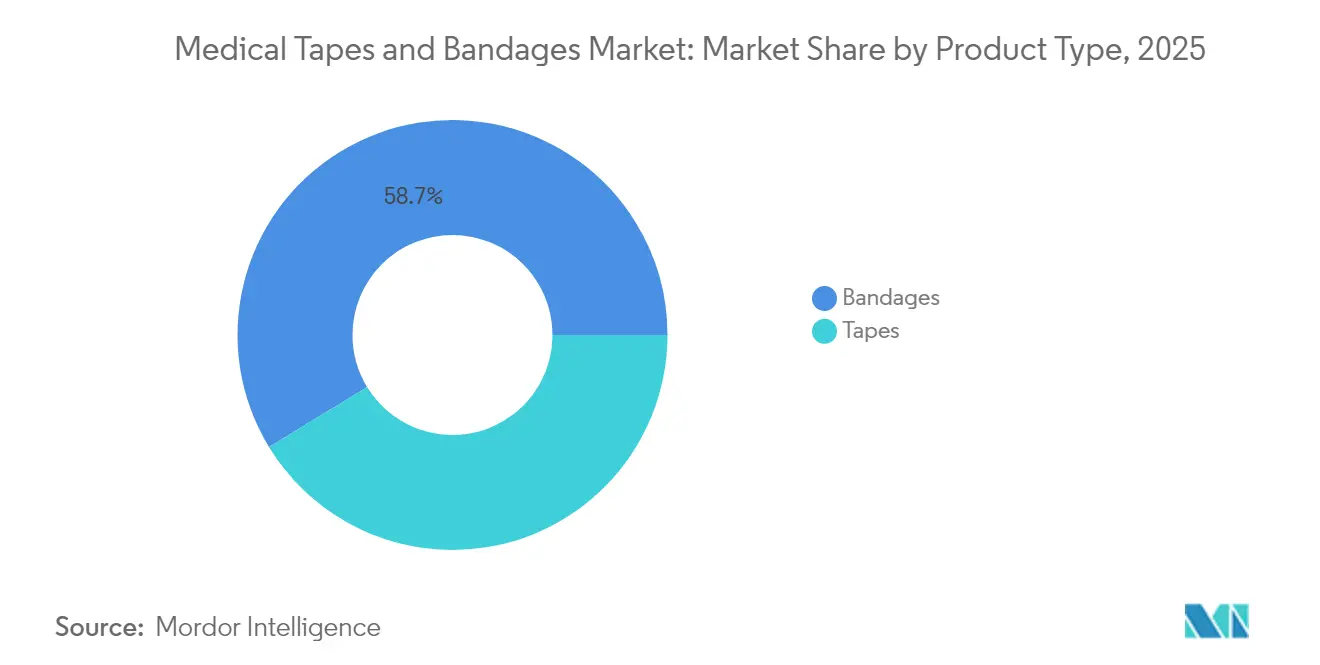
- By product type, bandages led with 58.72% of the medical tapes and bandages market share in 2025, while paper tapes are projected to expand at a 6.02% CAGR through 2031.
- By application, surgical wound care accounted for 34.22% of the medical tapes and bandages market size in 2025; ulcer treatment is set to grow fastest at 4.67% CAGR between 2026 and 2031.
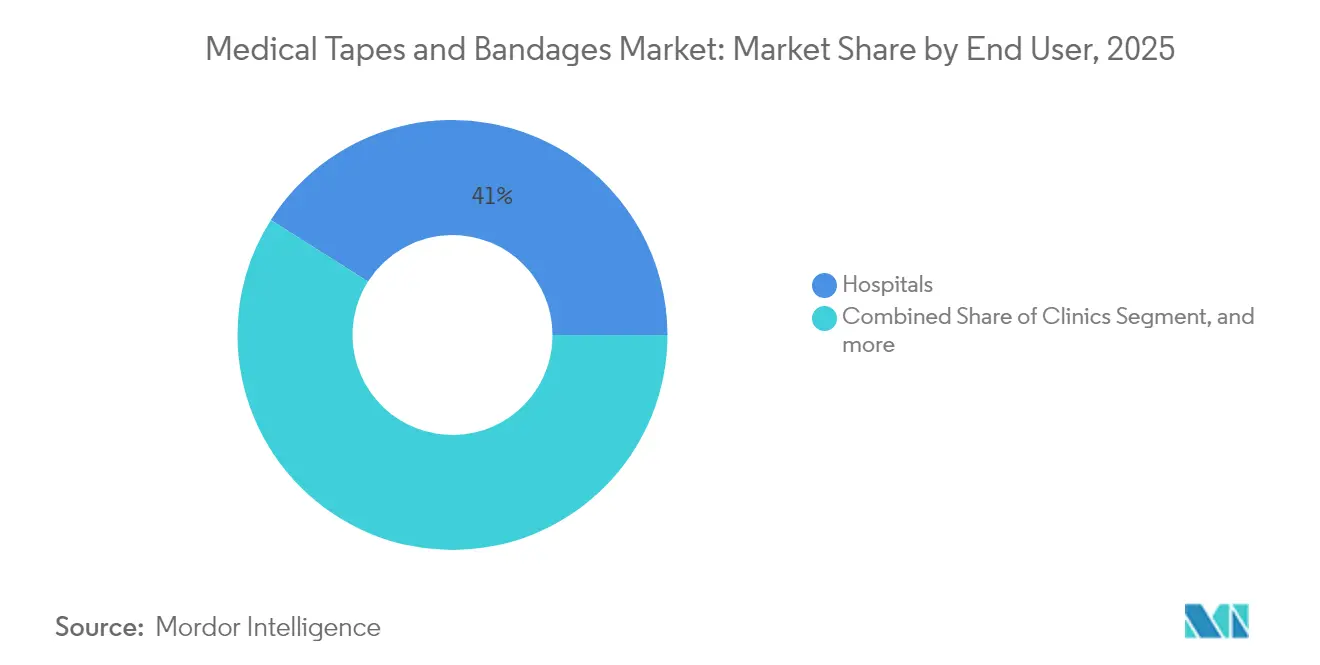
- By end user, hospitals held 41.02% revenue share of the medical tapes and bandages market in 2025, but home care settings are advancing at a 5.62% CAGR to 2031.
- By geography, North America controlled 33.05% of the medical tapes and bandages market in 2025, whereas Asia-Pacific is poised for a 4.83% CAGR, the quickest regional pace.
Note: Market size and forecast figures in this report are generated using Mordor Intelligence’s proprietary estimation framework, updated with the latest available data and insights as of 2026.
Market Trends and Insights
Drivers Impact Analysis of Medical Tapes And Bandages Market*
| Driver | (~) % Impact on CAGR Forecast | Geographic Relevance | Impact Timeline |
|---|---|---|---|
| Rising Global Surgical Volumes Increasing Demand for Post-Operative Wound Dressings | +0.8% | Global, with concentration in North America & Europe | Medium term (2-4 years) |
| Growing Prevalence of Chronic Wounds, Including Diabetic Foot Ulcers and Pressure Ulcers | +1.2% | Global, particularly APAC and North America | Long term (≥ 4 years) |
| Expansion of Home-Based Wound Care Supported by Telehealth and Self-Care Kits | +0.9% | North America & Europe, expanding to APAC | Short term (≤ 2 years) |
| Integration of Antimicrobial Agents in Tapes and Bandages | +0.7% | Global | Medium term (2-4 years) |
| Expansion of Aging Population Worldwide | +1.1% | Global, concentrated in developed markets | Long term (≥ 4 years) |
| Emergence of Smart, Sensor-Embedded Tapes Enabling Remote Wound Monitoring | +0.6% | North America & Europe initially | Long term (≥ 4 years) |
| Source: Mordor Intelligence | |||
Rising Global Surgical Volumes Increasing Demand for Post-Operative Wound Dressings
Over 300 million procedures are performed worldwide each year, and aging patients increasingly undergo orthopedic, cardiovascular, and minimally invasive surgeries that require robust peri-operative dressings. Post-operative care can cost more than USD 6,000 per day for complex incisions, prompting hospitals to specify longer-wear tapes that maintain seal integrity for up to seven days to avoid excessive change frequency. Bandages with elastic compression and atraumatic removal are now preferred in ambulatory surgery centers, where same-day discharge hinges on patient comfort and the absence of skin stripping. Consequently, procurement teams place adhesion longevity and hypoallergenic performance at the top of evaluation criteria. These imperatives continue to enlarge the medical tapes and bandages market.
Growing Prevalence of Chronic Wounds, Including Diabetic Foot Ulcers and Pressure Ulcers
Roughly 6.7 million Americans live with non-healing ulcers; diabetic foot ulcers alone will affect up to 25% of diabetes patients during their lifetime.[1] Chronic wounds generate USD 50 billion in annual treatment expenditures in the United States, driving demand for moisture-balancing bandages infused with silver or copper nanoparticles that curb biofilm formation. Clinical trials report 87.35% wound-area reduction from copper dressings versus 37.02% for conventional silver foams. Clinicians also favor layered composite tapes that modulate pH and temperature, enabling micro-environmental control and better granulation tissue development. These innovations bolster the medical tapes and bandages market by demonstrating measurable clinical payoff.
Expansion of Home-Based Wound Care Supported by Telehealth and Self-Care Kits
Telehealth reimbursement codes introduced in the 2025 Medicare Physician Fee Schedule allow caregivers to bill for remote wound-care instruction, accelerating adoption of self-service dressing kits.[2] Smart-sensor tapes now transmit moisture, temperature, and strain data to cloud dashboards so clinicians can intervene before infection emerges. For patients, simplified packaging and color-changing indicators guarantee correct application without professional supervision. Retail pharmacies are stocking complete ulcer-care bundles, lifting consumer-direct sales channels. Home-care distributors thus represent a growing route-to-market, reinforcing revenue diversification inside the medical tapes and bandages market.
Integration of Antimicrobial Agents in Tapes and Bandages
Silver, copper, and chitosan additives are widely embedded into polyurethane, foam, and hydrogel matrices. Silver nanoparticles offer broad-spectrum efficacy while maintaining low cytotoxicity at controlled release rates.[3] Newer copper-oxide meshes provide continuous ionic flux, achieving rapid bacterial kill even against resistant strains. Multilayer designs stagger the release of different ions for synergistic activity, and emerging photothermal coatings activate antimicrobial potency under visible light. Regulatory expectations now call for in-vivo evidence of sustained bioburden reduction across diverse patient groups, pushing manufacturers to run multicenter trials. The performance leap widens the medical tapes and bandages market by justifying premium prices in infection-prone settings.
Restraints Impact Analysis of Medical Tapes And Bandages Market*
| Restraint | (~) % Impact on CAGR Forecast | Geographic Relevance | Impact Timeline |
|---|---|---|---|
| High Cost of Advanced Dressings and Silicone-Based Adhesive Tapes | -0.9% | Global, particularly price-sensitive markets | Short term (≤ 2 years) |
| Clinical Concerns over Medical Adhesive-Related Skin Injury (MARSI) | -0.7% | Global, concentrated in vulnerable populations | Medium term (2-4 years) |
| Increasing Competition from Advanced Wound-Care Products | -0.5% | North America & Europe primarily | Medium term (2-4 years) |
| Environmental Sustainability Pressures on Single-Use, and Non-Biodegradable Materials | -0.4% | Europe & North America, expanding globally | Long term (≥ 4 years) |
| Source: Mordor Intelligence | |||
High Cost of Advanced Dressings and Silicone-Based Adhesive Tapes
Smart dressings can cost 5–10 times more per unit than plain gauze. Although clinical studies reveal 58.6% weekly material-cost savings when foam dressings shorten healing time lww.com, purchasing decisions often focus on sticker price. A Spanish regional audit recorded EUR 34.99 (USD 40.16) million in primary-care wound spending across three years, with EUR 8.46 (USD 9.74) million tied to tapes and bandages sciencedirect.com. Emerging markets with limited reimbursement struggle to absorb these premiums, delaying adoption and slowing the medical tapes and bandages market in low-resource settings. Wider transition to value-based procurement may temper this restraint over the next two years.
Clinical Concerns over Medical Adhesive-Related Skin Injury (MARSI)
Incidence of medical adhesive–related skin injury reaches 11.86% in adult intensive-care units and exceeds 50% among neonates. Mechanical stripping accounts for nearly three-quarters of cases, elevating risk for elderly and immunocompromised patients. Hospitals now mandate staff training on tape selection and removal angles, adding labor time and documentation burdens. Silicone and hydrocolloid tapes mitigate trauma but remain 20–30% costlier than acrylic adhesives. Until hypoallergenic options achieve parity pricing, MARSI fears will curb broader utilization of certain product lines, limiting some high-value niches within the medical tapes and bandages market.
*Our forecasts treat driver/restraint impacts as directional, not additive. The impact forecasts reflect baseline growth, mix effects, and variable interactions.
Medical Tapes And Bandages Market Segment Analysis
By Product Type:
Versatile Bandages Anchor Demand while Paper Tapes AccelerateBandages retained 58.72% of the 2025 medical tapes and bandages market share by revenue and continue to underpin routine wound protocols for surgical sites, lacerations, and chronic ulcers. Their configuration flexibility from conformable gauze rolls to high-compression elastic wraps allows clinicians to tailor pressure, absorbency, and breathability for each wound stage. Traditional cotton gauze remains ubiquitous due to procurement familiarity, but multi-layer cohesive dressings with viscose and elastic filaments are gaining traction for exudate control in limb ulcers. Hydrogel-impregnated pads embedded within elastic bandages reduce dressing change frequency by maintaining moist environments, vital for autolytic debridement. Consequently, the medical tapes and bandages market continues to leverage bandages as the baseline product family across emergency, inpatient, and home settings.
Paper tapes, though accounting for a smaller revenue base, register the strongest 6.02% CAGR thanks to their hypoallergenic cellulose fibers and gentle, repositionable adhesives that minimize epidermal stripping. Surgeons prefer them for delicate facial incisions, pediatric IV fixation, and ophthalmic dressings where skin trauma risk is elevated. Moreover, antimicrobial-coated paper substrates now incorporate silver salts without compromising tensile strength, positioning the sub-segment as a premium offering in infection-prone wards. Fabric tapes maintain relevance where tensile support and mechanical durability trump breathability, as in orthopedics. Plastic tapes fill waterproof niche demands for shower-safe ostomy and catheter sites. Across categories, solvent-free acrylic chemistries launched by 3M in 2025 illustrate how manufacturers are blending sustainability with high adhesion, reinforcing product-line differentiation inside the medical tapes and bandages market.

By Application:
Ulcer Care Outpaces Surgical MainstaySurgical wound care delivered 34.22% of overall revenue in 2025, validating its role as the historic backbone of the medical tapes and bandages market size. Hospitals issue standardized peri-operative kits specifying elastic compression wraps, transparent IV site dressings, and microporous tapes to ensure hemostasis and early ambulation. Volume growth remains tied to rising orthopedic, cardiovascular, and bariatric surgeries among older adults. Material advances—such as silicone retention strips that peel away without disrupting staples enhance patient comfort and lower re-admission rates tied to dehisced incisions. Consequently, surgical protocols continue to consume large quantities of high-performance tapes and bandages.
Ulcer management, however, achieves the highest 4.67% CAGR because diabetic foot, venous leg, and pressure wounds are mounting alongside global obesity and longevity trends. Multilayer compression systems embedded with zinc and calamine accelerate granulation tissue, while foam-based bandages with micro-channel vapor vents minimize maceration in exuding ulcers. Smart sensors integrated into adhesive patches alert clinicians via Bluetooth when moisture levels exceed preset thresholds, preventing malodor and infection. Traumatic wounds, burns, and sports injuries each occupy smaller yet steady shares, with specialized hydrocolloid island dressings or kinesiology tapes meeting performance demands. Evidence correlating application-specific dressings with 15–20% faster closure times continues to sway payer coverage policies, broadening commercial space for the medical tapes and bandages market.
By End User:
Home Care Climbs on Telehealth MomentumHospitals commanded 41.02% of 2025 revenue, reflecting their gatekeeper status in initial wound evaluation, debridement, and product testing that influences formulary choices. Purchasing consortia negotiate multi-year contracts balancing unit price against outcome metrics such as average length of stay and infection rates. This institutional sway explains why formulary acceptance can catapult a new tape into global prominence within months, underscoring hospitals’ ongoing dominance inside the medical tapes and bandages market.
Yet home-based care represents the fastest 5.62% CAGR segment as payers embrace cost-effective recovery outside clinical walls. Remote monitoring platforms bundle sterilized dressing kits, QR-coded instructions, and live nurse chat, reducing travel costs and encouraging adherence. Clinics remain vital for chronic-wound follow-ups, while ambulatory surgical centers benefit from adhesive sheets designed for same-day discharge. Employers and sports teams increasingly purchase kinesiology and cohesive tapes directly, diversifying demand streams. The shift toward decentralized care thus reinforces multichannel distribution, compelling manufacturers to design packaging, shelf life, and educational materials fit for non-professional users, thereby enlarging long-tail revenue inside the medical tapes and bandages market.
Geography Analysis
North America Medical Tapes And Bandages Market
North America led the medical tapes and bandages market with 33.05% revenue share in 2025, fueled by advanced reimbursement mechanisms, broad clinician acceptance of composite dressings, and robust clinical-trial infrastructure that validates new materials quickly. Hospitals routinely test digital dressings that send real-time data to electronic medical records, fostering early adoption of connected tapes. Material shortages and fluctuating resin prices, however, have prompted local production initiatives to de-risk supply chains.
Europe Medical Tapes And Bandages Market
Europe remained a dependable yet slower-growing region, with public health systems mandating tender processes emphasizing eco-labels and recyclability. Regulatory frameworks such as the European Medical Device Regulation impose extensive post-market surveillance, pushing companies toward thicker clinical evidence packages. Regardless, aging demographics and high prevalence of venous leg ulcers sustain steady consumption of compression bandage systems. Manufacturers must therefore align sustainability narratives with proven healing benefits to win pan-European tenders, maintaining their share of the medical tapes and bandages market.
APAC Medical Tapes And Bandages Market
Asia-Pacific, projected to advance at a 4.83% CAGR, witnesses rapid infrastructure modernization, rising chronic-disease burden, and government incentives for domestic med-tech manufacturing. China boosts local procurement quotas, prompting joint ventures between multinational brands and provincial device makers. India’s national wound-care guidelines published in 2025 emphasize low-trauma adhesives and antimicrobial dressings for diabetic ulcers, opening volume contracts across public hospitals. Southeast Asian nations, meanwhile, adopt telehealth wound platforms to reach remote islands, expanding demand for sensor-enabled tapes capable of transmitting data over low-bandwidth networks. The convergence of policy support and manufacturing capacity places Asia-Pacific at the center of long-term expansion for the medical tapes and bandages market.
Competitive Landscape
The competitive field balances global conglomerates with focused innovators. 3M leverages diversified adhesive expertise to introduce solvent-free tapes that cut greenhouse-gas emissions by 25%, meeting hospital sustainability scorecards while preserving peel force. Johnson & Johnson combines historical brand trust with outpatient-center distribution, pushing cohesive wraps through bundled orthopedic kits. Smith & Nephew recorded 3.8% underlying growth in Advanced Wound Management during Q1 2025 on the back of ALLEVYN Ag+ SURGICAL, an antimicrobial foam dressing targeting post-operative infections.
Start-ups focus on digitization; United States-based Stasis Health markets a patch with embedded flexible electronics that tracks lactate and pH, while South Korea’s BioSensorTech commercializes colorimetric paper tapes for rapid infection screening. Mid-tier firms pursue vertical integration, acquiring non-woven fabric producers to stabilize input costs and shorten development cycles. Meanwhile, contract manufacturers in Malaysia and Mexico raise FDA-audited capacity, lowering barrier-to-entry for private-label owners.
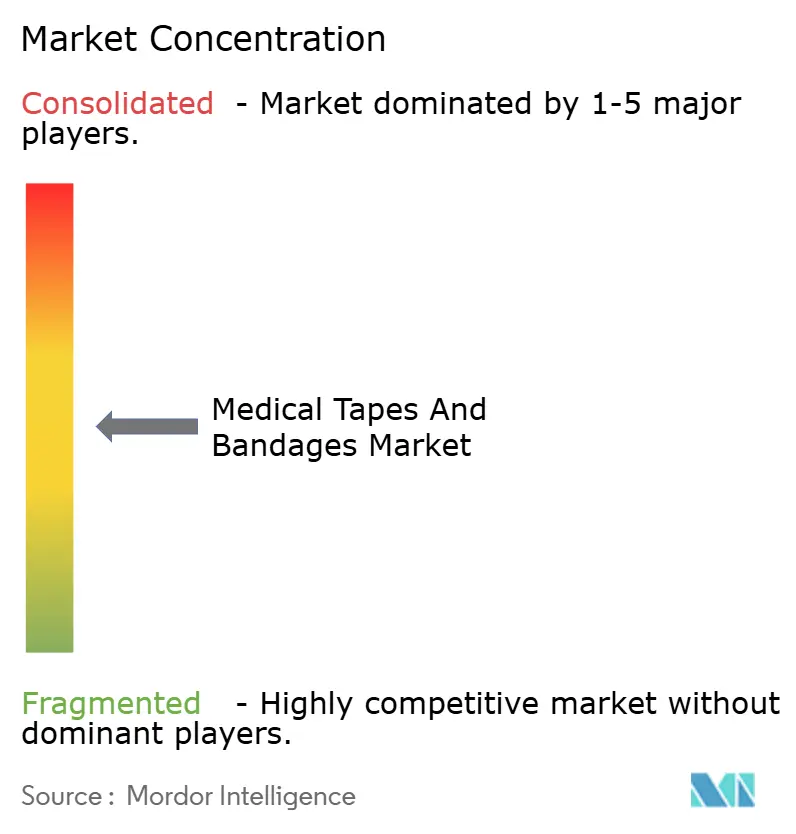
Pricing pressure is intensifying because hospitals award multi-year contracts through competitive tenders. Manufacturers therefore bundle value-added services analytics dashboards, training modules, and waste-takeback programs to secure renewals. Intellectual-property portfolios around polymer formulations and microfluidic channels serve as protective moats, yet patent cliffs on classic acrylic chemistries open room for generic tapes. The resulting landscape is dynamic but not fragmented, characterized by a handful of firms shaping standards while digital entrants chip away at specialty niches of the medical tapes and bandages market.
Medical Tapes And Bandages Industry Leaders
-
3M Company
-
B. Braun SE
-
Johnson & Johnson Services, Inc.
-
Coloplast A/S
-
Cardinal Health
- *Disclaimer: Major Players sorted in no particular order
Medical Tapes And Bandages Market Companies Covered in this Report
- 3M
- Johnson & Johnson
- Smiths Group
- Cardinal Health
- Coloplast
- B. Braun
- Nitto Denko
- Hartmann Group
- Henkel
- Mckesson
- BenQ Materials
- Triage Meditech Pvt. Ltd.
- Medline Industries
- Molnlycke Health Care
- Essity
- Derma Sciences
- Winner Medical Co. Ltd.
- Dynarex
- Lohmann & Rauscher
- Avery Dennison Medical
Market Opportunities and Future Outlook
Home-based wound care is creating whitespace for tape-and-bandage formats that are easier for non-professional users to apply correctly, including gentler fixation systems that reduce medical adhesive-related skin injury (MARSI) and packaging optimized for self-care kits supported by telehealth. The 2025 Medicare Physician Fee Schedule telehealth reimbursement codes for remote wound-care instruction reinforce demand for simple, reliable securement and compression solutions sold through home-care distributors and retail pharmacies, not only hospital tenders. In parallel, sustainability-driven procurement is lifting interest in solvent-free and water-based adhesive chemistries, with water-based specialty tape capability highlighted by Henkel’s January 2026 agreement to acquire ATP Adhesive Systems.
Consolidation and portfolio broadening in adjacent wound-closure and dressing categories signal a more integrated competitive push around surgical adhesives, tapes, and dressings, exemplified by H.B. Fuller’s June 2026 announced cash offer to acquire Advanced Medical Solutions Group plc (AMS) for USD 943 million. On the consumer and sports-injury side, the January 2025 acquisition of KT Tape by Bridges Consumer Healthcare underscores continued channel expansion and brand-led growth in kinesiology and recovery tapes. Although advanced hydrogel and sensor-enabled smart dressings are excluded from this report scope, R&D activity around bioelectronic and multifunctional wound platforms is shaping expectations for infection control, wear time, and skin compatibility, which feeds back into demand for higher-performance, skin-sparing tapes and securement bandages in mainstream clinical protocols.
Recent Industry Developments in Medical Tapes And Bandages Market
- June 2026: The potential acquisition of Advanced Medical Solutions Group plc (AMS) broadens the surgical adhesive, tape, and dressing portfolio and signals strategic consolidation in the medical adhesives space. H.B. Fuller disclosed a recommended cash offer to acquire AMS for USD 943 million. The move strengthens access to healthcare-focused formulations and expands participation across operating room and post-operative care workflows. It also intensifies competition for incumbents as adhesive specialists deepen medical positioning through acquisitions.
- April 2025: The EZCOVER Probe Cover Set was launched in the United States to support infection prevention during ultrasound-guided procedures. B. Braun Medical Inc. positions the product with gel and non-gel (adhesive) versions to highlight securement and barrier performance in clinical settings. The launch aligns with B. Braun’s broader emphasis on innovation in hospital consumables and procedure support.
- December 2024: Johnson & Johnson MedTech joined a global initiative to define and classify surgical site outcomes (SSOs) through a standardized system for reporting postoperative complications. Standardized outcome definitions help align clinical documentation, study endpoints, and quality programs that influence product selection in surgical wound management. This direction supports wider adoption of data-driven wound and infection tracking, reinforcing demand for products with consistent performance in surgical pathways.
Medical Tapes And Bandages Market Report Scope and Research Methodology
Market Definition and Coverage
This market covers medical-grade tapes and bandages used to secure dressings, protect wounds, provide light support, and help with basic compression in clinical and home-care settings. Values are captured on a revenue basis and aggregated across major end users and regions.
Scope exclusions: advanced wound care dressings such as hydrogel, foam, and alginate products, along with sensor-enabled smart dressings, are excluded from this sizing.
Segments Covered in This Report
- By Product Type
- Bandages
- Gauze Bandages
- Elastic / Compression Bandages
- Cohesive Bandages
- Adhesive Bandages
- Other Specialized Bandages
- Tapes
- Fabric Tapes
- Paper Tapes
- Plastic (PVC/PE) Tapes
- Silicone & Low-Trauma Tapes
- Hydrocolloid & Specialty Tapes
- Bandages
- By Application
- Surgical Wound Treatment
- Traumatic Wound Treatment
- Ulcer Treatment
- Burn Injury Treatment
- Sports Injury Treatment
- Others
- By End User
- Hospitals
- Clinics
- Ambulatory Surgical Centers
- Home Care Settings
- Others
- By Geography
- North America
- United States
- Canada
- Mexico
- Europe
- Germany
- United Kingdom
- France
- Italy
- Spain
- Rest of Europe
- Asia-Pacific
- China
- Japan
- India
- Australia
- South Korea
- Rest of Asia-Pacific
- Middle East & Africa
- GCC
- South Africa
- Rest of Middle East & Africa
- South America
- Brazil
- Argentina
- Rest of South America
- North America
Data Sources, Market Sizing, and Validation
Desk Research
Desk research is used to build the starting structure of the market and to keep assumptions anchored to wound care usage and healthcare activity in practice. Public sources such as the US FDA product and safety communications are used for regulatory framing, the US Centers for Disease Control and Prevention for infection and procedure context, World Health Organization health statistics for baseline health indicators, and OECD health data for system-level demand signals. We also use sources such as UN Comtrade for trade direction checks on medical textile and polymer materials that often sit upstream of tapes and bandages.
To make the company and product view more consistent, we review annual reports, investor presentations, regulatory disclosures, and reputable press coverage for portfolio mix and geographic exposure. Select paid databases are also used for company financials, patents, and shipment-level trade intelligence to validate directional trends when public detail is limited. These examples are not exhaustive, and many other public and paid sources were used for data collection, validation, and clarification during the work.
Primary Interviews and Surveys
Primary interviews and surveys are used to pressure-test desk assumptions and fill gaps around product mix, channel behavior, and price movement across regions. We speak with participants across manufacturing, distribution, procurement, and clinical usage so the model reflects how tapes and bandages are actually specified and purchased across hospitals, outpatient settings, and home care. For a global view, inputs are checked across major geographies to reduce single-region bias and to confirm how utilization and pricing differ by care setting.
Distribution of primary research fieldwork respondents
| Company type | Respondent position | Region |
|---|---|---|
| Top tier: 35% | CXOs: 17% | APAC: 43% |
| Mid tier: 45% | Functional/Unit leaders: 36% | EMEA: 35% |
| Smaller Players: 20% | Managers: 47% | Americas: 22% |
Market-Sizing & Forecasting
Sizing starts with a top-down build where procedure volumes, wound incidence patterns, and care-setting mix are used to reconstruct the addressable demand pool for tapes and bandages across regions. To keep totals realistic, results are then corroborated with selective bottom-up approximations such as sampled supplier revenue splits, distributor channel checks, and price-times-volume cross-checks for common formats.
Key inputs in the model include surgical and traumatic wound volumes, chronic ulcer and burn treatment activity, outpatient shift indicators, average selling price movement by material type (paper, fabric, plastic, silicone and low-trauma), and mix shifts between adhesive and compression usage. When a bottom-up datapoint is missing for a country or channel, we bridge the gap using proxy indicators like healthcare utilization and import intensity, then test the output with interview feedback. Forecasts are built using scenario analysis supported by near-term signals like procedure recovery, reimbursement and care pathway shifts, and expected input cost trends, which are then reviewed and adjusted based on what market participants expect to hold or change.
Data Validation & Update Cycle
Validation is done through repeated cross-checks between the model output and independent signals such as healthcare utilization, trade direction, and company exposure patterns, followed by variance checks at the region and product levels. Outliers are reviewed, the assumptions behind them are challenged, and then the affected cells are recalculated before sign-off so totals remain internally consistent.
Reports are refreshed annually, and interim updates are triggered when material events occur, such as regulatory changes, major pricing shocks in key materials, or visible shifts in care delivery settings. Before delivery, a final analyst pass is completed to ensure the latest public releases and primary feedback are reflected in the final market numbers.
Mordor Intelligence's Medical Tapes and Bandages Market Sizing Compared With Other Published Estimates
It is normal to see different market values for medical tapes and bandages across published sources, even when the topic sounds identical at first glance. The gaps usually come from how each publisher draws the product scope, sets the base year, converts currencies, and updates price and volume assumptions.
Some published estimates group advanced wound care dressings into the same bucket as basic tapes and bandages, which can lift the total even if usage volumes look similar. For Mordor Intelligence, the count is limited to medical tapes and bandages used for securing, shielding, and basic compression, and it keeps advanced hydrogel, foam, alginate, and smart dressings outside the total so the demand pool stays tied to these specific products.
Benchmark comparison
| Source | Market Size | Gaps in Research Methodology |
|---|---|---|
| Mordor Intelligence | USD 9.09 B (2026) | |
| Global Consultancy A | USD 8.16 B (2024) | Uses an earlier base year and a longer forecast window, and the public summary does not clearly state exclusions for adjacent wound care categories, which can shift what is counted as in-scope. |
| Industry Publisher B | USD 8.46 B (2025) | Relies on a different base year and may apply different price progression and mix assumptions by tape material and bandage type, which can change the implied ASP and the total value. |
Looking across the figures, most of the spread can be explained by base-year choice and scope treatment, followed by how pricing and product mix are carried forward. When the included products are clearly stated and the demand indicators are tied to wound and procedure activity, the resulting market total becomes easier to reproduce and easier to interpret for planning.
Key Questions Answered in the Report
What is the current value of the medical tapes and bandages market?
The medical tapes and bandages market size stands at USD 9.09 billion in 2026 and is projected to rise to USD 11.12 billion by 2031.
Which product category dominates sales?
Bandages lead, representing 58.72% of 2025 revenue, although paper tapes record the fastest growth rate of 6.02% CAGR.
Why is ulcer care the fastest-growing application?
Diabetic foot and pressure ulcers are increasing globally, and advanced antimicrobial dressings shorten healing time, pushing ulcer treatment to a 4.67% CAGR.
How are smart sensors influencing the market?
Sensor-embedded tapes transmit temperature, moisture, and strain data, enabling remote monitoring that reduces clinic visits and supports home-based care expansion.
Which region will grow quickest through 2031?
Asia-Pacific is forecast to expand at 4.83% CAGR due to infrastructure upgrades, chronic-disease prevalence, and domestic manufacturing incentives.
What is the main restraint facing high-tech dressings?
Premium pricing limits uptake in cost-sensitive health systems, even though long-term studies show advanced materials can lower total treatment costs.