
Medical Nonwoven Disposables Market Size and Share
Market Overview
| Study Period | 2022 - 2031 |
|---|---|
| Market Size (2026) | USD 30.39 Billion |
| Market Size (2031) | USD 38.98 Billion |
| Growth Rate (2026 - 2031) | 5.09 % |
| Fastest Growing Market | Asia Pacific |
| Largest Market | North America |
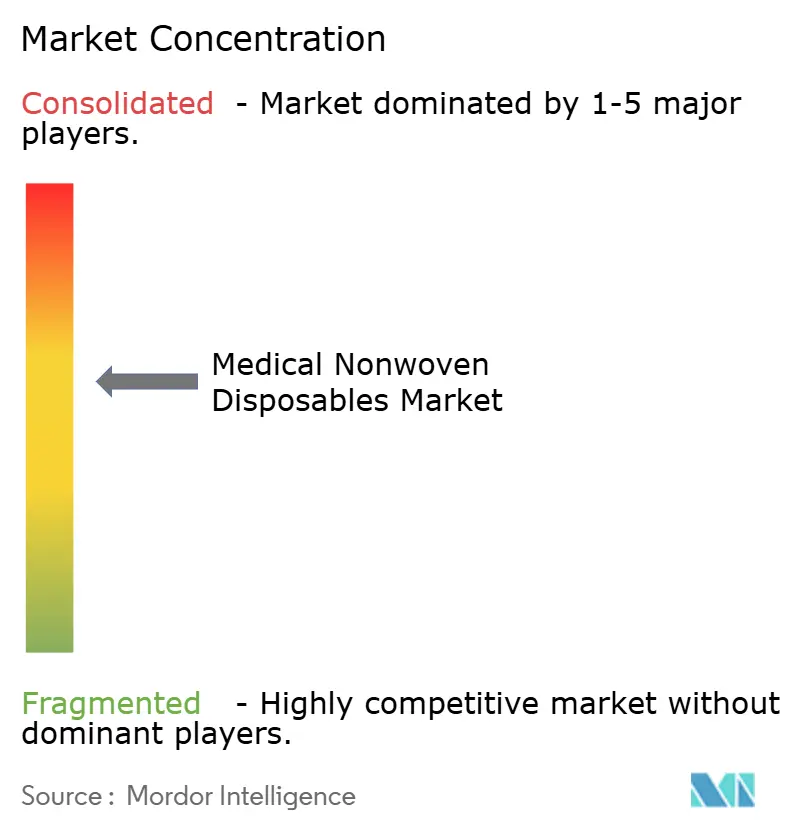
| Market Concentration | Medium |
Major Players *Disclaimer: Major Players sorted in no particular order Image © Mordor Intelligence. Reuse requires attribution under CC BY 4.0. | |
Medical Nonwoven Disposables Market Analysis by Mordor Intelligence
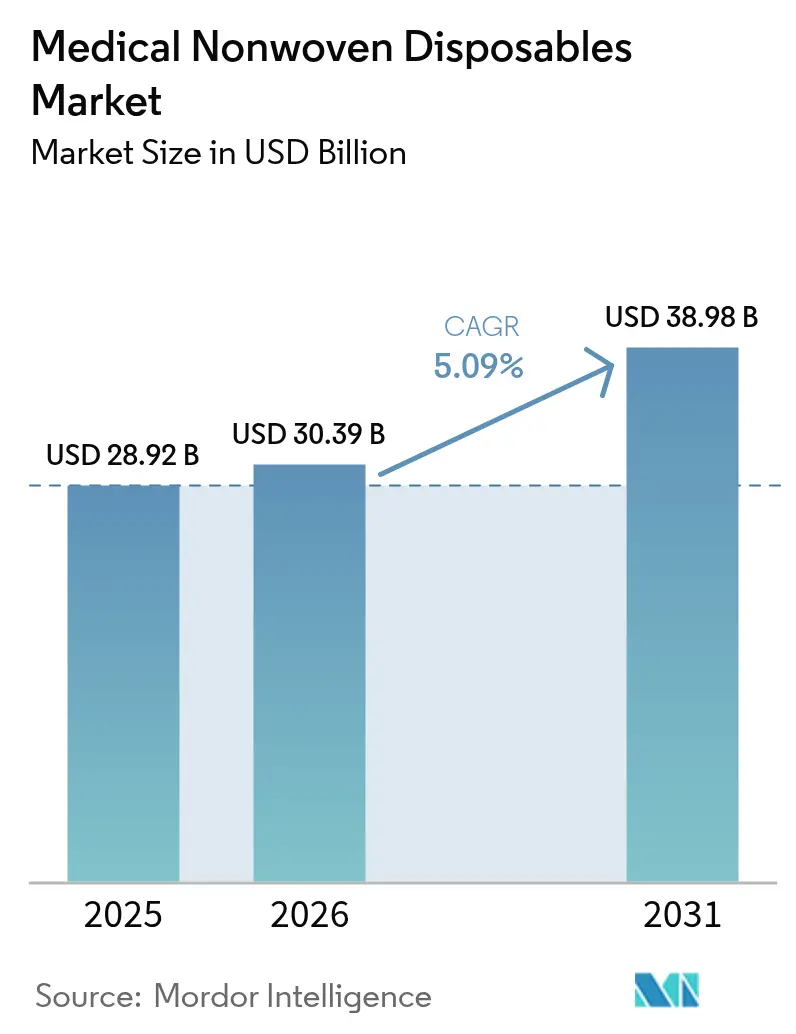
Medical Nonwoven Disposables Market size market size in 2026 is estimated at USD 30.39 billion, growing from 2025 value of USD 28.92 billion with 2031 projections showing USD 38.98 billion, growing at 5.09% CAGR over 2026-2031.
Rising demand for infection-barrier products, widespread adoption of disposable surgical apparel, and steady demographic shifts toward older populations continue to underpin volume growth. Product innovation, including breathable composites and antimicrobial finishes, enables premium pricing while helping hospitals comply with increasingly stringent infection-control protocols. Capital expenditure on domestic personal protective equipment (PPE) capacity in the United States, Europe, and selected Asia-Pacific markets enhances supply resilience, but cost pressure persists as polypropylene resin prices fluctuate. Sustainability imperatives are gradually redirecting investment toward biodegradable spunbond substrates, yet polypropylene remains indispensable due to its proven sterility performance and well-established regulatory track record. Competitive intensity remains moderate; leading suppliers use backward integration and proprietary barrier technologies to protect margins in a market that still rewards scale and reliability.
Key Report Takeaways
- By product category, incontinence products led with 42.21% revenue share in 2025; advanced wound dressings are forecast to expand at a 5.68% CAGR through 2031.
- By material, polypropylene spunbond held 47.62% of the medical nonwovens disposables market share in 2025, while biodegradable alternatives are projected to grow at a 5.55% CAGR through 2031.
- By end-user, hospitals and clinics accounted for 50.78% share of the medical nonwovens disposables market size in 2025 and ambulatory surgical centers are advancing at a 5.92% CAGR through 2031.
- By distribution channel, hospital pharmacies led with 45.71% revenue share in 2025; online pharmacies are expected to rise at a 6.04% CAGR over 2026-2031.
- By geography, North America captured 39.83% of the medical nonwovens disposables market share in 2025 and Asia-Pacific is set to grow at a 6.42% CAGR to 2031.
Note: Market size and forecast figures in this report are generated using Mordor Intelligence’s proprietary estimation framework, updated with the latest available data and insights as of 2026.
Market Trends and Insights
Drivers Impact Analysis of Medical Nonwoven Disposables Market*
| Driver | (~) % Impact on CAGR Forecast | Geographic Relevance | Impact Timeline |
|---|---|---|---|
| Increasing Global Geriatric Population | +1.2% | Global, with highest concentration in North America, Europe, and Japan | Long term (≥ 4 years) |
| Rising Incidence Of Hospital-Acquired Infections | +0.8% | Global, particularly acute in developing healthcare systems | Medium term (2-4 years) |
| Expanding Surgical Volumes In Emerging Economies | +0.9% | Asia-Pacific, Latin America, Middle East & Africa | Medium term (2-4 years) |
| Stringent Infection-Control Guidelines In Outpatient Settings | +0.6% | North America, Europe, with spillover to APAC | Short term (≤ 2 years) |
| Surging Adoption Of Antimicrobial-Impregnated Spun-Melt Nonwovens | +0.7% | Global, led by advanced healthcare markets | Medium term (2-4 years) |
| Government Subsidies For Domestic PPE & Medical Textile Manufacturing | +0.5% | United States, European Union, select APAC countries | Short term (≤ 2 years) |
| Source: Mordor Intelligence | |||
Increasing Global Geriatric Population
People aged 60 and older already exceed 310 million in China alone, a figure that is driving long-term demand for adult absorbent products and advanced wound dressings [1]. Chronic wound prevalence rises sharply with age, compelling both hospitals and home-health services to maintain higher inventories of breathable, skin-friendly nonwoven dressings. Long-term care facilities are expanding worldwide, and each bed translates directly into recurring demand for disposable bedding protectors and underpads. Clinical studies link aging to higher rates of frailty, malnutrition, and device-related infections, further reinforcing institutional reliance on sterile single-use drapes and gowns[2]. Together these demographic pressures create a predictable, multi-year baseline for the medical nonwovens disposables market.
Rising Incidence of Hospital-Acquired Infections
Healthcare-associated infections cost U.S. hospitals USD 35.7–45 billion every year, with analysts estimating that 70% of cases can be prevented through better barrier materials and workflow controls. Hospital procurement teams therefore prioritize nonwovens that incorporate fluid-impervious layers and embedded antimicrobial chemistries. Audit-and-feedback programs increasingly measure compliance at the material level, reinforcing the link between product choice and reimbursement. Advanced gauze dressings infused with silver ions or cationic additives have demonstrated significant reductions in surgical-site infection rates, validating premium pricing for such solutions. Regulators in Europe and the United States now require performance data on microbial strike-through resistance, accelerating replacement of legacy cotton packs with engineered composites. The result is steady, price-supported uptake of higher-margin antimicrobial nonwoven SKUs.
Expanding Surgical Volumes in Emerging Economies
Ambulatory and inpatient procedure counts continue to rise across Asia-Pacific and parts of Latin America as public and private insurers broaden coverage. Medicare data show ambulatory surgical centers treating 3.3 million beneficiaries in 2022, underscoring how outpatient facilities translate into incremental consumption of single-use gowns, caps, and shoe covers. Providers in resource-constrained settings prefer disposable SMS packs that balance cost and protection, creating export opportunities for large-scale converters in China and India. Government stimulus programs aimed at upgrading provincial hospitals further lift demand for sterile surgical drapes. With minimally invasive surgery gaining traction, thinner, breathable drape films that resist alcohol-based prep solutions have become a key product differentiator. These trends collectively sustain above-average growth for procedure-driven subsegments of themedical nonwovens disposables market.
Stringent Infection-Control Guidelines in Outpatient Settings
The U.S. Food and Drug Administration will fully align its Quality Management System Regulation with ISO 13485:2016 in February 2026, imposing uniform design-control and traceability rules on surgical apparel manufacturers. Non-sterile isolation gowns now fall under Class II rules that require documented fluid-barrier performance, while surgical drapes are regulated under 21 CFR 878.4370 with similar test mandates. Outpatient surgical centers must meet these standards without on-site sterilization capacity, so they rely heavily on pre-packaged, terminally sterile nonwoven kits. Ethylene-oxide compatibility has therefore become a critical material attribute, steering converters toward polypropylene-rich structures that tolerate repeated sterilant exposure. Compliance deadlines and audit risk drive near-term procurement spikes for certified products, reinforcing volume forecasts for high-specification nonwovens.
Surging Adoption of Antimicrobial-Impregnated Spun-Melt Nonwovens
Hospitals now treat antimicrobial finishing as a first-line defense rather than an optional upgrade. Spun-melt composites that disperse zinc or copper additives through the fiber matrix inhibit gram-positive and gram-negative bacterial growth, extending safe wearing time for gowns and masks. Field data confirm lower colony-forming unit counts on treated drapes compared with untreated polypropylene, supporting formulary inclusion for specific antimicrobial brands. Global demand is most pronounced in heightened-risk procedures such as orthopedic implant surgery, where infection can double patient length of stay. Because additive masterbatches integrate seamlessly into existing melt lines, suppliers scale output quickly, translating material science advances directly into higher revenue for the medical nonwovens disposables market.
Government Subsidies for Domestic PPE Manufacturing
The Make PPE in America Act commits federal agencies to source selected protective products from domestic factories for at least five years, providing clear volume signals to U.S. converters [3]. The Department of Homeland Security has mirrored this stance in its acquisition regulations, effectively guaranteeing baseline orders through 2029. Similar programs in the European Union reserve procurement quotas for within-bloc producers. These policy moves give vertically integrated players predictable cash flow to justify multimillion-dollar spunbond line investments. Capital formation reinforces supply resilience, shortens lead times, and enhances the global competitiveness of local suppliers, all of which support steady expansion of the medical nonwovens disposables market.
Restraints Impact Analysis of Medical Nonwoven Disposables Market*
| Restraint | (~) % Impact on CAGR Forecast | Geographic Relevance | Impact Timeline |
|---|---|---|---|
| Environmental Concerns Over Polypropylene-Based Waste | -0.9% | Global, with highest regulatory pressure in Europe and California | Long term (≥ 4 years) |
| Shift Toward Reusable Robotic & Laparoscopic Procedures | -0.6% | North America, Europe, advanced APAC markets | Medium term (2-4 years) |
| Volatility In Polypropylene Resin Pricing Due To Capacity Rationalisation | -0.7% | Global supply chain impact, acute in Asia-Pacific manufacturing | Short term (≤ 2 years) |
| Slow Clinical Acceptance Of Biopolymer Nonwovens Owing To Cost | -0.4% | Cost-sensitive markets in emerging economies | Medium term (2-4 years) |
| Source: Mordor Intelligence | |||
Environmental Concerns Over Polypropylene-Based Waste
Life-cycle studies undertaken during the COVID-19 pandemic recorded steep increases in nonwoven waste volumes, highlighting landfill pressure and carbon footprints associated with single-use PPE. Regulators in the European Union and the state of California now explore extended-producer-responsibility schemes that could raise compliance costs for disposable products. Hospitals in urban centers have started piloting closed-loop collection for sterilizable textile alternatives, potentially eroding demand for low-value SMS gowns. Brands counter by introducing polylactic-acid (PLA) spunbond that degrades 95% within 90 days under commercial composting conditions, yet price premiums and limited sterilization data inhibit rapid substitution. Unless cost parity is achieved, sustainability will remain a headwind that modestly tempers the long-run CAGR of the medical nonwovens disposables market.
Shift Toward Reusable Robotic and Laparoscopic Procedures
Growth in minimally invasive surgery reduces the field size and fluid exposure area, enabling some facilities to substitute hard-surface drape accessories for disposable fabric kits. Reusable powered air-purifying respirator programs in large health systems lower annual mask burn rates by up to 90% and can save millions of dollars over a five-year depreciation cycle. While procedure volumes still rise, the per-case consumption of standard drapes and gowns can fall, pressuring unit sales. Suppliers respond with slimmed-down procedural packs tailored for robotic platforms, but market expansion remains slower than for open-surgery products. This dynamic introduces moderate, segment-specific drag on overall market growth.
*Our forecasts treat driver/restraint impacts as directional, not additive. The impact forecasts reflect baseline growth, mix effects, and variable interactions.
Medical Nonwoven Disposables Market Segment Analysis
By Product:
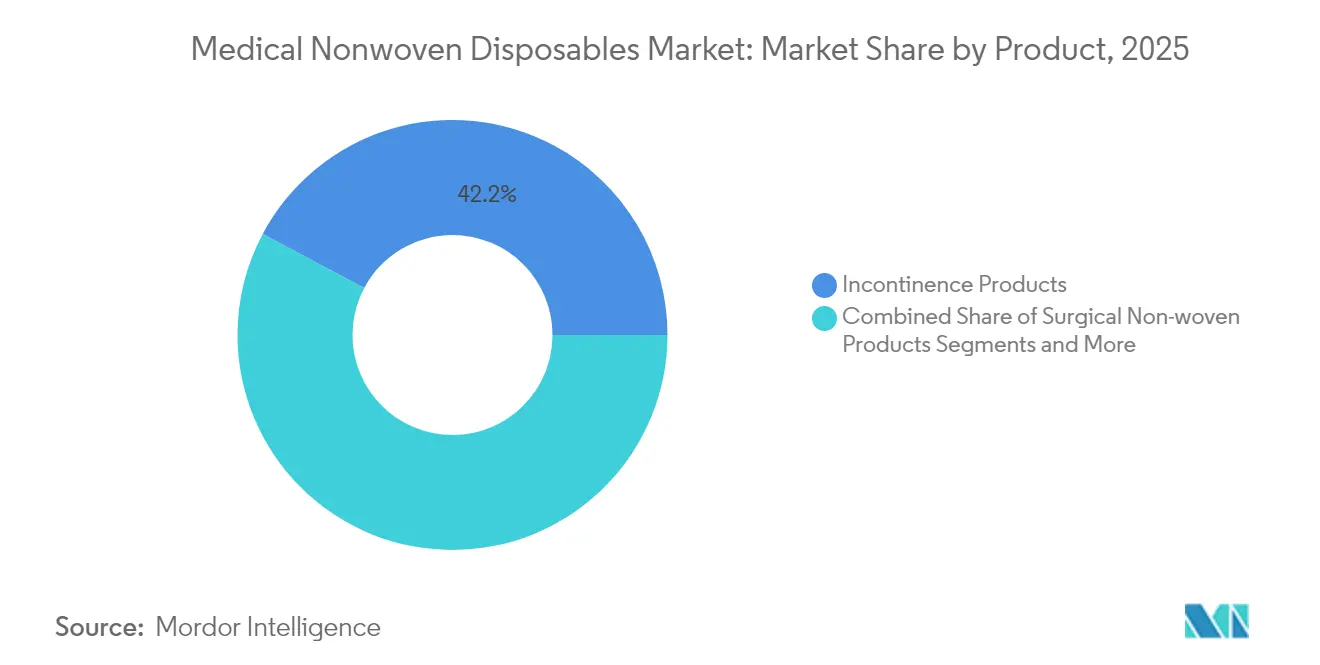
Demographic-Driven Dominance of Incontinence LinesThe incontinence segment held 42.21% of the medical nonwovens disposables market share in 2025. Consistent consumer uptake of adult briefs, underpads, and gender-specific liners underscores how stigma reduction campaigns and discreet product designs convert latent need into active purchasing. Manufacturers have boosted fluff-free core absorption and skin-contact softness, attributes that attract long-term-care operators and retail buyers alike. Disposable adult underwear volumes are rising in supermarkets and e-commerce channels, aided by plus-size SKUs that fit waistlines up to 95 inches.
Advanced wound dressings are the fastest-growing product cluster with a 5.68% CAGR as electrospun nanofiber scaffolds mimic extracellular matrix and foster moist-healing environments. Self-adhesive bioresorbable patches that integrate antibacterial agents and controlled-release growth factors shorten dressing change intervals, easing nursing workloads and lowering infection risk. Surgical packs remain a bedrock category, with procedure count growth offsetting modest pack optimization initiatives. Collectively, these trends ensure the medical nonwovens disposables market size continues to benefit from both volume-driven staples and value-added specialized dressings.

By Material:
Polypropylene Rules but Green Alternatives AcceleratePolypropylene spunbond represented 47.62% of the 2025 medical nonwovens disposables market size due to its favorable cost-to-performance ratio and straightforward compliance path. SMS and SMMS laminates blend spunbond strength with melt-blown filtration to meet high-stress surgical applications, and capacity additions in the United States and Vietnam are calibrated for healthcare volumes. Melt-blown webs maintain critical importance for N95-class respirators, with governments stockpiling media to hedge against future respiratory outbreaks.
Biopolymer and natural-fiber substrates posted the highest growth at 5.55% CAGR. PLA fibers from corn starch or sugarcane deliver hypoallergenic performance and moisture wicking for next-generation feminine hygiene pads. Start-ups leverage agricultural waste streams such as pineapple leaf and bagasse to spin biodegradable pulps into absorbent cores, a development that reduces fossil-carbon content while supporting rural economies. Although volumes remain small, price premiums have started to narrow as line speeds climb, setting the stage for broader adoption over the forecast period.
By End-User:
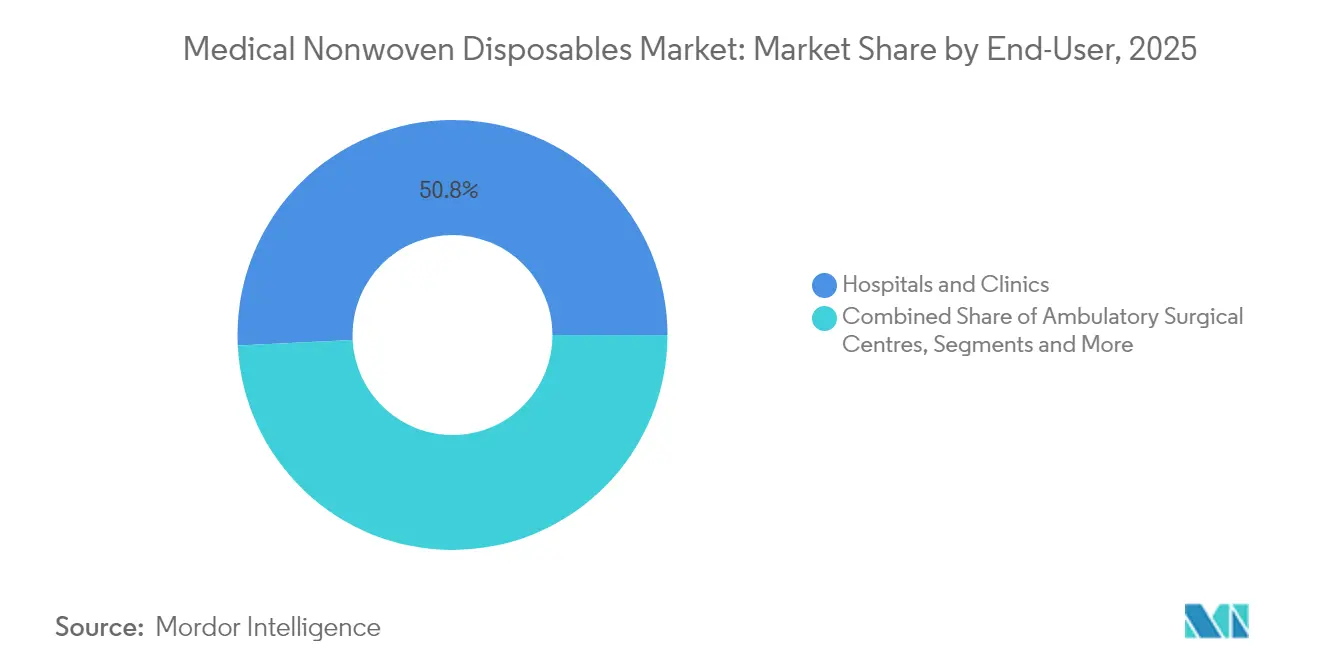
Hospitals Anchor Demand, Outpatient Sites SurgeHospitals and clinics absorbed 50.78% of the medical nonwovens disposables market size in 2025. They drive bulk orders for sterile surgical gowns, drapes, and shoe covers, often through multi-year tenders that favor integrated suppliers. Quality-linked reimbursement models encourage acute-care facilities to specify higher-grade barrier fabrics to curb infection penalties.
Ambulatory surgical centers posted the fastest growth at 5.92% CAGR as insurers steer low-risk procedures away from costlier hospital operating rooms. ASCs prefer all-in-one procedure kits that accelerate room turnover and simplify inventory. Home-healthcare use is also on the rise; disposable bed protectors and low-adherent dressings enable safe self-care in aging-at-home settings, further widening the customer base for the medical nonwovens disposables market.
By Distribution Channel:
Digital Disruption Gains TractionHospital pharmacies held 45.71% revenue share in 2025 as integrated supply chains keep high-value inventory within arm’s reach of surgical suites. Group-purchasing organizations negotiate multi-facility contracts that lock in volume and price for as long as five years, ensuring predictable offtake for converters.
Online pharmacies achieved a 6.04% CAGR, benefiting from an e-commerce boom that lifted global healthcare retail sales to USD 309.62 billion in 2022 and could top USD 732.3 billion by 2027. Direct-to-consumer shipping of incontinence and wound-care SKUs bypasses store shelves, cutting handling costs while enhancing privacy for buyers. B2B platforms now match clinics with vetted suppliers, indicating that digital channels will carve a steadily larger slice of the medical nonwovens disposables market.
Geography Analysis
North America Medical Nonwoven Disposables Market
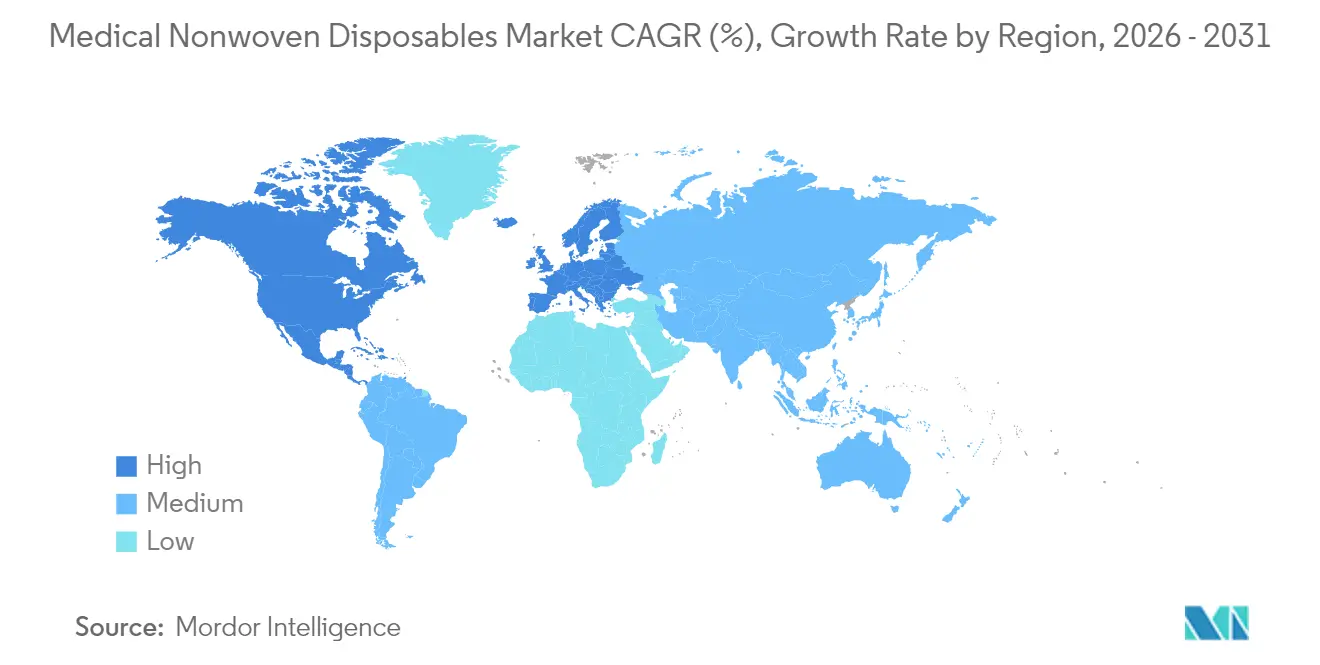
North America contributed 39.83% to 2025 revenue thanks to advanced infection-control standards, high procedure intensity, and federal incentives that channel PPE contracts to domestic mills. U.S. manufacturers committed over USD 290 million to new lines after federal demand forecasts guaranteed order visibility, though domestic unit costs remain above Asian benchmarks. Canada focuses on provincial stockpiles for pandemic resilience, further supporting regional utilization of premium nonwovens.
APAC Medical Nonwoven Disposables Market
Asia-Pacific is forecast to post the fastest 6.42% CAGR through 2031 as governments expand universal health coverage and build surgical infrastructure. China commands significant export volume in wound dressings and packs, leveraging economies of scale and improving quality systems to hold global share. India, Indonesia, and Vietnam combine low labor costs with rising local consumption, prompting multinationals to establish joint ventures for closer-to-market production. Japan and South Korea sustain demand for high-specification drapes in robotic surgery, underpinning value growth.
Europe Medical Nonwoven Disposables Market
Europe registers steady expansion on the back of stringent environmental mandates that stimulate early adoption of biodegradable spunbond fabrics. Extended-producer-responsibility rules set phased recycling targets for medical disposables, nudging procurement toward certified compostable gowns in Nordic hospitals. Eastern European facilities absorb niche contract manufacturing as Western EU converters focus on sustainable specialty lines.
MEA and South America Medical Nonwoven Disposables Market
The Middle East & Africa and South America together account for a modest but rising contribution to the medical nonwovens disposables market. Investment in flagship hospitals and national health-insurance schemes in Saudi Arabia, the United Arab Emirates, Brazil, and Chile create demand for disposable procedure packs, even though macro-economic volatility sometimes delays public tenders.
Regulatory Landscape
Medical nonwoven disposables sold as medical devices or medical device accessories must meet market-specific quality, safety, and performance requirements. In the United States, the FDA regulates surgical drapes and similar items under 21 CFR 878.4370. The Quality Management System Regulation (QMSR) took effect in February 2026, aligning 21 CFR Part 820 with ISO 13485:2016 and tightening expectations around design controls, traceability, and supplier management for manufacturers of disposable surgical apparel and procedure packs.
In Europe, Regulation (EU) 2017/745 (EU MDR) governs CE marking and post-market requirements for relevant medical devices, which increases technical documentation and conformity assessment expectations that affect procurement decisions for medical nonwovens used in clinical care. Biological safety is a recurring compliance gate across regions. ISO published ISO 10993-1:2025 (Edition 6) in November 2025, and the FDA formally recognized ISO 10993-1:2025 in May 2026 as a consensus standard, reinforcing risk-based biocompatibility evaluation for materials used in patient-contact nonwoven products.
Value Chain Analysis
The value chain starts with upstream feedstocks and fibers, including polypropylene resin for spunbond, melt-blown, and SMS/SMMS structures, as well as cotton or cellulosic inputs for spunlace and air-laid pulp. This is followed by nonwoven web formation, finishing (barrier coatings, antimicrobial additives, and lamination), and conversion into end products such as surgical gowns, drapes, packs, masks, incontinence items, and advanced wound dressings. Converters and private-label manufacturers then route products through hospital tenders and group purchasing organizations, hospital pharmacies, retail pharmacies, and online pharmacies, with sterilization and packaging partners supporting terminally sterile kits where required.
Quality and compliance requirements shape supplier qualification and process controls across the chain. Manufacturers increasingly seek tiered documentation for biological evaluation and materials traceability aligned with ISO 10993-1:2025, alongside market access requirements such as EU MDR 2017/745 and US FDA expectations for Class II devices (including appropriate premarket pathways where applicable). Supply risk management has emphasized diversification and transparency after pandemic-era disruptions. Vertically integrated participants, such as Winner Medical with end-to-end control from raw cotton processing through finished personal care products, use integration to stabilize quality, shorten lead times, and reduce compliance risk.
Competitive Landscape
The market shows moderate concentration; the top five suppliers control roughly 45% of global revenue. Kimberly-Clark announced USD 2 billion in North American expansion to shorten lead times and fortify its hospital portfolio. Berry Global invests in multilayer melt-blown capabilities that integrate electrostatic charging at the line, improving filtration while cutting secondary processing steps.
Freudenberg reported EUR 604.4 million in R&D expenditure for 2024 and continues to push low-basis-weight composites for advanced wound dressings. Asian challenger Magnera boosted spunbond width to 6.6 meters, enabling high-output PPE fabric runs that serve both export and domestic markets.
Mergers and acquisitions focus on niche technology pick-ups: Alkegen attracted fresh capital for its high-temperature specialty fibers, and specialty converters in Germany acquired nanofiber start-ups to secure sensor-ready wound-care platforms. Competition centers on barrier performance, sustainability credentials, and guaranteed on-time delivery, factors that collectively shape buyer preference in the medical nonwovens disposables market.
Medical Nonwoven Disposables Industry Leaders
-
Unicharm Corporation
-
Kimberly-Clark Corporation
-
Georgia-Pacific LLC
-
Cardinal Health, Inc.
-
Medtronic PLC
- *Disclaimer: Major Players sorted in no particular order
Medical Nonwoven Disposables Market Companies Covered in this Report
- Ahlstrom-Munksjö
- Asahi Kasei Corp.
- Berry Global
- Cardinal Health
- First Quality Enterprises
- Freudenberg SE
- Georgia-Pacific
- Kimberly-Clark Corp.
- Unicharm Corp.
- Cypress Medical
- Medtronic
- MRK Healthcare
- Mölnlycke Health Care
- Ontex NV
- Domtar Corp.
- TWE Group
- PFNonwovens a.s.
- Suominen Corp.
- Toray Industries
- Hogy Medical Co. Ltd.
- Medline Industries
Market Opportunities and Future Outlook
Capacity build-outs and process upgrades targeting medical-grade and sustainable substrates create whitespace for suppliers that can deliver barrier performance while meeting procurement sustainability screens. Saudi German Nonwovens inaugurated an expansion in Rabigh, Saudi Arabia in May 2025 featuring Reicofil 5 technology to supply medical and hygiene materials. YI TING Non-Woven announced in January 2026 that it doubled capacity at its Taiwan facility to support European and North American demand for biodegradable PLA-blend and medical-grade substrates. Together, these moves point to opportunity in qualifying new regional sources that can supply consistent, certified webs for hospitals and outpatient procedure kits.
Innovation and compliance-linked differentiation also support premium SKUs in infection control and patient-contact applications. The European Patent Office published EP 4347247 B1 in July 2025 describing a nonwoven fabric optimized for clean air suits meeting BS EN 13795-2:2019 standards, underscoring ongoing product development around clinical performance benchmarks. Investments in nonwovens platforms, including Kruger Inc.'s May 2026 announcement of a USD 333 million entry into the nonwovens sector at Trois-Rivieres (Quebec), and ANDRITZ's May 2026 wetlace line contract for Dalian Ruiguang in China for biodegradable wipes, also indicate an expanding base of equipment, know-how, and capacity. Medical converters can leverage this capacity for adjacent healthcare nonwoven formats where regulatory documentation and biocompatibility data are decisive.
Recent Industry Developments in Medical Nonwoven Disposables Market
- July 2026: Kimberly-Clark and Suzano launched Arbex as a global tissue and hygiene joint venture, commencing operations on July 1, 2026. The new entity includes assets from Kimberly-Clark’s former International Family Care and Professional business and holds a long-term license for Kimberly-Clark’s professional brand portfolio, including WypAll and Kimberly-Clark Professional. This reshapes how a major supplier supports institutional hygiene and professional channels, with implications for manufacturing footprint, sourcing, and portfolio prioritization across healthcare-facing product lines.
- August 2025: Kimberly-Clark entered into a deferred prosecution agreement with the US Department of Justice related to the sale of adulterated MicroCool surgical gowns and agreed to pay up to USD 40.4 million in penalties and victim compensation. The action elevates quality-system scrutiny and reinforces procurement emphasis on documented barrier performance and compliant manufacturing controls for disposable surgical apparel.
- November 2024: Cardinal Health entered into definitive agreements to acquire a 71% stake in GI Alliance and to acquire Advanced Diabetes Supply Group for a combined total of about USD 3.9 billion. The expansion into specialty care platforms broadens Cardinal Health’s role across clinical pathways and can influence how it bundles, contracts, and distributes procedure-related consumables, including medical nonwoven disposables, through its provider networks.
Medical Nonwoven Disposables Market Report Scope and Research Methodology
Market Definition and Coverage
This market covers disposable medical products made from nonwoven materials used for patient care, hygiene, and infection prevention in clinical settings. Revenue is counted at the point of sale for medical-grade nonwoven disposables across major healthcare delivery channels.
Scope exclusions: We exclude reusable woven medical textiles, capital equipment, and non-medical consumer hygiene items that are not positioned as medical-grade products.
Segments Covered in This Report
- By Product
- Incontinence Products
- Adult Diapers
- Feminine Hygiene Pads
- Infant Diapers
- Surgical Non-woven Products
- Surgical Gowns
- Surgical Drapes & Packs
- Face Masks, Caps & Shoe Covers
- Advanced Wound Dressings
- Personal Protective Equipment (PPE)
- Incontinence Products
- By Material
- Polypropylene Spunbond
- Melt-blown
- SMS/SMMS Composites
- Air-laid Pulp
- Biodegradable/Biopolymer Nonwovens
- By End-user
- Hospitals & Clinics
- Ambulatory Surgical Centres
- Long-term Care Facilities
- Home-healthcare Settings
- By Distribution Channel
- Hospital Pharmacies
- Retail Pharmacies
- Online Pharmacies
- By Geography
- North America
- United States
- Canada
- Mexico
- Europe
- Germany
- United Kingdom
- France
- Italy
- Spain
- Rest of Europe
- Asia-Pacific
- China
- Japan
- India
- Australia
- South Korea
- Rest of Asia-Pacific
- Middle East & Africa
- GCC
- South Africa
- Rest of Middle East & Africa
- South America
- Brazil
- Argentina
- Rest of South America
- North America
Data Sources, Market Sizing, and Validation
Desk Research
Desk work starts by mapping the nonwoven disposable ecosystem and the typical product flow from fiber and resin inputs to converted medical items. For grounding, we refer to public sources such as the US FDA for medical device and PPE guidance, the US Census Bureau and UN Comtrade for trade patterns, the World Bank and OECD for health system and macro indicators, and peer-reviewed journals that track infection-control usage and material shifts.
We also use manufacturer annual reports, investor presentations, and audited filings to understand revenue splits, capacity additions, and plant utilization narratives, which helps keep assumptions realistic. In parallel, patent databases are checked to see where material innovation is heading, including SMS and SMMS structures and breathable barrier upgrades, which can explain mix changes over time. The sources listed above are illustrative and not exhaustive, and additional public documents and datasets are also used for data collection, cross-checks, and clarification.
Primary Interviews and Surveys
Primary discussions are run with a mix of converters, raw material suppliers, distributors, and hospital procurement and infection-control stakeholders, so pricing logic and consumption patterns can be validated from both supply and demand sides. Because the market is global, inputs are checked across major regions to confirm what is standard versus what is local, and then the model is adjusted where usage intensity or channel structure differs.
Distribution of primary research fieldwork respondents
| Company type | Respondent position | Region |
|---|---|---|
| Top tier: 28% | CXOs: 13% | APAC: 46% |
| Mid tier: 55% | Functional/Unit leaders: 31% | EMEA: 32% |
| Smaller Players: 17% | Managers: 56% | Americas: 22% |
Market-Sizing & Forecasting
Sizing is built using a top-down and bottom-up approach, where healthcare activity and nonwoven consumption signals are used to reconstruct the demand pool, followed by selective supplier and channel checks to keep totals in range. On the top-down side, surgical procedure volumes, inpatient days, and long-term care population trends are translated into usage levels for key disposable categories, then reconciled with import and export direction, local production footprints, and healthcare spend signals.
To keep the model practical, a few inputs are tracked consistently, including surgical procedure growth, infection-prevention protocol intensity, per-procedure consumption of gowns, drapes, and masks, the share shift between reusable versus disposable adoption where relevant, and average selling price movement driven by resin and pulp costs. Forecasts are run using scenario analysis, where the base case is anchored to expert expectations on procedure growth and procurement norms, and then stress-tested for raw material price swings and public health event effects. If bottom-up checks are missing for smaller countries, gaps are handled through regional proxies using comparable hospital density and trade dependence, and then re-tested against region-level totals.
Data Validation & Update Cycle
Validation is done through multiple checks that compare final totals against independent signals such as trade values, reported capacity expansions, and the expected range of healthcare utilization. Any sharp jumps are reviewed, and the assumptions behind price and volume are re-checked before sign-off, especially when a single factor is driving the change.
Our refresh cycle is annual for full models, and interim updates are done when there is a material event like major regulation shifts, supply disruptions, or large capacity moves. Before delivery, the latest data is re-read and key interview points are revisited, so clients receive an updated view that aligns with current market conditions.
Mordor Intelligence's Medical Non Woven Disposables Market Size Measured Against Other Published Estimates
Published market sizes for medical nonwoven disposables can be far apart, even when the topic sounds identical, because the counting rules are not always aligned. Differences usually come from what products are treated as medical-grade, whether the study mixes consumer hygiene into the total, and how pricing is projected when raw material inputs move quickly.
By tracking average selling prices with resin and pulp cost timing and rechecking unit consumption by care setting, Mordor Intelligence keeps the 2026 total tied to medical-grade demand rather than broad nonwoven hygiene spending. Another gap driver is base-year selection, since some estimates anchor on 2025 and then apply a uniform growth rate across products, which can miss mix changes between surgical barrier items and incontinence-related categories.
Benchmark comparison
| Source | Market Size | Gaps in Research Methodology |
|---|---|---|
| Mordor Intelligence | USD 30.39 B (2026) | |
| Industry Research House A | USD 22.50 B (2025) | Anchors sizing on an earlier year and a longer forecast window, and the stated coverage leans on broad process and application buckets, which can understate higher-value sterile surgical barrier disposables in the near term. |
| Global Consultancy B | USD 28.90 B (2025) | Provides a headline value with limited disclosure on inclusions, which can blend medical-grade nonwoven disposables with adjacent nonwoven hygiene items and apply simplified ASP progression without clear cost pass-through checks. |
Across the three values, the main reasons for variance are year anchoring, what is counted as medical-grade versus adjacent hygiene products, and how price changes are carried forward when resin and pulp inputs move. When assumptions are tied back to procedure activity, care-setting consumption, and transparent pricing checks, the market size becomes easier for decision-makers to replicate and update.
Key Questions Answered in the Report
What is the current Medical Nonwoven Disposables Market size in 2026?
The medical nonwovens disposables market size stands at USD 30.39 billion in 2026, with a projected 5.09% CAGR to 2031.
Who are the key players in Medical Nonwoven Disposables Market?
Unicharm Corporation, Kimberly-Clark Corporation, Georgia-Pacific LLC, Cardinal Health, Inc. and Medtronic PLC are the major companies operating in the Medical Nonwoven Disposables Market.
Which is the fastest growing region in Medical Nonwoven Disposables Market?
Asia-Pacific is forecast to post the highest 6.42% CAGR over 2026-2031.
Why are antimicrobial nonwovens gaining traction?
Hospitals link these fabrics to measurable infection-rate reductions, supporting premium adoption.