
Medical Foam Market Size and Share
Market Overview
| Study Period | 2020 - 2031 |
|---|---|
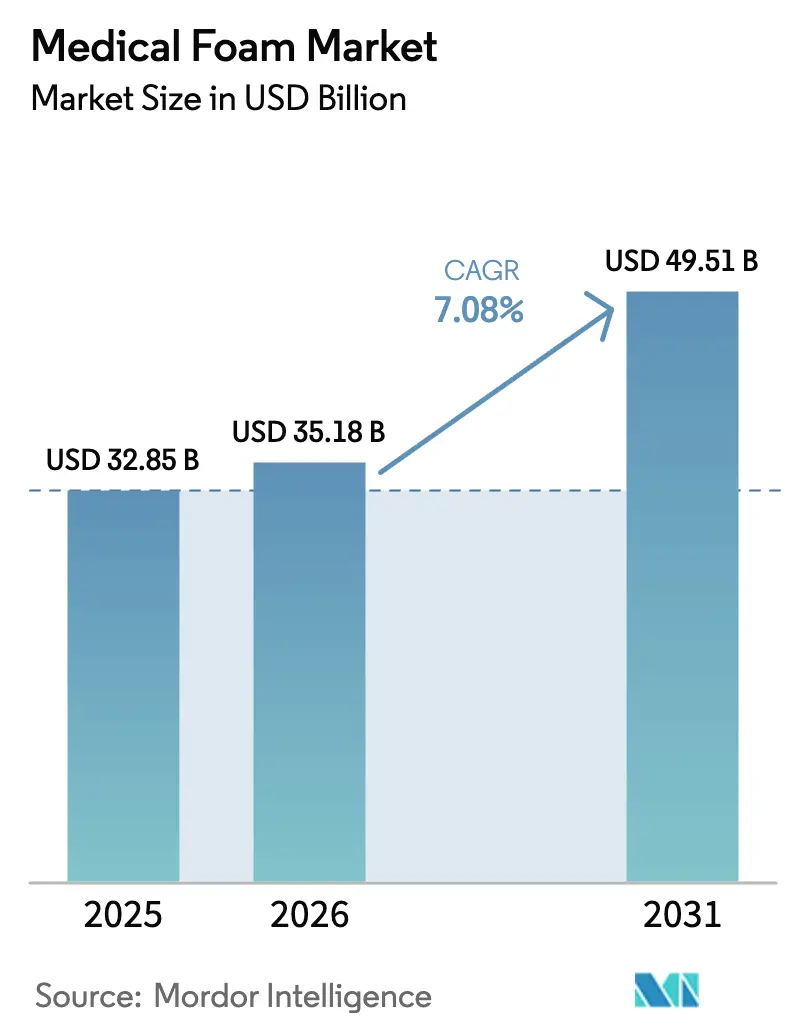
| Market Size (2026) | USD 35.18 Billion |
| Market Size (2031) | USD 49.51 Billion |
| Growth Rate (2026 - 2031) | 7.08 % |
| Fastest Growing Market | Asia Pacific |
| Largest Market | North America |
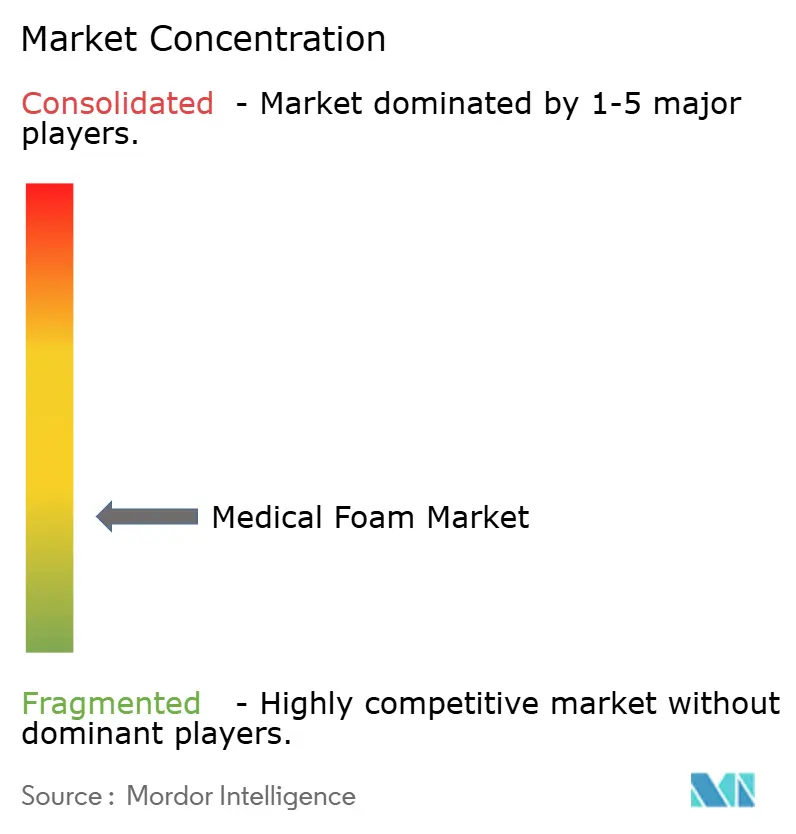
| Market Concentration | Low |
Major Players *Disclaimer: Major Players sorted in no particular order Image © Mordor Intelligence. Reuse requires attribution under CC BY 4.0. | |
Medical Foam Market Analysis by Mordor Intelligence
The Medical Foam Market size was valued at USD 32.85 billion in 2025 and estimated to grow from USD 35.18 billion in 2026 to reach USD 49.51 billion by 2031, at a CAGR of 7.08% during the forecast period (2026-2031).
A resilient demand pattern underpins this trajectory, led by polyurethane grades that accounted for 59.66% of 2024 revenue, while polyolefin grades are expanding at a 10.12% CAGR on the back of circular-economy initiatives. Demographic aging continues to widen the user base for pressure-relief bedding, advanced wound dressings and cushioning systems that rely on high-performance foams. Flexible formulations dominate day-to-day hospital and long-term-care needs, whereas spray technologies have opened custom-fit opportunities in prosthetics and orthotics. Regulatory incentives for infection control, coupled with temperature-controlled pharmaceutical distribution, keep demand for sterile and insulated packaging foams elevated.
Key Report Takeaways
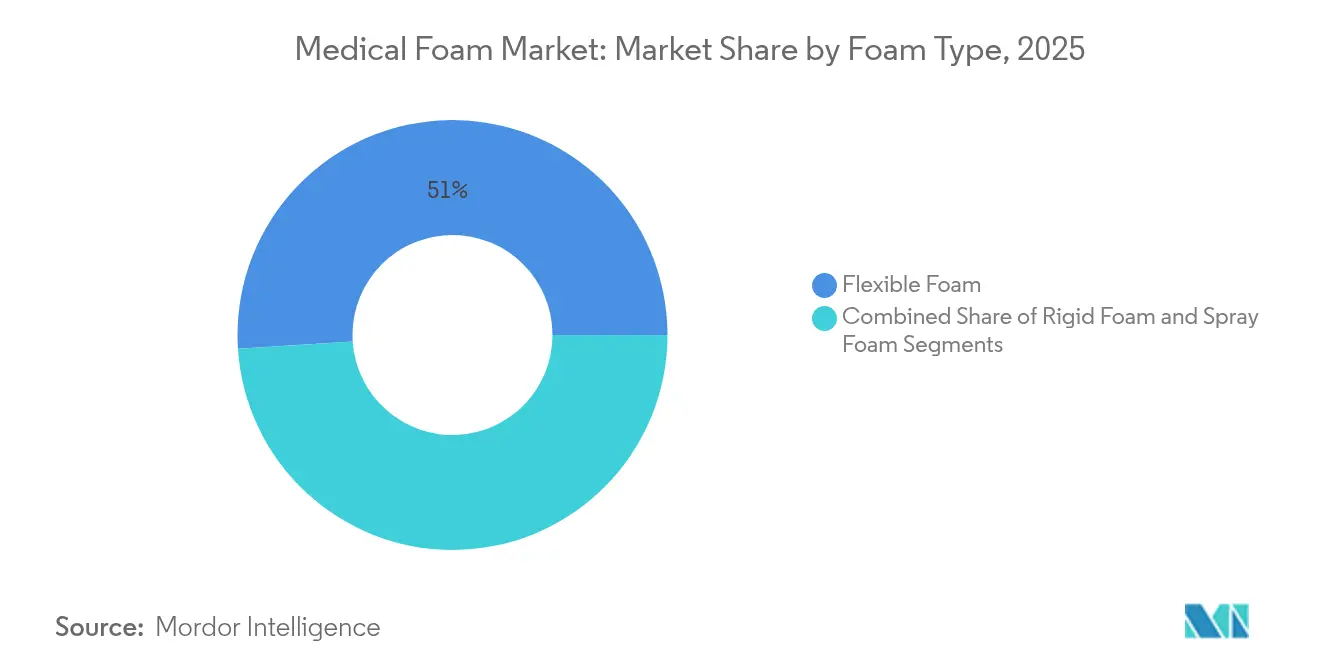
- By foam type, flexible foams led with 51.02% of medical foam market share in 2025 while spray foams are projected to register a 8.62% CAGR to 2031.
- By product, polyurethane captured 59.05% of the medical foam market size in 2025; polyolefin grades are forecast to grow at a 9.71% CAGR between 2026-2031.
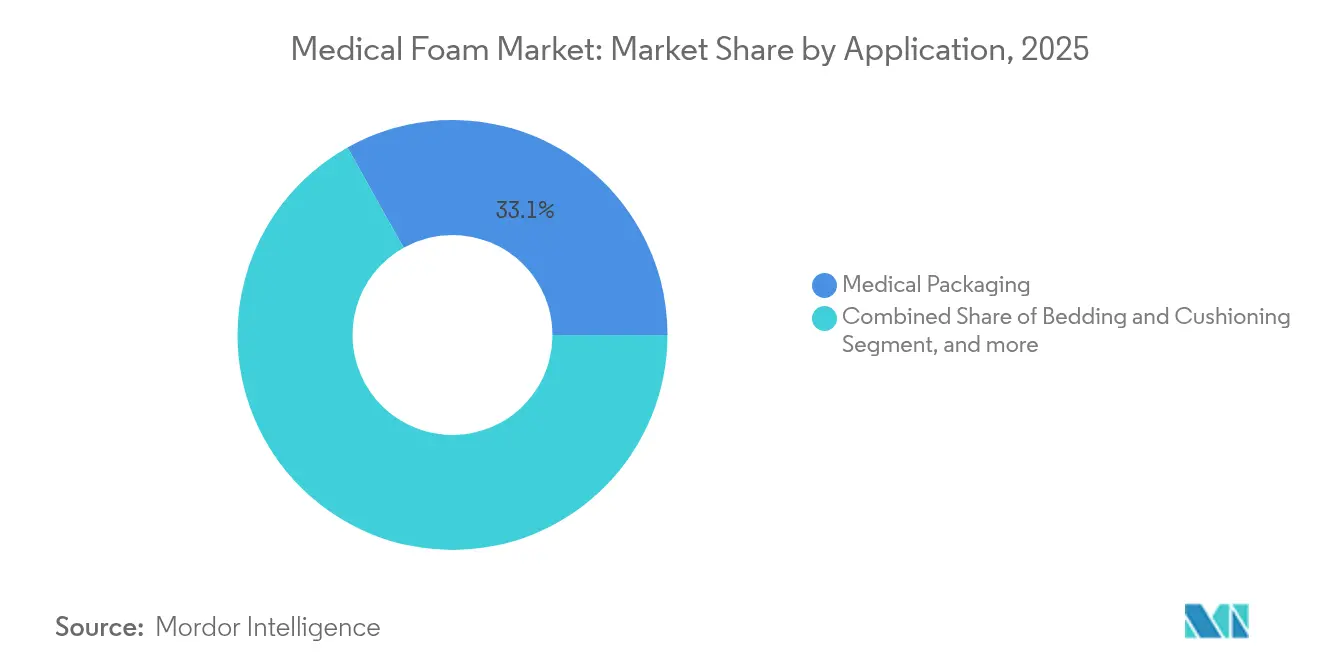
- By application, medical packaging held 33.12% revenue share in 2025 and prosthetics & wound care is advancing at a 11.74% CAGR through 2031.
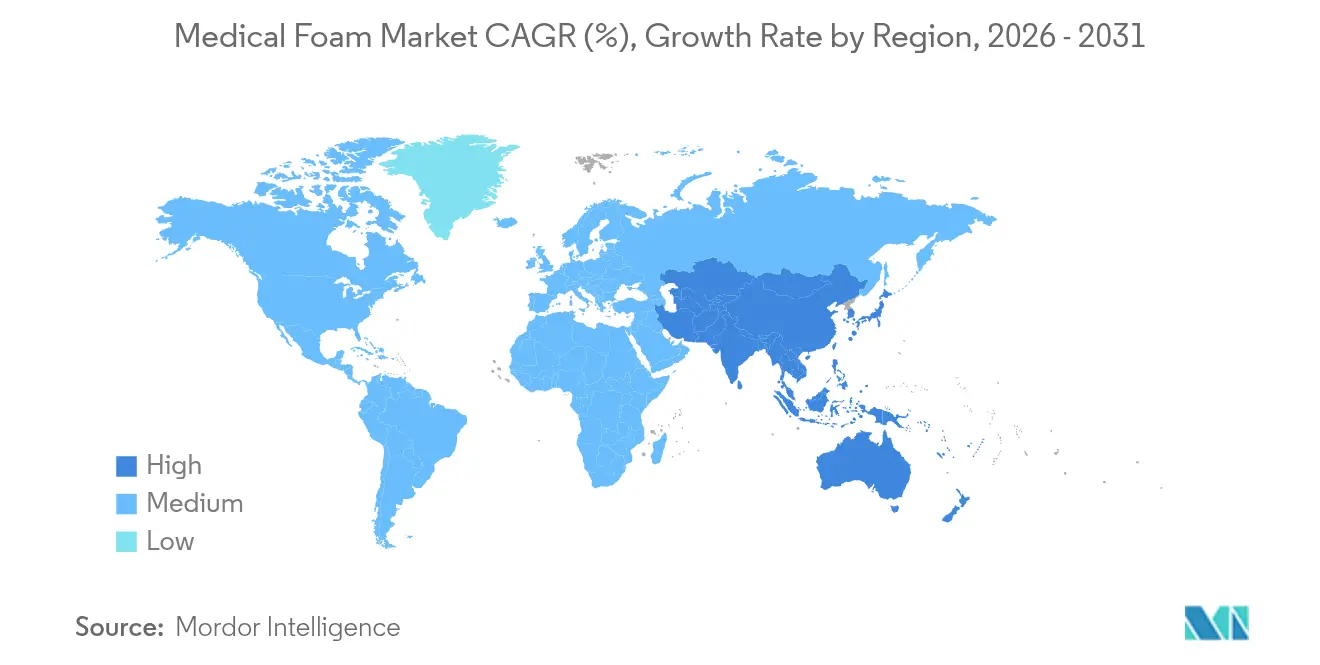
- By geography, North America commanded 33.21% of 2025 revenue, whereas Asia-Pacific is tracking the fastest pace at a 9.28% CAGR to 2031.
Note: Market size and forecast figures in this report are generated using Mordor Intelligence’s proprietary estimation framework, updated with the latest available data and insights as of 2026.
Market Trends and Insights
Drivers Impact Analysis of Medical Foam Market*
| Driver | (~) % Impact on CAGR Forecast | Geographic Relevance | Impact Timeline |
|---|---|---|---|
| Rising Geriatric Population and Chronic Disease Prevalence | +1.8% | Global, with highest impact in North America & Europe | Long term (≥ 4 years) |
| Rapid Adoption of Medical-grade Foams in Sterile Packaging | +1.2% | Global, led by North America & Asia-Pacific | Medium term (2-4 years) |
| Home-Health Boom Driving Demand for Pressure-Relief Bedding | +1.5% | North America & Europe, expanding to Asia-Pacific | Medium term (2-4 years) |
| Government Incentives for Advanced Wound-Care Materials | +0.9% | North America & Europe | Short term (≤ 2 years) |
| AI-guided Design of Foam Micro-Cell Structures for Personalised Prosthetics | +0.7% | North America, Europe, select Asia-Pacific markets | Long term (≥ 4 years) |
| Pharmaceutical Cold-Chain Mandates for Reusable Cryogenic Foam Shippers | +0.6% | Global, with emphasis on developed markets | Medium term (2-4 years) |
| Source: Mordor Intelligence | |||
Rising Geriatric Population and Chronic Disease Prevalence
Polyurethane dressings cut pressure-ulcer incidence by 35% compared with conventional gauze, lowering hospitalization length and after-care costs. Elderly patients experience pressure-ulcer rates of 10-25%, prompting hospitals and home-health operators to prioritise mattresses that redistribute load effectively. Medicare coverage determinations L38902 and L37166 reimburse advanced foam dressings, reinforcing adoption in long-term-care and outpatient settings.[1] Demographic ageing therefore creates a multi-year volume runway for vendors supplying bed, seat and heel-protection products across care environments.
Rapid Adoption of Medical-grade Foams in Sterile Packaging
ISO 11607-1:2019 prescribes that materials must safeguard terminally sterilised devices until point of use, favouring closed-cell foams with repeatable microbial-barrier performance.[2] Pharmaceutical cold-chain networks simultaneously need insulation that maintains 2-8 °C profiles. DS Smith’s TailorTemp solution keeps temperature ranges intact for 36 hours while cutting CO₂ emissions 40% versus expanded polystyrene, demonstrating how design can converge performance and sustainability dssmith.com. Demand spans orthopaedic implants to cardiology kits where vibration dampening, puncture resistance and ease of sterilisation matter.
Home-Health Boom Driving Demand for Pressure-Relief Bedding
Cost-containment policies favour shifting recovery to the home, where durable medical equipment must match hospital-grade safety standards. Memory-foam multilayer cores relieve interface pressure while breathable top layers maintain micro-climate comfort. Sensor-embedded foams allow real-time pressure mapping; research shows adaptive prosthetic sockets that auto-adjust via smartphone apps improve daily-wear tolerance.[3] Reimbursement frameworks classify such surfaces as medically necessary when risk factors meet threshold scores, sustaining a purchasing cycle among home-health agencies.
Government Incentives for Advanced Wound-Care Materials
Local Coverage Determinations and the Physician Fee Schedule reimburse surgical dressings that demonstrate clinical efficacy, incentivising procurement of modern polyurethane composites. FDA device-review pathways remain clear: EXEM FOAM recently secured regulatory-review-period determination, illustrating predictable market-entry routes. Hospital quality programmes that target lower infection rates now emphasise single-use, non-adherent foam dressings that manage exudate and minimise dressing changes.
Restraints Impact Analysis of Medical Foam Market*
| Restraint | (~) % Impact on CAGR Forecast | Geographic Relevance | Impact Timeline |
|---|---|---|---|
| Volatile Isocyanate and Polyol Prices | -1.1% | Global, with highest impact in manufacturing regions | Short term (≤ 2 years) |
| Stringent VOC and Phthalate Emission Regulations | -0.8% | North America & Europe, expanding globally | Medium term (2-4 years) |
| PFAS "forever-chemical" Scrutiny on Fluorinated Foam Additives | -0.6% | North America & Europe, with global regulatory spillover | Medium term (2-4 years) |
| Recycling Bottlenecks for Multi-Material Medical Foams | -0.4% | Global, with emphasis on developed markets | Long term (≥ 4 years) |
| Source: Mordor Intelligence | |||
Volatile Isocyanate and Polyol Prices
Toluene diisocyanate and methylene diphenyl diisocyanate underpin most polyurethane medical foams and track petroleum price swings, squeezing margins when contract prices lag feedstock inflation. Manufacturers hedge risk through dual-supplier strategies and bio-content initiatives that diversify feedstocks away from fossil-derived inputs.
Stringent VOC and Phthalate Emission Regulations
The Danish Environmental Protection Agency found dimethylformamide and related compounds in consumer foams at levels warranting tighter limits. California’s Consumer Products Regulations impose VOC caps and phase out toxic additives, pushing formulators toward water-blown or CO₂-blown systems. ASTM D8142-17e1 chemical-emission testing adds laboratory costs and lengthens product-development cycles. Collectively, these rules elevate compliance expenditure but promote safer end-use conditions.
*Our forecasts treat driver/restraint impacts as directional, not additive. The impact forecasts reflect baseline growth, mix effects, and variable interactions.
Medical Foam Market Segment Analysis
By Foam Type:
Flexible Domination and Spray-Segment MomentumFlexible grades held 51.02% of 2025 revenue, reflecting widespread use in hospital mattresses, OR table pads and wound dressings where contour conformity is paramount. Rising home-health demand anchors stable volumes, while incremental gains stem from the sensor-integration trend in next-generation cushions. Spray technologies accounted for a smaller baseline but are forecast to post a 8.62% CAGR as portable applicators and two-component chemistries allow clinicians to cast in-situ liners and bespoke limb sockets. Growing practitioner familiarity, faster curing and lower volatile-emission variants accelerate their penetration in orthotics laboratories and point-of-care fittings.
Innovation cycles favour spray foams containing blocked isocyanate systems that eliminate occupational hazards and enable room-temperature skin contact. Investment by raw-material suppliers in equipment training broadens the installer base, supporting market entry in ambulatory centres. Meanwhile, rigid foams remain indispensable where dimensional stability outranks flexibility, for instance within imaging-equipment housings or cold-chain pallet shippers. Volume growth, however, parallels overall device-manufacturing output rather than showing breakout expansion.

By Product:
Polyurethane Supremacy with Polyolefin Sustainability UpsidePolyurethane retained 59.05% revenue control in 2025, confirming its role as the staple polymer matrix for both flexible and rigid healthcare foams. Covestro’s Baymedix range illustrates how tailored isocyanate chemistry delivers both breathable backing films and hydrophilic pad cores that speed exudate uptake. High regulatory familiarity, ready sterilisation and fine-tuned hardness grades lock in formulation preference among OEMs.
Polyolefin foams, however, are expanding at a 9.71% CAGR. Their absence of plasticisers, intrinsic recyclability and density-reduction potential align with hospital sustainability charters. Emerging batch-foam processes can now achieve medical-grade cleanliness without post-foaming laminates, paving the way for adoption in sterile packaging inserts and paediatric positioning aids. Polystyrene and PVC retain niche roles where rigidity or clarity is indispensable, though volume prospects remain modest in view of environmental scrutiny.
By Application:
Packaging Scale and Prosthetic AccelerationSterile and temperature-controlled logistics maintained packaging’s 33.12% share in 2025. Stringent barrier, particulate and thermal-shock benchmarks lock in repeat demand for die-cut inserts, vial separators and vaccine shippers. Growth moderates in line with overall pharmaceutical output, yet product iterations that combine recyclability with drop-test resilience keep value realisation intact.
Conversely, prosthetics and wound care lead expansion at a 11.74% CAGR as patient-specific solutions gain traction. Multi-zone foams let prosthetists modulate durometer across sockets, improving residual-limb comfort. In wound management, open-cell polyurethane with ionic-silver impregnation controls bioburden while maintaining moisture vapor transmission, enabling extended wear intervals that lower nursing labor. These outcomes reinforce clinician switch from legacy gauze to advanced foams, feeding a robust replacement cycle.
Geography Analysis
North America Medical Foam Market
North America holds a 33.21% revenue lead on the strength of integrated chemical supply chains, device-manufacturing clusters and reimbursement mechanisms that reward clinical efficacy. Medicare coverage for advanced dressings and therapeutic mattresses underpins predictable purchasing budgets. Multinationals operate manufacturing footprints across the United States and Canada, ensuring rapid fulfilment and regulatory alignment.
Europe Medical Foam Market
Europe mirrors North America in technical standards but surpasses it in environmental policy intensity. The forthcoming Packaging and Packaging Waste Regulation obliges medical-device makers to engineer recyclability into product lifecycles, a shift that expands opportunities for low-density polyolefin solutions. Regional health systems favour cost-effectiveness studies, hence vendors that document reduced dressing-change frequency or shorter rehabilitation turnarounds gain bidding advantages.
APAC, MEA and South America Medical Foam Market
Asia-Pacific is advancing at a 9.28% CAGR, powered by capacity expansions at regional polyurethane plants which shorten lead times and reduce import costs. Public-hospital modernisation programmes in China and India direct investments toward pressure-relief bedding and negative-pressure wound-therapy kits, both foam-intensive categories. Governments simultaneously encourage localised sourcing to build supply-chain resilience, prompting raw-material suppliers to establish propylene-glycol and polyol plants within the region dow.com. Middle East & Africa and South America remain nascent yet promising, with hospital-construction pipelines and regulatory reforms laying groundwork for faster uptake of advanced care materials over the coming decade.
Regulatory Landscape
Medical foams used in devices, wound dressings, and protective packaging fall under medical-device quality and validation regimes rather than being regulated as a standalone material category. A key anchor is the US FDA Quality Management System Regulation (QMSR) under 21 CFR Part 820, which became effective on February 2, 2026 and harmonizes US quality-system expectations with ISO 13485:2016. The scope covers design, manufacture, packaging, labeling, storage, installation, and servicing activities that affect foam components and assemblies.
In parallel, global OEM qualification and supplier audits commonly reference ISO 13485:2016, which raises documentation and process-control requirements for foam converters and clean manufacturing specialists serving medical packaging inserts, device cushions, and patient-contact foam parts. This alignment increases emphasis on traceability, process validation, and change-control for foam formulations and converting steps, such as reticulation, lamination, and die cutting. As a result, suppliers are positioned to industrialize lower-VOC chemistries and sustainability-oriented grades while keeping validated performance for sterile barrier and clinical-use applications.
Competitive Landscape
The sector shows moderate fragmentation, with the top five suppliers controlling significant share of global revenue. BASF, Dow and Covestro command backward-integrated feedstock chains that deliver cost stability, while specialised converters such as UFP Technologies capture value in high-complexity assemblies. 3M separated its healthcare assets into Solventum in 2024, allowing a sharper focus on wound-care and sterilisation technologies. DuPont’s 2024 agreement to acquire Donatelle Plastics broadened its contract-manufacturing reach in drug-delivery devices.
Technology leadership hinges on coupling foam science with sensing and digital-design competencies. Academic collaboration has produced grid-based piezoresistive sensors delivering sensitivities of 2.24 kPa⁻¹, enabling mattresses that alert caregivers to shear-force build-up. Covestro and Huntsman advance bio-content pathways that cut greenhouse-gas footprints without compromising tensile or compression set.
Price competition characterises commodity bedding and packaging segments, yet OEM qualification costs and sterility-validation hurdles shelter margins in medical-device components. Suppliers that provide turnkey material, design and clean-room conversion services enjoy stickier customer relationships and higher switching barriers.
Medical Foam Industry Leaders
-
American Excelsior Company
-
American Foam Products
-
Heubach Corporation
-
UFP Technologies, Inc.
-
Rogers Corporation
- *Disclaimer: Major Players sorted in no particular order
Medical Foam Market Companies Covered in this Report
- American Excelsior Company
- American Foam Products
- Heubach Corporation
- General Plastics Manufacturing Company Inc.
- UFP Technologies Inc.
- FXI
- Rogers Corporation
- Dow
- Huntsman International LLC
- 3M
- Rempac Foam LLC
- VPC Group
- Recticel NV
- Sekisui Chemical Co. Ltd.
- BASF
- Covestro
- Carpenter Co.
- Armacell International
- Foamtec Medical
- ConvaTec Group plc
- Smiths Group
Market Opportunities and Future Outlook
A near-term whitespace is emerging around helping device and packaging supply chains simplify global compliance and supplier qualification under harmonized quality expectations, anchored by the FDA QMSR taking effect in February 2026 and its alignment with ISO 13485:2016. Suppliers that can provide medical-grade foam materials alongside documented, audit-ready converting, including validated cutting, lamination, cleaning, and packaging controls, have a clearer path to be embedded into OEM approved-vendor lists, particularly when foam is part of a higher-risk finished assembly like sterile kits, protective device packaging, or patient-contact cushioning.
Sustainability and circularity requirements are also driving specification resets across medical packaging and patient-support products, where buyers weigh VOCs, additives, and end-of-life options alongside performance. American Foam Products' public focus on sustainable packaging solutions, including bio-based polyols and starch-based foams for healthcare cushioning and thermal-resistance use cases (June 2026), reinforces this procurement lens. On capacity and lead times, American Excelsior Company’s investment in automated urethane foam molding at its Sheboygan, Wisconsin facility to increase molded output (January 2026) supports opportunities for faster-turn medical components, safe patient handling, and customized cushioning programs that require repeatable molding and reliable supply.
Recent Industry Developments in Medical Foam Market
- June 2026: American Foam Products, Inc. announced a strategic initiative to advance sustainable packaging solutions with bio-based polyols and starch-based foams for healthcare and medical device applications. This shift reinforces demand for greener packaging across medical devices and could influence packaging specifications and supplier qualification.
- April 2026: American Excelsior Company highlighted flexible foam for patient comfort and medical-solutions applications via a LinkedIn post. This signals continued product emphasis on comfort-driven medical foams and potential demand acceleration.
- January 2026: American Excelsior Company invested 2.0 million USD in an automated urethane foam molding line at its Sheboygan facility, tripling molded division capacity. This strengthens supply readiness and reduces lead times for medical foam components.
Medical Foam Market Report Scope and Research Methodology
Market Definition and Coverage
For this methodology, the medical foam market includes foam materials sold into healthcare and medical uses, where performance is tied to patient contact, hygiene, cushioning, packaging, or device-related needs across care settings.
Scope exclusions: We exclude non-medical consumer foams and general industrial foams that are not purchased for a healthcare-led end use.
Segments Covered in This Report
- By Foam Type
- Flexible Foam
- Rigid Foam
- Spray Foam
- By Product
- Polyurethane (PU)
- Polystyrene (PS)
- Polyolefin
- Polyvinyl Chloride (PVC)
- Other Products
- By Application
- Bedding & Cushioning
- Medical Packaging
- Medical Devices & Components
- Prosthetics & Wound Care
- Other Applications
- By Geography
- North America
- United States
- Canada
- Mexico
- Europe
- Germany
- United Kingdom
- France
- Italy
- Spain
- Rest of Europe
- Asia-Pacific
- China
- Japan
- India
- Australia
- South Korea
- Rest of Asia-Pacific
- Middle East & Africa
- GCC
- South Africa
- Rest of Middle East & Africa
- South America
- Brazil
- Argentina
- Rest of South America
- North America
Data Sources, Market Sizing, and Validation
Desk Research
Desk research starts with building a clear demand map for medical end uses, and then linking it back to foam supply chains and raw material context. We mainly use public data series that explain healthcare activity and plastics processing fundamentals, which helps keep assumptions grounded.
Sources used include, as examples, the US FDA for device and packaging context, the US Census Bureau and the US International Trade Commission for trade and manufacturing signals, Eurostat for regional industrial output indicators, and OECD health statistics for healthcare spend and utilization direction. We also review company filings and investor presentations, association and standards body publications, and reputed press coverage for pricing commentary and capacity changes. Paid subscriptions for company financials and intelligence are used selectively, alongside patent databases and shipment-level import and export records, to validate company exposure and cross-check trade-linked volumes. This list is not exhaustive, and many other sources were also referenced for data collection, validation, and clarification.
Primary Interviews and Surveys
Primary work is used to confirm what is truly counted as medical foam in practice, and where demand is shifting across end uses like medical packaging, bedding and cushioning, wound care, and device components. We spoke with foam converters, material suppliers, and downstream buyers, then used the inputs to test pricing bands, mix shifts, and regional adoption patterns, so the model reflects how the market actually operates.
Distribution of primary research fieldwork respondents
| Company type | Respondent position | Region |
|---|---|---|
| Top tier: 26% | CXOs: 19% | APAC: 43% |
| Mid tier: 55% | Functional/Unit leaders: 31% | EMEA: 33% |
| Smaller Players: 19% | Managers: 50% | Americas: 24% |
Market-Sizing & Forecasting
Sizing is built using a top-down approach where healthcare and medical manufacturing signals are translated into foam demand pools, and then split by the share of foam-based solutions used in each end use. To keep this realistic, the totals are corroborated with selective bottom-up checks, such as sampled ASP times volume for key foam types and channel checks on conversion output, which are then used to adjust outliers.
Inputs vary by geography and use case, and we rely on recurring market fingerprints. These include the mix by foam type (flexible, rigid, and spray), the product mix (such as polyurethane, polystyrene, polyolefin, and PVC), and the application split (such as medical packaging and bedding and cushioning), since each has different volume intensity and pricing behavior. We also track medical device production trends, hospital and long-term care utilization direction, and resin-linked cost movement that tends to flow into foam pricing with a lag.
For forecasting, scenario analysis is used so adoption and pricing can be flexed around realistic demand conditions, and then aligned with what primary respondents expect for regional growth. Where bottom-up clues are missing for smaller applications, gaps are handled by applying conservative share ranges and then cross-checking that the implied per-capita and per-procedure usage stays reasonable.
Data Validation & Update Cycle
Validation is done in layers so the final numbers are not driven by one data source or one assumption. We compare model outputs against independent signals like trade direction, healthcare utilization trends, and changes in foam type mix, and then investigate unusual jumps before sign-off.
A second analyst review is completed to test sensitivity around pricing, mix, and regional weights, followed by targeted re-contacts when variances look high or when new capacity or regulatory updates appear. Reports are refreshed annually, with interim updates for material events, and a fresh pre-delivery pass is completed so clients receive the latest updated view.
Mordor Intelligence's Medical Foam Market Size Compared Against Other Published Estimates
Published market sizes for medical foam can look far apart because firms do not always count the same end uses, and they often apply different price progression logic and currency timing. Differences also show up when one estimate leans more on broad polymers data, while another tries to trace medical demand more directly.
The main gap comes from whether medical bedding and cushioning sold through consumer-style channels is counted as medical demand, and Mordor Intelligence treats this as in-scope only when the buying intent and compliance requirements are tied to healthcare use, which keeps adjacent comfort foam out of the total.
Benchmark comparison
| Source | Market Size | Gaps in Research Methodology |
|---|---|---|
| Mordor Intelligence | USD 32.85 B (2025) | |
| Trade Publication A | USD 28.52 B (2024) | Uses an earlier base year and applies a lower growth path, and coverage tends to be tighter around core medical channels which can undercount spillover demand in packaging and institutional bedding. |
| Industry Newswire B | USD 34.06 B (2024) | Reports a higher near-term total that may reflect broader inclusion of foam sold into adjacent consumer and industrial uses, and the faster CAGR assumption can inflate the current-year level when back-calculated. |
The spread in the table is mainly explained by how closely each publisher ties foam demand to healthcare-qualified purchasing, along with how they update pricing and currency assumptions by year. By keeping scope rules explicit and checking totals against observable demand signals, the resulting market size stays traceable to repeatable inputs rather than broad material totals alone.
Key Questions Answered in the Report
What is the current value of the medical foam market?
The medical foam market is valued at USD 35.18 billion in 2026 and is projected to reach USD 49.51 billion by 2031.
How are regulations influencing product development?
ISO 11607 and VOC-emission rules require materials to offer sterile barriers and low volatile output, pushing manufacturers toward cleaner chemistries and bio-content formulations.
Which foam type dominates hospital and long-term-care applications?
Flexible polyurethane foams lead with 51.02% revenue share owing to their pressure-redistribution and conformability features.
Why are polyolefin foams gaining traction in healthcare packaging?
Polyolefin grades combine recyclability and low density, aligning with new packaging regulations that prioritise circular-economy performance.
Which application segment is expanding the fastest?
Prosthetics and wound care are growing at a 11.74% CAGR due to personalised-medicine trends and advanced wound-dressing adoption.
Which region is expected to be the fastest-growing market through 2031?
Asia-Pacific is forecast to progress at a 9.28% CAGR, supported by healthcare infrastructure investments and expanded local polyurethane capacity.