
Medical Beds Market Size and Share
Market Overview
| Study Period | 2020 - 2031 |
|---|---|
| Market Size (2026) | USD 4.06 Billion |
| Market Size (2031) | USD 5.36 Billion |
| Growth Rate (2026 - 2031) | 5.73 % |
| Fastest Growing Market | Asia Pacific |
| Largest Market | Europe |
| Market Concentration | Medium |
Major Players *Disclaimer: Major Players sorted in no particular order Image © Mordor Intelligence. Reuse requires attribution under CC BY 4.0. | |
Medical Beds Market Analysis by Mordor Intelligence
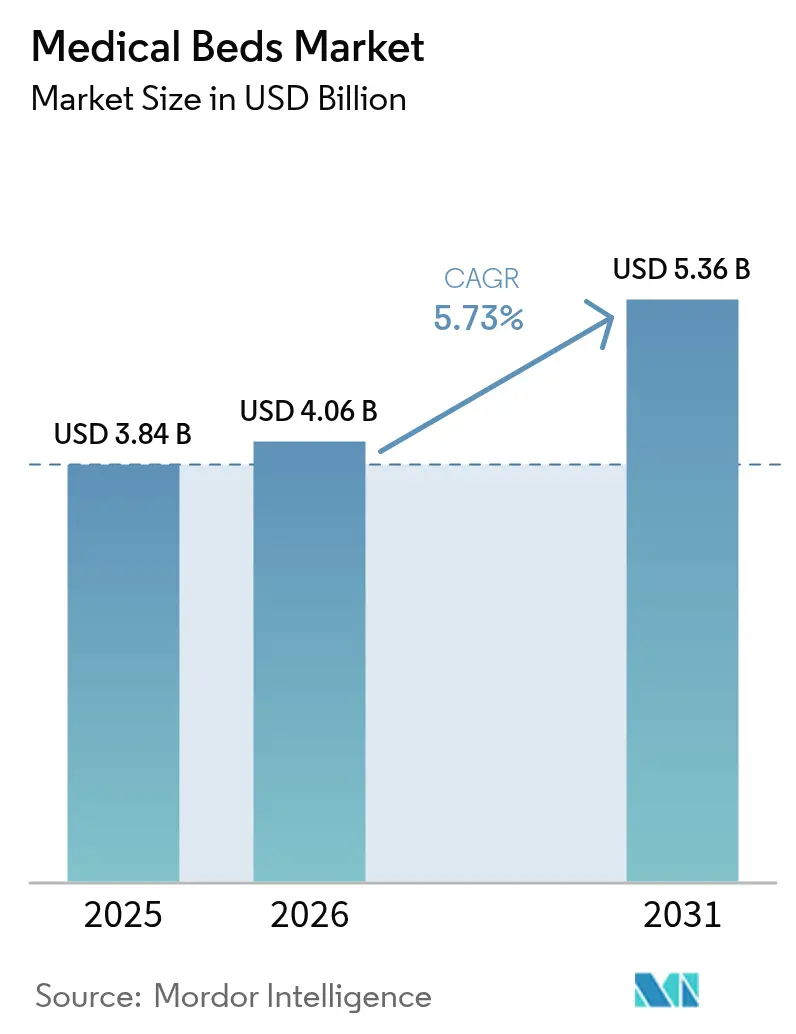
The medical beds market size was valued at USD 3.84 billion in 2025 and estimated to grow from USD 4.06 billion in 2026 to reach USD 5.36 billion by 2031, at a CAGR of 5.73% during the forecast period (2026-2031). Demand is shaped by population aging in developed regions and the broadening of hospital-at-home models that shift part of acute care into residential settings, which elevates the importance of flexible bed fleets in both institutional and home channels. Value-based purchasing frameworks and penalties tied to hospital-acquired conditions have made pressure injury and fall prevention core to capital decisions, which pushes adoption of advanced safety and positioning features. The growing burden of chronic diseases such as diabetes, cardiovascular conditions, and respiratory disorders sustains bed-day utilization and places continuous emphasis on comfort, mobility support, and monitoring readiness. Interoperability of bed-embedded sensors and cybersecurity obligations influence buying criteria in large health systems, since premarket and postmarket expectations for connected medical devices now include robust software bills of materials and vulnerability handling.
Key Report Takeaways
- By product type, general medical beds led with a 28.02% revenue share in 2025, while Intensive Care Beds are projected to expand at a 7.22% CAGR through 2031.
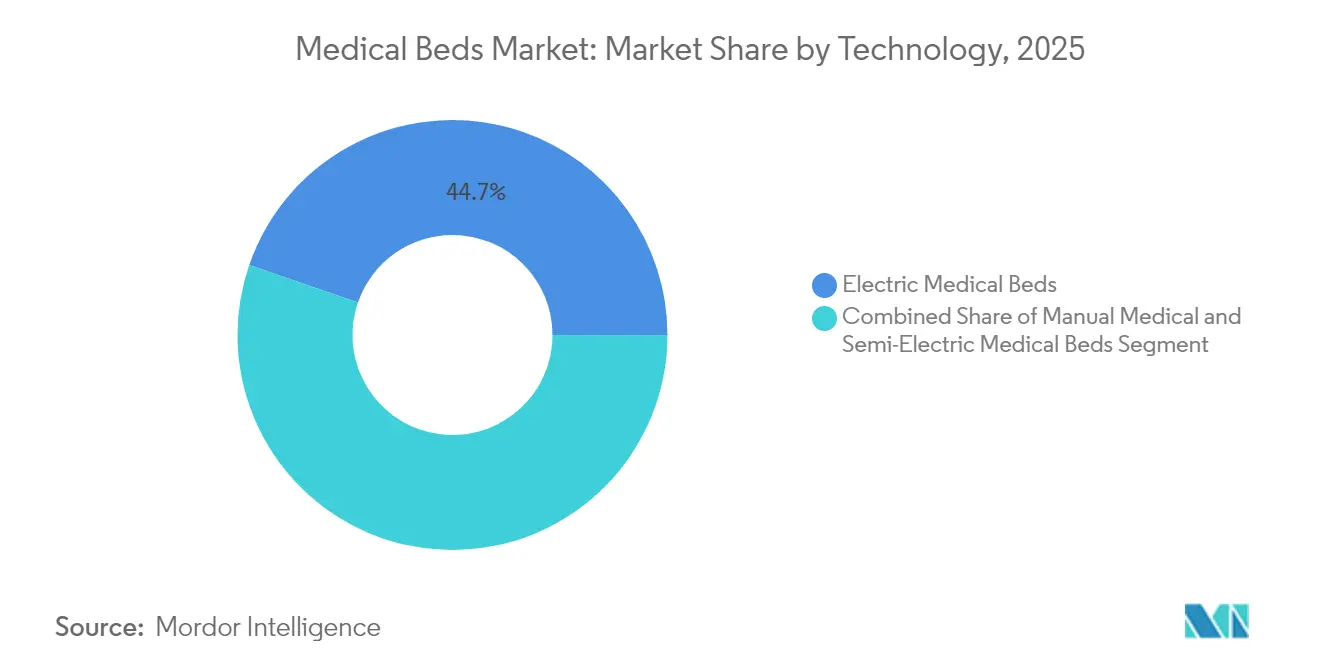
- By technology, electric medical beds held 44.72% share in 2025, while Semi-Electric Medical Beds are forecast to grow at a 7.05% CAGR through 2031.
- By end-user, hospitals and healthcare facilities accounted for 51.84% of the medical beds market share in 2025, while Long-term Care Facilities are projected to record an 8.12% CAGR from 2025 to 2031.
- By geography, North America retained a 41.93% share in 2025, while Asia-Pacific is anticipated to grow at a 6.18% CAGR through 2031.
Note: Market size and forecast figures in this report are generated using Mordor Intelligence’s proprietary estimation framework, updated with the latest available data and insights as of 2026.
Market Trends and Insights
Drivers Impact Analysis of Medical Beds Market*
| Drivers Impact Analysis | (~) % Impact on CAGR Forecast | Geographic Relevance | Impact Timeline |
|---|---|---|---|
| Growing Aging Population | +1.5% | Global, concentrated in North America, Europe, Japan | Long term (≥ 4 years) |
| Rising Prevalence of Chronic Diseases | +1.3% | Global, with acute pressure in North America, China, India | Medium term (2-4 years) |
| Technological Advancements in Smart Bed Features | +1.2% | North America, Europe, Asia-Pacific urban clusters | Medium term (2-4 years) |
| Rising Demand for Home Healthcare and Hospital-at-Home | +1.0% | North America lead, Europe following, pilot expansion in APAC | Short term (≤ 2 years) |
| Value-Based Harm Penalties Accelerating Safety Tech Adoption | +0.8% | United States, early adoption in UK and Germany | Short term (≤ 2 years) |
| Safe Patient Handling Mandates and Labor Shortages | +0.6% | North America and Europe | Medium term (2-4 years) |
| Source: Mordor Intelligence | |||
Growing Aging Population
The share of people aged 65 and older is on track to reach 16% of the global population by 2030, with Japan, Italy, and Germany already above 23% based on 2024 tallies. This aging dynamic raises bed-day intensity due to higher fall risk, reduced mobility, and multiple co-morbidities that require longer inpatient and post-acute stays. In the United States the Medicare-eligible cohort is expanding quickly, which sustains pressure on hospital capacity and skilled nursing bed availability as older patients represent a growing share of admissions. Electric and geriatric beds with low-height profiles, integrated scales, and caregiver-assist features have moved into the mainstream for facilities that concentrate on senior care. Payers and providers see bed technology as part of a strategy to shorten length of stay and to reduce harm events that drive penalties and reputational risk under quality programs[1].
Rising Prevalence of Chronic Diseases
Noncommunicable diseases account for a growing portion of admissions and long-term placements, which anchors steady demand for general medical beds and raises the need for ICU beds that support continuous monitoring. Acute exacerbations of diabetes, COPD, heart failure, and cancer often involve prolonged bed rest followed by staged rehabilitation that benefits from beds designed for frequent repositioning. In emerging economies where the disease burden is moving toward chronic conditions, procurement cycles favor scaled purchases of electric and semi-electric beds to equip new public hospitals. This trend is most visible where government programs are building capacity rapidly with a balance of cost control and functionality. The clinical workflow emphasis on preventing complications aligns with features that mitigate pressure injuries and enhance safer mobilization during recovery[2].
Technological Advancements in Smart Bed Features
Modern hospital beds function as data nodes within clinical and operational systems, with sensors for load, pressure, tilt, and bed-exit behavior that can inform both care and staffing decisions. Bed-exit prediction and mobility reminders help reduce the need for continuous observation, which assists teams facing nurse shortages and rising patient acuity. Interfacing with electronic records supports automatic documentation of repositioning intervals, which strengthens compliance posture during audits and claims review. Stryker and Hillrom have expanded deployments of connected bed fleets that enable dashboards with unit-level mobility and turnover metrics, though customers still face integration work because device messaging standards continue to mature[3]. Early adopters report improvements in pressure injury incidence and fewer overtime hours in nursing units where bed-connected alerts and documentation are integrated into daily workflows.
Rising Demand for Home Healthcare and Hospital-at-Home
Hospital-at-home models gained traction during the pandemic and remain available under recognized reimbursement pathways in the United States and parts of Europe. Programs require beds that deliver clinical functionality in a smaller footprint with easy-to-use controls for patients and family caregivers. In the United States participation in the Acute Hospital Care at Home program expanded through 2024, and hospital systems continue to manage conditions at home that were traditionally handled inside inpatient wards. Durable medical equipment providers face coordination and margin pressures due to rapid delivery and setup requirements, which increases the value of simplified semi-electric designs for the home setting. Over time the institutional channel is expected to concentrate advanced beds with extensive monitoring while the home channel scales volumes with hybrid feature sets that meet coverage thresholds[4].
Restraints Impact Analysis of Medical Beds Market*
| Restraints Impact Analysis | (~) % Impact on CAGR Forecast | Geographic Relevance | Impact Timeline |
|---|---|---|---|
| High Cost of Advanced Medical Beds (TCO Burden) | -0.9% | Global, acute in price-sensitive markets in LATAM, MEA, South Asia | Medium term (2-4 years) |
| Strict Regulatory Approvals and Safety Standards | -0.5% | Global, higher compliance overhead in United States (FDA) and European Union (MDR) | Long term (≥ 4 years) |
| Limited Reimbursement for Home and Long-term Care Beds | -0.7% | United States and Europe, payer variability in APAC | Medium term (2-4 years) |
| IoMT Interoperability and Cybersecurity Requirements | -0.6% | United States (FDA), European Union (MDR), global for networked devices | Long term (≥ 4 years) |
| Source: Mordor Intelligence | |||
High Cost of Advanced Medical Beds
Advanced ICU and electric beds with integrated rotation therapy and network connectivity come with higher capital outlays than manual or basic semi-electric models. In health systems with limited budgets, these purchases compete with other priorities such as imaging, surgical equipment, and medications, which slows upgrade cycles outside of flagship facilities. Total cost of ownership spans maintenance, parts, software licensing, and staff training, and gaps in onsite biomedical engineering capabilities can extend downtime when vendor service is required. Leasing and rentals can mitigate capital spikes while introducing recurring costs that accumulate over contract periods. The result is a split in adoption patterns, as premium beds concentrate in tertiary and private institutions while mid-tier facilities focus on durable and cost-effective options to expand capacity.
Limited Reimbursement for Home and Long-term Care Beds
Coverage in acute care is well defined, while reimbursement for home and long-term care beds varies by payer and jurisdiction. Medicare Part B reimburses hospital beds for home use when medically necessary, but co-insurance, caps, and documentation rules shape patient affordability and provider workflows. Private coverage often mirrors Medicare criteria, and state-level variability leads to differing access for similar clinical needs. In Europe the range spans comprehensive support in some countries and means testing or waiting lists in others, which complicates supplier forecasting and inventory planning. Manufacturers respond with product tiers that meet medical-necessity thresholds at lower price points while reserving advanced features for institutional buyers where integration justifies the investment.
*Our forecasts treat driver/restraint impacts as directional, not additive. The impact forecasts reflect baseline growth, mix effects, and variable interactions.
Medical Beds Market Segment Analysis
By Product Type:
General and ICU Segments Drive Divergent Growth PathsGeneral Medical Beds held 28.02% share of the medical beds market size in 2025, reflecting their broad deployment in medical-surgical wards, step-down units, and rehabilitation environments where moderate acuity dominates. These beds emphasize durability, cleanability, and essential features such as height adjustment, Trendelenburg positioning, and standardized side rails that align with fall prevention policies. Procurement in this category concentrates on batch replacement or expansion cycles, where buyers weigh volume discounts, warranty terms, and swap guarantees alongside upfront price. Hospitals running multi-year refresh plans often standardize on a few models to optimize parts inventories and staff training. Pediatric and geriatric models adapt the general form factor to age-specific needs, while birthing beds anchor obstetrics suites with positioning that supports clinical protocols.
Intensive Care Beds are projected to grow at a 7.22% CAGR through 2031 as systems keep critical care capacity above pre-pandemic levels and embed capabilities that support complex monitoring. ICU beds integrate advanced positioning, imaging compatibility, and pass-throughs for cardiac and respiratory devices, which command price premiums tied to their role in high-acuity care. Critical care expansion budgets in Europe, Asia-Pacific, and parts of the Middle East have prioritized ICU additions, which favors suppliers with demonstrated reliability and service coverage. Birthing beds continue to track local birth trends with stable demand in maternity centers, while pediatric and geriatric units serve specialist facilities with design features that reduce anxiety and falls. Surgical or operating room tables and transport stretchers round out the category, with growth aligned to procedural volumes and throughput optimization in perioperative and emergency departments, which continues to shape the medical beds market.


By Technology:
Semi-Electric Beds Gain Ground on Cost-Efficiency AppealElectric Medical Beds accounted for 44.72% share of the market in 2025, driven by automation that reduces caregiver strain and supports precise patient positioning for interventions. These platforms interface with nurse call and EMR systems, and a single button can adjust backrest, knee section, and overall height to suit clinical tasks and patient comfort. Hospitals capture operational gains when automated positioning shortens routine tasks for nursing teams across large wards. Semi-Electric Medical Beds are forecast to grow at a 7.05% CAGR through 2031 as facilities choose hybrid configurations that deliver key ergonomics at a lower purchase price. This balance is attractive to long-term care providers and community hospitals that must scale capacity while controlling capital budgets in the medical beds market.
Manual Medical Beds remain relevant in surge inventories and settings with limited technical support because mechanical simplicity enables long service life and minimal maintenance. Technology selection also mirrors workforce regulations, since safe patient handling rules increase the value of height adjustment and powered movement for injury prevention. Jurisdictions with defined safe patient handling requirements show faster adoption of electric platforms as part of occupational health strategies to lower musculoskeletal injuries among nursing staff. Regions with less prescriptive rules often move toward semi-electric options as a step-up path that balances ergonomics, training needs, and total cost over the useful life of the bed in the medical beds market.
By End-User:
Long-term Care Facilities Emerge as Fastest-Growth ChannelHospitals and Healthcare Facilities accounted for 51.84% share of the medical beds market size in 2025, reflecting higher acuity and strong capital budgets that support premium configurations. Procurement scale via group purchasing organizations and direct contracts supports standardized fleets and predictable replacement cycles, which help large systems manage maintenance and spares. The hospital channel values integration readiness for monitoring and clinical documentation to capture quality metrics and avoid harm-related penalties. Long-term Care Facilities are projected to grow at an 8.12% CAGR through 2031 as aging-in-place policies expand demand for skilled nursing and assisted living beds. Facilities upgrade from manual to semi-electric or electric beds to support caregiver retention and resident safety, which is central to quality ratings and reimbursement in the medical beds market.
Home Healthcare Providers coordinate rentals and purchases for patients transitioning from inpatient stays to home recovery, which drives preference for compact, easy-to-assemble frames with simple control interfaces. The channel is highly fragmented and operates under varied payer rules, which reinforces price sensitivity and emphasis on reliability for transport and setup. Emergency medical services represent a smaller slice of demand, focused on stretchers and transport beds where features center on weight, maneuverability, and compatibility with vehicle restraints. Investments in these categories follow fleet replacement schedules and the integration of lighter materials that support a single-operator lift. Across end-users, facilities that invest in equipment to reduce manual handling report improved staff retention, which underscores the human factors dimension of capital decisions in the medical beds market.
Geography Analysis
North America Medical Beds Market
North America held a 41.93% share of the medical beds market size in 2025, supported by high per-bed technology spend and regulations that link financial penalties to harm events. The Hospital-Acquired Condition Reduction Program in the United States docks reimbursement for pressure ulcers and falls in hospitals with rates above the national median, which strengthens the case for features that reduce injuries and support safe mobilization. Canada and Mexico add growth through public system expansions and private hospital investments, with the region leaning toward replacement and technology refresh rather than net new bed additions. Labor shortages, particularly among nurses and certified nursing assistants, increase demand for automation and monitoring that frees staff time for higher acuity care. Health systems in multiple states have reported persistent vacancy rates, which further integrates bed design into workforce strategies in the medical beds market.
Europe Medical Beds Market
Europe contributed a significant share of 2024 revenue, with Germany, the United Kingdom, France, and Italy as anchors. The European Medical Device Regulation has raised clinical evaluation and postmarket surveillance obligations, which favors companies with the resources to meet documentation and audit requirements. Germany’s DRG framework continues to reward efficiency improvements that shorten turnover times and reduce complications, which supports investment in mobility and prevention features. The United Kingdom’s capital budgets remain tight, which tempers ICU bed replacement outside specialized centers, while southern European countries prioritize adding basic bed counts to improve access. Occupational health rules on safe patient handling vary across countries, which influences the speed of migration from manual to powered platforms in the medical beds market.
APAC, MEA and South America Medical Beds Market
Asia-Pacific is projected to grow at a 6.18% CAGR through 2031, led by infrastructure investment in China, India, and Southeast Asia. China’s Healthy China 2030 blueprint emphasizes expansion of tier-two and tier-three city hospitals, which has led to large tenders that favor suppliers with local assembly or domestic partnerships. India’s Ayushman Bharat program is upgrading health and wellness centers and district hospitals, which pushes demand for semi-electric beds with dependable ergonomics at accessible price points. Japan remains a mature market with replacement demand and advanced monitoring integration driven by its aging demographics, while Australia’s private hospital segment continues to invest in premium configurations. The Middle East and Africa and South America collectively represented less than one fifth of 2024 revenue but show steady expansion as governments fund hospital construction and private operators develop specialty centers that procure ICU and surgical beds to international specifications in the medical beds market.

Regulatory Landscape
Medical beds are regulated as medical devices, with safety, performance, and quality-system obligations that affect design controls and documentation. In the United States, AC-powered adjustable hospital beds fall under FDA regulation 21 CFR 880.5100 as Class II devices, which aligns procurement requirements with conformity to recognized consensus standards and appropriate controls for electrically powered systems.
Internationally, updates to core bed safety standards act as a compliance anchor for global manufacturers. IEC 80601-2-52 (adult medical beds) moved to a 2026 edition in May 2026, and the FDA-established transition away from declaring conformity to IEC 60601-2-52 Edition 1.0 (2009) ends on July 5, 2026, tightening timelines for submissions that reference legacy test reports. In Europe, Regulation (EU) 2017/745 (MDR) continues to raise expectations for clinical evaluation, post-market surveillance, and traceability, favoring suppliers with mature technical files and audit-ready quality systems.
Value Chain Analysis
The medical beds value chain starts with upstream inputs including steel and aluminum structures, actuators and motors, electronics and sensors, plastics, coatings, and mattresses and accessories, then moves into design engineering and verification and validation testing against applicable IEC/ISO standards under regulated quality systems. For connected or sensor-enabled platforms, software, cybersecurity documentation, and integration tooling add additional specialist suppliers and testing, raising cost and lead time versus basic manual frames.
Downstream, distribution includes direct OEM sales to integrated delivery networks, group purchasing organizations, and public tenders, alongside durable medical equipment channels serving home healthcare and rental fleets. After-sales service, parts availability, field maintenance, and refurbishment programs influence total cost of ownership and fleet uptime, which can be a differentiator for multinational OEMs. Supply-chain risk is managed through dual sourcing and regional manufacturing footprints to reduce exposure to logistics volatility and trade frictions, while hospital standardization strategies, such as fewer bed models across sites, support simpler training, faster turnarounds, and lower spares complexity.
Competitive Landscape
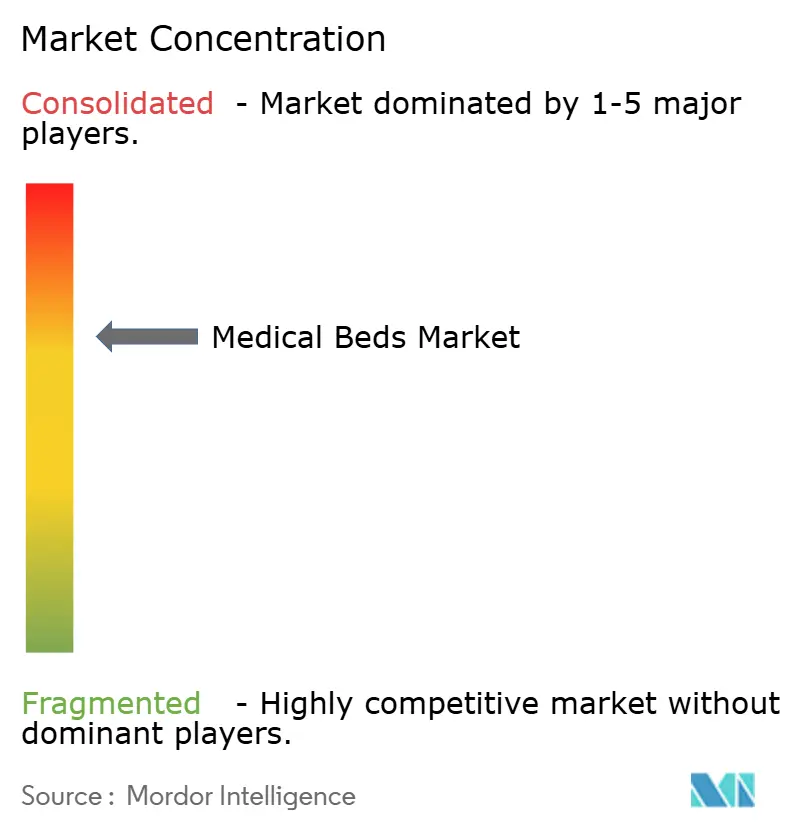
The medical beds market remains moderately concentrated as the top five manufacturers hold an estimated 45% to 50% global share. Large incumbents leverage scale in R&D, regulatory affairs, multi-country service, and compliance with standards that govern safety and cybersecurity for networked devices. Compliance with home-use design expectations such as IEC 60601-1-11 is increasingly relevant as hospital-at-home models expand, and established players can absorb the associated testing and documentation costs. Competitive strategies often emphasize ecosystems that bundle beds with patient handling equipment, nurse call systems, and analytics, which raise switching costs at the health system level.
Regional specialists such as Japanese and European manufacturers defend share through customization agility and responsive service, which wins public tenders that favor local content and short lead times. Partnerships and local assembly are common for navigating tariffs and currency risk in emerging markets, where scale and delivery reliability shape awards. Product roadmaps show a shift from mechanical innovation to sensor integration and software features, including fall detection and pressure mapping that suggest repositioning intervals. Suppliers that demonstrate secure device connectivity and clear vulnerability management workflows align with tighter regulator expectations for connected devices. These demands shape procurement criteria in the medical beds market as buyer IT teams evaluate device security posture alongside clinical benefits.
Data privacy and health information security considerations increase the importance of standards and frameworks across jurisdictions. In the United States HIPAA requirements govern handling of protected health information, which influences how bed-generated data is stored and share. In Europe GDPR establishes obligations for personal data processing, and vendors document anonymization or pseudonymization approaches to support compliance during analytics and user behavior monitoring. As beds become more deeply embedded in clinical systems, procurement teams assess interoperability alignment with evolving standards for device messaging, along with cybersecurity and data governance for fleet-wide deployments. These themes run across the medical beds market as buyers weigh safety, integration, privacy, and total cost in platform decisions.
Medical Beds Industry Leaders
-
Baxter International (Hillrom)
-
Stryker Corporation
-
LINET Group SE
-
Paramount Bed Co. Ltd.
-
Arjo AB
- *Disclaimer: Major Players sorted in no particular order
Medical Beds Market Companies Covered in this Report
- Amico Group of Companies
- Antano Group
- Arjo AB
- Baxter
- Besco Medical Ltd.
- Betten Malsch GmbH
- Drive DeVilbiss Healthcare
- Famed Żywiec Sp. z o.o.
- Favero Health Projects S.p.A.
- Gendron
- Getinge
- GF Health Products, Inc. (Basic American)
- Haelvoet NV
- Howard Wright Ltd.
- Invacare
- Joerns Healthcare
- Stiegelmeyer
- LINET Group
- Lojer Group
- Malvestio S.p.A.
- Medline Industries
- Narang Medical Ltd.
- Paramount Bed Co., Ltd.
- Pardo (Grupo Industrias Pardo)
- Savion Industries
- Stryker
- Völker GmbH
Market Opportunities and Future Outlook
Hospital demand is shifting toward mobility and safety capabilities that reduce complications from immobility and improve staffing efficiency. That is creating whitespace for specialty ICU platforms beyond standard electric frames. In March 2026, Kreg Therapeutics received a national group purchasing agreement with Premier, Inc. for the Catalyst bed supporting in-bed verticalization up to 750 lbs, showing how early-mobility solutions can be standardized across member hospitals. In June 2026, Agiliti announced an exclusive agreement to be the U.S. provider of the Total Lift Bed for ICU early mobilization protocols, reinforcing how equipment-service providers can accelerate adoption when capital budgets and operational deployment are tightly linked.
Localization and standards transitions also open specific pathways for suppliers to expand reach and refresh portfolios. In June 2026, LINET and Life Care Technology signed an MoU to form a joint venture for local hospital bed manufacturing in Egypt, aligning in-region production and partnerships with public procurement preferences and delivery lead-time requirements in emerging markets. In parallel, the publication of IEC 80601-2-52:2026 (May 2026) and IEC 80601-2-89:2025 (December 2025, for pediatric and atypical anatomy use cases) drives compliance-led replacement and redesign work, particularly for OEMs selling across regions that require up-to-date test evidence and traceable technical documentation.
Recent Industry Developments in Medical Beds Market
- June 2026: LINET Group and Life Care Technology signed an agreement to establish a joint venture for local hospital bed manufacturing in Egypt with equal ownership. The move expands LINETs manufacturing footprint in an emerging market where local production can improve lead times and alignment with domestic procurement requirements. It also deepens regional after-sales support potential, which is a key buying criterion for fleet standardization.
- July 2025: SonderCare launched certified home hospital beds targeted at middle-income seniors needing long-term care support in residential settings. The launch adds dedicated capacity and product focus to the home channel, where usability, compact footprints, and coverage documentation drive purchasing decisions. It also reflects the broader hospital-at-home and post-acute transition workflows that pull bed demand beyond hospitals.
- February 2025: Agiliti expanded Essentia deployment to multiple new health systems, enabling standardized multi-acuity bed coverage across hospital networks. The move strengthens the competitive landscape by accelerating replacement cycles for general and step-down bed fleets across diverse settings.
Medical Beds Market Report Scope and Research Methodology
Market Definition and Coverage
This market covers newly manufactured medical and hospital patient-care beds that are designed for clinical use and sold into hospitals, long-term care centers, ambulatory surgical facilities, and approved home-health distribution channels.
Scope exclusions: It excludes stretchers, examination couches, non-clinical smart mattresses, refurbished rental units, and non-purpose-built sleeping furniture.
Segments Covered in This Report
- By Product Type
- General Medical Beds
- Intensive Care Beds
- Birthing Beds
- Pediatric Beds
- Geriatric Beds
- Surgical/Operating Room Beds
- Transport/Stretchers
- By Technology
- Manual Medical Beds
- Electric Medical Beds
- Semi-Electric Medical Beds
- By End-User
- Hospitals & Healthcare Facilities
- Home Healthcare Providers
- Long-term Care Facilities
- Emergency Medical Services
- Geography
- North America
- United States
- Canada
- Mexico
- Europe
- Germany
- United Kingdom
- France
- Italy
- Spain
- Rest of Europe
- Asia-Pacific
- China
- Japan
- India
- Australia
- South Korea
- Rest of Asia-Pacific
- Middle East & Africa
- GCC
- South Africa
- Rest of Middle East & Africa
- South America
- Brazil
- Argentina
- Rest of South America
- North America
Data Sources, Market Sizing, and Validation
Desk Research
Desk research was used to set the demand context and keep the size model aligned with observable healthcare capacity signals. We reviewed public statistics and reference series such as World Health Organization health system indicators, World Bank population and aging data, OECD hospital capacity and utilization indicators, and U.S. CDC and CMS materials where they help explain care settings and utilization behavior.
To anchor supply-side reality, we also scanned sources such as U.S. SEC filings and investor presentations of bed manufacturers, import and export trade statistics from national customs portals, and published procurement notices and tenders where bed purchases are visible in volume terms. A paid subscription for company financials and news was used selectively to cross-check revenue direction and major plant or distribution changes, and a patent database was checked to understand which feature upgrades were truly new versus routine refresh cycles. These desk sources are illustrative, and many other public materials were also reviewed for data collection, validation, and clarification.
Primary Interviews and Surveys
Primary discussions were completed with a mix of manufacturers, distributors, hospital procurement stakeholders, and care facility operators to confirm assumptions on replacement cycles, average selling prices, and typical configuration mix. For a global view, inputs were balanced across APAC, EMEA, and the Americas, and where we saw large variance in electric bed adoption or ICU capacity, we rechecked through follow-up calls before finalizing totals.
Distribution of primary research fieldwork respondents
| Company type | Respondent position | Region |
|---|---|---|
| Top tier: 38% | CXOs: 15% | APAC: 44% |
| Mid tier: 46% | Functional/Unit leaders: 29% | EMEA: 35% |
| Smaller Players: 16% | Managers: 56% | Americas: 21% |
Market-Sizing & Forecasting
Market sizing was built using top-down and bottom-up logic, with the main construct coming from care capacity and demand pool math that can be explained and replicated. Hospital bed density, ICU capacity expansion, long-term care admissions, and home-health penetration were used to reconstruct the likely installed base and annual replenishment demand, and then those volumes were translated to value using a modeled price ladder for manual, semi-electric, and fully electric beds.
To avoid overcounting, results were checked using bottom-up approximations such as sampled supplier revenue splits by bed category, distributor channel checks, and an average selling price times unit volume cross-check in a few anchor countries, then scaled using regional weights. Where unit information was patchy for smaller care facilities, gaps were handled by applying validated replacement-cycle assumptions and using adjacent indicators such as hospital infrastructure spending and procurement activity. Forecasts were developed using scenario analysis supported by trend drivers that interviewees agreed were decision-critical, including aging population growth, hospital construction and renovation cycles, ICU utilization intensity, and the rate of electrification in general care wards.
Data Validation & Update Cycle
Validation is done through multiple passes so the final numbers stay consistent with real-world constraints. We compare model outputs with independent signals like hospital capacity series, trade movement patterns, and observed pricing bands, and investigate outliers before sign-off. When a variance is large, the assumptions are revisited and key experts are re-contacted to confirm whether the change is structural or temporary.
Reports are refreshed annually, and interim updates are made when material events occur, such as sharp procurement surges, large policy shifts, or major manufacturing capacity changes. Before delivery, a final analyst review is completed so clients receive the latest updated view based on the most current information available.
Mordor Intelligence's Medical Beds Market Size Compared Against Other Published Estimates
Published market numbers for medical beds can look quite different, even when they seem to describe the same space, because each study makes its own choices on what products to count and which selling channel to treat as the value point. Differences also show up when one source reports manufacturer-level sales, while another leans toward end-customer spending or mixes in adjacent items.
The table shows a spread that is mainly explained by scope and value definition, and in Mordor Intelligence's model the count is limited to newly manufactured clinical patient-care bed frames sold into defined care settings, with refurbishments and non-clinical items removed so the demand pool is not inflated by reuse.
Benchmark comparison
| Source | Market Size | Gaps in Research Methodology |
|---|---|---|
| Mordor Intelligence | USD 4.06 B (2026) | |
| Global Consultancy A | USD 4.58 B (2024) | Uses a hospital beds label with limited visible exclusion detail, and the value year is earlier, which can embed a different price base and a broader interpretation of what counts as a bed purchase across care settings. |
| Industry Publisher B | USD 4.11 B (2024) | Reported as factory-gate value with included services and a wide list of specialty bed types, which can shift totals depending on whether services, specialty configurations, and channel margins are treated inside the market value. |
Taken together, the comparison suggests that the biggest drivers of variance are the value point used (manufacturer sales versus broader spending) and whether refurbishments and adjacent items are included. By keeping inputs tied to capacity, replacement cycles, and a clear price ladder, our estimate stays traceable to specific demand signals and can be updated in a repeatable way as those signals move year to year.
Key Questions Answered in the Report
What is the current size and expected growth of the medical beds market through 2031 ?
The medical beds market size is USD 4.06 billion in 2026 and is projected to reach USD 5.36 billion by 2031, reflecting a 5.73% CAGR.
Which product categories are leading and growing fastest within the medical beds market ?
General Medical Beds led with 28.02% revenue share in 2025 while Intensive Care Beds are projected to grow at a 7.22% CAGR through 2031.
Which technologies are most adopted by buyers in the medical beds market ?
Electric Medical Beds held 44.72% share in 2025 and Semi-Electric Medical Beds are forecast to expand at a 7.05% CAGR, reflecting the balance between automation and cost.
Which end-user segment is expanding fastest in the medical beds market ?
Long-term Care Facilities are projected to grow at an 8.12% CAGR through 2031, while Hospitals and Healthcare Facilities remain the largest customer group with 51.84% share in 2025.
Which regions show the strongest momentum in the medical beds market ?
North America held a 41.93% share in 2025, while Asia-Pacific is forecast to grow at a 6.18% CAGR through 2031 on the back of sustained infrastructure investment.
What regulations most influence purchasing decisions in the medical beds market ?
Hospitals weigh compliance with harm reduction and safe patient handling policies, as well as device cybersecurity and medical device regulations, which shape feature requirements and integration readiness.