
Medical Affairs Outsourcing Market Size and Share
Market Overview
| Study Period | 2020 - 2031 |
|---|---|
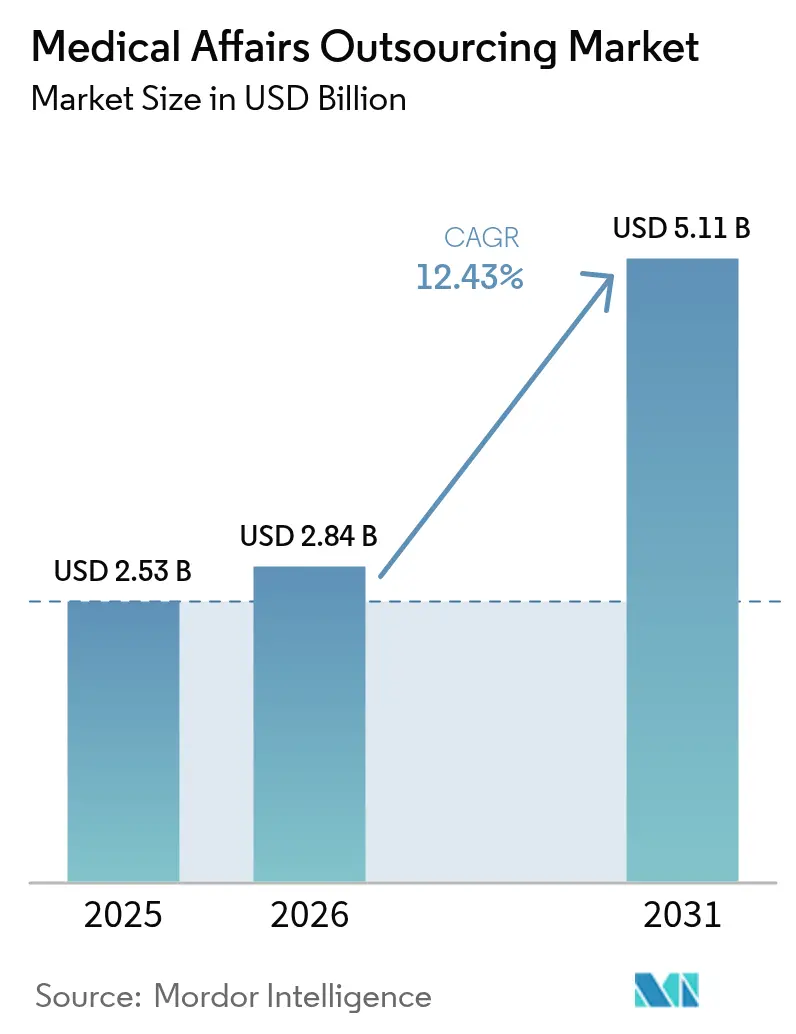
| Market Size (2026) | USD 2.84 Billion |
| Market Size (2031) | USD 5.11 Billion |
| Growth Rate (2026 - 2031) | 12.43 % |
| Fastest Growing Market | Asia-Pacific |
| Largest Market | North America |
| Market Concentration | Medium |
Major Players *Disclaimer: Major Players sorted in no particular order Image © Mordor Intelligence. Reuse requires attribution under CC BY 4.0. | |
Medical Affairs Outsourcing Market Analysis by Mordor Intelligence
The medical affairs outsourcing market size is expected to grow from USD 2.53 billion in 2025 to USD 2.84 billion in 2026 and is forecast to reach USD 5.11 billion by 2031 at 12.43% CAGR over 2026-2031. Robust demand reflects life-science companies’ decision to focus internal resources on discovery while sourcing regulatory writing, field engagement, and compliance expertise externally. Integrated generative-AI platforms are accelerating document preparation; AstraZeneca already uses large-language-model assistants to support its goal of launching 20 new medicines by 2030. Rising volumes of biologics and specialty-drug trials, ongoing EU MDR surveillance duties, and wider adoption of hybrid and decentralized clinical-trial designs reinforce the preference for flexible, specialist partners. Consolidation among contract development and manufacturing organizations (CDMOs) is adding scale benefits, while regional service hubs in Asia Pacific are winning share through cost and speed advantages.
Key Report Takeaways
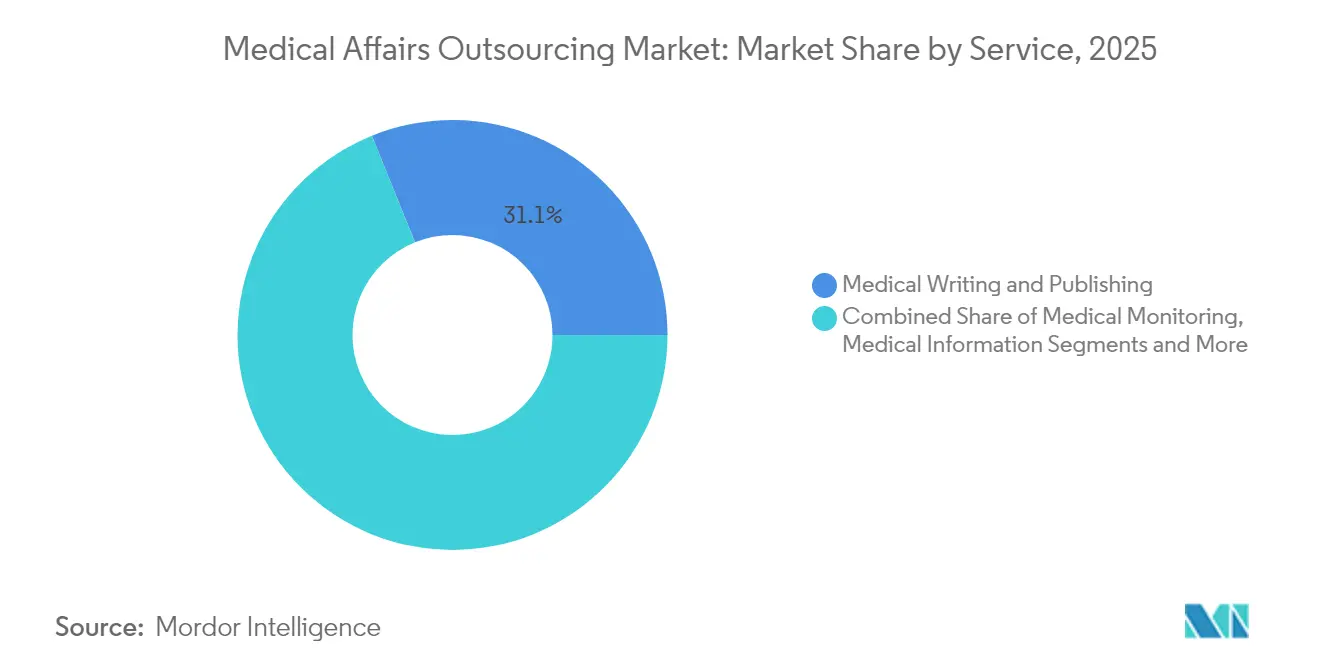
- By service, Medical Writing & Publishing led with 31.12% of the medical affairs outsourcing market share in 2025; Medical Science Liaisons (MSLs) are projected to expand at a 14.45% CAGR to 2031.
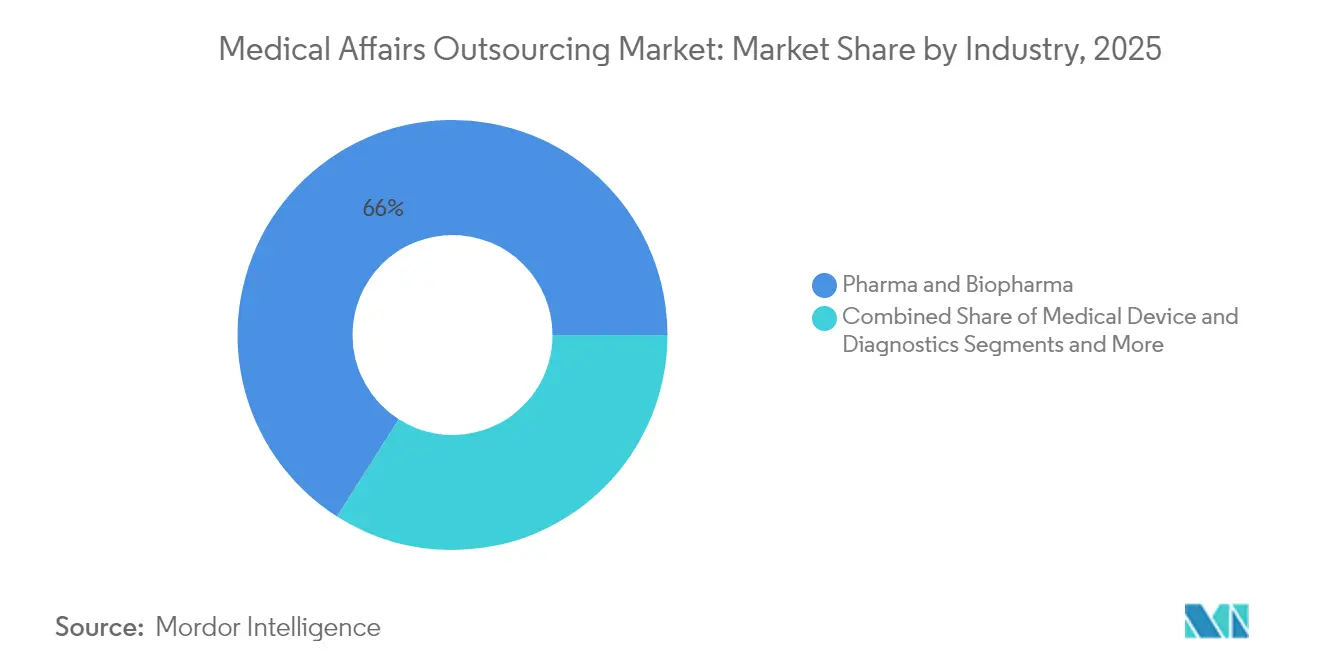
- By industry, pharmaceutical and biopharma companies controlled 65.98% of 2025 revenue, whereas emerging biotech is advancing fastest at a 15.05% CAGR through 2031.
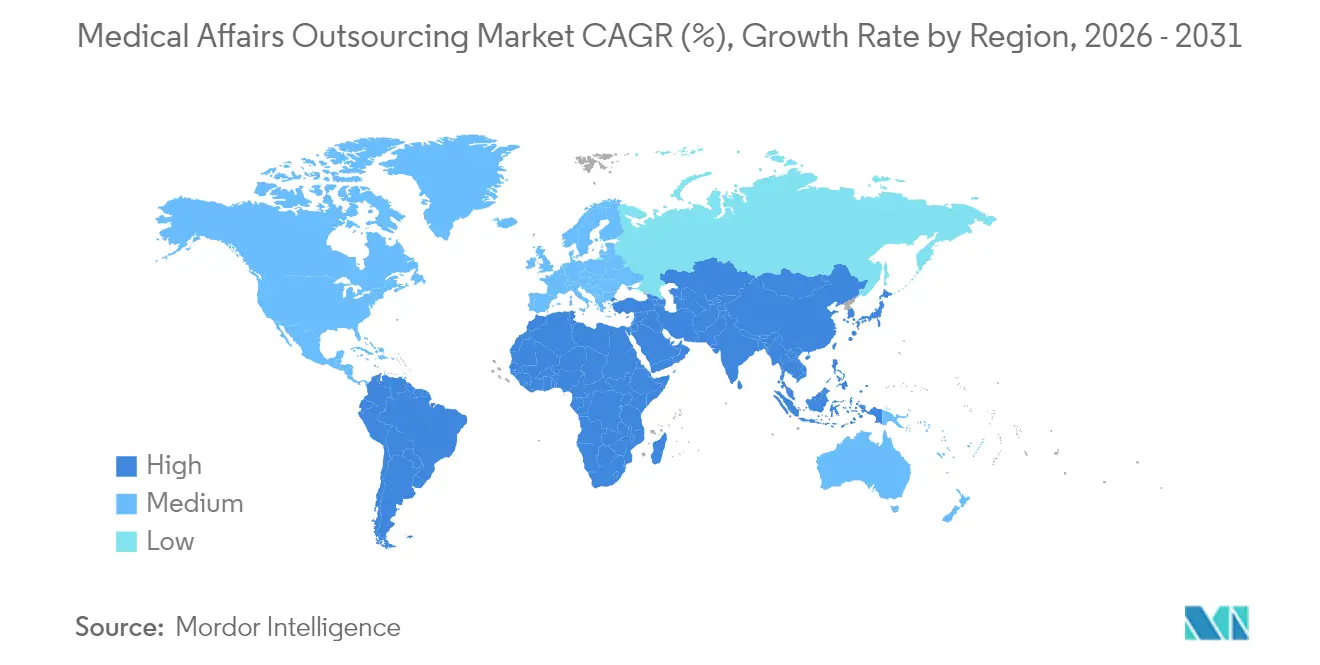
- By geography, North America held 39.55% of 2025 revenue; Asia Pacific is forecast to record the highest regional CAGR at 14.82% through 2031.
Note: Market size and forecast figures in this report are generated using Mordor Intelligence’s proprietary estimation framework, updated with the latest available data and insights as of 2026.
Market Trends and Insights
Drivers Impact Analysis of Medical Affairs Outsourcing Market*
| Driver | (~) % Impact on CAGR Forecast | Geographic Relevance | Impact Timeline |
|---|---|---|---|
| Cost-efficiency & quality advantages of CROs | +2.8% | Global, strongest in North America and Europe | Medium term (2-4 years) |
| Rising clinical-trial volume & R&D spend | +2.1% | Global, concentrated in Asia Pacific emerging markets | Long term (≥ 4 years) |
| Pharma focus on core competencies | +1.9% | North America and EU primary, expanding into Asia Pacific | Medium term (2-4 years) |
| Expansion of biologics & specialty drugs | +1.7% | Global, with Asia Pacific manufacturing hubs gaining prominence | Long term (≥ 4 years) |
| GenAI-enabled scale-up of medical-writing productivity | +1.4% | North America and EU early adoption, global rollout | Short term (≤ 2 years) |
| EU-MDR post-market surveillance needs in medtech | +1.0% | Europe primary, spill-over to other regulated markets | Medium term (2-4 years) |
| Source: Mordor Intelligence | |||
Cost-efficiency & quality advantages of CROs
Specialist contract research organizations pool infrastructure and therapeutic-area expertise across multiple sponsors, allowing clients to convert fixed overhead into variable spending and redirect capital toward pipeline priorities. The resulting flexibility supports virtual biotech and mid-tier pharma models that lack scale for full internal teams. Quality advantages flow from dedicated regulatory and therapeutic specialists who remain current with evolving agency expectations, reducing rework risk and audit findings.
Rising clinical-trial volume & R&D spend
Biologic, cell, and gene-therapy pipelines are expanding, each requiring complex trial designs and geographic diversity that favor experienced global partners. China and India are capturing an increasing share of multicenter studies thanks to sizeable patient pools and supportive regulatory reforms. CROs are adding remote-monitoring platforms and patient-engagement apps to manage decentralized protocols effectively.
Pharma focus on core competencies drives outsourcing
Large sponsors concentrate resources on molecule discovery, strategic portfolio decisions, and high-value scientific work. Non-core yet mandatory tasks—regulatory dossiers, safety updates, and field-medical engagement—transition to specialist vendors with proven compliance track records. The shift improves time-to-submission metrics and mitigates fixed-cost exposure during late-stage attrition.
Expansion of biologics & specialty drugs
Post-approval safety-monitoring, real-world-evidence generation, and payor-value dossiers for monoclonal antibodies and gene therapies demand niche knowledge. CDMOs with in-house medical-affairs units support end-to-end programs from manufacturing through launch, illustrated by Thermo Fisher’s earlier PPD purchase that integrated clinical research with biologics production.
Restraints Impact Analysis of Medical Affairs Outsourcing Market*
| Restraint | (~) % Impact on CAGR Forecast | Geographic Relevance | Impact Timeline |
|---|---|---|---|
| Shortage & turnover of skilled talent | -1.8% | Global, most acute in North America and Europe | Long term (≥ 4 years) |
| Cross-border data-privacy complexity | -1.2% | EU-US primary, spreading to Asia Pacific | Medium term (2-4 years) |
| Regulatory uncertainty over AI content | -0.9% | Global, with differing regional adoption speeds | Short term (≤ 2 years) |
| Vendor consolidation limiting supplier choice | -0.7% | Global, concentrated in North America and Europe | Medium term (2-4 years) |
| Source: Mordor Intelligence | |||
Shortage & turnover of skilled medical-affairs talent
The life-science workforce is ageing, and new graduates with both scientific depth and compliance knowledge remain scarce. Turnover among Medical Science Liaisons and safety physicians stretches project timelines and inflates bill rates. Large vendors invest in internal academies and AI-powered knowledge bases to attract and retain staff, yet demand still exceeds supply.
Cross-border data-privacy / compliance complexity
EU-US transfers rely on evolving mechanisms under GDPR, while Germany imposes additional restrictions on health-data cloud processing. Sponsors may choose regionalized document-authoring centers and pseudonymization layers, increasing operational duplication and eroding some cost advantages that originally drove outsourcing.
*Our forecasts treat driver/restraint impacts as directional, not additive. The impact forecasts reflect baseline growth, mix effects, and variable interactions.
Medical Affairs Outsourcing Market Segment Analysis
By Service:
Leadership of Medical Writing & Publishing with Rapid MSL GrowthMedical Writing & Publishing captured 31.12% of 2025 revenue, making it the largest slice of the medical affairs outsourcing market. High-volume clinical-study reports, risk-management plans, and structured benefit-risk templates anchor consistent demand. Generative-AI text engines reduce drafting time, yet skilled writers remain crucial for data interpretation and regulatory positioning. The segment’s scale also benefits from mandated EU MDR reports and US FDA periodic submissions.
Medical Science Liaisons generated the fastest expansion, advancing at a 14.45% CAGR to 2031. Growth reflects sponsor emphasis on scientific exchange with healthcare professionals and the need for real-world-evidence insights post-launch. Digital engagement tools allow smaller MSL teams to cover wider territories, yet therapeutic-area depth keeps head-count requirements high. Medical Information, Market Access & HEOR, and Digital/Omnichannel services round out the portfolio, each growing as pricing pressures and omnichannel outreach mature.

By Industry:
Pharma Dominance Amid Accelerating Emerging-Biotech DemandPharmaceutical and biopharma enterprises delivered 65.98% of total 2025 spending in the medical affairs outsourcing market thanks to established operating budgets and global launch pipelines. Their multiyear framework agreements foster integrated programming across writing, safety, and stakeholder engagement, enabling knowledge continuity.
Emerging biotech shows the most rapid advance with a 15.05% CAGR through 2031 as asset-light start-ups rely on external expertise from pre-IND through commercialization. Medical device and diagnostic companies outsource safety updates and EU MDR documentation, while consumer health and nutraceutical brands engage providers for evidence packages supporting product claims. These adjacent sectors diversify vendor revenue streams and help smooth demand cycles.
Geography Analysis
North America Medical Affairs Outsourcing Market
North America held 39.55% of global 2025 revenue, supported by the largest concentration of R&D budgets, FDA-aligned regulatory timelines, and a mature ecosystem of full-service CROs. Policy initiatives encouraging AI use in drug development further reinforce the region’s appetite for advanced knowledge services. Canada’s bilingual workforce and Mexico’s near-shore cost advantages complement US capacity, creating a resilient regional hub.
APAC Medical Affairs Outsourcing Market
Asia Pacific is forecast to generate the highest growth at a 14.82% CAGR. China and India supply expansive patient pools and competitive costs for clinical operations, while Japan, South Korea, and Australia contribute high-quality regulatory and data-analytics capabilities. Harmonization projects such as ASEAN CTPG reduce submission variance, accelerating multi-country trials. Regional governments also invest in digital-health sandboxes, enticing vendors to base data-science teams locally.
Europe Medical Affairs Outsourcing Market
Europe maintains a substantial share despite Brexit-related operational redraws. New device-surveillance rules under EU MDR sustain outsourcing demand for PSUR drafting and vigilance analytics. Initiatives like the European Health Data Space aim to unlock secondary-use datasets, creating longer-term opportunities for evidence-generation specialists. Eastern-European member states offer cost-efficient delivery centers, balancing higher labor costs in Germany and the Netherlands.
Regulatory Landscape
In the United States, medical affairs and market access communications are shaped by FDA guidance on manufacturer interactions with payors. In June 2026, the FDA issued a new draft guidance, Drug and Device Manufacturer Communications With Payors, Formulary Committees, and Similar Entities - Questions and Answers, which operationalizes the statutory safe harbor under section 502(gg) of the FD&C Act for certain communications and, for the first time, aligns medical device manufacturers under the same framework used for drug manufacturers. The draft also introduces an obligation to update payors when previously shared information becomes materially outdated (with a comment period running into August 2026).
In Europe, compliance requirements continue to reinforce the need for controlled outsourcing models. The EMA made the revised variations framework applicable on January 15, 2026 (stemming from Regulation (EU) 2024/1701), affecting how marketing authorization changes are documented and maintained across outsourced activities. Across EU GMP expectations, marketing authorization holders retain ultimate responsibility for compliance even when activities are delegated to vendors, which increases emphasis on governance, technical agreements, and auditability in outsourced medical and regulatory operations.
Value Chain Analysis
Medical affairs outsourcing begins with inputs such as clinical trial outputs, safety data, medical literature, and product evidence plans generated by sponsors (pharma/biopharma, emerging biotech, and medical device and diagnostics companies). Service providers then convert these inputs into regulated deliverables, including medical writing and publishing (clinical and regulatory documents, scientific publications, and evidence packages), medical information, MSL field engagement, and HEOR and RWE support, with end users spanning regulators, healthcare professionals, payors, and increasingly patient and advocacy stakeholders.
Delivery is typically executed through full-service CROs, specialist medical communications agencies, and functional service provider (FSP) models that provide dedicated teams and scalable capacity, often incorporating human-in-the-loop automation for content workflows. Critical handoffs in the chain include sponsor governance and review, privacy-preserving data operations for cross-border programs, and compliance controls that align outsourced work to evolving rules such as EU MDR post-market surveillance and global pharmacovigilance reporting. Talent availability (experienced writers, MSLs, and safety/medical reviewers) and platform integration (content modularization, insight management, and omnichannel orchestration) remain key operational bottlenecks and differentiators across vendors.
Competitive Landscape
The medical affairs outsourcing market remains moderately fragmented, yet top-tier players deepen scale through targeted deals. Novo Holdings’ USD 16.5 billion Catalent acquisition adds fill-finish and gene-therapy capacity, positioning the combined group as an end-to-end partner from manufacturing through post-market medical communications. IQVIA leverages a data-analytics backbone to integrate safety, writing, and field-medical programs, reporting USD 3.83 billion in Q1 2025 revenue with strength in technology solutions.
Syneos Health’s appointment of a new CEO signals renewed focus on operational efficiency and client retention. Parexel’s multi-year agreement with Palantir halves data-delivery timelines in complex trials, underscoring the strategic value of AI-led platforms.[3] Niche innovators such as Envision Pharma’s 4Sight suite aggregate literature analytics, insight management, and omnichannel planning into unified dashboards, challenging incumbents on speed and transparency.
Strategic priorities center on generating differentiated evidence packages for high-cost therapies, scaling omnichannel HCP engagement, and embedding governance for AI-authored content. Talent acquisition remains a battleground; vendors court experienced MSLs and safety physicians with hybrid work models and upskilling pathways. White-space opportunities persist in digital therapeutics, companion-diagnostic support, and sustainability reporting, areas where few providers yet claim mature offerings.
Medical Affairs Outsourcing Industry Leaders
-
ICON plc
-
IQVIA Holdings, Inc.
-
Syneos Health, Inc.
-
Thermo Fischer Scientific Inc.
-
Parexel
- *Disclaimer: Major Players sorted in no particular order

Medical Affairs Outsourcing Market Companies Covered in this Report
- IQVIA
- ICON
- Syneos Health
- Parexel International Corp.
- Thermo Fisher Scientific (PPD)
- Indegene Ltd.
- Accenture (Life Sciences)
- Ashfield Engage
- The Medical Affairs Company (TMAC)
- SGS
- Wuxi Clinical Development
- EVERSANA
- Charles River
- Medpace Holdings
- LabCorp
- OPEN Health
- Fishawack Health
- Certara
- PharmaLex
- Zeincro Group
- Clinigen Group
Market Opportunities and Future Outlook
White-space opportunities are concentrated in digital and AI-enabled operating models that help sponsors scale regulated content and field insights without proportionate headcount growth. MAPS highlighted the ongoing industry debate around outsourced field medical teams in its June 2025 white paper, reflecting active buyer scrutiny around retention, allegiance, and quality versus speed and cost. Vendors that can evidence governance, training, and compliant insight capture have room to win multi-country deployments, particularly around launch windows and lifecycle support. At the same time, consulting and provider publications in 2026 point to medical affairs digital teams increasingly owning CRM platforms, workflow enablement, and measurement frameworks, reinforcing demand for partners that can integrate medical information, MSL activity, and evidence generation into a single operating cadence.
Regulatory change also creates clearer service expansion lanes. The FDA draft payor communications guidance released in June 2026 extends a unified framework to both drug and device makers and introduces an obligation to update materially outdated information, which increases the need for structured content governance, version control, and monitoring across payor-facing materials. In Europe, the EMA variations framework applicable from January 15, 2026, together with MAH accountability for outsourced activities under EU GMP principles, supports demand for providers that can run standardized documentation, change-control support, and audit-ready oversight across distributed delivery hubs, including Asia Pacific centers that benefit from speed and cost advantages.
Recent Industry Developments in Medical Affairs Outsourcing Market
- June 2026: ICON selected Microsoft as a preferred technology partner to scale its Orbis agentic AI platform using Microsoft 365 Copilot and Azure. The selection supports ICON's ability to industrialize AI-enabled workflows across clinical and related evidence operations, aiming for faster and more standardized delivery for sponsors that outsource regulated content and engagement programs.
- May 2026: Syneos Health announced new and expanded AI partnerships, including deployments of Sageforce AI-powered field teams and causaLens data agents to improve HCP engagement and commercial decision-making. This advances the shift toward hybrid human-AI models in outsourced medical and commercial services, increasing competitive pressure on peers to match automation and analytics depth.
- January 2026: IQVIA and Boehringer Ingelheim announced a long-term collaboration to implement IQVIA Data-as-a-Service (DaaS+) for global commercial data harmonization across 59 countries. A unified data foundation is intended to support more consistent medical and market access operations across geographies, improving how outsourced teams align evidence, insights, and stakeholder communications at scale.
Medical Affairs Outsourcing Market Report Scope and Research Methodology
Market Definition and Coverage
This market counts the revenues earned by third-party service providers that deliver outsourced medical affairs work to life science companies, measured as service fees for ongoing and project-based support across the product life cycle.
Scope exclusions: It excludes in-house medical affairs costs at sponsors, non-medical commercial promotion work, and stand-alone contract clinical trial execution work that sits outside medical affairs delivery.
Segments Covered in This Report
- By Service
- Medical Monitoring
- Medical Writing & Publishing
- Medical Information
- Medical Science Liaisons (MSLs)
- Market Access & HEOR Support
- Digital / Omnichannel Medical Affairs
- Other Niche Services
- By Industry
- Pharma & Biopharma
- Medical Device & Diagnostics
- Emerging Biotech
- Consumer Health & Nutraceuticals
- By Geography
- North America
- United States
- Canada
- Mexico
- Europe
- Germany
- United Kingdom
- France
- Italy
- Spain
- Rest of Europe
- Asia-Pacific
- China
- Japan
- India
- Australia
- South Korea
- Rest of Asia-Pacific
- Middle East and Africa
- GCC
- South Africa
- Rest of Middle East and Africa
- South America
- Brazil
- Argentina
- Rest of South America
- North America
Data Sources, Market Sizing, and Validation
Desk Research
We start by mapping what "medical affairs outsourcing" typically includes in real buying decisions, and then we align it to observable signals. Public sources are used to anchor the demand environment and policy context, such as FDA and EMA guidance and communications, clinical trial registries, and OECD and World Bank health and R&D indicators. We also refer to PubMed-indexed literature for workload trends, including publication volumes and recurring evidence generation themes, plus association websites that publish standards and role definitions.
To connect demand to provider revenues, we supplement with company annual reports, investor presentations, and reputable press coverage describing outsourced medical affairs intensity and service mix changes. Where available, we cross-check with paid financial and news tracking subscriptions, and we use a patent database as a proxy for pipeline momentum that can affect medical information and scientific engagement needs. The desk sources listed here are illustrative only, and many additional public documents and datasets were reviewed to collect inputs, validate assumptions, and close open points.
Primary Interviews and Surveys
Next, we validate the service scope and pricing logic through expert interviews and structured surveys with outsourcing buyers and delivery-side professionals. Inputs include medical affairs leaders and operations managers, plus functional specialists involved in medical writing, MSL programs, and medical information work. For a global market, we balance inputs across major regions so service maturity, resourcing patterns, and procurement behavior differences are reflected, then we tighten assumptions when desk signals do not fully resolve the questions.
Distribution of primary research fieldwork respondents
| Company type | Respondent position | Region |
|---|---|---|
| Top tier: 27% | CXOs: 13% | APAC: 41% |
| Mid tier: 59% | Functional/Unit leaders: 38% | EMEA: 32% |
| Smaller Players: 14% | Managers: 49% | Americas: 27% |
Market-Sizing & Forecasting
Sizing is built first using a top-down approach where the demand pool is reconstructed by linking life science outsourcing intensity to therapy-pipeline activity and post-approval evidence obligations, and then converting that into expected outsourced service spending. After that view is formed, we corroborate it with selective bottom-up checks, such as sampled provider revenue disclosures, typical price ranges for recurring retainers, and volume-by-ASP approximations for repeatable work units.
Key model inputs include the active product pipeline and launch cadence by major regions, the typical mix between medical writing and publishing, medical information, medical monitoring, MSL coverage, and market access and HEOR support, and how often programs are refreshed through the year. We also track sponsor preferences for in-house versus outsourced ratios, the cost and availability of medical talent, and changes in evidence generation expectations that shift workloads after approval. Forecasting uses scenario analysis supported by expert-led ranges for outsourcing penetration and rate progression. Where bottom-up checks are missing, we apply conservative ranges and then re-test the totals against independent demand signals before finalizing.
Data Validation & Update Cycle
We run multiple checks to make sure the numbers behave like a real market, and then we review the logic step by step before sign-off. Outputs are compared against independent indicators such as pipeline trends, regional outsourcing uptake, and observed service mix shifts, and any sharp jumps are investigated and explained in plain terms. When variances remain unclear, experts are re-contacted to confirm whether the change reflects a real shift or a modeling artifact.
Before publication, another analyst reviews assumptions, arithmetic, and year-to-year movements, and the final file receives a fresh pass so clients see the latest view. Reports are refreshed annually, and interim updates are made when material events occur that could change demand or pricing in a noticeable way.
Mordor Intelligence's Medical Affairs Outsourcing Market Size Compared Against Other Published Estimates
Published market sizes for medical affairs outsourcing can differ because sources do not always count the same work, and they also choose different base years and growth windows. In our experience, the biggest swings come from whether adjacent activities are bundled in, how pricing is trended, and how quickly assumptions get refreshed when service delivery models change.
The main gap comes from scope stacking, where Mordor Intelligence counts only outsourced medical affairs services (such as medical writing and publishing, MSL support, medical information, and market access and HEOR support) and does not include broader outsourced clinical operations or general commercialization services in the same total. Other estimates may also start from a single 2024 base value without fully rechecking service mix shares, currency timing, or region-level adoption differences, which can pull the total down or push it up depending on the scenario used.
Benchmark comparison
| Source | Market Size | Gaps in Research Methodology |
|---|---|---|
| Mordor Intelligence | USD 2.53 B (2025) | |
| Trade Journal A | USD 1.85 B (2024) | Uses a shorter 2024-2028 window and provides limited detail on which medical affairs workstreams are counted, so service-scope and regional mix assumptions are harder to validate. |
| Regional Consultancy B | USD 1.95 B (2024) | Anchored to a single base-year value with broad functional descriptions, which can undercount higher-intensity programs and apply different rate progression and currency timing than a service-mix-led build. |
Taken together, the spread is mainly explained by base-year choice and how tightly the scope is limited to medical affairs work that is actually outsourced and billed as a service. Our approach keeps the total traceable to clear demand drivers, service mix, and price logic, which makes it easier for buyers to replicate the steps and stress-test assumptions.
Key Questions Answered in the Report
What is the current size of the medical affairs outsourcing market?
The market is valued at USD 2.84 billion in 2026.
What annual growth rate will the medical affairs outsourcing market register through 2031?
The forecast calls for a 12.43% CAGR, lifting revenue to USD 5.11 billion by 2031.
Which service segment holds the largest share of market revenue?
Medical Writing & Publishing leads with 31.12% of 2025 revenue, driven by regulatory-document volume and scientific-communication needs.
Which region will grow the fastest over 2026-2031?
Asia Pacific is projected to expand at a 14.82% CAGR, supported by rising clinical-trial activity and regulatory harmonization.
What is the most significant restraint affecting market expansion?
A global shortage and high turnover of skilled medical-affairs talent, estimated at a 35% deficit by 2030, is exerting a −1.8% drag on forecast CAGR.
How is generative AI influencing medical affairs outsourcing demand?
GenAI tools shorten document-preparation cycles and add an estimated +1.4% to CAGR by boosting medical-writing productivity and freeing experts for higher-value analysis.