
Media Gateway Market Size and Share
Market Overview
| Study Period | 2020 - 2031 |
|---|---|
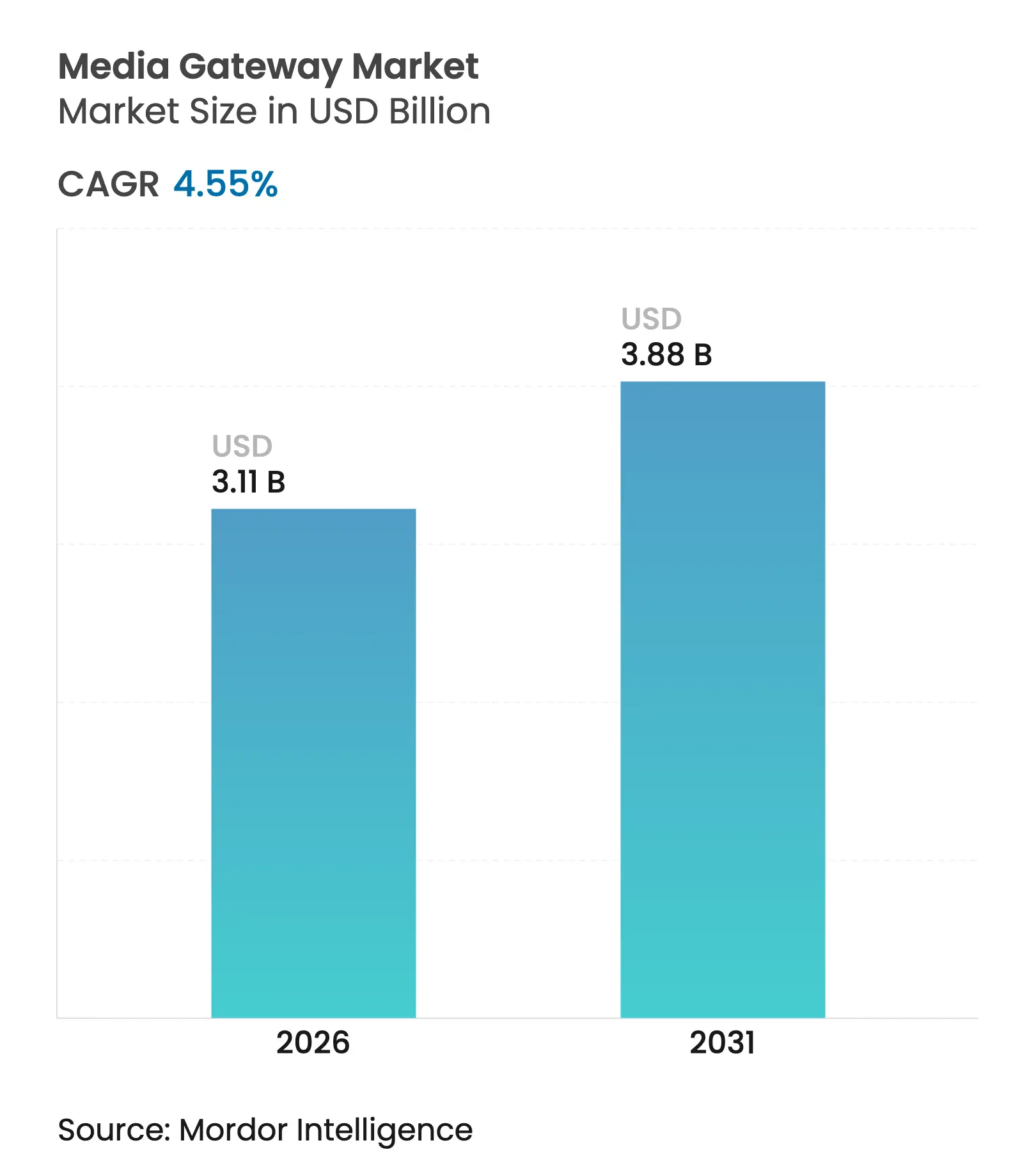
| Market Size (2026) | USD 3.11 Billion |
| Market Size (2031) | USD 3.88 Billion |
| Growth Rate (2026 - 2031) | 4.55 % CAGR |
| Fastest Growing Market | Asia Pacific |
| Largest Market | Asia Pacific |
| Market Concentration | Medium |
Major Players *Disclaimer: Major Players sorted in no particular order. Image © Mordor Intelligence. Reuse requires attribution under CC BY 4.0. |

Media Gateway Market Analysis by Mordor Intelligence
The media gateway market size is expected to grow from USD 2.97 billion in 2025 to USD 3.11 billion in 2026 and is forecast to reach USD 3.88 billion by 2031 at 4.55% CAGR over 2026-2031. Sustained growth reflects the global shift from Time Division Multiplexing to Internet Protocol infrastructure, heightened demand for Next Generation 911 services, and 5G roll-outs that need sophisticated interworking gateways. Adoption of unified communications platforms is accelerating gateway virtualization, while private 5G networks in factories and transport systems require low-latency protocol conversion. Energy-efficiency targets set by major operators add pressure to deploy cloud-native gateways that trim power use, and the rising focus on secure, encrypted voice drives investment in advanced media processing.
Key Report Takeaways
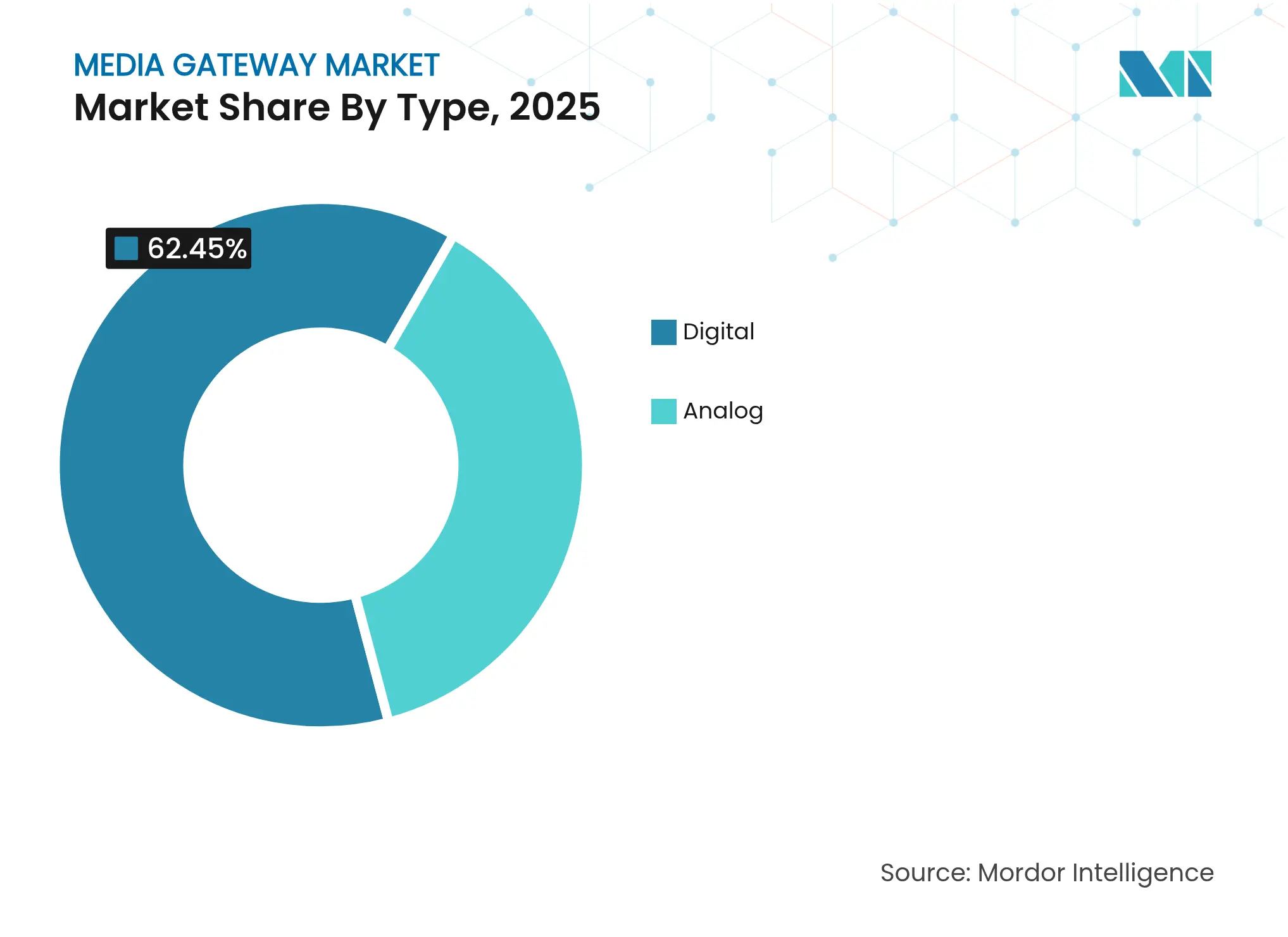
- By type, digital gateways led with 62.45% revenue in 2025 and are projected to advance at a 4.74% CAGR through 2031.
- By technology, wireline platforms captured 47.20% revenue in 2025, while hybrid deployments are set to post the fastest 6.52% CAGR to 2031.
- By deployment model, hardware appliances accounted for 67.10% of the media gateway market size in 2025; virtual/cloud-native solutions are forecast to grow at a 7.61% CAGR to 2031.
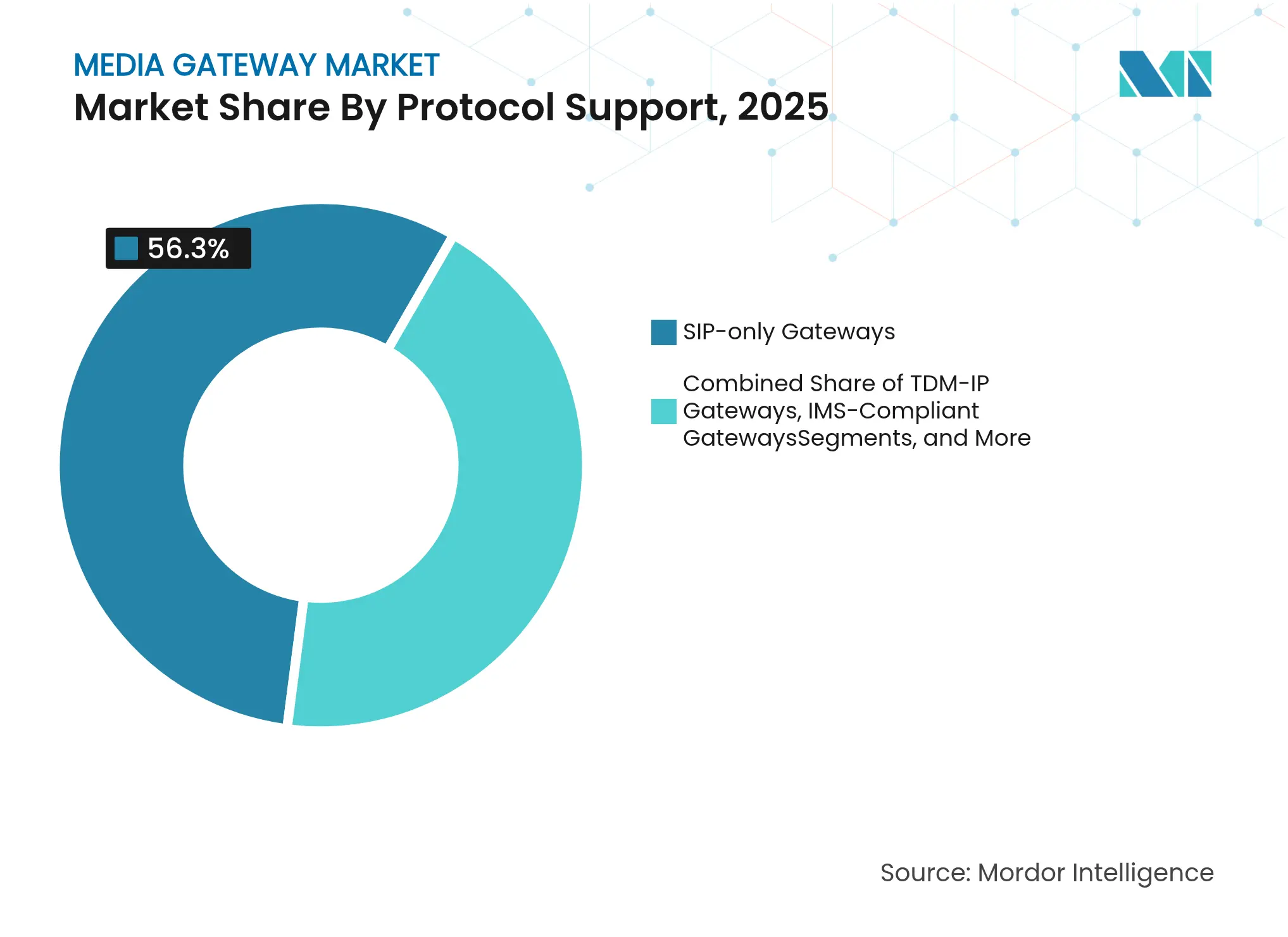
- By protocol support, SIP-only gateways commanded 56.30% revenue in 2025, whereas multi-protocol products are expected to register an 8.28% CAGR over the same period.
- By end-user, telecommunications operators generated 33.65% revenue in 2025; the transportation segment is projected to record a 5.24% CAGR through 2031.
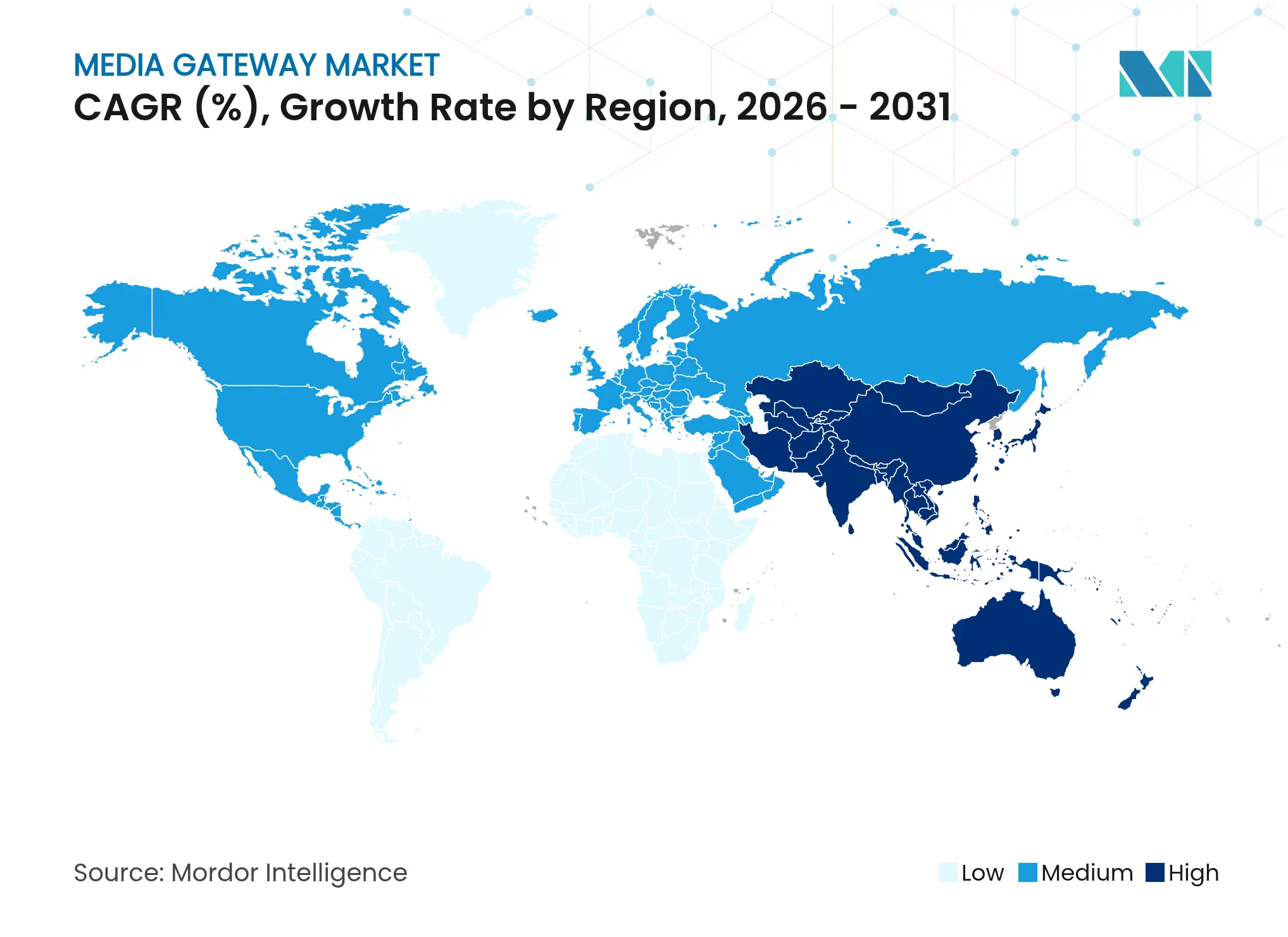
- By geography, Asia Pacific captured 41.70% of the media gateway market share in 2025 and is progressing at a 5.82% CAGR to 2031.
Note: Market size and forecast figures in this report are generated using Mordor Intelligence's proprietary estimation framework, updated with the latest available data and insights as of 2026.
Global Media Gateway Market Trends and Insights
Drivers Impact Analysis
| Driver | (~) % Impact on CAGR Forecast | Geographic Relevance | Impact Timeline |
|---|---|---|---|
Migration from TDM to VoIP/IP networks | +1.2% | North America, Europe | Medium term (2–4 years) |
Expansion of 5G and LTE requiring interworking gateways | +0.9% | Asia Pacific, global spill-over | Long term (≥ 4 years) |
Growing demand for unified communications in enterprises | +0.8% | North America, Europe | Short term (≤ 2 years) |
Edge-computing roll-outs needing ultra-low-latency transcoding | +0.6% | Manufacturing hubs in Asia Pacific | Medium term (2–4 years) |
Regulatory mandates for NG911/112 IP emergency services | +0.7% | North America, EU | Short term (≤ 2 years) |
Private industrial 5G networks needing protocol conversion | +0.5% | Industrial regions worldwide | Long term (≥ 4 years) |
| Source: Mordor Intelligence | |||
Migration from TDM to VoIP/IP networks accelerates modernization
Legacy circuit-switched assets are being retired as carriers migrate to all-IP cores. BT plans to disconnect the United Kingdom’s public switched telephone network in 2027, covering 25 million premises with gigabit broadband.[1] Network architects rely on carrier-grade Ethernet switches with circuit emulation to keep services running during the transition. Multi-Protocol Label Switching aggregation supports gradual migration without stranded assets, and vendors are adding software-based circuit emulation to gateway portfolios to smooth conversion.
5G network expansion drives interworking gateway requirements
China Unicom Beijing and Huawei activated a 5.5 G three-carrier-aggregation network covering 70% of Beijing’s Fourth Ring Road through more than 4,000 base stations that support immersive video and cloud gaming.[2] Interworking gateways handle signaling between legacy 4G gear and 5G Standalone cores, while Ericsson offers a hybrid core that retains 4G nodes yet enables rapid Standalone deployment.[3] Release 18 features such as L1/L2 triggered mobility cut handover delays to 30 milliseconds, underscoring the need for real-time transcoding.
Enterprise unified communications adoption transforms voice infrastructure
Microsoft Teams Direct Routing and Operator Connect services have driven double-digit adoption of software-based voice. AudioCodes posted 13% revenue growth from Microsoft-aligned services in Q4 2024, reaching USD 34.2 million.[4]Session Border Controllers hosted in the cloud replace appliance gateways, and vendors monetize recurring software licenses instead of hardware refresh cycles. Ribbon’s cloud-to-cloud connectivity keeps PSTN calls on existing PBX trunks while gradually shifting users to Teams, illustrating mixed topologies that still depend on media gateways for protocol mediation.
Edge computing integration demands ultra-low-latency processing
Intel’s Core Ultra processors demonstrated 5.8× faster media performance at CES 2025, supporting predictions that half of all edge workloads will embed machine learning by 2026. The University of Wisconsin Milwaukee integrated Ericsson private 5G with manufacturing systems, using Generic Routing Encapsulation tunnels to handle standalone 5G devices on factory floors. Multi-Access Edge Computing control APIs steer traffic to the nearest media node, keeping latency below 20 milliseconds for computer-vision quality checks.
Restraints Impact Analysis
| Restraint | (~) % Impact on CAGR Forecast | Geographic Relevance | Impact Timeline |
|---|---|---|---|
Shift toward softswitches and SBCs curbing hardware demand | –0.8% | North America, Europe | Short term (≤ 2 years) |
Shortage of skilled integration workforce | –0.6% | Global | Medium term (2–4 years) |
Semiconductor supply-chain volatility | –0.5% | Manufacturing regions | Short term (≤ 2 years) |
Energy-efficiency compliance cost escalation | –0.4% | Europe, North America | Long term (≥ 4 years) |
| Source: Mordor Intelligence | |||
Softswitch and SBC migration challenges traditional hardware models
Network-function virtualization lets carriers deploy voice control on commercial servers, shrinking appliance shipments. AudioCodes offers a carrier-grade virtual SBC with five-nines availability for enterprises that prefer cloud deployment over rack-mounted gear. Ribbon integrates Operator Connect for Microsoft Teams to provide SIP trunks without on-premises hardware. Appliance makers must recast portfolios around containers and micro-services, or risk revenue erosion as operators redirect budgets to software.
Skilled workforce shortage constrains integration capabilities
Industry groups warn of an 85 million-person global skills gap by 2030 that could erase USD 8.5 trillion in unrealized revenue weforum.org. Complex media-gateway roll-outs require expertise in VoIP signaling, 5G traffic flows, encryption, and container orchestration. Smaller operators turn to managed-service contracts or public-cloud solutions to offset shortages, contributing to rising adoption of turnkey hosted gateways.
Segment Analysis
By Type: Digital dominance drives protocol evolution
Digital solutions generated 62.45% of 2025 revenue and are forecast to grow at a 4.74% CAGR through 2031 as enterprises swap circuit-switched trunks for SIP and WebRTC. The digital share equated to USD 1.86 billion of the media gateway market size in 2025. Analog units remain relevant for niche industrial endpoints but will shrink as carriers dismantle copper access. Nokia renewed its voice-core contract with AT&T, pivoting to a cloud-native IMS core that will carry 5G voice across the United States.
Operators preparing for 3GPP Immersive Voice and Audio Services need gateways that support metadata-assisted spatial audio, a capability under joint development by Nokia, Vodafone, and RingCentral. The upgrade moves digital gateways beyond simple protocol mediation into full media enrichment, reinforcing their central role in the media gateway market.
Note: Segment shares of all individual segments available upon report purchase
By Technology: Hybrid solutions bridge legacy and modern networks
Wireline platforms still held 47.20% revenue in 2025, yet hybrid approaches that blend wireline reliability with wireless flexibility are climbing at 6.52% CAGR. T-Mobile selected Nokia’s Multi-Access Gateway to route high-speed internet traffic across LTE, 5G NSA, and 5G SA, proving that one platform can span multiple access modes. Hybrid configurations help carriers phase out legacy nodes without disrupting customers, anchoring demand in the media gateway market.
Wireless gateways serve private 5G and fixed-wireless access. Factory deployments in Japan and South Korea highlight the need for robust protocol mediation when mobile robots, cameras, and legacy production lines converge on a single 5G core. The flexible form factor keeps capital intensity low, a key buying criterion for manufacturers entering Industry 4.0.
By Deployment Model: Cloud-native architecture reshapes market dynamics
Hardware appliances still contribute 67.10% of 2025 revenue, equal to USD 1.99 billion of the media gateway market size. However, cloud-native gateways are expanding at 7.61% CAGR as operators pursue elastic scaling and usage-based pricing. Ericsson and Google Cloud’s On-Demand platform lets a carrier spin up a complete 5G core, including media processing, within hours, cutting lead times from months to days.
Containerized media functions appeal to edge scenarios where workload spikes are unpredictable. Broadcasters migrating live content to the cloud after pandemic disruptions underscore how cloud-native paths reduce time-to-air while preserving quality. Hybrid deployments allow mission-critical traffic to stay on physical hardware until operators confirm parity on the virtual side.

Recognized by Experts. Trusted by Leaders.
A trusted intelligence partner to global decision-makers across 90+ countries.







By Protocol Support: Multi-protocol gateways address interoperability complexity
SIP-only models led with 56.30% revenue in 2025. Yet multi-protocol products that support SIP, H.323, and Media Gateway Control Protocol are rising at 8.28% CAGR because large enterprises often maintain mixed infrastructures during migration phases. Cisco’s service-management framework shows call-flow intricacies when 5G session management interacts with charging and policy control
IMS-compliant gateways, capable of secure end-to-end encryption, are gaining traction in financial services. Federal rules on NG911 state that emergency calls must arrive at public safety answering points in SIP with embedded location data, driving uptake of gateways that can translate older trunks while satisfying new standards.
Note: Segment shares of all individual segments available upon report purchase
By End-User: Telecommunications sector leads while transportation accelerates
Operators generated 33.65% of 2025 revenue owing to nationwide 5G upgrades and voice-core modernization. Transportation is projected to expand at the fastest 5.24% CAGR as connected-vehicle systems lean on ultra-reliable voice links. The United States Department of Homeland Security expects 5G to transform vehicle automation and roadway coordination, creating a new layer of communications infrastructure that depends on secure protocol conversion.
Banking, manufacturing, and government domains follow. Banks are early adopters of encrypted SIP trunking for regulatory compliance, while factories deploy private 5G networks to support industrial robots. Public agencies invest in NG911 migration, keeping the media gateway market firmly rooted in long-term public-safety funding cycles.
Geography Analysis
Asia Pacific dominates with 41.70% revenue in 2025, driven by aggressive 5G Standalone deployments and private network investment. China Unicom’s city-wide 5.5 G coverage around Beijing’s Fourth Ring Road illustrates the sheer scale of protocol-mediation demand. Japanese automakers run private 5G lines inside smart factories, reinforcing the region’s leadership in next-generation communications.
North America remains pivotal because of NG911 mandates and enterprise cloud collaboration uptake. The Federal Communications Commission has set milestones for full IP connectivity across emergency services, ensuring steady procurement of gateways that insert location data into SIP messages. Nokia’s USD 2.3 billion acquisition of Infinera aligns with a strategy to capture optical transport upgrades linked to voice-core refresh cycles.
Europe advances on PSTN switch-off deadlines and stringent carbon-reduction targets. BT’s timeline for retiring copper access networks sustains hybrid gateway demand, while EU climate regulations push carriers to select energy-efficient media hardware. The combination of modernization and sustainability keeps Europe growing at a stable mid-single-digit rate through 2030.

Competitive Landscape
Market Concentration
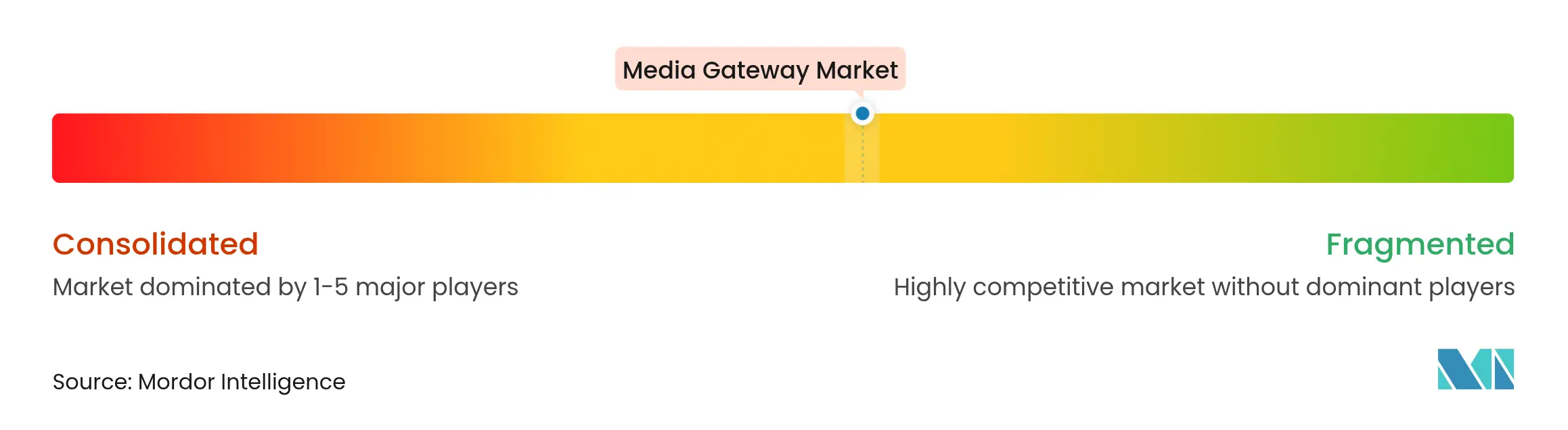
The media gateway market is moderately fragmented. Nokia’s planned acquisition of Infinera seeks to boost optical networking share to 20% and deepen North-American reach, underscoring a consolidation trend among equipment suppliers. Ericsson’s alliance with Google Cloud to deliver carrier-grade core-as-a-service shows how traditional vendors tap hyperscalers for elasticity and artificial-intelligence automation.
Tier-two specialists carve out success in software niches. AudioCodes focuses on Microsoft-centric unified communications and reported USD 34.2 million in services revenue for Q4 2024. Ribbon Communications emphasizes cloud-to-cloud SIP trunking, targeting enterprises that have mixed PBX and Teams estates. Vendors differentiate through AI-assisted voice analytics, digital twins that model network energy use, and open APIs that expose programmable media functions.
White-space opportunities arise in private 5G for factories, mining, and ports where bespoke protocols persist. Suppliers that pair low-latency media conversion with industrial-grade ruggedization can build defensible positions. Long-term success hinges on blending high availability with granular software control, a balance the media gateway market rewards with recurring licenses and managed-service contracts.
Media Gateway Industry Leaders

*Disclaimer: Major Players sorted in no particular order
Recent Industry Developments
- June 2025: Ericsson and Google Cloud unveiled Ericsson On-Demand, a SaaS 5G core that offers elastic scaling and pay-per-use billing.
- March 2025: Bridge Alliance and Ericsson formed Aduna to speed adoption of CAMARA network APIs across member operators.
- February 2025: AT&T extended its cloud-native IMS voice-core contract with Nokia, migrating from Azure to a Red Hat platform
- June 2025: Nokia agreed to acquire Infinera for USD 2.3 billion, strengthening optical transport capabilities.
Table of Contents for Media Gateway Industry Report
1. INTRODUCTION
- 1.1 Study Assumptions and Market Definition
- 1.2 Scope of the Study
2. RESEARCH METHODOLOGY
3. EXECUTIVE SUMMARY
4. MARKET LANDSCAPE
- 4.1 Market Overview
- 4.2 Market Drivers
- 4.2.1 Migration from TDM to VoIP/IP networks
- 4.2.2 Expansion of 5G and LTE that require interworking gateways
- 4.2.3 Growing demand for unified communications in enterprises
- 4.2.4 Edge-computing roll-outs needing ultra-low-latency transcoding
- 4.2.5 Regulatory mandates for NG911/112 IP emergency services
- 4.2.6 Private industrial 5G networks needing protocol conversion
- 4.3 Market Restraints
- 4.3.1 Shift toward softswitches/SBCs curbing hardware demand
- 4.3.2 Shortage of skilled integration workforce
- 4.3.3 Semiconductor supply-chain volatility
- 4.3.4 Energy-efficiency compliance cost escalation
- 4.4 Value Chain Analysis
- 4.5 Regulatory Landscape
- 4.6 Technological Outlook
- 4.7 Porter's Five Forces Analysis
- 4.7.1 Bargaining Power of Buyers/Consumers
- 4.7.2 Bargaining Power of Suppliers
- 4.7.3 Threat of New Entrants
- 4.7.4 Threat of Substitute Products
- 4.7.5 Intensity of Competitive Rivalry
5. MARKET SIZE AND GROWTH FORECASTS (VALUE)
- 5.1 By Type
- 5.1.1 Analog
- 5.1.2 Digital
- 5.2 By Technology
- 5.2.1 Wireline
- 5.2.2 Wireless
- 5.2.3 Hybrid
- 5.3 By Deployment Model
- 5.3.1 Hardware/Appliance-based
- 5.3.2 Virtual/Cloud-native
- 5.3.3 Cloud-Native / Containerized
- 5.3.4 Hybrid Deployments
- 5.4 By Protocol Support
- 5.4.1 SIP-only Gateways
- 5.4.2 Multi-protocol (SIP + H.323 + MGCP)
- 5.4.3 TDM-IP Gateways
- 5.4.4 IMS-Compliant Gateways
- 5.4.5 Secure/Encrypted Protocol Gateways
- 5.5 By End-User
- 5.5.1 BFSI
- 5.5.2 Manufacturing
- 5.5.3 Government
- 5.5.4 Healthcare
- 5.5.5 Telecommunications
- 5.5.6 Transportation
- 5.6 By Geography
- 5.6.1 North America
- 5.6.1.1 United States
- 5.6.1.2 Canada
- 5.6.1.3 Mexico
- 5.6.2 South America
- 5.6.2.1 Brazil
- 5.6.2.2 Argentina
- 5.6.2.3 Chile
- 5.6.3 Europe
- 5.6.3.1 Germany
- 5.6.3.2 United Kingdom
- 5.6.3.3 France
- 5.6.3.4 Italy
- 5.6.3.5 Spain
- 5.6.3.6 Russia
- 5.6.4 Middle East
- 5.6.4.1 United Arab Emirates
- 5.6.4.2 Saudi Arabia
- 5.6.4.3 Turkey
- 5.6.4.4 Israel
- 5.6.5 Africa
- 5.6.5.1 South Africa
- 5.6.5.2 Nigeria
- 5.6.5.3 Egypt
- 5.6.6 Asia Pacific
- 5.6.6.1 China
- 5.6.6.2 India
- 5.6.6.3 Japan
- 5.6.6.4 South Korea
- 5.6.6.5 ASEAN
- 5.6.6.6 Rest of Asia Pacific
6. COMPETITIVE LANDSCAPE
- 6.1 Market Concentration
- 6.2 Strategic Moves
- 6.3 Market Share Analysis
- 6.4 Company Profiles {(includes Global level Overview, Market level overview, Core Segments, Financials as available, Strategic Information, Market Rank/Share for key companies, Products and Services, and Recent Developments)}
- 6.4.1 Nokia Corporation
- 6.4.2 Huawei Technologies Co. Ltd.
- 6.4.3 Telefonaktiebolaget LM Ericsson
- 6.4.4 Cisco Systems Inc.
- 6.4.5 Ribbon Communications Operating Company Inc.
- 6.4.6 AudioCodes Ltd.
- 6.4.7 Avaya Inc.
- 6.4.8 ZTE Corporation
- 6.4.9 Mitel Networks Corporation
- 6.4.10 Dialogic Corp.
- 6.4.11 Synway Information Engineering Co. Ltd.
- 6.4.12 Grandstream Networks
- 6.4.13 Squire Technologies Ltd.
- 6.4.14 Shenzhen Dinstar Co. Ltd.
- 6.4.15 Sangoma Technologies
- 6.4.16 Patton Electronics
- 6.4.17 Alcatel-Lucent Enterprise
- 6.4.18 TelcoBridges Inc.
- 6.4.19 Edgewater Networks
- 6.4.20 ADTRAN Inc.
7. MARKET OPPORTUNITIES AND FUTURE OUTLOOK
- 7.1 White-space and Unmet-need Assessment
Scope and Methodology
Media gateways are translation devices or services transforming the digital media stream between telecom networks, such as signaling system 7 (SS7) and public switched telephone networks (PSTN). Media gateways are extensively applied in connecting different networks (such as 2G, 3G, 4G, and LTE); hence their primary function is to convert various coding and transmission methods to facilitate communication between the networks.
Themedia gateway market is segmented by type (analog, digital), technology (wireline, wireless, hybrid), end user (bfsi, manufacturing, government, healthcare, telecommunications, transportation), and geography (North America, Europe, Asia-Pacific, Middle East & Africa, Latin America). The market sizes and forecasts are provided in terms of value (USD) for all the above segments.
| By Type | Analog | |
| Digital | ||
| By Technology | Wireline | |
| Wireless | ||
| Hybrid | ||
| By Deployment Model | Hardware/Appliance-based | |
| Virtual/Cloud-native | ||
| Cloud-Native / Containerized | ||
| Hybrid Deployments | ||
| By Protocol Support | SIP-only Gateways | |
| Multi-protocol (SIP + H.323 + MGCP) | ||
| TDM-IP Gateways | ||
| IMS-Compliant Gateways | ||
| Secure/Encrypted Protocol Gateways | ||
| By End-User | BFSI | |
| Manufacturing | ||
| Government | ||
| Healthcare | ||
| Telecommunications | ||
| Transportation | ||
| By Geography | North America | United States |
| Canada | ||
| Mexico | ||
| South America | Brazil | |
| Argentina | ||
| Chile | ||
| Europe | Germany | |
| United Kingdom | ||
| France | ||
| Italy | ||
| Spain | ||
| Russia | ||
| Middle East | United Arab Emirates | |
| Saudi Arabia | ||
| Turkey | ||
| Israel | ||
| Africa | South Africa | |
| Nigeria | ||
| Egypt | ||
| Asia Pacific | China | |
| India | ||
| Japan | ||
| South Korea | ||
| ASEAN | ||
| Rest of Asia Pacific | ||
