
Meat Ingredients Market Size and Share
Market Overview
| Study Period | 2021 - 2031 |
|---|---|
| Market Size (2026) | USD 10.09 Billion |
| Market Size (2031) | USD 12.99 Billion |
| Growth Rate (2026 - 2031) | 5.18 % |
| Fastest Growing Market | Europe |
| Largest Market | North America |
| Market Concentration | Low |
Major Players *Disclaimer: Major Players sorted in no particular order Image © Mordor Intelligence. Reuse requires attribution under CC BY 4.0. | |
Meat Ingredients Market Analysis by Mordor Intelligence
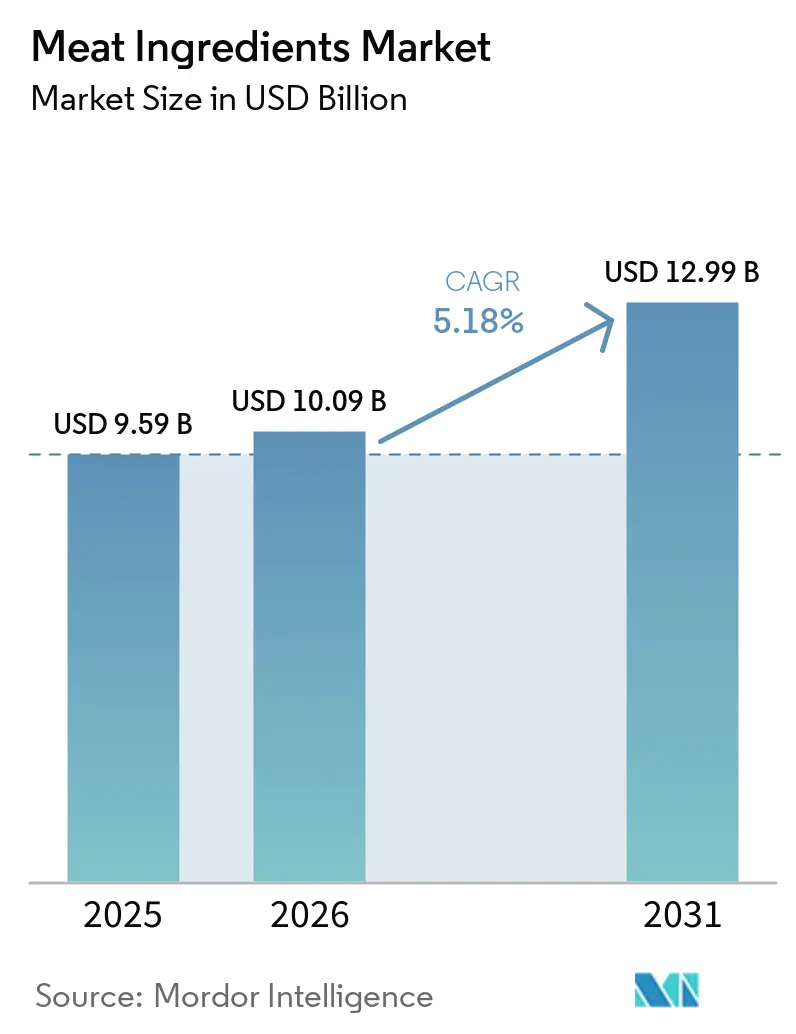
The meat ingredients market is projected to grow from USD 9.59 billion in 2025 and USD 10.09 billion in 2026 to USD 12.99 billion by 2031, registering a CAGR of 5.18% between 2026 and 2031. Growth is driven by processed meat output and reflects a shift toward ingredients with defined safety, yield, and labeling functions. U.S. meat and poultry availability is projected at 228.8 pounds per person in 2026, while broiler availability is projected at 105.6 pounds, supporting demand from further-processed poultry products. Processors are replacing some conventional additives with natural, fermentation-derived, and botanical systems, which can increase the value of each formulation. Regulatory requirements, retailer specifications, and foodservice procurement standards are increasing the importance of technical documentation in supplier selection. The market also faces higher formulation costs when raw materials and specialty inputs become more expensive.
Key Report Takeaways
- By ingredient type, binders held a 33.68% share in 2025, while the preservatives segment is forecast to grow at a 6.79% CAGR through 2031.
- By functionality, moisture retention and water-binding yield improvement held a 35.34% share in 2025, while flavor enhancement is forecast to grow at a 7.18% CAGR through 2031.
- By form, powder held a 76.18% share in 2025, while liquid is forecast to grow at a 6.97% CAGR through 2031.
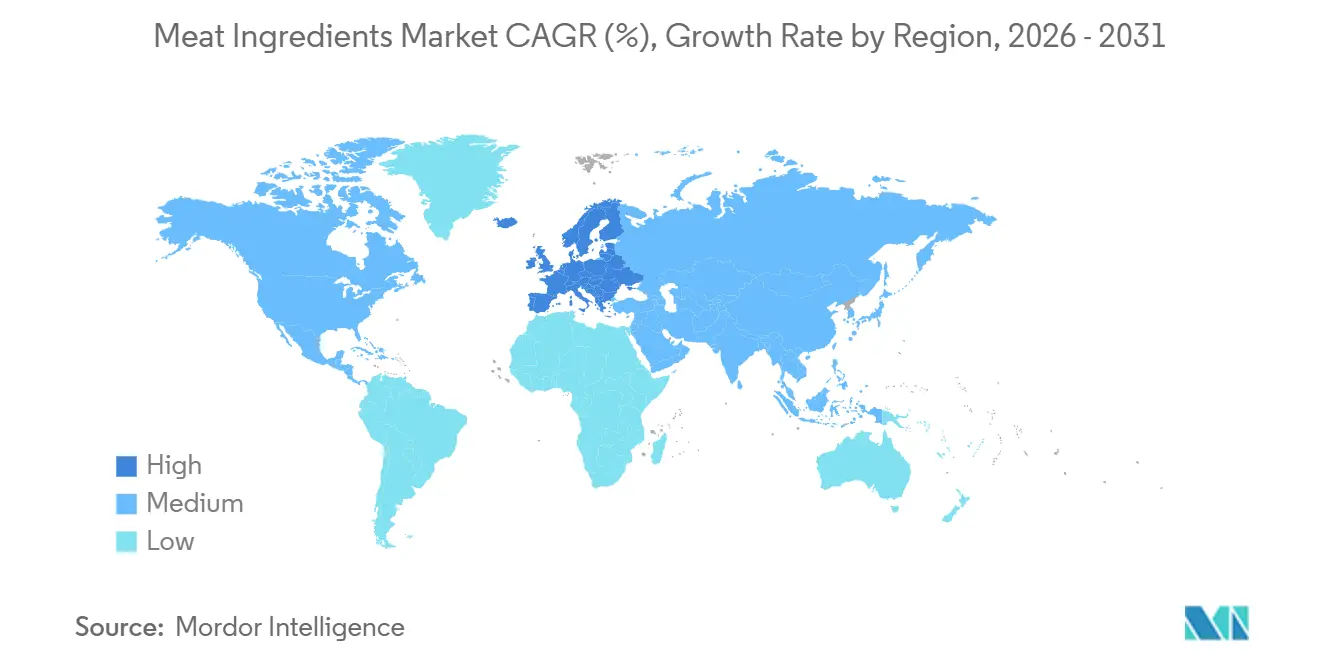
- By geography, North America held a 35.89% share in 2025, while Europe is forecast to grow at a 7.01% CAGR through 2031.
Note: Market size and forecast figures in this report are generated using Mordor Intelligence’s proprietary estimation framework, updated with the latest available data and insights as of January 2026.
Global Meat Ingredients Market Trends and Insights
Drivers Impact Analysis*
| Driver | (~) % Impact on CAGR Forecast | Geographic Relevance | Impact Timeline |
|---|---|---|---|
| Growth in Processed and Convenience Meat Consumption | +1.3% | Global | Short term (≤ 2 years) |
| Clean-Label Reformulation and Natural Preservation | +1.1% | North America and European Union, spill-over to Asia-Pacific | Medium term (2–4 years) |
| Expansion of Premium and Specialty Processed-Meat Products | +0.8% | North America, Europe, Asia-Pacific core | Medium term (2–4 years) |
| Low-Temperature and Multi-Hurdle Formulation Innovation | +0.6% | North America, Europe | Long term (≥ 4 years) |
| Specification-Driven Demand for Traceable, Certification-Ready Ingredients | +0.5% | Global, with early gains in QSR-intensive markets | Medium term (2–4 years) |
| Rising Demand for Protein-Enriched Meat Products | +0.7% | North America, Europe, Asia-Pacific | Short to medium term |
| Source: Mordor Intelligence | |||
Growth in Processed and Convenience Meat Consumption
Growing reliance on processed and convenience foods is increasing demand for meat ingredients that support flavor, texture, preservation, yield, and processing efficiency across ready-to-eat, ready-to-cook, and other value-added meat products. Processed food consumption in the United Kingdom illustrates the scale of this trend: ultra-processed foods account for approximately 57% of adults' calorie intake and around 66% of adolescents' calorie intake, while a UCL-led study found that 59% of calories consumed by children at age seven came from ultra-processed foods[1]. This widespread consumption of industrially processed foods supports continued use of specialized meat ingredients, including functional ingredients for moisture retention, texture enhancement, seasoning, preservation, and formulation consistency. As food manufacturers expand their convenience meat offerings, ingredient functionality becomes increasingly important for maintaining product quality and production efficiency at scale.
Clean-Label Reformulation and Natural Preservation
Growing consumer preference for simpler ingredient lists and recognizable components is encouraging meat manufacturers to reformulate products with clean-label ingredients and natural preservation systems. According to Ingredion's 2026 clean-label insights, approximately 49% of consumers actively seek clean-label products, while 65% report increasing their purchases of clean-label products over the past five years, reflecting a continued shift toward cleaner product choices[2]. This preference is particularly relevant to processed meat, where manufacturers need to balance shelf life, food safety, flavor, and texture while reducing reliance on ingredients perceived as artificial or overly processed. This shift is supporting demand for naturally derived preservatives, functional ingredients, and cleaner formulation systems that can maintain product stability and quality while meeting evolving clean-label expectations.
Low-Temperature and Multi-Hurdle Formulation Innovation
Advances in low-temperature processing and multi-hurdle preservation are expanding the role of specialized ingredients in meat processing. These approaches enable manufacturers to maintain food safety, quality, and shelf life while reducing reliance on aggressive thermal treatment. Meat producers are increasingly combining multiple preservation and formulation techniques, such as controlled temperature processing, pH management, water-activity control, natural antimicrobials, curing systems, and packaging technologies, rather than relying on a single preservation method. This creates greater demand for meat ingredients that can perform effectively under milder processing conditions while supporting microbial stability, texture, color, flavor, and moisture retention. This formulation flexibility is particularly relevant for premium, minimally processed, chilled, and clean-label meat products, where manufacturers need to balance safety and shelf life with sensory quality.
Rising Demand for Protein-Enriched Meat Products
Growing consumer focus on protein intake is supporting demand for meat products that deliver higher or more clearly communicated protein value. This is creating additional requirements for specialized meat ingredients that improve formulation, texture, moisture retention, and nutritional performance. According to the International Food Information Council (IFIC) 2025 Food & Health Survey, 65% of Americans identified meat and poultry among their preferred sources of protein, making it the leading protein source among the options surveyed[3]. This strong consumer association between meat and protein is encouraging manufacturers to develop value-added meat products with protein-forward positioning, including processed meats, ready-to-cook products, and other convenient formats. As these products are formulated to maintain desirable texture, flavor, and processing performance while delivering protein benefits, demand for functional meat ingredients is also increasing.
*Our forecasts treat driver/restraint impacts as directional, not additive. The impact forecasts reflect baseline growth, mix effects, and variable interactions.
Segment Analysis
By Ingredient Type: Binders Lead, While Preservatives Advance
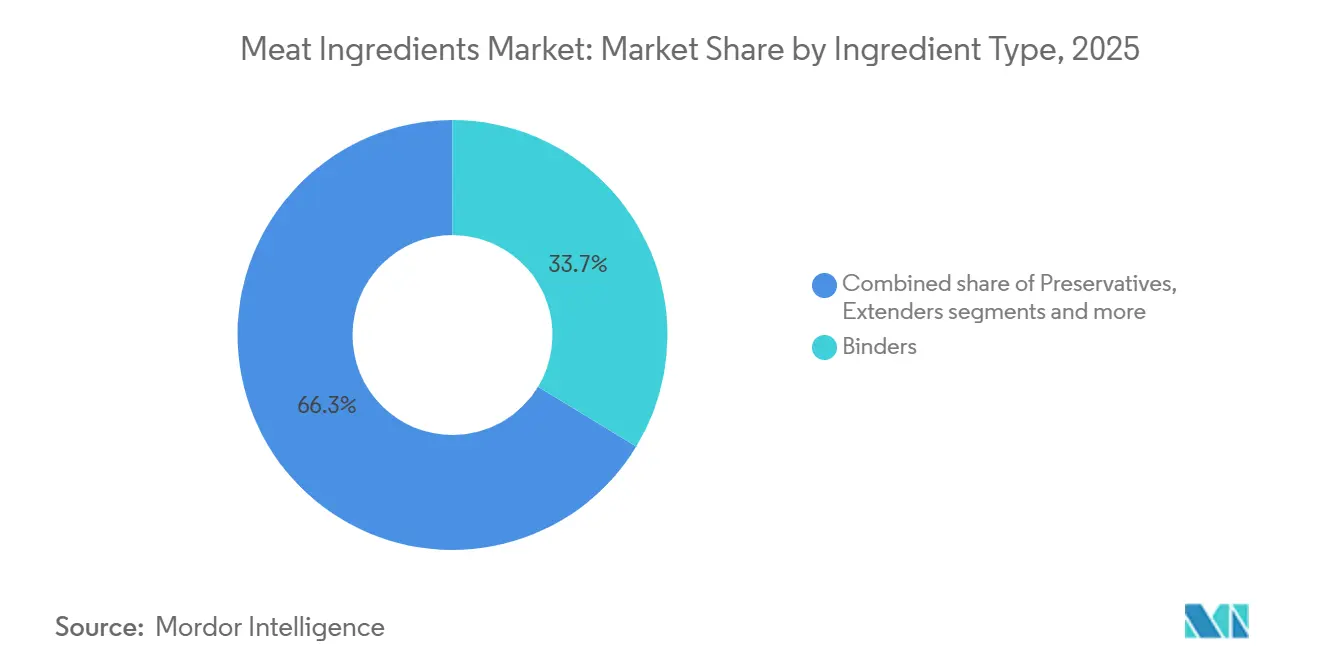
Binders accounted for 33.68% of the meat ingredients market size in 2025. They support protein extraction, structure, and yield in emulsified sausages, formed deli meats, and whole-muscle products. Extenders and fillers serve cost-sensitive formulations, while coloring and texturing agents support appearance and eating quality. Natural color systems, including carmine, annatto, and carotenoid solutions, are gaining attention as clean-label reformulation extends beyond preservation. Salts, phosphates, and curing agents remain important, although they face regulatory and retailer pressure in some European applications.
Preservatives are forecast to grow at a 6.79% CAGR from 2026 to 2031. The meat ingredients market is shifting from synthetic nitrites, propionates, and antioxidants toward lactates, cultured dextrose, buffered vinegar, and botanical systems. Enzymes and starter cultures hold a smaller revenue share, but validated culture systems can create lasting technical relationships with fermented sausage manufacturers. Galactic launched Galimax Flavor V-100 Pearls in July 2026 as a low-dust vinegar preservation solution for ready-to-eat chicken deli meat applications. Preservation systems that combine clean-label positioning with ease of handling on automated lines are a stronger fit with processor requirements.

By Functionality: Moisture Retention Leads, While Flavor Enhancement Expands
Moisture retention and water-binding yield improvement accounted for 35.34% of the meat ingredients market share in 2025. Yield directly affects the raw material cost per finished unit, making this function important to processors. Functional soy and pea proteins, phosphate systems, and carrageenan hydrocolloids can deliver overlapping yield-related outcomes. The meat ingredients market also uses natural antioxidant systems to support color protection and product stability. A 2025 review described the potential role of essential oils and related natural compounds in fermented meat preservation.
Flavor enhancement is forecast to grow at a 7.18% CAGR from 2026 to 2031. Processors are increasingly using regional, premium, and claim-compatible flavor systems in retail and foodservice products. This trend favors natural extracts and fermentation-derived ingredients that can support both taste and preservation. Symrise expanded its Alternative Smoke Taste Solutions to help food manufacturers respond to EU changes affecting primary smoke flavorings from 2026 to 2029. The meat ingredients market requires suppliers that can provide formulation support alongside flavor systems.
By Form: Powder Holds the Largest Position, While Liquids Gain Use
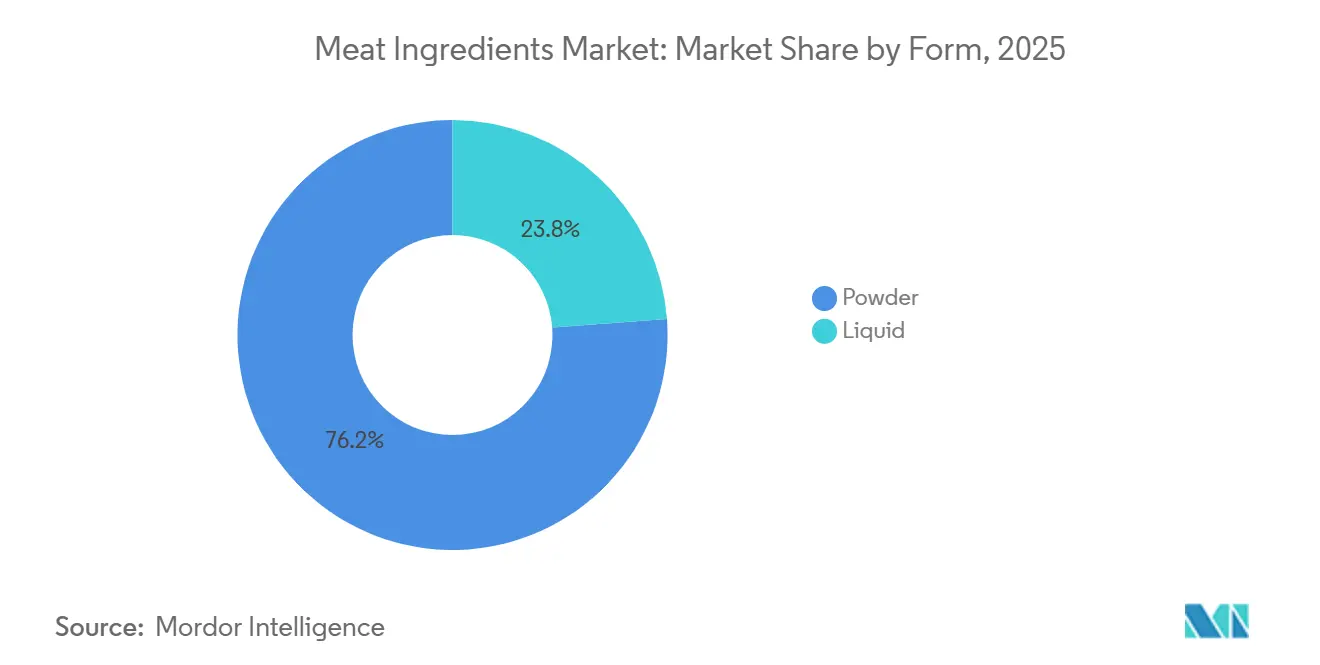
Powder formats accounted for 76.18% of the meat ingredients market in 2025. Their dominant position reflects dosing accuracy, ambient stability, and suitability for automated dry batching. Powder ingredients are well-suited to high-volume facilities where consistent handling and reliable performance are required. Microencapsulation can protect sensitive organic acids and botanical antioxidants during processing. Liquid ingredients accounted for the remaining market share and are commonly used for injection, marination, and whole-muscle tumbling.
Liquid formats are forecast to expand at a 6.97% CAGR from 2026 to 2031. Their use is supported by continuous-flow processing and multi-hurdle preservation methods for chilled, ready-to-eat products. In July 2026, ADM announced an investment of more than USD 16 million in naturally derived color capacity at its Boone County, Kentucky facility. FSIS Directive 7120.1 provides the framework for ingredients used in federally inspected meat and poultry products. The meat ingredients market requires safe-and-suitable-use documentation from both liquid and powder suppliers.
Geography Analysis
North America held 35.89% of the meat ingredients market share in 2025. The region combines high meat availability with detailed ingredient documentation requirements for federally inspected operations. FSIS Directive 7120.1 guides safe and suitable ingredients for meat and poultry products. Canada and Mexico support regional demand through integrated supply chains, and processors are investing in botanical and fermentation-derived preservation systems. Demand for clean-label and functional ingredients is also growing across the region, with manufacturers seeking solutions that meet both regulatory and consumer requirements.
Europe is forecast to record a 7.01% CAGR from 2026 to 2031. Regulatory reformulation is creating ingredient demand in this mature processed meat region. Regulation EU 2023/2108 reduced allowable nitrate and nitrite levels for specified meat products from October 2025. Fraunhofer IVV's NitriFree project is assessing plant extracts and high-pressure processing as alternatives for sausage and cooked-ham applications. Suppliers that help processors meet changing specifications have a route to growth in the European meat ingredients market. The shift toward natural preservation and reduced-additive formulations is expected to drive sustained ingredient innovation across Western and Eastern European markets through the forecast period.
Asia-Pacific, South America, and the Middle East and Africa are supported by different demand factors. In Asia-Pacific, industrial processing growth, foodservice expansion, and cold-chain investment support chilled and frozen products. Japan requires traceable, high-purity enzyme and starter culture systems, while Brazil supports South American demand through export-oriented meat processing and related certification requirements. In the Middle East and Africa, modern retail growth supports chilled and frozen meat products, while halal certification remains an important supplier requirement. Across all three regions, rising protein consumption and expanding processing infrastructure are expected to support continued demand for meat ingredients over the forecast period.
Competitive Landscape
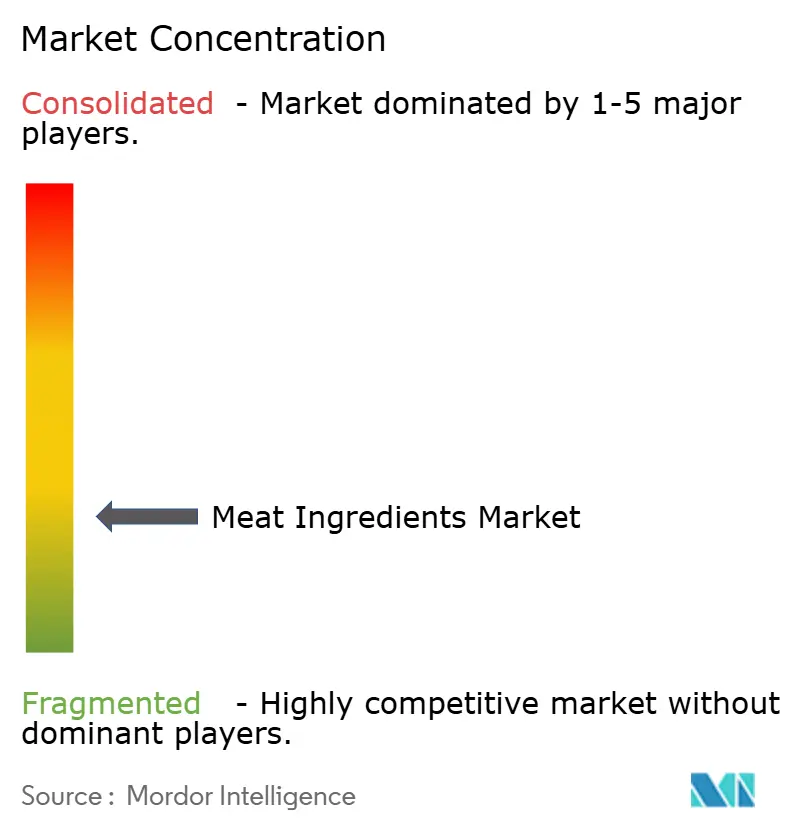
The meat ingredients market has a fragmented supplier base. Kerry Group, Roquette Frères, ADM, IFF, and BENEO compete across several ingredient categories. Corbion, Kemin Industries, Essentia Protein Solutions, and Advanced Food Systems hold focused positions in preservation, functional proteins, and application-specific systems. Competition is based on formulation capability, technical service, regulatory support, and production capacity. This structure gives processors a choice between integrated suppliers and narrower category specialists.
In July 2026, ADM and The EVERY Company announced a partnership for commercial-scale production of OvoPro egg white protein at ADM's Clinton, Iowa, facility. The partnership uses a precision fermentation route for a functional protein ingredient. ADM also expanded its Arcon soy protein offering in May 2026 for processed meat and hybrid applications. These developments reflect how suppliers in the meat ingredients market are building portfolios around protein functionality and reformulation support, while also reducing reliance on a single ingredient category.
Certification-ready natural systems present an opportunity for suppliers able to meet halal, kosher, non-GMO, or organic documentation requirements. These requirements can limit the ability of commodity suppliers to compete on price alone. Advanced Food Systems and Wenda Ingredients were identified in the supplied draft as specialists offering application knowledge, customized blends, and direct formulation support. The meat ingredients market depends on companies that can guide processors through validation, scale-up, and ingredient documentation.
Meat Ingredients Industry Leaders
-
International Flavors & Fragrances, Inc.
-
Kerry Group plc
-
Archer Daniels Midland Company
-
Roquette Frères
-
BENEO
- *Disclaimer: Major Players sorted in no particular order
Recent Industry Developments
- July 2026: ADM and The EVERY Company announced a collaboration to begin commercial-scale production of OvoPro, an animal-free egg white protein, at ADM's facility in Clinton, Iowa. The partnership combines ADM's precision fermentation manufacturing capabilities with EVERY's proprietary protein-production technology to expand OvoPro's supply for food manufacturers amid rising demand for protein fortification.
- July 2026: Galactic launched Galimax Flavor V-100 Pearls, a granulated, low-dust vinegar preservation solution, at IFT FIRST in Chicago. Validated studies demonstrated that a 0.75% concentration inhibits Listeria monocytogenes growth in ready-to-eat (RTE) chicken deli meats, positioning the product as a clean-label antimicrobial solution for processed and ready-to-eat meat producers.
- May 2026: ADM launched an expanded Arcon® soy and pea protein portfolio across North America and Europe. The portfolio includes Arcon IH for ham and pork chop applications, Arcon SB for sausages and meatballs, and Arcon 412 for deli meats and chicken nuggets, as well as European-sourced textured soy protein concentrates for meat extension and plant-based hybrid formats.
Global Meat Ingredients Market Report Scope
Meat ingredients are functional and processing ingredients used in meat and meat product formulations to improve processing performance, product yield, texture, moisture retention, flavor, color stability, preservation, and overall product quality. These include binders, extenders, fillers, coloring agents, and other specialized ingredients used in processed meat applications such as sausages, burgers, nuggets, deli meats, meatballs, and other prepared meat products.
The meat ingredients market is segmented by ingredient type, functionality, form, and geography. By ingredient type, the market is segmented into binders, extenders, fillers, coloring agents, flavoring agents, preservatives, texturing agents, salts, phosphates and curing agents, enzymes and starter cultures, and other ingredient types. By functionality, the market is segmented into moisture retention and water binding, yield improvement, flavor enhancement, color protection, and other functionalities. By form, the market is segmented into powder and liquid. By geography, the market is segmented into North America, Europe, and other regions. The report provides market size and forecasts in value (USD) for all the above segments.
| Binders |
| Extenders |
| Fillers |
| Coloring Agents |
| Flavoring Agents |
| Preservatives |
| Texturing Agents |
| Salts, Phosphates and Curing Agents |
| Enzymes and Starter Cultures |
| Other Ingredient Types |
| Moisture Retention and Water Binding Yield Improvement |
| Yield Improvement |
| Flavor Enhancement |
| Color Protection |
| Other Functionality |
| Powder |
| Liquid |
| North America | United States |
| Canada | |
| Mexico | |
| Rest of North America | |
| Europe | Germany |
| United Kingdom | |
| Italy | |
| France | |
| Spain | |
| Netherlands | |
| Poland | |
| Belgium | |
| Sweden | |
| Rest of Europe | |
| Asia-Pacific | China |
| India | |
| Japan | |
| Australia | |
| Indonesia | |
| South Korea | |
| Thailand | |
| Singapore | |
| Rest of Asia-Pacific | |
| South America | Brazil |
| Argentina | |
| Colombia | |
| Chile | |
| Peru | |
| Rest of South America | |
| Middle East and Africa | South Africa |
| Saudi Arabia | |
| United Arab Emirates | |
| Nigeria | |
| Egypt | |
| Morocco | |
| Turkey | |
| Rest of Middle East and Africa |
| By Ingredient Type | Binders | |
| Extenders | ||
| Fillers | ||
| Coloring Agents | ||
| Flavoring Agents | ||
| Preservatives | ||
| Texturing Agents | ||
| Salts, Phosphates and Curing Agents | ||
| Enzymes and Starter Cultures | ||
| Other Ingredient Types | ||
| By Functionality | Moisture Retention and Water Binding Yield Improvement | |
| Yield Improvement | ||
| Flavor Enhancement | ||
| Color Protection | ||
| Other Functionality | ||
| By Form | Powder | |
| Liquid | ||
| By Geography | North America | United States |
| Canada | ||
| Mexico | ||
| Rest of North America | ||
| Europe | Germany | |
| United Kingdom | ||
| Italy | ||
| France | ||
| Spain | ||
| Netherlands | ||
| Poland | ||
| Belgium | ||
| Sweden | ||
| Rest of Europe | ||
| Asia-Pacific | China | |
| India | ||
| Japan | ||
| Australia | ||
| Indonesia | ||
| South Korea | ||
| Thailand | ||
| Singapore | ||
| Rest of Asia-Pacific | ||
| South America | Brazil | |
| Argentina | ||
| Colombia | ||
| Chile | ||
| Peru | ||
| Rest of South America | ||
| Middle East and Africa | South Africa | |
| Saudi Arabia | ||
| United Arab Emirates | ||
| Nigeria | ||
| Egypt | ||
| Morocco | ||
| Turkey | ||
| Rest of Middle East and Africa | ||
Key Questions Answered in the Report
What is the projected value of the meat ingredients market by 2031?
The supplied forecast projects a value of USD 12.99 billion by 2031, rising from USD 9.59 billion in 2026 at a 5.18% CAGR.
Which ingredient category leads demand?
Binders were the largest ingredient category in the supplied draft, with a 33.68% revenue share in 2025.
Which meat ingredient function is growing fastest?
Flavor enhancement is projected to grow at a 7.18% CAGR from 2026 to 2031 in the supplied draft.
Why are natural preservation systems gaining use in processed meat?
Processors are seeking systems that support clean-label objectives and help meet evolving safety and formulation requirements.