
Measurement While Drilling (MWD) Market Size and Share
Market Overview
| Study Period | 2021 - 2031 |
|---|---|
| Market Size (2026) | USD 4.07 Billion |
| Market Size (2031) | USD 5.94 Billion |
| Growth Rate (2026 - 2031) | 7.88 % |
| Fastest Growing Market | Asia Pacific |
| Largest Market | North America |
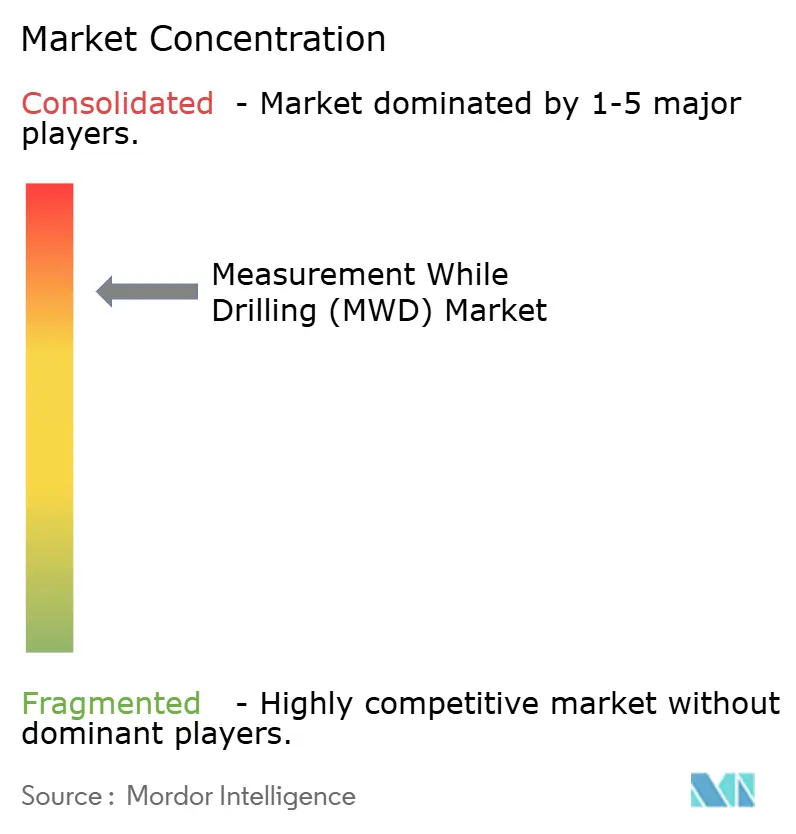
| Market Concentration | High |
Major Players *Disclaimer: Major Players sorted in no particular order Image © Mordor Intelligence. Reuse requires attribution under CC BY 4.0. | |
Measurement While Drilling (MWD) Market Analysis by Mordor Intelligence
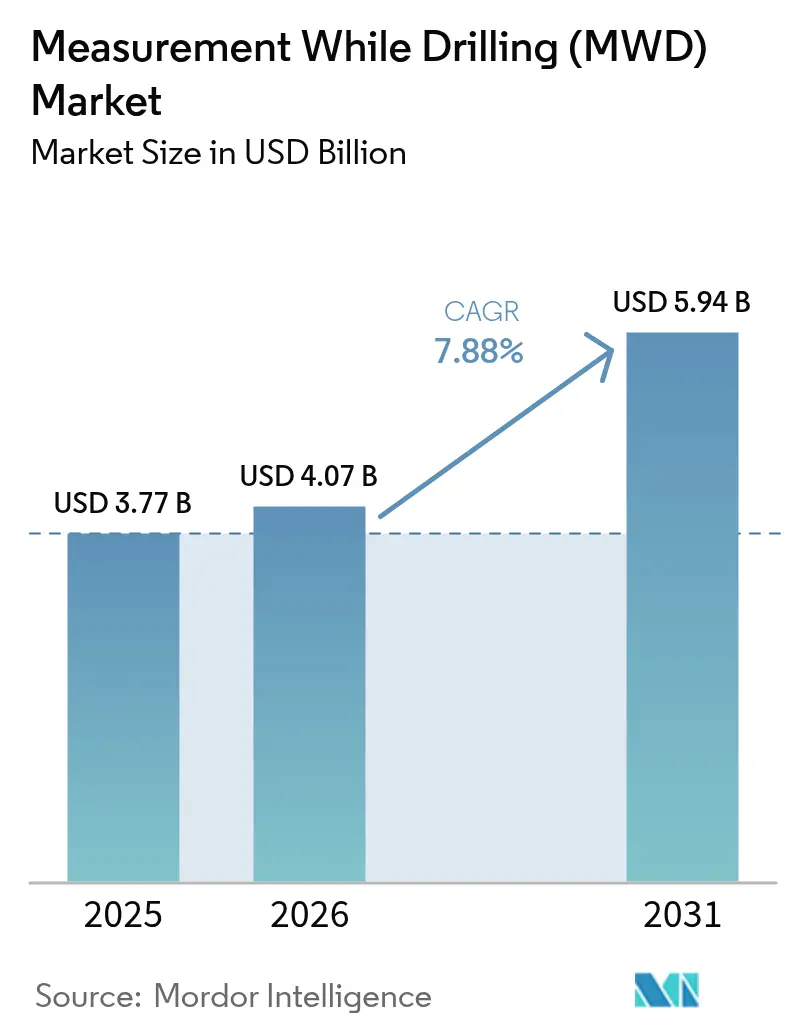
The Measurement While Drilling Market size is expected to grow from USD 3.77 billion in 2025 to USD 4.07 billion in 2026 and is forecast to reach USD 5.94 billion by 2031 at 7.88% CAGR over 2026-2031.
The accelerated adoption of real-time data acquisition, autonomous drilling, and high-bandwidth telemetry underpins this growth as operators strive to reduce non-productive time and enhance wellbore placement in complex formations.[1]SLB, “Autonomous Directional Drilling Systems,” slb.com Unconventional shale development in North America, a rebound in deep- and ultra-deep-water spending, and rising geothermal activity combine to widen the measurement while drilling market opportunity set. Competitive differentiation now pivots on artificial intelligence and closed-loop automation that boost drilling speed and reservoir contact while tempering safety risks. High-temperature reliability limits in HPHT wells and commodity price volatility remain the principal technical and commercial constraints.
Key Report Takeaways
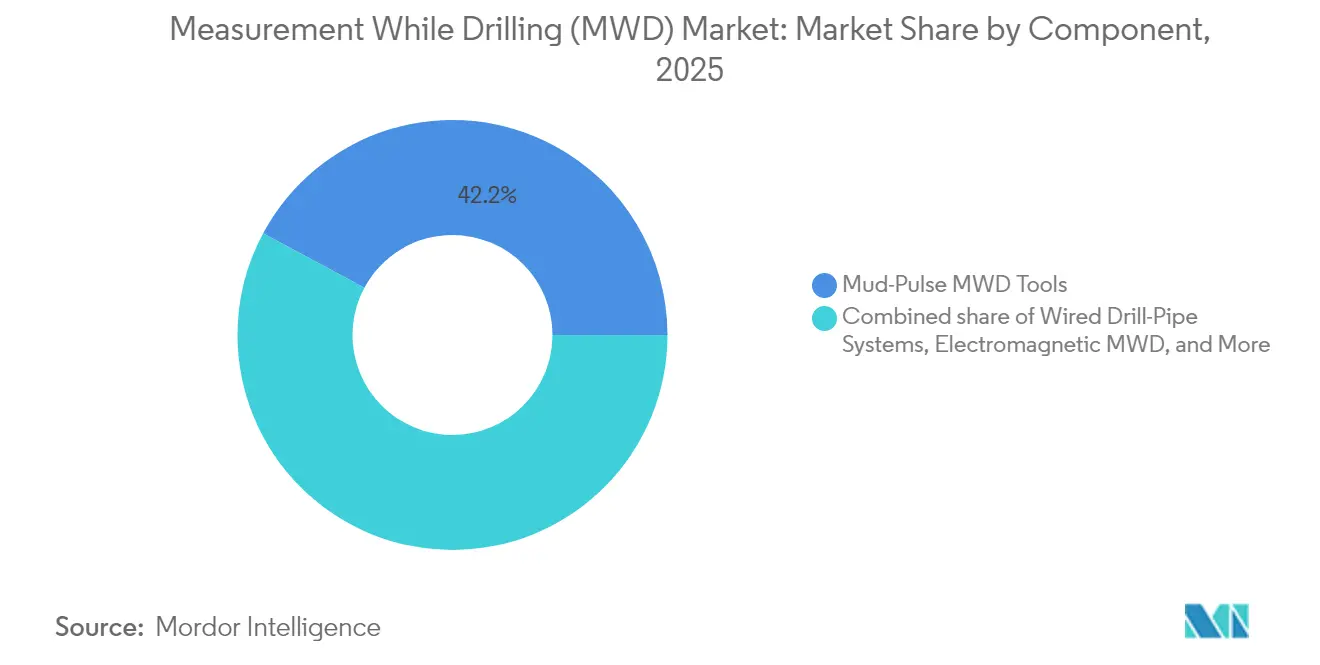
- By component, Mud-Pulse MWD tools led the measurement while drilling market share at 42.15% in 2025, while Wired Drill-Pipe systems are on track for a 9.73% CAGR through 2031.
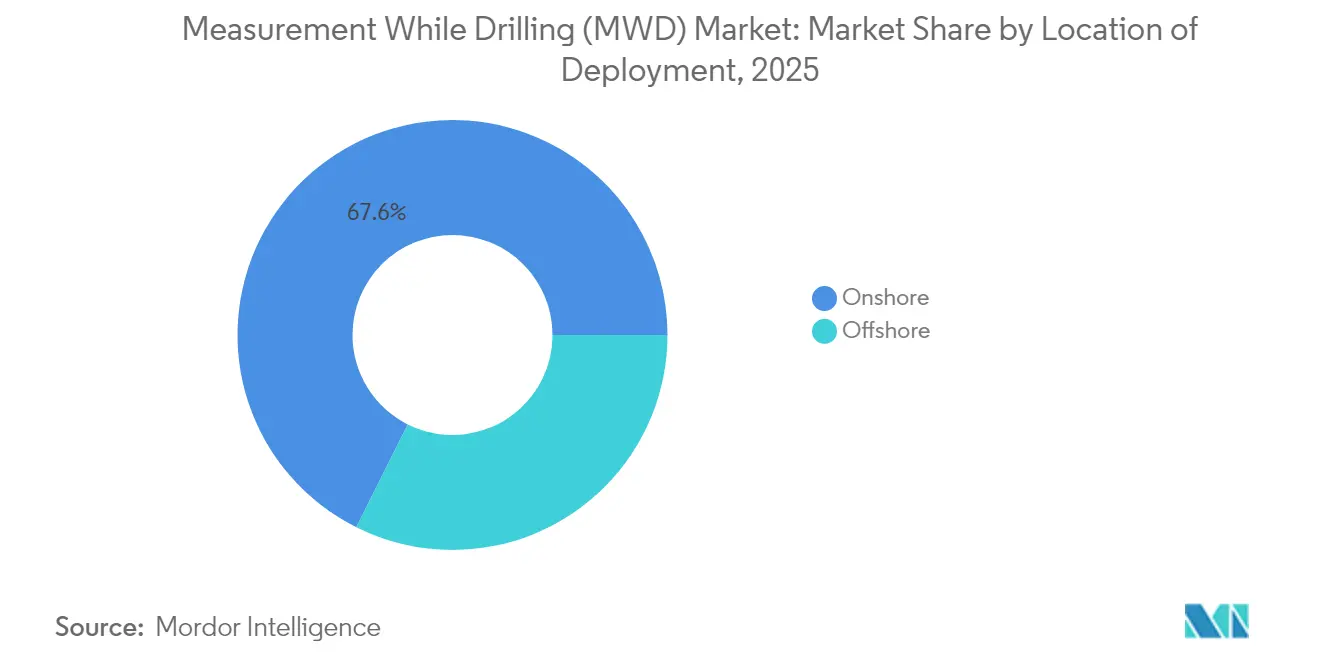
- By location of deployment, onshore operations captured 67.62% of 2025 activity, whereas offshore deployments are projected to advance at a 9.05% CAGR between 2026 and 2031.
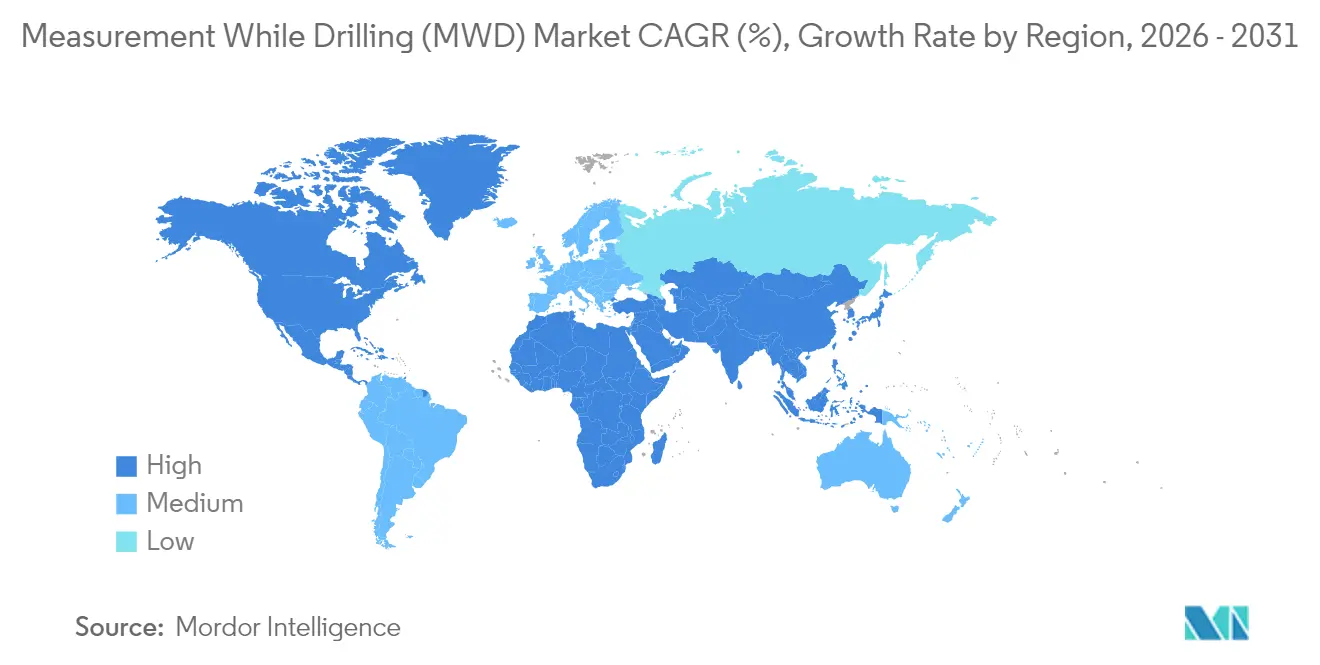
- By geography, North America accounted for 38.12% of 2025 revenue, and the Asia-Pacific region is forecast to expand at an 8.56% CAGR through 2031.
Note: Market size and forecast figures in this report are generated using Mordor Intelligence’s proprietary estimation framework, updated with the latest available data and insights as of 2026.
Global Measurement While Drilling (MWD) Market Trends and Insights
Drivers Impact Analysis*
| Driver | ( ~ ) % Impact on CAGR Forecast | Geographic Relevance | Impact Timeline |
|---|---|---|---|
| Growth in unconventional shale drilling | +2.1% | North America, Argentina, Australia | Medium term (2-4 years) |
| Rising need to reduce NPT & well-costs | +1.8% | Global | Short term (≤ 2 years) |
| Deep- & ultra-deep-water CAPEX rebound | +1.5% | North Sea, Gulf of Mexico, Brazil, West Africa | Medium term (2-4 years) |
| Wired drill-pipe adoption | +1.2% | Global with early gains in North Sea and Gulf of Mexico | Long term (≥ 4 years) |
| Geothermal drilling for energy transition | +0.8% | Europe, North America, Asia-Pacific | Long term (≥ 4 years) |
| Source: Mordor Intelligence | |||
Growth in Unconventional Shale Drilling
Horizontal shale wells in the Permian Basin continue to increase in length, with annual basin output expected to rise by 300,000 barrels per day, reaching 6.9 million barrels per day by 2026. Complex geosteering requirements in these extended laterals elevate demand for high-precision MWD systems that maintain borehole stability and optimize landing zones. Argentina’s Vaca Muerta program is scaling similar practices, using real-time pressure monitoring and formation mapping to unlock tight reservoirs efficiently. Continuous directional control enabled by advanced measurement while drilling market technology minimizes dogleg severity, lowers casing wear, and sustains reservoir contact across 10,000-foot laterals. Operators also deploy rotary steerable systems integrated with MWD sensors to decrease slide time and increase the average rate of penetration, thereby amplifying the economic benefit of each incremental foot drilled. Strategic focus on maximizing resource recovery at low break-even prices reinforces investment in robust downhole telemetry across unconventional portfolios.
Rising Need to Reduce NPT & Well-Costs via Real-Time Data
Unplanned events account for 15-20% of total drilling time, intensifying operator pressure to curtail non-productive time through continuous downhole feedback. Wired drill-pipe field trials by BP achieved average drilling time savings of 10%, proving that sub-second data improves weight-on-bit management and mitigates stuck-pipe risk.[2]OnePetro, “High-Bandwidth Wired Drill-Pipe Field Trial,” onepetro.org Real-time azimuthal gamma and resistivity measurements further sharpen geosteering accuracy, directly linking better placement to higher initial production rates. Measurement while drilling market technology capable of bidirectional command enables prompt parameter changes without tripping tools, eliminating costly lost circulation incidents. Enhanced reservoir exposure ultimately lifts estimated ultimate recovery, supporting capital-discipline strategies that dominate budget allocations in a volatile pricing world. The result is a compounding return on digital drilling investments even in mature fields.
Deep- & Ultra-Deep-Water CAPEX Rebound
Global offshore upstream spending is projected to exceed USD 300 billion in 2025 after rising 11% from 2024, signaling renewed capital flow into high-value deep-water prospects. Ultra-deepwater wells, located below 1,500 meters of water depth, require high-temperature, high-pressure-rated MWD systems that guide the bit trajectory through salt and sub-salt strata with narrow fracture gradients. The cost of remedial sidetracks increases offshore; therefore, real-time formation evaluation is crucial for selecting a safe casing point. Operators in Brazil and the Gulf of Mexico increasingly specify AI-enabled MWD packages that can predict drilling dysfunctions and autonomously adjust rotary steerable commands. Measurement-while-drilling market solutions supporting extended-reach wells also address the floating rig fleet’s need for shorter time-to-target to maintain project economics. Growth in subsea tiebacks and multi-well templates drives demand for high-bandwidth telemetry that can handle multi-phase flows and dynamic pressure changes without signal dropout.
Wired Drill-Pipe Adoption Enabling High-Bandwidth Telemetry
Data rates exceeding 57,000 bits per second over wired drill pipe contrast sharply with traditional mud-pulse telemetry, which operates at 10-40 bits per second, opening the path for real-time imaging while drilling and autonomous weight-on-bit control. The powerline system co-developed by Parker Wellbore and TDE shows industry commitment to robust and reusable downhole networks. Bidirectional communication allows surface engineers to modify tool programming on the fly, saving rig hours previously spent circulating for firmware updates. Although rig retrofits and handling practices require an upfront investment, early adopters report a measurable increase in penetration rate and a reduction in tortuosity in complex 3-D trajectories. Over the forecast horizon, the measurement while drilling market penetration of wired drill pipe is expected to transition from niche offshore pilots to mixed fleets across high-density shale pads, underpinning the market’s real-time automation narrative.
Restraints Impact Analysis*
| Restraint | (~) % Impact on CAGR Forecast | Geographic Relevance | Impact Timeline |
|---|---|---|---|
| Oil-price volatility impacting E&P budgets | -1.4% | Global | Short term (≤ 2 years) |
| Reliability challenges of MWD in HPHT wells | -0.9% | Middle East, North Sea, Asia-Pacific | Medium term (2-4 years) |
| Data-ownership & cyber-security concerns | -0.6% | Global | Long term (≥ 4 years) |
| Shortage of skilled MWD field engineers | -0.5% | Global | Medium term (2-4 years) |
| Source: Mordor Intelligence | |||
Oil-Price Volatility Impacting E&P Budgets
Historical data show that every USD 1 decline in crude price is associated with an average disengagement of 64 drilling rigs worldwide, underscoring the sector’s sensitivity to price swings. US exploration and production companies trimmed 2024 capital spending to USD 61.7-65.4 billion, echoing a cautious stance toward discretionary drilling budgets. Tight-oil projects require breakeven levels near USD 50 per barrel, so marginal campaigns become uneconomic during downturns, delaying measurement while drilling market deployments. The asymmetric recovery pattern further depresses service pricing power, compelling providers to stretch payment terms and manage spare tool inventory. Financial uncertainty also slows large-scale telemetry upgrades as operators favor incremental enhancements over full wired drill-pipe conversions until price stability returns.
Reliability Challenges of MWD Tools in HPHT Wells
Conventional MWD electronics are generally rated for 175 °C, whereas ultra-HPHT wells in the Middle East and China can routinely exceed 200 °C and 30,000 psi. Failure rates increase markedly with temperature, reducing tool life and inflating non-productive time through unexpected trips. Shunbei deep-carbonate projects reported elevated incidence of downhole tool failures, prompting reliance on positive-displacement motors and limiting continuous telemetry in critical intervals. Next-generation sapphire-based sensor housings and high-temperature batteries are progressing; however, commercial release cycles lag behind near-term drilling schedules. Until proven HPHT-ready systems reach scale, the measurement while drilling market expansion into ultra-deep reservoirs will face technical challenges, particularly in fields that require continuous formation evaluation for safety compliance.
*Our forecasts treat driver/restraint impacts as directional, not additive. The impact forecasts reflect baseline growth, mix effects, and variable interactions.
Segment Analysis
By Component: High-Speed Telemetry Reshapes Demand
Mud-Pulse systems dominated 2025 revenue with a 42.15% of measurement-while-drilling market share, as their reliability and rig-floor familiarity remain valuable in standard pressure and temperature conditions. However, the segment confronts mounting competition from Wired Drill-Pipe systems, projected to grow at a 9.73% CAGR through 2031, as operators equate higher bandwidth with faster decision-making cycles. The measurement while drilling market size tied to Electromagnetic MWD tools continues to rise in air-drilling and low-conductivity fluid operations, providing an alternate option where mud-pulse telemetry attenuates severely. Rotary steerable system modules are increasingly equipped with gyro-while-drilling and downhole vibration sensors, blending measurement and actuation within a single platform that supports autonomous navigation.
Demand for downhole telemetry sensors that capture dynamic pressure, shock, and rotational speed increases as real-time analytics enable immediate drill-string health management. SLB’s NeoLink demonstrates the migration toward integrated hardware and cloud-native software that shortens learning loops from the bit to the rig control system. Future growth in the measurement while drilling market hinges on modular tool designs that allow for rapid reconfiguration for geothermal, carbon capture, or extended-reach wells without inflating the string length. Providers investing in solid-state electronics, advanced vibration damping, and retrievable battery packs are likely to command premium day rates once drilling activity shifts toward more thermally and mechanically demanding plays.


By Location of Deployment: Onshore Scale Meets Offshore Complexity
Onshore drilling captured 67.62% of 2025 tool runs, supported by extensive shale development across North America, China, and the Middle East, where pad economies encourage high spud counts per rig. Land rigs benefit from lower logistics costs and improved well-site accessibility, enabling service providers to cycle tools efficiently and maintain high utilization rates. Nevertheless, offshore deployments are on track for a 9.05% CAGR to 2031, as deepwater campaign approvals accelerate and high-spec rigs demand integrated measurement while drilling market solutions that support managed pressure drilling and dual-gradient systems.
In ultra-deepwater Brazil and the Gulf of Mexico, continuous pressure while drilling modules detect micro-fracture gradients, enabling casing design optimization and safeguarding against kicks. The measurement while drilling market size, linked to offshore projects, benefits from premium pricing because downhole failures carry outsized cost penalties, incentivizing the adoption of high-reliability tools and redundancy protocols. Integration of seismic-while-drilling in challenging salt provinces informs real-time velocity models that guide bit steering, shrinking drilling uncertainty envelopes. Land projects continue to evolve towards factory-style operations where wired drill-pipe and closed-loop rig control drive rapid cycle times, cementing onshore as the volume anchor even as offshore remains the innovation pacesetter.
Geography Analysis
North America retained 38.12% of 2025 revenue in the measurement while drilling market, supported by sustained shale activity in the Permian Basin and deep-water exploration in the Gulf of Mexico. The region’s mature supply chain, abundant rig fleet, and data-driven operating culture drive the rapid adoption of automation, increasing the rate of penetration and minimizing sidetrack drilling. Canada’s oil-sands SAGD wells and emerging geothermal initiatives are driving demand for high-temperature MWD tools that can handle steam-assisted environments. Mexico continues to advance the Trion ultra-deepwater development, awarding multi-year contracts that specify AI-enabled service delivery to reduce well cycle time and enhance safety. The regulatory emphasis on remote real-time monitoring by agencies such as the Bureau of Safety and Environmental Enforcement further underscores the need for reliable, high-bandwidth telemetry in offshore wells.
The Asia-Pacific region is the fastest-growing, with an 8.56% CAGR expected through 2031, as national oil companies ramp up drilling to meet demand and improve energy security. China’s South China Sea projects deploy seismic-while-drilling for real-time formation imaging, enabling precise casing points in HPHT zones. India’s active rig count is projected to rise from 111 in 2024 to 142 by 2028, reflecting higher domestic production goals that translate into robust measurement while drilling market orders. Australia’s offshore gas fields and geothermal pilots similarly require high-temperature sensors and autonomous steering to control wellbore deviation in fractured granites. Southeast Asian operators in Indonesia and Malaysia focus on cost-effective MWD packages that balance real-time formation evaluation with lean rig budgets, highlighting the region’s price-performance sensitivity.
Europe’s market revolves around North Sea brownfield redevelopment and geothermal drilling aligned with decarbonization policy targets. Norway champions drilling automation, pairing Halliburton LOGIX software with Sekal AS algorithms to deliver autonomous directional drilling at scale. The measurement while drilling (MWD) market size in geothermal applications is expanding as Germany and the Netherlands incentivize the development of deep geothermal wells for district heating, necessitating tools that operate in corrosive brines at temperatures of up to 200 °C. The Middle East continues to experience steady growth, spurred by national oil company investments in unconventional reservoirs, such as Saudi Aramco’s Jafurah shale. Africa sees momentum in West Africa’s deep-water discoveries, while South America leverages Brazil’s pre-salt and Argentina’s shale developments to stimulate demand for high-spec MWD services capable of navigating tight pore-pressure margins.

Regulatory Landscape
MWD deployment is governed more by well-integrity and safety regimes than by tool-specific statutes, with regulators increasingly anchoring compliance around auditable real-time monitoring, well control, and data submission. In the United States, Bureau of Safety and Environmental Enforcement (BSEE) requirements under 30 CFR 250 (including Subpart S well-control provisions) and related guidance reinforce the use of reliable downhole measurement and pressure monitoring to support safe offshore operations. BSEE also issued NTL No. 2024-G05 for Managed Pressure Drilling projects using a subsea BOP, explicitly tying MPD operations to appropriate monitoring instrumentation such as MWD and pressure-while-drilling (PWD). In April 2026, BSEE published a Best Practices for Real Time Monitoring (RTM) final research report, further formalizing RTM expectations that shape how MWD data is captured, validated, and used in operational decision loops.
Outside the US, data transparency and standardized reporting increasingly influence MWD workflows. The UK North Sea Transition Authority (NSTA) updated requirements for National Data Repository (NDR) information reporting (September 2025), including submission of end-of-well reporting and digital well data packages that commonly incorporate MWD/LWD outputs. Across jurisdictions, API and ISO standards remain core technical benchmarks for oilfield equipment and measurement practices and are often referenced by operators and regulators for inspection, testing, and documentation, which pushes service providers toward traceable calibration, quality systems, and secure digital recordkeeping that can withstand regulatory scrutiny.
Competitive Landscape
The measurement while drilling market features a balanced structure, where three integrated service majors combine for approximately 51.8% of global revenue. Baker Hughes leads at 23.99%, closely followed by Halliburton at 15.4% and SLB at 12.41%, leveraging global service coverage and proprietary telemetry systems. These companies capitalize on scale to fund R&D in AI-driven autonomous control, high-temperature electronics, and digital twin optimization, which shortens drilling days and elevates the average rate of penetration. Mid-tier firms focus on niche offerings such as gyro-while-drilling for magnetic interference zones or modular battery-free tools aimed at geothermal markets.
Strategic alliances accelerate technology deployment. The Turnwell venture, which involves ADNOC Drilling, SLB, and Patterson-UTI, integrates advanced tools with regional rig capacity, securing multi-year contracts that guarantee fleet utilization. Nabors Industries’ acquisition of Parker Wellbore strengthens its presence in managed pressure drilling and downhole power transmission, complementing the adoption of wired drill pipe. Large operators also partner directly with service firms, exemplified by Chevron and Halliburton’s intelligent hydraulic fracturing initiative, which utilizes ZEUS IQ™ to synchronize surface and subsurface data for real-time optimization.
Innovation pipelines remain active. Patent filings for high-power laser drilling, solid-state downhole batteries, and multi-mode telemetry highlight attempts to transcend mud-pulse bandwidth limits and expand operating envelopes beyond 230 °C. Suppliers delivering integrated hardware, analytics, and cloud connectivity are best positioned to secure premium contracts, particularly in offshore and HPHT projects, where reliability guarantees and data ownership clarity significantly influence tender outcomes. Smaller companies can still capture a share by excelling in specialist segments, such as azimuthal sonic logging or extreme-temperature electronics for geothermal wells, indicating that technological agility offsets some of the scale disadvantages.
Measurement While Drilling (MWD) Industry Leaders
Baker Hughes Co.
Halliburton Company
Schlumberger Limited
National-Oilwell Varco Inc.
Weatherford International Limited
- *Disclaimer: Major Players sorted in no particular order

Market Opportunities and Future Outlook
Reliability and measurement continuity in extreme HPHT drilling stands out as a key whitespace, since conventional electronics (commonly rated around 175 C in standard tool designs) face elevated failure risk above 200 C. Recent technical and product activity points to multiple pathways: in April 2026, ZITN Tech showcased a 200 C MWD series using a Multi-Chip Module (MCM) modular approach, and in May 2026 published work described a fully mechanical well deviation measurement concept designed to bypass electronic limitations in ultra-high-temperature environments. This supports differentiated offerings for geothermal and ultra-deep HPHT oil and gas wells, where operators prioritize tool survivability, fewer unplanned trips, and consistent directional control.
A second opportunity cluster is tied to integrated digital drilling workflows that combine MWD streams with surface and cloud analytics to reduce dysfunction and non-productive time. In July 2026, Innova Drilling & Intervention integrated PV Fluid Products power-section performance data into a real-time drilling platform to provide temperature-adjusted motor performance analysis, reflecting a push to fuse downhole measurements with manufacturer-backed equipment models for faster operational decisions. In parallel, April 2026 field-trial documentation on real-time shock and vibration monitoring blends surface and downhole signals into actionable alerts, supporting predictive maintenance approaches aimed at preventing MWD tool damage. As anti-collision and wellbore-positioning practices increasingly rely on standardized survey error models (ISCWSA frameworks), demand is concentrating on higher-accuracy sensors, tighter survey protocols, and telemetry architectures (including dual-telemetry and gyro integration) that maintain data quality in crowded well environments and in magnetically challenging settings.
Recent Industry Developments
- July 2026: Innova Drilling & Intervention integrated PV Fluid Products power-section performance data into its Vantage cloud-based drilling platform, combining it with live MWD and EDR data for real-time, temperature-adjusted motor performance analysis. The update reflects growing demand for integrated drilling workflows where downhole measurements are contextualized with equipment models to improve decisions at the rig and remote operations centers.
- October 2025: Halliburton launched the StreamStar wired drill pipe interface system to support high-speed real-time data transmission and downhole power delivery. The launch reinforces the shift from bandwidth-limited telemetry toward wired architectures that enable faster downhole-to-surface feedback for automation and advanced measurement services.
- September 2024: Gordon Technologies (Enersol) highlighted its support for ADNOC Drilling's USD 1.7 billion unconventional drilling program through the Turnwell joint venture. The program-scale push in the UAE underscores how large unconventional campaigns can accelerate uptake of advanced MWD, geosteering, and related drilling optimization services under multi-year execution models.


Research Methodology Framework and Report Scope
Market Definition and Coverage
For this methodology, the measurement while drilling (MWD) market is defined as revenues generated from MWD tools and related downhole telemetry and integration systems used to capture and transmit real time drilling measurements during well construction, across onshore and offshore activity.
Scope exclusions: Excludes drilling rig hardware, general drilling fluids, and completion equipment that are not part of the MWD tool and telemetry set.
Segmentation Overview
- By Component
- Mud-Pulse MWD Tools
- Electromagnetic MWD Tools
- Wired Drill-Pipe Systems
- Gyro-While-Drilling Systems
- RSS-Integrated MWD Modules
- Downhole Telemetry Sensors
- By Location of Deployment
- Onshore
- Offshore
- By Geography
- North America
- United States
- Canada
- Mexico
- Europe
- Germany
- United Kingdom
- Norway
- Netherlands
- Italy
- Russia
- Rest of Europe
- Asia-Pacific
- China
- India
- Japan
- South Korea
- ASEAN Countries
- Australia
- Rest of Asia-Pacific
- South America
- Brazil
- Argentina
- Colombia
- Rest of South America
- Middle East and Africa
- Saudi Arabia
- United Arab Emirates
- Qatar
- Nigeria
- South Africa
- Egypt
- Rest of Middle East and Africa
- North America
Data Sources, Market Sizing, and Validation
Desk Research
Desk research was used to set the operating context and to build grounded ranges for drilling activity and service intensity before the model was finalized. We referenced public sources such as the EIA for upstream activity signals, the IEA for energy demand outlook, OPEC for supply balances, and the US Bureau of Labor Statistics for cost and wage direction that can affect service pricing.
To connect market demand with field activity, we also reviewed sources such as Baker Hughes rig counts, SEC filings and annual reports of listed oilfield service firms, investor presentations, and selected trade association releases tied to drilling and well construction. Where company level splits were not directly stated, a paid subscription for company financials and intelligence was used to reconcile business line exposure, and a patent database subscription was used as a light check on telemetry and sensor innovation themes. The desk sources listed here are illustrative, and many other public documents were also consulted for data collection, validation, and clarification.
Primary Interviews and Surveys
Primary work focused on validating how MWD demand tracks wells drilled, directional complexity, and the typical tool mix used across basins. We spoke with people across tool providers, oilfield service teams, and drilling operations roles, and we checked responses across APAC, EMEA, and the Americas so regional rig cycles and offshore intensity were not averaged out too quickly.
Distribution of primary research fieldwork respondents
| Company type | Respondent position | Region |
|---|---|---|
| Top tier: 29% | CXOs: 12% | APAC: 48% |
| Mid tier: 50% | Functional/Unit leaders: 31% | EMEA: 31% |
| Smaller Players: 21% | Managers: 57% | Americas: 21% |
Market-Sizing & Forecasting
The core sizing logic uses a top-down approach where drilling activity and well construction intensity are translated into an addressable demand pool for MWD, and then expressed in revenue using price and utilization assumptions. In practice, we start with regional onshore and offshore drilling levels, apply an MWD adoption and tool run intensity factor, and then translate it into spend based on typical tool mix across mud-pulse, electromagnetic, wired drill-pipe, gyro-while-drilling systems, RSS-integrated modules, and downhole telemetry sensors.
To keep the totals realistic, selective bottom-up approximations are used as a check, such as rolling up sampled supplier revenues tied to MWD product lines and testing implied revenue per active rig or per well against interview feedback. When gaps show up, the assumptions are adjusted with clear reasons, most often around offshore mix, tool days per well, and pricing progression for higher data-rate telemetry.
Forecasting is run with scenario analysis supported by a small set of drivers that respondents consistently connect to demand, including rig count direction, offshore project activity, horizontal and directional well share, day-rate and service price inflation, and the pace of telemetry upgrades. Where data is thin for smaller regions, we do not force precision and instead use conservative ranges that are later narrowed through expert validation.
Data Validation & Update Cycle
Validation is done through multiple checks so that a single data series does not control the outcome. We compare implied market totals against independent signals like regional rig counts, company commentary on drilling services demand, and the expected share of MWD within drilling-related spend, and then any outliers are reviewed before sign-off.
If a variance is large, the team re-contacts relevant interviewees and re-checks the input that likely caused the jump, which is often offshore mix, utilization, or a sudden pricing change. Reports are refreshed annually, and interim updates are made when material events occur, such as sharp rig cycle shifts or major policy changes that impact drilling activity. Before delivery, a final analyst pass is completed so the numbers reflect the latest available public data and the most recent validation inputs.
Mordor Intelligence's Measurement While Drilling Mwd Market Estimate Compared With Other Published Estimates
Published market numbers for MWD can look far apart even when they use similar growth rates, because scope choices are not the same and the pricing logic can be handled differently. Differences usually come from whether a source is counting only MWD tools, or also folding in adjacent drilling services, surface processing systems, or broader downhole measurement categories.
Some estimates expand the definition by bundling in wider drilling and measurement stacks, including extra surface systems and non-oilfield end uses, which naturally lifts the total. In Mordor Intelligence, the count stays focused on MWD tools and related downhole telemetry and integration systems (including mud-pulse, electromagnetic, wired drill-pipe, gyro-while-drilling, RSS-integrated modules, and downhole telemetry sensors), and the totals are checked against drilling activity signals and interview-confirmed tool intensity before the final number is locked.
Benchmark comparison
| Source | Market Size | Gaps in Research Methodology |
|---|---|---|
| Mordor Intelligence | USD 4.07 B (2026) | |
| Industry Publisher A | USD 3.93 B (2026) | Uses a similar global framing, but its build appears to apply a slightly lower near-term pricing and tool intensity assumption for high-complexity wells, which can reduce the 2026 total even with comparable growth expectations. |
| Research Platform B | USD 2.56 B (2025) | Reports an earlier base year and uses a broader component lens that can shift what is treated as core MWD revenue versus supporting equipment, which changes the starting point and can compress the apparent market size for the near term. |
The table shows that most of the spread is explained by what gets counted as MWD revenue, the base year selected, and how pricing and utilization are carried into the model. By keeping the scope tied to defined MWD tool and telemetry categories and validating intensity assumptions with drilling activity checks, our estimate stays traceable to a repeatable set of inputs rather than a single high-level spend share.


Key Questions Answered in the Report
What is the projected growth rate for the measurement while drilling market between 2026 and 2031?
The market is forecast to grow at a 7.88% CAGR, rising from USD 4.07 billion in 2026 to USD 5.94 billion in 2031.
Which component segment leads the measurement while drilling market share today?
Mud-Pulse MWD tools lead with 42.15% of 2025 revenue owing to broad rig compatibility and proven reliability.
Why is wired drill-pipe gaining traction in measurement while drilling operations?
Wired drill-pipe enables data rates above 57,000 bps, supporting real-time decision making and autonomous drilling that cuts average well time by about 10%.
Which region is expected to grow fastest through 2031?
Asia-Pacific is projected to expand at an 8.56% CAGR as China, India, and Australia increase drilling to meet energy demand.
How do oil-price fluctuations influence measurement while drilling tool demand?
Lower prices prompt operators to defer advanced drilling programs, with each USD 1 price decline historically linked to an average drop of 64 active rigs, directly reducing MWD service uptake.
What technical hurdle limits MWD adoption in HPHT environments?
Conventional electronics typically fail above 175 °C, so operators in HPHT wells above 200 °C face higher tool failure rates until new high-temperature systems become commercially available.
Page last updated on:


 Your data is secure and never sold or shared.


