
Maritime Patrol Aircraft Market Size and Share
Market Overview
| Study Period | 2020 - 2031 |
|---|---|
| Market Size (2026) | USD 15.17 Billion |
| Market Size (2031) | USD 21.03 Billion |
| Growth Rate (2026 - 2031) | 6.75 % |
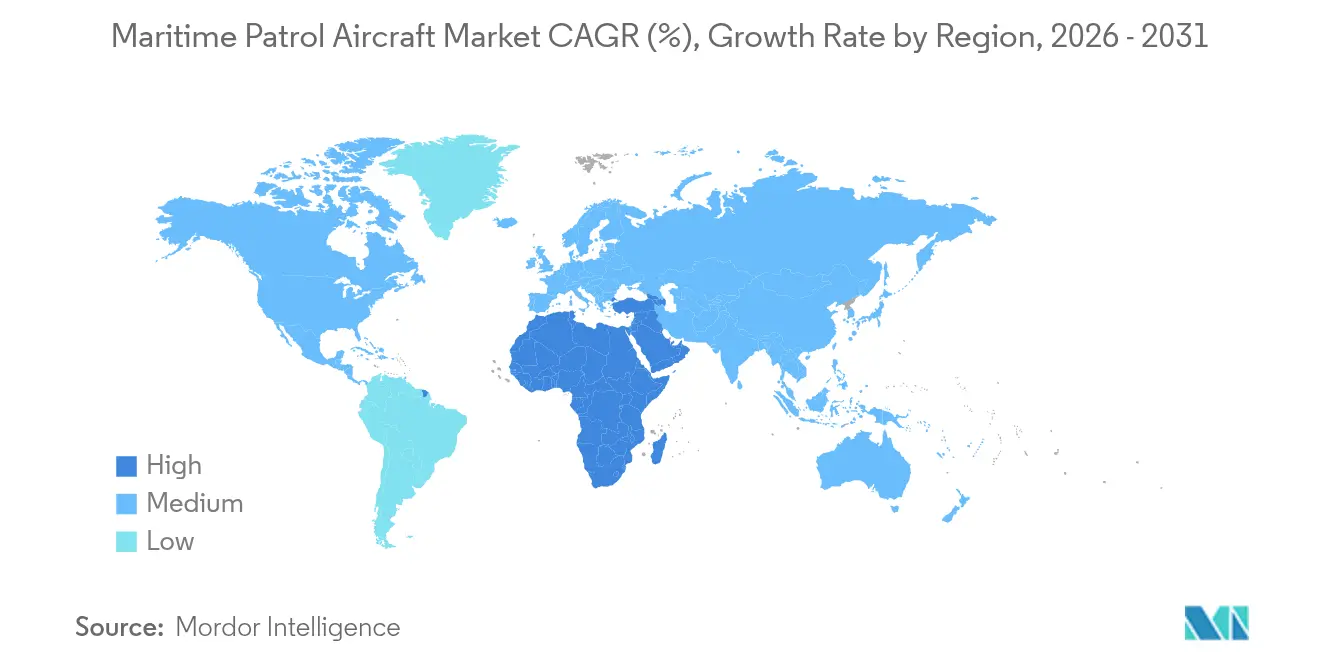
| Fastest Growing Market | Middle East and Africa |
| Largest Market | North America |
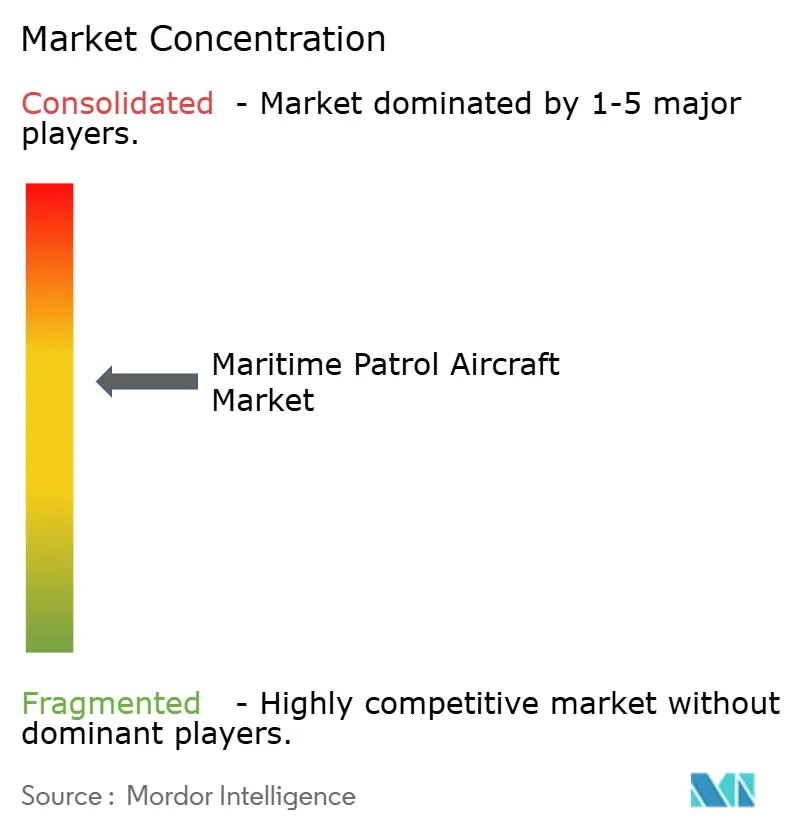
| Market Concentration | Medium |
Major Players *Disclaimer: Major Players sorted in no particular order Image © Mordor Intelligence. Reuse requires attribution under CC BY 4.0. | |
Maritime Patrol Aircraft Market Analysis by Mordor Intelligence
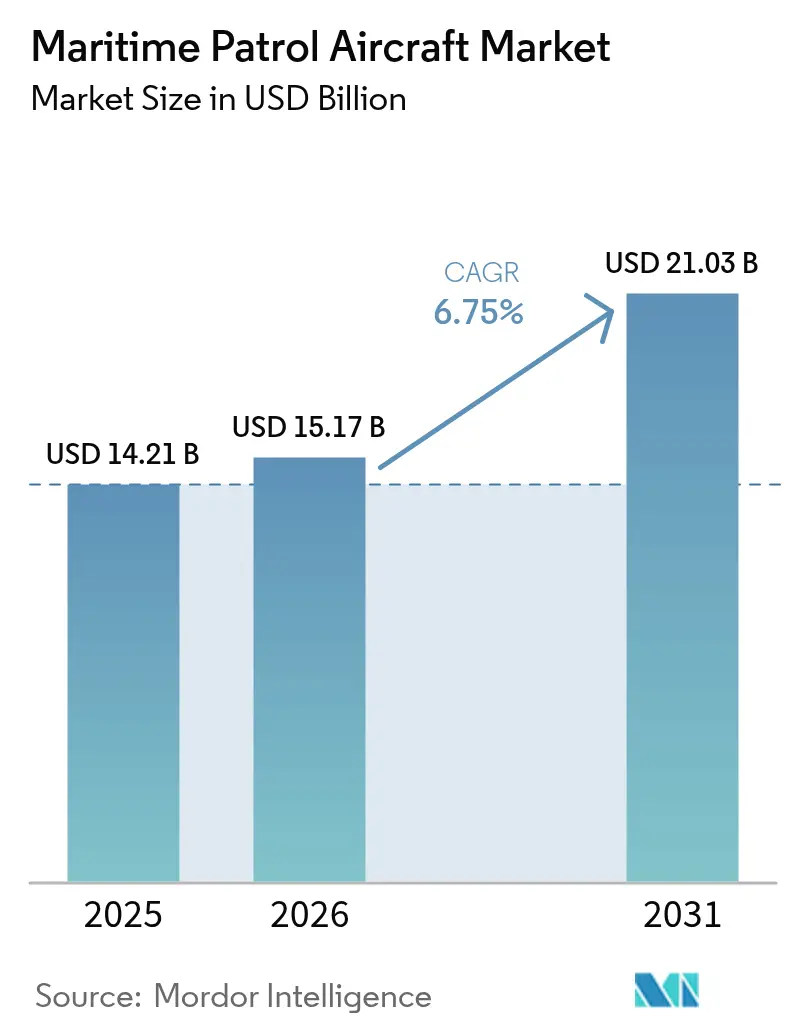
Maritime patrol aircraft market size in 2026 is estimated at USD 15.17 billion, growing from 2025 value of USD 14.21 billion with 2031 projections showing USD 21.03 billion, growing at 6.75% CAGR over 2026-2031. Growing submarine activity, rising blue-economy enforcement, and the shift toward manned-unmanned teaming underpin sustained demand. Fleet-replacement cycles for Cold War-era aircraft continue to generate large, multi-year procurement pipelines, while cost pressures are accelerating interest in modular sensor pods and hybrid-electric propulsion. North America maintains leadership on the back of the US Navy’s P-8A program and allied standardization. Yet, the Middle East and Africa show the fastest growth as coastal states fund new maritime-security missions.[1] Supply-chain bottlenecks in specialized sonobuoys and export-control limits on advanced radars remain structural constraints that could alter competitive dynamics over the decade.
Key Report Takeaways
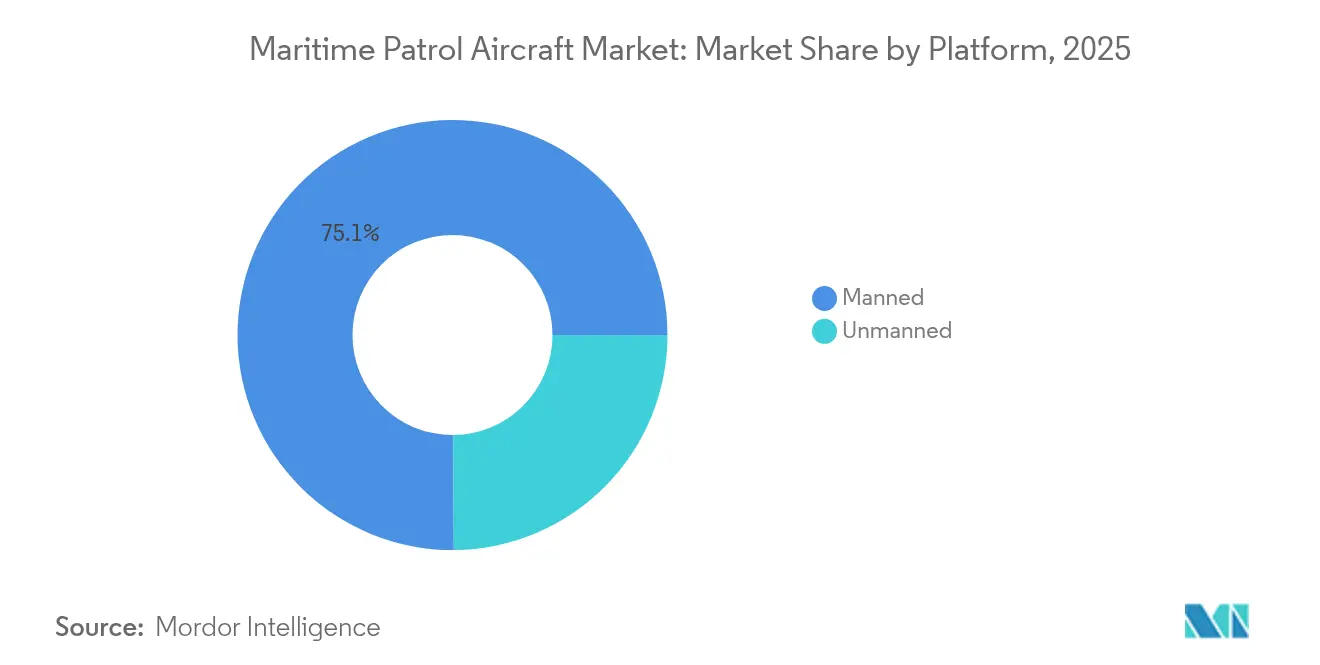
- By platform type, manned aircraft held 75.10% of the maritime patrol aircraft market share in 2025, while unmanned systems posted the fastest 9.78% CAGR through 2031.
- By propulsion, jet-powered designs dominated revenue by 85.05% in 2025, but electric systems are advancing at 11.86% CAGR as hybrid-electric programs mature.
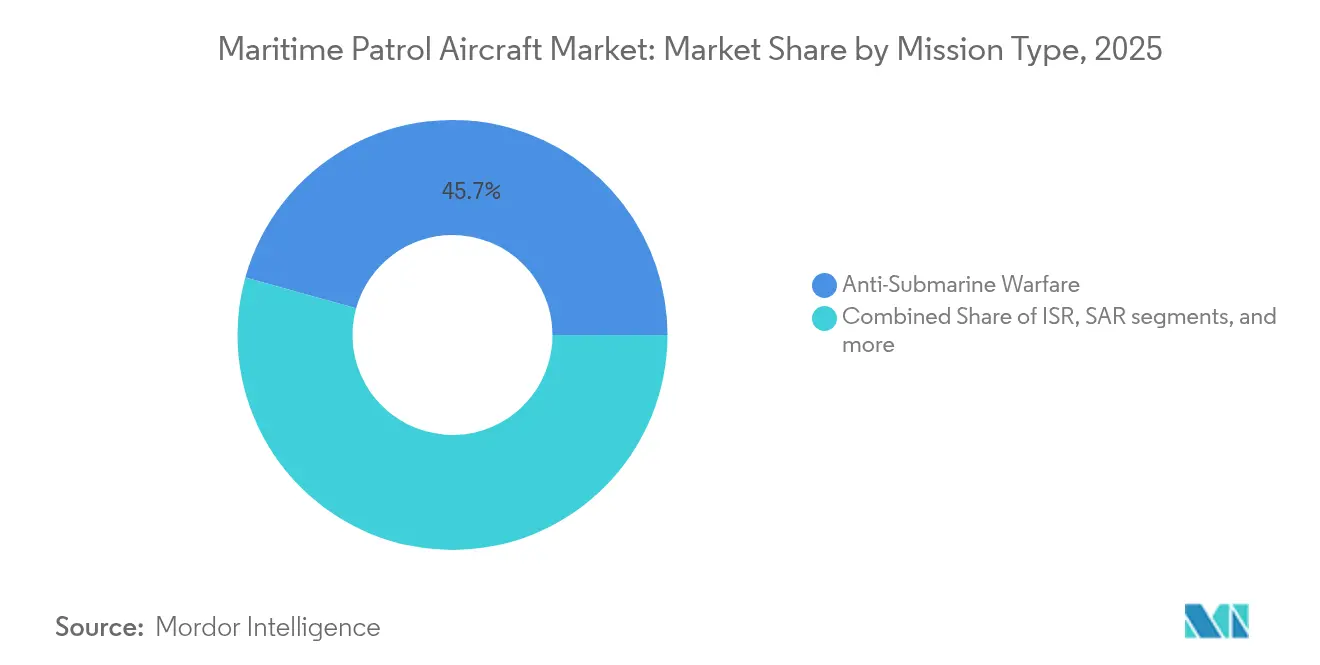
- By mission, anti-submarine warfare accounted for 45.70% of the maritime patrol aircraft market size in 2025; border and EEZ patrol is rising at a 9.35% CAGR to 2031.
- By end user, naval forces led with 61.65% revenue share in 2025, while coast guards recorded the highest 11.88% CAGR through 2031.
- By geography, North America commanded a 38.20% market share in 2025; the Middle East and Africa are projected to advance at a 10.06% CAGR to 2031.
Note: Market size and forecast figures in this report are generated using Mordor Intelligence’s proprietary estimation framework, updated with the latest available data and insights as of 2026.
Market Trends and Insights
Drivers Impact Analysis of Maritime Patrol Aircraft Market*
| Driver | (~)% Impact on CAGR Forecast | Geographic Relevance | Impact Timeline |
|---|---|---|---|
| Escalating long-range anti-submarine warfare requirements | +1.8% | Global, with concentration in Indo-Pacific and North Atlantic | Medium term (2-4 years) |
| Replacement of ageing P-3/P-8 fleets with multi-mission platforms | +2.1% | North America, Europe, Asia-Pacific | Long term (≥ 4 years) |
| Integration of unmanned "loyal-wingman" concepts with MPAs | +1.2% | North America, Australia, with spillover to NATO allies | Medium term (2-4 years) |
| Modular sensor pods enabling rapid role change | +0.9% | Global, early adoption in technologically advanced markets | Short term (≤ 2 years) |
| Blue-economy monitoring mandates (IUU fishing, seabed mining) | +0.7% | Global coastal states, emphasis on developing nations | Long term (≥ 4 years) |
| Defence "Green-Deal" push for hybrid-electric propulsion | +0.5% | Europe, North America, with gradual global adoption | Long term (≥ 4 years) |
| Source: Mordor Intelligence | |||
Escalating Long-Range Anti-Submarine Warfare Requirements
Renewed submarine build-ups by China and Russia compelled navies to prioritise platforms with 11-plus-hour endurance, multistatic sonar processing, and extended sensor fusion. The US Navy completed P-8A Increment 3 Block 2 upgrades in 2025 to meet these requirements. Germany’s order of 8 P-8As and Japan’s record JPY 7.95 trillion (USD 54.70 billion) defence budget underline the shift from coastal to blue-water ASW. Indo-Pacific nations with expansive EEZs see persistent surveillance as essential for deterring undersea incursions that legacy P-3 fleets cannot counter.
Replacement of Ageing P-3/P-8 Fleets with Multi-Mission Platforms
More than 600 veteran Orion aircraft across 20 countries are nearing retirement, positioning fleet renewal as the largest modernisation wave in maritime aviation history. South Korea accelerated its transition to P-8A after a 2025 P-3 crash, illustrating how safety events compress replacement timelines. France’s Airbus A321 MPA choice over a smaller Falcon platform signals a preference for payload-rich, multi-mission airframes. Nations lacking large defence budgets are adopting lower-cost C295 or C-130 mission kits to bridge capability gaps.
Integration of Unmanned “Loyal-Wingman” Concepts with MPAs
Successful teaming trials between Boeing’s MQ-28 Ghost Bat and RAAF E-7A early-warning aircraft in June 2025 validated open-architecture protocols for future maritime patrol cooperation.[2]The US Marine Corps exercises with Kratos XQ-58A drones displayed forward-sensor roles that extend P-8A coverage. General Atomics paired SeaGuardian UAVs with Saab airborne-warning sensors, underscoring a trend toward distributed, unmanned pickets supporting manned commanders. The approach allows states with limited pilots to blanket larger sea areas without proportionate manpower growth.
Modular Sensor Pods Enabling Rapid Role Change
Northrop Grumman’s OpenPod permits quick swapping between EO/IR, SIGINT, or targeting payloads without structural changes. L3Harris SPYDR II’s Rapid Aircraft Payload Deployment System achieves similar flexibility, reducing turnaround time from days to hours. Lockheed Martin’s C-130 maritime kit offers anti-ship missile launch capability as a roll-on pallet, supporting smaller air forces that cannot afford purpose-built fleets. The modular doctrine matches shrinking budgets and enables rapid response to shifting mission priorities such as disaster relief or counter-piracy.
Restraints Impact Analysis of Maritime Patrol Aircraft Market*
| Restraint | (~)% Impact on CAGR Forecast | Geographic Relevance | Impact Timeline |
|---|---|---|---|
| Ballooning unit cost amid low production volumes | -1.4% | Global, particularly affecting smaller defense budgets | Short term (≤ 2 years) |
| Preference shift toward maritime-surveillance drones | -0.8% | Developed markets with advanced UAV capabilities | Medium term (2-4 years) |
| Supply-chain chokepoints for specialised ASW sonobuoys | -0.6% | Global, with acute impact on non-US allies | Short term (≤ 2 years) |
| Export-control barriers on next-gen AESA maritime radars | -0.4% | International markets dependent on US/European technology | Medium term (2-4 years) |
| Source: Mordor Intelligence | |||
Ballooning Unit Cost Amid Low Production Volumes
Unit prices climbed as programs such as MQ-4C dropped from 70 to 27 aircraft, raising per-aircraft cost beyond USD 400 million and stressing customer budgets.[3] Despite adopting an efficiency-focused production system, Boeing faces similar diseconomies while scaling P-8A output to 1.5 jets per month. RAND analysis shows that each 10% uptick in annual volume can trim about 3% from flyaway cost, underscoring the affordability challenge small-batch buyers endure. Rising complexity in sensor suites magnifies this price curve, creating difficult trade-offs for nations with constrained defence spending.
Supply-Chain Chokepoints for Specialised ASW Sonobuoys
Global production remains dominated by a single joint venture, ERAPSCO, leaving inventories vulnerable to surge demand. The US Navy’s purchase of 166,500 sonobuoys worth USD 219.8 million in 2024 highlighted the strain on manufacturing capacity. Pacific Forum researchers argue Australia could alleviate risk by adding an independent production line, but certification timelines remain long. For mid-tier navies, limited access to SSQ-125A multistatic devices can degrade readiness during protracted ASW operations.
*Our forecasts treat driver/restraint impacts as directional, not additive. The impact forecasts reflect baseline growth, mix effects, and variable interactions.
Maritime Patrol Aircraft Market Segment Analysis
By Platform Type:
Unmanned Systems Drive Future GrowthThe manned fleet retained 75.10% share of maritime patrol aircraft market revenue in 2025, anchored by the P-8A Poseidon and Japan’s P-1, both suited for complex, crew-intensive missions. However, unmanned platforms post a 9.78% CAGR and will steadily erode manned dominance as AI-enabled autonomy matures. Loyal-wingman trials confirm operational viability, and the US Navy’s strong interest in MQ-28 insertion aboard carriers illustrates strategic commitment to mixed fleets.
Cost efficiency, endurance beyond crew limits, and lower risk in contested zones sustain the unmanned appeal. SeaGuardian’s 2024 RIMPAC debut featured sonobuoy dispense and LRASM cueing, proving that UAVs can now execute core ASW and anti-surface tasks. Hybrid architectures where a manned MPA orchestrates multiple autonomous sentinels will dominate force-design discussions through 2031.

By Propulsion System:
Electric Revolution AcceleratesJet engines controlled 85.05% of revenue in 2025, yet hybrid-electric demonstrators such as DARPA’s XRQ-73 achieved first flight, supporting a 11.86% CAGR for electric systems. GE Aerospace’s 1-MW hybrid module for Group 3 UAVs under US Army funding showcases transition momentum.
Electric propulsion reduces acoustic signature, increases loiter time, and aligns with defence-sector carbon goals. The maritime patrol aircraft market size for hybrid-electric demonstrators is modest today, but benefits from dual civilian-military R&D paths. Turboshafts retain relevance for vertical-lift patrol craft, yet sustained electrification funding in Europe and North America hints at wider adoption after 2028.
By Mission Type:
Border Patrol Emerges as Growth DriverAnti-submarine warfare dominated the maritime patrol aircraft market, with a 45.70% share in 2025 as undersea threats intensified. Governments, however, are boosting surface-oriented patrol budgets to protect fishing grounds and seabed resources, pushing border and EEZ security to a 9.35% CAGR.
Persistent IUU enforcement needs sensors tuned to small vessel detection and datalink architectures to share evidence with coastguard cutters. Anti-surface and ISR tasking converge on multi-mission airframes, prompting OEMs to offer rapid role-change kits and cross-domain datalinks for simultaneous ASW, surface, and electronic surveillance missions.
By End User:
Coast Guards Drive ModernizationNaval operators held 61.65% revenue in 2025, yet coast-guard agencies post a 11.88% CAGR thanks to broader blue-economy mandates. The US Coast Guard accepted its 17th C-130J and secured USD 183.6 million for additional units, highlighting sovereign investments in long-range surveillance.
Developing nations mirror this trend; India approved 15 C-295 patrol aircraft split between the Navy and the Coast Guard to share maintenance footprints while covering vast EEZs. Across all regions, coast-guard missions now encompass narcotics interdiction, disaster response, and environmental monitoring, driving demand for affordable, modular aircraft.
Geography Analysis
North America Maritime Patrol Aircraft Market
North America commanded 38.20% of the maritime patrol aircraft market revenue in 2025, buoyed by the US Navy’s USD 3.4 billion P-8A buy for Canada and Germany and the ongoing CP-140 Aurora replacement. Indigenous production capacity, established subsystem suppliers, and continuous R&D pipelines safeguard the region’s leadership. Canada’s participation underpins interoperability, while Mexico’s prospective procurement reflects trilateral security integration. Coast Guard Force Design 2028, targeting 15,000 new personnel and next-generation ISR assets, reinforces sustained domestic demand.
Europe Maritime Patrol Aircraft Market
Europe continues a robust modernisation cycle as NATO fleets phase out P-3 Orions. Germany’s first P-8A, delivered in February 2025, marked a pivotal milestone in alliance standardisation. France’s Airbus A321 MPA decision underscores the influence of industrial policy on procurement, while Spain’s 16-aircraft C295 order sustains regional workshare. European sustainability policies spur investment in hybrid-electric concepts and sustainable aviation fuel trials for MPAs.
MEA Maritime Patrol Aircraft Market
The Middle East and Africa are the fastest expanding regions at 10.06% CAGR to 2031 as Gulf states and African littoral nations strengthen maritime-security architectures. UAE completed its 5-aircraft GlobalEye program and signed a USD 190 million support contract ensuring readiness through the decade. Nigeria’s 50-aircraft procurement pipeline includes patrol models that address piracy and illegal bunkering threats. Offshore energy infrastructure, rising illegal fishing, and Red Sea security tensions drive spending across the region.
APAC Maritime Patrol Aircraft Market
Asia-Pacific demonstrates dynamic, multi-tier demand. Japan’s record defence budget funds enhanced P-1 upgrades, while South Korea advances P-8A induction by 2027. India’s C-295 buy for the navy and coast-guard roles exemplifies dual-service acquisition models. Australia’s capital expenditure surge to AUD 6.27 billion by 2029 prioritises maritime domain awareness. Collectively, vast EEZs, contested sea lanes, and accelerating submarine activity underpin a strong regional outlook.
Regulatory Landscape
Maritime patrol aircraft procurement and cross-border transfers are tightly governed by defense export-control and government-to-government frameworks, which influence platform selection, sensor configuration, and delivery schedules. In the United States, exports of MPA platforms and mission systems are controlled under ITAR (22 CFR 120-130) administered by the Directorate of Defense Trade Controls (DDTC), alongside EAR (15 CFR 730-774) administered by the Bureau of Industry and Security (BIS) for dual-use components. The Foreign Military Sales (FMS) process remains a primary route for allied acquisitions, with mechanisms such as LOA-driven arrangements and related ITAR provisions (for example, 22 CFR 126.6) affecting licensing and compliance approaches.
Recent government notices show how approvals can act as schedule anchors for high-end MPA programs. In January 2026, the US government notified Congress of a potential FMS case for Singapore covering up to four P-8A maritime patrol aircraft and associated equipment, and additional arms-sales notifications continued into 2026 via Federal Register publication. Separately, USML-related targeted revisions published in 2025 clarified ITAR versus EAR control boundaries, which is material for OEMs and subsystem suppliers trying to streamline export pathways for close allies while keeping restrictions on sensitive radar, ASW, and weapons-related technologies.
Value Chain Analysis
The maritime patrol aircraft value chain begins with airframe selection (purpose-built or commercial derivative) and progresses through mission-system integration, certification, weapons and stores qualification, and then long-tail sustainment. OEMs such as Boeing, Airbus, Leonardo, and Lockheed Martin coordinate distributed supplier networks for radar/AESA sensors, EO/IR turrets, ESM/SIGINT suites, datalinks, acoustic processing, and sonobuoy launch and handling systems. Final assembly and integration are followed by operator-specific ground segment buildout, training systems, and fleet entry-into-service activities, while aftermarket value concentrates in spares, depot maintenance, software upgrades, and capability insertion (including open-architecture pods and modular roll-on/roll-off kits).
Supply continuity for defense MPAs remains linked to adjacent commercial production lines and obsolescence management. In May 2026, the US Department of Defense awarded Boeing an USD 854 million contract modification for P-8A production and non-recurring engineering to address diminishing manufacturing sources and material shortages tied to the platform supply chain, illustrating how legacy-to-new commercial transitions can affect defense availability. Capacity and throughput decisions on adjacent aircraft lines also shape MPA-adjacent builds, including Airbus ramping C295 production to 13 aircraft per year at the San Pablo facility in Seville, Spain (June 2026), supporting delivery cadence for specialized variants and missionized derivatives alongside baseline transports.
Competitive Landscape
The maritime patrol aircraft market displays moderate concentration. Major players such as The Boeing Company, Lockheed Martin Corporation, and Saab AB are leveraging established government relationships and in-house mission-system integration. Boeing’s backlog spans US, Canadian, and German P-8A orders; Lockheed Martin capitalises on modular C-130 kits and AESA radar exports; and Saab differentiates via multi-domain GlobalEye solutions that blend radar, EW, and SIGINT.
The focus of innovation is shifting toward software and autonomy. General Atomics flew Avengers with AI copilots and is developing the YFQ-42A collaborative combat aircraft, signalling a pivot from pure platform to algorithmic advantage. Northrop Grumman and L3Harris pursue open-architecture pods that broaden aircraft utility and shorten upgrade cycles.
Supply-chain vulnerabilities represent both a threat and an opportunity. ERAPSCO’s dominance of sonobuoys exposes fleets to shortages, encouraging new entrants backed by Australian or Japanese industrial policy. Export-control friction on X-band and AESA radars has accelerated South Korean indigenous development, signalling regional diversification of critical subsystems.
Future competition will hinge on ecosystem partnerships that merge airframe OEMs with AI software vendors, advanced sensor houses, and green propulsion specialists. Companies able to orchestrate these networks are positioned to capture incremental value as mission complexity rises.
Maritime Patrol Aircraft Industry Leaders
-
The Boeing Company
-
Lockheed Martin Corporation
-
Airbus
-
Saab AB
-
Leonardo S.p.A.
- *Disclaimer: Major Players sorted in no particular order
Maritime Patrol Aircraft Market Companies Covered in this Report
- The Boeing Company
- Saab AB
- Dassault Aviation SA
- Lockheed Martin Corporation
- Airbus SE
- Kawasaki Heavy Industries, Ltd.
- Leonardo S.p.A.
- Textron Inc.
- Israel Aerospace Industries Ltd.
- Diamond Aircraft Industries GmbH
- Northrop Grumman Corporation
- Hindustan Aeronautics Limited (HAL)
- Aviation Industry Corporation of China, Ltd. (AVIC)
- Bombardier Inc.
- Singapore Technologies Engineering Ltd.
- De Havilland Aircraft of Canada Limited
- Gulfstream Aerospace Corporation
- ShinMaywa Industries, Ltd.
- General Atomics
Market Opportunities and Future Outlook
Active procurement and program definition activity continues to open whitespace across both high-end ASW fleets and multi-mission maritime surveillance aircraft. In January 2026, the US government approved a potential FMS case for Singapore for up to four P-8A aircraft and associated mission systems (estimated at USD 2.316 billion). In July 2026, Denmark confirmed a plan to buy two P-8A aircraft to strengthen Arctic and North Atlantic surveillance. Together, these decisions support demand for long-range, networked platforms that can integrate ASW and wide-area ISR, along with related opportunities in ground integration, training, and sustainment packages.
Europe’s platform refresh and capability roadmaps point to opportunities in commercial-derivative MPAs, software-defined upgrades, and modular mission systems. France is moving through definition for its future maritime patrol aircraft, with Airbus holding a two-year study contract signed in February 2025 with the French defence procurement agency (DGA) for an A321-derived concept, while the French Navy continues Atlantique 2 modernization as a bridge for sensor and information-management upgrades. Parallel demand signals also persist for missionized, medium-class aircraft, including Saudi Arabia contracting Leonardo in February 2026 for four C-27J maritime patrol aircraft with integrated mission suites. Across these programs, export-control constraints and supply bottlenecks, especially for ASW consumables and sensitive radar technologies, support opportunities for qualified second-source development, localization of sustainment, and open-architecture integration approaches that reduce dependence on single-country release decisions.
Recent Industry Developments in Maritime Patrol Aircraft Market
- July 2026: Denmark confirmed its decision to acquire two Boeing P-8A Poseidon maritime patrol aircraft to support Arctic and North Atlantic operations under its national defense plan. The acquisition expands the P-8A user base in Northern Europe and strengthens NATO-aligned interoperability for ASW and wide-area maritime surveillance missions.
- October 2025: Boeing delivered the first of eight ordered P-8A Poseidon maritime patrol aircraft to the German Navy. Delivery milestones such as this help convert multi-year orders into installed fleet footprints, pulling through training, mission-system support, and upgrade demand across the aircraft life cycle.
- November 2024: Boeing received a USD 1.68 billion contract modification to produce and deliver seven Lot 13 P-8A Poseidon aircraft for the US Navy. The award sustained the production pipeline for the leading jet-powered MPA program and supported continuity for a supplier base that also serves export customers.
Maritime Patrol Aircraft Market Report Scope and Research Methodology
Market Definition and Coverage
For this report, the market covers maritime patrol aircraft used to monitor sea lanes and coastal zones, detect and track surface or subsurface threats, and support search and rescue. The market value is measured as the selling price of aircraft delivered with installed mission equipment.
Scope exclusions: Retrofit upgrade kits for existing aircraft and generic ISR drones that are not built or configured for maritime patrol use are excluded.
Segments Covered in This Report
- By Platform Type
- Manned
- Unmanned
- By Propulsion System
- Jet Engine
- TurboFan
- TurboProp
- TurboShaft
- Electric Propulsion
- Jet Engine
- By Mission Type
- Anti-Submarine Warfare
- Intelligence, Surveillance and Reconnaissance (ISR)
- Search and Rescue (SAR)
- Anti-Surface Warfare
- Border / EEZ Patrol
- By End User
- Naval Forces
- Coast Guards
- Other Government Agencies
- By Geography
- North America
- United States
- Canada
- Mexico
- Europe
- United Kingdom
- Germany
- France
- Italy
- Spain
- Russia
- Rest of Europe
- Asia-Pacific
- China
- India
- Japan
- South Korea
- Australia
- Rest of Asia-Pacific
- South America
- Brazil
- Rest of South America
- Middle East and Africa
- Middle East
- Saudi Arabia
- United Arab Emirates
- Turkey
- Rest of Middle East
- Africa
- South Africa
- Rest of Africa
- Middle East
- North America
Data Sources, Market Sizing, and Validation
Desk Research
Desk research was used to build the first version of the demand map and to keep assumptions tied to publicly observable signals. We referenced sources such as defense budget documents and procurement portals, parliamentary or congressional hearing notes, and official armed forces fleet updates to track program starts, order timing, and delivery batches.
To pressure-test totals, we also used sources such as aviation registries and airworthiness releases, government trade statistics where applicable, and technical publications in peer reviewed defense and aerospace journals. On top of that, we reviewed company annual reports, investor presentations, and reputable press coverage to reconcile contract values, delivery schedules, and whether agreements were described as upgrade versus new-build. For gap filling on financial context and patent activity, a paid subscription for company financials and a patent database were selectively consulted. The source list above is illustrative, and many other public and paid references were used during data collection, cross-checks, and clarification.
Primary Interviews and Surveys
Primary interviews and structured surveys were used to validate what desk research could not fully confirm, especially around deal timing, what mission system content is included in pricing, and how multi-year support is separated from the aircraft value. We spoke with a mix of OEM-side teams, integrators, operators, and maintenance ecosystem participants across key buying regions so the model could be adjusted when program realities differed from published plans.
Distribution of primary research fieldwork respondents
| Company type | Respondent position | Region |
|---|---|---|
| Top tier: 33% | CXOs: 14% | APAC: 49% |
| Mid tier: 45% | Functional/Unit leaders: 26% | EMEA: 33% |
| Smaller Players: 22% | Managers: 60% | Americas: 18% |
Market-Sizing & Forecasting
Sizing is built using a top-down approach where defense procurement plans, fleet replacement cycles, and delivery schedules are translated into annual unit demand and then priced using program-level aircraft values. Once the demand pool is formed, it is corroborated with selective bottom-up approximations such as sample program roll-ups, platform delivery cross-checks, and indicative ASP times volume math for a short list of high-share aircraft families.
Key model inputs include announced contract award values and lot sizes, delivery cadence by program, expected mission system fit (for example radar, EO/IR, and acoustic processing), share of new-build versus conversions where relevant, and regional spending priorities for naval aviation. For forecasting, scenario analysis was used, and it was guided by primary feedback on how quickly programs move from requirement to award, plus the likely timing of replacement for aging fleets. Where a bottom-up view was incomplete for smaller operators, gaps were handled through regional demand proxies tied to fleet size, patrol needs, and budget capacity, and then normalized back to observed award and delivery signals.
Data Validation & Update Cycle
Outputs are checked against independent signals such as known platform backlogs, visible fleet induction events, and publicly reported procurement totals, and then variances are investigated before sign-off. When an outlier is found, the underlying assumptions are revisited, and follow-up calls are triggered if the difference is linked to scope, pricing content, or delivery timing.
An internal multi-step review is completed so calculations, units, and year alignment are consistent across regions and aircraft categories. The report is refreshed annually, and interim updates are made when material events occur, such as a major multi-year award or a large cancellation. Before delivery, a final analyst pass is done to capture the most recent awards and schedule changes so the numbers stay current.
Mordor Intelligence's Maritime Patrol Aircraft Market Size Measured Against Other Published Estimates
Published market sizes for maritime patrol aircraft can vary a lot because the market boundary is not always the same, and because aircraft pricing content is treated differently by different publishers. Differences in the base year used, the way multi-year contracts are allocated across years, and currency timing can also shift the final value.
Delivery schedules, public contract award disclosures, and fleet induction records are the evidence checks that keep Mordor Intelligence's 2026 estimate tied to new-build aircraft value with factory-installed mission systems, rather than mixing in retrofit-only upgrades or long-term services. When those boundaries shift, totals move quickly, especially in years with a few large program lots.
Benchmark comparison
| Source | Market Size | Gaps in Research Methodology |
|---|---|---|
| Mordor Intelligence | USD 15.17 B (2026) | |
| Global Consultancy A | USD 19.41 B (2024) | Uses a different base year and appears to include a wider application and end-user perimeter, which can pull in adjacent surveillance and support value beyond the aircraft-delivered scope. |
| Regional Consultancy B | USD 7.50 B (2024) | Likely narrower counting around platform types or programs covered, and may exclude higher-priced mission system content or omit certain regions, which lowers the observed market total. |
The spread in figures mostly comes from how each study treats scope and year timing, not from a disagreement that demand exists. By keeping aircraft delivery, award documentation, and mission-system-included pricing aligned to a single year definition, the sizing steps remain easy to repeat and simpler to audit when new program news comes in.
Key Questions Answered in the Report
What is the current size of the maritime patrol aircraft market?
The maritime patrol aircraft market is valued at USD 15.17 billion in 2026 and is projected to reach USD 21.03 billion by 2031, witnessing a 6.75% CAGR over 2026-2031.
Which segment is growing fastest within the market?
Unmanned platforms are the fastest-growing, posting a 9.78% CAGR through 2031 as manned-unmanned teaming gains traction.
Why are coast guards investing heavily in new patrol aircraft?
Expanding blue-economy enforcement, narcotics interdiction and disaster-response roles are driving coast-guard demand, resulting in a 11.88% CAGR to 2031.
Which region leads in maritime patrol aircraft procurement?
North America leads with 38.20% market share on the strength of the US P-8A program and allied aircraft acquisitions.
What technologies are reshaping future maritime patrol aircraft?
Key technologies include hybrid-electric propulsion, modular sensor pods and AI-enabled loyal-wingman drones that extend surveillance reach while reducing crew risk.
What supply-chain risks could hinder market growth?
Dependence on a single sonobuoy supplier and export-control barriers on advanced radars create vulnerabilities that may delay capability upgrades for several navies.